Discovering disc golf in Second Life

Disc Golf, The Raven’s Nest, March 2021

I’ve written about golf in Second life in these pages a number of times; whilst hardly a fan of the game in the physical world – I tend to be firmly in the Arthur Myers camp that “to play golf is to spoil an otherwise enjoyable walk” (Lawn Tennis At Home & Abroad, 1903, and often quite apocryphally attributed to Mark Twain as “golf is a good walk spoiled”), I do enjoy the occasional round with Caitlyn in-world. So, when Kali Rose recently invited me to pay a visit to The Raven’s Nest and try a round of something called disc golf – which I confess I’d never actually heard of before – it seemed like I should hop over hop over and try things out.

A full region utilising the 30K private region bonus, The Raven’s Nest is home to the Rose family (private residences are located on the south and west sides of the region, so do please keep that in mind if you visit) and also to Her GeekSpot brand and store, which has been rather neatly as a film studio lot. The disc golf course takes up the majority of the region, offering a good means to explore.

The Raven’s Nest, March 2021

Disc golf is essentially “regular” in-world golf, but with the club and ball replaced by a Frisbee-style disc and the hole by a basket you try to throw your disc “into”. Like golf, it can be played over 9 or 18 “holes”, with The Raven’s Nest offering the full 18.

The landing point for the course is the clubhouse on the east side of the region. Here, those wishing to play can join the local group (required, and needs a free in-world group slot). Once the group has been joined, players can obtain a disc and control HUD from the game vendor, and if they wish, a scorecard and game notes from the neighbouring givers. The HUD provides the means to play the game and also personalise both your disc and gameplay elements; however, if you prefer, it can be ignored and the game enjoyed directly through the disc itself.

Disc Golf: get your Frisbee into the basket

Note that once received, the disc must be worn while in close proximity to the vendor in order to activate it. Discs will remain valid for 24 hours after activation, so if you get interrupted in the middle of a round and as long as you return within that time, you can continue playing without having to re-start.

Each tee takes the form of a square, grey base,  the number of the hole on one side, indicating the direction towards the basket.The first tee is located on the deck at the back of the clubhouse. Baskets are quite low and can be a little hard to locate from a distance – so you may need to cam a little to spot some as you continue around the course.

Once at the tee for a hole, walk onto it and select your required club (generally the driver)  via the HUD (or by clicking your disc and selecting it from the dialogue). This will trigger a particle wind speed indicator alongside your avatar together with a direction of throw indicator itself.

Winding up for a throw

You can adjust your direction of throw to compensate for the wind by using the LEFT / RIGHT cursor keys (or A/D if you prefer); when you are ready to “throw” move the mouse pointer over the terrain or the tee base and press and hold down the left mouse button.

This will cause you avatar to prepare to throw your disc, and display a power indicator – the higher this gets, the more power will be applied to your “throw”. When you are ready, release the mouse button to “throw” your disc.

The flight of a disc is indicated by a line. By default, this is white, but you can use the colour button on  the HUD to select a preferred colour for it, your disc and the landing marker (handy if you part playing with friends).

The landing marker, a large arrow, indicates – as if the name doesn’t give it away 🙂 – where your disc landed. If you hover the mouse pointer over it, a teleport sit icon will be displayed, indicating you can teleport directly to the marker. Also, the colour button on the HUD allows you to toggle whether or not the marker, wind direction indicator, etc., are displayed.

Additional strokes are played the same way, with the ability to use the wedge for “chipping” up towards a basket when reasonably close to a basket and the putter when particularly close to it. Throughout it all your scorecard will track your shots and keep score, and when you’ve completed a round, you can return to the clubhouse and see if you’ve set a new course record.

My disc heads towards the basket (to the right of the tree, atop the old well)

Whilst playing, and if you use use an over-the-shoulder camera view by default, you might want to centre your camera up when playing to get an more accurate view of the ground pointer. Also, if you have double-click to teleport enabled, you might want to turn it off – an accidental click will have you routed back to the clubhouse – and be sure to avoid the local train (when it is running), which winds its way through the course!

I do have a couple of minor niggles: the holes are all par 3, no matter what their difficulty – which appears to be baked into the game;, unfortunately. Where this course is concerned, some of the signage could be clearer (it’s not obvious where the first tee is,  for example). However, this doesn’t overly interfere with things.

Playing a round of disc golf lets you discover the rest of The Raven’s Nest

Golf games are fairly common across SL, but disc golf is just that little bit different, and The aven’s Nest offering an interesting means to get to know the game, offering as it does the opportunity to explore the region whilst playing, maybe try out a little fishing afterwards, or simply sit and relax at the water’s edge. My thanks to Kali for the invitation.

SLurl Details

Isolation, self, and mood at Ribong Gallery, Second Life

Ribong Gallery Artspace: Confined Within Me

It’s been too long sine my last visit to Ribong Gallery Artspace, operated and curated by San (Santoshima) – so my apologies to her for this being the case.

Ribong is a gallery that offers extensive space for 2D and 3D arts, the individual display spaces separated by altitude, giving each a sense of individuality. They can also be reached either via direct LM, or for first-time visitors via the gallery’s lobby. Exhibitions within the spaces can be quite long-lasting (or possibly permanent); I actually reviewed Harbor Galaxy’s Alter Ego, available at Ribong 2535, in October 2019, and Bamboo Barnes’ Receding Reality at Ribong 2243 in September 2020.

Ribong Gallery Artspace: Confined Within Me

More recent to Ribong is Meiló Minotaur’s Confined Within Me, located at Ribong 903. While it is a more recent exhibit than those mentioned above, it nevertheless shares something of a common theme: that of introspection, the nature of self and reflections on identity, although its core theme is perhaps somewhat deeper and potentially darker.

Starting from a large room with a small poem printed on one wall, the installation leads visitors through a pattern of spaces that grow smaller in size, including narrow hallways. Within them are figures, partially embedded in walls, or lined between the narrowing walls, slumped, eyes or mouths covered, whilst further inside the installation the figures become more smoke-like or become themselves wreathed in black, apparently trying to pull themselves apart.

Ribong Gallery Artspace: Confined Within Me

The references to mental illness – depression, anxiety, depersonalisation-derealisation disorder (DPD), the sense of losing one’s own identity – losing oneself -, of being trapped within one’s life – all appear clear. Without the need for extensive exposition, but through simple representation and a six line poem that is itself incredibly powerful in its wording, Confined Within Me visualises a range of conditions that can be so debilitating to those who suffer from them, but so hard to put into words such that others might might understand.

It is an exhibition that is given additional poignancy at this time: With a global pandemic forcing people to keep apart, stay at home, avoid social contact, those caught in the web of mental illness can find their sense of separation even harder to endure, and made more visible through the need to wear face masks – something that may well be referenced by Confined Within Me through the mouth coverings worn by some of the figures (which also represent the sense of not being heard, just as the eye coverings represent the sense of not being seen.

Ribong Gallery Artspace: Silence is the Flower

Opening on Saturday March 20th at Ribong 1920 is Silence is the Flower, by Joss Floss, an exhibition of 2D art. Again, it shares something of a connection with the other three exhibitions, in that it explores communications and feelings, as noted in the artist’s statement on the images presented:

“Silence is the Flower” is a Japanese phrase roughly translated as “Some things are better left unsaid.” These pictures are about not saying and not showing.

– Joss Floss on Silence is the Flower

Ribong Gallery Artspace: Silence is the Flower

Spread across three levels (use the yellow teleport cubes to move between them), Silence presents a series of images in soft focus or which use depth of field in order to focus the eye on the flowers whilst keeping the figure (Joss) either out-of-focus or gently blurred, the idea being to allow the flowers and tone to offer the sense of mood and message within each piece.

What this might be is down to those observing each of the of the images presented here. What is clear is that the direct, unadorned method of presentation allows the eye to focus on each picture, allowing it so suggest its own story.

Ribong Gallery Artspace: Silence is the Flower

Whether taken individually or as part of a visit that also encompasses Alter Ego and Receding Reality, both Silence is the Flower and Confined Within Me offer two engaging exhibitions.

SLurl Details

Mieum is rated General

Return to Sheepville in Second Life

Sheepville, March 2021

Update, March 15th: Mickey contacted me to let me know that after eight years and now retired, he has had to let Sheepville go, and he has downsized to a half Homestead. For further details, see: A Trip to Seagull Rock in Second Life. 

This blog has been in its current iteration “Living in a Modemworld” for nigh-on 12 years, and during some PC housecleaning related to it, I surprised myself by realising that in that time I’ve actually visited and written about 968 unique public locations in Second Life as a part of my Exploring Second Life Series, for a total of 1,334 articles (given I’ve visited certain places more than once).

Many of these articles relate to private regions that can remain for years as a time, undergoing seasonal changes and complete re-dressing, encouraging multiple re-visits. Others are more temporal, perhaps lasting only a modest handful of months at most. Some, however, endure, marking the passing of the years with smaller scale changes that allow them to retain their core looks and setting.

Sheepville, March 2021

One of the latter is Micky Woodget’s Sheepville, a place I originally visited way back in 2013. It’s relocated since then, but I’m pleased to say that a visit Caitlyn and I made to it earlier in their year reveals it has not lost any of its unique charm, nor its curious mixing of eras.

The landing point is located in the village of Sheepville, a place that feels as if it stands at the confluence of strands of time. In looks, it resembles a small English village that has witnessed the passage of the centuries. The buildings are distinctively Tudor in style (although referred to as medieval). Nothing unusual in this, to be sure. However the local populace are presented in clothing that in places seems to be rooted in medieval times and in others has a distinctly Victorian lean. Meanwhile, the local pubs appear to brace a modern era, with their respective outdoor seating and the promise of fish and chips at a very modern price.

Sheepville, March 2021

Thus, wandering around the village’s cobbled square, rich in the colour of spring / summer flowers, it is possible to feel as if you’re moving between historical periods simply by stepping into our out of a shop or building, as if the generations of history here have all become entwined in a single period instant of time. Is this the result of a natural phenomena, or the mischievous intervention of the leprechaun-like characters in St. Patrick’s green who are dotted around the setting? That’s up to you to decide – but the fact is, this mix of periods as subtle and works, giving the village an added layer of charm.

Just beyond the village is a small lake where canoes can be taken out on the water – one of a number of activities available in the region for people to enjoy. Both it and the village are overlooked by a large Norman / Tudor castle sitting atop the highlands to the north-east. This offers a clear destination for explorers, and has an interesting amount to see within, complete with a hint of Arthurian legend, as well as clear references to the Tudor era.

Sheepville, March 2021

Paths and tracks run outwards from the village, offering routes around the region and up to the castle. These pass by outlying houses and cabins, as least one of which appears to be a private home, and the others may be available for rent (the use to be the case with Sheepville in the past, although we found no evidence it still is). So do be aware of the potential for trespass where these are furnished.

One of the charms about Sheepville is that while it makes use of mesh, it has about it a nostalgic feel of being “classic” Second Life. This is in part due the presence of the prim-style puppets that inhabit the village and the design of various elements used to dress the setting, such as the log benches found throughout, some of which retain the use of pose balls (with other poseballs scattered around the region). All of this further assists the sensation that Sheepville is a place genuinely caught in time.

Sheepville, March 2021

In the eight years since my original visit to Sheepville, the setting has changed in a gentle manner that allows it to retain its core looks. It offers a gentle place to explore, complete with its own little quirks within a rural, semi-pastoral setting. In this it is remains an engaging place to visit.

SLurl Details

Commemorating a tsunami through art in Second Life

(now) Ten Years After, March 2021 – Tsukioka Yoshitoshi: One Hundred Aspects of the Moon

Ten years ago, on March 11th 2011, the fourth most powerful earthquake in the world since modern record-keeping began in 1900, took place off the coast of Japan. The epicentre of the magnitude 9.0–9.1 megathrust ‘quake lay some 72 kilometres east of the Oshika Peninsula of Honshu, at a depth of around 32 km below the surface of the ocean. It caused an upthrust of between 6 to 8 metres that gave rise to a massively powerful tsunami.

The wave front of this tsunami struck the northern islands of Japan at speeds of up to 700 km/h and a maximum wave height of 39 metres (Omoe peninsula, Miyako City). It travelled inland up to 10 km, creating widespread devastation and caused the Fukushima Daiichi nuclear accidents. As of 2019, the death toll as a direct result of the tsunami was put at 15,899, most killed as a result of drowning. A further 6,157 were injured and 2,529 remain missing.

(now) Ten Years After, March 2021 – Tsukioka Yoshitoshi: One Hundred Aspects of the Moon

In the aftermath, national and international relief efforts were launched, and people around the world sought to help those affected by the disaster through a wide variety of fund-raising efforts. In Second Life, Curator, who was still relatively new to the platform at the time, put together a special art exhibition with funds going to a number of charities dedicated to recovery efforts.

Entitled One Year After, the exhibition featured the paintings of Tsukioka Yoshitoshi and Katsushika Hokusai, two of Japan’s foremost exponents of the ukiyo-e genre of woodblock printing and painting. Yoshitoshi’s career spanned the end of the Edo period of Japan and the rise of modern Japan following the Meiji Restoration, and he was the last great master of ukiyo-e. In particular, the exhibition featured his major series One Hundred Aspects of the Moon. Hokusai preceded Yoshitoshi (their lives overlapping by just ten years), and he was largely responsible for transforming ukiyo-e as an art form, with his greatest work being 36 Views of Mt. Fuji.

(now) Ten Years After, March 2021 – Tsukioka Yoshitoshi: One Hundred Aspects of the Moon

To mark the 10th anniversary of the Tōhoku earthquake and its tsunami, Curator once again offers one Year After for people to appreciate. Hosted at the gallery space above Bagheera Kristan’s Bohemian Underground store, it also has the alternate title of (now) Ten Years After to mark the tenth anniversary of the tsunami. And if you’ve never encountered either Yoshitoshi’s or Hokusai’s work before, I highly recommend paying a visit.

Ukiyo-e first rose to prominent in the late 1670s and continued to flourish through until the Meiji Restoration saw it enter a sharp decline in the rush towards modernisation. As an art form, it initially focused on portraiture featuring courtesans, geishas and kabuki actors. However, Hokusai, however, broadens the genre to include landscapes, plants, and animals, a broader expressionism Yoshitoshi would embrace.

(now) Ten Years After, March 2021 – Tsukioka Yoshitoshi: One Hundred Aspects of the Moon

There is particular relevance in using Yoshitoshi’s One Hundred Aspects of the Moon to commemorate the tsunami.  While he was fascinated by all that was happening as a result of Japan opening its doors to the rest of the world, Yoshitoshi became concerned with the loss of many aspects of traditional Japanese culture, so much so that towards the end of his life he turned more towards Ukiyo-e, using it as a means to comment on the passing of Japan’s traditional ways in its headlong rush to modernise.

Thus, One Hundred Aspects of the Moon as presented here provides a poignant means of commemorating both the washing away of translational Japanese ways in the tide of change witnessed by Yoshitoshi, and the loss of life caused by the tsunami.

(now) Ten Years After, March 2021 – Katsushika Hokusai: 36 Views of Mt. Fuji

Each image in One Hundred Aspects depicts figures from Japanese and Chinese legend, history, literature, folklore and theatre captured at a moment in time, often in a poetic dialogue with the Moon. The presence of the Moon additionally references the role it played in the pre-industrialised Japanese calendar, when specific events on both a national and personal level being marked by the lunar phases. In this, the choice of this collection for the exhibition adds a further layer of meaning, marking as it does an event and point in time that affected some many lives and a nation as a whole.

Similarly, Hokusai’s 36 Views of Mt. Fuji has a certain poignancy in the context of commemorating the tsunami. It’s a series in which several of the images embody Japan’s long relationship with the seas around it – the most famous being The Great Wave off Kanagawa, depicting a large rogue wave about to overwhelm three boats. They also, as the title of the collection suggests, feature images feature Mount Fiji – the enduring symbol of the nation, the people and the spirit of Japan throughout the ages.

(now) Ten Years After, March 2021 – Katsushika Hokusai: 36 Views of Mt. Fuji

Although some of the pieces are slightly blurred as a result of the reproduction process, these are genuinely engaging copies of an evocative series. Each piece has a a richness of narrative to it and a deep sense of history, and those that you find attractive enough can be purchased for L$100 each.

SLurl Details

ChicLand’s allure in Second Life

ChicLand, March 2021

I’ve recently received several suggestions / invitations for region visits, which I’m trying to work my way through in some semblance of order – thank you to everyone who sends them by IM, note card or via the blog itself.

One of the locations passed to me a couple of weeks back was for ChicLand. It came via Morgana Carter after I wrote about Poison Rouge (see: Sampling some Poison Rouge in Second Life), with a note accompanying it to explain that like that region, ChicLand is both the home of a store – Lilo Denimore’s ChicChica  (I’m using the region’s formal designation in this piece to differentiate it from the store) – and a landscaped public setting open to visitors, so might I be interested in taking a look?

ChicLand, March 2021

A Full region, Chicland is a setting of multiple parts. The store itself is located in the sky, reached via a teleport in the from of a large arrow at the main landing point. As such, it does not intrude into the multi-faceted landscape that flows outwards from the landing point to offer a rich assortment of locations and ideas to explore, appreciate and photograph.

At the foot of the steps leading down from the landing point is a broad French  boulevard, lined by the façades of tall town houses and places of business, vehicles parked at the roadside and under the shade of the richly blossoming trees that march down either side of the road.  Blossom petals drift on the breeze that’s gently funnelled by the height of the houses, the fluttering of the petals attracting the attention of a local cat. Static NPCs provide further depth to the scene, the mother and daughter in front of the ice cream kiosk particularly grabbing attention thanks to the upturns cone on the path nearby its former topping now oozing over the concrete suggesting a slight accident has prompted a return to the kiosk to stem the resultant upset.

ChicLand, March 2021

The road winds on to pass under the single span of an elevated walkway (that it goes nowhere makes no difference, it acts as a unique form of gateway) to arrive at a fresh produce market that offers a view across the region whilst remaining separated from it by the surrounding wrought iron fence; to reach the landscape beyond the fence it is necessary to either jump it or, more easily, re-trace steps and find an alternative route – thus encouraging exploration.

One of these alternate routes reveals the cleverness in parts of the design: one of the façades of town houses is double-sided. On the one side it forms an aspect of the street scene first encountered on leaving the landing point, whilst on the other it offers another row of of house fronts overlooking a marvellous walled garden space (one of two in the region, in fact, the other being alongside the produce market). The use of the façade in this way thus gives the impression the urban aspect of the region is much larger than its actual footprint.

ChicLand, March 2021

The walled garden here offers a lot to take in, including a path through to the rest of the region – although you do have to pick your way through the flowers growing around the borders of the garden space in order to reach the gates. Beyond the garden sits open countryside through which a stream meanders and which is watched over on the far side by a Tuscan style farmhouse sitting atop a low butte of rock and reached by a rough park.

A dusty track winds across this open landscape from the bridge connecting it with the town’s garden. This passes along the side of an orchard that straddles the path up to the farmhouse, and points the way to more places to discover: a little pergola where tea from a samovar might be enjoyed with some sweet desserts, and also a vine-enshrouded garden bar where a more varied selection of refreshments might be had. There’s also a playground and a Romany caravan to be enjoyed along the way, each offering views across the stream to two eye-catching terrariums.

ChicLand, March 2021

From the end of one arm of this dusty track, a grassy trail points the way onwards to the lee of the rocky table on which the farm house is perched. It leads to a cosy vineyard where the freshly decanted produce of vine and fermentation might be sampled in comfort.

Lightly furnished and sitting slightly above a walled courtyard, the farmhouse offers another retreat – although how to reach it from the courtyard may initially have you guessing, given it appears to sit on a sheer-sided block of rock with no visible steps cut into it. But check around to one of the sides, and you’ll find a steep, grassy slope provides the means to scramble up to the house. The courtyard itself is home to a little vegetable garden and cows and geese, both of which make it a little noisy, but for those who do not mind and farmyard noises, further freshly press grape juice and nibbles at a table are awaiting enjoyment.

ChicLand, March 2021

All of this and several more elements I’ve not mentioned in the piece make ChicLand a joy to explore. Each of these elements stands both as a part of and a part from, the whole, offering both a continuous setting and a series of individual vignettes that can uniquely catch the eye and / or camera lens. However, what I found particularly attractive were all the little touches awaiting discovery that give the region a sense of life.

There’s the mother / daughter vignette at the ice cream kiosk I mentioned earlier, complete with dropped cone. It is balanced by a woman holding up a small boy, both of them looking to the same point, inviting the suggestion they are posing for a photograph. There are also little touches of humour awaiting discovery – and I do mean little! – as anyone who spots grandpa gnome, his audience and his clearly less-than-happy wife will doubtless agree!

ChicLand, March 2021

Rich in detail throughout whilst avoiding overly taxing the viewer, ChicLand has much by which to commend itself to the casual visitor and the Second Life explorer alike, with the teleport up to the store offering the chance to mix a little shopping with exploration and photography.

Slurl Details

Crossing The Divide in Second Life

The Divide, March 2021

A tweet from Second Life blogger and photographer Rig Torok concerning one of his recent region outings set a bell clanging in the back of my head when it showed up in my time line. It featured an image of, and URL to, a place called The Divide,  was sure we’d visited in the not-to-distant past, but which which failed to show up on my listed of blogged destinations.

That prompted me to rifle through Windows Explorer, and sure enough, there was a folder from December 2019 with a couple of photos of the setting, some rough notes  – and nothing else; so we’d clearly visited, but for whatever reason, had either never fully explored or I’d simply forgotten to go back for photos and write-up thoughts for a post. Hopefully, this piece will therefore make up for things.

The Divide, March 2021

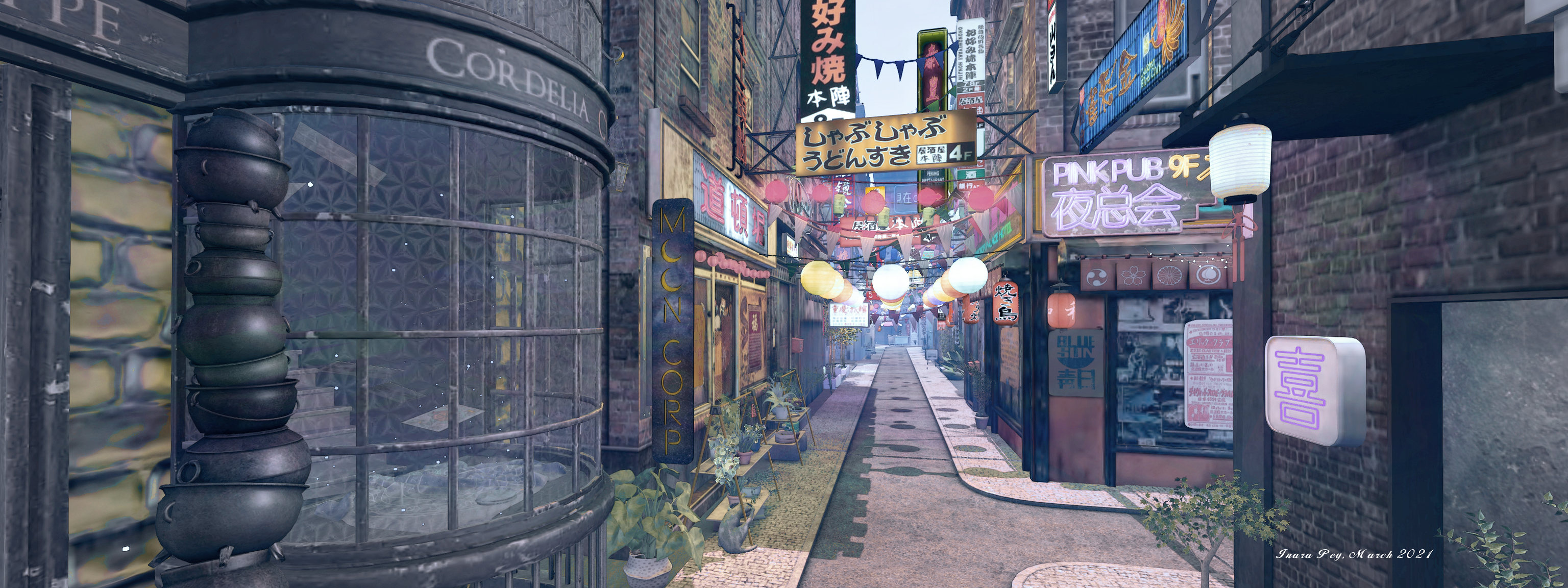
The work of Xen (Xenia Nordberg) and Coriel (Coriel7766), and sitting on a sky platform over a Full private region that leverages the Land Impact bonus, The Divide is described as a study of contrasts, an expression of duality inspired by the works of Hayao Miyazaki.

For those unfamiliar with Miyazaki, he is a Japanese Anime artist, writer, director and producer of animated films. He is internationally regarded as one of the accomplished film-makers and story tellers in the history of animation. His work is characterised by a range of recurrent themes, including humanity’s relationship with nature and technology, elements of which are evident within The Divide, both directly and indirectly.

The Divide, March 2021

Humanity’s relationship with nature is perhaps most clearly shown in the divide within the setting: to one side, and containing the landing point, sits a very Japanese theme town or village. To the other lies a sinuous, climbing valley, the separator between the two a narrow river channel spanned by bridges.

On the one hand, these two settings speak of both more prevalent aspect of our relationship with nature in our standing apart from it in our towns and cities of concrete and glass whilst constraining its presence to parks and gardens. On the other it represents our underlying need to embrace nature and the escape it can offer in its open spaces and amongst its flora and fauna.

The Divide, March 2021

The town itself is a marvellously compact affair that packs a lot into it, which  admittedly can make moving through it a little heavy going thanks to things like texture loads; I found it easier to disable shadow rendering entirely other than when actually taking snapshots, just to get the textures to load in a little faster and to offer smoother walking / camming. Streets run between an assorted collection of buildings, bunting and lanterns stretched overhead as if for a festival, a subway station hinting at a connection with places further afield whilst hiding a surprise.

While a good number of the town’s buildings are simple façades, others offer interiors to be explored, adding depth to the setting’s sense of place. Little side gardens may also await discovery, again harking back to the idea of our relationship with nature in the manner they offer retreats from the hustle of the street life just a few metres away. An interesting curio sits on the west side of the town: a mushroom-like rock rising above the surrounding buildings, topped by an ancient ruin that is itself home to a able-top D&D style game.

The Divide, March 2021

The human / technology reference is also much in evidence throughout, from the very obvious – all the neon signage, the vehicles, and so on – to the more subtle (anyone spot the reference to a certain film franchise focused on technology?). There’s also the pointers to the speed of modern life such as the “fast food” kiosks for grabbing a bite while on the move, countered by little temple-like places where life can be put on pause and more spiritual matters addressed.

Across the water, the valley and parkland offers the means to escape and explore and presents an interesting mix of themes and ideas. There are Chinese elements such as the of pandas in their bamboo copse, for example, and more studies in our relationship with nature, notably typified by the little shrines along the path that climbs up into the hills.

The Divide, March 2021

To the south of the setting, beyond a bamboo curtain sits a ramshackle home. Reached via a concrete bridge, it again echoes the ideals of relationship: humans living within nature, with our relationship with technology represented through the use of a converted shipping container for the house – the same kind of contain that is used to transport all our little electronic and computerised gizmos around the globe aboard massive ships guided by satellites circling the world high overhead.

Some of the landscaping along the valley and its climbs could perhaps do with a little tidying up, but as long as you follow the paths and steps, you shouldn’t have too much of an issue in finding your way around. Make your way all the way to the top of the steps that wind up through the head of the valley, a zipline awaits to offer a faster way back down – just mind the trees on your way!

The Divide, March 2021

Rich in detail, expressive in design, The Divide presents a lot to be discovered and enjoyed. My thanks to Rig for the reminder.

Slurl Details