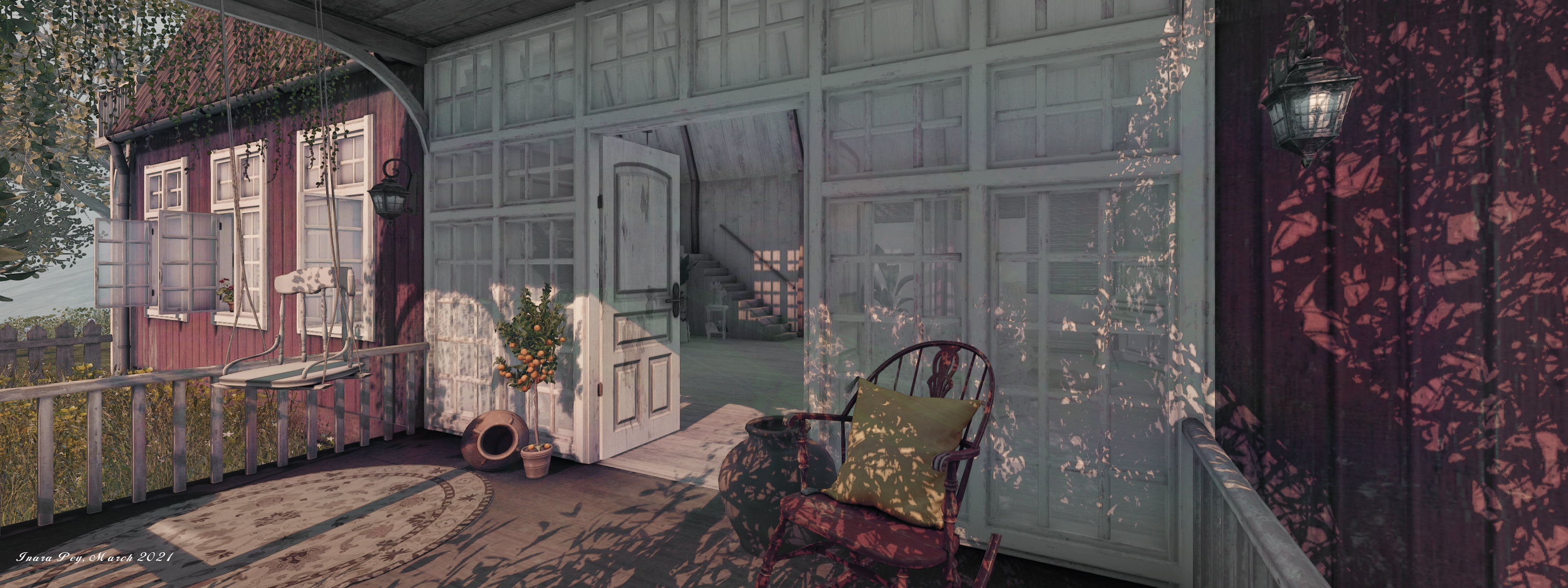
Nelipot, March 2021 – click any image for full size
Shawn Shakespeare (SkinnyNilla) is not only a superb photography artist and discoverer of regions to explore, he is also a dab hand at designing photogenic settings – as anyone who remembers The Mill will agree. And right now there is an opportunity for all of us to appreciate his eye for design, along with that of his partner, Lein (Lien Lowe), as they have opened up their current Homestead region of Nelipot for visitors to explore and enjoy.
Nelipot, March 2021
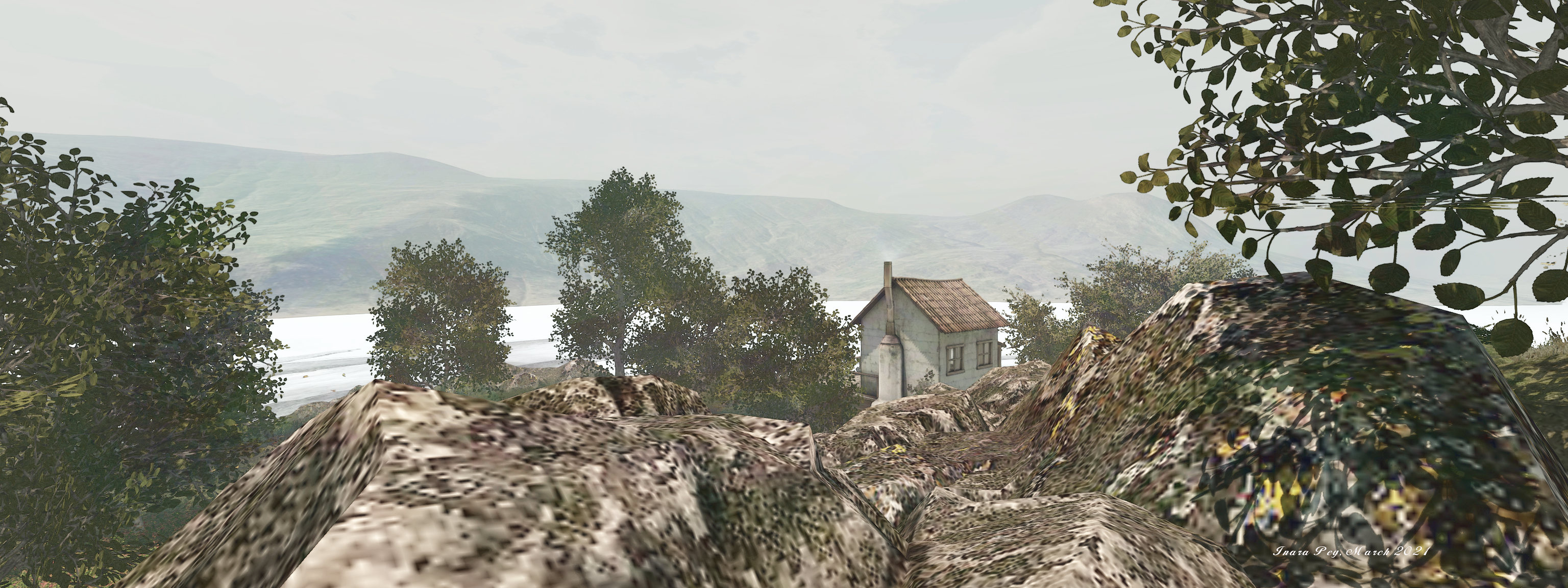
Set with a green surround of hills, Nelipot as a small coastal island, such as might be found along the Baltic coast of Denmark. Small and rugged, it is the kind of place many of us might sometimes imagine escaping or retiring to – or perhaps moving to in order to take up a new life style away from the hue and cry of the city.
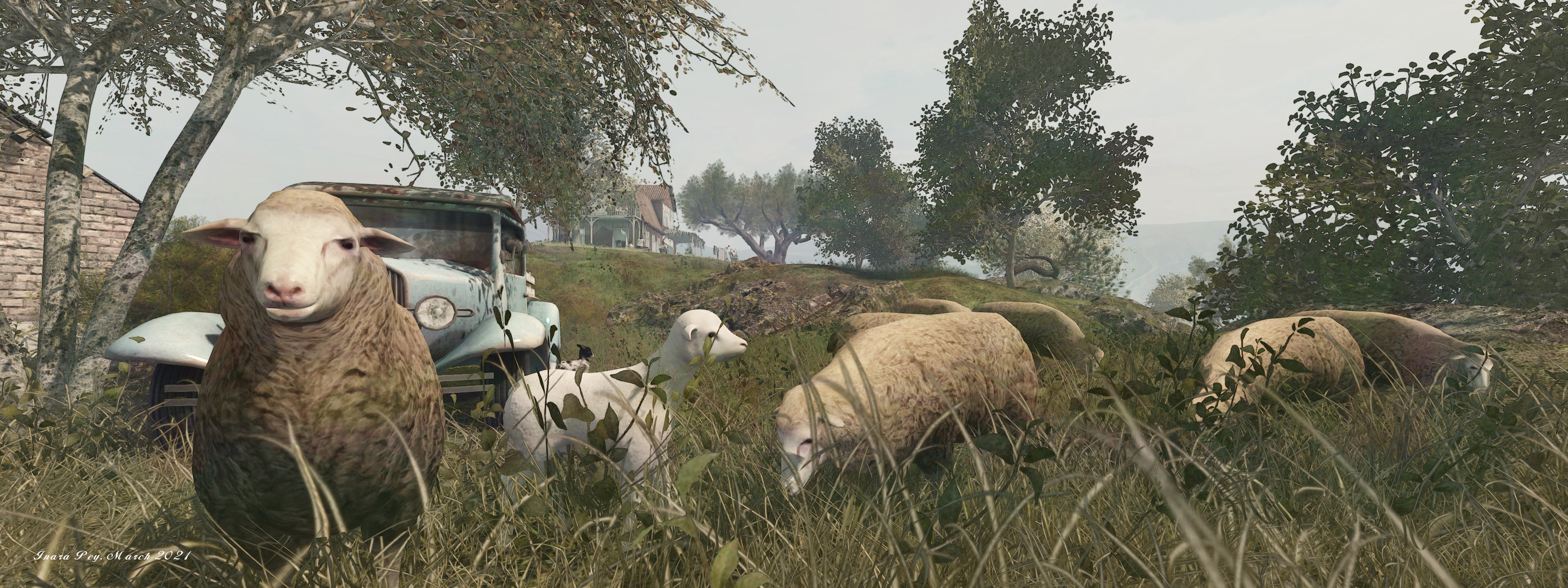
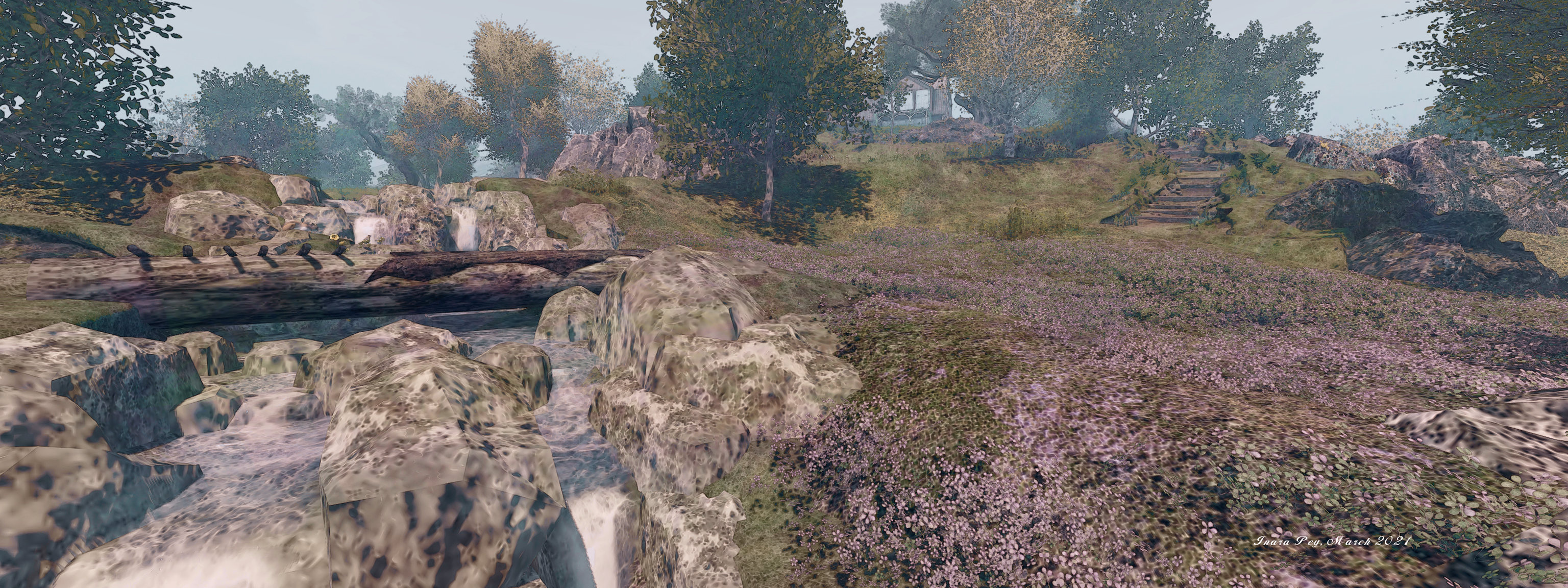
Rising from a rocky shoreline that is broken only by a small shingle beach, the island forms a small hill that rises in rugged steps up to its flat top. Most of the land is wild and almost untouched – although rope marked trails offer a route around and over it, together with stone or wooden steps that allow visitors to reach points of interest. The top of the island is crowned by a farmhouse that carries a hint of Danish about its name, adding to its sense of location. Sheep graze just down slope from the house, while between it and the water, a field of lavender is being cultivated.
Nelipot, March 2021
This is a place with a subtle sense of history to it: down on the shingle is a fragment of an aircraft wing with propeller engine still attached. It sits as a suggestion that a World War 2 ‘plane attempted a forced landing here. Elsewhere the building around the base of the hill have a sense of having been around for a good while – longer than the farmhouse, perhaps.
A further twist of age is added across the island from the beach, where is single stretch of railway track sits accompanied by a span of road. Neither leads anywhere, while a small building stands alongside both, almost like a local railway station.
Nelipot, March 2021
A train sits on the track – but it is clear it has never travelled the line to get to the island, nor will it ever use it to leave; instead, it sits, fronted by a pilot (aka cow catcher). This points to it likely having originated in America, whilst its overall styling points to it belonging to an era that has long since passed. Quite what it might be doing here is up to you to decide; my own story for it is that it was brought to the island as a collector’s piece, but the years and the salt air have perhaps not been kind to it.
Throughout the island are multiple places to sit and admire the setting it presents, together with a lot of small touches that add to its photogenic looks. The former encourage visitors to enjoy a leisurely exploration, while the detail waiting to be discovered is genuinely captivating.
Nelipot, March 2021
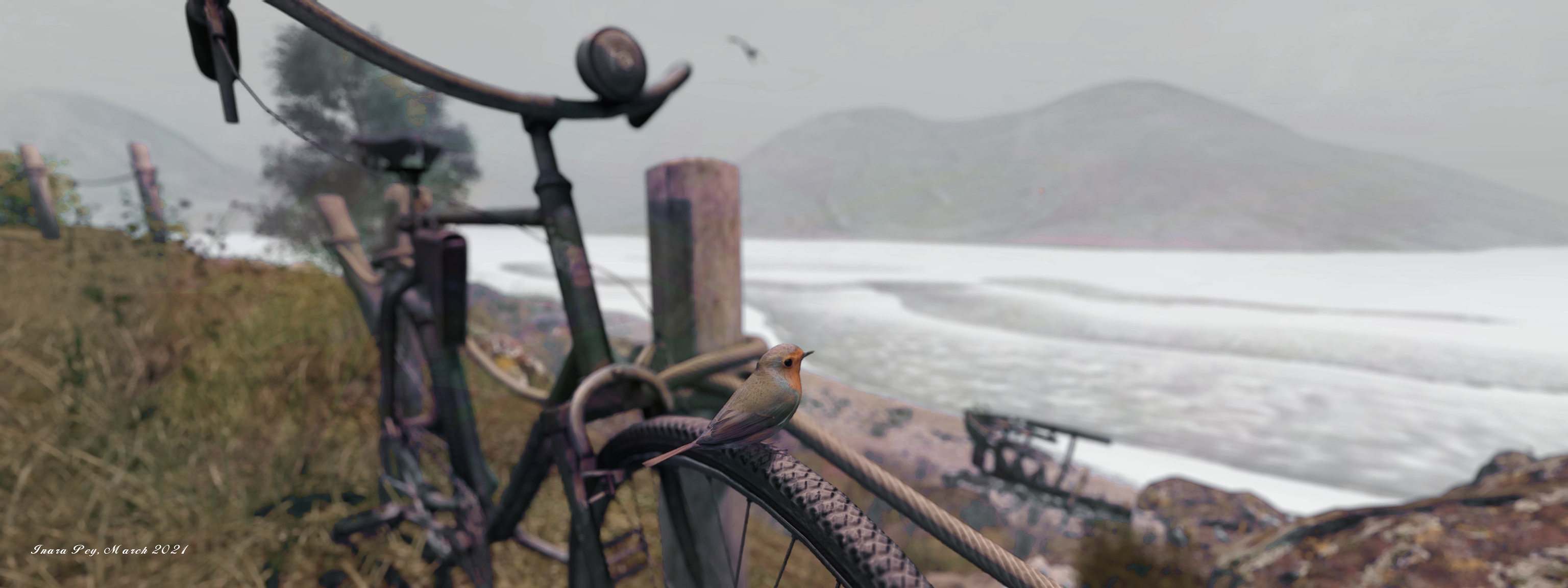
From the rabbits at the “station” to the cat on the bonnet of a pick-up truck to the blue tit and robin engaged in a conversation, these are all a treat, whilst the little cabins and old camper vans and the many bicycles give the setting a different kind of attractiveness. And while some of the buildings are run-down and / or broken, they are each given a unique character through their décor and furnishings.
Throughout all of the island there is a depth of life and – again, the birds, cats and so on, together with the sheep and seagulls. This richness of life is particularly evident within and around the farmhouse itself. This is been furnished is a homely, inviting manner that is simple but fully homely.
Nelipot, March 2021
This is a setting that is proof that while it might might well be long in the tooth, the old adage of less is more is very much true. When people tend to cram their regions absolutely full of masses of plants and suchlike, Nelipot shows us there is no reasons we cannot have open spaces or make frequent re-use of objects and textures to lighten the render load.
It’s not clear how long leave Nelipot will be open for public exploration; when discussing it with me, Shawn suggested it will probably be available through to the summer. But, and however long it remains open Nelipot is not going to be a place the Second Life traveller is going to want to miss.
Nelipot, March 2021
Many thanks to Lien and Shawn for opening their home!
Bella’s Glade, March 2021 – click any image for full size
Currently featured in the Destination Guide is Bella’s Glade, a summer’s garden located on a sky platform over Shara Lights of Amara, a full region with the private island LI bonus. Designed by Shara estate owner Dhanle (DaneLee), it originally formed a place for his physical world mother, but has has now been opened as a further retreat for those wishing to find escape from whatever pressures they are facing.
It’s a gloriously colourful setting, but one likely designed for those who do not run with shadows enabled, given it sits under a skydome that casts everything into a post-twilight gloom for those who do prefer to have shadows running. As such, for those who do have shadows on, I’d recommend taking a moment to derender the dome to allows for more natural lighting – although I do so with a further caveat, which I’ll come to in a moment.
Bella’s Glade, March 2021 – click any image for full size
The landing point for the glade is located towards the centre of the setting, occupying a semi-circular pergola built out over an ox bow of a small lake separated from a fast-flowing river by a needle of land. A conservatory sits on this narrow band of green and colour, reached via a broad board walk they spans the lake. It is the first of several places to be found within the gardens – the others waiting to lead visitors away from the landing point in a number of directions.
Bella’s Glade, March 2021
These paths wind under trees and between beds of flowers that are both planted and wild. In places railings and fences mark the route to be taken, elsewhere steps and cut logs mark the way. One route directs feet to a distant house, another to the ruin of a cottage on a hill with others passing swings and benches awaiting lovers and / or those seeking the opportunity to sit and appreciate the view before them. Some of these paths might be obvious, others less so – but to describe them all would be to spoil the opportunities to be had for discovery.
Bella’s Glade, March 2021
While it may not mean much to the majority of people reading this piece, Bella’s Glade reminds me of the Shuttleworth Swiss Garden in Bedfordshire, England. The two share a similar mix of the cultivated and the wild, of water and open spaces and tree-shades walks and richly wooded copses. And while Bella’s Glade might not have the same mix of follies and topiary as the Swiss Garden and be a little wilder overall, it nevertheless offered to me that same sense of wonder and delight.
Within all of this sits the house, an A-framed cottage that overlooks the river, a cobbled walk following the curve of the water in the suggestion of a canal side walk. The cottage forms an idyllic home, a place to be savoured for its solitude and the beauty of its surrounding gardens.
Bella’s Glade, March 2021
If there is one issue to be had with this setting it circles back to that aforementioned caveat about the use of shadows. Simply put, this is a setting with a lot of individual textures – and these both take time to load – sometimes frustratingly so – and can also significantly impact rendering performance when combined with shadows. As such, it may well be preferable to only toggle shadows on when taken photos.
That said, Bella’s Glade is an enchanting setting for those wishing to find a sanctuary or who enjoy garden spaces and are willing to make the necessary adjustments to their viewer.
Lyrical Café’s Cultural Centre – the Lyrical Café, March 2021
An entry in the Destination Guide for the Lyrical Café’s Cultural Centre recently caught my eye, prompting me to slot it into my weekend travels – and it proved to be a more than worthwhile visit, revealing as it did a new centre for arts in SL and the opportunity to chat with the driving force behind it, Mrs. Kamille R. Kamala – LIVE (Kamille Kamala).
Occupying just under one half of a Full region that boasts the private island LI bonus, the setting has been designed by Angela Viera (AngelFruiT) with the assistance of JJ Landar (Jucae). In looks, it might be said to present a West Coast urban vibe with a sub-tropical lean (although the region surround also suggests somewhere more temperate) and which is set under an evening’s sky cut through by the Milky Way (although I opted for more of a daylight EEP for the photos here). Within the provided space can be found a range of facilities that enfold visual arts, literary arts and performance arts and music, all of which are gently mixed within an environment that offers spaces and informal venues that include a beach and spa, that warmly invites exploration.
Lyrical Café’s Cultural Centre – the gallery exterior, March 2021
The main landing point is located alongside the entrance to the Lyrical Café itself, the home of the Lyrical Café Poetry Club founded by Kamille in 2009. This is the location for twice monthly poetry events (2nd and 4th Saturday of the month) that are streamed into the Café as a mix of poetry and music – Kamille is an accomplished poet. Its a place with a sense of intimacy in its décor, one that carries with it a sense of Africa that is both subtle and inviting.
To open a culture and art centre has been a dream I’ve had for years. I would spend time just contemplating it over and over, not really thinking I could pull it off. I had an event in my prior venue, but it got to the point where so many people came, it was too small. Once I realised I needed a bigger place, it gave me the courage to go for my dream.
– Kamille Kamala on the inspiration for the Lyrical Café’s Cultural Centre
Located just inside the entrance to the Café are a couple of teleport stations. The first of these is a wall sign – one of several to be found throughout the setting – that provides ease of access to the major facilities. Simply touch it and accept the local experience to display the TP directory from it and all the other identical signs to be found around the ground-level locations. The second teleport is a floor disk that will carry visitors up to a sample sky home – the region offers four such homes for rent, each with a 500 LI allowance and landscaped grounds, with the rental boxes located in a rear room of the Café.
Lyrical Café’s Cultural Centre – the Gallery, March 2021
While it may be tempting to use the venue teleport system, I would urge exploration on foot, as this properly reveals the care with which the Centre has been designed. Two routes of exploration are available from the landing point – through the Café itself and out along the road on the far side, or down the steps immediately behind the landing point.
My recommendation is to take the latter. It goes by way of an open-air performance area to the lower street level. With a broad board walk overlooking the beach, this route provides the most direct access to pedestrianised area that is home to little boutique shops and cafés, water features and four studio spaces available for rent as art galleries or shops, each with a 100LI allowance. Shaded by palm trees and completed by modern art sculptures (which are found throughout the location, further adding to its appeal), this area and the road running parallel to it offer the way to the eastern side of the parcel.
Lyrical Café’s Cultural Centre, March 2021
This upper area is home to the venue’s main gallery, dance / ballet centre, night club and gardens. The former are all housed in a series of very modern structures that, together with the palm trees surrounding them, give the strongest sense of West Coast design. They make for a handsome set-up, laid out is such a way that they do not look or feel packed in, despite their relative proximity to one another.
My idea has always been to create a hub of some sort. A studio for the art of dance and music, a gallery to celebrate visual arts , a centre for literary art and so on. Angela made it happen; she took my vision and brought it to reality, and we even included a spa for relaxing, which you might say is part of the art of meditation.
– Kamille Kamala on the Lyrical Café’s Cultural Centre
Lyrical Café’s Cultural Centre – the gardens, March 2021
Currently the gallery is home to a diverse collection of African American art drawn from the physical world, with reproductions of pieces by the likes of Whitney Austin, Elizabeth Catlett, Chuck Styles, Charles White, and more offered for visual appreciation. In the future, the gallery will be host to similar exhibitions of art from the physical world, and also the work of artists active within Second Life, who will have the option of also selling their work if they wish.
Alongside of the gallery, and back-to-back to one another are the dance centre and the Mahogany Club. The latter is a venue for DJ events focused on soul music (dates and times available through the Centre’s in-world group), while the former is named for Misty Copeland,the first African American performer to be appointed as a principal dancer for American Ballet Theatre, and is open to anyone wishing to make use of it, with the barres fully animated.
Facing the entrance to the gallery building is an impressive garden that makes superb and colourful use of the space allotted to it to present a further open-air venue with dance area, a little café of its own, together with a bar space and a little cosy corner neatly tucked away awaiting discovery.
Lyrical Café’s Cultural Centre – the Lyrical Café, March 2021
There is a richness to Lyrical Café’s Cultural Centre that goes beyond words. There is a sense of balance through the setting that is genuinely captivating, be it the positioning of buildings and use of space around them, or the depth of greenery that offsets the muted tones of the structures, or the utterly artful use of water throughout in the form of falls, fountains, water walls and natural channels, or the manner in which nature, architecture and 3D all come together as a single entity. As a home for arts, it is truly sublime and richly diverse; as a statement of art, it is equally exceptional, and I look forward to making many more visits – as I’m sure all patrons of the arts in SL will as well.
TokSik Jello, March 2021 – click any image for full size
SL explorers are probably only all too familiar with region designs that hint at, or directly portray dystopian and / or post-apocalyptic settings; at times it can feel impossible to not throw a virtual pebble without hitting one. However, once in a while there comes a region that, whilst it presents such an environment – and can be appreciated and enjoyed for doing so – can also carry a deeper message.
Just such a region is TokSik Jello, to which I was drawn courtesy of a prompt by Shawn Shakespeare. On the surface, this is a highly photogenic setting suggestive of some near future in which Something has happened to bring about widespread destruction and breakdown. At the landing point, buildings point broken fingers accusingly at the sky and an elevated road hints that it once offered a through route to Somewhere, but now ends abruptly at the edge of a landscape the sea has partially claimed, flooding what might have once been a coastal setting built around a small natural harbour, turning what is left into a series of roughened rocky islands split by channels and upon which the remnants of a civilisation cling, perhaps almost tribally.
TokSik Jello, March 2021
When this might be is anyone’s guess, as it what might have happened. There are certain cultural references to the modern age to be found, such as the cooling towers of a ruined power station that rise Fukashima-like on the horizon, Others such as the bulk of a great metallic airship moored above what remains of an elevated tramway, point the way to this perhaps being a place a little in the future.
Between these two landmarks and the landing point, two of the remaining islands have been converted into encampments: one within the remnants of a circus the other – looking somewhat fortified – utilising old building and cargo containers. Both camps are the homes of two gangs of children, the Misfits and (I believe) the Harlequins. Through them is revealed a further layer of meaning for the setting; that of a place where those who enjoy coming together and reliving (or perhaps living for the first time, depending on their personal situation) a time of childhood and its inherent freedoms through the use of child avatars and adventure role-play.
TokSik Jello, March 2021
This focus is pointed to in the first instance within the Sonnet of Jello, framed a short walk from the landing point. An ode to the freedoms childhood should embrace, the sonnet sets out the intent behind the creation of TokSik Jello. It is a poem that also reveals the core purpose of the reason for the region as expressed in the Tale of Beanz.
Child avatars and those who use them are perhaps one of the most marginalised groups within Second Life. Contrary to the view of some, they are not “against the TOS”, nor are they automatically indicative of either sexual age play (which is very much against the SL terms of service, but not something we’re discussing here) or an indicator that the person behind the avatar is under age. That so many are so quick to jump to such negative interpretation of child avatars in SL is both unfortunate and, perhaps, more of a commentary on their own lack of understanding (on multiple levels) and inability to think compassionately about others than anything else; particularly where said attitudes are accompanied by outright hostility.
TokSik Jello, March 2021
Simply put, child avatars can be used for a number of valid reasons, and such use is no different to any other means of avatarian self-expression that sit within the Second Life Terms of Service. They can be used simply for fun, or for very real and personally therapeutic reasons. As such, simply dismissing them out-of-hand (and in some cases by direct trolling any any opportunity – something also referenced in verse and physically within the setting) is simply unfair – and unnecessary.
Thus, the Tale of Beanz is something of a commentary on this; a statement on how easily actions can lead to people feeling ostracised, disliked and isolated to the point they fell little more than a ghost, slowly fading from SL. It’s a story revealed through the presence of “Beanz”, a lonely, emaciated figure found at different points within the region and who will, when touched, reveal more of the story through wonderfully constructed verse; verse that also speaks to the self-destructive nature that can also be found within social structures in Second Life and beyond, marking the setting as statement of social politics in the digital domain that should give us pause for thought.
TokSik Jello, March 2021
However, to frame the region entirely as some form of r”angry” reaction to all of this would be a mistake. Yes, it highlights a degree of negative perceptions and actions – but in doing to, it offers an entirely positive response. In recognising and understanding the prejudices and petty politics that can and do exist in the digital world as much as the physical, the team behind TokSik Jello have established the region as a of haven of openness, a place where child avatar role-players can escape the toxicity they might otherwise face, and simply enjoy themselves, as is noted in the region’s concept notes:
Regardless of how negatively people think of us, true Role-play SL kids are important to Second Life as a creative and diverse group. Eager to be part and valued as any other person. Therefore It seems crazy that one of the most discriminated SL demography, turns into its own discriminators with internal wars, arguments and hatred for each other. Especially when we have others destroying our community from the inside… for various nefarious reasons ….
Our goal is to install a community structure built on core values such as mutuality, compassion, honesty, respect and trust. A place for true role-play kids to be as they are and have a place, to share positive community values in a safe, supportive and holistic environment.
– The TokSik Jello Team
TokSik Jello, March 2021
As such, the region is currently open to the public through until (I believe) May, after which is will be gated and restricted to access for members of the role-play group associated with the region – details will be made available through the associated Facebook group, or by containing group members Jordy Zippy Banana (Zippy Banana), Niklas Howlett, Kenzie (Hiro Dismantled).
Slurl Details
TokSik Jello (rated General) – limited time access
Currently open at Glinka Gallery, operated and curated by Wolfgang Glinka, are two very different but equally attractive exhibitions, one featuring paintings and images, and the other focused on words and poetry.
Combined Technique presents a selection of art by Serbian painter and digital artist, Lash VV. Having opened on March 22nd, 2021, it is another enticing series of pieces the combine traditional painting and digital techniques that bring together elements of abstraction and impressionism and motifs that incorporate a range of themes in a brilliant mix of colour and line, offered is a setting suggestive of a primal forest with effects by Boris Twist.
Glinka Gallery: Lash VV – Combined Technique
There is something of a divide in styles presented here: those pieces centred on abstraction are clearly so; their form frequently wild or suggesting a certain frenzy. There is a deep and almost primal sense of emotion to them in the predominant use of lauder colours. The one apparent exception to this is Remembering Blue, a piece using the calming influence of blue shades that evokes a sense of anchor and balance amidst the more vibrant emotive splashes of the pieces around it.
Mixed with these are pieces that offer impressionist views that are equally as captivating and offer some unique commentary on human history and our relationship with nature. Take Marsh as an example, as it carries within it a primal memory of humanity’s origins as a hunter-gatherer and times when hunts and the animals encountered were recorded through painting on rock walls, or Caravan, capturing that period of time – notably in the American west – when meat came to humanity’s growing towns and cities by means of the cattle drive.
Glinka Gallery: Lash VV – Combined Technique
Meanwhile, Torn perhaps offers a link between the impressionist and the emotional tones of the more abstracted pieces, the bull within it clearly evocative of ideas or emotional responses (being bull headed, charging in like a bull, etc.), whilst Shadowlands offers a narrative of freedom and spiritual escape.
Intriguing in form, Combined Technique is an engaging visual display of art, a unique combination of technique and form.
Glinka Gallery: Wolfgang Glinka – Wolfie Tells Fibs
A short walk from Combined Technique is Wolfie Tells Fibs an exhibition of poetry by Fibonacci poetry penned by Wolfgang Glinka under his physical world name, Colin Bell.
For those unfamiliar with it, Fibonacci Poetry – or Fibs – plays on the Fibonacci sequence. The typical Fib is a six line, 20 syllable poem with a syllable count by line of 1/1/2/3/5/8 – with as many syllables per line as the line’s corresponding place in the Fibonacci sequence. Gregory K. Pincus is credited with bringing this 6-line form to widespread recognition; however, as a broader poetical form, “Fibs” can be said to date back to Sanskrit prosody, with a similar stress on long and short syllables.
Glinka Gallery: Wolfgang Glinka – Wolfie Tells Fibs
As a poetic form, Fibonacci Poetry has become an expression in art not only for the mathematical progression of syllables, but for the fact poems can be shaped by rules – such as ascending from a single syllable to a set number of syllables at the mid-point in the poem, before descending once more back to a single syllable, or running in reverse, or forming mirrored forms in line / syllable counts. Much of this is in evidence in the poems displayed with the Glinka Gallery space, the poems themselves rich in imagery that encompasses a range of themes and narratives.
Utilising the Fib to present multi-stanza poems and well as single stanza pieces, and even reference classical poetry forms – do check out Three Fibonacci Poems AfterOvid’s Metamorphosis – Wolfgang presents a rich and engaging display of Fibonacci Poems.
Glinka Gallery: Wolfgang Glinka – Wolfie Tells Fibs
Drune Diesel, March 2021 – click any image for full size
I’ve been a fan of the region designs by Hera (zee9) ever since I visited 2019XS before it morphed into what has been perhaps her most poplar series of region builds, the Drune series. I’ve not written about every single iteration, but they have been something of a theme in this blog down the years for their marvellous cyberpunk vibes edged with a touch of bohemian dystopia.
However, with Drune Diesel, I think Hera has created one of the most engaging, intriguing and layered region designs it has been my pleasure to visit – and one I really do urge folk to hop over and witness for themselves, particularly if, like me, you are a film and cultural buff. Rather than keeping to the broadly cyberpunk theme of previous design, with this iteration, Hera has turned towards the oft-overlooked dieselpunk genre.
Drune Diesel, March 2021
I was sent the LM for the region by my ever-vigilant region sleuth, Shawn Shakespeare, and it arrived somewhat serendipitously. Earlier in March I had visited Isabel Hermano’s art exhibition at the Janus II Gallery entitled Living in a Steampunk World (see here for more). Whilst steampunk oriented, two pieces within it – Radio City Music Hall, and The Sisters – incorporated very distinct deco and dieselpunk vibes and seeing these pictures set me to wondering if anyone in SL had actually stepped away from the more common steampunk and cyberpunk themes to present something more rooted in dieselpunk – and then just a few days later, Shawn drops Hera’s LM on me!
For other unfamiliar with the genre, dieselpunk (and it’s sub-genre of decopunk) is based on the aesthetics popular in the interwar period of the 1920s/30s and extending through to the end of World War II, with some exponents also including the early 1950s. It is broadly defined as the era in which the diesel engine replaced the steam engine as the focus of technology. Within it, decopunk centres the aesthetic of art deco and streamline moderne art styles particularly prevalent to design and architecture in the same overall period.
Drune Diesel, March 2021
Within Drune’s familiar city setting, compete with its tall buildings, canyon-like streets and split-level roadways, Hera has created a setting that encapsulates the heart of dieselpunk/decopunk to present something that will be instantly recognisable to those who have visited Drune’s earlier iterations – but which is also utterly unique. It’s a place where the richness of detail, large and small, is truly staggering and the cultural and film references sublime in their placement and presentation.
The initial sense of familiarity comes not only from the lie of the city and its streets, but also in the display of lighting and signage that adorns the sides of building and lines the railings of overpasses. But whereas past iterations this lighting and signage has been a mix of bright neons, flickering LED screens and brash images, now we have a richer mix: spotlights illuminating billboards, softer-toned neons, traditional banners, and fluorescent lighting that follows the lines and curves of building façades or sits within parking metres and so on.
Drune Diesel, March 2021
Another change is with the cars on the roads. While many of these (again in keeping with past iterations of Drune) may well hover, they are not the seek Blade Runner-esque designs visitors may recall. Instead, they are entirely of the era, encompassing bulky Cadillac-like beasts to smaller open-topped Mercedes and pencil-like single seaters. They are held aloft over tracks that line each side of the road by great round conduction coils that replace their wheels and which are presumably powered by the diesel engines sitting under their hoods. They share the roads with cars that retain their wheels, perhaps because their owners cannot afford the hover update or perhaps simply because they want to be fashionably different.
A number of the buildings include interiors that have been made over to match the theme. The Black Pussy nightclub goes full-on deco in its interior styling that could have you out on the dance floor like the most carefree flapper, whilst the Cortez Hotel’s lobby has more grandiose deco setting, complete with stained glass windows and vaulted ceiling (as a set of four themed bedrooms). Those seeking a meal can always drop into the Shanghai Dragon, a restaurant that is truly delightful in its own suggestions oriental decadence.
Drune Diesel, March 2021
The cultural and film references I mentioned are to be found everywhere. Some are mentioned in the note card offered at the airship landing point, others are awaiting discovery as you explore. Some are large and obvious, some either small and/or not quite so direct. Many reference the era represented by the the setting, others draw on references that may not at first appear to be connected, but on examination are not so anachronistic as they might first appear.
Take the P51D fighter sitting on the airstrip below the city, for example. Loaded for a ground attack role and bearing D-Day markings, it hardly looks dieselpunk in nature. However, it immediately brings to mind Kerry Conran’s 2004 box-office-flop-turned-cult-classic, Sky Captain and the World of Tomorrow (Jude Law, Gwyneth Paltrow, and Angelina Jolie), one of the first attempts to encapsulate diselpunk in modern film after game designer Lewis Pollak coined the term in 2001.
Drune Diesel, March 2021
Similarly, the city’s movie theatre boasts showings Blood and Sand, starring Rudolph Valentino and released at the start of the dieselpunk era, together with Fritz Lang’s Metropolis (1927), arguably the first film to depict dieselpunk long before the term was ever coined. Indeed, Drune Diesel reflects something of Metropolis: whilst the workers are all down on the lower levels of the city, living in basic conditions and with the muck and sweat and fumes of the city, the elite live up in the towers, where halls are lined with marble and grand statues hold aloft light fittings or strike heroic poses.
Other references are more subtle but are bound to bring a smile to the lips when recognised, from the SS Venture alongside the wharf and being prepared for the voyage that will see her bring home King Kong (1933), to the U-boat sitting in its pen and carrying something of an Indiana Jones vibe. One of my favourites is the billboard reference to Karel Čapek’s 1921 film Rossumovi Univerzální Roboti (Rossum’s Universal Robots). Not only does it fit the period, it is the film that first brought us the term “robot” (although those in the film were closer androids than robots); it has also been cleverly paired with an indirect reference to Douglas Adams’ The Hitchhiker’s Guide to the Galaxy through its tag-line – even if the Sirius Cybernetics Corp might want to have a few words about it!
Drune Diesel, March 2021
As indicated in the introductory notes, the city also contains references to the BBC Television series Peaky Blinders, the fictionalised tale of one of England’s most notorious crime gangs that was based in the city of Birmingham. These range the The Garrison pub, inspired by the pub seen in the series and rumoured to have been used by the real Peaky Blinders, to the wharfside chalk advert featuring a racing horse and the words “Shelby, est. 1920”, a reference to both the family leading the fictional Peaky Blinders and to the illegal bookmaking both the fictional and real gangs ran. There’s even billboard advertising Cadbury’s products providing further references to the Midlands origins of the gang.
Drune is also a setting that encompasses so much more as well. There is a very Gotham-esque vibe in places that goes far beyond the Batmobile awaiting discovery, whilst the streets and atmosphere lend themselves to thoughts of a dieselpunk Philip Marlowe trudging the glistening footpaths (It was raining in the City — a hard rain — almost hard enough to wash the slime from the streets. But it never does.), and more besides.
Drune Diesel, March 2021 – a touch of Angel Heart, as well?
This is a place that deserves time to appreciate all of the detail that has gone into it, from the way the building rise from worn brickwork to fine, faced stone with carved motifs and proud banners to the crafted rotary engines that pump clean air into their refined interiors from their tops and cough it used and dirty, onto the streets below. Much of this detailing, all created by Hera, both adds depth to the setting and offers up more in the way of cultural references, particularly for central Europe in the inter-war period.
Magnificent, engaging and deserving to be witnessed, Drune Diesel is simply superb – when visiting, do make sure you are running with Advanced Lighting Model active (Shadows not required).