Shades of Eo in Second Life

Art Korner, October 2021: Eoleon Elcano

Update, June 27th, 2022: Art Korner has Closed.

Currently open at Frank Atisso’s Art Korner through until October 25th, 2021, is Shades of Eo, a selection of art by Eoleon Elcano. Spread across the two levels of the exhibition space, it is a themed display of art focused on the the seasons of autumn and winter and the days, rich in golden hues or cossetted by white blankets of snow or cast in the greys that we so often associated with either season.

Within the space, the lower display area is given over to autumn. The floor of the hall is textured in grass topped by a patina-like spread of fallen leaves, whilst corner trees carry browned leaves and share their space with pumpkins to further help slip the mind and eye into an autumnal frame. The images themselves are rich in that aforementioned golden brown hue reflective of the time of month, although one or two could perhaps topple into the days of a late summer, depending on one’s personal take.

Art Korner, October 2021: Eoleon Elcano

Reached via individual stairways but adjoining one another are the upper halls of the exhibition space, each offering individual collections of Eo’s art.  One is devoted to the winter months, five of the images rendered in soft tones and colours we tend to associate with the winter months: white, grey, blue; they sit within a hall in which snow falls to blanket the floor. Primarily landscapes, these five images are dominated by a sixth that spans one entire length of wall in a panoramic format I have not seen since Ziki Questi ceased exhibiting in Second Life. It is a genuinely magnificent piece entitled Winter Melodies, which carries with it a greater warmth of colour courtesy of a lowering Sun that forms something of a visual bridge between this hall and the autumnal display below.

All of the pieces across these two halls evocatively denote the time of year they represent. Each is individually styled through technique (such as the considered use of vignettes in some) and finish to evoke an emotional response in keeping with that time of year. Each carries within in a single-frame story as they catch a moment in time, a story to which we can also relate. But there is also something more within them as well; whilst the theme of this collection may well be that of the seasons and their shades, so too might they be said to carry hints of Eo herself, something hinted through the exhibition’s title.

Eo describes herself as “socially incompatible”, a term that suggests she is perhaps more comfortable with her own company or that of very close friends she has come to trust over the passage of time rather than with broader acquaintances; yet at the same time, there is perhaps that desire that comes upon us all at times to be freer in the company of others – or at least with someone we can regard as particular special. This sense of separation of self from others and the associated longing might be found within several of the images within both the “autumn” and “winter” halls of the exhibition.

Art Korner, October 2021: Eoleon Elcano
Holding You, for example appears to be celebrating the autumnal (and often solo) pursuit  of kite-flying, it also suggests that yearning to have someone close, but being unable to bridge that last (self-imposed?) gap that forces separation. On the neighbouring wall, A Symphony of Solitude, we have a story of someone both at home within her solitude as she walks a sandy shore as the evening draws in, and also an image – courtesy of the long shadow stretched over the sand at an angle suggestive that it is leading her – that hints at a desire to share the moment with another.  Within the “winter” hall, similar subtexts might be found with both Winter Melodies and I Hold You.

However, this reflection of self really comes to the fore in the second of the upper floor halls, where eight monochrome images are to be found while are almost physically striking, they are so emotionally charged.

Given this, and if possible, I would recommend this selection of Eo’s work is viewed after the “autumn” and “winter” displays, simply because it is so rich in personal narrative (to achieve this, take the stairs closer to the eastern side of the gallery hall when moving to the upper levels). With the exception of Neverending Sakura Tales, the depth of personal feeling presented within each of these works is so beautifully mixed with their monochrome nature and composition that it is hard not to be completely captivated by each one, marking this selection very much as a exhibit in its own right.

Art Korner, October 2021: Eoleon Elcano

Perfect in composition and presentation, rich in narrative and layered in interpretation / meaning, Shades of Eo is a magnificent exhibition of art and self.

SLURL DETAILS

Paradiso’s peaceful waters in Second Life

Paradiso, October 2021 – click any image for full size

In January 2019, I dropped into -Paradiso-/Cor meum, a quarter Homestead region designed by Cain Evergarden as a restful setting mixing water and islands to create a place of escape for those who needed (see: A quiet corner of Second Life). Some time after that, the setting apparently vanished; so I was delighted to recently learn, courtesy of Annie Brightstar, that it has once again returned, this time occupying an entire Homestead region of its own and offering a very different environment.

Paradiso has always been a personal setting for Cain,  as he explains in a note card available within the current region:

I made the region for my Grandfather who passed away  two years ago. I offer my condolences to him and Reproduce my own heart. The region is always raining because the rain in my heart has not stopped yet. It’s a sad story, but I hope you can feel it and enjoy it freely.

– Cain Evergarden

Paradiso, October 2021

This is a heart-rending statement, and one with which any of us who have lost a loved family member will identify. Thus it presents Paradiso as a place where we might allow memories to flow free. However, even for those who might not have such memories, Paradiso is also a place for anyone who simply wishes to find a moment of peace, or who loves water-based settings will also appreciate.

The primary landing point lies towards the middle of the region, alongside one of several points of interest that rise from the sapphire waters and reside under a midnight sky that is itself in part cut through by the path of the milky way.  Ringed by clouds that clouds that tick their way around the region with a steadfastness that is mindful of the second-by-second passage of time – and life -, this is a setting without recognisable landform, but with water shallow enough the wade through.

Paradiso, October 2021

The grassy setting with its single tree alongside the landing point sits as a field of blue roses over which pale butterflies fly spirit-like. Rain patters the water, perhaps encouraging visitors to scuttle over the water to the nearby looming mass of a run-down theatre. Hidden within this is what appears to be a dance club of a most unique styling. The stage stands as a melding of stage, equipment and giant roses, a pair of hands to either side raised almost in supplication towards the projection of a white dove flying against the rear wall. Taken as a whole, it suggests a place of both remembrance and celebration.

A second roofed structure lies to the west of the landing point, a pavilion that is home to  the region’s guestbook in which comments on the setting and / or notes of remembrance might be left. Further off to the west lies a more surreal setting: a portal rises from a bank of wildflowers watched over by a large bird cage whilst a school of fish circles overhead, perhaps ensuring the clouds of hovering fireflies do not stray far from the portal.

Paradiso, October 2021

This portal – which I’ll return to in a moment – is somewhat mirrored by cloud formation that sits on the northern edge of the region. Forming a vertical ring encircling a shimmering ring that suggests it is a gateway to heaven, awaiting the souls of those who have passed as the continue their journey.

But to return to the stone portal: touching this will allow visitors to teleport up to a small sky platform. This presents a town setting put together by NEOs Klaar. This is a very different setting to the ground level, offering a place that is dominated by the presence of shiro0822’s Matsuri cats – characters who remain as cute as when I first encountered them a year ago – as they run an open-air marketplace with a second DJ stage. It’s a space that offers an interesting melding of Japanese and Chinese influences, with the latter in particular carrying my to Hong Kong and childhood (more than adult) memories of Wan Chai thanks to the billboards to one side of the setting.

Paradiso, October 2021

With several places to sit and pass the time, and backed with the hissing sound of falling rain, Paradiso’s current appearance is very different to the quarter region I visited in 2019; however, it retains that certain touch of attractiveness that tends to both encourage a visit and to spend time within the region once you’ve arrived.

SLurl Details

London Junkers: celebrating American literature in Second life

UASL: London Junkers, Marking the Twain

3D artist London Junkers is a 3D artist unafraid to offer art and thoughts on a broad canvas (so to speak) that encompasses subjects as diverse as the horrors of war (see: Picasso in 3D – Guernica at LEA) to the likes of the history of aviation (see: To Slip the Surly Bonds of Earth…). Currently within Second Life he has two installations that stand as celebrations of American literature, one of which recently opened, and the other of which is likely to be approaching the end of its run, and so might be vanishing in the very near future.

The latter of these two installations is Marking the Twain, a celebration of the life of Samuel L. Clemens, the typesetter turned  Mississippi riverboat pilot turned journalist who would become one of America’s most famous writers using the pen-name he appropriated from his days days as a riverboat pilot and under which he is lauded as “the greatest humourist the United States has produced”, Mark Twain.

This is an installation that is both elegantly simple in approach whilst also wrapping within it some very rich imagery, comprising four major parts. The first is at the entrance, where London has penned a story that might have between written by Clemens himself, a telling of the most popular tale of how he came by his pen-name from the practice of  tossing a weight on the end of line to measure (mark) the depth of water beneath a riverboat to ensure it did not become less than the two fathoms (the “twain” – equivalent to 12ft) laden boats tended to require to avoid running aground.

UASL: London Junkers, Marking the Twain

Whether this is true or not is hard to tell – Clemens himself claimed he appropriated the name from Captain Isaiah Sellers the “most respected, esteemed, and revered” riverboat captain on the Mississippi, following the latter’s death in 1863, and who had used it to sign reports on the river’s general condition. But howsoever Clemens came by the name, London’s story is a worthy read.

Beyond the plinths carrying the neatly penned story, a stern wheeled steamer of the kind Clemens would have piloted up and down the great Mississippi River rises from the river’s waters on a powerful blast of air whilst a giant pen dribbles into into the river to form letters that drift on the water beneath the boat’s flat bottom. Together, both flying boat and the dribbling pen and its letters offer metaphors for the two major halves (in his own eyes) of Clemens’ life: his time as a fully qualified riverboat pilot, a career he had dreamed of since his boyhood in Missouri, and his most famous years as the writer Mark Twain.

UASL: London Junkers, Marking the Twain

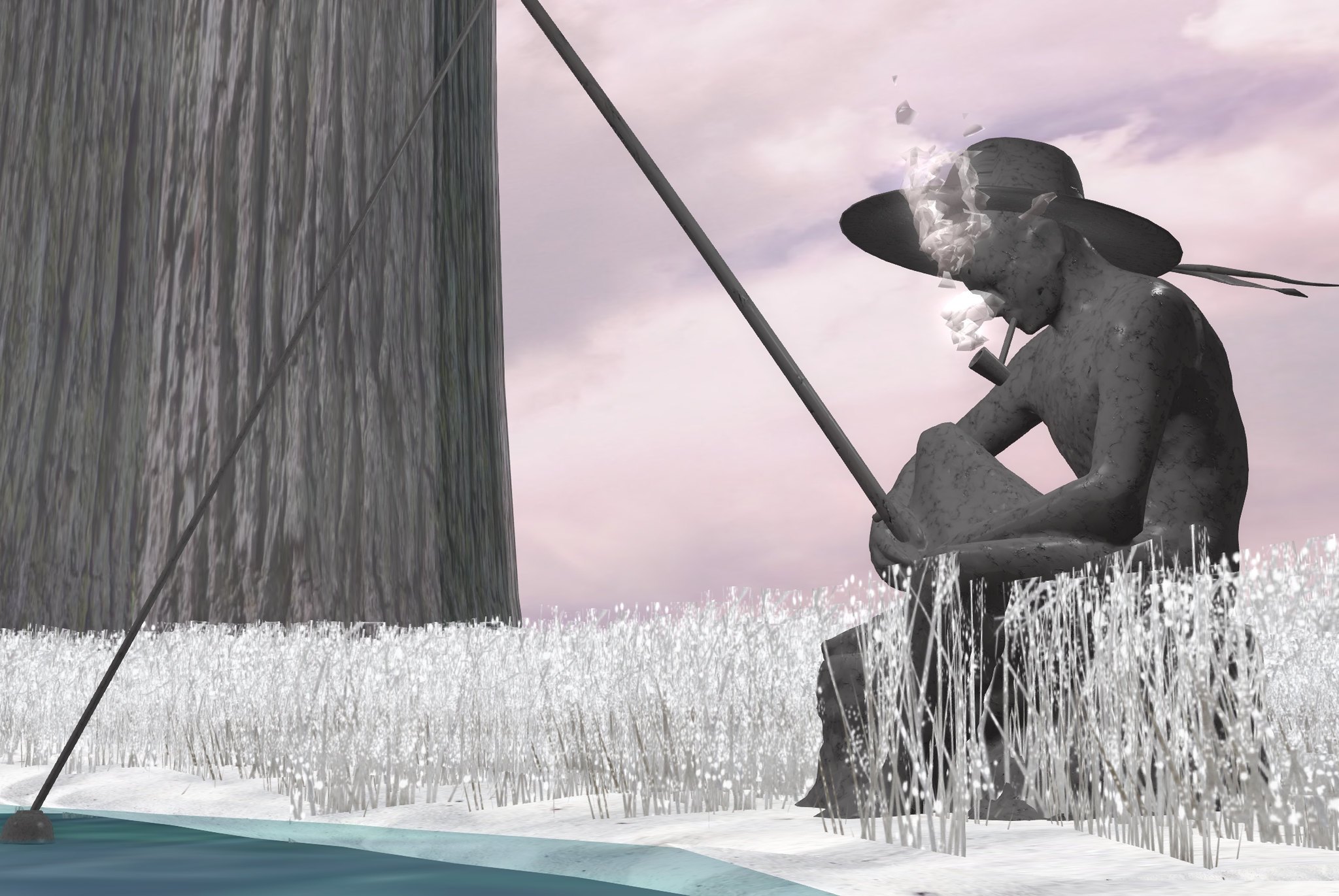
On the deck of the boat – and able to be reached by ramp offered as a swirling tail of the wail that has lifted it into the air – is the tall, stout figure of Clemens himself. He stands, staring into the face of the wind as it carries his boat aloft, in the white suit and homburg hat that became his trademark dress in later life, whilst clutched between teeth and lips hangs a clay pipe rather than the cigar we might usually associate with him.

Thus the figure, whilst not a metaphor, is offered as a composite to further mark these two sides of his life: the suit marking him as the well-established humourist and writer, Mark Twain, the clay pipe harking to his time as riverboat pilot Clemens.

The final part element of the installation can be found in two parts that directly reference Twain the writer.

The first part is perhaps the easiest to understand. On the bank of the river, and seemingly oblivious to the boat’s airborne passage, sits a boy – “Huck Sawyer”  – quietly fishing. He is by name and nature a conglomerate representation of the two major characters from Twain’s most famous works of fiction. Less obvious, perhaps, is the frog that sits alongside the figure of Clemens/Twain on the deck of the boat. Looking a tad dapper in his top hat and bow tie, he has three three small round pellets before him and while he might look to be merely a piece of decoration, he is not.

For both frog and the pellets reference Jim Smiley and His Jumping Frog, a humorous story Twain first saw published to a good deal of acclaim in the New York Saturday Post in November 1865. Less than a month later (possibly to greater acclaim) it appeared under the title The Celebrated Jumping Frog of Calaveras County by The Californian (Calaveras being a county in California). Most significantly of all, perhaps, is the story of the frog became the anchor for Twain’s first full-length book, published in 1867. As such, the presence of the frog and the pellets neatly round-out this celebration of Twain’s life.

Kuidvis Art Space: London Junkers – The Thunderous Train of Air

Meanwhile at the newly-opened  Kuidvis Art Space, London presents The Thunderous Train of Air, another celebration, this time of the life and works of American poet, author and teacher, Ruth Stone.

Again an installation of elegant in its simplicity, this installation takes as its title and encompasses within it the story Stone told journalist Elizabeth Gilbert as to her inspiration as poet, and which Gilbert in turn related thus during a TED talk in 2009, not long before Stone passed away:

As [Stone] was growing up in rural Virginia, she would be out, working in the fields and she would feel and hear a poem coming at her from over the landscape. It was like a thunderous train of air and it would come barrelling down at her over the landscape. And when she felt it coming . . . ’cause it would shake the earth under her feet, she knew she had only one thing to do at that point. That was to, in her words, “run like hell” to the house as she would be chased by this poem.

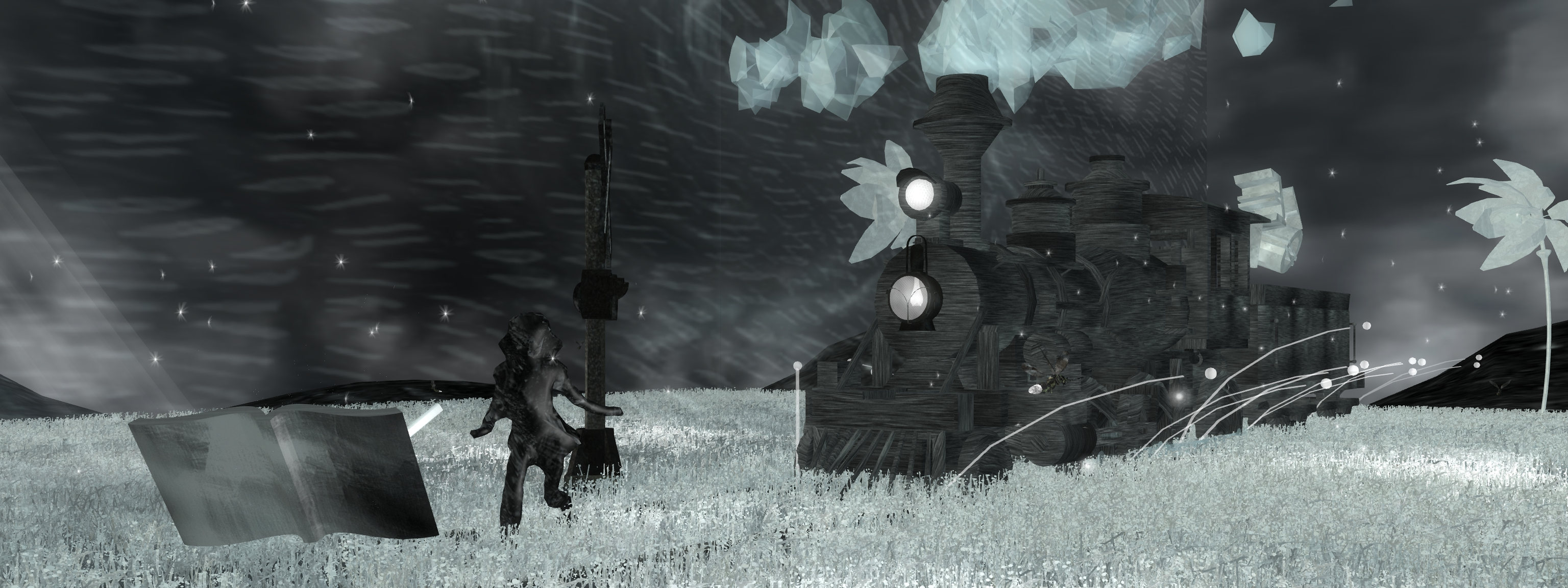
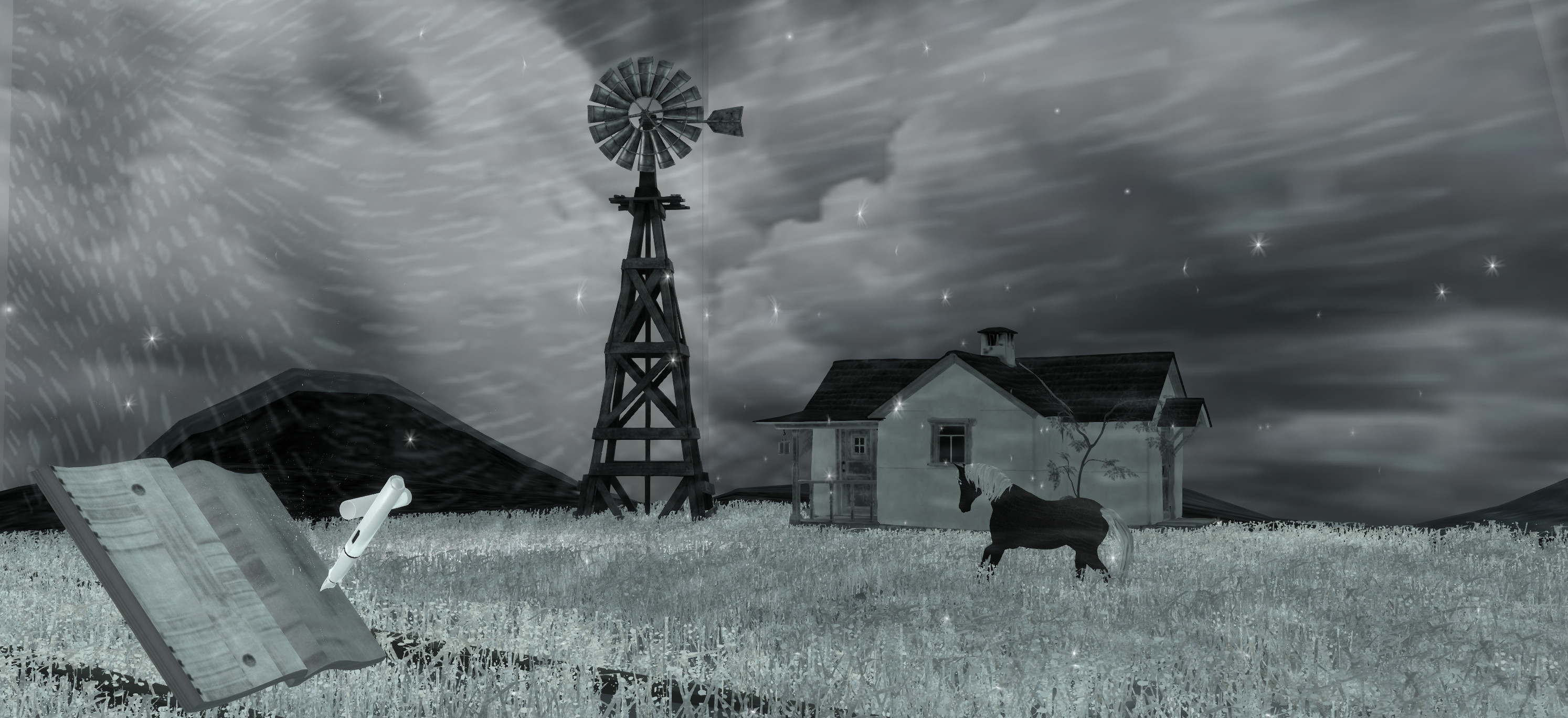
Thus, The Thunderous Train of Air offers a scene set within a open field sitting beneath a sunlit sky, the rural piece of which has been shattered by the drive of wind and the arrival of a great steam train, tracks and all, charging through the crop, driving the young figure of Ruth Stone before it as she desperately chases pens and writing book as they are carried in the wind before her, so she might capture the words as they reach her and set them down indelibly in ink.

Kuidvis Art Space: London Junkers – The Thunderous Train of Air

The proximity of the train to the running figure perfectly  encapsulates Stone’s acknowledgement that when the inspiration came, she would sometimes succeed in her race for home and pens and paper, and capture the words of the poem, whilst other times would see the inspiration “barrel through [her] and continue on across the landscape looking for another poet”.

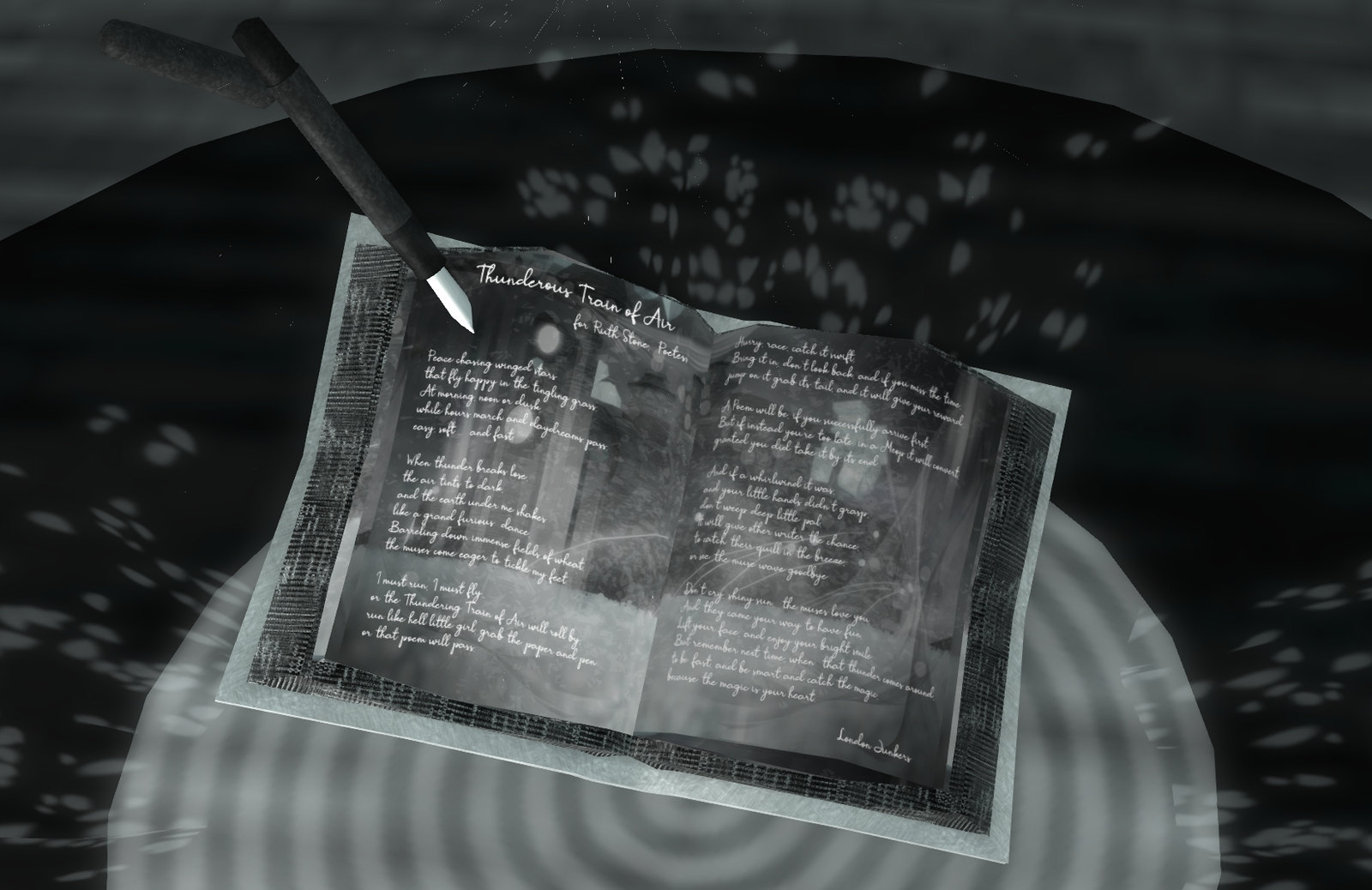
Nor is the train alone as a representation of creativity. To one side of the installation a tornado-like tower of air turns, a single book at its base,. It carries with it the image of the whirlwind rush, even when home safe, and with pen in hand and paper on table, to get the words down in the order they desire, before their memory fades entirely.

Close to this tornado sits a small stage and a microphone, perhaps metaphors for her time as a teacher and the fact that her poetry has one of the most unique voices of the modern age, combining as it does imagery from the natural sciences with a broader non-scientific intellectualism in a complex, and at times philosophical, dynamic.

And be sure to touch the book at the base of the tornado’s funnel, it offers a poem by London, a beautifully written homage to Stone and her poetry.

Kuidvis Art Space: London Junkers – The Thunderous Train of Air

Both Marking the Twain and The Thunderous Train of Air are presented as monochrome pieces that adds depth to their reflections on the two writers and their writing. They are also installations that should preferably be seen under their intended environment settings and with both Advanced Lighting Model (Preferences → Graphics → check Advanced Lighting Model) and local sounds enabled for the greatest sense of immersion.

SLurl Details

A Forest of Mystical Dreams in Second Life

The Forest of Mystical Dreams, September 2021 – click any image for full size

It’s funny how sometimes the mind sometimes plays tricks on you. I tend to have a pretty good ability to mentally file away the things I write about and pull them back out of the murky depths of my memory as needed without the need to run searches and the likes through the pages and posts of this blog.

I mention this because in coming across a Landmark for The Forest of Mystical Dreams, part of my mind initially responded with a, “Yep! blogged!” and the LM was filed in Inventory. Only the underpinning region name  – Spiked dAlliez – kept gnawing at me, and after looking through notes and posts I realised I was wrong – The Forest of Magical Dreams isn’t somewhere I’d written about. So either my mind played a little trick – or age is finally catching up with me, and the mind is starting to slip! Either way, the fact that I haven’t previously documented the setting gave me cause to hop over and have a wander.

The Forest of Mystical Dreams

Occupying a Full private region that leverages the additional Land Capacity bonus, the Forest of Mystical Dreams offers an eclectic mix of terms in its About Land description, ranging from fantasy – elves, mermaids, etc., through to the distinctly adult-oriented (D/s BDSM), the latter of which might put some off a visit, although I would hasten to add that if it is present in the setting, it is by no means overt. It is also a place that is not child avatar friendly,  possibly as a result of the adult themes (if present), so I’ll point that out up front. All that said, the description for the region found on the Profile for the region’s holder and principal designer, Jen Volodar Dorran (Jennifer Beverly) is far more reflective of the regions true nature:

This Forest is many moons old now . This forest is what my RL vision of “Romance” is.. there is love , and care , my thoughts and dreams and ideas on this sim as it is my canvas to do anything my heart can come up with .. this forest is every changing small spots but always something new to enjoy.
Thank you for enjoying my Romantic Dream ♥
The Forest of Mystical Dreams

This description opens the door to a setting that is caught beneath a twilight sky (under which it should be seen for the best impressions, which I hope the photos herein are indicative of. To describe the region would in some ways be a waste of time; the care put into creating the atmosphere found within it should be experienced, rather than seen. Wandering the trails and climbing the steps and stairs to be found within the setting, I kept expecting to hear elements of Howard’s Shore’s music for The lords of the Rings Trilogy or come across Cate Blanchett’s Galadriel, such is the sense of fantasy woven into the region.

The Forest of Mystical Dreams

Surrounded by off-region hills, this is a place that extended upwards from the ground level to high plateaus and even island floating amongst its clouds, and which plunges under the surface of its waters to offer the havens for merfolk promised in its description.

At the time of my visit, a large new pavilion was under construction on one of the plateaux, but otherwise the region was wide open to exploration, with paths meandering under the rich canopy of trees and passing over the waters cutting through the land via bridges of wood and stone.

The Forest of Mystical Dreams

Lit by glowing stones and plants dotting with firefly-like lights, or which glow with their own natural luminescence and are frequently marked by circling spirit-like sprites, the paths offer the best way to explore, linking-up all of the regions spaces and places of interest, revealing along the way the rich vein of music, dancing and romance that is promised in Jen’s description of the region. The paths will also bring to light the region’s variety wildlife, whiles a climb up into the hills can bring you to settings that vary in form from distinctly Tolkien-elvish is style through to more fairy-tale in form (you also might want to check under some of the rocky plateaus as well!).

But as noted, this is a region that should be seen, rather than described in words, and so to that end, I’m going to round out this piece with a couple more images and the SLurl details once more!

The Forest of Mystical Dreams

SLurl Details

Hikaru Enimo’s Reflection in Second Life

Nitroglobus Roof Gallery: My Reflection

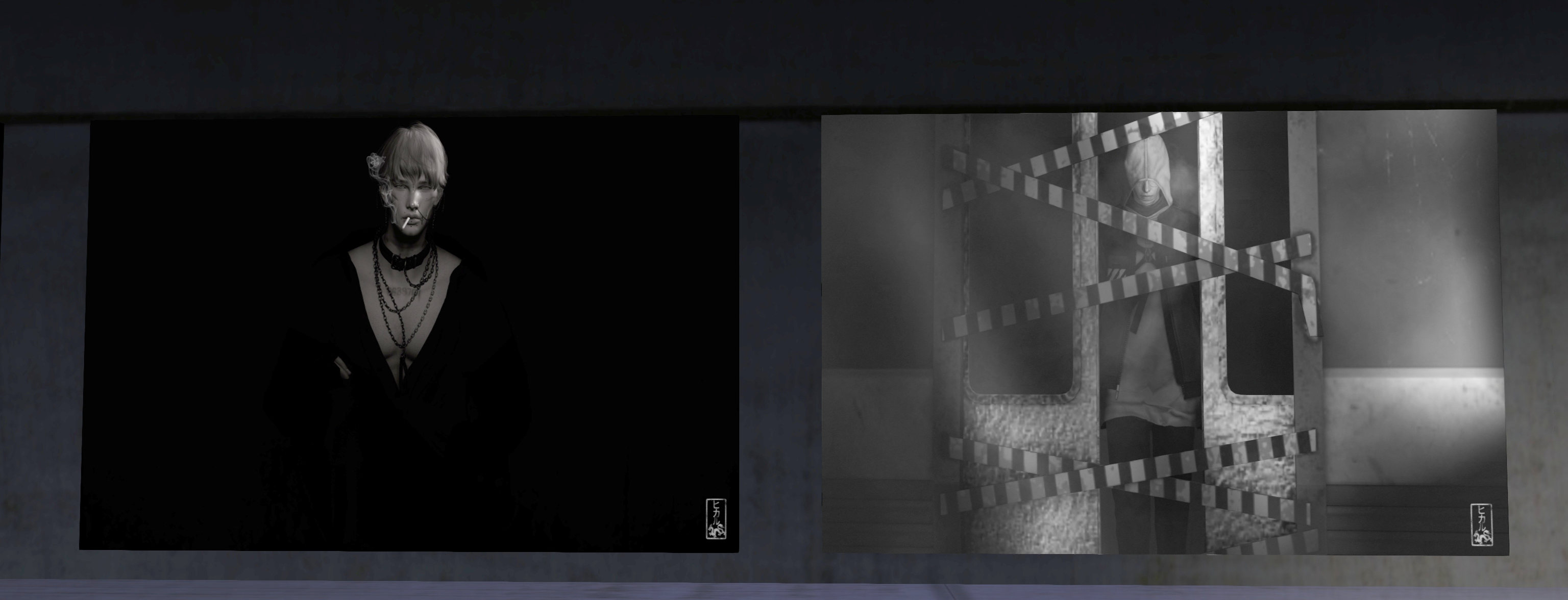
Who doesn’t know Hikaru? Dido Haas asks in reference to Hikaru Enimo in her introduction to the October art exhibition at her Nitroglobus Roof Gallery in Second Life. Well, to my embarrassment, I have to hold a hand up and say “me”; for despite Hikaru being a photographer, blogger, event organiser and Editor-in-Chief of L’Homme Magazine SL, I have not had a prior opportunity to view his work. Thus My Reflection, as his exhibition at Nitroglobus is titled, has been an opportunity for me to become better acquainted with, if not the man, then at least his work.

This is something of a person exhibition of pieces for Hikaru, as again the liner notes make clear. Each piece is intentionally designed to offer insight into the moods and emotions the artist was feeling during its composition of each shot, rather than just trying to evoke a mood or response in the viewer of his work. The result is a baker’s dozen of fabulously monochrome pieces that are presented in the large format that marks exhibitions at Nitroglobus, all focused on Hikaru’s avatar (joined in places by his dog), that are deeply expressive, and in which pose, tone, lighting and setting have been carefully crafted to as much give insight into the artist’s mindset as much as any facial expression.

Indeed, given that many of the images offered – in difference to Hikaru’s own comments on his use of his avatar’s gaze – eyes and face are not visible, the depth of feeling that is conveyed in some of these pieces just through pose completely captivates. Just take My Reflection 07, My Reflection 09 and My Reflection 10, for example, all of which contain a sense of listlessness borne of solitude and / or boredom. Similarly, Reflection 12 is a completely stunning narrative of mood in which, while it partially reveals a downcast face, the statement come no closer is perfectly portrayed through the placement of the stripped bars across the doorway before Hikaru’s avatar; so much so, I would suggest, that even whilst rendered in monochrome, bars mentally convey the idea they are in fact stripped yellow-and-black in that familiar warning do not cross.

Nitroglobus Roof Gallery: My Reflection

Where his avatar’s face is visible, the conveyance of mood / feelings is more directly pronounced, but not less marvellously framed. My Reflection 11 and My Reflection 04 (which I would not is definitely NSFW when viewing!) for example, utilise the placement of a hand over or before the face to charge each piece with its emotional content, the use of splayed or crooked fingers speaking volumes as to the thoughts that lie behind the avatar’s eyes even as those eyes remain hidden by lowered lids. Similarly, and alongside of it, the curl of cigarette smoke rising beside the steady gaze of Hikaru’s avatar in Reflection 01 draws us into his eyes and the sense of mood within them. And then there is My Reflection 14, where pose, directed gaze and the presence of a window (or door) frame between us and the avatar offers an entire story.

And it is in the idea of contained narrative that Reflections further unfolds before us. For while these are images intended to reflect Hikaru’s own moods, thoughts, feelings – and yes, his vitality – at the time of their creation, such is their depth and composition, we cannot help be see each as part of a larger canvas. Each image invites us in to it, awakening our imaginations to weave stories that can fill the rest of that unseen canvas. Stories in which our own role might also be defined: are we merely a observer of a moment in Hikaru’s life, or are we an invisible participant – lover, partner, friend, passer-by – looking upon someone we care for, like or just happen to see – or who has caught us unexpectedly within his gaze?

Nitroglobus Roof Gallery: My Reflection

Evocative, rich, personal, emotive and a tour de force of an artist’s talent for expression and story-telling, My Reflection is both a superb introduction to Hikaru’s work for those who like myself have not been fortunate enough to encounter it previously, and as a richly layered series of images that superbly straddle the line of “personal” and “public” in their conveyance of mood and narrative respectively.

SLURL DETAILS

A return to Oxygen in Second Life

Oxygen, September 2021 – click and image for full size

Earlier in September 2021, I took a tour of Oxygen: The Rock, Justice Vought’s homage to the island of Alcatraz and its famous former federal prison (see: A trip to The Rock in Second Life). Whilst I didn’t come across Nicolas Cage and Sean Connery trying to stop Ed Harris in his evil plans, much less Clint Eastwood planning his escape or Burt Lancaster (slightly apocryphally in historic terms) keeping his birds – it was an engaging visit, and one I encourage those who haven’t done so to also partake.

At the time, I noted that the start of a tour of Justice’s Alcatraz starts on wharf abutting his main region (co-held and designed with Six Vought (SixDigital)) of Oxygen, and that it was high time I took another look around it to see how things are. particularly as it is now some two years since my first visit. And I’m delighted to say – albeit without any surprise, given Justice’s eye for region design and detail – it remains as engaging as ever, offering a setting that carries forward the design first seen during my October 2019 visit, but with a number of small changes and touches that make a re-visit worthwhile.

Oxygen, September 2021

While it is not enforced, the landing point is given as the railway station that sits to the east of the region. and which contains one of those little anachronistic juxtapositions I like finding within region designs, this one in the form of a very British red telephone box facing off against a very US Postal Service mail box sitting across the narrow street that splits the station buildings.

From here, steps lead the way down a flat-topped ridge running along the region’s south side, the home to a little parade of shops fronted by a cobbled street marked by a fountain. A similar parade, complete with the Justice League Comics shop was present in the October 2019 version of Oxygen, but overall offered a slightly different mix of businesses.

Oxygen, September 2021

Two further elements retained within this iteration of the setting are the harbour and The Mystic. Facing north, the harbour sits directly behind (and separate from the wharf that marks the start of a visit to The Rock. On the landward side of the harbour, the ground rises upwards to the plateau that is home to The Mystic, the regions hilltop lodge. Wooden stairs climb the rocky face of the hill from the Harbour Master’s building with its arched sign, to reach the lodge by way of passing pelican and seagulls at the steps rise upwards.

Offering a place to relax or enjoy music events at the outdoor deck stage, The Mystic still offers a commanding view over the west side of the region as it falls away to the beach, which appears to be perhaps a little narrower than I recall from 2019. Getting down to it remains a choice of zipline or wooden steps, the latter leading both down the lower slopes of the hill and also presenting a route to Six Vought’s photo gallery as it sits tucked into the region’s gorge.

Oxygen, September 2021

The major shift in emphasis within the region’s design is that where it once included a number of rental properties, these have now been reduced to just a single property, tucked away into one corner of the region. This gives explorers more room for wandering along the lowland areas inland, and along the western beachfront.

The lack of additional rentals gives the impression the beach and its surrounds are a little more open than previously, although the drive in theatre remains. Similarly, the hills rising towards The Mystic seem a little more wooded and perhaps have some additional points of interest to find, such as the old bathtub watched over by a pair of peacocks or the sculptures sitting in the shade of trees.

Oxygen, September 2021

With the subtle changes made to its design, Oxygen remains an engaging visit; the kind of place you can visit and catch your breath, take a few photos and enjoy the ambient sounds and just be.

SLurl Details