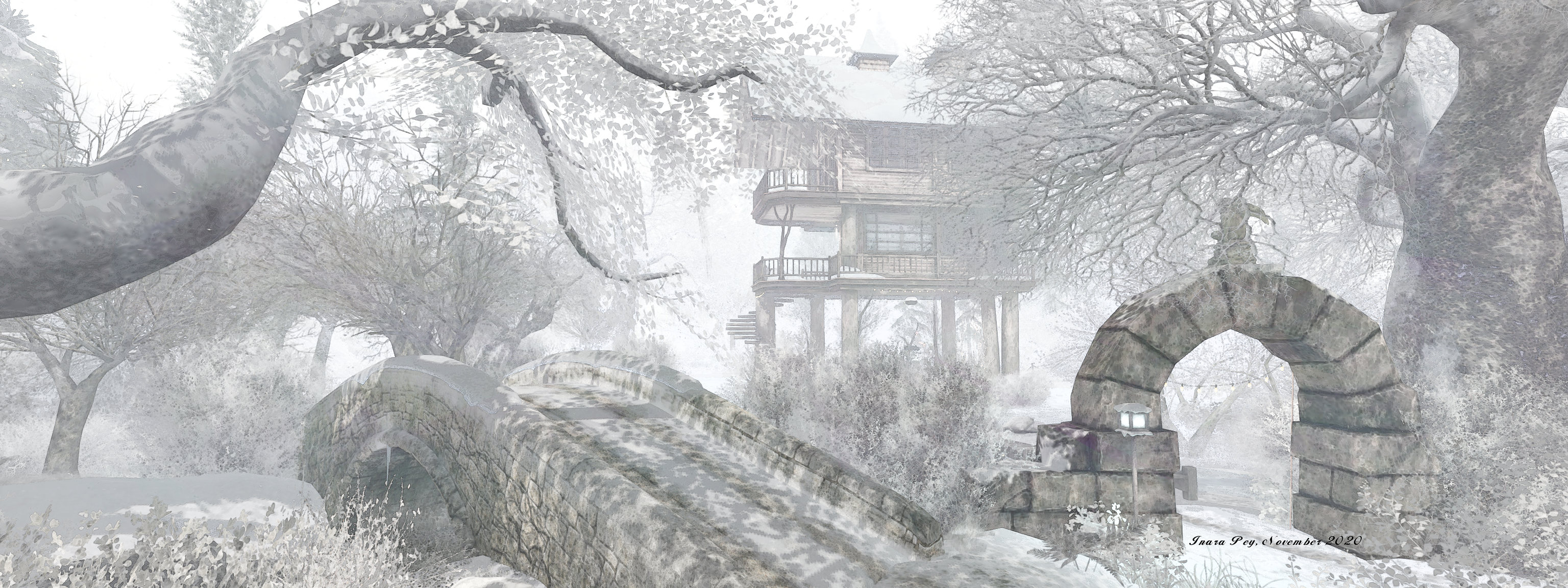
Those who fancy a little touch of winter / seasonal cheer and snow but who don’t fancy exploring a full region, might want to drop in Little Winter, Terrygold’s look at the season for 2020.
Terry has been offering these little winter scenes at the end of the year in Second Life for the last few years, and I’ve always enjoyed visiting them – although I will confess to missing her 2019 design.
Little Winter, November 2020
Located on a sky platform over Solo Arte, where Terrygold often displayed her art and immersive installations, Little Winter presents a simple, easy to appreciate outdoor setting that starts at a little chapel decorated with little stars, with an outhouse that might be the modern-day equivalent of a stable, housing as it does a tricycle and a motor scooter.
A path winds away from the chapel between shoulders and tables of rock and marked by silver birch trees, eventually arriving at a little cabin facing another barn. The cabin is cosy and warm, the barn a little grotto of waiting presents, guarded by large toy soldiers.
Little Winter, November 2020
Around these are lots of little details to be appreciated, from puppies playing with the reins of a sled to happy snowmen and strutting snow kiwis. As well as these, there are places to sit and cuddle, dances to be enjoyed and various opportunities for photography – or even to make a snow angel.
Watched over by deer, Little Winter is an easy to enjoy setting that doesn’t overly impact system performance or require a huge amount of time to explore and appreciate, making it a relaxing and engaging visit.
With winter on our doorstep, Milly Sharple has once again opened her annual Let It Snow! winter / Christmas themed region for Second Life residents to enjoy, and Caitlyn and I once again received an invitation – although I’m still playing a lot of catch-up on general blogging due to the physical world occupying a lot of my time at the moment, so it has taken me a fair few days to get to the point of writing about it.
I’ve actually been covering Let It Snow! on an annual basis since 2014, only stopping during the years Milly took a break from presenting the region, and have always enjoyed our little pilgrimages to see what seasonal delights Milly has served up – as an artist, she has an eye for framing photogenic series of vignettes across her chosen region, often with touches of whimsy design to bring smiles to the faces of those visiting.
Let It Snow!, November 2020
A visit to the region starts on the north side, where a little village square awaits arrivals, a pavilion offering the warmth of an open fire, a gazebo a place for dancing and, for those seeking something a little warmer, a cosy cottage. Overlooked on one side by a large and warmly-furnished house atop a rocky table,the village is a short walk to a frozen pond ready for ice skaters.
Cut by channels of frozen water spanned by bridges, this year’s Let It Snow! follows Milly’s previous iterations of the region by presenting within its snow-covered landscape a series of interlinked vignettes and scenes, each of which stands on its own whilst also being linked to the rest of the region.
Let It Snow!, November 2020
To describe all of these settings here would be to spoil the opportunity for exploration and discovery, but there are various points within the region I found particularly attractive. Chief among these is the the manner in which Milly has combined The Chapel Ruins from The Looking Glass with pieces by Paco Pooley and Krystali Rabeni to create the site of a ruined chapel, complete with a stained glass window by Milly as a romantic setting with an ethereal edge to it.
Whimsy is added here and there, as with previous designs – such as the snowball-throwing snowman lurking under a tree, while seasonal touches come in the form of the decorations adorning the rooms of the large house, the lights hanging on the trees around the skating rink and so on.
Let It Snow!, November 2020
As well as ice skating, the region offers signs where sleds can be rezzed, plenty of opportunities for dancing, and even the opportunity to play chess with a companion.
The best way to explore the region is to go where your feet will take you – there are no formal paths (just steps to get up to and down from he raised portions of the landscape). However, when visiting I do recommend you use the region’s environment settings to appreciate i to the fullest – and the sky dome Milly has placed over it – to the fullest.
Let It Snow!, November 2020
With plenty to see and do, and with lots of opportunities for photography, 2020’s let It Snow is as captivating to the eye as past iterations, and more than worth the time taken in a visit.
Occupying half of a Full region, Yukina is the home of Namanax & Stella (Stella Mahogany), who is largely responsible for its design. Currently sitting within a winter setting, we were directed to it by Shawn Shakespeare, our resident region discoverer :).
The parcel runs north-south, with the eastern side open to the sea, and the west boundary marked by high cliffs separating it from the neighbouring parcel.
Yukina, November 2020
The southern end of the land is a actually the private home of Stella and Namanax, and while protected by ban lines to prevent trespass, leaving the garden open, it might be a good idea to avoid straying beyond the gabled gates leading up to the house (complete with stone lions guarding the path), in order to avoid the flick-knife armed squirrel patrols (you’ll have to visit and take a peek into the grounds of the house yo understand this comment 🙂 ).
The main house isn’t the only property on the parcel, however; the public area of the parcel are home to a number of houses and cabins large and small, including one particularly impressive structure rising from the small lake in the middle of the landscape. All of these appear to be open to the public and are furnished, giving each of them a cosy feel.
Yukina, November 2020
The landing point sits on the east side of the parcel on the dock alongside a boathouse. From here visitors have a choice of routes for exploration, most laid out in the form of snowy tracks that wind their way out and around the houses and cabins. The way around is also marked by by the local wildlife within the parcel, which ranges from the aforementioned squirrels (which are in fact more interested in playing than carrying weapons of any description!) through rabbits, cats, puppies, chipmunks and – most notably reindeer.
All of this makes for a lot to see, from the comfort and warmth of the houses to the scenes along the tracks to the decks that sit alongside a number of the houses (and which offer places for visitors to sit).
Yukina, November 2020
There are also some nice scenic touches waiting to be found – the Christmas tree shop operated by some nattily dressed gnomes being one of the more obvious, although I liked the little hump backed bridge over the still-flowing stream that feeds the (otherwise frozen) lake. And for those who like a little a little activity during their visits, the lake offers ice shaking; just look for the sign on one of the tracks that loops by it.
Overall, the setting is well presented and makes for an engaging visit. However, there is a lot packed into this half region, including falling mesh snow (that actually invites itself into one of the houses, drifting through the roof!), all of which can make for heavy going in places due to the volume of mesh, so some might want to tweak their viewer to get the most comfortable level of performance.
Yukina, November 2020
But that said, Yukina offers a rewarding wintertime visit.
Snowdrops, November 2020 – click any image for full size
November is here, and with it comes – for those in the northern hemisphere – thoughts of snow a and winter scenes. And, inevitably in Second Life, regions start to reflect those thoughts.
Kess Crystal has jumped into the mood, offering SL residents a chance to hear sleigh bells ringing whilst walking through a winter wonderland with Snowdrops, a seasonal Homestead that offers all the feel of winter without overly going down the rabbit hole of becoming heavily Christmas themed.
Snowdrops, November 2020
There are some familiar elements to the region that tend to make their presence felt at this time of year – the DRD Polar Express, a skating rink, ski lifts and little Christmas tree shop, for example, but while these tend to pop-up a lot across public regions, there is no denying they fit the theme perfectly.
Surrounded by hills, this is a mostly low-lying, rural setting, much of the land with the home of trees. To the west the land rises to a snowy slope leading to a table of high rock split by a watery inlet. To the east is the railway line and the DRD train mentioned above, which has pulled into the local station that forms the landing point.
Snowdrops, November 2020
From the station, snow-covered roads loop around the region, marked by boulders on either curb. Frequently branching, these offer the ideal way to explore what is available, leading as they do under the shade of the trees to the little Christmas tree shop, the skating rink, and the many places to sit / pose.
To the south-west, a path climbs up to the top of the rocky plateau and the house that is waiting up there. This does offer various hints of Christmas from the holly garlands hanging across windows, through the decorated trees with presents below, and the stockings hanging from the mantelpiece, to the seasonal meal on the table.
Snowdrops, November 2020
Northwards, across the natural rock arch that spans the inlet splitting the rock, can be found a Scandinavian style pavilion with an open fire to help warm visitors up. This faces a snowy slope offering sleds and snowboards as a means to get back down to the lowlands and have a little fun along the way. The north west end of this ridge is home to a chair lift that people can also use to ride up from below – but be warned, the ride really is a case of, “Ahead warp six, Mr. Sulu”!
Given Kess is herself a photographer, the region has multiple opportunities for avatar photography – many of the items to be found within it offer poses, while for those who wish to use there own, joining the local group will provide rezzing right – just please pick things up behind you.
Snowdrops, November 2020
Easy on the eye and to explore, Snowdrops makes for a pleasing visit – our thanks to Shawn Shakespeare for the landmark!
England’s Birmingham City may at first glance appear to be an odd choice for a parcel theme; the city today is typical of modern conurbations and to those from beyond its borders perhaps seemingly unremarkable and famous only for a particular motorway / trunk road interchange. However, the city has a long and notable history, one that dates back to at least Anglo-Saxon times as the settlement for a local clan from which its name is derived – Beormingas (“Beorma’s People”), although whether or not Beorma was an actual clan leader or a mythical character associated with the people who settled there isn’t actually known.
As a centre of commerce, the city flourished from around the mid-1500s, which in turn gave rise to a certain level of wealth flowing into it, such that by the mid 18th-century, it was the centre of the Midlands Enlightenment that allowed Birmingham become a centre of literary, musical, artistic and theatrical activity and, as a result of that, a major driving force behind Britain’s industrial revolution.
VOIR Gallery, November 2020
However, for their VOIR Gallery parcel build, Simone (SimoneFiore) and Frenchy25, have selected the Birmingham of the 1920s as a founding theme. This was the era of the Birmingham Boys, a notorious gang who controlled horse race betting across the majority of England in thrall.
Occupying 1/8th of a full region, the parcel packs a lot into it without ever feeling overcrowded. Sitting on a sky platform, it offers the aforementioned steam train (admittedly of American design, but that’s the nature of SL when it comes to available content) and canal. Large commercial buildings (including the façade of the parcel surround) mix with rows of (oddly flat-topped) worker’s houses.
VOIR Gallery, November 2020 – Lula (Lulalali)
To be honest, I’m not really clear how the Birmingham boys fit into the setting as noted; in walking the parcel, I didn’t see any overt signs of their activities (betting shops, etc.), and as a result, did find myself wondering if the reference may be the result of the TV series peaky Blinders, which offered a fictionalised glimpse of a least one of the founding members of the gang. However, influences don’t really matter here, as there is much to commend the location to photographers, both outdoors and in (notably the pub and warehouse converted to a blues club).
Given this is a gallery space, the art with the parcel can be found discretely parked along two of the façade walls, one of which is occupied by images by Lula (Lulalali) and the other by images by Ness(?) Several of the pieces deal with adult themes, so may be considerer NSFW. In addition, one of the warehouse building looks as if it in the process of being readied as a gallery space, so more art may be added in due course.
VOIR Gallery, November 2020 – NessIn the meantime, the parcel makes for a pleasant visit, and our thanks to Cube Republic for the pointer.
Angels Nest, November 2020 – click any image for full size
Shawn Shakespeare passed me the landmark to Angel’s Nest, a Full region held by Denise Wirtanen and designed by Busta (Badboy Hi) with additional elements by Denise herself. As I’ve mentioned in these pages in the past, hearing or seeing Busta’s name associated with an region is bound to get me bouncing to take a look, as he has a particular eye for designing environments that I really appreciate – and Angel’s Nest is no exception.
A semi-tropical island marked by a central high peak (the summit reachable via teleport disc), this is a design the brings together multiple themes in a manner that is genuinely breathtaking, and considerable care ha been taken to ensure that visitors can be gently lead around the island via a series of paths that allow everything to be revealed naturally – so much so that I’d tend to recommend not camming around too far in advance so as not to ruin any revelations and allow the paths to lead you onwards.
Angels Nest, November 2020
The landing point is located part-way up the central mountain, sitting on a broad shelf of rock that is home to a Tuscan style villa and courtyard. The house is furnished, offering a first point of exploration. From here, a number of paths marked by logs set in the loamy soil offer several routes of discovery. Two wind down to the coastal regions while a third curls upwards to twist around the flat-topped tower of the mountain, and a fourth points the way to a lookout point built out over a pool of fresh water fed by multiple falls – which are very much a theme for the island, as more are waiting to be found.
I don’t want to give a blow-by-blow account of the region’s sights – as noted above, they deserve to be discovered naturally; but I do want to highlight a number of things and offer some impressions.
Angels Nest, November 2020
The first of the latter is the manner in which the island – deliberately or otherwise – evokes thoughts of settings from television and film. Taken as a whole, the island has – for those that many have seen it when originally aired or in re-runs – something of a Fantasy Island feeling. Not that there is any grand villa or guest houses (although the lighthouse just off the main island might be seen as a place where Tattoo might cry, “The ‘plane, Boss! The ‘plane!”), but rather that the settings to be found around the island might be taken as individual fantasy areas for visitors.
Similarly, and a little unexpectedly, the tall mountain with its sliced top carries (for those of us who enjoy science fiction) an echo of Devil’s Tower, Wyoming. Again, not that any flaying saucers or motherships are liable to rise from behind it – but it does give the island an additional sense of place and mystery, whilst its flat top offers a place for meditation – just use the teleport disc in the courtyard of the villa to hop up and have a look around.
Angels Nest, November 2020
In terms of highlights, there are many to choose from, however there two that particularly caught my attention. The first of these again lies off of the main island to the north-east. Rugged and low-lying island in which Busta has placed a – for me – quite eye-catching modification of AustinLiam’s Captain Retreat house (which as I’ve commented on in these pages is a favourite of mine), so much so that I might well borrow elements of the idea from him!
The second is the café-bar located on the south side of the island, overlooking the southern beach. Utilising the Trompe Loeil Yara Treehouse. With the two halves of the structure located on two shoulders of rock and linked by their rope bridge, the café presents an eye-catching location, reached by several routes, one of which rises from the beach to pass under the rope bridge.
Angels Nest, November 2020
Another aspect of the region are the many little place people can gather and sit, all of which should be sought out carefully. But it’s not only the various settings that catch the eye here, but all the smaller details within them and across the island as whole that add a sense of presence to the island.
Some of these – such as the old British red telephone box just outside of the villa – is one of the more easy of these to spot, nestled alongside an old piano that has become a garden feature with colourful blooms (and which has been claimed by some of the local cats!). Others might actually be easily missed – such as the great Buddha sitting on a shoulder of the mountain, and a sculpture of a spear-carrying Angel on an opposite shoulder.
Angels Nest, November 2020Returning to the teleport discs for a moment, as well as presenting a quick means of jumping directly to various points on the islands, they also provide the means to access a large skybox overhead. Designed by Denise, this offers a Zen garden under a star-filled sky and, across the water from it, a retreat within a Japanese style house that has a slight BDSM twist.
Rounded by a balanced soundscape and given life through the inclusion of birds, cats and assorted animals, Angel’s Nest is an engaging visit – although some may find they may need to disable shadows / make adjustments to their their viewer to enjoy smooth motion within the region. I’d also note that there is a second region to the south, reached via a footbridge;; however, as this appears to be a private home, we didn’t venture to it, and would advise caution to those considering doing so.