Hikaru Enimo’s Reflection in Second Life

Nitroglobus Roof Gallery: My Reflection

Who doesn’t know Hikaru? Dido Haas asks in reference to Hikaru Enimo in her introduction to the October art exhibition at her Nitroglobus Roof Gallery in Second Life. Well, to my embarrassment, I have to hold a hand up and say “me”; for despite Hikaru being a photographer, blogger, event organiser and Editor-in-Chief of L’Homme Magazine SL, I have not had a prior opportunity to view his work. Thus My Reflection, as his exhibition at Nitroglobus is titled, has been an opportunity for me to become better acquainted with, if not the man, then at least his work.

This is something of a person exhibition of pieces for Hikaru, as again the liner notes make clear. Each piece is intentionally designed to offer insight into the moods and emotions the artist was feeling during its composition of each shot, rather than just trying to evoke a mood or response in the viewer of his work. The result is a baker’s dozen of fabulously monochrome pieces that are presented in the large format that marks exhibitions at Nitroglobus, all focused on Hikaru’s avatar (joined in places by his dog), that are deeply expressive, and in which pose, tone, lighting and setting have been carefully crafted to as much give insight into the artist’s mindset as much as any facial expression.

Indeed, given that many of the images offered – in difference to Hikaru’s own comments on his use of his avatar’s gaze – eyes and face are not visible, the depth of feeling that is conveyed in some of these pieces just through pose completely captivates. Just take My Reflection 07, My Reflection 09 and My Reflection 10, for example, all of which contain a sense of listlessness borne of solitude and / or boredom. Similarly, Reflection 12 is a completely stunning narrative of mood in which, while it partially reveals a downcast face, the statement come no closer is perfectly portrayed through the placement of the stripped bars across the doorway before Hikaru’s avatar; so much so, I would suggest, that even whilst rendered in monochrome, bars mentally convey the idea they are in fact stripped yellow-and-black in that familiar warning do not cross.
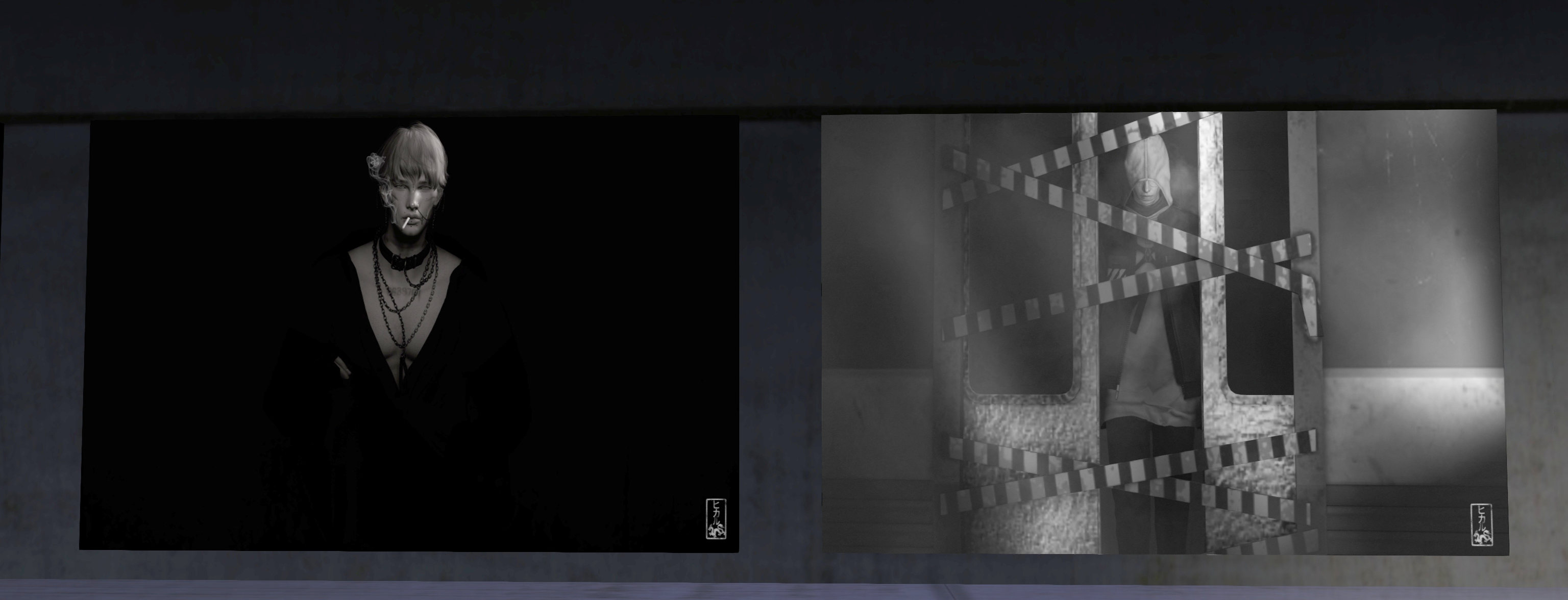
Nitroglobus Roof Gallery: My Reflection

Where his avatar’s face is visible, the conveyance of mood / feelings is more directly pronounced, but not less marvellously framed. My Reflection 11 and My Reflection 04 (which I would not is definitely NSFW when viewing!) for example, utilise the placement of a hand over or before the face to charge each piece with its emotional content, the use of splayed or crooked fingers speaking volumes as to the thoughts that lie behind the avatar’s eyes even as those eyes remain hidden by lowered lids. Similarly, and alongside of it, the curl of cigarette smoke rising beside the steady gaze of Hikaru’s avatar in Reflection 01 draws us into his eyes and the sense of mood within them. And then there is My Reflection 14, where pose, directed gaze and the presence of a window (or door) frame between us and the avatar offers an entire story.

And it is in the idea of contained narrative that Reflections further unfolds before us. For while these are images intended to reflect Hikaru’s own moods, thoughts, feelings – and yes, his vitality – at the time of their creation, such is their depth and composition, we cannot help be see each as part of a larger canvas. Each image invites us in to it, awakening our imaginations to weave stories that can fill the rest of that unseen canvas. Stories in which our own role might also be defined: are we merely a observer of a moment in Hikaru’s life, or are we an invisible participant – lover, partner, friend, passer-by – looking upon someone we care for, like or just happen to see – or who has caught us unexpectedly within his gaze?

Nitroglobus Roof Gallery: My Reflection

Evocative, rich, personal, emotive and a tour de force of an artist’s talent for expression and story-telling, My Reflection is both a superb introduction to Hikaru’s work for those who like myself have not been fortunate enough to encounter it previously, and as a richly layered series of images that superbly straddle the line of “personal” and “public” in their conveyance of mood and narrative respectively.

SLURL DETAILS

Art and Asperger’s in Second Life

Janus Gallery, September 2021: Xia Chieng

Open until the end of the September 2021 at Sinful Retreat’s Janus Gallery is Visions of an Aspie, a collection of original physical world paintings by Xia Chieng. While I’m getting to it late, this is a fascinating exhibition that should not be missed.

Asperger Syndrome (AS or sometimes referred to just as Asperger’s (without the “syndrome” when used with the apostrophe)) is an autism spectrum disorder (ASD) characterised by significant difficulties in social interaction and nonverbal communication, along with restricted and repetitive patterns of behaviour and interests.

Having been diagnosed with the condition, Xia has found a way to overcome her difficulties in communicating with others through her art, using oils and watercolours to express the feelings and emotions she experiences and to give a sense of the her personal situations, outlook and experiences.

The Janus Gallery, September 2021: Xia Chieng
I see artistic creation as a tool for self-transformation and healing, a way to dialogue with my own internal demons and those of our culture, a means to create my own myths with which one moves through the world. I am on personal journey; personal exploration into the essence of the live; the nature of the relationship between my senses, ideas and perceptions and the external world; my conception of space and substance. Only things that are personal can be truly real for me. 
My art is narrative but not literary, it tells stories but does not create their meaning. It may not mean anything, more than we can individually feel. My work is a thing, an object, presented to you for your pleasure and for my relief. It just is what it is. It is not explained alone.

– Xia Chieng

At Janus Gallery I, Xia presents a collection of self-portrait images each one of which presents a narrative – but not one in the literary sense; these are stories designed to give insight into a thought, a feeling, a senses of mind. In part, this might be contained within the title of each individual piece, but which is also mostly through the composition itself. Given this, these are exceptionally poignant pieces, paintings that might also be seen as a part of Xia’s own quest.

My condition makes me face life as a continuous challenge. Rejection, misunderstanding, intolerance have been present throughout my life and have led me to become elusive and lonely.

– Xia Chieng

Janus Gallery, September 2021: Xia Chieng

This quest is perhaps most clearly indicated in those images in the collection that feature a keyhole (or in some cases a question mark) painted onto the forehead of the subject(s) in each painting. A keyhole that might be taken as both Xia’s quest to unlock that part of her that causes her to feel apart, separate and lonely, and also perhaps as a pleas for use to better understand the blurred, isolated, challenging world in which she finds herself living.

As insights into a person’s life, these are pieces that can be stark, dark and a little disturbing (Memento Nori, I was a Suicide Girl, Misery, Nightmare, Good Memories), other have a difficult edge to them (The Princess of Broken Hearts, The birthday Party Without Guests); but these should not be taken to mean these are exercises in personal pathos – life is abundant throughout all of them, with some encompassing religious motifs that speak to broader questions that can affect us, thus offering something of a bridge between our own inner thoughts on life and those that flow through Xia’s mind.

Janus Gallery, September 2021: Xia Chieng

I cannot imagine what it means to be diagnosed with Asperger’s and would not try; but what is undeniable about Visions of an Aspie is  the over-arching statement of the power of art in its ability to give voice, to share, to overcome  – to help understand oneself and one another. This makes it – as mentioned at the top of this article – an exhibition that should not be missed, although it will be ending on September 29th.

SLurl Details

Five artists at La Maison d’Aneli in Second Life

La Maison d’Aneli – Desy Magic
The latest exhibition at Aneli Abeyante’s La Maison d’Aneli opened on September 15th, 2021, once again focusing on a group of artists with very different styles who present both 2D and 3D works, in a set of exhibitions that compliment one another, and which I’ll tackle in their teleport (via the ground level teleport disk as short walk from the landing point) order.

Hailing from Italy, Daco Monday is a self-taught artist who entered Second Life in 2009. His art is inspired by, and makes use of, space, as is amply demonstrated within Severed Roots, a fascinating 3D environment that mixes elements from a previous work (De Chiricocanto) with newer pieces to create a fascinating diorama that offers multiple possible interpretations. The central characters in this diorama take two forms: there is the stylised 3D artist from De Chiricocanto, who stands alongside a 3D musician (“the drummer”), then there is the image of a couple posing for a portrait and which occurs multiple times, in whole or in the shards of a shattered mirror. A large handgun and an old-style photographic plate camera hang on the air to one side, while particle figures dance and eyeballs roll.

La Maison d’Aneli – Daco Monday

Quite what we are to make of this is, as I’ve noted, a matter for personal interpretation  – although I would suggest a clue might be found within the installation’s title and possibly the idea of time being shattered (but admittedly, as I’m mid-way through binge-watching Lost, I could be under the influence of that show’s frequent left turns into weirdness!).

Within her space, Madee (Kupu2) presents Precious Moments, a highly engaging series of self-studies with her avatar in both motion (dance) and at rest. Some of these should be considered not suitable for work as they contain nudity, but all are all completely engaging in capturing mood, emotion, movement and form. Presented in monochrome with a soft focus finish, the pieces reveal a talent that whilst new to the world of Second Life photography, is already producing quite mesmerising images and stories.

Utilising a soft form of black and white chiaroscuro, Madee’s art perfectly frames the beauty of the female form against a consistent dark background, leaving us with no distractions to carry our attention away from the central figure in each.

La Maison d’Aneli – Madee (Kupu2)

Desy Magic is an artist I first gained familiarity with whilst visiting Ayuda Virtual, the community gateway specifically developed in support of Spanish-speaking people. She is modest enough to believe she is not an artist, but an experimentalist who particularly likes to work with colour and form. However, the pieces offered in this exhibition prove that while she is very much an experimentalist, she very much is a skilled artist with an eye not only colour and form, but composition, cropping and finish to present highly engaging pieces rich in narrative and which encompass a number of artistic styles including abstract, expressionism and digital collage. It is a selection that includes what is perhaps my favourite of Desy’s pieces I’ve seen to date: Astronauta – if only NASA and ESA would paint the Orion capsule and its service module so imaginatively.

Around these 2D pieces are a number of equally engaging 3D pieces by Desy, some comprising a mix of fluid and abstract female forms.

La Maison d’Aneli – JudiLynn India

Abstract is the nature of JudiLynn India’s work, which really needs no introduction in these pages, as I’ve long appreciated her work. Her original painting are glorious in the order she offers out of the apparent chaos of colour, As always with JudyLynn’s art, the pieces displayed in this exhibition are all remarkable pieces she has created and then uploaded to Second Life; pieces that should be allowed to speak to us individually.

Nino Vichan has always been an artist who seeks to challenge our perceptions and thinking through his work – although I confess I’d lost track of him over the last few years (I was actually under the  – possibly incorrect – thinking he had stepped away from Second Life). How well he achieves the former is a matter of individual choice, but there is no mistaking the evocative / provocative intent to his work. With Better Angels at La Maison d’Aneli, he highlights the dichotomy between our lean towards goodness and kindness, as represented by the images of angles offered on their easels, with our proclivity towards cruelty towards each other in so many ways – warfare, genocide, human trafficking, slavery, etc.  Between the images are the words, there are at least two questions: the first is can we listen to the appeal of our better angels, our better selves?

La Maison d’Aneli – Nino Vichan

Five very different artists, each with an individual talent for presenting their work and engaging our eyes and minds, who here combine to present an evocative tour of art well worth taking the time to visit and appreciate.

SLURL DETAILS

The Art of Portraiture in Second Life

Art Korner: Tiya Aura – The Art of Portraiture

Update, June 27th, 2022: Art Korner has Closed.

Currently available at Frank Atisso’s Art Korner is an exhibition of avatar studies by a artist whose work is new to me: Tiya Aura, who presents a series of images under the title The Art of Portraiture, and it is a fascinating collection to view.

Avatar studies are one of – if not the – most popular forms of art and photography produced through Second Life. images take many forms, from straightforward portraiture intended for use within Profiles to complex posed pieces, often with an backdrop of some form and intended to reflect a theme (generally the title of the piece) and / or tell a single-frame story. Sill others focus on the avatar itself, tightly-focused and intended (again) to convey a narrative and / or emotional content, and so on.

Within The Art of Portraiture, Tiya very much focuses on that category of studies intended to convey emotion, offering 21 images of her own avatar and those of her friends (some subjects featured in more than one image), split between the two display spaces within the skybox gallery. Some of the images are captured in the “traditional” style of a portrait image, with the subject looking directly at the camera or in profile. Others are offset in both cropping and angle, suggesting a sudden moment caught by chance. Throughout all of them there is a deep of character.

Art Korner: Tiya Aura – The Art of Portraiture

These are images that not only capture an emotional element, many offer insight into the nature of the subject within the image, and by extension, the persona behind it. This is perhaps more evident within Tiya’s self-portraits, but is also very notable in several of the other pieces as well. Thus, this is a collection where the life – the humanness – of the avatar subjects is prevalent, and with a depth that suggests it was as much captured within the raw image as brought to the fore by considered and practiced post-processing that more than demonstrates Tiya’s artistry with digital tools.

In terms of post-processing, lighting and contrast are perhaps the most powerful tools Tiya uses to complete her work. Several of the pieces utilise lighting overlays and effects to help bright forth the emotional content, either by framing the subject so as to cast illumination around but perhaps not directly on the face, or by providing a seen, a projection of light and softer colours we must look through. Both approaches are utterly effective, as they causes one to focus in on the subject, to study eye, expression, direction of gaze, tilt of head, and thus become drawn into the sentiment Tiya saw when creating each piece.

In this the pictures within The Art of Portraiture not only offer a richness of emotion within the study of an avatar or present a glimpse of the persona projected by an avatar’s looks, they provide a subtle insight into the artist herself and how she responded to these images as she post-processed them.

Art Korner: Tiya Aura – The Art of Portraiture

Rich in form, colour, content and presentation, The Art of Portraiture is a genuinely bewitching collection of images; one that is offered – as is becoming increasingly popular within SL art circles – for sale on the basis of “pay as you feel” – the buyer set the amount they wish to pay for a given piece, rather than the artist setting the price.

SLurl Details

Cica’s Waiting in Second Life

Cica Ghost: Waiting

It seems like only a few days since I was writing about Cica’s Sandcastles, so I was surprised to receive an invitation to return to her installation region and witness Waiting, which opened on September 19th.

This is a very different environment to Cica’s most recent installations – Sandcastles, Lollipop, Summer Day – in that the theme here is darker, both in tone and potential meaning. However, before going into specifics, while Cica’s environment settings are always central to her work, it is particularly important that Waiting is viewed under its intended environment settings, or an important detail will be lost.

On the one hand, this is a setting where the orientation seems clear: across a desolate, parched landscape with desiccated trees hills rise hump-like or broad and flat, and on which what might be the remnants of a town stand: tall, aging buildings that stand without glass in windows or roofs on top. This all seems straightforward enough. But then there is the sky.

Cica Ghost: Waiting

Stretching from horizon to horizon, the sky is a frozen expanse of flat, parched ground hanging over the setting. And while it may be difficult to initially discern, not only are the trees towards the centre of the land stretching up towards this desolate sky – they also appear to be reaching down from it, branches interwoven like bony fingers. It is a disquieting sight, once noticed, but its and the desolate land below (or is that above, if you flip your perspective to match the “sky”?) are just the start.

As well as the empty buildings and dried-out trees, this is a setting that is home to tall figures. Stone-like grey, emaciated and with faces largely caught in shadows frowns, they are almost golem-like, looking as if they have been formed out of the clay of the Earth beneath the feet of the majority as they sit atop of the central hill (although individuals might be found elsewhere). Why they are huddled together is unclear, but they sit under the tangle of branches “growing” down from the sky – but whether the latter are trying to grasp them or simply form a canopy over them?

Thus, this is a setting with many potential interpretations. These might be aided by consideration of the quote Cica includes with the installation: time waits for no-one. It’s a truism we’re all familiar with, but how might it be applied here? Could it be a reference to the idea that while we have been caught within the worry of the pandemic, life and the world have continued to move forward without us, or might the installation reflect the idea that life is something that happens whilst we sit around waiting for something to happen, or might it mean something more personal, is a matter for how the installation speaks to you as a visitor.

Cica Ghost: Waiting

However, when visiting, do be sure to look around carefully and mouse-over things: there are some interesting characters awaiting discovery – check the trees for a couple of them; and there are the expected sit points and dances that mark Cica’s settings, but which many also not always been easy to spot (but as a clue: when all you have is a hammer…).

SLurl Details

  • Waiting (Luna Sea, rated Moderate)

Duna’s Simply Nature in Second Life

Janus Gallery II: Duna Gant – Simply Nature

Currently open at the Janus Gallery II at Sinful Retreat, Chuck Clip’s superb arts centre, is Simply Nature by Duna Gant. As the artist notes, this is something of a continuation of an earlier exhibition from around two years ago, entitled Poetic Lines, in that it furthers the minimalist theme started in that exhibition, turning the direction fully onto to nature. Thus, the twelve pieces offered at Janus Gallery II capture the elegant beauty of nature, as reflected in so many ways by creations within Second Life, in a marvellously minimalist style that have woven into them a central thematic thread of the interplay of light and water within nature’s realm.

This interplay is perhaps most directly expressed within the sculpture by Duna that spans the entrance to the gallery, itself called Light and Water. As well as offering an anchor for the surrounding images, this sculpture also personifies Duna’s central inspiration for her Second Life photography.

Given this, it should come as no surprise that several of the pieces offers images of the water and the sky, each of which is lightly rendered, both in terms of palette and touch; naturally drawing the eye to the further details within each piece, or which express the natural beauty waiting to be found within the sky itself or upon the ripples of water.

I have looked for those elements that, isolated from everything superfluous that surrounds them, represent by themselves a concept, a poetic line, that invites the viewer to open a door that leads them to interpret the image for themselves beyond what it represents.

– Duna Gant

Janus Gallery II: Duna Gant – Simply Nature

These are images that are almost haunting in their vacant expanse; they naturally draw the eye into them and invite the mind to frame a narrative around them. From Always with its slowly rising (or setting) Moon, through to Loneliness – to offer a minimal sense of progress around the images from lower floor to upper – there is a palpable sense of life, place and wonder, of emotion and thought, that leads the visitor onward from one image to the next, the story forming and re-forming almost prism-like as each new image is encountered. This sense of story is in some respects enhanced by the gallery itself: the dark walls and hidden entrance leaving the visitor with no distraction from the subtle, soft richness of the images.

Through her use of muted tones, minimal colour and both framing and blurring, Duna presents 12 pieces that speak to the beauty of nature, the way in which it can use the simplest of forms over and again, never repeating but also never really changing, to offer something uniquely beautiful, be it the spread of a tree against the sky or the sea, the roundness of a hill or sand dune, or the sense of escape and freedom evoked by the rolls and curls of clouds – a sense further and quite fabulously embodied by the flock of birds to be found in Get Away.

Janus Gallery II: Duna Gant – Simply Nature

An outstanding exhibition, Simply Nature speaks from and to the heart.

SLurl Details