When we are young and growing up, life and the world can be filled with the wonderous and the unexpected. While there can be moments of upset and tears, curiosity and our imaginations shape much of what we see, filling us with excitement and laughter. We are led by a desire to play, to make dreams real and have fun. Yesterday is so far behind us, it lies forgotten, tomorrow so far ahead of us, it lies beyond our thinking. There is only the timelessness of today.
As we grow older, we start to lose this infectious joy. Memories of yesterday and concerns for tomorrow start to crowd our thoughts. Laughter becomes rarer; something increasingly restricted to certain activities, losing its childhood spontaneity as childhood falls behind us and we take the command to “put away childish things” perhaps too seriously.
Cica Ghost: Timeless
But laughter, fun and living in the moment, being at one with our dreams and imaginations are all important aspects of life. They can give release from pressure, stress and mood, lifting our spirit. Laughter is infectious, positive, warming. Imagination is freedom and dreams can be inspirational. All are timeless in the gifts they bring us and as such, all should be embraced whenever encountered – and we should seek every opportunity to experience them. Such as when visiting Cica Ghost’s latest installation Timeless.
A playground for grown-ups, Timeless offers a lot to do and things to find (three gifts in all). We can sit and talk, or cuddle and relax or get physical and join in a silly dance or two, or show off with the kind of acrobatic prowess many of us may remember from childhood years or wish we could have. Among the bunny people, we can let our imaginations free to picture stories and life in this playground-town and give reign to laughter as we witness Cica’s Birds In Shoes and their reactions to our madcap dancing. And if walking gets too much, there are even little cars to motor around in.
Cica Ghost: Timeless
This is a place that encourages us to recapture our sense of fun and laughter; to let go of cares and woes and worries about work or whatever else might be be exerting a negative influence on us. And it is a places perfectly encapsulated by the quote Cica has used with it:
Laughter is timeless. Imagination has no age. And dreams are forever.
– Walt Disney
Cica
So, why not take a moment to smile and laugh, seek Cica’s little gifts and recapture a welcome sense of childhood wonder and enjoy a Timeless visit? And as you do, please take the opportunity to show appreciation for Cica’s work in encouraging us to smile and laugh every month.
Subcutan Art Gallery and Multimedia Centre: Sophie de Saint Phalle – Infinite
Indigenous Australian art takes many forms – rock painting, dot painting, rock engravings, bark painting, carvings, sculptures, and weaving and string art – and is the oldest unbroken tradition of art in the world.
It is rich in meaning and forms a central element of aboriginal life, the motifs, symbols and designs used revealing tribal relationships, social position, and more – all of which is noted by Sophie de Saint Phalle (Perpetua1010) in the introduction to Infinite, her latest exhibition which opened at the end of January 2022 in a new level of her gallery spaces, the Subcutan Art Gallery and Multimedia Centre.
Art is part of the main rituals in Aboriginal culture: it marks territories, records history, supports and transmits narratives about the Dreamtime. Similar to how Christians have their own story about the creation of the world, Aboriginal Dreamtime describes the creation of the world and each landscape.
– From the introduction of Infinite by Sophie de Saint Phalle
Subcutan Art Gallery and Multimedia Centre: Sophie de Saint Phalle – Infinite
Laid out in a setting designed to evoke thoughts of the outback desert, with large rock-like blocks that appear to shimmer in the heat, Infinite presents a series of bass-relief paintings and watercolours by Sophie produced in the same manner and styles as those used by Australian aboriginals. However, these are no mere interpretations of indigenous art; rather, it is a genuine homage, as Sophie notes:
My art shown at this gallery was inspired by my stay in Australia where I lived with the Aborigines for several weeks.
From the Aborigines I learnt how to find and use the typical aboriginal paints. Mainly pigments derived from clay tinted with mineral oxides Very rare is the colour blue which you find in some of my paintings.
Some colours are mined from “ochre mines” and used for both painting and ceremonies. Inorganic pigments such as ochre or rock flour is sometimes collected only by certain men of a clan. Other colours are made from clay, wood ash, and animal blood. All colours are natural.
– Sophie de Saint Phalle
Subcutan Art Gallery and Multimedia Centre: Sophie de Saint Phalle – Infinite
These are richly evocative pieces that speak to traditions, beliefs and a view of the world that is far, older than any European or other influences that have made their way to, and across, Australia.
They also stand as a mark of respect from Sophie to the peoples with whom she spent time and from whom she learned their techniques and approach to their painting as a expression of their history. For as she again herself notes: within aboriginal society, reputation is acquired through the gaining of knowledge and understanding and not by the accumulation of material possessions.
Thus the pieces in this exhibition speak to the knowledge and understanding Sophie has received from her mentors, and presents a reflection of the infinite depth of their beliefs and connection to Nature. They also offer a fascinating glimpse into a world the majority of us will never witness, much less encounter or understand, marking Infinite as much a journey as an exhibition.
Subcutan Art Gallery and Multimedia Centre: Sophie de Saint Phalle – Infinite
In the United States (where it also known as African-American History Month) and Canada, February marks Black History month, an annual remembrance of important people and events in the history of the African Diaspora (also observed in the UK and Ireland, but in the month of October). Given this, it is fitting that February should also see The Eye Arts host the latest 3D installation by London Junkers and which celebrates the life and work of a great American heroine – Harriet Tubman.
Entitled Hero, this is another installation by Junkers that is both marvellously understated in form but powerful in its content and depth. Rather than offering multiple scenes depicting Tubman’s life and work, London instead presents two gallery spaces that simply and directly encapsulate the major factors of her early life and work as an abolitionist, supported by the words of a poem also penned by Junkers.
Born into slavery in 1822 (as Armanda Ross) in Dorchester County, Maryland, Harriet Tubman was routed exposed to violent beatings and whippings as a child, and received traumatic head wound when a heavy metal weight thrown by an irate overseer struck her, leaving her with bouts of dizziness, pain in the form of headaches and hypersomnia throughout the rest of her life. As a result of this injury and the visions it gave her, Harriet became devoutly religious – and determined to escape her bonds.
In 1849, Tubman finally realised her goal to escape slavery, thanks to several factors combining – her belief in the Old Testament’s tales of deliverance for enslaved people; the discovery that her current owners were ignoring a stipulation the her mother would be manumitted (freed by her owners) at the age of 45; and thirdly that the widow of her owner might actually break up her family be selling them off.
The Eye Arts: London Junkers – Hero
However, a first attempt, made with her brothers Ben and Henry, ended when her siblings opted to return. A few months later Harriet tried again, this time making use of the so-called Underground Railroad – a network of former slaves, those still enslaved, abolitionists, and other activists – to reach the relative safety of Philadelphia. But she did not rest on her laurels.
I was a stranger in a strange land. My father, my mother, my brothers, and sisters, and friends were [in Maryland]. But I was free, and they should be free.
– Harriet Tubman
And so, spurred both by the Fugitive Slave Law of 1850 which imposed heavy punishment on those aiding escaped slaves, together with the news that members of her family were to be sold off, Tubman started working to bring her family and other escaping slaves out of Maryland and, thanks to the threat of the Fugitive Slave Law making it harder to find places where escapees could be kept safe, she would lead them as far north as British Ontario (Canada), the British Empire having abolished slavery altogether. Over the course of 11 years and 13 expeditions, Tubman directly guided 70 slaves to freedom, and assisted an estimated 50-60 more in their efforts to find freedom.
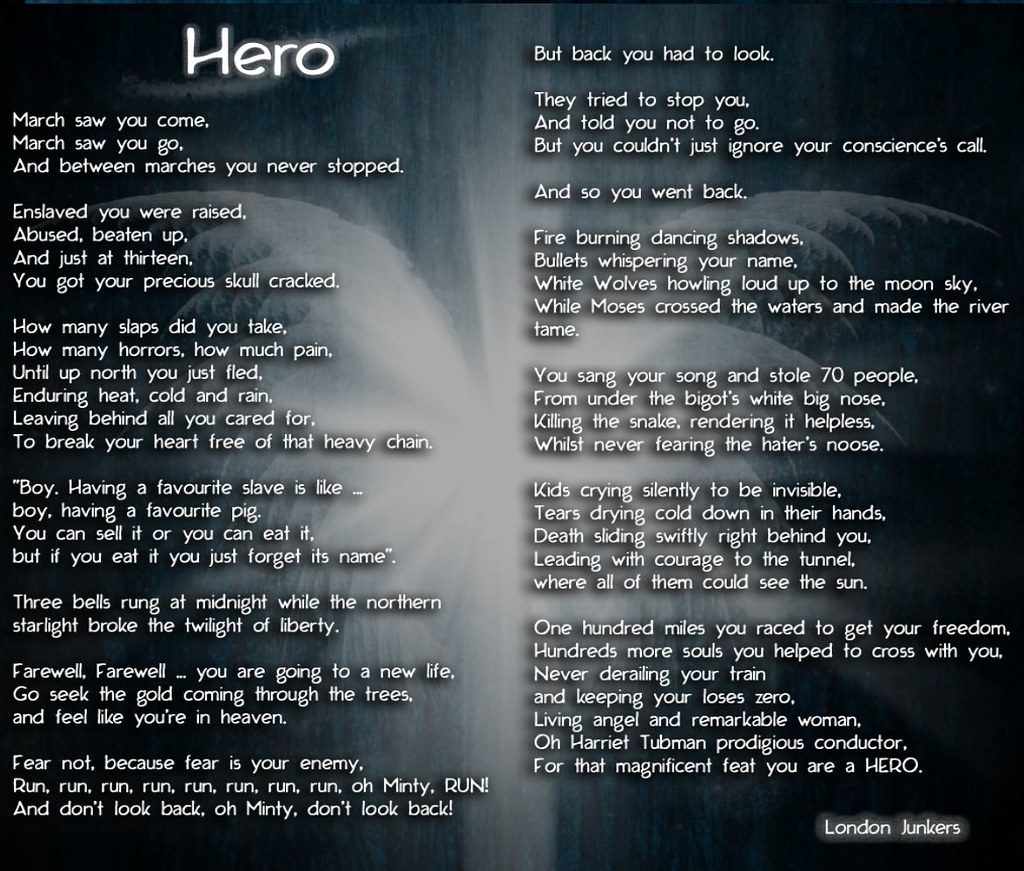
All of this is captured with Junker’s words and installation. In the first hall, the poem is set upon a pedestal alongside a fire roaring in a hearth – the latter suggestive of the warmth and comfort of a place to live free from the rigours and terror of slavery. Click the poem to get a HUD version for ease of reading, if required, for the words are beautifully crafted, telling Harriet’s tale in freeing herself and then seeking to free the rest of her family and others. Within in it we find not only a reflection of her life and work as a practical abolitionist, but also personal touches that bring her to life, such as the name Minty awarded her by her family or that of Moses, the name given her by those she freed because like him, she led her people from bondage.
The Eye Arts: London Junkers – Hero
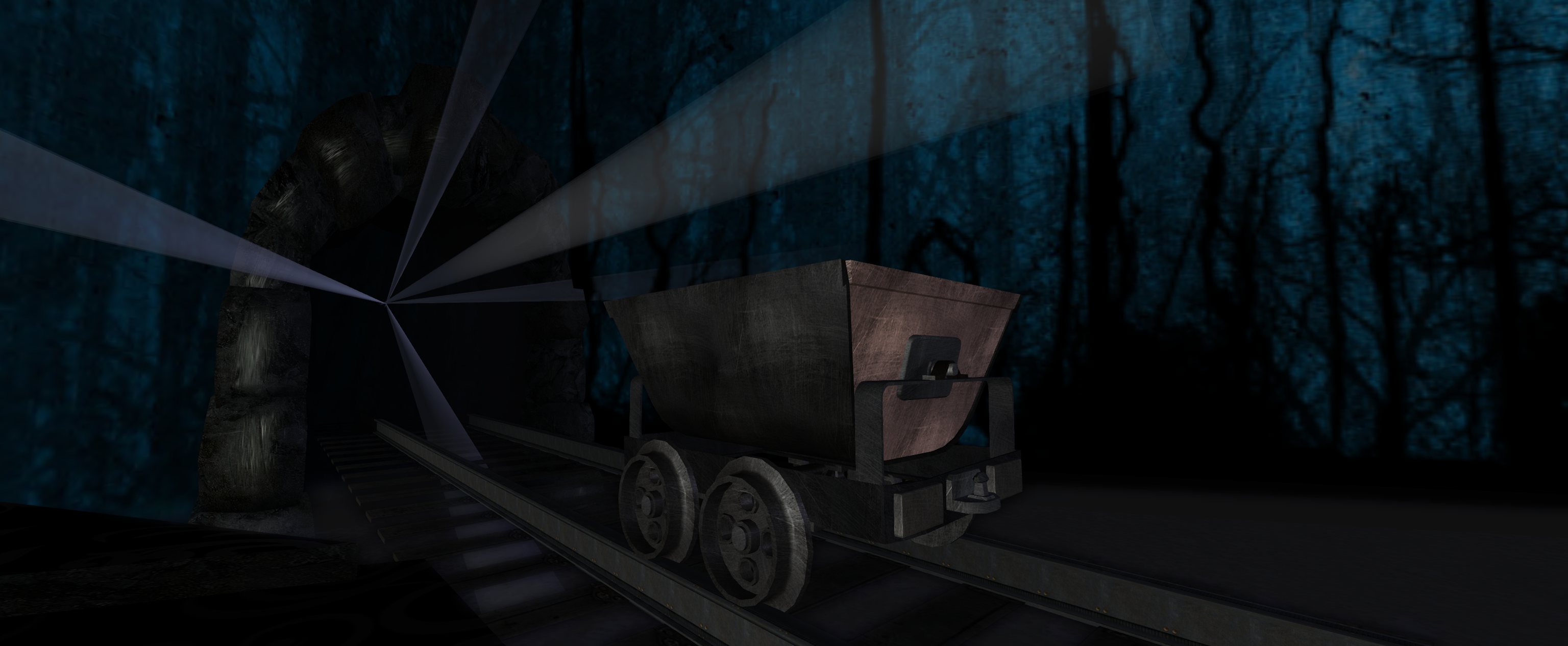
Either side of this poem and its warm, safe fireplace sit railway tracks and little wagons, personifying the idea of the Underground Railroad and to the idea of slave labour (the wagons resembling those used to haul coal, rock or other fruits of manual labour). Both of these tracks angle towards a stone arch that leads visitors into woodland clearing at night.
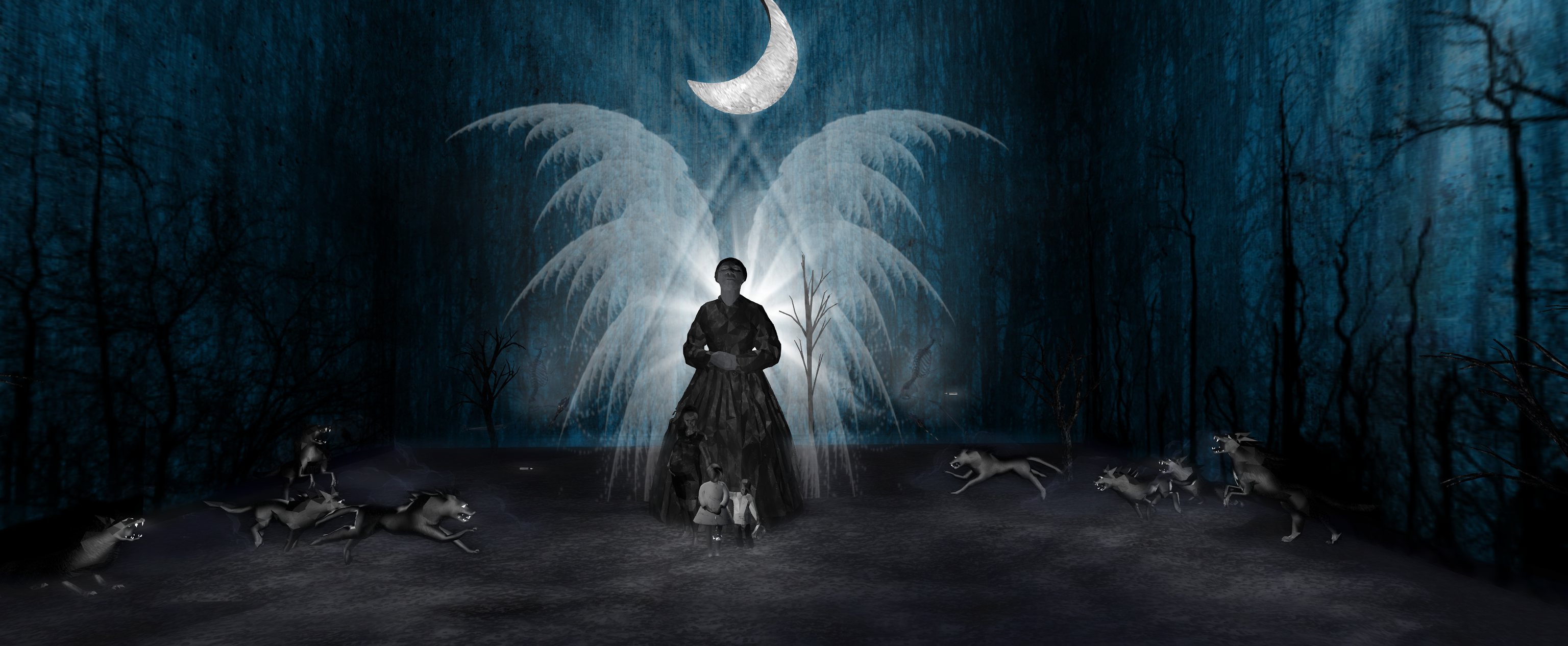
Here a single track of rail line points to the towering figure of Tubman as show towers like an angelic protector over a pregnant woman and two young children – one of whom carries the yoke and chains of slavery -, figures that represent all those she guided to safety from captivity. Around them, the Moonlit woods stand as a reminder of the covert nature of journeys Tubman took with her wards, travelling by night and hiding by day. Within the setting we also witness the dangers that hunted them by day and night: the baying hounds that tracked them, leading torch-bearing, angry men promising the threat of recapture or even death from a bullet or at the end of a rope for having the temerity to attempt to seek a life of freedom.
Harriet Tubman’s life and work was remarkable; not only did she do much to free those enslaved directly by physical efforts, she also worked alongside abolitionists like Frederick Douglass and John Brown and working in support of the Union cause in the US Civil War (where she was directly involved in an action that resulted in the freeing on 750 slaves), and then in later life worked to promote the cause of women’s suffrage. Within Hero London offers a just honouring of Tubman and her endeavours and a fitting exhibit for Black History Month – do be sure to pay it a visit.
Vibes Gallery: Hermes Kondor – It’s All About the Sea
I first encountered the physical world photography of Hermes Kondor back in 2020, when he presented a magnificent select of photographs centred on the Tejo Power Station, Lisbon, Portugal, one of the country’s great heritage centres and home to the Electricity Museum (see: The beauty of steam machines in Second Life).
I was, to say the least, immediately smitten by his work: his use of lighting, colour, composition, together with an avoidance of post-processing, these were images inherently and natural captivating. As such, while his focus within Second Life since that time has been establishing the Kondor Arts Centre as a multi-facet arts hub, I have always been excited when I learn that he is exhibiting his own work in-world.
And so, while I could not make the opening at Eviana Raider’s Vibes Gallery, I was keen to hop over and visit It’s All About theSea as soon as life offered me the time to fully immerse myself in Hermes’ latest exhibition.
Vibes Gallery: Hermes Kondor – It’s All About the Sea
For almost our entire history, humankind has had a relationship with the sea. It has been a source of food, a vast spread of blue that has called us to try to reach across its far horizon to touch whatever might lay beyond; it has romanced us with its mysteries and terrified us with it power, It has challenged our urge to conquer and master – if ever we could master so powerful and capricious a force. But, we have also sailed the seas of the world, and learned to harness their power; we have received their bounty and sought to use their power and beauty as a means to partake of sport.
All of this is very much captured in this exhibition, which Hermes has cleverly split into three individual sections within the gallery’s three halls, allowing him to bring forth specific elements of our relationship with the sea.
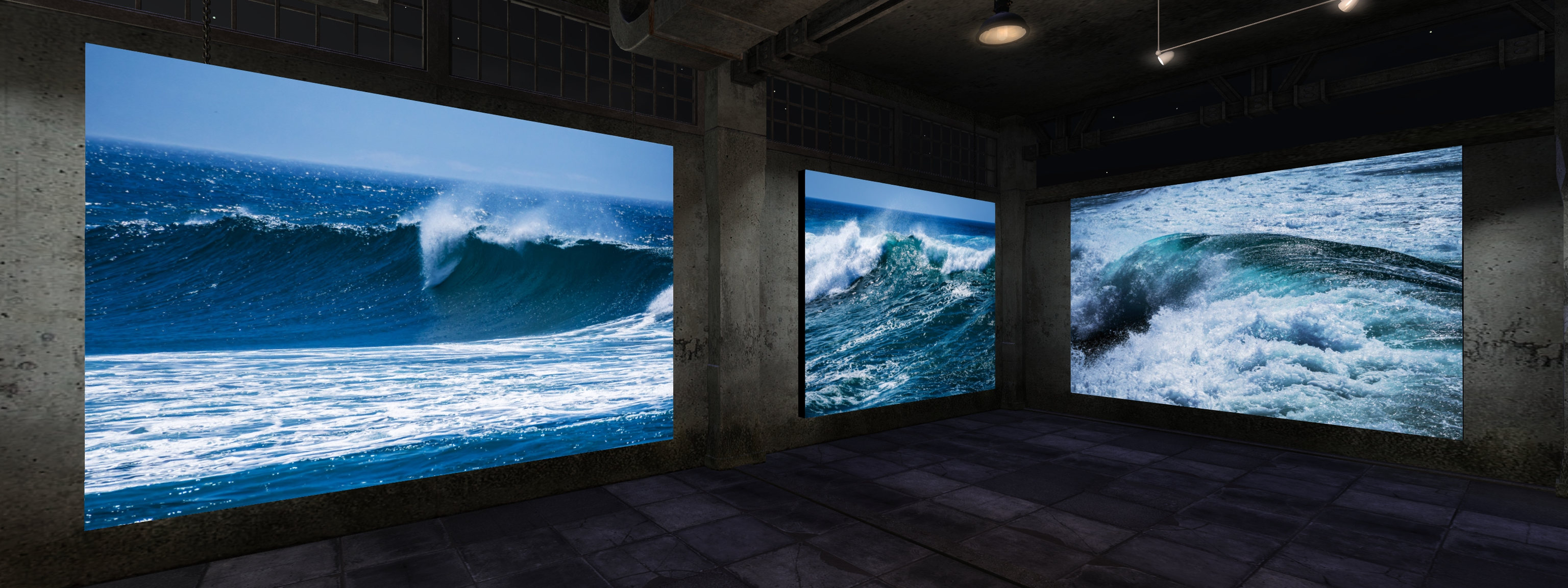
Within hall 7, Hermes presents Sea & Waves, a magnificent series of 11 photographs focused on the rolling power of breakers and whitecaps as they hurl themselves through the coastal shallows to batter and strike the shore. These are the kind of waves that are fearsome yet fascinating; the directly represent the sheer power the sea holds – and in a way, it’s anger at land’s temerity in trying to confront it and stem its ebb and flow; an action which is at times foolhardy: as the fine grains of sand that form the beaches of our coastlines and island reminds us, the sea is both patient and relentless, and given time, she will wear land down.
Vibes Gallery: Hermes Kondor – It’s All About the Sea
In some of these images we can see beyond the curl of wave and sweep of foam to a glittering expanse of ocean stretching out to hazy horizons of the kind that have called to us throughout time to reach towards and beyond. These views are further underscored by the opening stanza of Emily Dickenson’s And if the Sea ShouldPart underscores the inherent challenge offered by these waves and those far horizons.
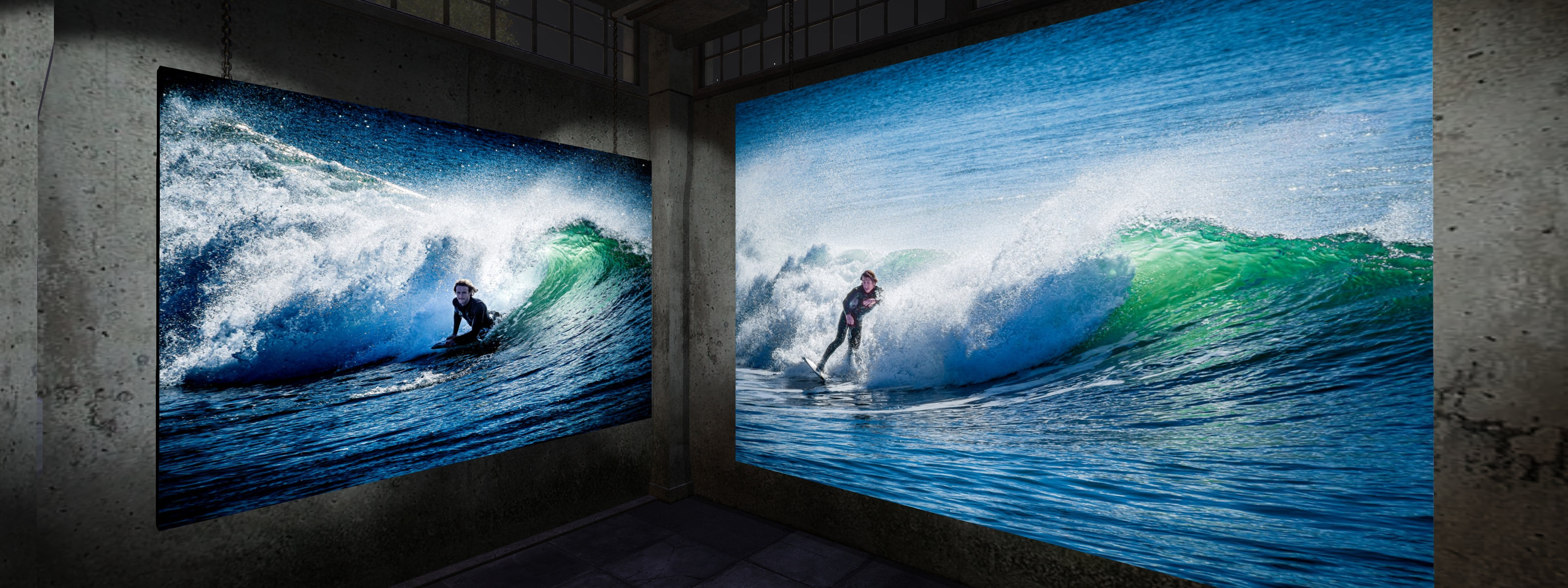
In Hall 8, reached via a connecting walkway, the study of waves and the idea of challenge continue, but are presented in an entirely different manner. Here, within a further eleven images, we are presented with Surfer, simply stunning images of surfers taking on and using the power of waves, riding them from initial roll through to where the water repeatedly kisses the shore before retreating once more to re-gather its strength. Thus, through these images, Hermes carries us to a place where our relationship with the sea is bound within the sporting challenge of trying to master its power and demonstrate skill and artistry within its rolling thunder; a love affair between Man and wave that is again carefully amplified through the words of Fernando Pessoa.
Vibes Gallery: Hermes Kondor – It’s All About the Sea
The images in Halls 7 and 8 are utterly captivating not only for their subject matter, but in the sheer skill Hermes has used in taking them. The clarity with which he has captured roiling white anger of wave crests as they curl over deep blue-green troughs; and retained the natural blue-green colour of the troughs themselves that call forth thoughts of the depths of the oceans is just stunning, as is the clarity with which Hermes has caught the faces of the surfers. Nor is that all; looking at these pictures one cannot help but hear the roaring boom of the sea’s coastal voice and feel the fine spray of salt carried from wave tops to shore on the accompanying winds.
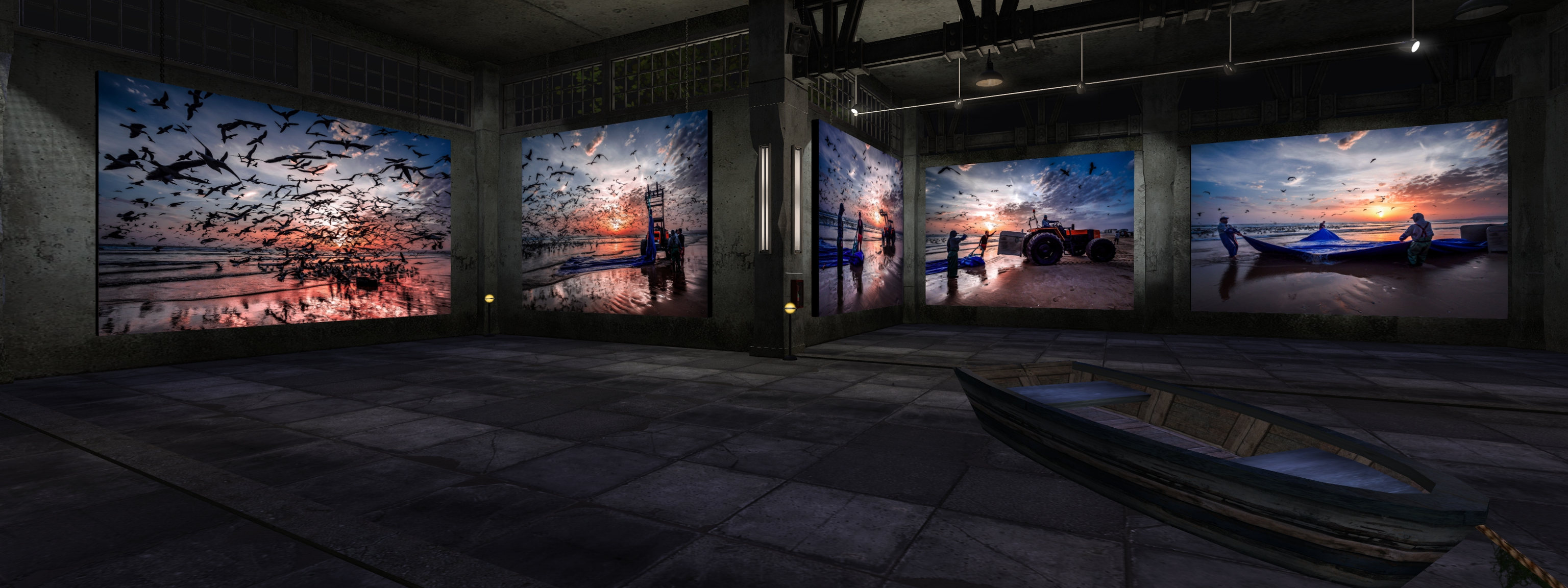
Across the courtyard in Hall 9, is a series of 15 images that are again utterly masterful in their framing, colour and focus. Beach Workers differs somewhat from Sea & Waves and Surfers, as there is very much a narrative flow to the 15 pieces within it; a story of the sea and its place in our lives as a source of livelihood and of sustenance – and not just for humans. To the left, on entering the hall are five images depicting the life and work of coastal fishermen, taking to the sea against the rolling and split of early-morning waves to cast their nets to seek whatever bounty the waters below might yield, before returning as the Sun lowers itself towards the horizon, and the work of taking the catch and clearing / drying the nets begins.
Vibes Gallery: Hermes Kondor – It’s All About the Sea
This is a story that continues through the five images to the right of the hall’s entrance, where the work gains interlopers in the form of gulls and seabirds, perhaps alerted by the commotion on the beach and the scent of fish carried in the breeze, and who have arrived to see what they might get away with helping themselves to. Both of these arms of the gallery then give way to the final five images to the rear, where the fishermen and their wives, their work now done for the day, have mostly retreated from the sands to leave them free for the birds to claim, together with whatever thy might find forgotten or ignored by the fisher folk.
Each and every one of these images is utterly extraordinary in the depth of life it contains, be it aboard the little boats, pushed from the sands and riding their way over the incoming breakers or the swirling, fluttering masses of gulls wheeling in to seek their share of food. Within each picture again, not only is there a beauty of an individual scene, there is a rich suggestion of sound and smell that lifts each one from the level of a “mere” picture to a complete experience / story of life.
Vibes Gallery: Hermes Kondor – It’s All About the Sea
With its three interwoven but unique elements, It’s All About the Sea is not only a magnificent celebration of the sea and our relationship with it; it is a triumphal tour de force of the eye and hand of a truly gifted photographer and an exhibition not to be missed.
I always wait for the rain, that thin, cold, bright … pleasant rain. I remember that day on the path in the birch forest. The rain was falling light, cold, illuminated by sunbeams, a light mist rising from the ground. Motionless to admire, my memories were born then among white clouds, white cloud of sheets.
With these words, Terrygold introduces us to her January 2022 art exhibition Rain. In some respects, it is another personal exhibit that follows on from Empty Chairs (see: Terrygold’s Empty Chairs: remembrance in Second Life), offering a story that touches on both Terrygold’s art and life.
Terrygold: Rain – January 2022
From the above introduction, we are led along a passage suggestive of that path through the birch woods. It leads us past elements that add depth and presence to itself, delivering us to places where a story unfolds through images and words. As with Empty Chairs a part of the theme here circles around the fact of loss; unlike Empty Chairs, however, Rain doesn’t just encompass the impact of the permanent loss of those around us – although it certainly starts that way.
Rather, Rain provokes us into considering how a personal loss can shape us; isolating us as we respond to the loneliness it imbues by rejecting the contact and affection of others; how the pain of loss causes a retreat that – whilst we may not be conscious of it as the time – results in an experience of further loss.
Terrygold: Rain – January 2022At the same time, also wrapped within this is an exploration of time and how it, too, influences and changes us; the fact that of everything in life, time is our one constant companion. It marks the steps of our lives, the changes we experience. From the loss of those we love, through our other growth from childhood through to adulthood, it marks our desire to escape, whilst also offering what can be a warm / cold memory of those childhood years.
This is a poignant, personal journey, exquisitely frame in terms of setting, props and Terrygold’s images, marvellous self portraits that express the emotions and feelings captured within the words and setting. These are pieces of extraordinary minimalism, extraordinary creativity and framing, and extraordinary depth.
Terrygold: Rain – January 2022
I love to take pictures by creating my own photographic set and using exclusively tools that Second Life provides without any kind of external editing.
– Terrygold describing her art
But to think the monochrome nature at forms the main aspect of Rain is a walk through loneliness or depression would be a mistake. There is a narrative here that brings together the ideas of loss, time and growth, that brings us towards acceptance and peace / understanding; self-recognition that – if I might barrow from T.S. Eliot – times past and times present combine to paint our path into the future.
This latter aspect is beautifully illustrated in the final area within Rain, where the wild grass of the floor bursts forth in colours that are also reflected in the final set of Terrygold’s pictures. They bring with us the suggestion of warmth and comfort, a realisation that while we may still feel the coldness of loss and the rain of tears, there is still much in live that can bring warmth and colour.
Terrygold: Rain – January 2022
Perfectly designed and executed, Rain is another fascinating walk through the art and mind of a talented artist and photographer.
Now open at the Kondor Art Garden, located within the Kondor Art Centre operated by Hermes Kondor, is double-header exhibition featuring the landscape art of Lori Bailey (Ishtara1) and Lam Erin.
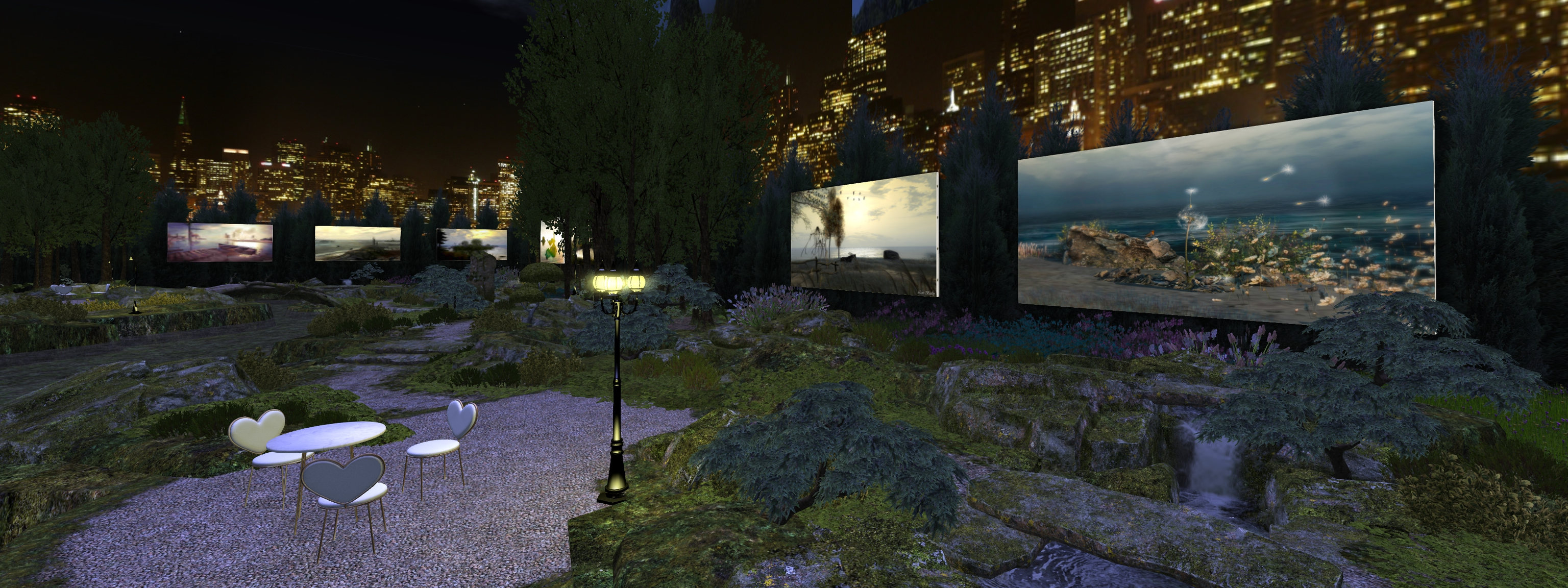
The Garden has been a regular exhibition space at Kondor since the centre opened, but it has been recently given a completely new look by Naru Darkwatch on behalf of Hermes to present a striking new exhibition space. Gone is the central event space surrounded by a path and a space for images to be places, with a stage at one end and an additional open display space at the other. Instead, the gardens present a central events space, bounded by two pools of water around which gravel paths loop. Predominantly constructed using Alex Bader’s Zen Garden building kit, it is a space I immediately felt at home within, both because Alex’s kit is a personal favourite of mine and because the design reminded me of the open-air area display spaces I built using it and on behalf of the Phoenix Artists Collaboration.
Kondor Art Garden: Lori Bailey (Ishtara1)
This much larger design means that the garden can now easily feature two exhibitions of art, each centred on one of its two halves, or potentially a single large exhibition by an artist, their being plenty of room on the outside of each path as it loops around its respective water feature to display both 2D or 3D art as the need arises. Given both Lori and Lam specialise in landscape works, the garden is especially well suited to this joint exhibition.
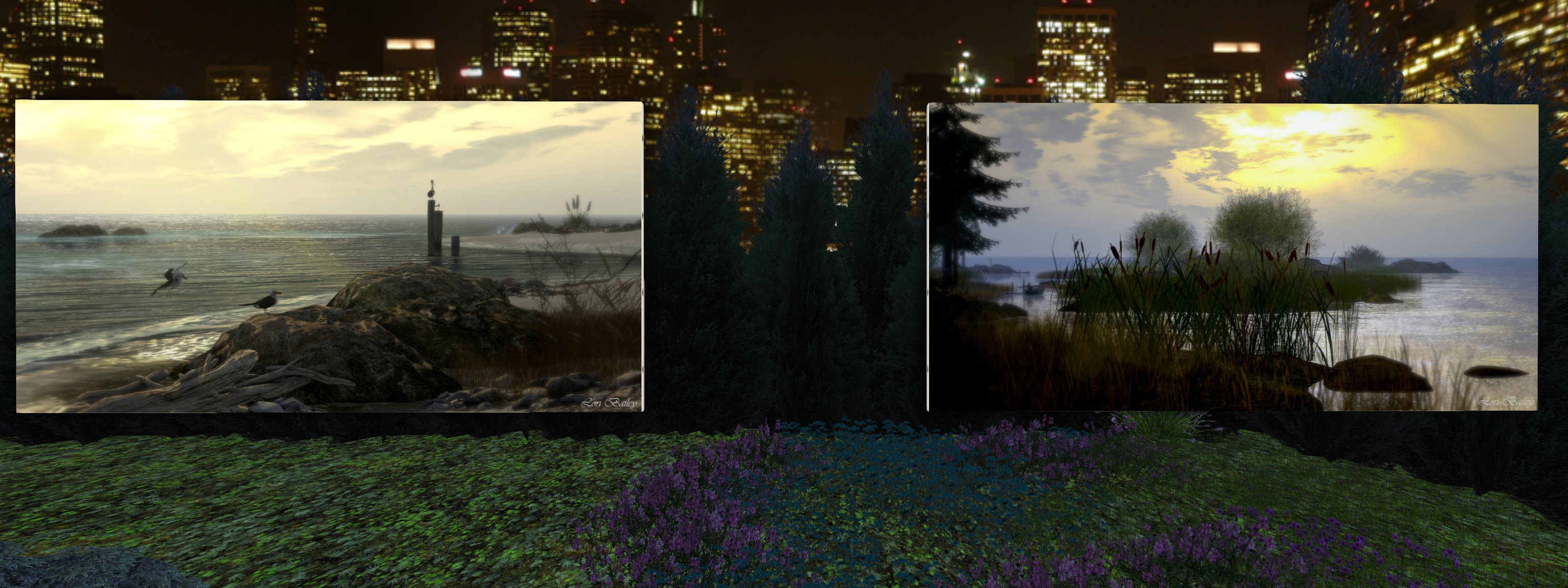
I believe this is the first exhibition I’ve been to in which Lori’s art is very much centre stage. Occupying the northern end of the gardens, it presents some 15 pieces, all with a focus on water, and most taken during the later part of the day when the Sun is low on the horizon. However, what makes all of them particularly engaging is the manner in which Lori has used light, shadows and reflections, together with a very considered hand in post-processing to give us images that, while shot within the digital realm of Second Life, could so easily have been captured in the wilds of Canada or the United States or perhaps Scandinavia or northern Europe – and in one case, somewhere in the far south Atlantic.
Kondor Art Garden: Lori Bailey (Ishtara1)
These are pieces which, in terms of tone, balance and colour, capture a natural beauty that is far from the world of pixels and rendering engines. In looking at Dawn for example, it is hard not to think we are looking at a picture taken from aboard a survey vessel cruising along the coast of Antarctica (or maybe somewhere like South Georgia).
Sitting further along the same side, Remoteness, Duo and Transparency bring forth thoughts of a long walk along the banks of one of Canada’s wilderness rivers and what might be encountered along the way. Each image offers a scene so beautifully composed, it is hard not to get lost within it, whilst within others, narrative stir and entice us – perhaps the most evocative laying curled within Childhood Memories of Winter and Golden Hour.
Kondor Art Garden: Lam Erin
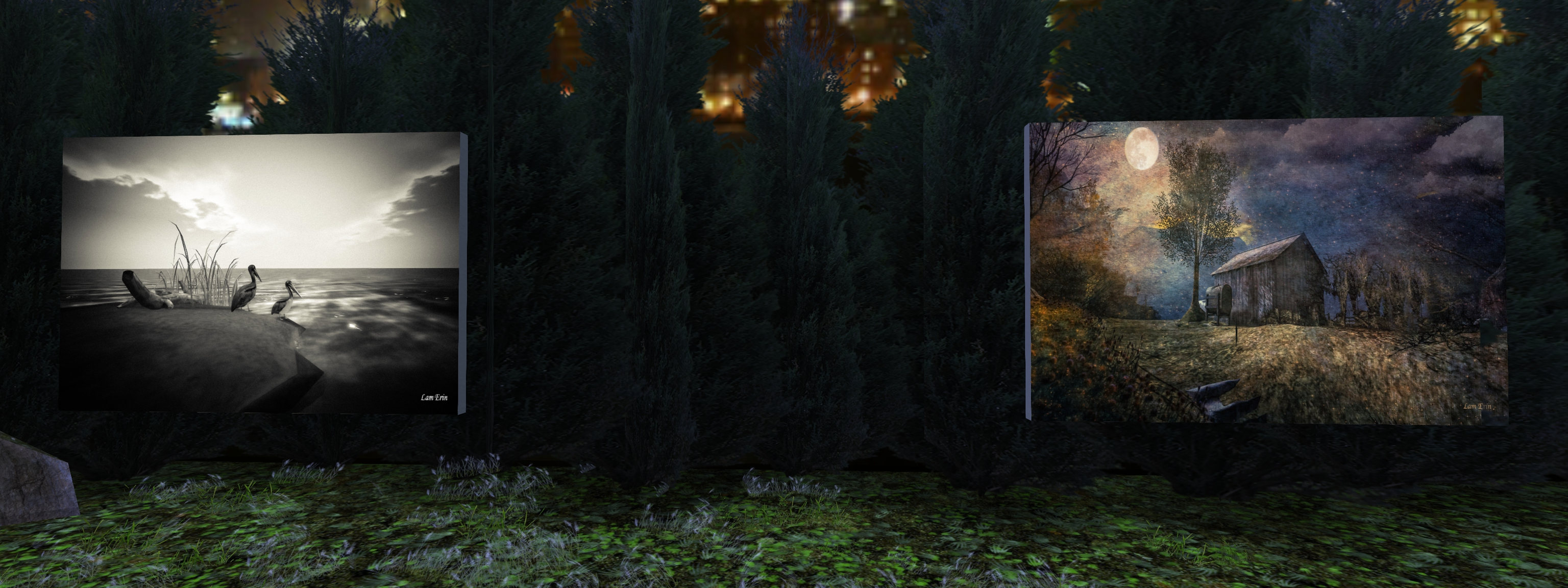
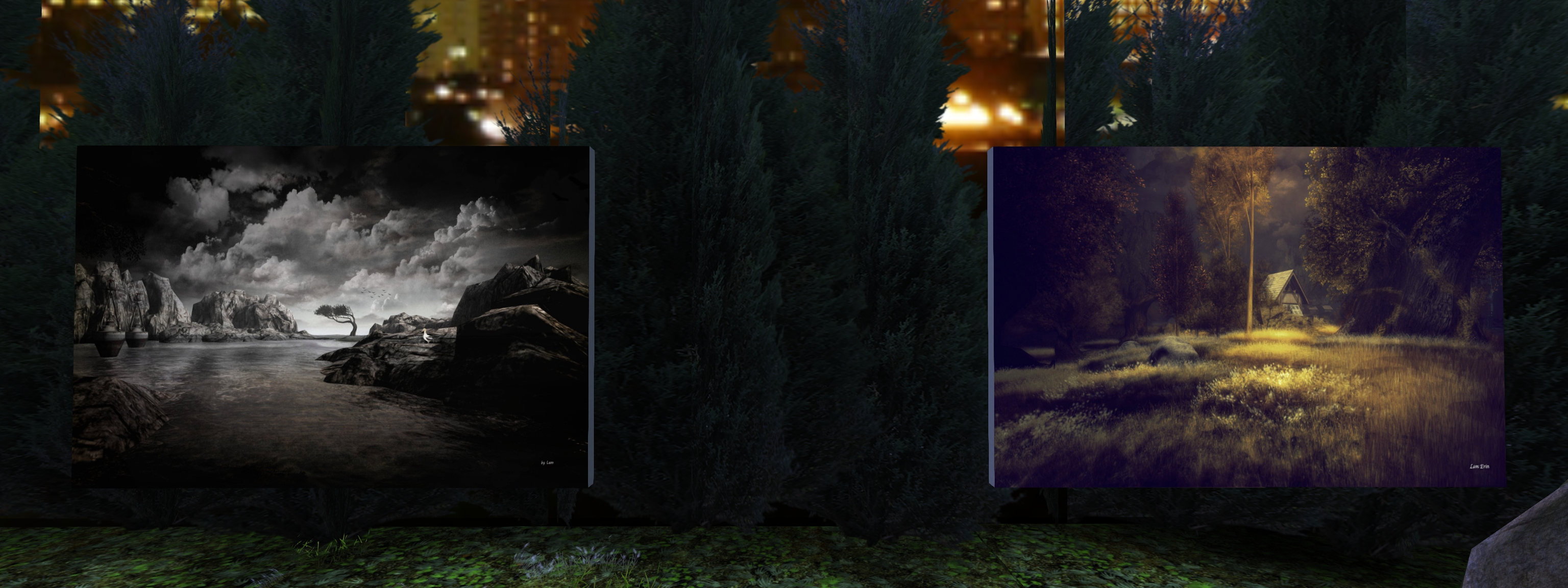
Lam Erin is an individual whose work I have covered numerous times in this blog, both as the holder / creator of his Cherishville region designs and as a master of Second Life landscape photography. His work is almost always immediately recognisable due to the richness of colour he tends to present – a deliberate over-saturation of the colours of the Sun – and the processing of the clouds within his images to give them an often brooding sense of presence, so often stirring thoughts of Nature’s power and her sometimes capricious nature.
This is very much evident within the majority of the 11 pieces Lam offers here, images perfectly composed to convey a mood within their setting, the cloudscapes most clearly hinting at the narrative each picture contains. And even in those where the colour has been removed, leaving us with a monochromatic view of Lam’s world, the clouds continue to speak out and frame the image and its story.
Kondor Art Garden: Lam Erin
Were I to critique this joint exhibition at all, it would be in the size of the individual images. They are pieces whose beauty deserves to be writ large, but within the expanse of this garden, there is a risk that, without close examination, they might be overwhelmed. However, this does not detract from both halves of this exhibition from being thoroughly engaging and well worth the time taken to visit them.