UWA 6th Machinima Challenge: L$1.1 million in prizes

On Friday March 1st, the University of Western Australia (UWA) kicked-off their sixth MachinimUWA Challenge under the title Reflections.

This year is the biggest Challenge to date, offering are prizes totalling L$1.1 million (approx. $4,500 US) – almost a 50% increase over the last UWA Machinima Challenge. The figure includes a top prize of L$200,000 for the winning entry as decided by the judges, as well as 9 other prizes ranging from L$150,000 to L$40,000. In addition, the UWA Centenary Prize of L$50,000 will also be awarded to the Machinima that best captures the essence of 100 years of reflections on education, and the UWA Art of the Artists Prize of L$50,000 will be awarded to the Machinima that best incorporates one or a number of the artworks that have been submitted to the UWA Centenary 3D Art Challenge. Finally, all winners will also receive a special RL UWA package.

MachinimUWA VI

The theme for this year’s challenge is Reflections, which the UWA press release on the challenge describes as:

Reflections in a pool of water… Reflections of light… Reflecting on the grandeur of the universe… Reflections of art…. An Inner Reflection…..Reflecting on opportunities lost, or seized… How ‘Reflections’ is interpreted is exactly like how beauty is interpreted…. in the eyes of the beholder… or in this case, the eyes and lens of the machinimatographer.

The Major Rule and Requirements

As always, there is the familiar UWA Major Rule and entry requirements.

Your machinima can be about any type of ‘Reflections’ you may wish to portray. There is only one  requirement to make this a valid entry. At least one of the 3 major spaces of Reflection at UWA needs to be included in your storyline (the Reflection Pond, the Sunken Gardens, the Somerville Auditorium). You may choose to film in any other area of the campus if you so wish or you could include all 3 locations, but the rule is you need to select at least ONE. You may use props at the location, or maybe want to change the footage later during the post process, this is up to you… as long as one of the 3 spaces you choose to be part of your machinima can be recognised and form part of your storyline.

The other key requirements are:

  • The recommended running time for entries is around 4 minutes 30 seconds in length. This isn’t a hard rule, but entries aiming for the UWA special prize must fit within the recommended length
  • Entrants are asked that they acknowledge the works featured in their submission and the lands in which the submission was filmed
  • All work must be free of copyright issues. If requested, entrants must provide detailed information regarding the source, creator and background information of their work. If any 3rd party materials, such as music, is used, permission must be obtained from the creator
  • Completed entries should be uploaded to a suitable broadcast medium (e.g. Vimeo, YouTube, etc.), and links to the film sent to the UWA’s Jayjay Zifanwe and LaPiscean Liberty.

Please refer to the UWA presse release for full details on all requirements.

Key Dates

  • Entries Close at Midnight SLT 30th June 2013
  • Winners will be announced in August 2013.

And The Audience Can Get a Prize

There are also audience participation awards totalling L$45,000, with a top individual prize of L$15,000. All audience members have to do is watch all of the entrants and compile a top ten list of their favourites. Those which most closely match the judges’ top ten winners list will be awards prizes.

The Sponsors

This year’s UWA Machinima Challenge is generously sponsored by: The Parramatta City Council, Aview TV (LaPiscean Liberty), MetaHarpers (Arhenn Oberlander),  Freemnason Magic and a very generous anonymous donor.

Seek Wisdom: Second Place winner of the 2012 MachinimUWA Challenge, by Karima Hoisan and Natascha Randt

Related Links

LEA Full Sim artists 2013-14 announced

LEA_square_logo_60The Linden Endowment for the Arts has announced their choices for the 2013 Full Sim Art series, which will now run through until the end of April 2014.

The Full Sim Art series offers artists across the grid a full month’s access to an LEA region in which they can host a show of their choosing. As such, applicants receive:

  • A full, 15,000-prim region (inclusive of the media) – not all the prims have to be used!
  • The freedom to choose when to open the show to the public
  • Coverage within the LEA and UWA blog & potentially in any other blogs confirming their continuing support of the series

Access to regions will be granted to successful applicants on the first day of each month, and must end and be cleared from the region on the last day of the month.

The 2013-14 line-up, as announced by the LEA on Wednesday 27th February, comprises:

2013

  • March: Fuschia Nightfire, Fuschia’s Fantasy Fairyland
  • April: Krystali Rabeni, Virtually Real
  • May: paleillusion, Frozen in Time
  • June: Kalanglarik Tomorrow
  • July: Nino Vichan, Musical Tonalities & Colour
  • August: SerenVide, Hope Springs
  • September: Secret Rage, Connected by Commonalities
  • October: Rebeca Bashly, Key
  • November: Lilia Artis & Moeuhane Sandalwood The Machine
  • December: Giovanna Cerise Fisicofollia

2014

  • January: Gem Priez Fractal Cathedral
  • February: Sea Mizin California Giant Redwood Forest
  • March: Mary Wickentower, CINEMA! Take II
  • April: michaelromani & beawildered Americana Retread

LEA AIR-4 application deadline extended

LEA_square_logo_60The Linden Endowment for the Arts has extended the application deadline for the fourth round of the Artist-in-Residence (AIR) programme.

Originally schedule to close at Midnight SLT on the 19th February, the deadline has been moved to midnight on Sunday February 24th. The announcement of the extension reads in part:

While many well-known virtual artists have received grants, the LEA has also had the pleasure of hosting ‘younger’ AIRs and hopes to continue in that tradition. You need not have a great deal of experience, just some good ideas. The application is a bit more detailed to help guide you in thinking through your project, which we do expect at this point to be an idea in progress and not necessarily a portrait of the final result – more like a loose sketch! We also welcome applications from across the spectrum of the arts, for example performance groups that might want to embark on a bigger/longer term project than we can support at our performing arts space!

The LEA AIR programme seeks to promote and nurture the arts in Second Life, through providing limited term full-sim land grants to be used for creative projects and art installations over the course of a few months. Recipients can be individuals or groups interested in creating or curating art, or proposing cultural projects which would require/utilise a full-sim build and can be completed within the allotted time frame (5 months). The LEA is able to offer land grants through the generosity of Linden Lab.

Up to twenty regions, donated by Linden Lab and managed by the LEA, are generally offered under the land grant programme, and successful applicants will be granted the use of one full region for a period of six months. The region may then be used on an individual or group basis for such diverse activities as:

  • Full sim exhibitions and / or immersive installations
  • Curated projects, especially those which have a connection to physical exhibitions and events (augmented reality)

Applications are not limited to visual art but are welcomed from all areas of artistic expression, including performance, music, and film.

Land grant regions: LEA10 through LEA29

Preference is for submitted works to be original in nature, although curated projects may present extant works. Successful applicants will have up to four months in which to execute their build, and must have it open for public viewing for at least the last two months of the grant period. Artists may alternatively use the land for multiple exhibits, but it is imperative that projects will be ready within four months from acceptance, and this time-frame should be considered (and reflected) in applications.

So if you have not yet applied for the programme, there is still time to do so!

Key Dates

  • Applications open: February 5, 2013
  • Application deadline: February 24, 2013
  • Sim handover and public announcement: March 8, 2013
  • End of round: July 31, 2013

Applications forms can be found at the end of the LEA website announcement for Round 4, together with all other necessary information.

Teleports to the exhibits by the current Artists in Residence, which will be open until the end of the month, can be found at LEA 3.

When a Song Bird did sing to me

Song Bird, Song bird; Inara Pey, Feb 2013, on FlickrSong Bird (Flickr)

I discovered Song Bird, JadeYu Fhang’s wonderful homestead region, entirely by chance during my random roamings in SL.  Part art installation, part gallery, part store, part photographers dream, Song Bird is perhaps best summed-up in a single word: exquisite.

The are three distinct parts of the region. There is the ground-level art installation, which is both a veritable tour-de-force of sculpture and artistic expression in SL, and also visually stunning when taken as a whole work of art in itself, complete with windlight settings. Overhead, and high in the sky, are JadeYu’s store, Dark Tears, and her art gallery – both of which should very much form part of anyone’s visit to Song Bird.

Song Bird, Song bird; Inara Pey, Feb 2013, on FlickrSong Bird (Flickr)

I cannot fully express how marvellous the ground level installation is. I’ve no idea how often JadeYu may change it (if she does at all), so if you’ve not seen it already, you should. Amazing really doesn’t cover it.

The pieces of the installation are on a grand scale, towering over a landscape which is covered in places by ghost-like dandelion seed heads which tower over you, or hanging in the air with a surreal precision. Such is the scale of things here that is some respects it is easier to look around via camera rather than explore on foot – but if you opt for this approach, be sure you do so carefully, as there is much here on more “normal” scales which can be easily overlooked when camming between the larger pieces.

Several of the pieces feature repeated motifs, which give a sense of theme to the various pieces, while other pieces appear to stand entirely on their own, leaving one with a very mixed set of impressions; JadeYu doesn’t provide any descriptive notecards for the various pieces, so the mind is free to offer-up its own interpretations – or to simply admire.

Song Bird, Song bird; Inara Pey, Feb 2013, on FlickrSong Bird (Flickr)

Many of the pieces are themselves vendors – hovering the mouse over them will display the L$ icon, and the prices at which they are offered are not going to break anyone’s bank – so those looking for sculptures and pieces with which to decorate their own regions / larger parcels with some very striking pieces of art may well find a visit to Song Bird more than worthwhile.

Overhead, the gallery displays a range of JadeYu’s striking paintings, which are also offered for sale as well and which would more than grace most homes. The pieces are all uniquely evocative and eye-catching. One thing I would perhaps recommend is that you turn your sound down before entering the gallery building – there is a background noise which I have to admit I found almost headache-inducing.

Song Bird, Song bird; Inara Pey, Feb 2013, on FlickrSong Bird (Flickr)

Also reached via teleport is JadeYu’s whimsical store – where having the stream active is liable to have your foot tapping (well it did mine, as I can’t resist the likes of the Andrews Sisters, Artie Shaw and Billie Holiday). Here you’ll find her skins and shapes, horns, wings and clothing, all in a cosy house atop a hill in a Halloween-style setting, and with the aforementioned music tripping out of a lovely pre-war radio by Lauren Bentham which is a delight in and of itself.

All-in-all, Song Bird is a real joy to visit, which anyone with a love of photography and art is going to find appealing.

Thoroughly recommended – just don’t forget the donation points and tip jars scattered around the region and at the gallery and store :).

Song Bird, Song bird; Inara Pey, Feb 2013, on FlickrSong Bird (Flickr)

Related Links

Tripping out in Second Life

It isn’t every day that one enters an art installation comes with a health warning. Yet that’s exactly what you get with Thoth Jantzen’s Mediamorphosis, the notecard for which opens:

WARNING!!
Seriously, If you suffer from epilepsy or are otherwise adversely affected by flashing lights and colours, do NOT play media here.  You won’t get the proper experience, but you may just survive!

"My God, it's full of stars!" - a Bowman-like start to Mediamorphosis
“My God, it’s full of stars!” – a Bowman-like start to Mediamorphosis

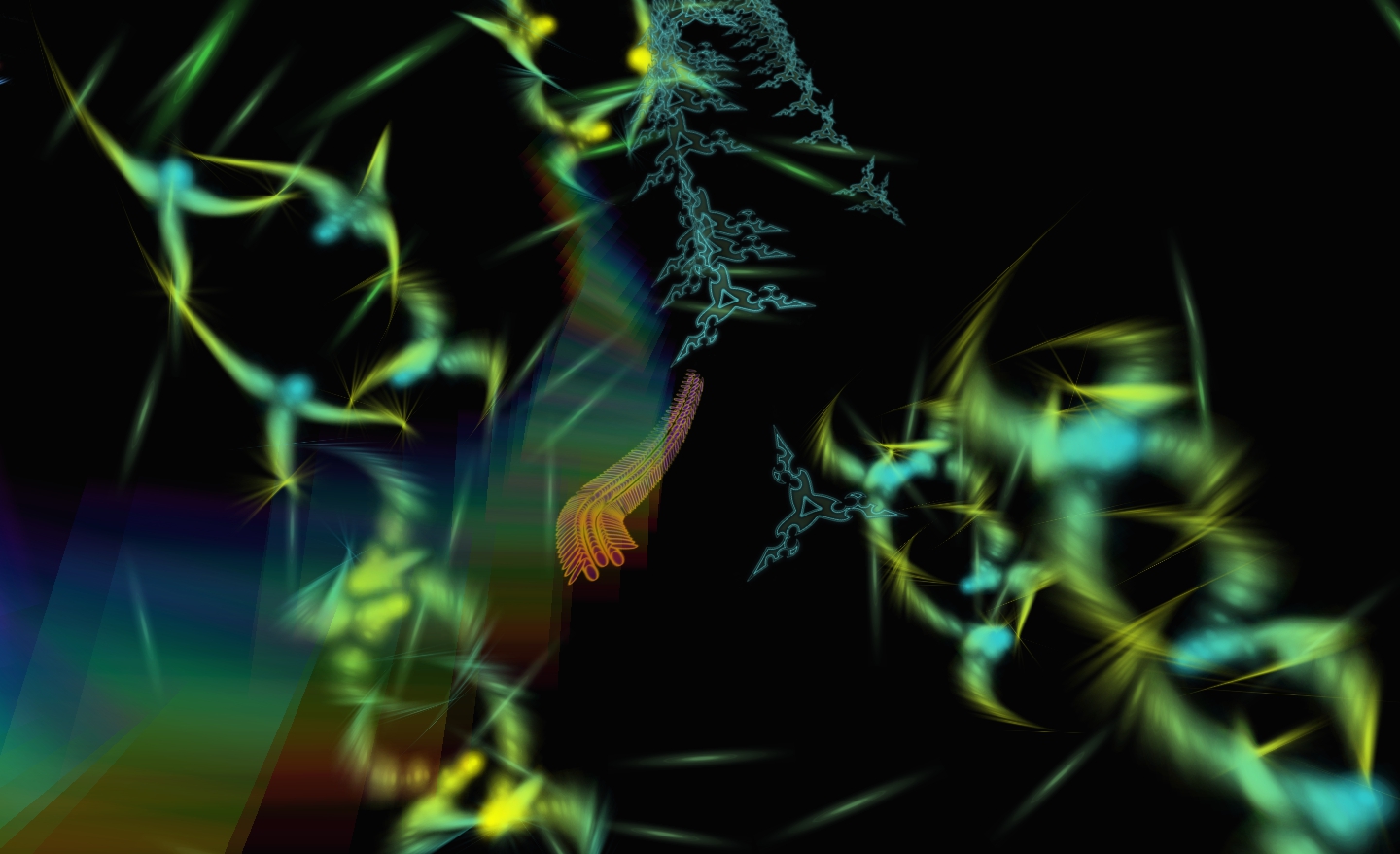
This is a fully immersive multimedia presentation which features a mix of music, particle effects, set-pieces, art and a touch of interaction. There’s an extensive backstory to the piece, which forms a narrative and helps points the way towards explorations, but as Thoth points out, there are many ways through the piece (and several points where you can sit back and enjoy the show). Equally, while there is a certain depth and purpose to the piece, it’s not intended to be meaning-of-life deep.

Mediamorphsis
Mediamorphosis

The key thing with this piece is to make sure you have streaming media on and set to play all (if using a media filter) and use the local windlight (or set your viewer to midnight) and – explore.

When you arrive, you’ll find yourself in a white room with a single exit – the wormhole. Walk through – you’ll find the 2001 motifs clear – and the teleport to the exhibit proper in the form of one of the set pieces, the Hopper Cafe. Read the notecard offered and then follow the road. Along the way you’ll find pods you can jump into and enjoy a trippy little ride or two mixing particle effects, art and the various set-pieces, into an immersive show.

Mediamorphosis
Mediamorphosis

You can also spend time inside the Hopper Cafe and witness some of the show projected onto the windows, or you teleport to the other builds which make up the installation, where there are additional opportunities to sit and watch the light / image show. Just be aware that wherever you go – you have yourself become a part of the show for anyone else watching!

Metamorphosis is a piece which is hard to quantify. As the artist himself says in explanation of it, “Huh?  What..?” … It is a piece which should, by its nature, be experienced rather than described – although it’s certainly not going to be everyone’s cup of tea. Or coffee, for that matter.

Mediamorphosis
Mediamorphosis

Ican only say enjoyed my time exploring and trying out the first-person pods and seats in which you hand over control of your camera to the scripts controlling the exhibit itself, leaving you with nothing to do but just enjoy (and the show is great with the lights out in the room!). Everything is looped, so “rides” take only a few minutes, although it is worth running through things a couple of times to enjoy the complete magical mystery tour.

If I have any complaint at all, it is that there should perhaps be more choice in the music – a loop of just three tracks which can be heard throughout one’s visit to the installation can start to get one’s teeth grinding by the time the fourth or fifth loop is reached…

However, this is just a niggle. Overall, Mediamorphosis is immersive, engaging, unusual and, well, trippy.

Go see for yourself.

Mediamorphosis
Mediamorphosis

Related Links

Inspiring Orientation: getting users started, stage 2

In June 2012, I reviewed MetaHarpers’ The Inspiring Orientation, an installation intended to be part gallery, part orientation course, with various interactive elements intended to teach new users the basics of getting around in Second Life – walking, flying, chatting, using the camera, sitting, etc.

The originia Inspiring Orientation - from the outside
The original Inspiring Orientation – from the outside

Opened to the public on February 5th, The Inspiring Orientation, Stage 2 now takes the concept a step further by providing additional interactive lessons covering such diverse subjects as in-world shopping, instant messaging, inventory management, profile creation, in-world combat and games, and exploration. At the same time, it revamps the original installation, and incorporates features such as media-on-a-prim. So what is it like?

On arrival, the installation appears familiar – the welcome area is the same as its first iteration, and the familiar tablet-like guides are still there. However, on stepping inside, it is clear things have been changed. Basic movement – walking and jumping – is quickly dealt with before moving onto the basics of camera control, which used to come somewhat later in the piece, and which is dealt with in a more compact manner. The rest of the initial elements of the piece remain largely unchanged until one arrives at the teleport portals, which in the original more-or-less marked the end of the process. While people can still teleport away at this point, a sign points the way to the new additions waiting to be explored.

Inspiring Orientation Stage 2
The Inspiring Orientation Stage 2

Here people can learn about shopping, instant messaging, profiles, inventory (including attachments, clothing layers, etc), dealing with “hidden objects” and combat, all in discrete units linked by footpaths, chair lifts and ladders.

There are several routes around this part of the installation, which can lead to a degree of repetition in instructions (accessing inventory, for example). However, this is no bad thing in that it allows for easy re-caps on lessons and pointers.

The Inspiring Orientation Stage 2

The inclusion of combat options might at first glance seem a little odd, but it actually does make sense given that, while “Second Life is not a game”, many people actually do join SL in anticipation of engaging in roleplay (which can include combat elements) and engaging in combat-related activities (the dreaded zombie hunting beloved of the official SL promo videos, etc). Ergo, getting people started on how weapons, HUDs, mouselook, etc., all work within the realms of combat isn’t necessarily a bad thing.

Whither the context menu?

The use of media-on-a-prim in the portal area, is both new and subtle. Drawing on the Destination Guide to provide a click-through list of destinations and descriptions related to the selected portal, it does much to present users with far more choice on where they go next, and on seeing where they are likely to meet other users.

That said, there are a few niggles with the update. Given this is an exhibition intended to demonstrate a new user orientation, the almost exclusive use of screen shots of a popular TPV is surprising. Yes, it may weel be the most popular viewer in use in SL, but given this is a new user experience, and presumably something the creators would hope users would encounter early-on in their explorations of Second Life, I can’t help but feel that there should perhaps be more emphasis on the official viewer – particularly as this is the viewer the majority of new users will initially be using when they log-into SL.

It could also be argued that other essentials are missed or given scant explanation as well – such as the Marketplace, the use of the world map, search and the concept of teleports (although teleports is touched upon throughout the exhibit, if not fully explained). However, the piece is a work-in-progress (the team behind it plan to move it to a location of its own at the conclusion of its time at the LEA), so these are matters which may still be addressed.

One thing that does still disappoint me with the update, though, is that it still fails to reference the viewer’s own means of providing help to users. The How To guide still goes unmentioned, as does the Help options in the menu. The How To guide is certainly worth a reference, given it forms an easy aide-mémoire to some of the lessons given during the orientation tour.

Some might argue that The Inspiring Orientation fails to offer any significant advantages over a more straightforward approach to user orientation such as that provided by the Phoenix Firestorm Support Region. In some respects, I’m inclined to agree; the latter has the beauty of keeping to a KISS approach which make progress perhaps seemingly less time-intensive. However, The Inspiring Orientation perhaps offers greater visual and aural stimulation, and thus may better hold a new user’s attention than a more traditional “walk-and-read” approach.

Whether it is viewed as a prototype / alternative approach to engaging new users and unlocking some of the mysteries of the viewer or whether it is seen purely in terms of an art installation which encompasses learning experiences, The Inspiring Orientation remains an interesting insight into how an engaging and interactive user experience might be built. As such, it has always made for  an interesting visit, and the Stage 2 updates provide plenty of additional food for thought, particularly for those interested in the new user experience ethos.

Related Links