Holly Kai Park made it into the Destination Guide on Friday, September 23rd – and was selected as an Editor’s Pick (see above)!
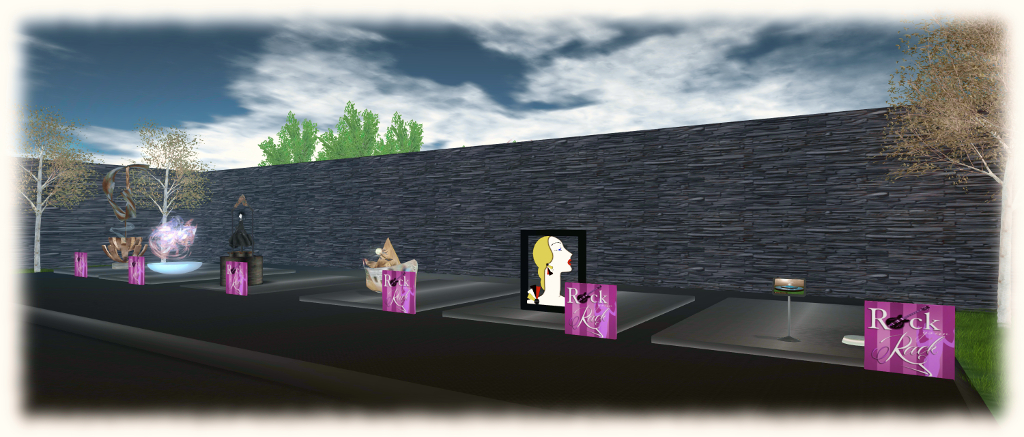
The Park’s entry (shown at the foot of this article), can be found in the Nature and Parks section of the Destination guide, with the usual teleport links.
We’re pleased to have the park featured, as this weekend see the opening of our new Art at the Park Exhibition, which will run from Saturday 24th September through to Sunday 23rd October, 2016. The artists featured in this exhibition are:
Anibrm Jung – award-winning photographer
John Brianna – physical world and virtual world photographer and artist
Giovanna Cerise – renowned physical world and virtual world artist
Wildstar Beaumont – popular and well-regarded Second Life photographer
Inara Pey – (who she?)
The exhibition opens at 2:00pm on Saturday, September 24th at our new hill-top art display area, with Erin68 Frog and Satin providing the music at our new art events area on by the art displays.
“it’s not a misspelling,” Seafore Perl (aka Nick Friess, Master of Fine Arts in the physical world) notes of his exhibition, called ArtIfacs, now open at DaphneArts Centre, “but a deliberate play of words. My art (I) resulting in facsimiles, (facs).”
Having served in the United States Army Special Forces – the Green Beret – as a medic, deployed to both the tri-border area where Laos, Cambodia and Vietnam meet and to Delta area near the Cambodian border, Seafore uses his art as a means to explore his wartime memories. In doing so, he also considers matters of self perception as coloured by memories and emotions.
With ArtIfacs, he presents a series of images, most of them paired or in a group of three, each offering an interpretation of a scene in different mediums. So, for example, there might be a photograph, a digital rendering and an oil painting, all of the same scene. While the same subject matter might be used, each image is entirely unique in its interpretation, the individual use of colour, tone, lighting, and emphasis on elements within each piece drawing the eye differently to each one, so that different aspects become prominent s we shift focus one to the next and back again.
In this, ArtIfacs – for me at least – presents itself in three layers. In the first, there is the literal presentation of “artistic facsimilies”: the majority of the images, be they photographs, digital renderings or paintings, are of physical world object; thus, each image is literally a facsimile of the objects it represents. In the second, there is the element of the artist processing he experiences of active duty through his art; thus there are semiotics perhaps present, “artistic facsimiles” representative of his own thoughts, reactions, feelings and perceptions of he time on active duty in a hostile environment.
Then there is the third layer: how we respond to the images each in turn. Why are we perhaps drawn to one over the other(s), when all represent the same scene? What is colouring our own perception of, and reaction to, each piece? Is it the way different aspects of the scene are given prominence, or something else? What role do semiotics play in shaping our response, and how much of it is driven by our own internal processes – our own artefacts of memory and self, if you will – impinging themselves upon our conscious reaction?
Also included in the exhibition are insights in Seafore’s creative processes through a 3D model of one of his pieces and drawings showing the development of his ideas. There is also a large image of the avatars he has used over the years, making for another intriguing opportunity for interpretation.
As with Awakening, which I reviewed here, this is a deeply thought-provoking exhibition, albeit far more deceptively so. Nuanced, and with more to see than may first meet the eye. Like Awakening, Seafore’s ArtIfacs is fully deserving considered time and attention. It will be open through to mid-October.
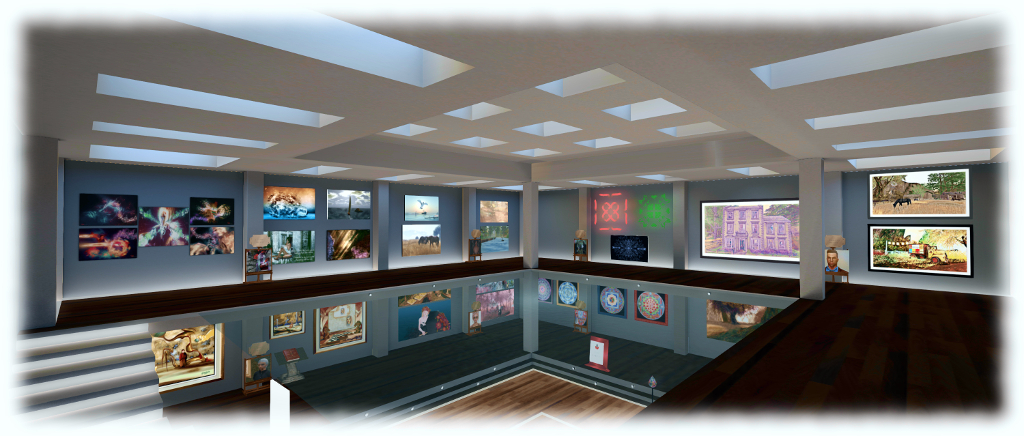
Opening on Saturday, September 17th at 12:00 noon SLT is the DiXmiX Gallery, a new venue for 2D and 3D art and for music in Second Life.
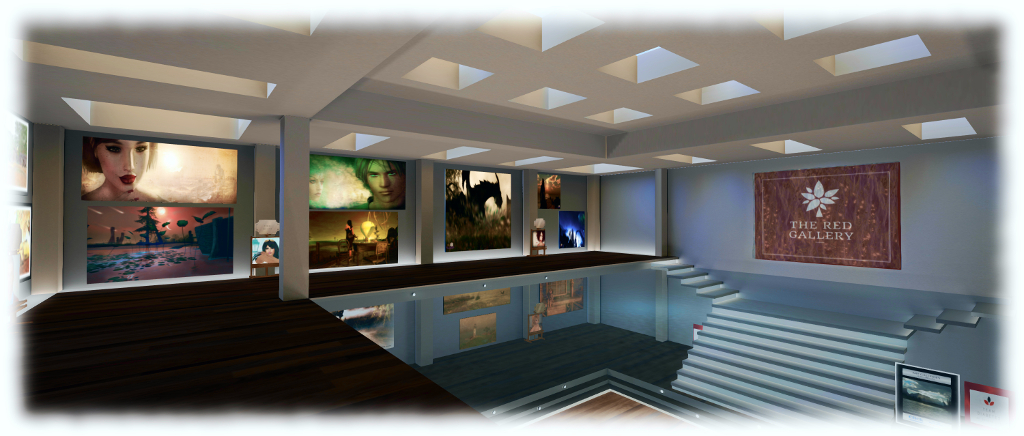
Designed by Megan Prumier (famous for Crimarizon and Deadpool) and curated by Dixmix Source, the gallery offers a large foyer area and three halls for art displays – the Black and the White Gallery Halls, which are apparently to be dedicated to monochrome art, with the Grey Gallery linking them. Art in these halls may be split over two levels, the ground floor and a mezzanine area, while a music venue, The Atom, completes the major facilities.
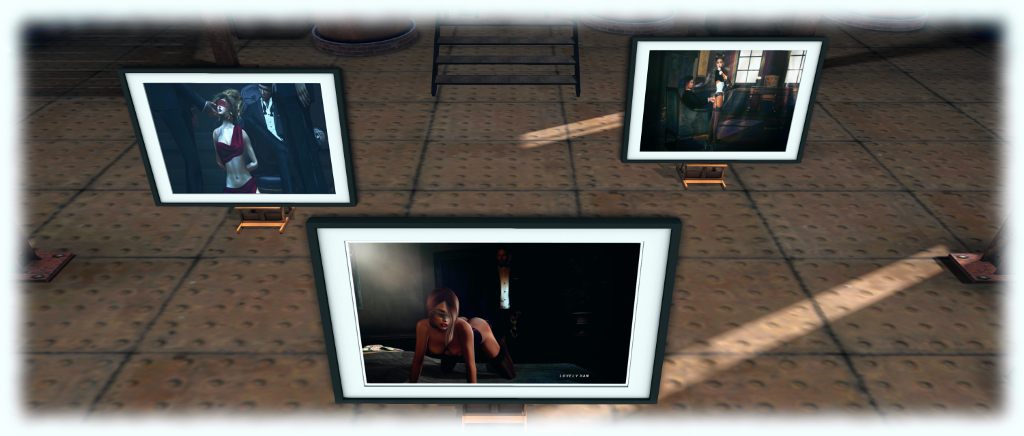
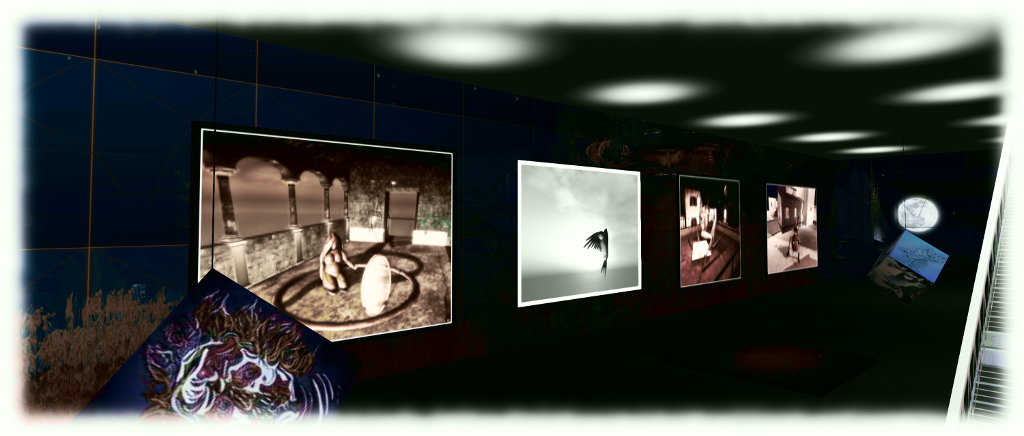
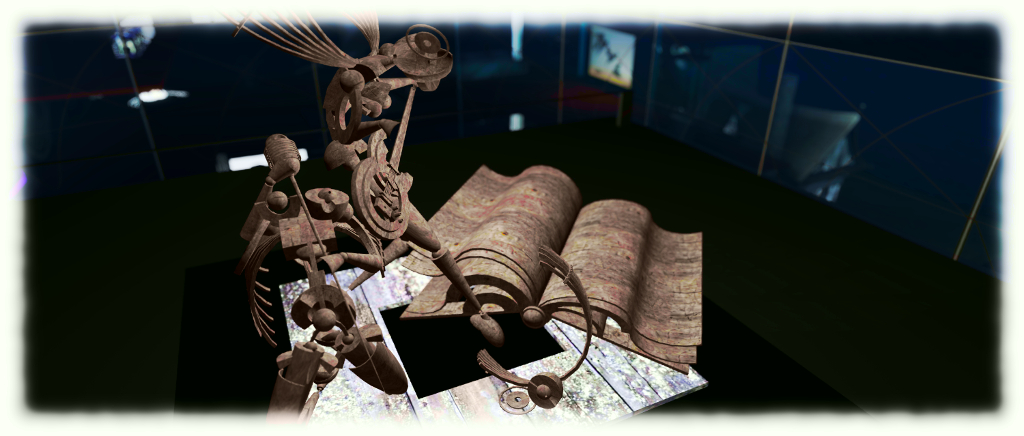
For the inaugural exhibitions, the gallery presents a series of striking images by Ariel Brearly (directly above) on display in the spacious entrance foyer. These are from Dixmix’s personal collection of her work, and he notes he hopes to have her displaying in person at the gallery in the near future. Also on display is a selection from Megan’s personal collection of 3D art by Mistero Hifeng.
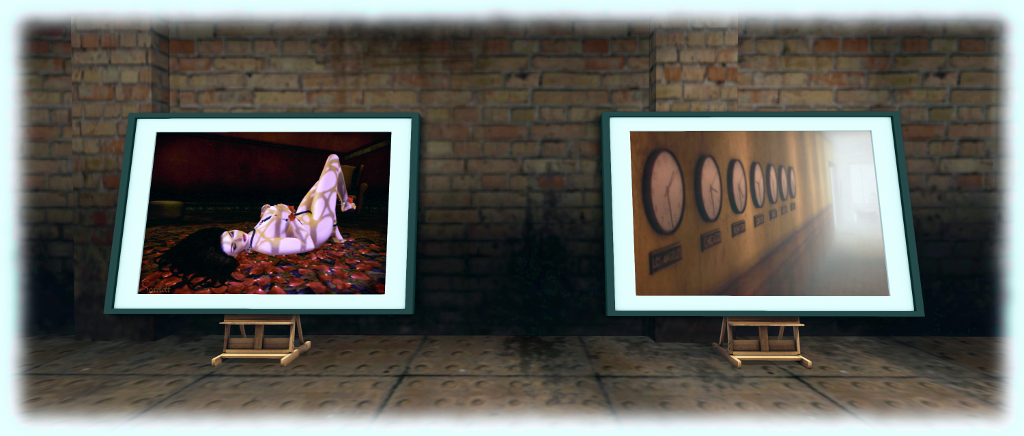
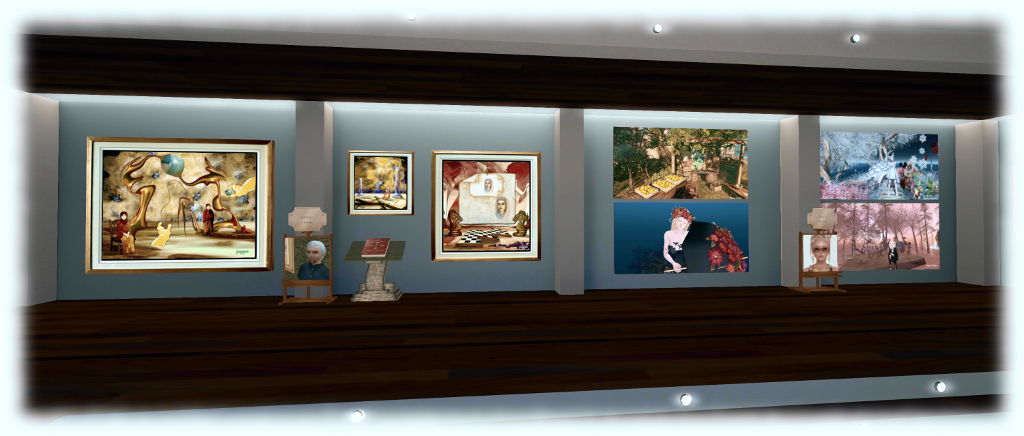
The Black Gallery and the White Gallery offer exhibitions of avatar studies by Grazia Horowitz and Dixmix Source respectively. The images by Graziamark the first time her art has been formally exhibited in Second Life. I confess to finding Grazia’s work hauntingly beautiful, with Aditi (seen as the banner image to this piece) in particular captivating me.
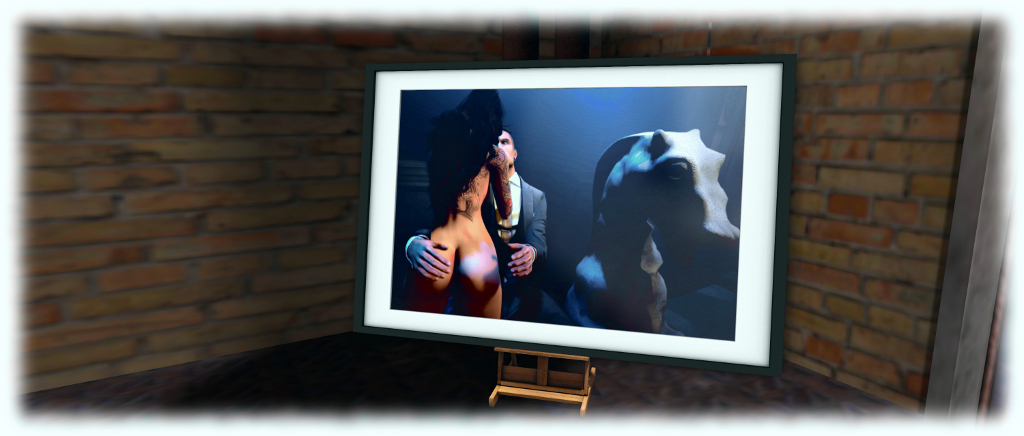
The Grey Gallery presents a set of Ziki Questi’s familiar panoramic images, these focused on art-related installations, on its two levels. Uncredited in the introductory notes, but also on display in the halls behind The Atom music venue, is a series of nude colour avatar studies by Megan Prumier (seen in the image above). Rich in tone, these stand in marked contrast to the monochrome studies found in the Black and White galleries, and are displayed with two 3D pieces also by Megan, which each offer a visual play on the old idiom, nature abhors a vacuum.
All of the 2D art from the artists is available for purchase, and music for the opening will be provided by Nadja Neville in The Atom. Note that public access to the gallery will only be available from 12:00 noon onwards on September 17th.
“I am grabbing things that appear in front of me, moments and sensations. I keep them as treasures, which are open in moments when I want to colour the silence,” Natalia Seranade says in introducing her work. “When my imagination and fantasies are flying, I mix the collected stuff with new things that appear in the moment, I never know what can appear, and I never know what will be the result. I am in another world where I am able to find what was unknown to my eyes.”
It’s a description which encapsulates her work perfectly: moments captured in time, filtered through a lens of imagination and the inspiration which occurs in the very instant of creativity to produce a striking image, often rich in emotion and subtext. And it is a description which in turn is perfectly framed by Awakening, an exhibition of Natalia’s work on display at Nitroglobus Hall, curated by Dido Haas, during September / October 2016.
Awakening is a visual interpretation of the philosophical / psychological idea that everything we see in the world, all the encounters we have, intimate, friendly, happy, unhappy, and so on, in whatever we do, are in fact a reflection of ourselves. As Natalia notes, it is perhaps best embodied on a personal level through our interactions and relationships by the saying your perception of me Is a reflection of you, my reaction to you is an awareness of me.
Within Awakening, we have an exploration of this concept. In viewing the images, colourful, striking, blended through considered use of PhotoShop, we are directly challenged to consider what is it within ourselves that drives our reactions to them, and how does our perception of the art – the individual pieces and the collective whole of the exhibition – speak to our own nature?
It’s an intriguing approach; when witnessing art – or anything we find attractive or unattractive – it is easy to externalise our reaction, as to what is right / wrong about the art (or event or person, etc.). If we consider what might be within us that drives our reaction, it is generally only on a superficial level. We rarely delve deeply into our own psyche to determine what might be working within ourselves to generate that reaction, or what may have been at work to inform any perceptions we have about art, virtual or otherwise. Within Awakening, we’re being asked to do just that.
This may not be a comfortable subject for some – but it is an intriguing one, and something which perhaps gives us greater pause in visiting this exhibit than might otherwise be the case. But just because there is a deeper potential within Awakening for introspection and questions about ourselves shouldn’t be used as a reason to not visit. Jungian considerations aside, as noted towards the top of this article, the images within Awakening beautifully exemplify Natalia’s approach to her art. They are striking pieces, rich in colour, imagery and emotion, deserving to be witnessed and appreciated.
Desy Magic is an Italian artist and photographer who is marking the opening of her new gallery on Wednesday, September 14th with an exhibition of her own work entitled Soul of Avatar, which Desy defines as, “a reflection of our dreams and fantasies, as realised through our avatar.”
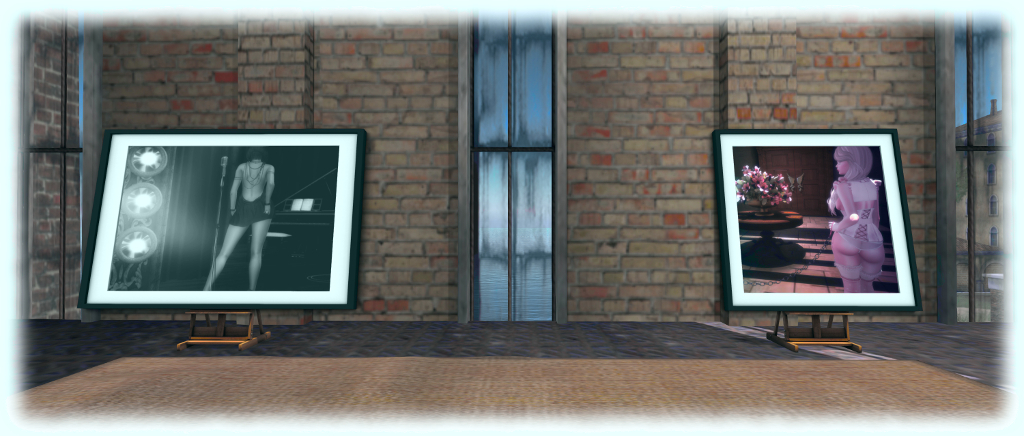
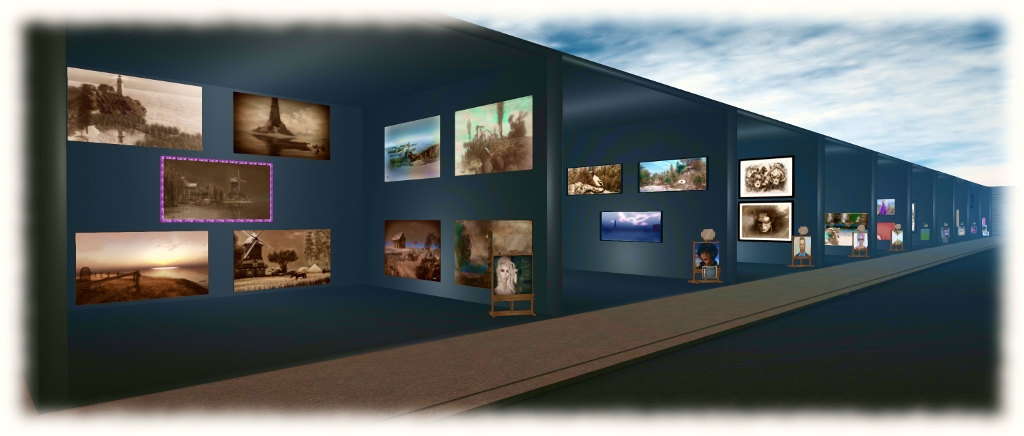
Housed within a gallery space designed by Desy, the exhibition features nineteen avatar studies presented in a number of different styles, from relatively straightforward posed portraits through to very stylised and post-processed works – hopefully the pictures in. All intended to highlight the rich diversity of vision and fantasy we can embody within our avatar.
While they may be of different styles and presentation, it is in their celebration of the avatar that they are united as a cohesive set. Whether an image shows a “normal” human avatar, naked or clothed, or whether it reveals a more fantasy or science fiction look; whether it is processed in colour or rendered as a monochrome image, all of them make Soul of Avatar a deceptively engaging exhibition; one ideally suited to the interior styling of the gallery space.
Each of the pieces in the exhibit is available for purchase, and the opening at 13:30 SLT on Wednesday, September 14th will feature the music of artist (and friend) Morlita Quan – my congratulations to Desy on the opening!
Update, October 10th: JayJay Zifanwe has announced that the four core UWA regions will remain open through until July 2017. You can read more here.
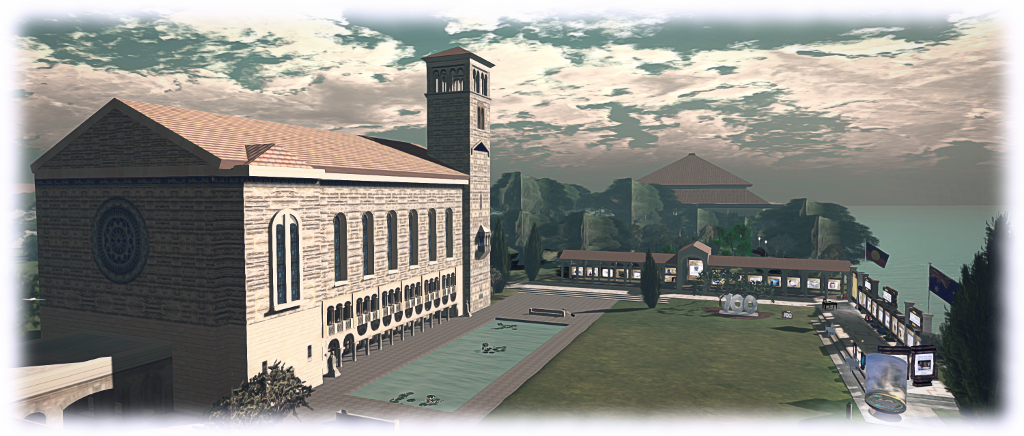
I received a nudge about the University of Western Australia, which has enjoyed a long presence here in Second Life, operating multiple regions and becoming a stalwart supporter of virtual arts through its grand challenges and other competitions and opportunities offered to artists to present their work, as well a through support of machinima in physical world film challenges, such as those run by Screen My Shorts.
The news was actually broken over the weekend by Jayjay Zifanwe, who has spearheaded the UWA’s presence in Second Life since it started, and who has worked exceptionally hard with FreeWee Ling to promote and support artistic creativity within the broad cross-section of second life users and talent. In the post, Jayay states:
Everything on all [the] sims will remain as is for the next 2 weeks… do come back for a visit as many of the artworks going back 7 years are still at various locations. Once those 2 weeks are up, our curator, Freewee Ling will start to rationalise what is on the UWA sims, so that some items from all sims are brought onto the one remaining sim.
UWA: UWA Winthrop and the gallery displaying some of the smaller art pieces on display within the UWA regions
FreeWee adds to the blog post with a note to those artists who have works on display in the UWA regions. So if you are one of those artists, do please make sure you read the post in full. Of the four regions which the UWA is closing, three will be shutting down completely, and one will be changing hands.
The reasons for the region closures appear to be internal to the UWA, and not anything specifically directed towards virtual worlds and Second Life. At the end of 2015, the UWA did cut back on its direct support of artistic endeavours in SL through its patronage of the Grand 2D and 3D art challenges, again spearheaded by Jayjay and FreeWee. Since that time, arts have continued to be supported at the UWA through smaller, but no less attractive activities, such as a the current Immaterial contest, which I’ve been covering in this pages, and the entries for which can be seen at the UWA gallery.
If you have not visited the UWA regions, I urge you to do so before the four scheduled to be removed vanish. There is a stunning amount of art to see, much of it standing as a historic look back over artistic expression in Second Life, including the Grand Final winners from the various challenges, including Nish Mip’s Last Ocean, which forms a poignant opening to Jayjay’s post, As well as the art, there are campus facilities to explore.
Tutsy Navarathna’s “The Residents“, overall winner in the machinima category of the 2013 Project Sci-Fi challenge, sponsored by the UWA
For my part, I’d like to thank Jayjay and FreeWee for all of their hard work over the years in building the UWA environment in-world, and to those at the UWA itself, for their support of virtual spaces and digital arts.