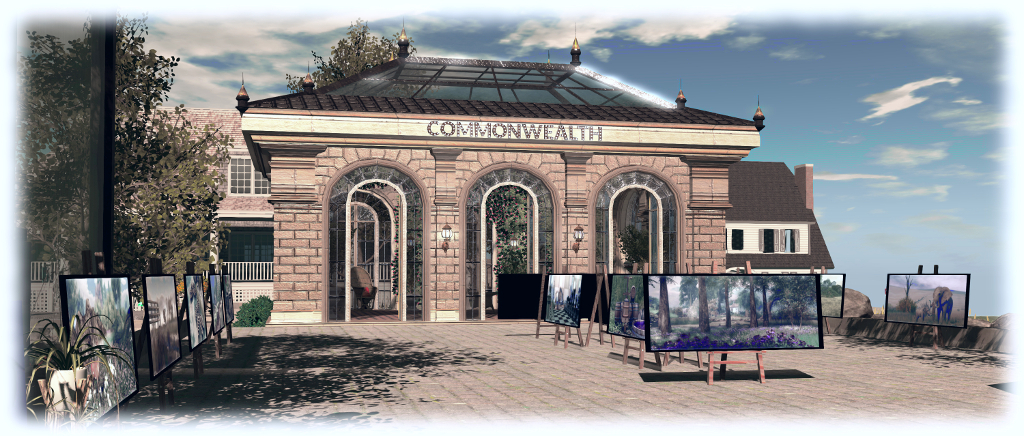
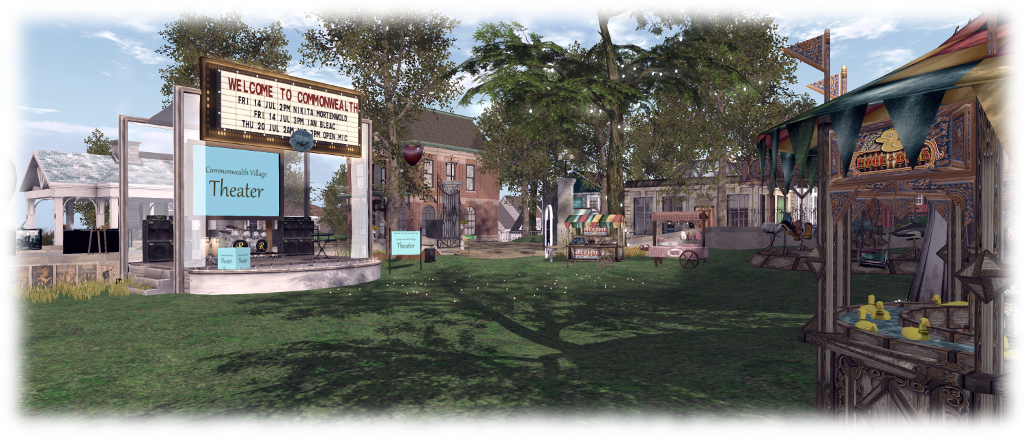
Commonwealth Village is a Mainland located Community themed on the looks and climate of New England. Developed by Derek Boston, it offers residential rentals, village shopping and an expanding arts and music programme.
Built around a central square without outlying rental residences all in a New England style, the communal heart of the community is a tavern-side meadow where live music events are held, together with open mic sessions. Friday July 14th will see Nikita Mortenwold performing on the stage from 14:00 SLT, followed by Ian Bleac at 15:00 SLT.
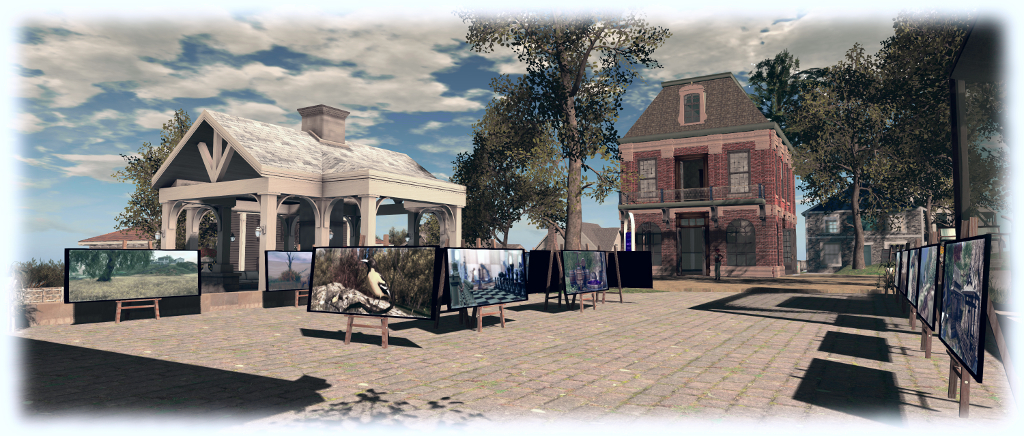
Also opening at 14:00 SLT on Friday 14th July is a new art exhibition at the Commonwealth Village. An open-air event being held on the paved piazza in front of the village’s imposing pavilion, I’m quite delighted and honoured to say that the display is of work by …. me!
It was a genuine surprise and pleasure to receive an invitation from Derek to display images from my Exploring Second Life series of blog posts in these pages, particularly as art is one of the newest additions to the Commonwealth’s event calendar. I was equally delighted to be able to chat with Derek in June in my role as a gallery space curator to discuss art exhibitions in SL.
For the exhibition, I’m offering some 16 images from some of the more recent travels Caitlyn and I have made across the grid, and I hope people will find them pleasing. I’d also like to offer an open invitation to anyone do minded to join us at the Commonwealth Village for the music and the opening from 14:00 SLT on Friday, July 14th.
Karma Avedon sent me an invitation to visit her full region installation, One Tree Hill which is – although still in part a work-in-progress – now open for visitors. “[It’s] my first ever work for the LEA and I am very excited both to have had my idea accepted and to have managed to actually bring it to fruition,” she told me prior to Caitlyn and I paying a visit.
The installation is a virtual reflection of U2’s seminal album The Joshua Tree, which celebrated the 30th anniversary of its release in March 2017. The album grew from a mix of influences – social, political, spiritual, and cultural. It was released in a period of history which we see echoed somewhat today, with economics dominating the politics of the UK (U2’s home) and America; global small-scale conflicts; the changing face of traditional industries – notably coal mining; etc.
All of this, including the influences behind many of the songs contained within the album are reflected within One Tree Hill. Some of these references are obvious, others are more subtle or layered. Also to be found are reflections on the band’s contrasting views between “real America” and “mythological America”, and reminders that the UK and the USA have much in common.
A journey begins Where the Streets Have No Name, a flat desert-like environment cut by broad, nameless roads, stretching away to the horizon, a great mesa rising to one side. Much of this contains images of the American mythos: great flat desert plains, broad, ruler-straight roads arrowing to the horizon, billboards (which carry some of the more overt political references for both the 1980s and today), and a reminder of the former importance of coal in building both the UK and USA.
Where one travels through this landscape is a matter of choice. Follow the single south pointing road, and you’ll pass a row of bonnet-buried Cadillacs – a reference to Cadillac Ranch, and emblematic of the American mythos. Close by, on the other side of the road visitors can reflect on being With Or Without You; the internal struggle of the song (to be a husband at home or a rock star on tour) powerfully represented by the statue of a couple caught in the tension of a tango – and a dance orb allows visitors to engage in a dance as well.
Staying on the lowland area, where Joshua trees via with umbrella thorns to offer some greenery, and travelling south, one will eventually come to a large gallery space (still under construction) and references to Bono’s time in South America. The latter represents both Bullet the Blue Sky and Mothers of the Disappeared in a rain-soaked corner. The latter of these also perhaps contains modern-day references: the three distressed mothers all being clad in burqa-like garments, whilst the boards set on the chain link fence appear to be in reference to more recent conflicts.
Atop the mesa and reached via an ascending set of wooden platforms, sits a literal representation of Red Hill Mining Town literally sits, offering another layered interpretation of the period. The song itself was written around the unfolding political upheavals impacting Britain’s coaling communities in the mid-1980s, and in particular the 1984 Miner’s Strike; however, the town is very clearly American in setting. Thus, a parallel is drawn between the decline in the importance of domestic coal witnessed in both the United States and the UK – for largely the same economic reasons – during the 1980s. A further layer is perhaps added as well, in that the embodying Red Hill Mining Town as a run-down American township might be seen as a metaphor for the band’s own conflicted views of the “real” (declining traditional industries), and “mythological” (land of golden opportunities) United States.
Within this town are further references to both The Joshua Tree with I Still Haven’t Found What I’m Looking For, featured appropriately enough within a church; and to U2’s own history in the form of the STS Studios, where many of the group’s songs (including some from The Joshua Tree, but notably the likes of Rattle and Hum) originated / were recorded. Standing over all of this, and reach by another set of wooden steps, is One Tree Hill, written in reflection of a 1984 visit to Maungakiekie, a volcanic peak in New Zealand, and one of the most spiritually significant to Māori people. As with it’s namesake, Karma’s One Tree Hill is a place of reflection and peace.
One Tree Hill is a fascinating, layered installation, one which should be explored carefully, allowing for reflections on U2’s album and music and the imagery presented within the build. Do be sure to have ambient sounds active when visiting and – if you’re a U2 fan, try the music stream as well. I’ve also not referenced all the tracks on the album – others are to be found, but I’ll leave you to find them (hint: look indoors for at least one), as that’ll leave you some mystery as well 🙂 .
Riflessi Sul Nero (“Reflected On Black”) is the title of the latest installation by Italian artist Terrygold, which is now open to the public at Solo Arte. It comprises a series of around 15 large format avatar studies, all set out within the setting of an old mine works visitors must explore.
On arrival, visitors should be sure to set their viewers in accordance with the local instructions – accept the local windlight, then ensure Advanced Lighting Model (ALM) is set via Preferences > Graphics and, if your system can handle them, enable shadows (a little is lost in terms of general ambience by not having shadows active, but not enough to spoil the installation). Once set, follow the tracks down into the mine.
Within the tunnels and vaults of the mine can be found Terrygold’s self-portraits, and the reason for the title . Rather than being in her usual alabaster skin, she is using an ebony skin for the portraits – so she is literally a reflection (image) of herself in black. Presented in a large format, these are to be found spaced along the tunnel walls and within the side room and chamber opening off of the main horizontal shaft as it slopes and twists gently downwards.
The mine itself is superbly done – testament again to Terrygold’s skills as a designer. Beautifully lit and atmospheric, it gives a very real impression of going underground. The lighting is extremely well done (again, just make sure you have ALM enabled), while shadows further add to the ambience.
The setting might also be a play on words, working on a number of levels. Gold is often mined, and we have Terry’s full name – Terrygold, so we are literally entering a mine to discover the gold of her images. Coal is also mined, and this is a celebration of an ebony look, so again there could be a thematic tie. Finally – and as Caitlyn pointed out, there is the reference to black gold used in jewellery. Just as the latter can be produced by a variety of means, including eletroplating, which sees the gold coated with black rhodium or ruthenium, so Terrygold has coated herself in an ebony covering to produce these images.
My one minor quibble with the installation is that the lighting does in places work against the images; in places it can be a struggle to fully appreciate them. Nevertheless, this is an intriguing and interesting installation to visit.
Fuyuko Amano (Wintergeist) is perhaps best known for hosting exhibitions at her Club LA and Gallery, where she also displays her own images, which I’ve personally felt deserving a wider in-world audience. So it was with delight that I received an invitation to see the first public exhibition of her work hosted by another gallery – and hopped over ahead of the official preview to take a look.
Wintergeist: Pieces of aWhole opens at 13:00 SLT on Sunday, July 2nd and is a fascinating tour of Fuyuko’s art – digital world and physical world. Taking place at the InterstellART Artist in Residence Gallery, it presents eighteen primary images, together with a small collage of images in the gallery entrance space.
The exhibition mixes images captured in Second Life with those from Fuyuko’s physical world photography, with all of them interspersed with quotes from artists and writers which serve to help illustrate the nature of inspiration in the artist’s life. This makes for a fascinating display, ranging from landscapes from within Second Life through to beautiful macro-level shots of water droplets on leaves and the stamen on flowers. Between them are images that may have you guessing – were they taken in Second Life, of in the physical world? Even abstract work is represented, adding to the mix.
What is also attractive in this exhibition is the range of formats presented, with images in colour and monochrome, or presented as a photograph or post-processed to resemble art, the considered us of filters – even the ratio of individual images.
All of this further speaks to the art and craft of a gifted photographer and artist. Thus we have, through subject and presentation, individual images that come together as pieces of a whole – not only presenting us with insight into the artistry of a photographer, but the vision and thoughts of the photographer herself.
As noted, a special preview opening for Wintergeist: Pieces of a Whole will be held at 13:00 SLT on Sunday, July 2nd. Whether or not you can make that, however, this is an exhibition well worth visiting.
The July exhibition at Sorcha Tyles’ Artful Expressions gallery opens on Saturday July 1st, and in keeping with the gallery’s recent expansion, features three guest artists exhibiting their work: Rose Hanry Jarom (RoseHanry), Lawrence D. Pryce and Cecilia Nansen Mode (Cecilia Nansen). All three present displays focused on avatar studies, each presenting an individual style and approach to their work.
Artful Expressions marks Cecilia’s debut exhibition, and on the strength of the images she’s selected, this will not be her last. As a tangential coincidence, her partner, Jes Mode, is exhibiting at DixMix gallery in his first public outing with his photography (see my recent review in these pages). Having now seen their respective work, I’d love to see them exhibit together – and may see if I can arrange that for Holly Kai Park!
Working in both colour and black-and-white, Cecilia’s pieces are exquisite, and I particularly like the fact that within the nine pieces, she has presented three sets of three, each offering a narrative flow or thematic continuance between the images in each set.
Lawrence D Pryce says of himself, “I’m just a hermit who took up photography as a means to encourage my introverted personality.” Introverted he may well feel, but his art speaks volumes. We’re perhaps all used to seeing studies from in world which are carefully posed and framed to tell a particularly story, but while these are all clearly posed, each is so natural in setting and tone, there is not a single story to be told. Instead, each offers a host of tales in the making – and, perhaps, each offers a glimpse into the artist’s thoughts and his embrace of being alone.
Rose is not only a photographer, but a designer of poses for her work as well, noting that she likes to bring setting, windlight and pose together when taking photos. The result is some of the most natural images I’ve seen for a while. Carefully crafted again they may well be, but so to are they natural – and expressive of a story. I freely admit to being entranced by the lifelike depth present in Dream dreams no one else can see (below).
Once again, Sorcha has selected three outstanding artists who come together to present an exhibition linked by a central theme of avatar studies, whilst each offers unique perspectives and a unique approach to their work. The exhibition officially opens at 14:00 SLT, with music by DJ Julianna. Don’t forget when visiting the gallery, you can also enjoy Sorcha’s own photography.
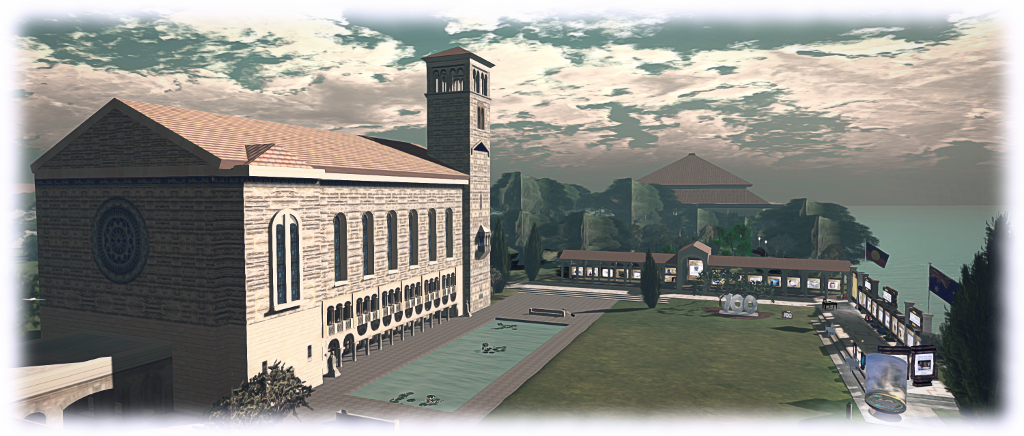
UWA: Winthrop Clocktower and the Reflection Pond, with the SLeducate area on the right (which you can read about here) all now set to remain in Second Life for the next two years
On Friday, June 30th, Jayjay Zifanwe contacted me with some excellent news: the University of Western Australia (UWA) is to retain a presence in Second Life for a further two years – albeit on a reduced scale.
UWA has enjoyed a long presence here in Second Life, operating multiple regions and becoming a stalwart supporter of virtual arts through its grand challenges and other competitions and opportunities offered to artists to present their work, as well a through support of machinima in physical world film challenges, such as those run by Screen My Shorts.
However, in September 2016, it was announced that due to changes within the UWA, its digital presence was to be largely shut down, with all but one of the five regions being removed from the grid at the start of October 2016, and the last given a stay of execution for at least a year.
Then, in October 2016 came word that one of the regions would transfer to the management of Sonicity Fitzroy (aka Dr Phylis Johnson) of the San Jose State University (and is now called SJSU Virlantis), while the four remaining regions – University of WA, UWA, UWA Winthrop and WASP Land would remain in place in-world until July 2017 before finally vanishing into the night.
Noke Yuitza: Transcendence Despite Falling Rain – an entry in the last UWA Grand Challenge style of art competitions, Transformations. You can see all the Transformations entries at the UWA Gallery
Now, two of the regions will be continuing for at least two years, as a jubilant Jayjay informed me via IM:
“I’m pleased to be able to tell you that thanks to the ‘UWA Community Partnerships Programme’, the University of WA and UWA regions will now be remaining in Second Life for the next two years,” he said. “This is absolutely wonderful news, and I’d like to thank everyone who have believed in and participated in all we have done and achieved over the years.”
Nor is that all. As noted above, one of the things UWA is famous for in it patronage of the arts, is its series of grand challenges involving 2D and 3D art and machinima – and there is good news here as well.
“A benefactor has donated L$300,000 for a machinima challenge,” Jayjay went on. “So we will be running one with art as the theme. Participants will be asked to select one or a number of artworks on display at UWA and weave a story around it or them.”
Full details on the news about the extension to the two regions, and detailed information on the machinima challenge will be made available via the UWA of SL blog in due course. In the meantime a hint of the coming news can be found on the blog.
For now, congratulations to Jayjay, FreeWee Ling and everyone involved in making this happen.