I made my second visit of the week to Chuck Clip’s Sinful Retreat region in order to see Mindscapes, an exhibition by JudiLynn India, and which can be found within the region’s Janus Art Gallery II.
JudiLynn is a remarkable abstract artist who has been active in Second Life since 2009. Having studied graphics design at the Tyler School of art, at the opening of the new century she decided to focus her creativity on acrylic and digital painting, particularly exploring the opportunities for textured painting in the former and the ability to play with light and colour with the latter. When combined, these two approaches give her art a genuinely tactile dimension which in turn breathes a fascinating sense of life into them.
The title of this exhibition appears to be drawn from the fact that much of JudiLynn’s work originates within her mind’s eye, rather than being inspired by external sources. These are bold, vivid pieces, clearly drawn from her love of colour, their finish retaining the layered, tactile look that is so intrinsic to her art.
It is my goal to make charitable creation my life’s work. My intent is to share my craft and use it to raise much needed support for organizations that improve the quality of life for people at home and abroad.
– JudiLynn India, describing her art and her approach to life
Fourteen pieces are offered – twelve as conventional canvases, two as totems standing within shallow alcoves in the gallery’s curved wall. While all the pieces naturally draw and hold the eye, their mix of bright tones and more organic colours quite captivating, I confess that I found Mindscape 2 Totem particularly attractive; the colours within it richly organic, its form – a rectangular block – primal, its entire form exceptionally Earthly – by which I mean it has an element of having been drawn from the very crust of the planet, and raised up to offer a story of the ages that progresses down through its colours.
but each of these pieces that make up Mindscapes has something to say to those looking upon it; there are subtle narrative running through each, be it due the the shapes that are suggested within each or the manner in which colours ebb and flow with one another or intertwine gracefully, or the suggestion of things half-seen produced by the mix of line, colour and textural layering.
Captivating, entrancing, emotive and offering a combined journey into the art and imagination of their creator, the pieces presented through Mindscapes are not to be missed.
Milly Sharple is a remarkable artist, creator and patron of the arts in Second Life. An artist and photographer in the physical world, she has always enjoyed art and artistic expression, particularly that of fractal art, a technique she started using in 2005. It’s a medium in which she has gained deserved recognition: she has sold pieces around the globe, had them used as book and CD cover art and as promotional material, and has had her work used on the face of the bank cards issued by an Indonesian bank. Her work has even brought her to the attention of Salvador Dali’s protégé, Louis Markoya, who asked her to collaborate with him.
Milly was perhaps one of the first artists to bring fractal art to Second Life after she joined in 2008. Gaining familiarity with the platform, it became a place where she understandably wanted to exhibit her work, and following her initial exhibitions, she started receiving multiple invitations to display her work. She thus became immersed in the Second Life arts community, establishing her own gallery and also the Timamoon Arts Community, a place where artists could find a gallery home and like minds, and over the course of four years, she grew Timamoon into one of the most successful arts communities in Second Life.
For her incredible and expressive fractal art, Milly uses the Apophysis software package, which allows her to create soft, flowing, liquid effects that sets her work apart from other, more rigidly geometric fractal art with which we might be familiar as it is displayed in Second Life. This approach gives her work a stunningly organic look and feel, rich in life and often encompassing the intricate beauty of the Mandelbrot set.
However, Milly is not constrained to only producing fractal art; as a mixed media artist her expressive range is broad and deep – and I have long been an admirer of this aspect of her work as much as I am her fractal art. Indeed, I’m honoured to be able to have a copy of what I regard as one of the most engaging pieces of art in my modest personal collection -her Woman with Cat – hanging on the wall at our SL home. As with her fractal work, Milly’s mixed media art couples a rich use of colour with an etching-like finish to bring individual pieces to life in the most incredible manner.
I mention all of this because Milly has a new exhibition of work currently being hosted at Chuck Clip’s Janus Gallery, which opened on September 27th.
Meanderings brings together all of the above elements of Milly’s art and adds to it with a selection of her black-and-white portrait studies in a captivating microcosm of her talent. On display are seven large-format fractal pieces (with the patterns of two repeated on benches in the gallery’s two halls, and a third mirrored and inverted in the foyer that so blends with the décor, it might easily be overlooked), eight monochrome portraits and eight mixed-media pieces that are – without being in any way superlative – utterly stunning.
These latter pieces bring together all aspects of Milly’s art: her fractal work, her skills as a portrait artist and her expressiveness as a mixed media creator; there is a richness of life about them that is utterly absorbing, Similarly, the depth of life in the black-and-white portraits cannot fail to hold the eye; these are pieces that, whether inspired by real people or their images, or have been drawn entirely from Milly’s imagination, not only capture the likeness of the subject, but offer a very real sense of their life essence. Further, these monochrome pieces share a strong sense of narrative flow that can also be found within each of the mixed media pieces, thus presenting a thematic thread to connect them, whilst their arrangement around two of the much larger (and richly organic) fractal pieces offers a natural visual connection to them.
Meanderings: The Mystic and The Flirt (with its hint of Kate Bush) two of the entrancing mixed media pieces presented by Milly at The Janus GalleryTaken together the three styles of art present within Meanderings offer a rewarding introduction to Milly’s art for those unfamiliar with it whilst also offering a unique thematic and narrative flow through the differing mediums, making this both an engaging and outstanding exhibition.
Milena Carbone (Mylena1992) opened her latest art installation on September 23rd, 2020. Entitled Plead Guilty, its an installation of for distinct, but locationally and thematically connected exhibition in which the setting – the Adult-rated Noir’Wen City. As with all of Milena’s work, Plead Guilty is intended to get the grey matter sitting between the ears chugging on a four cylinders; it’s also an installation in which the location plays something of an integral role, given the way it struck a chord with Milena as she explored it ahead of her exhibition.
When visiting Noir’Wen City, I was struck by the density: density of urban planning, density of shops and the almost suffocating presence of the pleasure of the flesh…
Noir’Wen City illustrates for me the dead end of our civilisation of pleasure, the headlong rush into hedonism, the need for more and more dopamine for less and less desire …
Within the exhibition Plead Guilty, I wished to denounce this massive massive drift towards addiction, this infernal cycle of the hedonic system of our brain…
– Milena Carbone
Given this description, it might be said that Plead Guilty stands as something of a treatise through art, and as such, its four parts are best visited in the order suggested by Milena through her introductory note cards and the wearable book she has produced on the installation, which can be obtained at the landing points for each of the four installation exhibitions.
Plead Guilty: Nude Is Art
The first of the four parts, Nude Is Art, is located within the Noir’Wen Castle above the Adult club, Les Boudoir des Libertines (the front entrance of which forms the landing point – take the stairs to the right as you look at the club). As the exhibition’s name suggests, it is an extensive collection of nude studies located in the castle’s enclosed courtyard and surrounding rooms on the same level. Ten of the images within the courtyard’s cloisters represent the relationship between a couple, and the natural role nudity plays within it. Thus, it could be said to be a commentary on “nudity as innocence” – an act entirely free from the vice-driven lust, but which, in the privacy of their home, is a simple expression of love and comfort a couple can feel for one another.
The remaining images within the various rooms are more general in nature, drawn from Milena’s admitted enjoyment of imaging the nude avatar form, and which continues the theme of the more innocent presentation of nudity as a statement of art. However, they are faced by images from real life that show homophobia, violence towards the LBGTQ community, people of colour and women; images that remind us that while society may see itself as “enlightened” and free to accept the needs of desire without love and guilt-free gratification, in actual fact it is still often driven by the intolerance bigotry and petty hatreds that long marred humanity’s development, and which remain all too present in the world today.
Plead Guilty: Sermon of Madhi
The Sermon of Madhi, located in the city’s church, offers further commentary on the intolerance our society can express. building on a situation Milena first explored in Locked. It tells the story of a homosexual relationship in the style of renaissance religious paintings, with the central triptych expressing the tragic core of the story.
Nine Levels of Love, located within the City’s art centre, takes as its core, Diotima’s Ladder of Love (also referred to as Plato’s Ladder of Love), together with five virtues – knowledge, empathy, concord, spirituality and justice. These are arranged so that visitors can sit on a ring of five seats, each with an image representing one of the virtues on its upright back, facing the nine paintings inspired by Diotima’s Ladder. The aim is to encourage discussion (amongst multiple visitors) or consideration (if on your own) on the place of virtue in modern life, and the nature of love itself in today’s physical, self-centric world. A mosaic again depicting the crueller, baser aspects of modern life hangs on the wall at the entrance to the exhibit, challenging us to further consider the virtues and idealisms of love espoused within the gallery in the context of the world at large.
The final part of the exhibition, Plead Guilty, is a collection of images found hanging over the main streets of the city. These feature those responsible for Noir’Wen together with friends and volunteers, each study framed against a Police arrest backdrop, and collectively presented by a poem inspired in part by Dante’s Divine Comedy, which can be viewed on-line by touching any of the little cube vendors that sit with a extract of the poem, below each of the portraits as they are strung across the city’s main streets.
This is a complex exhibition to untangle, containing what might at first appear condemnatory statements given the artist’s opening statement. Take the Plead Guilty portraits hanging over the city streets for example.
The use of the Police mugshot backdrop might initially be seen as accusatory – those pictured being seen as guilty of aiding and promoting through the development and operation of Noir’Wen, the selfish hedonism the installation is attempting to denounce. But look again: the poses within the images belie this; they offer a genuine take on the individuals feature as they are seen through Milena’s eyes – they are genuine portraits. It is perhaps with a third or at least longer look that the the underlying message might be revealed – the mugshot backdrop hinting that in fact we are all guilty of leading lives driven by a pursuit of happiness that has perhaps turned increasingly selfish over time, and which allows us to use it as veil to ignore the increases in intolerance and bigotry that once again become increasingly apparent in society.
Plead Guilty: Sermon of Madhi
Given all of this, Plead Guilty perhaps isn’t the easiest or most comfortable of installation to face. Each exhibition element requires time to absorb and interpret – so it is as well that (I believe I’m correct in saying) the installation forms a central part on Noir’Wen City’s Autumn Festival that runs through until December 20th, as this offers time to visit and revisit the installation and absorb it. However, for those who appreciate art that carries a theme or social statement, I would encourage taking the time to visit; and for art lovers in general, I would also note that these are all pieces worth viewing even if you prefer to separate them from statements or thematic interpretation, as they are exquisitely produced and presented.
Bamboo Barnes at Ribong Artspace Gallery, September 2020
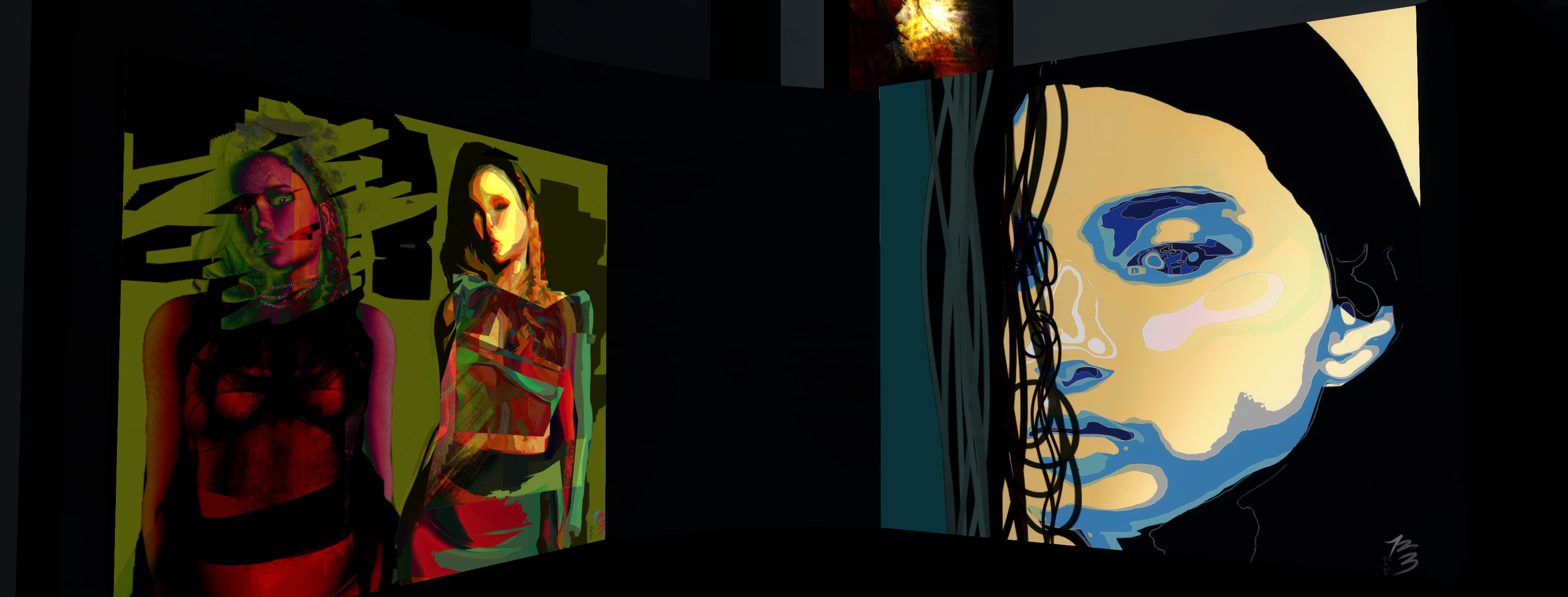
Bamboo Barnes is one of the most vibrant, evocative, provocative, and emotive artists displaying her work in Second Life. Hailing from Japan, Bamboo works with digital tools to produce pieces that are strongly assertive, both in terms their narrative depth and their ability to dominate the space they occupy, rich pieces that speak to the eye and mind.
All of this can be witnessed first-hand at her current exhibition, Receding Reality, which opened at Ribong Gallery’s Artspace 2243, and which opened on September 12th, 2020.
Bamboo Barnes at Ribong Artspace Gallery, September 2020
What is born out of me transforms like water: here is an uncertain ego and an inexhaustible feeling for those who have left.
– Bamboo Barnes
This is an extensive exhibition of work that presents pieces in a range of styles that have, per Bamboo’s description, something of a introspective nature about them. The styles themselves offer hints of Dali, Picasso, Warhol, encompassing abstract, pop-art, neo-impressionism, expressionism and neo-expressionism.
Bamboo Barnes at Ribong Artspace Gallery, September 2020
The elements of introspection comes from the faces apparent within many of the painting on offer; faces that oft carry thoughtful expressions or distant looks, suggestive of caught in memory, or are incomplete or distorted, as if being pulled from half-remembered memories. Those that feature figures rather than facial features equally suggest distant thoughts.
As I’ve noted in the past when writing about Bamboo’s art, the emotions she experiences whilst producing a piece are a central aspect in how it eventually emerges. These emotions may be the result of her own feelings or perhaps those evoked by the music she is listening to, and her own response to the emerging piece. This tends to give her art an added depth, those emotions remaining with it and transferring to the observer the longer one regards it. There is also something almost visceral in her work through her use of colour; this in turn gives her work an attraction that pulls at the attention.
Bamboo Barnes at Ribong Artspace Gallery, September 2020
The Artists’ Village at Campbell Coast, created by BJoyful and Doc Rast (rasterscan) and curated by Owl Dragonash, opened A Street Fair, an extensive ensemble exhibition of 2D and 3D art on Tuesday, September 22nd.
A Scottish themed Mainland residential setting that’s open to the public, Campbell Coast offers access to both Linden roads and protected land and to sailable water, with the Artists’ village occupying one corner overlooking the coastal waters. The exhibition features a mix of residential artists and guest artists, with art displays both within the town houses of the village, along the cobbled streets and on the outdoor walls of some of the the buildings.
Artists’ Village, Campbell Coast: Etamae
Participating artists within the studio spaces comprise: Dhyezl, Moondance, Reycharles, Gidgy Adagio, Whimsical Aristocrat, Michiel Bechir, Owl Dragonash, John and Tempest Huntsman, Suzen Juel, Dimi Ludwig, Jed Luckless, Lexus Melodie, Inara Pey, Larree Quixote, GoSpeed Rasere and Skip Staheli.
Further special exhibits are presented by Etamae, Jaz, Shakti Adored, Thomaz Blackbur, Lena Kiopak, Radagast Malaprop, and Ciottolna Xue.
Artists’ Village, Campbell Coast: Skip Staheli
As might be expected from this list, the art on display is wide-ranging and covers both 2D and 3D art, the former primarily focused on landscapes and avatar studies – although Jed luckless presents a rather unique display of posters from his past exhibitions and those from Phish Bowl events, , whilst GoSpeed offers links to her novels. Ciottolna Xue’s sculptures, meanwhile bring additional life to the local streets, together with some by Reycharles as they sit outside his studio.
Given the sheer volume of art on offer, trying to define all of it would lead to a TL;DR piece – suffice it to say that what is presented is engaging and well worth the visit. And given the sheer volume of art, for those looking for something new for their SL home, as well as those who appreciate art, will find this a worthwhile destination.
The University of Western Australia has been a long-term patron of the arts in Second Life
From 2009 through through 2018, the University of Western Australia (UWA) was a name synonymous with patronage of the arts in Second Life.
The university first became involved in Second Life largely through the encouragement of faculty member Jayjay Zifanwe, and under his guidance and the curation of FreeWee Ling, UWA oversaw a series of art challenges that offered impressive cash rewards for 2D, 3D and machinima artists.
These Art and Grand Challenges yielded some of the most exceptional displays of art and creativity seen within – and beyond – Second Life, and became a hallmark for artistic excellence. Over the years, I attempted to cover down the years through this blog; however, from the end of 2015, UWA started a gradual winding-down of their operations in Second Life.
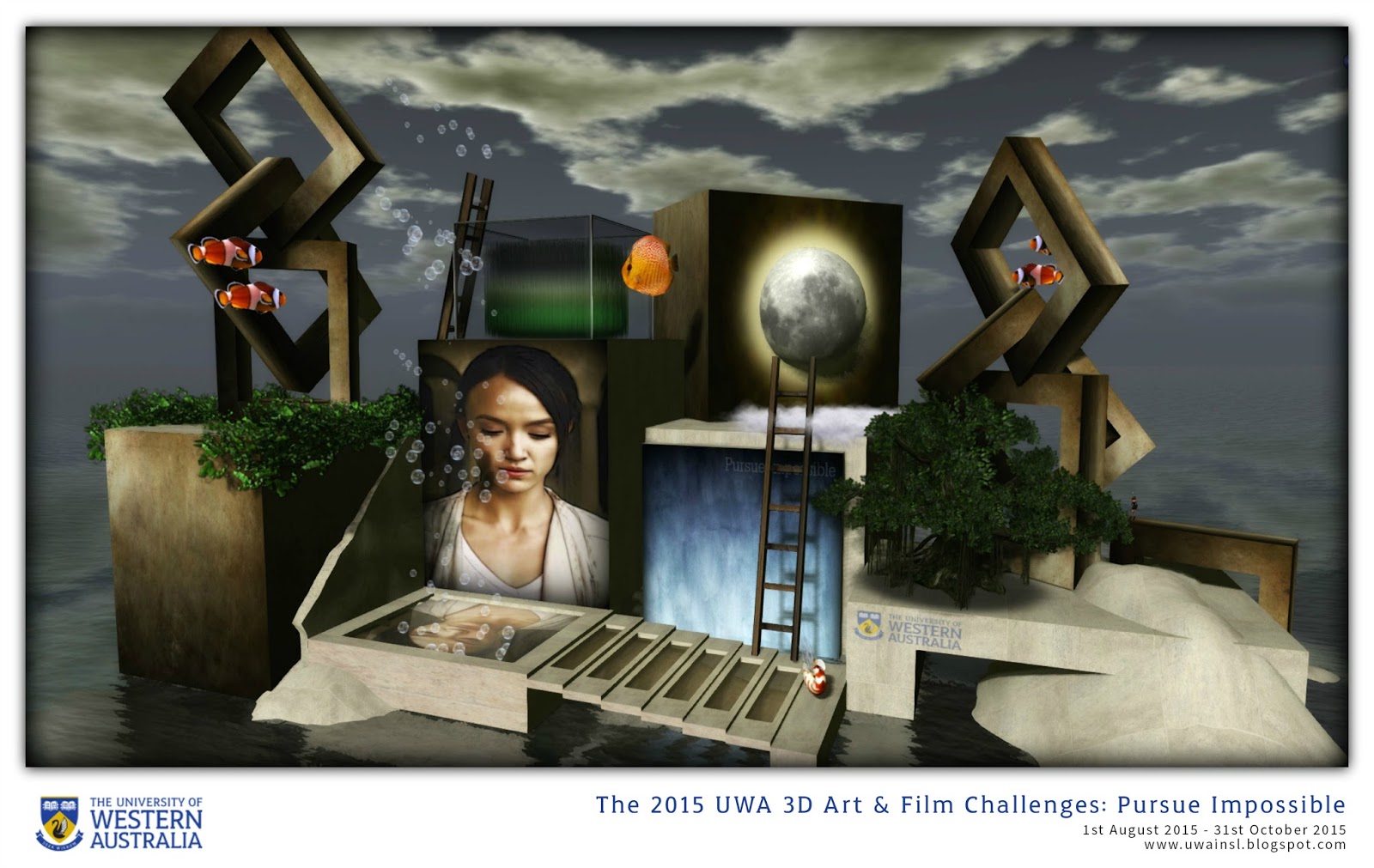
Pursue Impossible (2015) marked the end of the UWA supporting Second Life artistic expression with large-scale cash prizes. Image courtesy of UWA
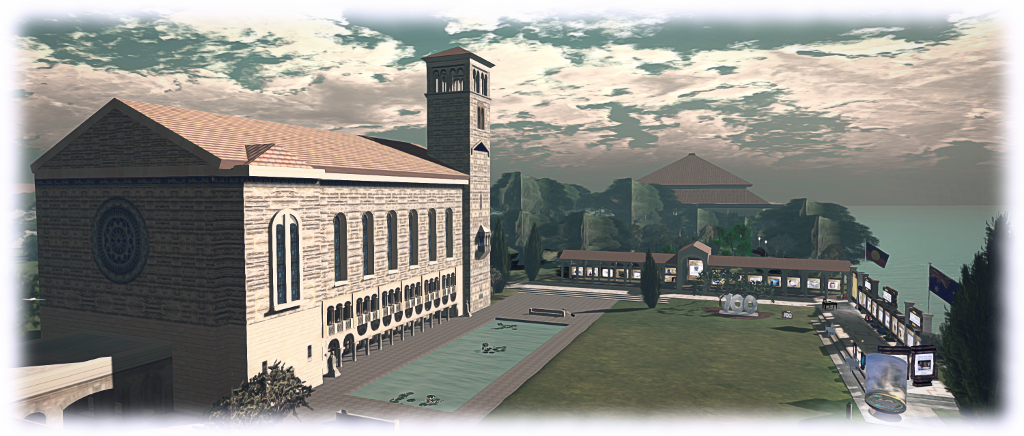
Sadly, all good things must eventually come to an end, and the time is coming to say farewell to the last remaining UWA region – and in order to do so, a final art exhibition is to take place in the UWA’s exhibition space over the region.
Open to all 2D and 3D artists, the exhibition has been entitled Gratitude. It is being organised with the approval of the UWA by Chuck Clip, who describes the event thus:
This is a grand finale, a sad farewell to show our gratitude to UWA and all that they did for us as artists, curators, and residents of SL. Their work brought life and beauty to all of us and made the art world in Second Life a thing to behold. Why The Theme “Gratitude”? For over a decade, the University of Western Australia has been synonymous in the minds of many residents of Second Life with the arts and the support thereof. Their work was unparalleled on the grid, and made waves in the art world that, even as they prepare to close their sim, resonate through the art world today.
There are so many people whose lives they touched in one way or another. So many artists found inspiration in their 3D Art Challenge themes, and support in the encouragement of the community they created. Let us all come together this one last time to say thank you to the men and women of this great institution, to celebrate their achievements, their impact on our own achievements, and to mourn their departure.
– Chuck Clip, via note card
Those wishing to participate in this special event should note the following:
The event is open to all Second Life 2D and 3D artists, but is limited to one entry per artist.
Artists will be given a maximum of 150 LI with which to realise their work.
Entries should be able to be interpreted by the casual viewer as being representative of the theme of Gratitude. Where the link to the theme is difficult to ascertain, this should be referenced in a note card accompanying the work.
All entries must be submitted no later than 23:59 SLT on Sunday, November 1st, 2020 via the official UWA Art Show Submissions boxes (see below).
All entries must be accompanied by a note card containing: the artist’s name and a brief biography; the name of the submitted art (this should match the actual name of the piece as an object); a description of the piece; any landmark to more of the artist’s work, if applicable.
The exhibition will open at 12:00 noon SLT on Wednesday, November 11th, 2020, and will be marked by a special opening event with live entertainment, and will close on December 30th, 2020.
The region is currently set to close on December 31st, 2020, and art will be cleared prior to this occurring.
How to Enter
Place the artwork and covering note card in the UWA Art Show Submissions boxes located in the following regions:
To submit entries, left-click on the entry and HOLD the mouse button down, then press CTRL and drag the entry to the Art Show Submissions box. When the cursor is over the box (red outlines should appear around the receiver box), release your left mouse button and the item is received.
Repeat the above for the note card as well.
If you have problems with the box give artwork to Chuck Clip along with a note card containing your name, together with the art.
General Rules
Any style of 2D and 3D artwork can be submitted, provided it is in keeping with the exhibition theme and meets the General maturity rating for the UWA region and in accordance with Linden Lab’s Terms of Service and Community Standards. Items can be static or animated.
In addition:
All entries cannot exceed a maximum of 20×20 metres.
If scripts are used, they should be kept too a run time of 0.2ms (0.5ms maximum). Anything above this must include an on/off on touch with time out of up to 10 minutes.
By submitting an entry, you are giving permission to the University of Western Australia and Chuck Clip to place the objects anywhere on the UWA region, and to have information and images of the entries placed on UWA websites and on websites promoting the UWA region or events held on the UWA region or to be filmed for machinima purposes.
All work must be original. Renderings of works by others, in part or in whole, whether or not they are under copyright, should be acknowledged and permissions secured when appropriate.