I recently received an invitation from region holder Kye (Kyevaiy) to visit her Homestead region of Salt Water. The initial part of the region’s description certainly piqued my interest – “The cure for anything is Salt Water — in one form or another, sweat, tears or the Salt Sea”; but it was Kye’s invitation that captured my desire to pay a visit sooner rather than later:
I asked Tippy Wingtips to help me recreate a places I had recently visited in Mexico, Belize and the Island of Roatán. I sent her several photographs of my trip and she tried to duplicate many of them in order to capture the places I love.
– Kye (Kyevaiy) describing the development of Salt Water
Belize is one of those places in the world that has long fascinated me, and I was keen to see how elements of it had been interpreted in the region design, hence pushing a visit to the top of my list. Sadly, I can’t really speak for Mexico or Roatán – the latter was completely out of my ken until I looked it up, and my one visit to Mexico was limited to Sonora. However, what I can say is that, even without any in-depth knowledge of all the countries and locations used as inspiration for the design, Salt Water is marvellously conceived and designed.
The region presents itself as a rugged, tropical island that climbs slowly from a western bay up to high plateaus. It has also, at some point in the past, been split into two: to the north-east a narrow gorge breaks the land, spanned by a single rough bridge, looking for all the world like it has been cut over time by water action. Throughout the entire region, the attention to detail is stunning.
“I loved doing this sim! It took me almost 3 months to get it the way I wanted it!” Tippy informed me. In spending several hours over the last couple of days exploring, I can see why.
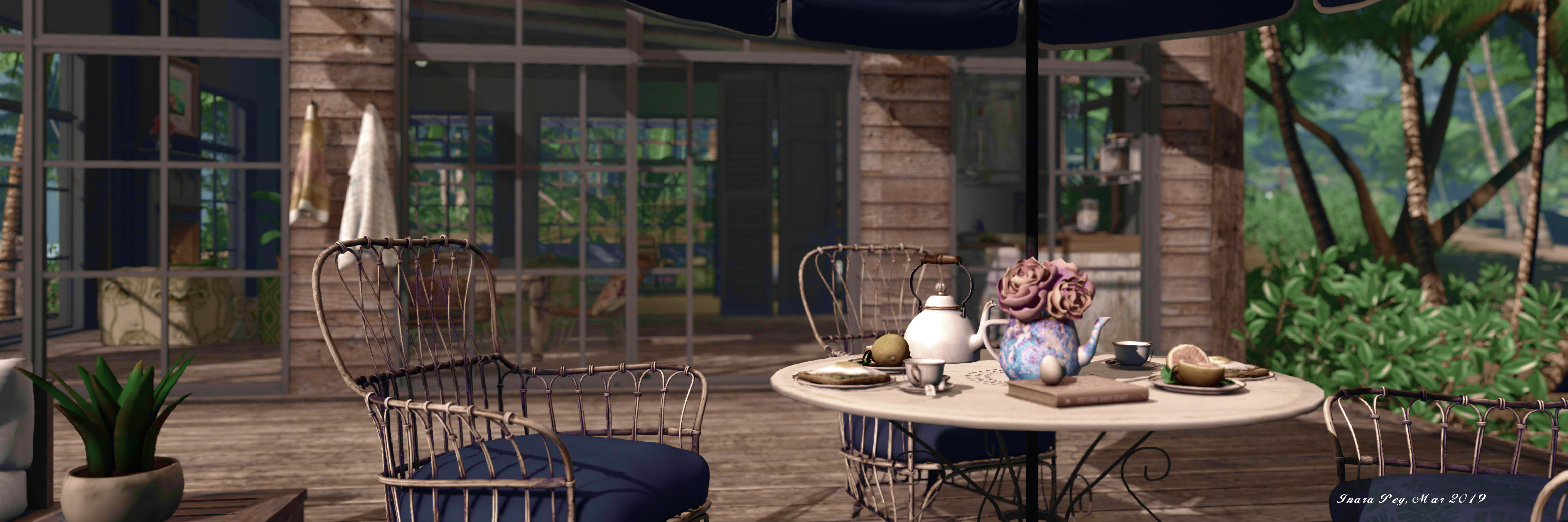
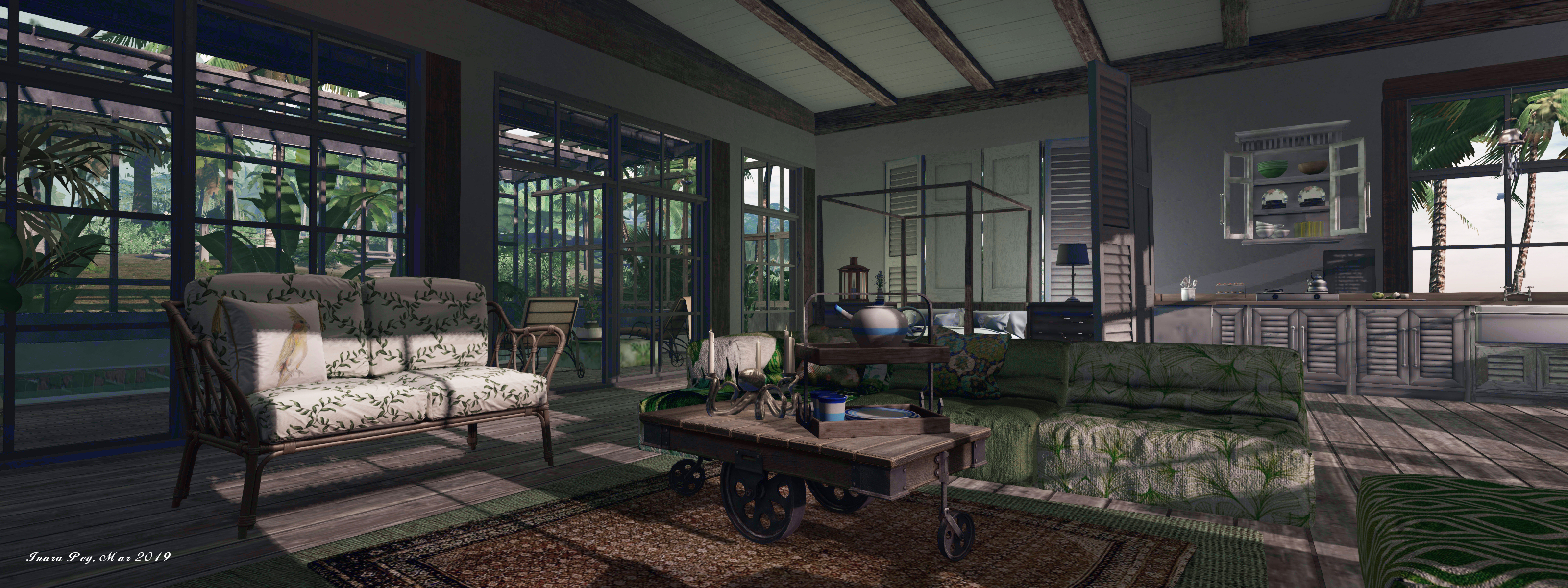
The low-lying areas of the region to the west offer beach houses, sand, board walks over the shallow waters of the bay, open decks over both sand and water, all of which are woven together to present the most idyllic setting: the perfect vacation paradise. As the beach houses are presented for public access, there is no danger of trespass, and they offer additional places to sit and relax and become immersed in the setting as the westering Sun casts long shadows over sand and grass.
As well as the waters of the bay, the west side of the island offers a small rock-encircled pool for bathing while the board walks continue over the sands, helping to form – along with the bay itself – a natural boundary between the low-lying beaches and the island’s uplands.
The latter are reached via stone steps cut into the rocks or an age-worn path, and rise in tiers, the trees slowly changing with altitude, with the palm trees gradually giving way to a small rain forest that hugs the upper reaches of the island. These tiers are cut by a the passage of water that cascades down falls and flows along rocky channels to feed the bay below.
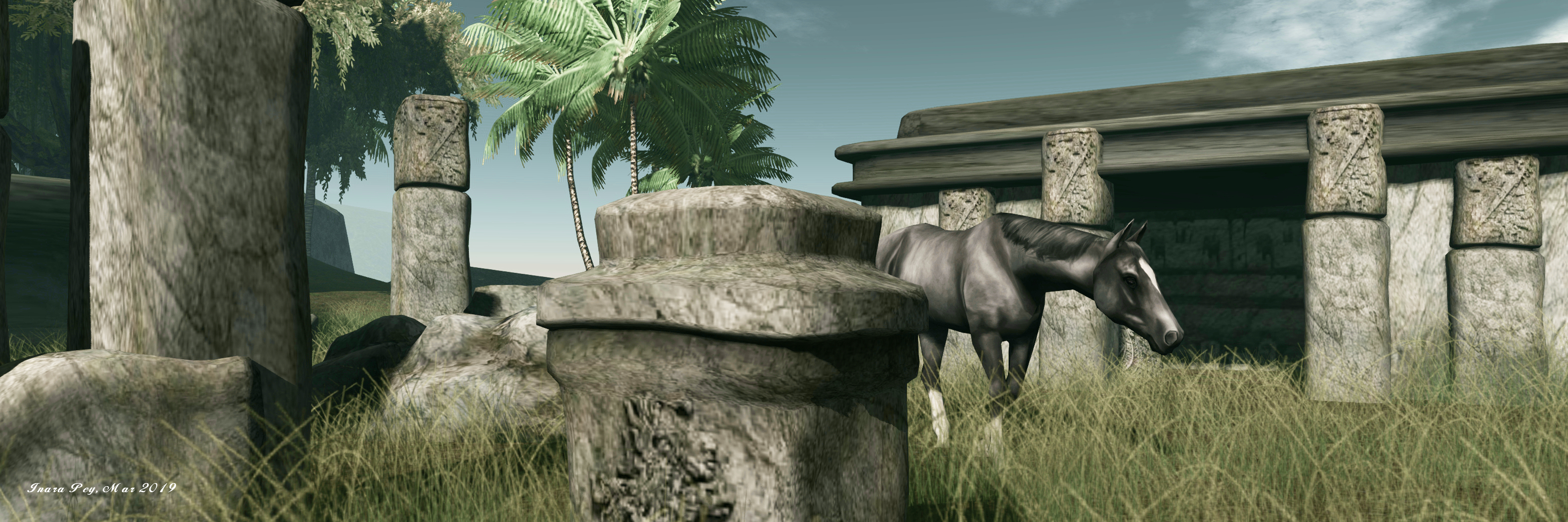
It is up on the highest level of the plateau, where the air is rent by lightning, the ancient Aztec ruins can be found, presided over by a large stone tablet raised onto its edge. These ruins, backed by the dense foliage of the rain forest, actually form the region’s landing point, and offer a marvellous lookout down and to the west to the beaches and the setting Sun.
Two paths – one at the foot of the steps cut into the rock of the plateau and which lead down to is first lower tier, the other running through the trees of the rain forest and then down through a rocky gorge, lead the way north to where that heavy bridge of felled (or fallen) tree trunks crosses the chasm separating the two parts of the region. Across it, more ruins await discovery while paths and steps wind down the land to the west, passing snuggle spots and look-out points until they reach the little beach of a headland.
All of this only really scratches the surface of Salt Water. There is a wealth of detail to be discovered, from the way in which all of the snuggle spots, seating and look-out points offer views over and between trees to the ocean and the lowering Sun, to the inclusion of suitable wildfowl across the waters and in the air, to the selected sound scape.
A marvellous design, perfectly put together and well worth visiting and exploring. Photographs are welcome at the region’s Flickr group, and gratuities towards the upkeep of the region will be accepted by the monkey at the landing point.
The 2019 Virtual Worlds Best Practice in Education (VWBPE) conference will be taking place between Thursday, April 4th and Saturday April 6th, 2019 inclusive. A grass-roots community event focusing on education in immersive virtual environments, VWBPE attracts 2200-3500 educational professionals from around the world each year.
On Saturday, March 2nd, 2019, the organisers of the event announced their list of keynote speakers – one for each day of the event.
Thursday, April 4th Tom Boellstorff: (Tom Bukowski in SL), a professor of anthropology at the University of California, Irvine. His interests have included the anthropology of sexuality, the anthropology of globalization, the anthropology of virtual worlds, Southeast Asian studies, the anthropology of HIV/AIDS, and linguistic anthropology.
The winner of the 2009 Dorothy Lee Award for Outstanding Scholarship in Ecology of Culture, Media Ecology Association, his has authored several books, including Coming of Age in Second Life: An Anthropologist Explores the Virtually Human,(Princeton University Press, 2008), the result of two years fieldwork in Second Life, living among and observing its residents in exactly the same way anthropologists traditionally have done to learn about cultures and social groups in the so-called real world. He has also co-authored Ethnography and Virtual Worlds: A Handbook of Method (Princeton University Press, 2012) a concise, comprehensive, and practical guide for students, teachers, designers, and scholars interested in using ethnographic methods to study on-line virtual worlds, including both game and non-game environments.
Tom is perhaps best known for his joint study with Donna Z. Davis, Disability and Virtual Worlds: New Frontiers of Appropriation, which I first wrote about in 2016, and which is the subject of the film Our Digital Selves: My Avatar is me!
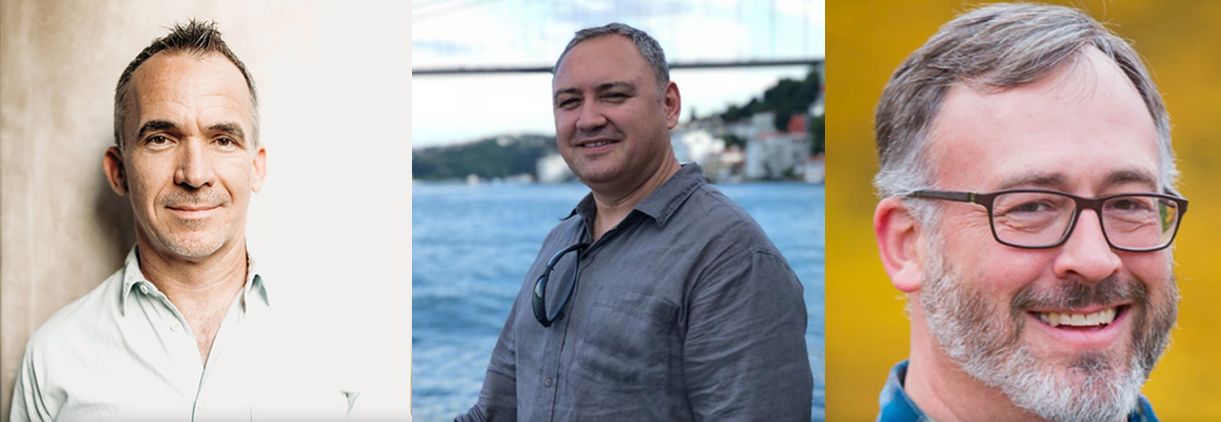
VWBPE 2019 keynote speakers: Tom Boellstorff, Tuncer Can and Jonathon Richter
Friday, April 5th Tuncer Can: Tuncer is no stranger to the vLanguages community, a VWBPE 2019 partner. His most recent collaboration with vLanguages is GUINEVERE, an EU Commission funded language learning project. An exploration of the GUINEVERE project in OpenSim will be offered as an Immersive Experience after the conference.
Saturday, April 6th Dr. Jonathon Richter: a long-time friend of virtual and immersive environments, Jonathon Richter is the co-founder and Executive Director of the Immersive Learning Research Network (iLRN). Jonathon will explore with us what works in immersive XR (VR/AR/MR).
Call for Volunteers
VWBPE would not be possible without the dedicated service and support of its volunteers. If you would like to help at the upcoming conference, please sign up today!
Update: There is still time to sign the petition / wrte to MEPs, the Parliamentary vote on the Directive is now set for between March 25th and March 29th, 2019.
There has been a lot written over the last few months about the upcoming European Union Directive on Copyright in the Digital Single Market. It’s a controversial topic. Within it, the Directive is an attempt to reshape EU copyright law for the internet age, and the relationship between copyright holders and on-line platforms.
In short, the core issues with the Directive – which has been under consideration by the EU for the last two years – come in three of its key elements, or Articles:
Article 11, (colloquially referred to as “the link tax”) which could severely restrict how we can share links, and information found on European on-line sites.
Article 13 (the so-called “meme tax”, although its scope is far greater), which has drawn the heaviest criticism, and is the Article I’m focusing on here.
Driven largely out of the wants and needs of big media rights holding corporations concerns about re-use of the media (be it music, film, television, whatever), Article 13 sees a fundamental shift in rights management on the Internet. Whereas currently, the onus is on the rights holders to content to protect their rights, Article 13 seeks to make content platforms responsible for ensuring anything uploaded to their services is not in violation of any IP / copyright – or face severe financial penalties.
Aimed at the likes of Google (including YouTube), Facebook and the like, Article 13 could fundamentally impact any platform playing host to user-generated content (UGC), including Second Life, Sansar and other virtual worlds.
Under the Article, all such services are expected to pro-actively prevent any content that might violate the Directive from being uploaded. They are to do so through the use of “proportionate content recognition technologies” – that is, automated content filtering, designed to block anything that might by in violation of copyright. However, such systems a) may not be affordable to those required to implement them, and b) don’t actually work as advertised (as is the case with Google’s multi-million-dollar ContentID system, which has been shown to be far from successful).
Flaws contained within Articles 3, 11, and 13 have generated global concern from politicians across Europe, government organisations such as the Electronic Frontier Foundation, businesses Internet experts such as America’s Cory Doctorow and the UK’s Glyn Moody and more.
Tim Burners-Lee, the father of the World Wide Web has been a critic of the proposed new EU Copyright Directive
Even German politician Julia Rada, who in 2014 was appointed rapporteur of the EU’s Parliament’s review of the 2001 Copyright Directive, and whose initial report Cory Doctorow described as “amazingly sensible”, has become a fierce critic of the new Directive.
However, such concerns – and suggestions for improvements to the Directive – have been largely brushed aside by the Directive’s chief proponents, the right-of-centre EPP, which has been vitriolic in its response to public concerns, dismissing them as the actions of “bots”, etc. Despite this, efforts to get the Directive reformed did prevent it being passed in votes held during 2018, and for a time at the end of the year, it appeared that saner heads would prevail, and both Article 11 and Article 13 would be revised.
Unfortunately, this has proved not to be the case. Due to the way in which the EU works, a final log-jam in the wording was cleared at the start of February 2019 when France and Germany – two nations strongly in favour of the Article 13 – reached an agreement. This leaves Articles 3, 11 and 13 fully retained, with Article 13 somewhat worse than previously worded, as Julia Reda explained:
In the Franco-German deal [PDF] … Upload filters must be installed by everyone except those services which fit all three of the following extremely narrow criteria:
Available to the public for less than 3 years [and]
Annual turnover below €10 million [and]
Fewer than 5 million unique monthly visitors.
Countless apps and sites that do not meet all these criteria would need to install upload filters, burdening their users and operators, even when copyright infringement is not at all currently a problem for them.
The potential implications of this are huge – and not just for EU-based services. Any service hosting content potentially covered by the Directive is liable to face significant issues, both in terms of trying to implement suitable content filtering and in potential penalties if they are considered to be in breach of copyright. Again, as Julia notes:
Even the smallest and newest platforms, which do meet all three criteria, must still demonstrate they have undertaken “best efforts” to obtain licenses from rights holders such as record labels, book publishers and stock photo databases for anything their users might possibly post or upload – an impossible task.
Nor does it end there. There are significant ambiguities in Article 13 that potentially make the upload of content from EU nations problematic for platforms / hosting services:
What happens to content before a platform receives notice from a rights holder over its use?
How does a platform provider go about seeking this information?
The role of rights holders in producing the required information needed by content platforms to identify their content.
The kind of content that will require a license.
Whether or not there are added legal responsibilities for creators.
There is no “fair use” provisioning (although the concept of “fair use” has never actually been enshrined in any EU law).
The first two bullet points above could result in content having to be blocked simply on the basis that it might be in violation of IP or copyright, while the third essentially puts all the cards in the hands of rights holders – theoretically a good thing, but one fraught with even greater potential for misuse by those rights holders that enjoy significant power.
The issue of the kind of content that will require a license, combined with the first two bullet points above it is particularly problematic where something like SL is concerned. What happens, for example to all the in-world models based on European vehicle, boat and aircraft designs? And what about images uploaded as textures or uploaded audio files, the playing of videos in-world? Such questions barely scratch at the surface of things.
Such are the remaining concerns that already, five EU nations have publicly opposed the current version of the Directive – the Netherlands, Luxembourg, Poland, Italy, and Finland.
The end-result on copyright is a step back for the digital single market. It [the EU Copyright Directive] fails to strike a balance between protecting right holders and the interests of individual citizens. This is why the Netherlands, Luxembourg, Poland, Italy and Finland don’t support the final package.
One of the final phases of this process is a vote on the current wording of the Directive by all 751 MEPs. This had originally been scheduled for March 23rd, 2019. However, in a cynical move aimed at preventing objections from the public being made and considered by MEPs, the EPP has pushed for the vote to be brought forward to March 12th.
This is why it is now vital for anyone in the EU concerned about the potential impact of Article 13 (and the Directive as a whole) to make your feelings known to your MEPs and to the European Parliament. there are two key ways to do this:
By visiting https://saveyourinternet.eu/act/ and using it to e-mail those MEPs from your country who have been in favour of, or have no opinion on, the Directive as it stands.
Because of the accusations that e-mails being received by MEPs voicing concern for about the Directive, it is very important you do not simply cut / paste text into e-mails “as is”, but you take the time to write a personal letter. However:
Glyn Moody’s has provided a blog post which might help in formulating your own blog post.
My own e-mail (sent earlier this year) can be found here – again, please do not simply cut and paste, but use it as a potential guideline for your own e-mail.
When I last spoke to Linden Lab on the subject, they indicated that they were following the progress of the Directive and would review matters once the Directive was approaching legal status. Those of us in the EU, can – and noted – make our voices heard; so please do make sure you take the time before March 12th to e-sign the petition, locate your country’s MEPs and send an e-mail.
Logos representative only and should not be seen as an endorsement / preference / recommendation
Updates for the week ending Sunday, March 3rd
This summary is generally published every Monday, and is a list of SL viewer / client releases (official and TPV) made during the previous week. When reading it, please note:
It is based on my Current Viewer Releases Page, a list of all Second Life viewers and clients that are in popular use (and of which I am aware), and which are recognised as adhering to the TPV Policy. This page includes comprehensive links to download pages, blog notes, release notes, etc., as well as links to any / all reviews of specific viewers / clients made within this blog.
By its nature, this summary presented here will always be in arrears, please refer to the Current Viewer Release Page for more up-to-date information.
Note that for purposes of length, TPV test viewers, preview / beta viewers / nightly builds are generally not recorded in these summaries.
Official LL Viewers
Current Release version 6.1.0.524670, formerly the BugSplat RC viewer February 13, promoted February 28. NEW.
Release channel cohorts:
EEP Release Candidate viewer version 6.0.2.524683 released on February 27th.
No man is an island is the opening line from a poem by English poet and cleric John Donne which perhaps is more often referenced via quotations of its final lines, And therefore never send to know for whom the bell tolls; It tolls for thee.
However, this poem actually originated as a passage of greater length and written in prose as Meditation 17, from Donne’s Devotions Upon Emergent Occasions. Originally written in late 1623 (and published the following year), Devotions was written whilst Donne was recovering from a but unknown illness (possibly relapsing fever or typhus), and forms a reflection of death, rebirth and the Elizabethan concept of sickness as a visit from God, reflecting sinfulness, with each of the 23 devotions within it a meditation on a single day of Donne’s illness.
I mention this because No Man Is An Island is also the title of the latest immersive installation by Angelika Corral and Sheldon Bergman, artist curators of DaphneArts, with the installation itself marking the reopening of the gallery at a new location in Second Life.
Taking its lead from Devotions, the installation offers the opportunity to reflect on Donne’s words as they came to be written in the poem, using a visual setting, music and the spoken word. Full instructions are provided at the landing point – and if you are using the Firestorm viewer, then you should automatically receive the required windlight environment setting. You should also accept the HUD that is offered on arrival. This will attach itself to your world view to present you with a “letterboxed” style view of your surrounding. If, by chance, you’re not using Firestorm and / or the HUD doesn’t attach (or you accidentally reject its request to attach), instructions and an option to obtain the HUD can be found on the wall of the arrival area.
The main setting for the installation and the poem’s recital is very atmospheric – and made more so by the music (played as local sounds, not via any audio stream). Across a windswept stretch of sand stands the silhouette of a lighthouse drawn against the heavy sky, a hut below it lit from within. A candle-lit bridge, with more candles scattered over sand and rocks despite the rain, beckon you forward to hut and lighthouse.
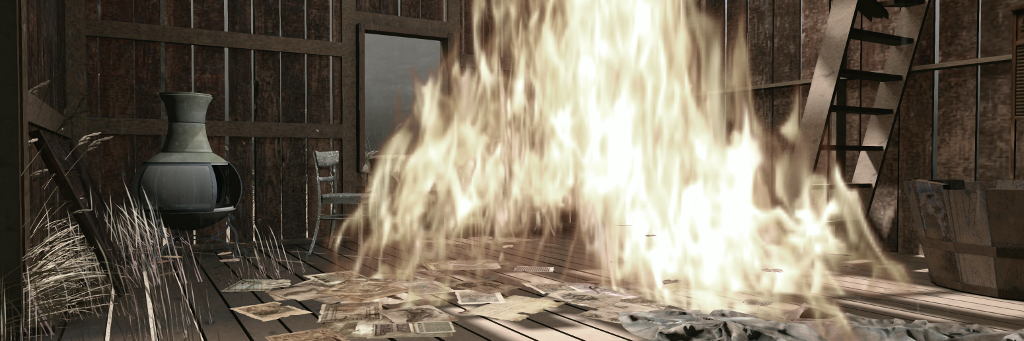
As you approach the hut, the light from within is revealed as a fire, burning brightly in the single room and consuming pages of manuscripts together with a shroud-like blanket. More candles light the way up the lighthouse and its single door. Inside lies the opportunity to listen to a recital of the poem, and contemplate the sculptures that sit within the lighthouse walls.
Perhaps disarmingly simple in appearance, No Man Is An Island is actually nuanced and layered in presentation. Within Meditation 17, Donne is considering the nature of death (his own), and its impact (on him, if it is fact claiming another and not him), noting:
No man is an Iland, intire of it selfe; every man is a peece of the Continent, a part of the maine; if a Clod bee washed away by the Sea, Europe is the lesse …. any mans death diminishes me, because I am involved in Mankinde;
Thus, within the hut with have the fire and the burning of manuscripts, many of the pages painstakingly written and illustrated by hand. They represent the idea that a loss does not just impact the one or the few, but lessens the whole; in their burning, the pages are not just lost to whomever set them ablaze, but are lost also to all who might otherwise have read them. Similarly, the blanket with its edge caught within the flames might be taken as a death shroud, symbolising, Donne’s view that any mans death diminishes me, because I am involved in Mankinde
In addition, the presence of the lighthouse offers reference to life and death, presenting a balance of views that reflects Donne’s thoughts. On the one hand, it was once perhaps the loneliest job on Earth, undertaken in isolation, would his passing of a lighthouse keeper really be missed by the world? But on the other, the role by its very nature was to protect the lives of those at sea, steering them away from the risk of death through the loss of the vessel beneath them – so yes, the loss of a lighthouse man could be sorely missed by the rest of us.
Other references are more obvious – the island-like setting, the rain (the curtained veil of death) – even our place in the cosmos (or what Donne might have regarded as God) is brought into focus, both visually and through the eternal questions repeatedly asked at the landing point.
It’s time to highlight another week of storytelling in Voice by the staff and volunteers at the Seanchai Library. As always, all times SLT, and events are held at the Library’s home at Holly Kai Park, unless otherwise indicated.
Sunday, March 3rd, 13:30: Tea Time with Mary Russell and Sherlock Holmes
Following his retirement from active investigations, Sherlock Holmes moved to the Sussex Downs in order to keep bees. However, the gentility of his retirement takes a turn after an encounter with one Mary Russell, a 15-year-old orphan from the United States who moved to England to live with her Aunt.
Somewhat precocious, Mary Russell is also gifted with wit and intellect, and without anything being planned, the two form a new partnership, Holmes teaching Russell his trade craft and assisting her in solving crimes, their adventures charted by American writer, Laurie R. King.
For six years the two work together, until 1921, when they deal with the case of A Monstrous Regiment of Women. At the end of that adventure, Holmes and Mary are wed – but the matter was only given passing mention in the story.
With The Marriage of Mary Russell, here recounted in voice Savanah Blindside, Da5id Abbot, Kayden OConnell, and Caledonia Skytower, Laurie King revisits the nuptials between the two in a short story that also helps to fill some of the blanks around the relationship between Russell and Holmes.
A Tea Time Special Vote
In March and April, Seanchai Library will be presenting Sherlock Holmes Greatest Hits for the Sunday Tea Time at Baker Street sessions. BUT – which four stories should they present? A short list of 10 of the adventures completed by Holmes and Watson has been drawn up, but Seanchai fans and supporters have the power to select the final four. Just visit Sherlock’s Greatest Hits, read the synopses of the short listed ten stories and place your vote for your preferred stories in the list. The final four will be selected from those receiving the most votes.
Monday, March 4th 19:00: The World Of Ptavvs
Gyro Muggins returns to Larry Niven’s Known Universe to read the first novel Niven ever set within it – given it was actually he first full-length novel. Within it, he lays many of the seeds, human and alien that would come to define that universe, its characteristics, traits and races.
A reflective statue is found at the bottom of one of Earth’s oceans, having lain there for 1.5 billion years. Humanity’s experiments with time manipulation lead to the conclusion the “statue” is actually an alien caught within a “time slowing” field.
Larry Greenberg, a telepath with highly developed and honed abilities is asked to participate in an attempt to make contact with the alien. This involves Greenberg and the “statue” being places within a single time slowing field, the effect of which is to nullify the one shrouding the alien.
The the new field in operation, Greenberg finds himself in the company of Kzanol, a member of a race called the Thrint. Powerfully telepathic, the Thrint once rules the galaxy pure through their mental powers and the ability to bend the minds of others to their own will. However, in the time that Kzanol has been trapped the result of a malfunction aboard his ship which forced him to abandon it and fall to Earth protected by the stasis field of his space suit, the Thrint were facing a revolt by all the races they had enslaved.
As a result of this, the Thrint had determined to wipe out every race in the galaxy using a thought amplifier. Now, his own mind mixed with that of Kzanol, Greenberg sets out with the alien with the aim of using the weapon to enslave every mind in the solar system…
Tuesday, March 5th 19:00: The Storyteller’s Path
An original story presented by Caledonia Skytower, together with poems by W.B. Yeats, time permitting.
Wednesday, March 6th 19:00: Selections from Wind on the Willows
With Faerie Maven-Pralou.
Thursday, March 7th
19:00: Beyond the Veil
A story from Ancient Ireland. With Shandon Loring. (Also in Kitely grid.kitely.com:8002:SEANCHAI).
21:00: Seanchai Late Night
Contemporary science fiction and fantasy with Finn Zeddmore.
 Salt Water – click and image for full size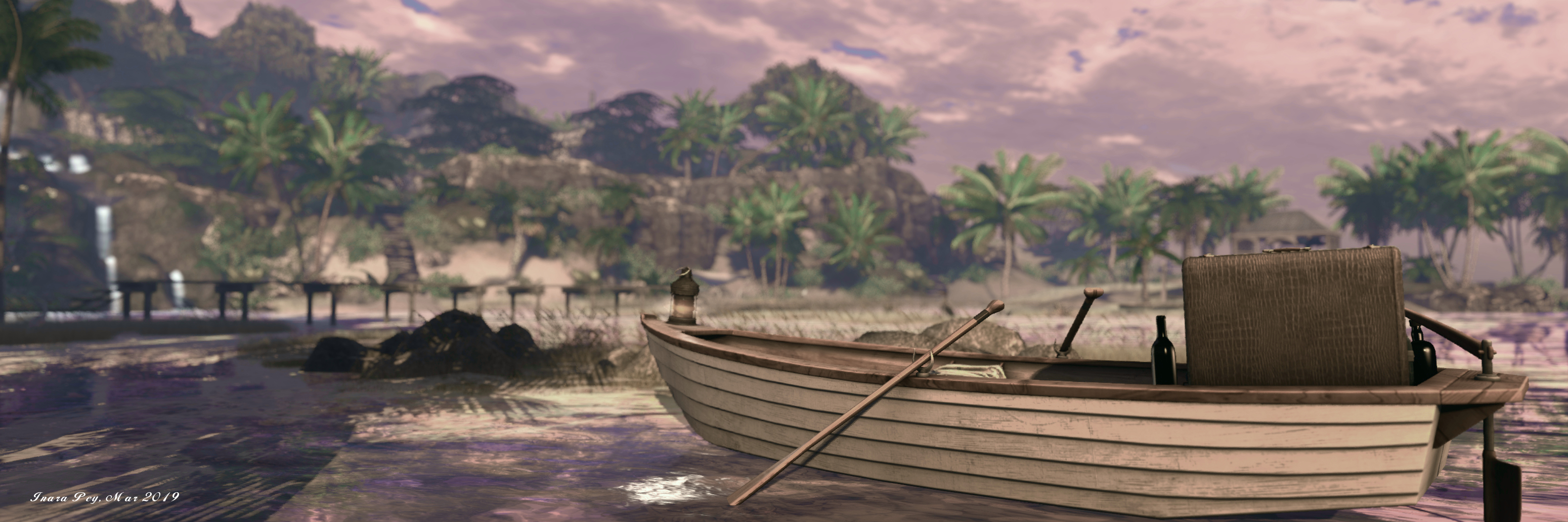












 Inara Pey: Living in a Modemworld