Speedlight: group functionality and other updates

via Speedlight

It’s been a little over a month since my last update on Speedlight, the browser based Second Life client, so here’s a quick round up of the major updates since then.

Note that unless otherwise stated, the following notes apply to the browser version of Speedlight, as at the time of writing they had yet to be applied to the dedicated Android app version or (so far as I’m aware), the beta iOS app version.

Group Support

Perhaps the most noticeable update to the browser version of Speedlight since June is the expansion of Group related capabilities, specifically:

  • Search your groups.
  • View group notices and send  group notices.
  • Leave a group.
  • Invite someone into a group.

Obviously, all group actions are subject to the group permissions assigned to your role within the group.

Notes:

  • Groups are accessed via the Group option in the Speedlight client menu.
  • The Group option will display your current groups as a searchable list, via the Search option at the top of the list.
  • When using Speedlight on a mobile device, the group list is displayed as an overlay to the main group information display, and is shown / hidden by tapping the Groups>> link displayed at the top of the options menu.
  • Tapping on the name of a group in the list will open the Group Info panel, shown below (and auto-close the Group list mobile devices).
The updated group display panel showing: 1. The pre-existing Group Chat button; 2. the new Group Notices button; 3. the Button to Join / Leave a group; 4. the Group Invite button.

Group Notices

Note: at the time of writing, the group notices functionality was only available to the browser version of Speedlight (any browser / device).

  • To view your group notices, click / tap the Group Notices button.
  • The Group Notices panel will open and load any available notices.
  • Click / tap on any notice to display it below the list of available notices.
  • Note that notice attachments cannot presently be viewed / opened, but are listed in the text of the notice.
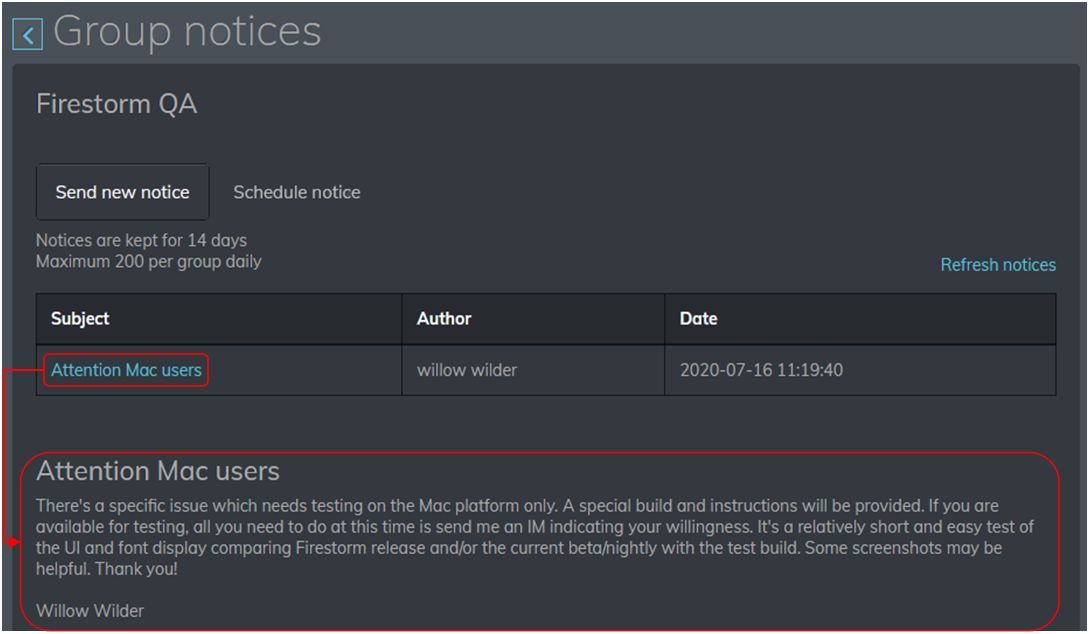
View a group notice in the Speedlight browser version

The Group Notices panel has two buttons associated with it:

  • Send New Notice – described below.
  • Schedule a Notice – this option is either awaiting implementation or a Gold / Patreon subscription option. As I currently do not have either of the latter, I was unable to check, ergo it is excluded from this article.

Send a Group Notice

Subject to group permissions you can also create and send group notices from Speedlight:

  • From the Group Notice panel, click the Send New Notice button at the top of the panel.
  • The New Notice panel is display. Here you can:
    • Enter a title for the notice.
    • Enter the text of the notice. Note the character counter will turn red if you exceed the 512 character count for a notice, and the text beyond that point will be truncated when the notice is sent.
  • Click the Send Notice button when you’re ready to send your notice.

Send a Group Invite

Subject to group permissions you can send a group invitation to one or more users from Speedlight:

  • From the Group Info panel, click the Invite to Group button.
  • The Invite to Group panel is displayed.
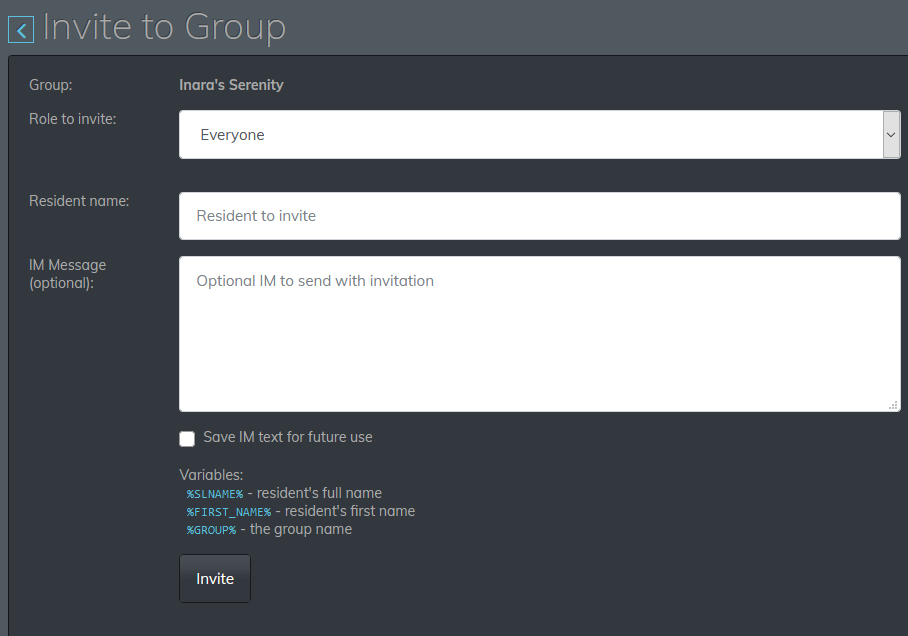
Speedlight Invite to Group panel
  • Role To Invite: select the required role (if available) that will be offered in the invite.
  • Resident Name: enter the avatar name of the person whom you wish to receive the invite.
  • IM Message (optional): if you wish, you can send the person you are inviting an IM alongside the group invite – such as an explanation on why you’re sending it, etc.
    • Note you can use the listed variables to personalise the IM. For example, clicking the %FIRST_NAME% option will precede your IM with the recipient’s first name, while %GROUP% can be used to display the group’s name in the IM.
  • When you’re ready to send the invite, click the Invite button.

Additional notes for group invites:

  • Pressing ENTER after typing the recipient’s name will actually send the invitation, so if you want to send an IM with the invite, be sure to click / press TAB / tap to position the cursor in the IM field.
  • You can also append “sent from Speedlight” to the invite IM (and any other initial session IM you send to someone) by going to Settings in the left menu and then checking Append “Sent from SpeedLight” to my IMs (first message of the conversation only) .

Other Updates

Search Functionality

The Search functionality has been tweaked so that you can now:

  • Search for friends in your Friends List.
  • Search for IMs in you IM history by sender’s name.
  • Search for a group in your groups list (as described above).

Teleport Offers

You can now accept / decline teleport offers via the Notifications bar.

Multi-Line Text Entry (Chat and IM)

Both IMs and local chat accept multi-line text entry – use SHIFT-ENTER to start a new line / offer a paragraph break.

RLV Support

RLV support is now available to Speedlight Gold and Patreon users. However, it is not clear if this is Marine Kelley’s RLV API or Kitty Barnett’s RLVa API.

Android and iOS App Versions

  • The Android version has yet to receive the multi-line text input option and the group updates, as noted. However, it has received a series of bug fixes and allows errors or issues to be reported back to the developers.
  • The iOS version version of Speedlight is available for Speedlight Gold and Patreon users, and requires Apple’s TestFlight app to be installed on the device using it.

Feedback

The group updates are good to have, with the promise of more to come. Further performance improvements are in the offing as well, apparently. This may well be a good thing, as it appears the issue from April of an avatar refusing to stop moving once set in motion in the 3D World view, is back, and once again requires a relog to stop it. I’ve no idea how widespread this issue is, or if it is encountered on Android devices (as my poor little Nexus 2013 HD cannot run Speedlight’s 3D rendering, being stuck on Android 6.0.1), but for me, it is consistent and appears to be a regression. I shall await further updates with interest.


Related Links

Bryn’s mythical creatures in Second Life

Bryn Oh: Mythical Creatures

Now available at her Immersiva arts region, is Bryn Oh’s latest presentation Mythical Creatures, which is will have an official opening on Sunday, July 19th, 2020.

Perhaps the best way to describe this collection of 21 pieces is as a series of art collectibles, in that they come with a unique property, which I’ll get to shortly.

This was a fun project where I researched 20 legendary, mythical or creatures of folklore from around the world and re-imagined them. Some are well known such as the Dragon or Phoenix, but then there are more obscure ones like the Nariphon or the horrifying Manananngal.

– Bryn Oh on Mythical Creatures

Bryn Oh: Mythical Creatures

Each creature is presented as a 3D sculpture on a plinth bearing a brief description of the creature’s form. More detailed descriptions of the creatures and their histories, drawn from multiple sources, hang from the ceiling of the hall behind each of the sculptures. As Bryn notes, some of the creatures are very well known; others may ring bells without necessarily being something we’re actually deeply familiar with, whilst others are liable to be entirely new to us. For me, examples of the latter two would be the Baba Yaga – something I’d heard of, but not actually researched, and the Tatzelwurm, a creature I’d never heard of.

As well as the Russian Baba Yaga and Swiss Tatzelwurm mentioned above, the collection comprises: from Greek / Roman mythologies Capricorn, Cerberus, the griffin, Medusa, and the phoenix; from Japanese mythology: Jorōgumo, Kitsune and Ōmukade; from multiple folklores and mythologies: the dragon and the mermaid; together with the banshee (Irish mythology), the ettin, the kraken (Scandinavian), La Sayona (from Venezuela), the manananggal (Philippines), the nariphon (Buddhist legend), the Canadian Ogopogo, and the Chinese qilin.

Bryn Oh: Mythical Creatures

And in case you’re wondering why I reference 21 pieces, but only list 20 creatures, that’s because there is a bonus item in the collection, the Bryn Oh.

Bryn Oh is a pale white moth girl born on the Internet. She has curved glowing horns, cyberpunk interface plugs, wings or a neko tail. She is queen of the moths and creates stories and worlds with hidden meaning inside. She has magic and when threatened she can deform her enemies or launch them high in the air. She is drawn to music but often lurks on the outside listening and never dancing. Other creatures find her strange an melancholy.

– the description of the “Bryn Oh”

What is special about these creature is the manner in which they have been created in two parts: “left” and “right” as you look at each of them. Gacha machines within the exhibition halls allow visitors to obtain a random “left” or “right” half of a creature. Any “left” part of a creature can be combined with any “right” part of another creature to create an entirely new one. The clever part here is that whichever combination of to parts is put together, the descriptive text on the two plinth halves will always seamlessly combine to offer a description of the new creature.

Bryn’s own notes on combining a “left” and “right” half from two sculptures to creature a new creature

Thus, it is possible to creature any of the original creatures in the exhibition by collecting all of the different halves – with up to 441 combinations of creature to be created. Further, to help in the joining process, the individual halves have been scripted so that when placed together, they will correctly align and join.

Another interesting aspect of these creatures is the sources Bryn has drawn upon to creature their “mini biographies” hanging in the exhibition halls, and the manner in which set portrays some of them. With Medusa, for example, the focus is very much on her violation at the hands of Posidon – and for which Athena unfairly punished the young and beautiful girl, turning her into the monster with whom we are more familiar.

Bryn amongst her creations

As noted, Mythical Creatures officially opens on Sunday, July 19th, 2020, with a special event starting at 15:00 SLT. Skye Galaxy will be providing the music, supported by Semiiina. And when visiting, keep an eye open for Bryn’s flying machines that have appeared in her own mythologies and her floating / falling bricks that have also featured in her past work, and both of which – together with the design of the exhibition hall, very much hook Mythical Creatures into her universe.

SLurl Details

An ethnographic exhibition in Second Life

Ethnographic Exhibits of Two Cultures from the Republic of Panama

Available now at the Community Virtual Library, and with its official opening towards the end of July 2020, is Ethnographic Exhibits of Two Cultures from the Republic of Panama.

A collaboration between Nexus Dot, a  cultural anthropologist, and co-curator and media specialist Shiloh Emmons, the exhibit represents two decades of ethnographic research Nexus has made studying two groups indigenous to the lowland tropical rain forests of Panama, the Guna and the Emberá, examining their life styles, culture, art and religion.,

Located on a sky platform, the exhibition comprises six main components that examine both the Guna and the Emberá from several perspectives, including their cultures, the Mola art of the Guna, Emberá cosmology, ecology, and shamanism, and more. In addition, the exhibition presents photos of the Emberá Drua heritage ecotourism project, and offers an ethnobotany examination of how these lowland cultures of Panama make use of plants.

Ethnographic Exhibits of Two Cultures from the Republic of Panama

The aim of the exhibition is two-fold:

  • To communicate Nexus’ work in studying these two groups of people over a span of two decades, and the place and role of such cultures in the world today.
  • To provide the non-profit community and education system with a template of how scientific research can be transformed into an engaging, multimedia 3D virtual experience that resonates with scientists, educators, and interested Second Life residents.

The video below serves as a general introduction to the exhibit.

Based in both Panama and Idaho, USA, Nexus earned his MA in anthropology at the University of Oregon, where he specialised in the ecology and cosmology of tropical indigenous cultures, and where he also spent time as a graduate teaching fellow. Whilst he does hold that MA in anthropology, his work in studying the Guna and Emberá is very much born of personal passion, rather than being funded directly as a part of a set academic study.

Most of my research is self-funded, although I have executed a number of projects for agencies and institutions as a consultant. Often these projects were involved with ecological l or socio-economic components, so there is a link there. I’m also a geospatial analyst, and have been involved in computer mapping and handling data like the COVID map system; I’m actually at my farm in the countryside of Panama at the moment due to the general quarantine.

– Nexus Dot discussing his work

As a long-time user of Second Life who had been largely absent the platform several years, it was the current SARS-CoV-2 situation that encouraged Nexus back, with the idea of experimenting with the platform to see how well complex material like a professional anthropological paper might be translated into an engaging, multi-media learning tool, and a meeting with Shiloh started the ball rolling with the exhibit.

Ethnographic Exhibits of Two Cultures from the Republic of Panama

The exhibition is open now informally to visitors, with the formal opening taking place on Sunday, July 26th – of which more below.

Ahead of that, however, on Sunday, July 19th, Nexus will gives a short presentation about his work, and discuss the value of the anthropological perspective. The specifics of this event are:

The formal opening on July 26th will be split between the exhibition space and the CVL meeting place, and comprise the following schedule and activities:

  • 11:20am: the exhibition will be available for those wishing to visit it ahead of the opening activities.
  • 11:50am: Beragon Betts will introduce Nexus Dot at the CVL meeting place.
  • 12:00 noon: Nexus will present  Mola art and aesthetics among the Guna people.

Arisia Vita will will provide music ahead of the presentation, and people will again be able to visit the exhibition following the presentation, with both Nexus and Shiloh on hand. Those attending this event are asked to take their seats in the CVL meeting place no later than 5 minutes prior to the presentation commencing.

For me, the talks are the meat, the exhibit well it is the teaser so to speak; although the exhibit has taken on something of a life of its own! We’ve tried to ensure people can still appreciate the exhibition should they be unable to attend the presentations.

– Nexus Dot discussing his work

Ethnographic Exhibits of Two Cultures is an engaging exhibition, rich an detail and information, and an absolutely must see for anyone with an interest in anthropology, ethnography or culture.

SLurl Details

Cookie, the home of CVL, is rated Moderate.

Casting call for a new Second Life Documentary

Credit: unknown

Olivia De Camps is a freelance Dominican-American film student in her Senior year at New York University Tisch School of The Arts and a former intern at the New York based independent film production company, Killer Films Inc.

For her latest project, she has teamed with producer and writer Tom Sidi in order to produce a documentary examining the ways in which people use virtual worlds like Second Life, with their introduction to the project stating:

THROUGH A SERIES OF INDIVIDUAL STORIES, THIS DOCUMENTARY AIMS TO EXPLORE THE CORE OF BASIC HUMAN INTERACTION. FOR MANY INDIVIDUALS, VIRTUAL WORLDS NOT ONLY SERVE AS ESCAPISM, BUT ALSO MORPH INTO AN EXPANSION OF THEIR REAL LIFE – WHERE GENUINE FRIENDSHIPS ARE FORMED, ECONOMY THRIVES, AND OFTEN ROMANCE IS BUILT UPON AN VIRTUAL IMAGES THAT IS FREQUENTLY TRANSFERRED INTO THE REAL WORLD. USERS HAVE THE ABILITY TO IMMERSE IN THE WORLD THEY HAVE ALWAYS DREAMED OF LIVING IN, EXPLORING THEIR GENDER, RACIAL OR SEXUAL IDENTITY, AND CREATING STRONG BONDS WITH PEOPLE THEY MIGHT NEVER GET A CHANCE TO MEET OFF-SCREEN. AS WE HAVE BEEN SUCK AT HOME WITHOUT A POSSIBILITY TO PHYSICALLY MEET, THE IDEA OF A DIGITAL WORLD HAS BECOME EVEN MORE ATTRACTIVE.

– Olivia De Camps and Tom Sidi

Olivia De Camps

In order to make the documentary, the team are seeking Second Life users who are willing to to be interviewed and have their avatars filmed as they tell their own stories about their particular interest(s) in, and use of, the platform. In particular, they are interested in hearing from people who can represent the broadest possible use of Second Life, noting:

WE ARE SEARCHING FOR STORIES TO TELL FROM AN EXPERIENTIAL, NON-JUDGEMENTAL AND VISUALLY-DRIVE WAY. TELL US YOUR STORY! HOW HAS SL BEEN A WORLD FOR YOU IN QUARANTINE? HAS IT HELPED YOU FIND YOUR IDENTITY? DID YOU FORM A SPECIAL RELATIONSHIP ON THE PLATFORM? IF YOU ARE AN ARTIST, DO YOU COME HERE TO SHARE YOUR WORKS (DESIGN, CLOTHES, HOST VIRTUAL RAVES, TAKE DIGITAL PHOTOGRAPHY)? WE ARE LOOKING FOR PEOPLE WHO WOULD LIKE TO SHARE THEIR SL EXPERIENCES WITH US, DURING OR BEFORE QUARANTINE. YOU CAN CHOOSE TO REMAIN ANONYMOUS IF YOU WISH.

– Olivia De Camps and Tom Sidi

Those interested in taking part or wish to receive further information, should cotact either Olivia (oliviadecamps-at-gmail.com) or Tom ( t-at-boraxcfm.com) directly.

2020 Content Creation User Group week #28 summary

Wision, May 2020 – blog post

The following notes were taken from my audio recording and chat log of the Content Creation User Group (CCUG) meeting held on Thursday, July 2nd 2020 at 13:00 SLT. These meetings are chaired by Vir Linden, and agenda notes, meeting SLurl, etc, are are available on the Content Creation User Group wiki page.

This meeting featured a lot of general chat on possible features and / or performance improvements that might (or “should”) be made to SL, comparisons in the pros and cons of incremental changes over “radical” changes (e.g. the former can be turned around more quickly, but can be finite in pact; the latter can dramatically change/ improve SL, but on a time frame that means that when they are delivered, they’re not what users are looking for / they don’t actually deliver what had been anticipated), etc.

SL Viewer

Currently, the official viewers remain unchanged from the start of the week:

  • Current Release viewer version 6.4.3.543157, dated June 11, promoted June 23, formerly the CEF RC viewer – No Change.
  • Release channel cohorts:
  • Project viewers:
    • Custom Key Mappings project viewer, version 6.4.5.544079, June 30.
    • Mesh uploader project viewer, version 6.4.4.543141, June 11.
    • Copy / Paste viewer, version 6.3.5.533365, December 9, 2019.
    • Project Muscadine (Animesh follow-on) project viewer, version 6.4.0.532999, November 22, 2019.
    • Legacy Profiles viewer, version 6.3.2.530836, September 17, 2019. Covers the re-integration of Viewer Profiles.
    • 360 Snapshot project viewer, version 6.2.4.529111, July 16, 2019.

General Viewer Notes

  • The Tools Update RC viewer is on track to be promoted to de facto release status, possibly on Friday, July 17th, or more likely week #29 (commencing Monday, July 20th).
  • The Love Me Render viewer is still seeing additional EEP fixes added to it, as well as some other issues that are being looked into.
    • The upcoming version of the LMR viewer will include a fix for the EEP specularity issue (see BUG-228781 and BUG-228581).
    • BUG-229079 “[EEP] Density multiplier does not allow full range of settings to be saved/loaded”, requires adjustments to be made to both the viewer and the simulator code.
    • BUG-229031 “[EEP] Water has a large performance hit on EEP” has been accepted, an analysis has yet to be completed.

ARCTan

Project Summary

An attempt to re-evaluate object and avatar rendering costs to make them more reflective of the actual impact of rendering either in the viewer. The overall aim is to try to correct some inherent negative incentives for creating optimised content (e.g. with regards to generating LOD models with mesh), and to update the calculations to reflect current resource constraints, rather than basing them on outdated constraints (e.g. graphics systems, network capabilities, etc).

As of January 2020 ARCTan has effectively been split:

  • Viewer-side changes, primarily focused on revising the Avatar Rendering Cost (ARC) calculations and providing additional viewer UI so that people can better visibility and control to seeing complexity.
  • Work on providing in-world object rendering costs (LOD models, etc.) which might affect Land Impact will be handled as a later tranche of project work, after the avatar work.
  • The belief is that “good” avatar ARC values can likely be used as a computational base for these rendering calculations.

Current Status

  • It’s still not clear in the Jelly Doll updates will appear in an ARCTan project viewer or within a project viewer of their own. These are more generic Jelly Dolls that improve their rendering.
  • It might be preferable for the Jelly Doll updates to move to their own project viewer, as ARCTan is awaiting a Bake Service update, which is in turn held up due to the on-going cloud uplift work.
  • There was a scare that the ARCTan updates might cause a performance hit – although this might be down to a system configuration issue and is still being investigated.

In Brief

  • There is some background work going on to update the Second Life systems requirement page. Not so much because SL’s requirement have changed, but simply to bring them more in-line with modern systems.
  • The data the Lab does gather on client systems indicate that a lot of users are based on laptops using on-board graphics and “a lot on older systems”.
  • Next meeting: Thursday, August 20th, 2020.

Linden Lab’s acquisition: sundry thoughts & speculation

via lawdonut.co.uk

It’s been a week since the news broken that Linden Lab is in the process of being acquired by new owners (see Linden Lab announces it is to be acquired, July 9th, 2020). Since then there has been a lot of comments and speculation ranging from the entirely positive to the inevitable “we’re doomed! / the sky is falling!”

Some have raised concerns that neither J. Randall Waterfield nor Brad Oberwager have experience with running games companies. However, having hands-on experience in running the type of company in which you’re investing isn’t actually a prerequisite for funding / representing / guiding it. Rather, what’s important is having the ability to understand the company, appreciate its value proposition and being able to contribute to its continued growth; and both Mr. Oberwager and Mr. Waterfield appear to have these abilities. In particular, J. Randall Waterfield, as CEO of the Waterfield Group, comes from an environment where long-term investment in companies to ensure their growth is very much the raison d’etre.

Waterfield buys and builds well-run American businesses.
We prefer basic businesses with a few years of proven, conservative growth. We avoid companies that are growing too fast. We believe slow and steady makes the race… We strive to be a good partner to existing management, are passive with regards to general managerial issues, and work hard to help our CEOs and their families’ realize their vision.
Waterfield’s investment timeframe is forever. We work to grow book value at a reasonable pace with no exit in mind.

– from the About / Investment Criteria page of Waterfield

Now, to be clear, it’s not the Waterfield Group that is investing in Linden Research, but rather a venture between Mr. Waterfield and Mr. Oberwager; but given Mr. Waterfield’s pedigree with long-term investment, is hard not to see him taking the same approach in his other ventures.

Nor should the fact that Mr. Oberwager has sold off three of the businesses he’s built be seen as a negative. Building a company from the ground up is a different matter to investing in an established, profitable entity, and selling the former in order to repeat the cycle isn’t automatically indicative of a intent to buy-in to an existing company simply to sell it on without a longer-term commitment.

Which is not to say a buy-out like this isn’t without risk; with the best will in the world on the part of incoming investors to a company, things don’t always go as planned or turn out as hoped – but planning for failure isn’t generally how investors set about acquiring profitable companies.

A further point to remember is that acquiring a company isn’t something that happens overnight; it can actually take multiple months or even years to progress from an initial decision to sell, through reaching an agreement in principle, to that final closure.

Due Diligence means investors are rarely unaware of the business they are about to invest in

One big part of this process is due diligence, a process designed to make potential investors precisely aware of what they are getting themselves into – things that might alter the deal, such as revealing unwanted risks or unwelcome financial exposure that they might wish to see properly mitigated prior to proceeding further. This means that incoming investors are rarely coming into a company flying blind or are suddenly going to find themselves facing an unwelcome wake-up call that might leave them re-evaluating their desire to retain the company.

On a more interesting – to me at least – level is that given the length of time an acquisition can take – even if measured over months, rather than years – is how closely the decision to sell Sansar might have been tied to the decision to offer Linden Research up for acquisition.

Simply put and despite the effort already put into Sansar, it still has a long way to go before it is likely to establish a sold income-generating business model, and therefore represents a significant revenue sink hole of unknown depth. As such, it would make sense for the Lab to divest itself of Sansar prior to putting itself up for acquisition; doing to removes the uncertainty around that platform whilst leaving the company with a demonstratively profitable product (Second Life) and a second that is just starting to show its potential (Tilia Inc.). Depending on the time frames of the two events, the sale of Sansar might even have been a pre-requisite put in place by the new investors to limit potential risk raised through the due diligence process.

Following the acquisition announcement, there were questions asked through the forums, etc., on why would a profitable company be put up for sale, and statements (such as can be seen in comments on this blog) that you “don’t sell a profitable company”.

Well the fact is that profitable private companies are routinely sold for a variety of reasons, and none of them are “bad” or “negative”. For example, and leaving aside the point that the fact a company is profitable obviously makes it more attractive, a sale can be because the current owners wish to exit the company entirely to pursue other opportunities; or they may simply want reduce their overall holdings in the company as part of a general change in lifestyle, whilst leaving the company with the ability to continue operating successfully (and in the case of the latter, still have their experience / expertise available, should it be needed).

I’m not about to try to second guess what reasoning is at work in the case of Linden Research, but  I am curious as to the shape of the board once the acquisition has been finalised. Will it be just the two new investors (which seems likely), or will one or two of the remaining board remain?

Obviously, how things pan out will only become clear over time, but overall (and such is my nature as a “glass half full” person) I lean towards the feeling that the coming change for Linden Research will prove to be positive.