Logos representative only and should not be seen as an endorsement / preference / recommendation
Updates from the week ending Sunday, April 4th
This summary is generally published every Monday, and is a list of SL viewer / client releases (official and TPV) made during the previous week. When reading it, please note:
It is based on my Current Viewer Releases Page, a list of all Second Life viewers and clients that are in popular use (and of which I am aware), and which are recognised as adhering to the TPV Policy. This page includes comprehensive links to download pages, blog notes, release notes, etc., as well as links to any / all reviews of specific viewers / clients made within this blog.
By its nature, this summary presented here will always be in arrears, please refer to the Current Viewer Release Page for more up-to-date information.
Note that for purposes of length, TPV test viewers, preview / beta viewers / nightly builds are generally not recorded in these summaries.
Official LL Viewers
Release viewer: Custom Key Mappings RC viewer, version 6.4.17.557391, dated March 24th, promoted March 27th – NEW.
In January, I visited Planet Idun, home of Jasper Point and Ymir base, the operations centre for the Blushock team (see: An away team mission to Planet Idun in Second Life). It was a fascinating and engaging visit, one that gave me the opportunity to meet with the region’s co-creator Fazzy Constantine (Faisel Constantine). And in the last week, Fazzy contacted me with an intriguing invitation:
We’ve got a full sized region and have been working on our next location for 11 days. We’re close to being ready to open, and I’d like to invite you to come for a sneak VIP preview.
Resilient Station, April 2021
It was an invitation I could hardly refuse given how much I appreciated my trip to Idun, so over the weekend I took the opportunity to warp over to the facilities – and was even more impressed by what I found.
As a small amount of background information (you can find more at the Blushock coalition website), the focus of the group is the Vanaheim star system located in the beta quadrant of the Milky Way galaxy. Centred on a cool, blue giant star, the system has a total of seven planets, two of which have been found suitable for habitation by the mix of races making up the coalition: the ice world of Vanargand and the tropical Idun.
Resilient Station, April 2021
Resilient Station is the latest of the Blushock facilities – in fact the team’s newest base of operations. It is located on – or within – a 200-300m diameter asteroid orbiting Vanaheim over a period of 19 terrestrial years. By nature the asteroid appears to be typically carbonaceous in type, carrying the official designation of VH706-C, although the Blushock team have christened it – in keeping with the use of old Earth Norse mythology names within the Vanaheim system – Baldur (brave or defiant), thus matching the station’s name of Resilient.
Asteroid VH706-C, better known as Baldur, is a newly discovered body which was discovered by the BluShock team. Originally discovered during one of the teams planetary scans, they sent one of their mechanics, weeks later, to do a recon of the 200m tall rock that was orbiting the star and planets. It was decided that the asteroid would make for a good base of operations for the future, as Idun was becoming more and more unstable for everyday life.
– From the Resilient Station backstory
Resilient Station, April 2021
The landing point is located within a smaller asteroid occupying the same orbit as Baldur. It is where newcomers can gain a degree of orientation and set their viewers appropriately – it is absolutely essential to enable the viewer’s Advanced Lighting Model (Preferences → Graphics → check Advanced Lighting Model) before proceeding to the station proper. Shadows are not required, nor is setting the viewer to High / Ultra (although both will increase the visual enjoyment of the setting). Visitors should also obtain a visitor ID badge from Holly, the station’s AI, who can be found on various wall panel displays in what is a nice nod to Red Dwarf.
Touching the door access panel alongside Holly at the landing point will transfer visitors down to the main reception centre in the station itself. This sits alongside the main docking / landing bay for incoming ships; it is the largest of four such bays that have been hewn out of the asteroid’s rock, with several external locking and landing facilities to provide additional facilities for visiting craft.
Resilient Station, April 2021
Where you go from here is a matter of choice – although do note that some parts of the station have restricted access (as you would expect from such a facility). Exploration can be carried out on foot using the stairways and via the station’s elevator stations that provide access to all of the levels, from engineering at the base of the asteroid, to the very impressive arboretum located on the uppermost level.
An incredible amount of detail has been put into the build by chief architect Noah Constantine (NoahLion); the overall design is entirely logical in nature; major area of occupation are placed deep within the station where they can be protected from cosmic gamma rays and the excesses of local solar radiation without the need for additional shielding (the bedrock should provide that; the exception being the arboretum, although that could well have specialised shielding within the material of the dome. The overall feeling is of a pristine centre of operations – again, well in keeping that the station has only recently been constructed.
We got the region on March 20th. Noah had it ready to move to for role-play by the 23rd, and the rest of us helped decorate and furnish it. We’ve got lots of new planets planned too. Idun was just the 2nd attempt – but this station will be staying.
Fazzy Constantine on Reslient Station and Blushock’s plans
Resilient Station, April 2021
Similarly, the main landing bay is through-and-though, ideal for manoeuvring large vessels in and out of it, whilst the smaller bays leave more than enough room for shuttles and other small craft to manoeuvre within their confines. True, there is a fair amount of debris occupying the same space as the station – presumably chunks of rock that were broken free during Resilient’s construction – that look like they might be a hazard to local navigation; but presumably these will be cleared away in due course.
Two places most definitely worth seeing in the station are the aforementioned arboretum on level 8 and also the spa and pool on level 2. There’s also Vanaheim’s Eclipse and the public and crew facilities on levels 5 and 6. But really, the entire station fully deserves careful exploration.
Resilient Station, April 2021
Resilient Station is a genuinely superb design that officially opens its doors on Tuesday, April 13th, although visitors are able to explore now. For those wishing to catch upon the story of the Blushock Team should visit the official website and particularly take a look through the Events section for a recap of what’s happened through until now.
My thanks to Fazzy for the invite to get this first look, and kudos to Noah on the work in developing the station’s look and feel. I look forward to future visits!
I’ve been visiting Mareena Farrasco’s IMAGO art gallery in its various forms for the last few years (check the IMAGOLand tag in this blog). However, and as Shawn Shakespeare recently reminded me, I haven’t dropped in to see it since Mareena relocated and expanded its offerings using her IMAGOLand title.
The new location continues to offer art exhibitions – the galleries now located in skyboxes, rather than using the ground level’s open spaces as once was the case for IMAGO. Waht’s more, they share the sky with a number of other public areas which are connected to the ground via a teleport network.
IMAGOLand, April 2021
The ground itself presents an open, low-lying island which is probably best thought of as offering a series of populated vignettes rather than having a contiguous theme stretching through it. There’s no set landing point, so I’ve arbitrarily selected a location nor far from the region’s centre, where sits a teleport disk and a directory of destinations (sit on the disk for the menu dialogue in order to TP rather than touching the directory).
Close by is one of the vignettes: an open-air dance floor and stage where an Animesh band is playing. Most of them appear to be engaged in a ballad of some kind, although one of the guitarists looks as if she’s off in a hard rock / metal riff of her own!
IMAGOLand, April 2021
Beyond this stage lies a bar where patrons and staff are engaged in coming, greetings and reading – and thus the frame of the island is set: simply wander the landscape and you’ll come across much such settings, some large, others small. Some can be reached via the teleport system, but it’s honestly worth taking the time to wander on foot, as there are some that can be easily missed just hopping point-to-point. The use of static and Animesh NPCs helps to give the setting an interesting sense of life – particularly along the beach (although I wouldn’t recommend arguing with the seagulls laying claim to the little rowing boats – they are big enough to make their objections felt!).
When you feel you’ve seen all the ground has to offer, the teleport system can be used to reach the gallery spaces. At the time of my visit, these were home to exhibitions by Mareena and Carelyna (Carelyna Resident).
IMAGOLand Gallery #1: Mareena Farrasco – Painting the Summer
In Gallery 1, Mareena presents Painting the Summer, an utterly gorgeous collection of rendered paintings taken from around Second Life that capture the warmth and delight of slow summer days, both in subject and the muted tones used in their post-processing.
Looking through the images within the exhibition, I realised that Mareena and I are frequently drawn to similar focal points for our images – notably bicycles and rowing boats. However, Mareena has a superb talent not only for turning her images into watercolour-like works of art, she also frames them in a way that tells a story – a technique I have yet to come anywhere near achieving; these are painting that you feel you could simply step into and explore, or join her as she sits or stands in contemplation within some of them.
IMAGOLand Gallery #1: Mareena Farrasco – Painting the Summer
Red Alert is the title of Carelyna’s striking and evocative exhibit, occupying the second gallery space and featuring 15 large format images together with a series of oversized props.
It may at first be difficult to assess whether there is a central theme within this selection that reaches beyond the predominant use of red within all of them. However, closer examination of each image together with its title helps crystallise the theme of danger – hence Red Alert – each represents.
IMAGOLand Gallery#2: Carelyna – Red Alert
This danger spans the personal – as seen in the likes of Femme Flamme, with its essence of la femme fatale, Addiction, Alone With Myself with its suggestion of isolation and depression – to more global themes of concern such as global warming (Crying out for Rain and the Titular Red Alert) and ecological disaster (Burning Forest. some, like Never Enough…. appear to span both personal and global excesses (personal exemplified in the idea of spending too much time in the Sun; global suggested by the vivid red and the loss of our protective ozone).
Rendered in styles that range from painting to etching, and which mix elements of abstraction and expressionism, this is a genuinely stylish collection of images that can be appreciated both for the artistry involved in each piece and for the interweaving of ideas and expressions.
IMAGOLand Gallery#2: Carelyna – Red AlertBeyond the galleries,the teleport network can also be used to reach a photographic studio(although props cannot be rezzed even by group members) and a little setting called Storyteller Burrow, which I admit I’m not clear on as to its purpose. These share the same platform with one another and a small club space, although the latter was not connected to the teleport system at the time of my visit., so many or may not be part of the main facilities within the region.
Art remains the primary attraction at IMAGOLand, although the ground level offers its own attractions as well. As such, I look forward to seeing what future exhibitions are unveiled here.
The following notes are taken from the TPV Developer meeting held on Friday, April 2nd, 2021.
These meetings are generally held every other week. They are recorded by Pantera Północy, and her video of the meeting is embedded at the end of this report – my thanks to her for allowing me to do so – and it is used with a transcript of the chat log from the meeting and my own audio recording to produce these notes.
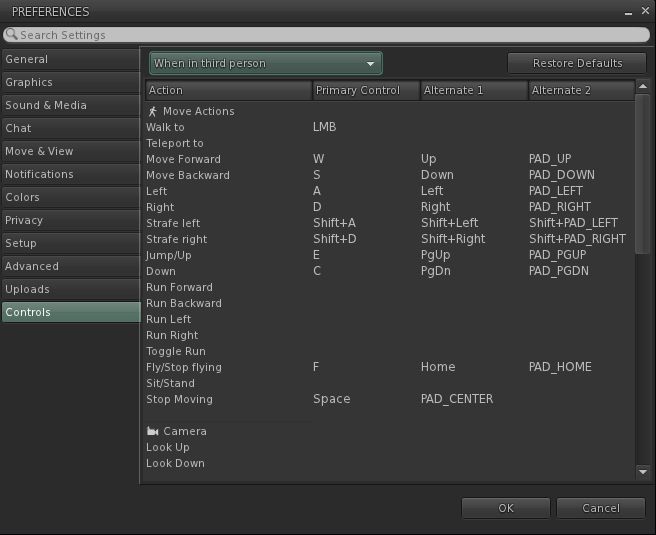
As noted in my CCUG summary, the Custom Key Mappings viewer, version 6.4.17.557391 was promoted to de facto viewer release status on Thursday April 1st.
The Key Mapping viewer adds the ability to assign your own keyboard short-cuts to a list of defined commands
The rest of the current pipeline of upcoming RC and project viewers remains as follows:
Release channel cohorts:
Maintenance RC viewer – Eau de Vie, version 6.4.17.557412, dated March 25.
Love Me Render (LMR) 5 project viewer, version 6.4.14.556118, dated February 23.
Project viewers:
Legacy Profiles viewer, version 6.4.11.550519, dated October 26, 2020.
Copy / Paste viewer, version 6.3.5.533365, dated December 9, 2019.
Project Muscadine (Animesh follow-on) project viewer, version 6.4.0.532999, dated November 22, 2019.
360 Snapshot project viewer, version 6.2.4.529111, dated July 16, 2019.
General Viewer Notes
LMR 5 is being used to address crashes relating to older hardware using Intel Graphics drivers. These have proven difficult to track down as almost nothing is reported on where in the viewer the issue causing the crash occurred. In the meantime, those on systems using older Intel HD graphics drivers are encouraged to update to more recent versions.
Both LMR-5 and the Maintenance RC are awaiting merges with the new release viewer code.
The Simple Cache Viewer has been updated following the forced roll-back, and should be appearing as a new RC viewer some time in the next week.
The recent hold-up in the viewer update and release cycle means that there are now a number of Maintenance RC viewers, each with its own focus, awaiting initial release.
A further Lover Me Render viewer (LMR-6) is also in development, with around 8 known issues awaiting resolution before it can be considered for initial release as an RC viewer.
In Brief
[7:20-8:06] the re-working of the Map Tile code continues. It is believed “significant progress” has now been made, but no ETA on when the fully revised code will be in operation.
I love to travel – not that I’ve had much of a chance to do so the last few years (even before the SARS-CoV-2 situation brought a halt to travelling around for just about all of us); I also have a love of cats (I’m the Chief Meal Giver and Dish Washer to two). So when an art exhibition combines both travel and cats, I’m going to hop along to take a look.
In My Greece, My Cats, open at the Kultivate Loft Gallery through most of April 2021, Slatan Dryke presents a personal series of images that document some of his travel to Greece over the years, revealing a place that has become one of his favourites – and introducing some of its feline denizens he came across during his visits.
Kultivate Loft Gallery: Slatan Dryke, April 2021
Slatan is perhaps best known for his in-world sculptures and his digital art, which have been displayed widely across the grid and been a signature part of many collaborative endeavours. His work is oft marked by the use of vibrant colours or deep tones that can give it an almost symphonic depth. However, with My Greece, My Cats, we have a dozen images in monochrome or with a lean into sepia that suggest a lightness of touch and more informal musicality, something totally in keeping with the nature of the country he is representing.
My love of Greece goes back to when I travelled there for the first time more than 40 years ago. My good fortune has been that Greece is a neighbouring country, allowing me to visit so many of its islands where the marrow of its culture and traditions has not changed in centuries.
[But] don’t ask me about the most fashionable locations, because I have never been to them. Ask me about those small islands where the time runs slowly under the shade of a tamarisk tree.
– Slatan Dryke on his love of Greece
Kultivate Loft Gallery: Slatan Dryke, April 2021
One place Slatan particularly fell in love with is the island of Astypalaia, one of the 12 members of the Dodecanese archipelago in the south Aegean Sea, and it is this that he celebrates within this exhibition.
With pieces finished as either photography or processed digital art, Slatan uses the exhibition to reveal the village of Astypalea (or Chora as it climbs one of Astypalaia’s craggy hills to where the imposing bulk of a stone castle sits, commanding a view on all sides. Castle and village are celebrated as a whole in three of the pictures in this exhibition, but so too are more personal aspects of the village and life there: the hand-written chalk menu at a café, the red-roofed barrels of old windmills that match along a street or a quiet place to sit at the water’s edge.
And, of course, there are the cats. As Slatan notes, no Greek village is complete without its local cats, and here he has magnificently captured them – including an endearing look at one cheeky little chappie peeking over a wall to see who dares disturb his rest…
Kultivate Loft Gallery: Slatan Dryke, April 2021
An engaging and charming exhibition that will more than likely have you wanting to visit Astypalaia – I’ve already added it to my itinerary of future visits!
The following notes were taken from my audio recording and chat log of the Content Creation User Group (CCUG) meeting held on Thursday, April 1st. These meetings are chaired by Vir Linden, with dates available via the SL Public Calendar, and the venue is the Hippotropolis camp fire.
SL Viewer
On Thursday, April 1st the Custom Key Mapping viewer version 6.4.17.557391 was promoted to de facto viewer release status.
The rest of the official viewers remain as:
Release channel cohorts:
Maintenance RC viewer – Eau de Vie, version 6.4.17.557412, dated March 25.
Love Me Render (LMR) 5 project viewer, version 6.4.14.556118, dated February 23.
Project viewers:
Legacy Profiles viewer, version 6.4.11.550519, dated October 26, 2020.
Copy / Paste viewer, version 6.3.5.533365, dated December 9, 2019.
Project Muscadine (Animesh follow-on) project viewer, version 6.4.0.532999, dated November 22, 2019.
360 Snapshot project viewer, version 6.2.4.529111, dated July 16, 2019.
Graphics Work
The graphic team is addressing crashes relating to older hardware using Intel Graphics drivers. These are proving difficult to track down as almost nothing is reported on where in the viewer the issue causing the crash occurred. In the meantime, those on systems using older Intel HD graphics drivers are encouraged to update to more recent versions.
Project Muscadine (Animesh Follow-On)
Project Summary
Currently: offering the means to change an Animesh size parameters via LSL.
Current Status
On semi-permanent hold and unlikely to resume in the near future.
The initial project viewer had some significant issues, which have not as yet been addressed.
More particularly, as this was a test project prior to the work in transitioning the simulator software to the cloud, the necessary support code was never made a part of the core simulator core build, and so would require engineering time to be updated and integrated into the post-transition simulator code, and this is not something that is currently under consideration.
However, the hope is to at least get the LSL extensions work that has been done thus far into the simulator and the viewer updated “at some point”.
ARCTan
Summary: An attempt to re-evaluate avatar rendering costs and the cost of in-world scene rendering, with the current focus on avatar rendering cost / impact, with the in-world scene rendering to be tackled at some point in the future.
The updated Jelly Dolls rendering is seen as the first phase of the avatar work, even though it was more of a side project when initiated..
The next stage is to improve how Avatar Rendering Cost (ARC) information is presented to users, together with improved performance controls within the UI.
Once the UI updates have been made, the updated ARC calculation code can be integrated into the viewer – although these new calculations remain dependant on a Bake Service fix that has been awaiting the cloud migration work to complete before being scheduled for implementation.
The hope is to get through this work Soon™.
In Brief
Proposals for New Forms of Avatar Customisation / Skeleton Deformation
Two proposals have been put forward to allow for a more “dynamic” approach to customising the avatar skeleton on the part of the user.
BUG-230428 “Interpolate between poses/animations via script” presents the idea for allowing pairs of scripted animation to act on the skeleton in such a way that when used, they present a UI slider element the user can adjust to define how the two animations interact with one another. As cited in the feature request, this could be used to combine walking animations so as to produce a unique walk / stride for an avatar. Currently, the idea has been accepted for consideration as possible future work.
BUG-230430 “Ability to interpolate between mesh skeleton offsets/deforms” presents the idea for users to gain a greater degree of avatar customisation by being able to deform the avatar skeleton using dynamic sliders.
Currently, the avatar skeleton can be deformed in two ways: via joint offsets and via animations. These are particularly (but not exclusively) used to force the avatar skeleton to adopt the shape required by a non-humanoid mesh avatar – such as a dog or elephant, etc. These are more-or-less “permanent” deformations, in that as long as the offsets are applied / animations are running, the avatar skeleton will be deformed, and the user has no real control over the deformation.
BUG-230430 proposes a number of ideas (of decreasing complexity as thoughts are better crystallised) for presenting the means for the user to be able to use and adjust / interpolate different groups of offsets or animations (with the bias shifting towards the latter) by means of a set of sliders that are made available as the groups are applied to the avatar.
There are numerous complexities involved in the approaches suggested (e.g. animation priorities when running multiple other animations through AOs; predictability of results in running multiple animations and possible offsets where timing / relationships can be user-adjusted; added UI complexity; viewer / server / viewer synchronisation, etc.). As such this request is currently set to “needs more information” should animators / avatar creators wish to add thoughts.
New User Experience
As I’ve reported elsewhere in these pages, considerable effort is being applied to the new user experience and on-boards of new users. Some of the work is approaching the point where it should be surfacing in a few months time. Elements of the work have included:
Analysing the hardware incoming new users have by logging non-intrusive stats through the viewer. This is indicating that the majority of incoming new users have hardware of much lower specification than might be thought.
Work on simplifying / improving elements of the viewer UI, and looking at the potential of removing settings that are rarely, if ever used.
In a sampling of 10,000 individual user sessions it was found that over 700 of the 1,500 non-intrusive visible settings (i.e. settings that do give rise to privacy concerns if logged) the Lab now log in the official viewer, were never actually used by any user. This raises the question, would any of those 700 be missed if removed?
This does not mean those settings *will* be removed, and the Lab are aware their data doesn’t include TPV users, as third-party have yet to adopt the logging code – although the Lab would be happy to work with them on this.
Updating the learning and social islands incoming users encounter.
Performance updates. This includes considering ways users can be made aware of controls they can adjust / turn off to improve frame rates; possibly introducing a means to have the viewer adjust itself to optimise frame rates, etc.
General Notes
Feature request BUG-230429 “Morph Targets/Shape keys on Mesh” has been accepted by the Lab for consideration as a possible future project.
There was more discussion on the animation system, with views fairly split.
Some see the animations system and formats as being “too old” and needing replacement; others see the BVH format as being extraordinarily flexible in the way it allows control of individual joints when compared to other systems / engines.
Some would like to see a better internal engine with greater support for inverse kinematics, etc., but a concern here is potential knock-on effect / scope (how would such a system relate to the existing animation system? Would it require broader changes to the avatar system? Could it result in existing content breakage? And so on).
There was further discussion of whether or not a system like Marvelous Designer could be incorporated into Second Life as a means to provide a better means of adjusting / fitting clothing to an avatar.
Neither a complete overall of the animation system or the adoption of a Marvelous Designer like cloth / clothing system is currently under consideration.





 Inara Pey: Living in a Modemworld