Currently underway at Campbell Coast art centre, is their autumn 2021 Art Walk exhibition, featuring an outdoor display of art by a number of artists, and the opportunity to tour the study galleries within the village.
The featured artists for the Art Walk are: Eylinea Seabird (eylinea), Ourane NuevaVida (ourane), Loony Carabosse – Moretto (louna.perl), Samanthe Mirror, Traci Ultsch and Zia Sophia (zia.branner). Between they, they present a contrasting selection of art. Zia, as the closest to the landing point, presents to of her abstract painting from the physical world that are captivating in their use of colour, tone, contrast and line. Alongside of her, Samanthe presents four avatar studies, nicely balanced between colour and monochrome pieces that offer narratives on an individual’s life, from enjoying the simple pleasure of a hot drink to moments of dance and delight or of quiet introspection.
Campbell Coast Art Walk: Loony and Eylinea
Loony’s images, meanwhile make use of soft tones and carry a distinctly avian theme across two of them, whilst one presents a layered digital media piece. Beside these, Eylinea’s work is a stark contrast, giving us three simply marvellous digital pieces that are fabulously minimalist or abstracted, and gently animated in a manner that is genuinely captivating and calming.
Traci Ultsch is an artist who repeatedly pushes herself with her art; she has a fearlessness when it comes to experimentation and diving into different styles and genres. Her work has embraced avatar studies, landscapes, photography, whilst also offering personal statements on life and society. Here, bracketing the door to her studio gallery, she presents four stunningly abstract expressions of nature.
Campbell Coast Art Walk: Traci and Ourane
Ourane is an artist I’m not overly familiar with, but her paintings at Campbell Coast immediately captivated me. These are richly expressive pieces, their use of colour and line as unique as their subject matter.
As noted, the art walk also offers the opportunity to visit the boutique galleries of the other artists exhibiting at Campbell Coast as well, comprising Bijoux (BijouxBarr), Michiel Bechir, eta (etamae) and Jeanie (jeanienabottle), all of whom definitely worth viewing.
It’s time to highlight another week of storytelling in Voice by the staff and volunteers at the Seanchai Library. As always, all times SLT, and events are held at the Library’s home in Nowhereville, unless otherwise indicated. Note that the schedule below may be subject to change during the week, please refer to the Seanchai Library website for the latest information through the week.
Monday, November 22nd, 19:00: The Stone God Awakens
A 20th century scientist is rendered frozen at the molecular level, and then reanimated millennia later by a freak accident. He finds himself in a strange world populated by sentient, anthropomorphic animals, who take his awakening to be the fulfilment of prophecy.
He accepts the mantle of godhood and sets about discovering this brave new world, hoping to find clues to the past while finding his place as the last human. But his quest leads to to question the reality of his status – might other humans also have survived? To find the answers he must lead his tribe of feline worshippers to the heart of a rival god: a great tree spanning half a continent.
Join Gyro Muggins as he reads a novella by the fantasy and sci-fi author Philip José Farmer.
A young artist returns to her cabin in the deep woods of Canada to concentrate on her illustrations. But somehow, strange and beautiful creatures are slipping into her drawings and sketches. The world of Faerie is reaching out to her for help – and she may be its last chance for survival.
With Willow Moonfire.
Wednesday, November 24th, 19:00 Steampunk Stories
Finn Zeddore opens the pages of Lightspeed magazine to read Carrie Vaughn’s Harry and Marlowe Meet the Founder of the Aetherian Revolution.
As they crossed the Great Plains of America, Harry was certain she’d never seen anything so astonishing in all her life.
The Kestrel hadn’t had such a long stretch airborne since she crossed the Atlantic. Even on the third day of it, Harry leaned out a window to watch the land passing beneath them, and what seemed to be all of heaven passing above. “Have you ever seen the sky look so very large, Marlowe?”
“Only at twenty thousand feet of altitude.”
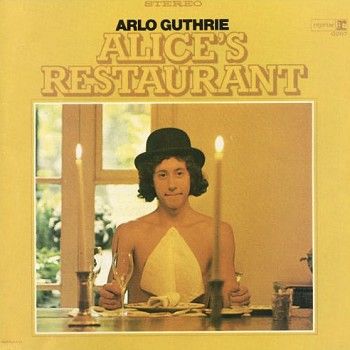
Thursday, November 25th, 10:00: Alice’s Restaurant Massacree
A Seanchai Library Thanksgiving tradition with Shandon Loring.
You can get anything that you want
At Alice’s restaurant.
You can get anything that you want
At Alice’s restaurant.
Walk right in, it’s around the back,
Just a half-a-mile from the railroad tracks, And you can get anything that you want
At Alice’s restaurant.
As Thanksgiving arrives in the United States, Shandon Loring presents singer-songwriter Arlo Guthrie’s famous 1967 musical monologue, Alice’s Restaurant Massacree (also popularly known as Alice’s Restaurant, and the inspiration of the 1969 Arthur Penn film of that name, starring Guthrie himself).
Aside from the opening and closing chorus, the song is delivered as the spoken word accompanied by a ragtime guitar. The story is based on a true incident in Guthrie’s life when, in 1965, he (then 18) and a friend were arrested for illegally dumping garbage from Alice’s restaurant after discovering that the town dump was closed for the Thanksgiving holiday.
What follows is a complicated, ironic and amusing story told in a deadpan, satirical tone, which encompasses fines, blind judges, guide dogs, 27 8×10 copiously annotated glossy photos related to the littering, frustrated police officers, the Vietnam War draft and, ultimately, the inexplicable ways in which bureaucracy moves to foil itself, just when you’ve given up hope of foiling it yourself.
Don’t be late – the entire presentation is just 20 minutes in length!
Logos representative only and should not be seen as an endorsement / preference / recommendation
Updates from the week ending Sunday, November 21st
This summary is generally published every Monday, and is a list of SL viewer / client releases (official and TPV) made during the previous week. When reading it, please note:
It is based on my Current Viewer Releases Page, a list of all Second Life viewers and clients that are in popular use (and of which I am aware), and which are recognised as adhering to the TPV Policy. This page includes comprehensive links to download pages, blog notes, release notes, etc., as well as links to any / all reviews of specific viewers / clients made within this blog.
By its nature, this summary presented here will always be in arrears, please refer to the Current Viewer Release Page for more up-to-date information.
Note that for purposes of length, TPV test viewers, preview / beta viewers / nightly builds are generally not recorded in these summaries.
Official LL Viewers
Release viewer: version version 6.5.0.565607, formerly the Maintenance RC and dated November 10, promoted November 15 – this viewer now contains a fix for the media issues caused by the Apple Notarisation viewer.
Skrunda-3, November 2021 – click any image for full size
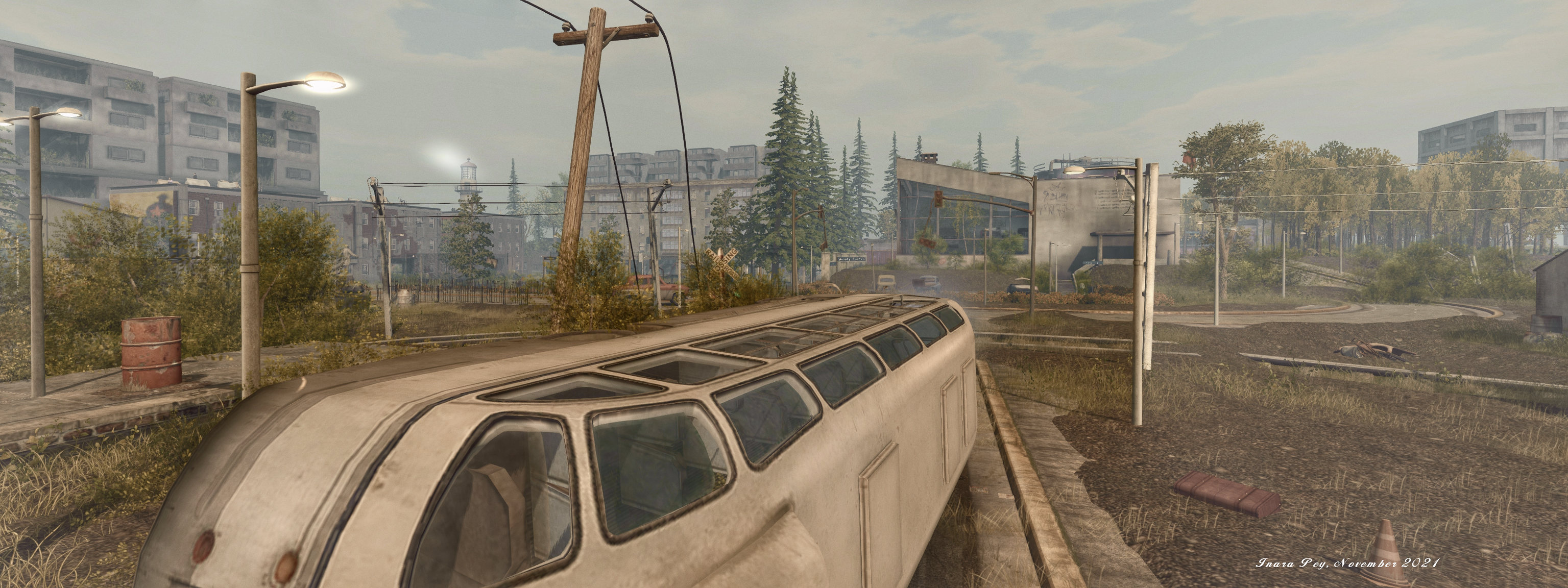
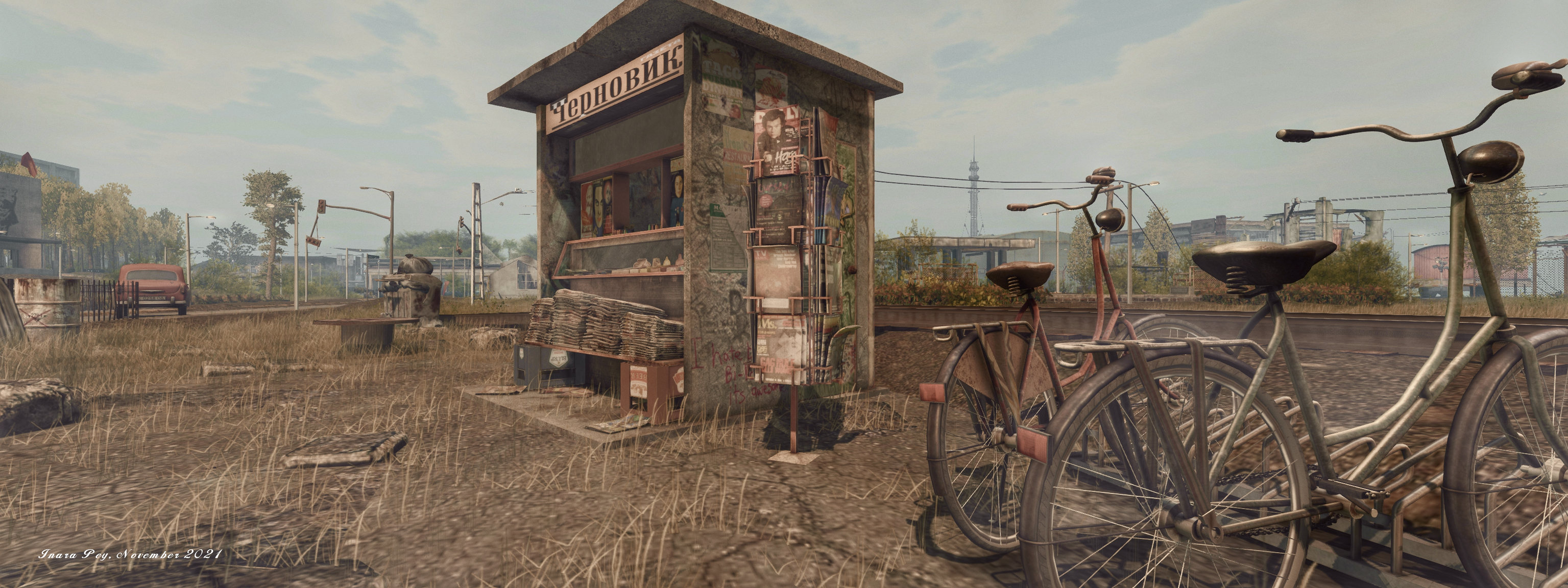
Not long after the start of the year, I dropped in to Skrunda-2, the recreation of a Soviet-era town called “Skrunda-1” in Latvia. Designed by Titus Palmira, Sofie Janic and Megan Prumier, the region was a visit I very much enjoyed, so when Lien (Lien Lowe) dropped me the LM for the second iteration of the build – called Skrunda-3 -, I knew I’d have to drop back in and have a look around.
For those who have not visited previously, allow me to provide a little history to help frame this build: in the 1960s Russia established a radar facility some 5 kilometres from the Latvian regional centre of Skrunda as the home of two Hen House (Russian system name Destnr) first generation space surveillance / early warning radar systems. Its position within the Baltic state meant it was of major strategic importance to the Soviet military, having an uninterrupted view of airspace over the Western Hemisphere so it could “see” NATO / US space-based activities like missile launches. In fact, it was one of only two such facilities Russia constructed for this purpose in the 1960s, the other being near Murmansk, provide a view over the Arctic and north pole towards the United States.
Skrunda-3, November 2021
Such was this strategic importance, that the radar station grew an entire town around it, supporting some 5,000 personnel and their families at its peak, offering them all the amenities they might expect: swimming pool, theatre, a school, and so on, and well as “Soviet typical” apartment blocks and more – including dedicated electrical power generation and water supply system, enabling it (again, in typical Soviet style) to be entirely self-contained.
As a military installation, Skrunda-1 served its purpose through to the 1980s, with the radar systems being upgraded over time, until the decision was made to use the site as the location for three state-of-the-art radar systems that would have been ready to start operations in the 1990s, however, the collapse of the Soviet Union meant that the new facilities were never completed. Instead, in the post-Soviet era, Russia reached an agreement with the Latvian authorities to continue to run the Destnr radars through until 1998, after which they had to dismantle them and withdraw from Lativa before the end of 1999 – which they did.
Skrunda-3, November 2021
What was left behind became a ghost town, most of the buildings stripped bare but left standing, roads all in place – and something for the Latvian authorities to deal with. During the next 15 years, the town was left to nature’s ways, despite attempts to sell the land for redevelopment, around half of the land eventually being converted into a training ground for the Latvian national armed forces, although much of the deserted town still remains.
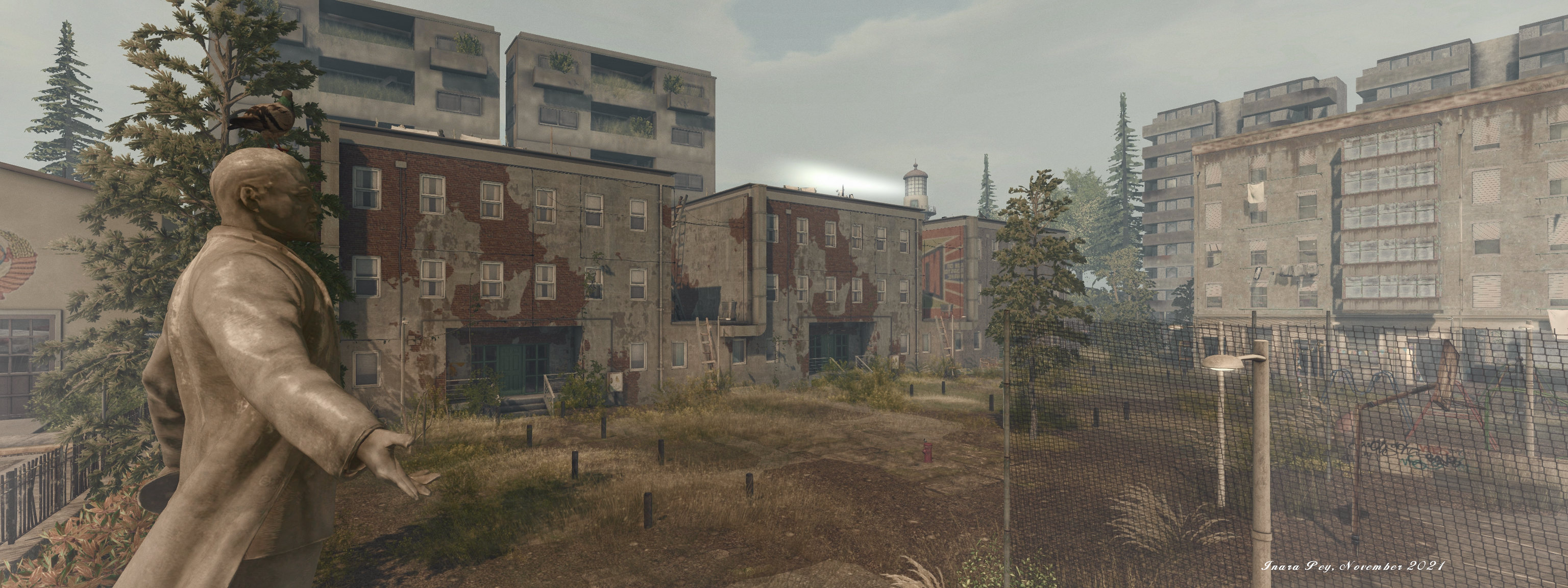
It is in this deserted, overgrown state that Skrunda-3 is offered – as was the case with Skrunda-2. However, whilst that version placed us fairly squarely within the residential parts of the town, this iteration offers more the the “business end” of the town and an iteration perhaps more rooted in the imagination of the builders. I say this because as far as I’m aware (and based on admittedly minimal research), Skrunda-1 was built far enough inland it does not have any form of deep water port, however, Skrunda-3 features an significant dockland area. expanding on a waterfront area found within Skrunda-2.
Skrunda-3, November 2021
This is something that gives the region a unique flavour unto itself, and presents a feature that makes up from the absence of any radar facilities the Russians took with them when they left and in all likelihood, a more interesting environment to explore than a load of military blockhouses. To further offer a sense of continuation from Skrunda-2, this build also has some of the apartment blocks tucked to one side, suggesting that were we to walk beyond them, we’d find ourselves within the previous iteration of the design.
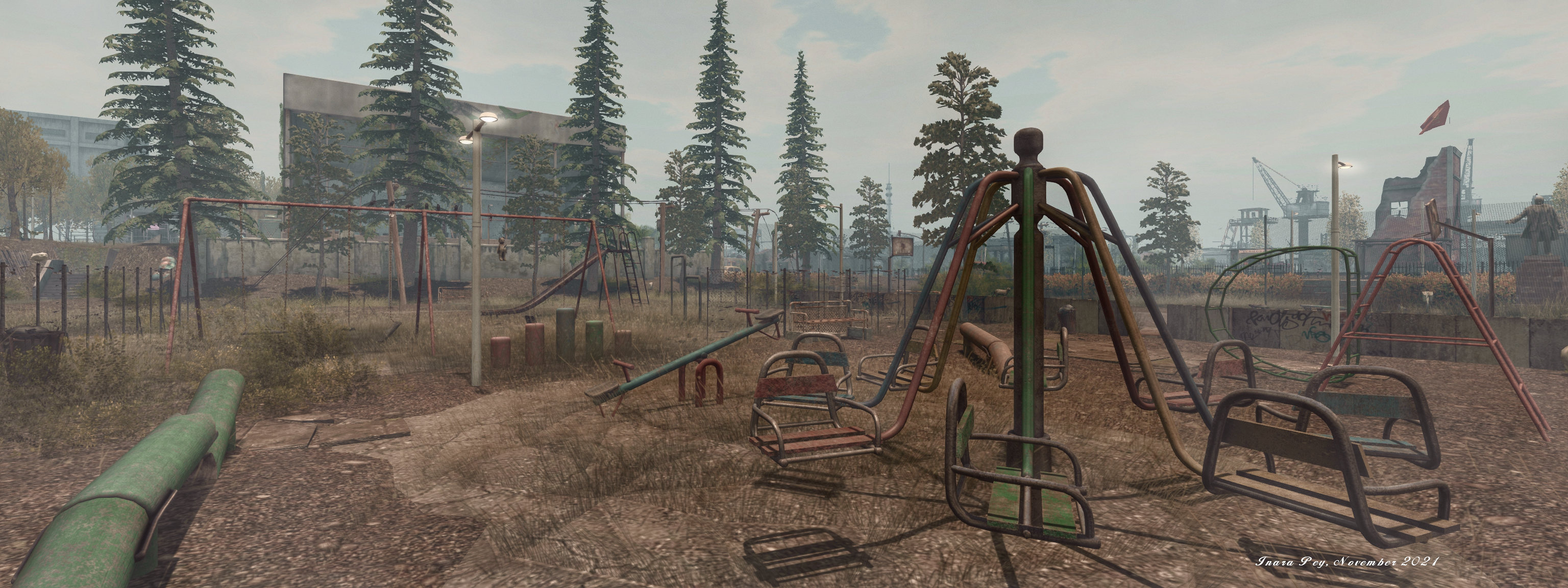
As with Shrunda-2, there is a lot of small details to be found within this build that make it something of a work of art in itself, from the graffiti on walls to the placement of the abandoned vehicles to the suggestions that either the town was deserted in a manner that saw possessions left behind, or that it has at times been used as a home by the dispossessed.
Skrunda-3, November 2021Where the former is concerned, there is a sense of family and abandonment within buildings and rooms; with the latter, there is a sense of loneliness and a feeling that despite those hidden souls who may have been forced to live among the deserted buildings have formed a community: within an open space, a stage for live music has been put together, completed with a battered – but presumably still tuneful – upright piano. A short distance away, a warehouse building has been converted into an art gallery, displaying images captured from within Skrunda-2. And over all of this, someone has even managed to restore electrical power, adding a further twist to the idea that whilst abandoned, the town enjoys a secret life.
Payment of L$150 brings visitors rezzing rights, allowing for photographic props and poses to be used, adding to the photogenic nature for the setting, while the supplied sound scape helps to give further depth to explorations.
Skrunda-3, November 2021
Standing with echoes of Skrunda-2, and sharing a common historical heritage, Skrunda-3 is nevertheless entirely unique in its presentation and design, making it a further ideal visitor for the Second Life traveller.
If it seems my recent art reviews have been somewhat focused on artists who bring their work from the physical world into Second Life, then there is a simple explanation: it’s because they are. Admittedly, some of it is simply down to the manner in which I receive invitations or find them within the various art group notices I frequently check; however, it is also because – contrary to the statement I’ve heard made more than once – I think SL is actually a very good medium for artists to present their physical world art as much as it is for presenting in-world images.
Take Bif Mopp, for example, whose work is now being displayed at the AmandaT Tamatzui Gallery, owned and curated by AmandaT Tamatzui, who is herself an accomplished professional artist in the physical world who hails from New Zealand. Bif is a most extraordinary artist who dedicates a good portion of his talent and portfolio to aviation paintings, capturing aircraft, military and civil and of times past and times present. And he does so with amazing skill and imagery, perfectly capturing his subjects in all of their majesty and / or going about their business. Such accuracy, in fact that his work has been displayed not only in galleries, but also aviation museums – and even the office of a former US Air Force Chief of Staff.
AmandaT Tamatzui Gallery: Bif Mopp, November 2021
As an aviation enthusiast myself, I was immediately captivated by the paintings presented within this exhibition, not only because of their technical accuracy – I challenge anyone with a love of aviation through the 20th century not to be able to recognise any of the aircraft here, even when viewed at a distance, such is the skill with which Bif have portrayed them – but because each image carries within it an entire story of an aircraft, and / or its era and or / or pilot.
Take, for example, 27 August 1941 (which I’ll state up-front is my favourite among favourites within this selection). At first glance, it is very obviously a Supermarine Spitfire Mark IID, possibly from the Battler of Britain. However, the markings reveal it to be aircraft P7308 of No. 71 (Eagle) squadron, one of three squadrons so-called as they were formed with volunteer pilots from the United States.
In particular, this aircraft was flown by Pilot Officer William R. Dunn, a man so determined to fly with the RAF, he lied his way into the Canadian Army (claiming he was from Moosejaw, Saskatchewan!), then once in the UK sought a transfer to the RAF, making a “pen slip” on his application form, so that it was believed he had 560 flying hours under his belt (500 being required to be accepted for pilot training), rather than his actual 160. In particular, on August 27th, 1941, Dunn’s squadron was escorting RAF light bombers over France when they engaged with enemy fighters. Dunn took two out before his own aircraft – and Dunn himself – took hits, forcing him to return across the channel and a trip to hospital. He eventually re-joined the war as a member of the US Army Air Force – and already recognised at the first American fighter Ace of WWII (and in conclusion, I’ll note that Dunn went on to a distinguished USAAF/USAF career and became an artist himself).
AmandaT Tamatzui Gallery: Bif Mopp, November 2021
It’s a story that brings the image even more to life, as do the stories bound within other paintings here – such as the long tradition of Dallas Doll, (Buzz Job), the P51D Mustang flown by the 352nd Fighter Squadron, US 8th Air Force and which still flies today, a favourite of several aviation artists. Then there is Bunker Hill, with its Corsair fighter (as piloted by ace Lt. Dean Caswell), showing just how small and lonely the deck of an aircraft carrier can be on an ocean as big as the Pacific – and the relief felt on finding it in the fading light of day, a sentiment also shared by Almost Home. Elsewhere, US Mail evocatively captures the pioneering days of the US air mail service as exemplified by the men who flew the rugged Pitcairn Mailwing, specifically designed to ply US government airmail routes of the 1920s and 1930s, while a high-flying DC3 hails the aircraft that really kick-started mass passenger transport after the end of WWII.
Rounded-out by a trio of beautiful landscape / seacape, this is genuinely a superb exhibition, and SL aviators from across the grid (as well a lovers of art) really should come and see.
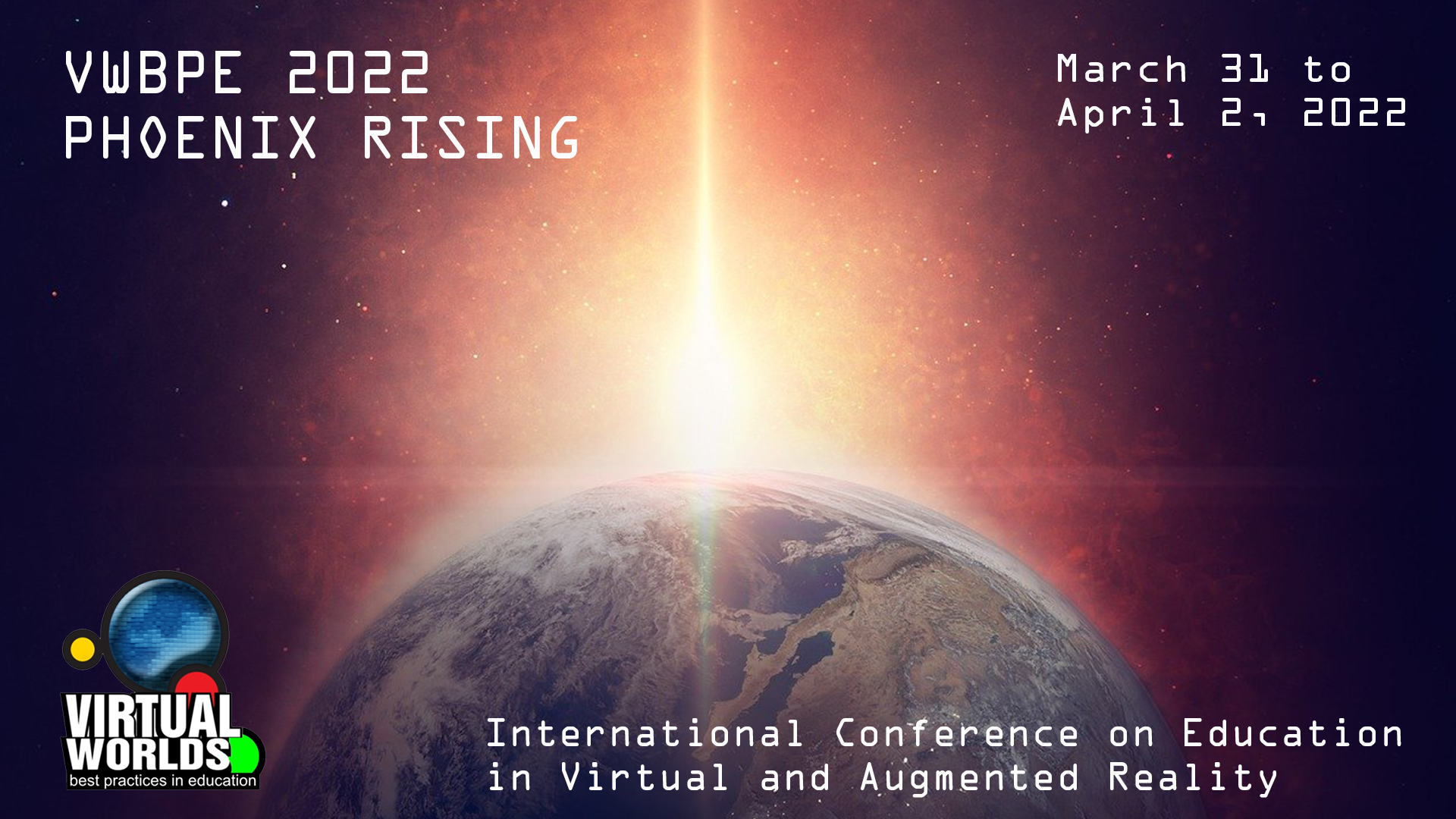
The 2022 Virtual Worlds Best Practice in Education (VWBPE) conference will be taking place between March 31st and April 2nd inclusive, and both a call for proposals and a call for sponsors are currently open.
VWBPE is a global grass-roots community event focusing on education in immersive virtual environments which attracts over 2,000 educational professionals from around the world each year, who participate in 150-200 online presentations including theoretical research, application of best practices, virtual world tours, hands-on workshops, discussion panels, machinima presentations, and poster exhibits. For the purposes of the conference, “virtual world” refers to any on-line community through which users can interact with one another and use and create ideas irrespective of time and space, whether 3D in presentation or as characterised through platforms such as Meta, LinkedIn, Twitter, etc., in which the direction of the platform’s evolution is manifest in the community. The conference itself is hosted within Second Life.
The theme for the 2022 conference is Phoenix Rising, with the organisers describing it thus:
In every culture, from China in the east to the Indigenous cultures in the west, the phoenix as a symbol of hope and renewal is ubiquitous across the ages. Whether it is referred to as Feng Huang, Garuda, Ho-Oo, Bennu or the Quetzal bird, in every case the phoenix ushers in an era of prosperity and transformation that goes beyond the individual to encompass our home and surroundings.
The world is forever a changed place. Those in education find themselves on the front lines of how the next generation of students are going to perceive and integrate a post-COVID society into opportunities for growth, for renewal, and for a redefinition of the values that once drove us.
The past two years have represented a global case study in real time of the merits and limitations of virtual education: what works, and what doesn’t. Educators have immersed themselves in online learning methodologies that have been mostly talked about but never implemented on a wide scale until recently. There is now a plethora of real-world evidence supporting the practical application of teaching virtually that we have never truly had access to until now.
Like the newly reborn phoenix arising from the ashes of its previous life, virtual education is also experiencing a renaissance of abundance and transformation. Whether it be fully immersive or simple video conferencing, the practical application of tools and techniques over the past two years represents a wealth of inspiration for connecting teachers and students in ways that are comprehensive, progressive, and meaningful.
Call For Proposals
VWBPE 2022 will include six formats for presentations the familiar Spotlight Presentations, Hands on Technology Workshops, Compass Points Roundtable Discussions, Micro Burst presentation Clusters (each no more than 15 minutes), together with two new formats – Tool Talks, and Poster presentations.
Tool Talks: The big ideas are often shared at conferences, but what about those “little” things that you cannot do without in your practice – be it a tool, technique, or technology? Share a short and engaging demonstration showing us why this idea is not to be missed.
Poster presentations: Share your research in our new Posters venue, with time for both asynchronous exploration and scheduled synchronous presentation times during the conference. Students are strongly encouraged to share their current work with a poster presentation.
In addition, there will be Immersive Experiences that will take place in the 2 weeks prior to and 2 weeks after the conference itself. New for 2022 will be an opportunity for video engagement to promote your Immersive Experience, details of which will be provided for all accepted Immersive Experience proposals. Full details on submitting any form of proposal and general guidelines can be found via the following links:
The VWBPE organiser are currently seeking sponsors for this year’s conference to help to keep this open source conference free for all to participate and to help with the conference’s informational systems, live streams, and archives active.
Your generous support will help raise your organisation’s profile to gain the attention of over 1000 conference participants, including K-12 instructors, post-secondary instructors, researchers, non-profits, creative designers, education business leaders, and social media influencers in the field of education.
– From the VWBPE sponsorship page, 2020
Sponsorship opportunities start at US $250 for organisations and groups, and US $20 for smaller communities. Those interested are referred to the official VWBPE Sponsorship Opportunities pack, or sign-up directly / contact the organisers via the conference sponsorship page.


 A Seanchai Library Thanksgiving tradition with Shandon Loring.




 Inara Pey: Living in a Modemworld