2021 CCUG meeting week #46 summary: Graphics work

Bella’s Lullaby, September 2021 – blog post

The following notes were taken from my audio recording and chat log of the Content Creation User Group (CCUG) meeting held on Thursday, November 18th 2021 at 13:00 SLT. These meetings are chaired by Vir Linden, and agenda notes, meeting SLurl, etc, are are available on the Content Creation User Group wiki page.

AVAILABLE VIEWERS

This list reflects those viewers available via Linden Lab.

  • Release viewer: version version 6.5.0.565607, formerly the Maintenance RC and dated November 10, promoted November 15 – this viewer now contains a fix for the media issues caused by the Apple Notarisation viewer.
  • Release channel cohorts (please see my notes on manually installing RC viewer versions if you wish to install any release candidate(s) yourself):
    • The Tracy Integration RC viewer version 6.4.23.563771 (dated Friday, November 5) issued Tuesday, November 9.
    • 360 Snapshot RC viewer, version 6.5.0.564863, issued October 21.
    • Simplified Cache RC viewer, version 6.4.23.562623, dated September 17, issued September 20.
  • Project viewers:
    • Performance Improvements project viewer updated to version 6.4.24.565324 (dated November 5) November 9.
    • Performance Floater project viewer, version 6.4.23.562625, issued September 2.
    • Mesh Optimizer project viewer, version 6.4.23.562614, issued September 1.
    • Legacy Profiles viewer, version 6.4.11.550519, dated October 26, 2020.
    • Copy / Paste viewer, version 6.3.5.533365, dated December 9, 2019.

General Viewer Notes

  • It is possible the 360 Snapshot RC viewer and the Simplified Cache RC viewers may be merged prior to either being individually promoted to de facto release status.

Graphics Work

  • The core of the graphics team is shifting emphasis from making performance changes to the rendering pipe to focusing on stabilising the changes thus far made. As Vir has elsewhere noted, the problem with moving operations between threads / to their own threads is that there can be undesired consequences which then must be addressed.
    • This work has comprises a number of elements, both in moving processes that should logically have their own threads, and in moving processing that can cause the main thread to stall while it is handling them (e.g. processes that talk to the graphics API, the texture upload to OpenGL, etc.) to other background threads.
  • Runitai Linden continues to update how avatar rigged meshes are rendered.
    • In short, he hopes to use the same approach to handling static meshes to rigged mesh (including Animesh creations), allowing the latter to be handled in batches, reducing the overall number of draw calls and giving a potentially substantial performance boost.
    • The improvements should be particularly noticeable when rendering the “onion layer” avatar meshes that have multiple layers and are segmented into multiple cuts. Runitai reports his testing shows a 50% improvement in rendering 20 avatars – but improvements will be hardware dependent.
    • There are some issues: as it stands, the updated code does change the order of sorting / rendering alphas, which could be problematic for some creators. If so, LL will look at what can be done to prevent this (as an aside to this, vertex ordering within Blender, etc.), should not be impacted). There are also limits on how far this can be taken due to things like how faces with unique textures or with separate materials must be handled.
    • Currently, Runitai plans to spend the next few weeks testing and improving the changes with a view to having a view publicly available in the New Year.
  • Part of the discussion centred on texture use (and over-use), which covered a number of elements including:
    • A reminder of why the use of 1024×1024 textures on every surface, no matter how small is really bad idea, both because of the amount of VRAM each texture (+ any associated materials) uses (up to 4MB each); and because even if the face used only exposes a small portion of the texture, the viewer still has to process the entire texture before it can be rendered at full resolution, so it’s just leaving people with a greater amount of time the texture is blurred in their view.
    • The pros and cons in using a texture atlas. On the plus, this always multiple textures to be handled as a single draw operation, and is done where possible. However, unlike a conventional game, texture use in Sl is less predictable (e.g. an avatar can use the same texture “as is”, alpha masked, alpha blended and as a specular map, impacting the ability to use it within any texture atlas.
  • Whilst on the back burner at present, it is hoped that Vulkan, if / when adopted, could solve a lot of texture batching and draw call issues on the Windows platform, as it has a “fundamentally different” way of handling the latter. However, any shift in graphics API is held depending the current clean-up of the rendering code. On October 30th, Runitai described the options under consideration as:
    • Using Vulkan (Windows) and Metal (Apple).
    • Running Vulkan extraction layers on top of G3D on Windows (and MoltenGL for Apple?)
    • Implementing an off-the-shelf multi-API extraction layer.
    • Home-brew a dedicated extraction layer.
    • Stick with OpenGL for Windows and use MoltenGL for Apple (as noted above).
    • Initially supporting Vulkan + OpenGL for Windows and then retiring OpenGL and running Vulkan extraction layers on top of G3D (no word on Apple solutions in this scenario).
  • As a part of the current  work, LL has tested using OpenGL Core Profile rather than the currently-used OpenGL Compatibility Profile.
    • Core Profile offers a performance win for nVidia GPUs – but presents a performance hit for AMD and Apple systems, so a determination on its use has yet to be made.
    • Core Profile also does not work GLOD for mesh uploads, so if adopted, GLOD support may be entirely dropped from the viewer in favour of the Mesh Optimiser (as found in the current Mesh Optimiser project viewer).
  • Other updates the graphics team are considering include:
    • Making VSync enabled by default in the viewer, which should give a more consistent rate at high (100+) FPS.
    • Removing the ability to uncheck OpenGL Vertex Buffers and Hardware Skinning, as disabling either isn’t particularly good for performance.
Ashemi’s neon return in Second Life

Ashemi, November 2021 – click any image for full size

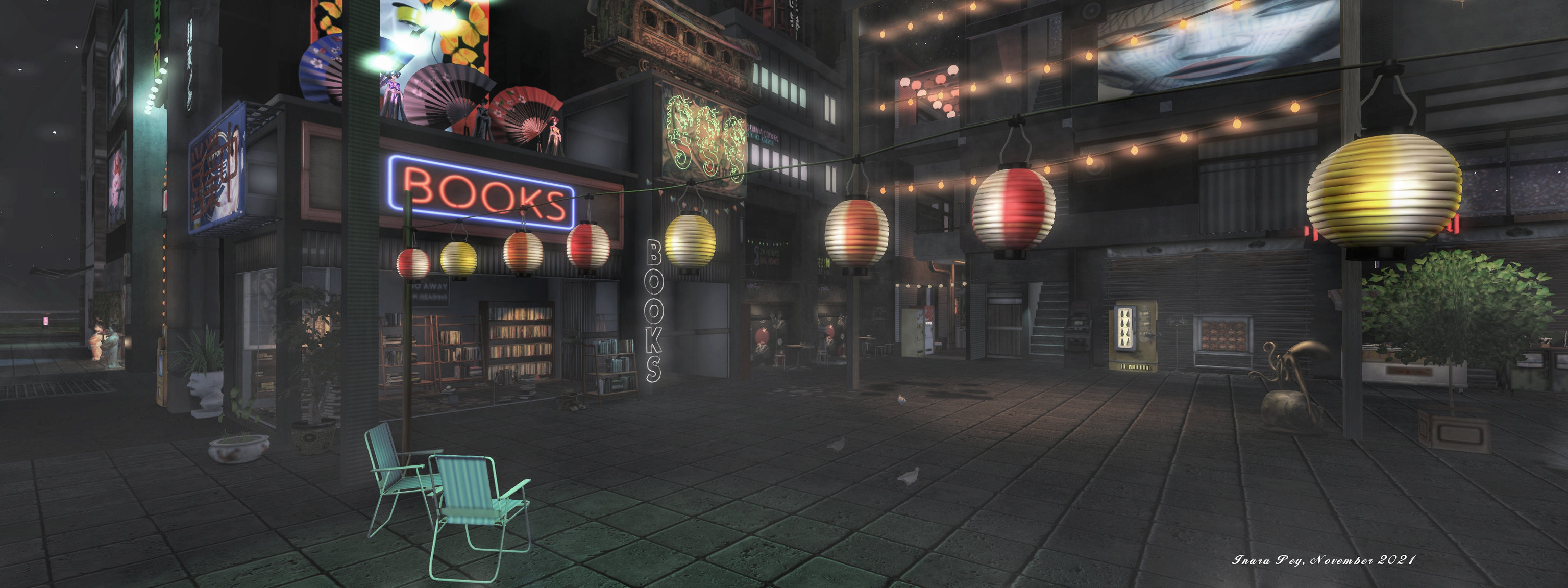
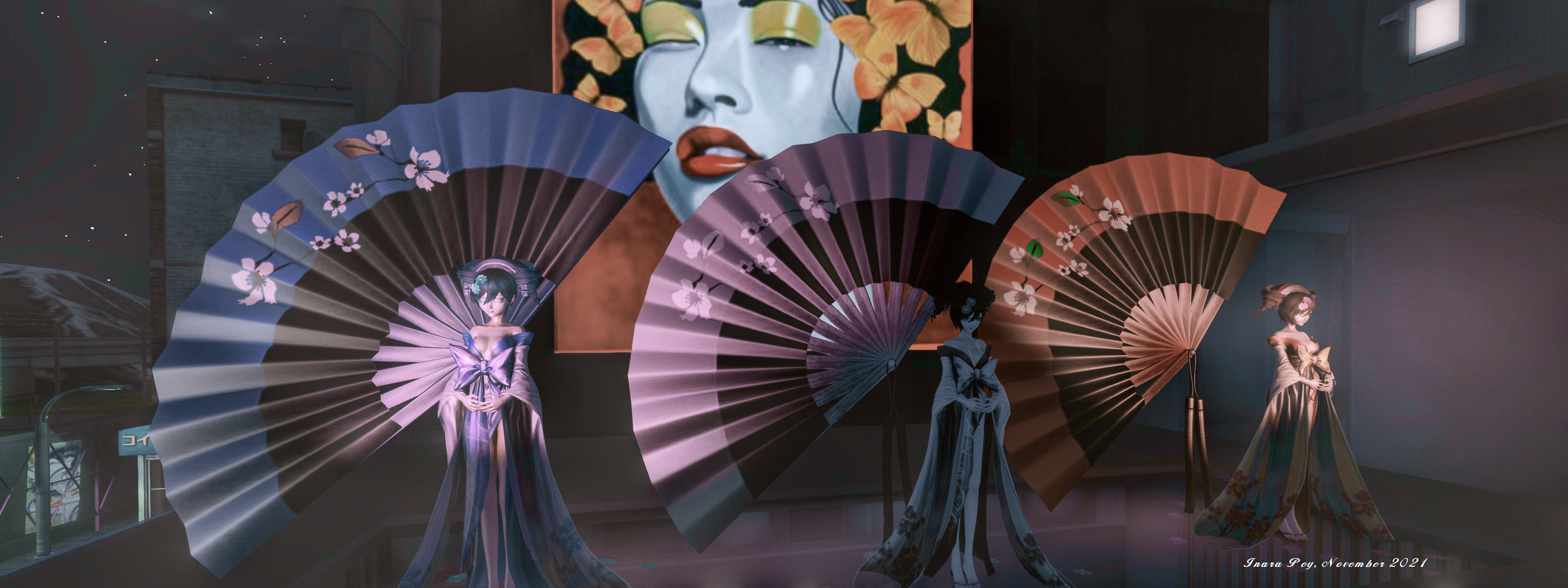
It’s been a little over three years since my last visit to Ashemi, the ever-evolving Oriental-themed region designed by the team of Ime Poplin, Jay Poplin (Jayshamime) and Shaman Nitely (see: Ashemi: an Oriental reprise in Second Life), although I believe for some of the intervening period, the region may have been absent from Second Life. So, when Shaman kindly dropped me a line to renew my acquaintance with the setting, I was happy to accept.

As with its past incarnations, Ashemi offers a busy urban setting primarily designed to be seen under night-time conditions – witness the huge Moon hanging in the sky! – although it also lends itself to daytime settings as well, as I hope some of the images herein demonstrate. I’ll also note a couple of things up front, as they both help with any visit.

Ashemi, November 2021

The first is that you really should have local sounds enabled. This is a cityscape that offers a rich sense of depth through the use of a rich sound scape. Not just cars, cicadas and so on, but the sounds of people as they hold conversations indoors and out; the echoes of shouts and laughter along train platforms, the clatter and chiming of crockery and glasses – all of which gives further depth to the setting.

The second point is that Ashemi really is a place that can clobber performance; under the default EEP and with shadows enabled, I was looking at around 4.5-6.7 FPS on average on my not-top-of-the-range-but-reasonably-OK system. Flipping to my preferred EEP settings, and so often seen in my images (as they tend to get attached to me for travelling), this clambered its way to 9-10.8 fps. So, if you are on a mode-to-lower-range system, you might want to toggle shadows on when needed and otherwise leave them off.

Ashemi, November 2021

This is a setting that carries with it echoes of earlier iterations of Ashemi, whilst at the same time offering something entirely new. The lightness of touch with the familiar – for those who remember past versions of the city – may help prompt the imagination to consider that we are within the same metropolis, but a different district or prefecture. Or we can accept what we see as an entirely new setting. like those past iterations, this is a busy place – not in terms of textures, mesh etc.), but in style. The ambient sounds suggest a place where people work, live and relax. The buildings offer a mix of outer high-rises and smaller, inner buildings that include places of business and entertainment as well as transit points and homes.

But whereas the Ashemis of the past tended to feature water within them, here is has been pushed outwards, as if roughly shoved away to make way for humans. Nevertheless, whilst waterside walks may have vanished, this setting carries with it places where a degree of peace and relaxation might be found – although one in particular may require a little effort to find, while others may have their solitude poked at by the noise of the unruly masses.

Ashemi, November 2021

There is also, perhaps a sense of age here that may not have been quite so prevalent in previous iterations. Older, more traditional houses have been converted to places of business, whilst the concrete blockhouses common to the latter part of the 20th century peer over fences and wall as if to see what is going on. Sad to say, as well, that such is the age of this district, it appears to have become something of a littering ground, as can be seen within  the local cemetery; clearly no longer used, it is home to  unwanted bodies of metal, plastic stone quite aside from the souls who might still be interred within. And as one wanders, so might the slow lament of a violin be heard – or perhaps it is a kokyu.

Some interesting references might also be found here for eyes that seek and feet that walk. For example, outside of one place of work there might be found a certain car awaiting the call of lightning; down another street you might prompted to ask who ya gonna call? Throughout all, NPCs further bring the setting to life as they work in garages, await a train or walk down pathways.

Ashemi, November 2021

Rich in detail with assorted opportunities for photography, Ashemi remains an engaging visit – if one a little hard on the system, as noted, although this should not stand in the way of any visit.

My thanks again to Shaman, Ime and Jay for the invitation to visit and explore once more!

Ashemi, November 2021

SLurl Details

  • Ashemi (Queen Dreem, rated Moderate)

The art and beauty of the microscopic in Second Life

Limoncello Art Gallery Annexe: Unseen Beauty

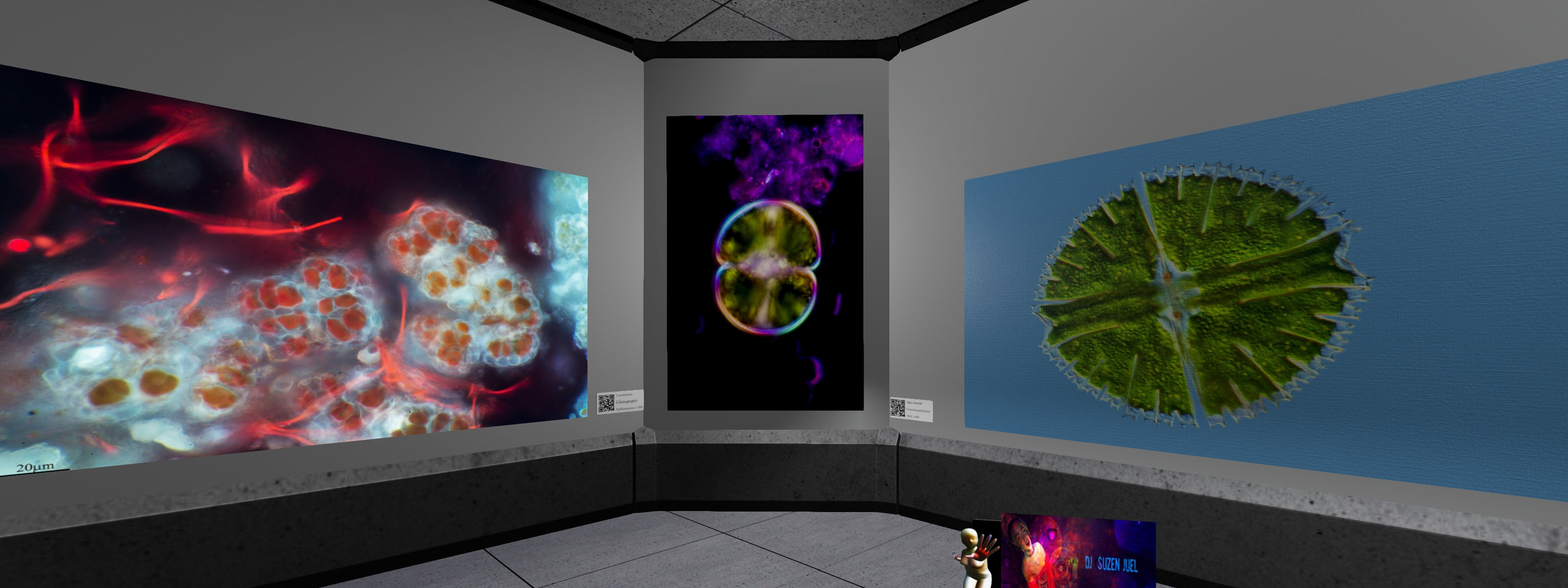
Currently available within the Annexe of the Limoncello gallery – for a while longer, at least, given it opened at the start of November – is an intriguing exhibition of images by Guille (Antoronta) entitled Unseen Beauty.

Guille appears to be a relatively recent arrival in Second Life – as inferred by his Profile. An educator by profession and hailing from Spain, he appears to be bound to the natural beauty of Nature, noting in his Profile that it is the ultimate expression of art whilst his Flickr stream takes us on a journey into the microscopic – as is the case with Unseen Beauty.

Through both the exhibition and his Flickr stream, Guille takes us on a rarely-seen journey, one to a world that exists not beyond our own, but within it. no, not a world – an entire universe where the strangest and in many respects the more wonderous forms of life exist.

Limoncello Art Gallery Annexe: Unseen Beauty
It is possible that this is the first time that a sample of these characteristics has been exhibited in SL, as in RL this type of exhibition is extraordinarily scarce, as well as the knowledge of these wonderful and fascinating living beings to whom it is dedicated. All the images have been taken under the microscope, on living organisms that, after being observed, have been returned to the place from which they were collected. Almost all of them are very little known, and some of the smallest, contain the keys to know how we are and how we have evolved.

– Guille, describing Unseen Beauty

Thus  we are presented with a series of living images of the most incredible creatures, from cyanobacteria (aka Cyanophyta or “blue-green algae”), a kind of  prokaryote and one of the first organisms known to have produced oxygen, thus helping to start life on Earth as we know it today. Then there are diatoms such as the family of Coscinodiscaceae, noted for their radial symmetry and circular shapes when viewed from the front.

Each image is accompanied by an information giver providing a description of the featured algae, bacteria or amoebic form, each beautifully – in places poetically – written by Guille. Witness:

In each drop, the world of Cosmarium becomes rainbow, letting the sun melt on its cover, while absorbing the juice of life between its rays, tiny pearls that live are arcoris, true water jewels. They gravitate in the water like planets that in each drop for them is infinite.
Perhaps because it has the skin of an elephant, Cosmarium pachydermum, it endures the icy winter nights with the starry sky and the scorching summer sun on the highest peaks, as long as a drop of water is its ocean between Sphagnum, and in it, which is its universe, can show its soul scalloped with green jewel, perhaps from the times when the ice was the mantle of these mountains.

– Guille, describing Cosmarium pachydermun

Limoncello Art Gallery Annexe: Unseen Beauty

Beautiful images of life unimagined – but without which we would not be here to admire it – captured in an instant and written into the memory through colour and words, Unseen Beauty is a bewitching exhibition, not to be missed, and an excellent gateway to the additional exhibitions on the remaining levels of the Annexe.

SLurl Details

2021 SUG meeting week #46 summary

Endless: Permafrost, August 2021 – blog post

The following notes were taken from the Tuesday, November 16th, 2021 Simulator User Group (SUG) meeting. The meeting was recorded by Pantera Północy, and the video is embedded at the end of this summary. Note this summary focuses on the key points of the meeting; where there is something to report, the video should be referred to should full details of the meeting wish to be reviewed.

Server Deployments

  • The are no planned deployments to the majority of the region simhosts.
  • On Wednesday, November 17th, the servers on the Bluesteel channel should be updated with a fresh version of the tools update simulator version.
  • It is unlikely the simulator version on Bluesteel will be rolled to additional simhosts / channels prior to US Thanksgiving, as there are some issued the Lab has noted, which are proving a little hard for the Lab to track down in testing on Aditi and the Lab’s internal test grid.
  • It is likely that the number of server deployments between now as the end of the year will be “minimal”.

SL Viewer

This list reflects those official viewers available via Linden Lab.

  • Release viewer: version version 6.5.0.565607, formerly the Maintenance RC and dated November 10, promoted November 15 – this viewer now contains a fix for the media issues caused by the Apple Notarisation viewer.
  • Release channel cohorts (please see my notes on manually installing RC viewer versions if you wish to install any release candidate(s) yourself):
    • The Tracy Integration RC viewer version 6.4.23.563771 (dated Friday, November 5) issued Tuesday, November 9.
    • 360 Snapshot RC viewer, version 6.5.0.564863, issued October 21.
    • Simplified Cache RC viewer, version 6.4.23.562623, dated September 17, issued September 20.
  • Project viewers:
    • Performance Improvements project viewer updated to version 6.4.24.565324 (dated November 5) November 9.
    • Performance Floater project viewer, version 6.4.23.562625, issued September 2.
    • Mesh Optimizer project viewer, version 6.4.23.562614, issued September 1.
    • Legacy Profiles viewer, version 6.4.11.550519, dated October 26, 2020.
    • Copy / Paste viewer, version 6.3.5.533365, dated December 9, 2019.

In Brief

  • It has been reported that general region performance is better with the new toolset simulator version. However, when something is rezzed with scripts there is a 2 second rez delay if there are child prims in the object – if it is a singular object, there’s hardly any delay. The object appears inworld but on_rez() and object_rez() don’t trigger for a solid 2 seconds. This does not happen for a single prim object. It’s not clear if this is some variant of BUG-228939; however, that tended to become more noticeable the longer a region was running, but this issue seems to occur immediately after a region is restarted. See here for more.
  • User Fourmilab has also been investigating the user of the broader “2-second delay”, and has posted findings here and here.
  • BUG-231303 “Scripted agents can no longer log in” is still under investigation, although it had been hoped the issue might have been resolved by now. The issue has caused some “alarm” (on behalf of those doing so) that so much is being run on what is effectively outdated “abandonware”.
  • Work is going on to make Map updates more reliable, and it is possible there may be further updates to the Map system in 2022.


A Coven of Crows in Second Life

Coven of Crows, November 2021 – click any image for full size

When Shawn Shakespeare first sent me the landmark to Coven of Crows, I initially thought that perhaps it would led me to a region offering something of a Games of Thrones theme. Well, I was entirely wrong – and all the better for being so. Not that I have anything against the books or the TV series; just that having recently waded back through the first three volumes A Song of Ice and Fire, I am a little full with the likes of Jon Snow,  Daenerys Targaryen, Petyr “Littlefinger” Baelish, Cersei and Tyrion Lannister et al.

A Full region carrying the private island land capacity bonus, and designed by Sena Heartsong, Coven of Crows is, to quote the About Land description “a place between worlds, ruled by crows and magical souls”, to which I would add, “and a place with secrets awaiting discovery”, for such is the case on all counts.

Coven of Crows, November 2021

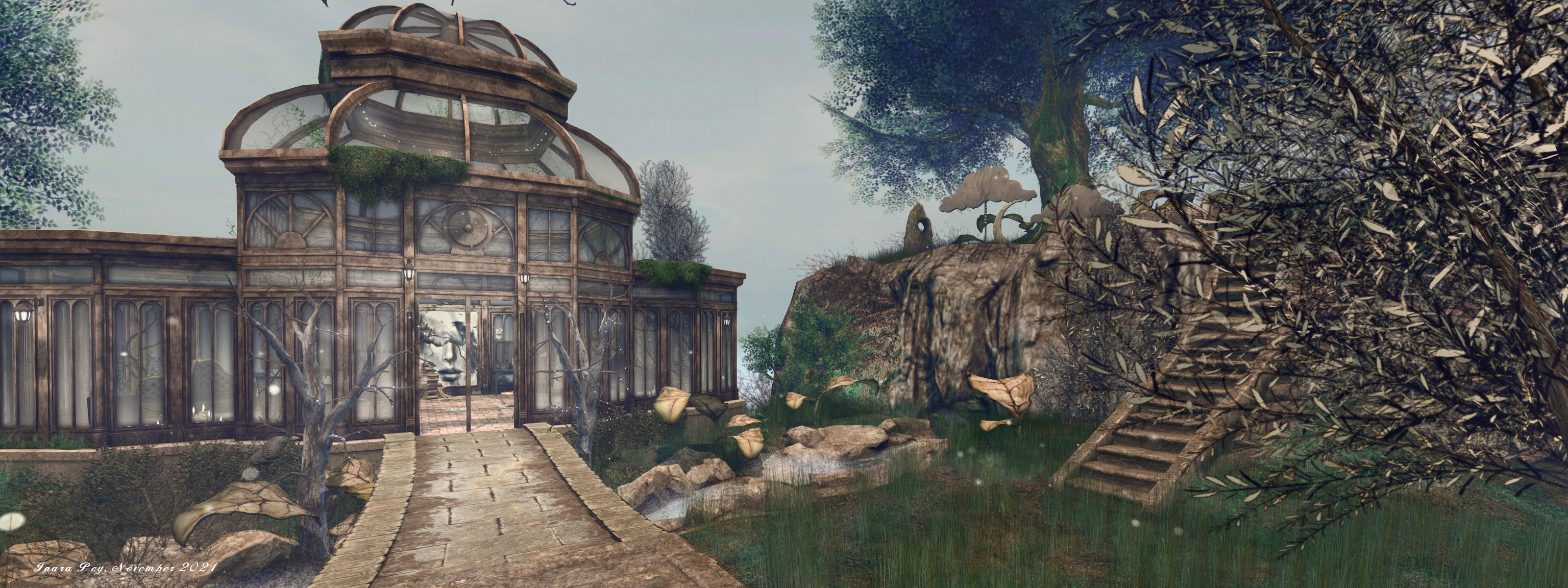
Set in a south-north orientation, the region comprises two main rugged islands linked via the single span of an elegant stone bridge, a handful of smaller isles scattered to either side of them. The more southerly and smaller of this main islands rises on near-vertical cliffs to form the landing point. This sits within a large conservatory offering comfortable seating, information, and wide open doors standing in invitation, from which an arrow-straight path runs due north, passing over a stream that issues forth from the island’s peak and thence over that graceful bridge to reach the larger island.

Here, atop cliffs every inch as sheer as those of the southern island, the great flags of the path rise by way of broad flights of steps to where a great palace of steel and and glass rises, beckoning visitors towards it as its domed roof rises above the tree tops.

Coven of Crows, November 2021

Intended as a place of music and dance, this circular house of glass of not the only destination upon this larger isle, however, for the path to it branches severally. One arm runs to the west to join with the island’s edge where water falls to the sea below and views might be taken of the islands that sit on the calm waters below. From here, the path joins with a second, as as it passes on around the island’s edge – and of which, more anon.

A further arm of the path points east, joining with an unpaved way that switch backs down to the waters edge and a small dock, one of many scattered among the islands. These docks form places where a boat might be rezzed (touch the dock and allow time for said boat to be delivered if one is not already available), such that travellers might make their way by water between the various isles.

Coven of Crows, November 2021

To the west, two of the islands are linked one to the other by way of a floating bridge, to the east, the two islands can each only be reached the use of the boats. All have points of interest to be found, be they ruins, or round pavilion with cosy bed, or long-dead tree. To the north lies the last of the islands, a high-topped nub of rock, a balloon-supported bridge linking it to the largest island in the group. A long finger of steps crooks its way down one side of this isle, the ruins to top and bottom offering points of photographic interest.

But to return to the large island and the path that runs to the west and north around its high-placed lip. This is the same path as gives access to the high, balloon-held bridge, beyond which it ends in steps that present the way down to a broad shoulder of rock, where another switch back of rocky path winds to the waters below – and the candle-lit entrance to mine-like tunnel entrance might be found.  Enter this, and you will find a long passage, a throat hewn of rock that might swallow you into its depths by way of path and stair.

Coven of Crows, November 2021

To enter it is to step into the region’s secret; for as the tunnel descends, so does it arrive at a huge cavern. High-ceilinged from which multiple chandeliers hang, and the broad entrance to a building hewn into the rock draws the eyes. Its columned façade forms the backdrop to what is at first glance a stage, and the great cavern a further place for dance. But a door in the façade gives access to a room beyond, wherein just a hint of the tales from Game of Thrones and thoughts of Aria Stark’s journey might reside.

Facing the entrance to this great chamber is a second tunnel, sitting on the far side of wood and door. Here the path runs beside water over which candles float, and the carved statue of a goddess rises. Thus with this small cavern and the chamber it faces, the mysteries of the island become clearer. But they are not the last of the secrets awaiting discovery, for the path leads onward to where another chamber sits, one perhaps with the largest surprise of all; a place that might be accessed through a second tunnel, one within its entrance somewhat hidden from the the view of the world at large.

Coven of Crows, November 2021

Watched over by the crows of its name, their caws and cries filling the air, this is a region rich in detail without being overly burdensome on the viewer; a place where many photographic opportunities await, as do places to sit and cuddle or simply pass the time. Recommended.

SLurl Details

2021 viewer release summaries week #45

Logos representative only and should not be seen as an endorsement / preference / recommendation

Updates from the week ending Sunday, November 14th

This summary is generally published every Monday, and is a list of SL viewer / client releases (official and TPV) made during the previous week. When reading it, please note:

  • It is based on my Current Viewer Releases Page, a list of all Second Life viewers and clients that are in popular use (and of which I am aware), and which are recognised as adhering to the TPV Policy. This page includes comprehensive links to download pages, blog notes, release notes, etc., as well as links to any / all reviews of specific viewers / clients made within this blog.
  • By its nature, this summary presented here will always be in arrears, please refer to the Current Viewer Release Page for more up-to-date information.
  • Note that for purposes of length, TPV test viewers, preview / beta viewers / nightly builds are generally not recorded in these summaries.

Official LL Viewers

  • Release viewer: version version 6.5.0.565607, formerly the Maintenance RC and dated November 10, promoted November 15 – this viewer now contains a fix for the media issues caused by the Apple Notarisation viewer.
  • Release channel cohorts:
    •  The Tracy Integration RC viewer version 6.4.23.563771 (dated Friday, November 5) issued Tuesday, November 9.
  • Project viewers:
    • Performance Improvements project viewer updated to version 6.4.24.565324 (dated November 5) November 9.

LL Viewer Resources

Third-party Viewers

V6-style

  • No updates.

V1-style

Mobile / Other Clients

  • No updates.

Additional TPV Resources

Related Links