Is Sansar the name of the Lab’s new virtual experiences platform?

LL logoFor the last several days, speculation has been circulating on whether the name SANSAR might be the name of the Lab’s new next generation platform for  virtual experiences.

Speculation first came via a post made to the SL Universe forums, and has since appeared on both the Profile feeds and forums, relating to trademarks filed by the Lab on April 10th, 2015, namely:

In addition, in October 2014, Ascio Technologies, Inc., filed a domain name registration for projectsansar.com listing Linden Research as the Domain Administrator.

As has already been indicated in some of the responses to the forum posts referring to the trademarks, Sansara was one of the early names considered for Second life (being derived from Samsāra, which occurs in both Buddhism and Hinduism, and, perhaps more particularly where SL is concerned, was used by Hermann Hesse in his 1922 novel Siddhartha as a reference to the “world of illusion”), and currently lives on as the name of SL ‘s oldest and largest mainland continent. Whether “SANSAR” is a play on this is unclear – it might just as easily be an acronym.

Within Second Life, Sansra refers to the oldest and largest mainland continent. The word was also considered as one of the possible names for SL back when the Lab was first working on things
Within Second Life, Sansra refers to the oldest and largest mainland continent. The word was also considered as one of the possible names for SL back when the Lab was first working on things. whether “SANSAR” as used in the the new trademarks filed by LL is a play on this is unclear

The description of both trademarks is identical, and for those preferring to read it in a single pass rather than via the filings with the US Trademark office, it can be found on the Legal Force website, from which I’m quoting below:

Entertainment software, namely, software that is used for providing multi-player access to an on-line game environment; computer game software; virtual reality game software; computer graphics software; software that is used for providing multi-user access to an online 3D virtual environment; computer 3D virtual environment software, namely, software for use in creating, manipulating and participating in 3D virtual environments.

Advertising and marketing services, namely, developing and distributing electronic marketing materials.

Online financial services, namely, offering a fictional-dollar-denominated credit card to charge online purchases.

Communication services in the nature of text messaging and electronic mail services used in playing on-line computer games; communication services in the nature of text messaging and electronic mail services used in an online virtual environment.

Entertainment services, namely, providing an on-line computer game by means of communications networks; entertainment services in the nature of providing an on-line multi-player electronic computer game; entertainment services, namely, providing an on-line computer game that may be accessed by means of communications networks.

Computer services, namely, hosting an on-line 3D virtual environment featuring a wide variety of user-defined subject matter and hosting an on-line 3D virtual environment featuring a wide variety of user-defined subject matter that may be accessed by means of communications networks; design and development of multimedia and three dimensional virtual environment software.

Most of this reads pretty much as description for Second Life – so the applicability for a new virtual experiences platform is fairly obvious, and hence the speculation that is circulating.

However, what really does pique interest in this description  – beyond whether or not it pertains to the Lab’s new platform – is not the description of the environment, but the description of “online financial services”. The Lab has already indicated that Linden Dollars would be supported on the new platform, however, the description of a fictional-dollar-denominated credit card to charge online purchases suggests a new mechanism by which good and services within the new platform can be purchased, and by which the Lab might generate revenue.

Whether the name reflects the actual name for the Lab’s new virtual experiences platform or purely an interim project name (or even both, as may be the case given the two trademarks), is unclear. Sansar itself is a popular name for organisations related to the Asian continent (including SANSAR, the South Asian Network Supporting Awareness and Research based in Canada), so brand recognition, if this is to be the name, might be interesting in some quarters.

I approached Linden Lab for a comment on the matter, but have yet to receive a reply. Should one be forthcoming, I’ll update this article.

With thanks also to Ziki Questi

VMM meeting May 1st, 2015 – video and transcript

On Friday, May 1st, Brooke Linden chaired a Viewer-Managed Marketplace (VMM) feedback meeting to address any issues so far uncovered during the current beta testing and answer questions from Merchants.

The meeting was recorded by Chakat Northspring, and the video is embedded below, with a transcript of the Q&A session. My thanks, as always, to North for providing the video. The transcript picks-up after Brooke has made her opening comments thanking people for their attendance, etc. Questions / comments from attendees are show in italics, timestamps are provided at the start of replies so that those interested can jump to the relevant part of the video and list to the answers directly.

Note that during the meeting, there were some questions which were returned to as a result of additional comments. Where this is is the case, either: a) the question is given in the transcript at the point at which the major discussion on the subject took place, or b) subsequent comments and replies have been listed at the point at which the main answer to the question was given.

[01:34] Brooke Linden (BL): So I’m going to go over a little bit of how it works, and talk to you about some of the decision-making process and then I’d mainly like to focus on people who have experienced VMM and get feedback from them on the process and how it’s working for them, and then we can deal with high-level concerns.

So, what we had been doing with Direct Delivery is having people put items into a Merchant Outbox, which sent inventory items to the Marketplace, and then Merchants would then list those items, and those items would get delivered to their customers in-world. With Viewer-Managed Marketplace, we are getting rid of an extra step … and we are allowing deliveries to occur directly from the Merchant’s inventory.

Many of the Merchants we talked to are storing copies of the items they’re selling in the Marketplace in their inventory. Some of them are doing this in box form due to concerns over inventory sizes; and one of the things we did do is we spent a lot of time talking to out internal groups that have worked on and maintained large inventories for some of our customers to evaluate whether or not there was risk involved in increasing the size of some existing inventories.

The feedback we got from them is that the problems aren’t necessarily with large inventories, they are with situations where somebody has 10,000 folders or objects at the root of another folder [aka a “flat” inventory structure]. Now there are a handful of people on the Marketplace who have this many listings, and we’ll be working with them to help make sure that their old listings that are no longer in use get deleted.

One of the things that we changed with Direct Delivery is that we made it much easier to delete listings; so now if you want to delete a Direct Delivery listing, it will put your inventory back into your unassociated items folder, so you can return it to yourself in world … One additional thing we did as a part of Viewer-Managed Marketplace as a result of feedback … is that when an item runs out of stock [No copy items], it needs to be removed from the Marketplace … so we have changed the behaviour in Viewer-Managed Marketplace to unlist items that run out of stock.

We basically tried to fit-in related issues that made sense with the change to VMM. And one of the things we also did was to meet with some Merchants to talk about versions, and how they want to manage those versions, and how they typically manage them in their inventory. and we worked to create a hierarchy in the viewer-Managed Marketplace to support the ability to store more than one version under a listing and choose which one is the current active one.

So that’s a high-level overview with some of the thinking and some of the problems we tried to address while we were working on Viewer-Managed Marketplace. So, those of you who have tired Viewer-Managed Marketplace, are there questions or concerns or feedback that you have for us?

Why the sudden change when the Merchant Outbox is working fine?

VMM replaces the Merchant Outbox with the Marketplace Listings panel, which allows merchants to carry out a number of Marketplace-related tasks from within the viewer

[07:39] BL: The merchant Outbox isn’t working fine for everybody, and the Merchant Outbox also does not support  the group of Merchants who sell items that they do not have Copy rights on … in order to sell those, we had to make some changes to the way that Direct Delivery worked, and because we were going in to do this, we looked at the problems and feedback that we had received on Direct Delivery, and made some improvements there.

Overall, the number of times you move something between systems or people, the greater the risk of there being some kind of problem. And so we really wanted to minimise that. There are come people who have had their Merchant Outboxes stuck in initialising, and haven’t been able to put things on the Marketplace, and that’s something out support team is able to help with, but this is the kind of thing that we wanted to address.

Can you confirm the exact time line before auto migration starts so that we know how long we have to migrate ourselves if we wish?

[09:23] BL: We’re trying not to give exact dates, because one of the things we want to do is make sure that we have time to address any bugs or issues that come up before we start moving everybody.

So we will not be officially launching into production until the viewer is the released viewer. We’re planning to put the viewer into the release process hopefully in the next week or two [the viewer is currently a project viewer]. We’re working on getting the updates localised. So however long that takes  – and you all know it can take a month or so to get a new viewer out.

So at that point, will will have launched to production, and we’re planning to have users in production for probably about a month, to give them a chance to start moving things over manually if they would like to. We are going to be getting some volunteers who will let us migrate them early-on, and we might even want to migrate a couple of them during the beta period. We’ve already started testing migrations for some of our internal test accounts.

Once we’ve done those tests and dealt with any issues that come up, then we’ll begin the automated migration process.

[11:04] For very large stores [with] a few thousand or more listings, and if people are Premium members, we’re going to be allowing them to work with us to schedule a night where we can do the migration work. We’re going to do most of the migrations overnight Pacific Time, because that’s when our lowest traffic is on the Marketplace.

Other people who aren’t scheduled will get an e-mail at the start of the migration with an estimate of how long it will take for your store [to be migrated], we’re trying to be conservative, and then an e-mail at the end of the migration, letting you know that the migration is complete.

During the migration process your stores will not be available because there’s just so much risk for things to get messed-up. We expect it to be milliseconds per listing, 500 milliseconds at the most So hopefully that answered that question.

While transferring from the old system the new listings don’t automatically activate. They have to be listed even though it says “active”.

Kurt Linden (via chat): We are aware of this issue and working on a fix.

Continue reading “VMM meeting May 1st, 2015 – video and transcript”

Lab promotes affiliate programme

On Thursday, April 30th, the Lab put out a blog post reminding people of their Second Life Affiliate Programme.

This programme allows users to associate a sign-up link to Second Life in their own website, blogs, social media channel, etc. They can then earn a commission of US $0.75 every time someone becomes a Second Life user by registering a Second Life account through the affiliate link and then logs-in to Second Life within 45 days of first licking on that link.

The Affiliate Programme has been around for a long time, and is currently run in partnership with CJ Affiliate by Conversant, with whom the Lab first partnered in August 2013. Prior to that, the Affiliate Programme was associated with the Google Affiliate Network and LinkShare.

As indicated in the Lab’s blog post, you should read the Affiliate Programme FAQ, which outlines the steps you need to take to join the programme. A button on that page will also take those interested to the special Second Life sign-up page on the CJ Affiliate by Conversant website.

Should you be considering applying, there are a few things to keep in mind:

  • The affiliate programme is run through CJ Affiliate by Conversant – not directly by the Lab, so by signing-up to CJ Affiliate by Conversant, you will be a party to their Affiliate Publisher Agreement, which is provided as a part of the sign-up page
  • As the Lab’s FAQ points-out: The Second Life Affiliate commission totals are tabulated every month. Linden Lab pays the Affiliate Network for all qualifying referrals. The Affiliate Network, in turn, distributes these commissions to all qualifying affiliates, aggregating them with payments from other programs – in other words, it is CJ Affiliate by Conversant who pays you, not Linden Lab
  • Obviously, as you are signing-up to CJ Affiliate by Conversant, there is nothing stopping you from adding other suitable advertisers from their list to your blog or website, etc., to further increase your potential for generating revenue
  • If you are a blogger and are considering trying the programme, also keep in mind that if you don’t host your own blog (e.g via something like wordpress.org), you blog supplier might not allow the use of affiliate programmes through their platform (as is the case with wordpress.com), so make sure to check your blogging platform’s ToS.

As the application form notes, if you already use CJ Affiliate by Conversant, you can add Second Life to your account, if you have not already done so.

Bright Canopy: first user group meeting notes published

Bright CanopyBright Canopy, the planned new streaming service for Second Life and OpenSim, hosted its first user group meeting on Saturday, April 25th.

The meeting drew interested parties and beta testers from SL and OpenSim, and was hosted by Bright Canopy founder, Bill Glover (known in-world as Chaos Priestman). As Bright Canopy will be running on technology provided by Frame (who are putting considerable effort into helping to get the service up-and-running and ensuring it can meet users’ expectations), they were represented at the meeting by Carsten Puls (Carsten at Frame in SL).

Held in text chat to allow those running on SL Go to join the session, the meeting was mainly focus on questions and answers to give people a chance to learn what they wanted to learn about the service, and ran to just over an hour.

The notes from the meeting have now been posted on the Bright Canopy website. Rather than presenting a formal transcript (because some questions were asked a number of times), the meeting notes group questions and answers in to subject groups.

While those interested in potentially moving to Bright Canopy when it does launch should read the notes directly in order to get the most complete picture of things, I’m providing a high-level key point summary below from the major topics discussed (note questions were asked about supporter viewers, please refer to the meeting notes for these):

Chaos Priestman, aka Bill Glover, Bright Canopy’s founder, at the in-world meeting

When will Bright Canopy be ready?

  • Bright Canopy is in closed beta,  right now. The plan is to move to an invitation-only pre-launch as soon as possible, to allow for more widespread testing; when this happens depends on getting a few more technical issues dealt with and sorting management and billing issues

How does it work?

  • Bright Canopy is like SL Go, but accessed via a web browser. Initially, for the pre-launch this will be Chrome, but support for other browsers will be there for the launch. Essentially, if your device can run a modern browser and is capable of viewing a streamed video, you should be good to go
  • Bright Canopy will provide the service, Frame will managed the underlying technology and Groove will provide support assistance

Accessibility and performance

  • Bright Canopy will initially be hosted in the USA. However, Frame utilises Amazon WAS G2 servers, so the aim is to support Bright Canopy as widely as possible. Frame already utilises Amazon data centres in Ireland, Tokyo, Sydney, Singapore, as well as both the east and west coasts of the USA
  • There may still be legal restrictions that prevent people in some countries from using the service (as we the case with Germany and SL Go); these will be looked into
  • In terms of connectivity, a bandwidth of at least 3 Mbps is required and latency of under 100 ms

Price and Payment Options

  • Pricing is not currently available. The idea is to make the service as cost-effective as possible while obviously meeting the costs involved in supplying the service
  • Stripe is being used for back-end payment processing
  • Payment options will initially be credit card and bitcoin for the pre-launch. linden dollars will be added after pre-launch, and PayPal may be offered as well.

For the rest, as noted above, please refer to the Bright Canopy blog.

If you have any questions on the service, please be sure to ask them on the Bright Canopy blog, not here, so that they can be fully addressed.

SS Galaxy: a last cruise into the sunset

SS Galaxy
SS Galaxy

Update, May 11th: the SS Galaxy is set to return to Second Life as a result of an intersession from the Lab. See my update for details.

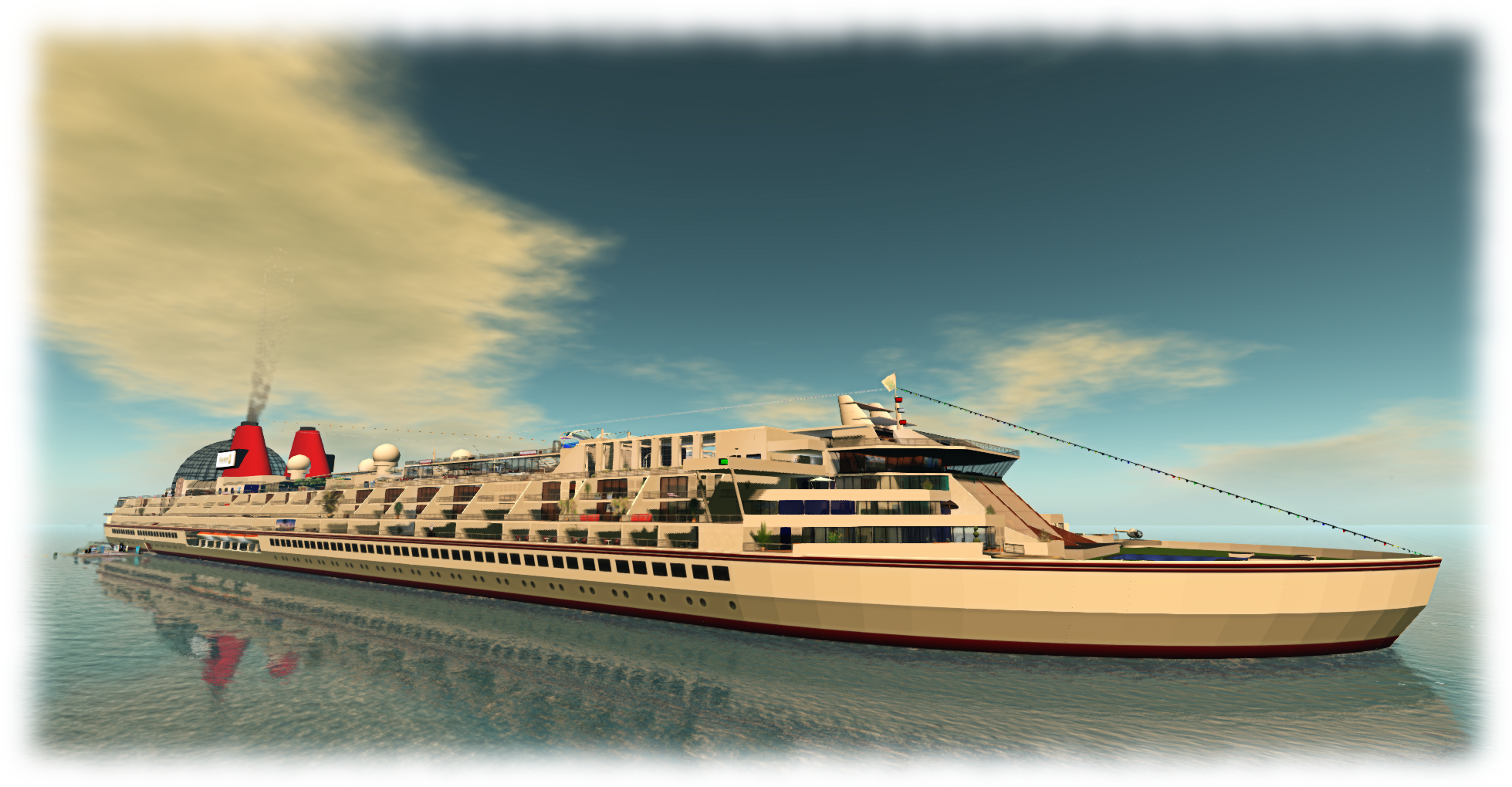
I’ve written about the SS Galaxy a couple of times in this blog, the most recent being in March 2015. The Queen of the Sagittarian Sea has been a staple of Second Life for many years,  being a destination, a venue and a home to many, as she sits to the south of Blake Sea, spanning the length of three regions from bow to stern.

And now it seems that she is embarked on her final cruise. On Sunday, May 3rd, the mighty Queen will make a final figurative return to port as she is removed from the grid.

The news came on Sunday, April 26th, in the form of a post on the SS Galaxy blog, which reads in part:

Dear Supporters and Friends of the SS Galaxy,

The Management and Crew of the SS Galaxy would like to thank each and every one of you for helping make the Galaxy community one of the most thriving, vibrant and welcoming on the Second Life grid.

Together with your help, we have been building wonderful memories since February 2007…

For us as the Crew, the privilege has been ours to meet and interact with each of you over these eight years. The memories we have from these experiences, will continue to inspire us and our values, long beyond 2015.

Many of you have become more than our cabin tenants – we consider you a part of the Galaxy family as well  :-). In the many diverse strands of life stories, God has granted us the blessing of having our respective stories intertwine, at least for a time. As we prepare to go on beyond April 2015, the Crew wish you that the strength in bonds will continue to sustain each and every one of you, along life’s way.

From all of us here at the SS Galaxy,

A heartfelt thank you.

SS Galaxy
SS Galaxy

The reasons for the closure are complex, and are not related to problems of tier, but rather have arisen as a result of a number of unfortunate incidents over the course of the past month.

As someone who has always enjoyed my visits to the Galaxy, I know that I will miss her presence in Second Life enormously. It was while exploring her in 2009 that I first discovered the fun of skeet (clay pigeon) shooting in Second Life – and i think there was a time back then when my name could regularly be seen on the Leader board 😉 .  I also thoroughly enjoyed skydiving from the launcher on her stern deck, and frequently used her as a venue to introduce friends to the fun of skydiving – the last one being Strawberry Singh.

Saying farewell to a much-loved venue, destination and home in Second Life is never easy, particularly for those closest to something that has, over the years been a labour of love. Commenting on the Galaxy’s forthcoming departure from Second Life, DBDigital Epsilon, the driving force behind the great cruise liner said, “as hard as this is, I know it is God’s timing and time for her to go with dignity and grace as she always has.”

Events aboard the ship will continue up until she returns to port on Sunday, May 3rd, so if you haven’t visited her before or in a while, while not schedule a visit around one of them, and both tour the ship and enjoy her unique atmosphere? Because once she is gone, I doubt we’ll see the likes of her again in-world.

SS Galaxy is a unique environment; a highlight of Second Life
SS Galaxy has been a unique location; a highlight of Second Life since 2007 now heading into the sunset

Related Links

Lab seeks assistance from Linux developers

Linux-SLDuring the Third-Party Developer (TPVD) meeting on Friday, April 24th, Oz Linden put out a request for assistance from members of the SL Linux community in order to ensure that the Linux version of the SL viewer continues to be developed.

His comments came as a part of a discussion on media work within the viewer in general, and can be heard in the video of the meeting provided by  Chakat Northspring, starting at the 9:10 mark.

For ease for reference, I’ve extracted the comments into an audio file (with a little clean-up to remove repetition), which is embedded below, any timestamps in this article refer to this audio.


Essentially, given the “extremely low” number of users running the Linux flavour of the viewer, and because the Lab wishes to focus on some “really cool things” for Second Life (no details on what these are), a decision has been made to remove Linux from any major focus of the Lab’s attention. Therefore, the Lab is looking to the TPV and open-source community to help ensure the Linux version of the viewer is maintained and moves forward. In making the request, Oz said in part [00:38]:

I just don’t have the time to put people on doing a lot of Linux work. I just don’t.  So, if there’s going to be a working Linux viewer, the Linux user community is going to need to pitch-in and help get it done, because frankly, if it doesn’t work, I can’t afford to fix it.

I have not been getting Linux contributions. What I get is occasional complaints that this or that thing doesn’t work in Linux … and the ethos there is that the community is what makes it work, and what I’m saying to the Second Life Linux community is, if you want it to work, you’re going to have to help.

The Lab will integrate and provide build services for Linux, and publish the results, but the Lab is no longer going to pursue development of the viewer on Linux, which means that if things are not working in the Linux flavour of the viewer, and there is no inwards support to fix them, then they’re unlikely to be fixed.

This shouldn’t be taken as a sign that the Lab is trying to “kill off” Linux support; it is a matter of focusing resources to serve the community as a whole. In this respect Oz added [01:55]:

And I hope that having said this, I will get a bunch of people step-up and start doing things and give me a lot of integration work to do. That’s my fondest hope. So next time you hear someone complaining about things not working on Linux, tell them i invited them to help.