Space Sunday: see Pluto’s mountains and the size of the Solar System

Back lit by the sun: Pluto's hazy atmosphere seen from just 18,000km (11,000 miles) and 15 minutes are the point of closest approach to the planet by the New Horizons spacecraft on July 14th, 2015. To the upper right of the planet can be seen the icy expanse of "Sputnik Planum", bordered below and to the left by tall mountains, and to the right by what appears to be glacial outflows. Image courtesy of NASA / JHU / APL,
Backlit by the Sun: Pluto’s hazy atmosphere seen from just 18,000km (11,000 miles) and 15 minutes are the point of closest approach to the planet by the New Horizons spacecraft on July 14th, 2015. To the upper right of the planet can be seen the icy expanse of “Sputnik Planum”, bordered below and to the left by tall mountains, and to the right by what appears to be glacial inflows. Image: NASA / JHUAPL / SwRI (click for full size)

Just when you thought images of Pluto returned by the New Horizons spacecraft could get any more awe-inspiring, NASA / JHU  APL release a set of raw images that are utterly stunning.

The images come from the wide-angle Ralph/Multispectral Visual Imaging Camera (MVIC) on the space craft and were captured just 15 minutes after the vehicle reached is point of closest approach to the little world, and thus from a distance of just 18,000 km (11,000 miles) from Pluto.

The stunning vistas presented in the image show the ice plains of “Sputnik Planum” bordered to the left and from below by Pluto’s huge mountain ranges, informally named Hillary and Norgay, Montes after the first partnership to successful reach the summit of Mt. Everest here on Earth. All of this is dramatically backlit by sunlight reflected through Pluto’s hazy atmosphere to create a wonderful scene said to be reminiscent of views of the Antarctic viewed from space or very high altitude.

A closer view: In this image just 380 km (230 miles) across, shows "Sputnik Planum" bordered to the west by towering mountains reaching up to 3,500 metres (11,000 ft) in altitude. In the foreground sit the informally-named Norgay Montes, and on the skyline to the top and left of the image, the Hilary Montes
A closer view: in this image just 380 km (230 miles) across, shows “Sputnik Planum” bordered to the west by towering mountains reaching up to 3,500 metres (11,000 ft) in altitude. In the foreground sit the informally named Norgay Montes, and on the skyline to the top and left of the image, the Hillary Montes. Image: NASA / JHUAPL / SwRI (click for full size)

However, the images aren’t just notable for the panoramic beauty; they actually reveal a lot about what is happening in the Plutoian atmosphere. Because of the back lighting from the Sun, the high-resolution MVIC has revealed just how complex Pluto’s atmosphere is, comprising multiple layers of nitrogen and other gases rising to around 100 km (60 mi) above Pluto’s surface (and visible as a banding in the images above).

“In addition to being visually stunning, these low-lying hazes hint at the weather changing from day-to-day on Pluto, just like it does here on Earth,” said Will Grundy, lead of the New Horizons Composition team from Lowell Observatory, Flagstaff, Arizona.

What is also exciting the science team is evidence within the images for Pluto having a complex “hydrological” cycle which seems to be comparable in some ways to that found on Earth – only on Pluto, it involves nitrogen ice, rather than water ice.

When compared with images captured as New Horizons approached Pluto, the MVIC images further suggest that the regions eastward of “Sputnik Planum” appear to have been encroached over time by ices and material possibly evaporated from the surface of “Sputnik Planum” to be deposited on the higher lands as a new ice blanket, which in turn appears to have formed glacial formations flowing back into “Sputnik Planum”.

Glacial flow on Pluto: deposits of frozen nitrogen which have accumulated on the uplands on the right side of this 630 km (390 mi) wide image has formed glacial flows leading from the uplands beck into "Sputnik Planum" draining from Pluto’s mountains onto the icy plain through the valley system indicated by the red arrows (the valleys average between 3 and 8 km (2 and 5 mi) in width). In the meantime, the ice of the plain appears to be flowing outwards and towards the uplands, as indicated by the blue arrows. Image: NASA/JHUAPL/SwRI.
Glacial flow on Pluto: deposits of frozen nitrogen which have accumulated on the uplands on the right side of this 630 km (390 mi) wide image has formed glacial flows leading from the uplands beck into “Sputnik Planum” draining from Pluto’s mountains onto the icy plain through the valley system indicated by the red arrows (the valleys average between 3 and 8 km (2 and 5 mi) in width). In the meantime, the ice of the plain appears to be flowing outwards and towards the uplands, as indicated by the blue arrows. Image: NASA / JHUAPL / SwRI (click for full size)

“We did not expect to find hints of a nitrogen-based glacial cycle on Pluto operating in the frigid conditions of the outer solar system,” said Alan Howard, a member of the mission’s Geology, Geophysics and Imaging team from the University of Virginia, Charlottesville. “Driven by dim sunlight, this would be directly comparable to the hydrological cycle that feeds ice caps on Earth, where water is evaporated from the oceans, falls as snow, and returns to the seas through glacial flow.”

To Scale: The Solar System

We’re all familiar with the idea that the solar system is so vast, that it is almost impossible to show the Sun and the major planets proportional to one another and at a scale where all the later are both visible and have orbits which can be adequately encompassed in an easily viewable space.

1972: The Blue Marble (click to enlarge)

Obviously, some models do exist; the Lowell Observatory in Arizona, USA, for example, has a walk that allows visitors to travel from the sun and by each of the planets, but it’s not always easy to clearly grasp the sheer scale of things. The same goes for digital models (and a few have been built within virtual worlds like Second Life).

With this issue of scale and proportion in mind, Wylie Overstreet and Alex Gorosh set out to produce a scale model of the solar system that might help people understand just how vast our planetary back yard is when looked at on a human scale.

They started with a blue marble to represent the Earth, echoing the famous photograph taken on December 7, 1972, by the crew of Apollo 17 en route to the Moon and which NASA dubbed the Blue Marble.

Continue reading “Space Sunday: see Pluto’s mountains and the size of the Solar System”

Space Sunday: of Pluto, Mars and crowdfunding space outreach

new-horizonNASA and the Applied Physics Laboratory (APL) at John Hopkins University kept their promise a little earlier than expected.

With the resumption of image and data transmissions from New Horizons, at the start of September, they had indicated that Fridays would henceforth, and for the course of the next 12 months, be known as Pluto Friday, the day on which the latest raw images from the mission to that distant tiny world and its companions would be released.

However, the first set of images came a little sooner than advertised: on Thursday, September 10th, and they continue to show two tiny worlds which continue to astound and have planetary scientists rethinking much about their understanding of dwarf planets.

“Pluto is showing us a diversity of landforms and complexity of process that rival anything we’ve seen in the solar system,” New Horizons’ principal investigator Alan Stern, from the Southwest Research Institute in Colorado, said in a statement. “If an artist had painted this Pluto before our flyby, I probably would have called it over the top — but that’s what is actually there.”

Charon, Pluto's largest companion, as seen by New Horizons on July 14th, 2015, from a distance of some 464,000 kilometres (290,000 miles), revealing a rich and diverse range of surface features
Charon, Pluto’s largest companion, as seen by New Horizons on July 14th, 2015, from a distance of some 464,000 kilometres (290,000 miles), revealing a rich and diverse range of surface features (image: NASA / JHU / APL / SWU) – click any image for the full-size version

The images render details as small as 400 metres / 440 yards per pixel on the surface of Pluto, and reveal features that have scientists agog with excitement; so much so that at a NASA press conference, the images were summarised thus, “it’s complicated!”

In them, we can see a rich complexity of features: nitrogen ice flows which have apparently oozed (and might still be slowly oozing) out of mountain ranges and across broad plains; mountain ranges which are themselves reminiscent of chaotic regions on Mars and Jupiter’s Europa; complex valley systems which might have been carved by the action of material flowing across the planet; and even – perhaps most curiously of all –  what seem to be wind-blown fields of dunes.

A synthetic perspective view of Pluto, based on the latest high-res received from New Horizons presents a view of Pluto from around 1,800 km (1,100 mi) above Pluto’s equatorial area. Towards the bottom of the image is the cratered and dark region dubbed "Cthulhu Regio", and above it, the bright "heart" of Pluto, showing the icy plains of "Sputnik Planum". The images used to create this view were captured from a distance of 80,000 km (50,000 mi) from Pluto
A synthetic perspective view of Pluto, based on the latest high-res received from New Horizons presents a view of Pluto from around 1,800 km (1,100 mi) above Pluto’s equatorial area. Towards the bottom of the image is the cratered and dark region dubbed “Cthulhu Regio”, and above it, the bright “heart” of Pluto, the “Tombaugh Regio”, with the icy plains of “Sputnik Planum” prominent. The images used to create this view were captured from a distance of 80,000 km (50,000 mi) from Pluto (images: NASA / JHU / APL / SWU) – click any image for the full-size version

What is also particularly striking about these images of Pluto is the way that they reveal some of the oldest  (geologically speaking) regions yet seen on the planet sitting right alongside what are the youngest locations on the planet, adding further emphasis to the idea that Pluto has been, and might still be, an active world.

But what about those dunes mentioned above? If they are indeed what the images released on September 10th suggest, Pluto has once again served up a surprise.

“Seeing dunes on Pluto, if that is what they are would be completely wild!” William McKinnon from the mission’s Geology, Geophysics and Imaging (GGI) team, said, “because Pluto’s atmosphere today is so thin. So either Pluto had a thicker atmosphere in the past, or some process we haven’t figured out is at work. It’s a head-scratcher!”

The dunes of Pluto? This image, representing a portion of Pluto's surface some 350 km (220 mi) across, shows some of the planet's older, chaotic terrain at the bottom, and an enigmatic field of dark, aligned ridges that resemble dunes which have caused planetary scientists to feel their eyebrows further vanishing under hair lines. The image was captured from a distance of 80,000 km (50,000 mi) from Pluto.
The dunes of Pluto? This image, representing a portion of Pluto’s surface some 350 km (220 mi) across, shows some of the planet’s older, chaotic terrain at the bottom, and an enigmatic field of dark, aligned ridges that resemble dunes toward the top. The image was captured from a distance of 80,000 km (50,000 mi) from Pluto (images: NASA / JHU / APL / SWU)

More is also being discovered about Pluto’s atmosphere, which is also proving to be a lot more complex than had originally been thought, having many more layers within its thin haze than had been thought. However, these layers of haze have allowed the science team to glimpse surface features which might otherwise have remained unseen as sunlight caught by the haze over the terminator – the divide between the day and night sides of the planet – cast a soft glow over part of Pluto’s night side. When enhanced through careful processing, this glow could be used to reveal what lay below.

Continue reading “Space Sunday: of Pluto, Mars and crowdfunding space outreach”

Space Sunday: Pluto calls, Mars mystifies, Starliner prepares

new-horizonIt’s been a little quiet on the new images front where the New Horizons mission is concerned. The spacecraft, which performed the first ever flyby of Pluto and Charon in July, gathered a wealth of data, around 95% of which has remained aboard the spacecraft awaiting transmission back to Earth.

There have been a number of reasons this has been the case. First off, for the period following the close encounter, New Horizons continued to gather data and images of the Pluto-Charon system. Such is the design of the vehicle that while doing this, it couldn’t actually transmit information back to Earth. Also, once the data had been gathered it required sorting and prioritising ready for transmission back to Earth, and this again took time to do.

However, on Saturday, September 5th, New Horizons oriented itself to make contact with the Deep Space Network (DSN) operated by NASA for what was the start of a year-long “intensive” download of the 10 gigabits of data gathered by the craft, starting with information the science team regard as the highest priority data sets.

The reason the transfer will take so long is not only because the enormous distance between New Horizons and Earth, which takes radio signals moving at the speed of light over 4.5 hours to cross (a time which is slowly increasing), but also because the rate at which the data can be transmitted is limited.

Currently, the nuclear “battery” powering New Horizons can only produce around 2-10 watts of electrical power, which has to keep all of the various electrical systems warm and running. So to conserve power, the vehicle only transmits data at between 2-4 kbps. To put that in perspective, it would take you about 2 hours to download a single photo from your cellphone to your computer at those speeds.

NASA Deep Space Network facility near Canberra, Australia
NASA Deep Space Network (DSN)  is a set of three communications facilities operated by NASA in Spain, Australia (shown above) and California. They are tasked with maintaining communications with NASA’s deep space and planetary missions. Located roughly 120-degrees apart around the Earth, the three facilities can between them maintain a constant radio observation on any spacecraft under their command as the Earth rotates.

Discussing the start of the extended data download from New Horizons, Alan Stern, the mission’s Principal Investigator, said, “this is what we came for – these images, spectra and other data types that are going to help us understand the origin and the evolution of the Pluto system for the first time.”

He continued, “and what’s coming is not just the remaining 95 percent of the data that’s still aboard the spacecraft – it’s the best datasets, the highest-resolution images and spectra, the most important atmospheric datasets, and more. It’s a treasure trove.”

To mark the receipt of data and images, NASA / JPL and John Hopkins’ APL have designated Friday as Pluto Friday, when they’ll be publishing that latest images, unprocessed, received from the spacecraft the previous week. The images will be available on the LORRI image catalogue, operated by JHU / APL, starting on Friday, September 11th, 2015.

In the meantime, here’s an animated video from NASA, showing the Pluto flyby, just to whet appetites.

Mars’ Atmosphere: Where did It Go?

One of the many mysteries of Mars is what happened to its atmosphere. All of the evidence gathered over the years about the Red Planet is that it once had an atmosphere dense enough to support free-flowing liquid water, and that potentially as much of 20% of the planet’s surface may have been submerged.

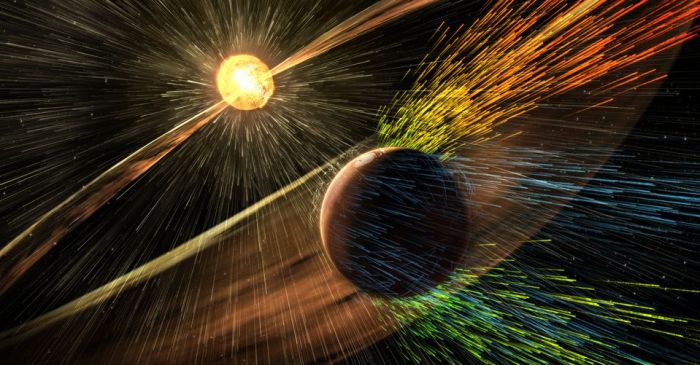
So what happened? There are a number of theories. One of these is that over time, the action of the solar wind, combined with Mars’ relatively weak gravity, effectively “scooped” much of the atmosphere away into space.   Measurements of heavy and light carbon ratios in the present day atmosphere lend considerable weight to this theory.

An artist's impression of what a wet Mars may have looked like, based on the ratio of deuterium contained within the Martian polar caps
An artist’s impression of what a wet Mars may have looked like, based on the ratio of deuterium contained within the Martian polar caps

Another idea is that carbon dioxide, the major constituent of Mars’ atmosphere may have been “sequestered” – that is, “pulled” out of the atmosphere to be stored in rocks and subsurface deposits by various chemical reactions, forming carbonate minerals in the process.

This theory was given its own boost when a region of Mars called Nili Fossae, approximately as big as the US state of Arizona, was found to have huge deposits of carbonates (more recently this region has been of interest to scientists due to the discovery of impact glass, helping to mark the region as a candidate target for the Mars 2020 rover mission).

Continue reading “Space Sunday: Pluto calls, Mars mystifies, Starliner prepares”

Space Sunday: of selfies, sprites, and black holes

CuriosityCuriosity, NASA’s Mars Science Laboratory rover has departed “Marias Pass”, a geological contact zone between different rock types on the slopes of “Mount Sharp”, some of which yielded unexpectedly high silica and hydrogen content.

As noted in a recent space update in these pages, silica  is primarily of interest to scientists, because high levels of it within rocks could indicate ideal conditions for preserving ancient organic material, if present. However, as also previously noted, it may also indicate that Mars may have had a continental crust similar to that found on Earth, potentially signifying the geological history of the two worlds was closer than previously understood. Hydrogen is of interest to scientists as it indicates water bound to minerals in the ground, further pointing to Gale Crater having once been flooded, and “Mount Sharp” itself the result of ancient water-borne sediments being laid down over repeated wet periods in the planet’s ancient past.

Curiosity actually departed “Marias Pass” on August 12th, after spending a number of weeks examining the area, including a successful drilling and sample-gathering operation at a rock dubbed “Buckskin”, where the rover also paused to take a “selfie”, which NASA released on August 19th. It is now continuing its steady climb up the slopes of “Mount Sharp.”

A low-angle self-portrait produced from multiple images captured by the Mars Hand Lens Imager (MAHLI) camera mounted on the "turret" at the end of the rover's robot arm. The images were taken on August 5th, as the rover was parked at the "Buckskin" rock formation from which it gathered drill samples
A low-angle self-portrait produced from multiple images captured by the Mars Hand Lens Imager (MAHLI) camera mounted on the “turret” at the end of the rover’s robot arm. The images were taken on August 5th, as the rover was parked at the “Buckskin” rock formation from which it gathered drill samples

As it does so, initial analysis of the first of the samples gathered from “Buckskin” is under-way. It is hoped with will help explain why the “Marias Pass” area seems to have far higher deposits of hydrogen bound in its rocks than have previously been recorded during the rover’s travels. This data has been supplied by the Dynamic Albedo of Neutrons (DAN) instrument on Curiosity, which almost continuously scans the ground over which the rover is passing to gain a chemical signature of what lies beneath it.

“The ground about 1 metre beneath the rover in this area holds three or four times as much water as the ground anywhere else Curiosity has driven during its three years on Mars,” said DAN Principal Investigator Igor Mitrofanov of Space Research Institute, Moscow, when discussing the “Marias Pass” DAN findings. Quite why this should be isn’t fully understood – hence the interest in what the drill samples undergoing analysis might reveal.

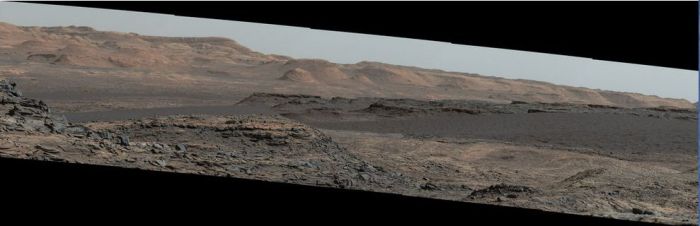
A stunning vista: the slopes of "Mount Sharp" as seen by Curiosity as it commenced the upward drive away from "Marias Pass". Captured by the rover's Mastcam systems, the image shows an intriguing landscape, with the gravel and sand ripples typical of much of the terrain over which the rover has passed in the foreground. In the middle distance sit outcrops of smooth, dust-covered bedrock, above which sit sandstone ridges. On the horizon sit rounded buttes, rich in sulfate minerals, suggesting a change in the availability of water when they formed - click image for the full size version
A stunning vista: the slopes of “Mount Sharp” as seen by Curiosity as it commenced the upward drive away from “Marias Pass”. Captured by the rover’s Mastcam systems, the image shows an intriguing landscape, with the gravel and sand ripples typical of much of the terrain over which the rover has passed in the foreground. In the middle distance sit outcrops of smooth, dust-covered bedrock, above which sit sandstone ridges. On the horizon sit rounded buttes, rich in sulfate minerals, suggesting a change in the availability of water when they formed – click image for the full size version

The drilling operation itself marked the first time use of the system since a series of transient short circuits occurred in the hammer / vibration mechanism in February 2015. While no clear-cut cause for the shorts was identified, new fault protection routines were uploaded to the rover in the hope that should similar shorts occur in the future, they will not threaten any of Curiosity’s systems.

A Flight over Mars

With all the attention Curiosity gets, it is sometimes easy to forget there are other vehicles in operation on and around Mars which are also returning incredible images and amounts of data as well – and were doing so long before Curiosity arrived.

One of these is Europe’s Mars Express, the capabilities of which come close to matching those of NASA’s Mars Reconnaissance Orbiter. Mars Express has been in operation around Mars for over a decade, and in that time has collected an incredible amount of data.

At the start of August, ESA released a video made of high resolution images captured by the orbiter of the Atlantis Choas region of Mars. This is an area about 170 kilometres long and 145 wide (roughly 106 x 91 miles) comprising multiple terrain types and impact craters, thought to be the eroded remnants of a once continuous ancient plateau. While the vertical elevations and depressions have been exaggerated (a process which helps scientists to better understand surface features when imaged at different angles from orbit), the video does much to reveal the “magnificent desolation” that is the beauty of Mars.

Continue reading “Space Sunday: of selfies, sprites, and black holes”

Space Sunday: images of meteors, aurorae and comets

A composite image of the Perseids by Jeff Sullivan
A composite image of the Perseids by Jeff Sullivan showing roughly half of the meteors he captured on film in a 3-hour period over the Mojave Desert, California, on August 13th

Visually, it’s been a stunning week for astronomy and space science. We’ve had amazing images of the Perseids reaching this year’s peak as the Earth ploughs through the heart of the debris cloud left by comet Swift-Tuttle; there have been amazing shots of the Northern Lights Tweeted to Earth from the International Space Station; and another comet – 67P/Churyumov–Gerasimenko has shown us just how active a place it came become under the influence of the sun.

As I noted last Sunday, the Perseids meteor shower promised to be quite a spectacle this year, once again coinciding with a new moon which would leave the night skies particularly dark – ideal circumstances with which to see the meteor display for those able to get away from more Earthbound light pollution.

Gary Pearson caught this incredible meteor trail over Brancaster, Norfolk, UK on August 12th - a stunning display from an already vaporised particle of dust
Gary Pearson caught this incredible meteor trail over Brancaster, Norfolk, UK on August 12th – a stunning display from an already vaporised particle of dust

The Perseids – so-called because they appear to originate from the constellation of Perseus – are always a popular astronomical event; during the peak period, it is possible to see between 60 and 100 meteors per hour. They are the result of the Earth travelling through a cloud of dust and debris particles left by  Comet 109p/Swift-Tuttle’s routine passage around the Sun once every 133 years.

As the comet last passed through the inner solar system in 1992, the debris left by the outgassing of material as it was heated by the Sun is extensive, hence the brilliance of the Perseids displays. As noted, with the peak of the Earth’s passage through the debris (which lasts about a month overall from mid-July through mid-August, so there is still time to see them) occurring at a time when there would be a new moon, 2015 promised to offer spectacular opportunities for seeing meteors – and duly delivered.

Amateur astronomers Stojan Stojanovski, Kristijan Gjoreski and Igor Nastoski of the Ohrid Astronomy Association in Ohrid, Macedonia
Amateur astronomers Stojan Stojanovski, Kristijan Gjoreski and Igor Nastoski of the Ohrid Astronomy Association in Ohrid, Macedonia, captured this meteor as the Sun set on August 13th

Across the northern hemisphere between August 12th and August 14th, 2015, the Perseids put on some of the most spectacular displays seen in our skies in recent years – and people were out with their cameras to capture the event.

The highest concentration of meteors was visible after 03:00 local time around the world, although by far the best position to witness the event was in the northern hemisphere, with things getting under way as the skies darkened from about 23:00 onwards in most places.

It is not uncommon for the shower to coincide with a new moon (2012, for example was the same). However, this year’s display has been particularly impressive for those fortunate enough to have clear skies overhead.  “I have been outside for about 3 hours” Ruslan Merzlyako reported on August 13th. “And the results are bloody fantastic! Lots of Perseids and Northern Lights had just exploded in the sky right over my home town. For now, I am not going to argue with Danish weather, because I am 200 percent happy!”

A composite image by Danish photographer Ruslan Merzlyakov, who also caught the background glow of the Northern Lights in the skies of Denmark

You can find more images of this year’s Perseids event on Flickr.

Aurora From Space

Staying with the Northern Lights – more formally referred to as the Aurora Borealis –  the current commander of the International Space Station, Scott Kelly, captured some stunning images of the event, some of which he shared via his Twitter feed,  during the 141st day of his current mission – the joint US / Russian Year In Space – aboard the station.

“Aurora trailing a colourful veil over Earth this morning. Good morning from @spacestation!” he tweeted at the start of the series, which included a remarkable time-lapse video. With a further image, he commented, “Another pass through #Aurora. The sun is very active today, apparently.”

Continue reading “Space Sunday: images of meteors, aurorae and comets”

Space Sunday: active Ceres, open Mars, and shooting stars

Dawn mission patch (NASA / JPL)Dawn, the NASA / ESA joint mission to explore two of the solar system’s three “protoplanets” located in the asteroid belt between the orbits of Mars and Jupiter, continues to intrigue scientists as it studies Ceres, the second of its primary targets.

As I reported in June 2015, Dawn is part of a broader effort to better understand the origins of the solar system and how the planets actually formed; all of which might give us greater understanding of how life arose here on Earth.

Launched in September 2007, Dawn arrived at Ceres in March 2015, after a 2.5 year transit flight from Vesta, its first destination, which it had been studying for 14 months following its arrival in July 2011. Because of their relative size – Ceres accounts for around one-third of the total mass of the asteroid belt – both of these airless, rocky bodies are regarded as dwarf planets, rather than “simple” asteroids. However, Ceres is proving to be quite the conundrum.

At the start of July, Dawn completed the first part of its high-altitude survey of Ceres and fired its low-thrust ion drive to start a series of gentle manoeuvres to reduce its orbit around from 4,400 kilometres (2,700 miles) to 1,450 kilometres (900 miles). It’s now hoped that from this lower orbit, the space craft will be able to discover more about some of Ceres’ more mysterious features.

One in particular has been the subject of much debate. It started when Dawn imaged a series of bright spots within the crater Occator as it made its initial loop around Ceres to enter orbit. Since that time, it has repeatedly images the bright spots, and their presence has also been confirmed by the Hubble Space Telescope.

A June 6th image of the bright spots within a crater on Ceres, captured by Dawn on June 6th, 2015, from a distance of
A Dawn spacecraft image of the bright spots within a crater on Ceres, captured on June 6th, 2015. With the vehicle now entering a much lower altitude mapping mission, it is hoped that even more detail on the spots  – and the faint haze discovered within the crater – will be obtained

Currently, it is believed the bright marks might either be salt deposits or water ice (the European  Herschel Space Observatory had previously found evidence of water vapour on Ceres).  However, while the science team aren’t leaning either way, their mission briefing on July 21st, leant some weight to the bright spots perhaps being water ice. This came in the form of an announcement that he 92 kilometre (57 mile) wide Occator has its own, very localised atmosphere focused around the bright areas.

The evidence for this comes from images of the crater taken from certain angles which reveal a thin haze covering around half of the cater, but not extending beyond its walls. Th thinking is that this haze is perhaps the result of the ice in the bright area – if they are ice – sublimating out.

However, if this is the case, it actually raises a further mystery: why the haze? Generally, such sublimation would lead to the resulting gases dissipating very quickly, without forming a haze. One hypothesis is that Ceres’ gravity, which is somewhat higher than might be expected for a body of its size) may be and influencing factor.

The 5 km high "pyramid" mountain pokes up above the limb of Ceres. Flat-topped, it has streaks of bight mateiral on its flanks giving the impression something has been flowing down it.
The 5 km high “pyramid” mountain pokes up above the limb of Ceres. Flat-topped, it has streaks of bright material on its flanks giving the impression something has been flowing down it.

The bright spots aren’t the only curious feature on Ceres. Dawn has also spotted numerous long, linear features whose cause is unknown, as well as one big mountain that mission team members have dubbed “The Pyramid.” This massif, about 5 km (3 mi) in height, and around 30 km (19 mi) across at its base, is oddly flat-topped and has streaks of bright material on one of it flanks, as if something has been cascading down the slope. What this might indicate has planetary scientists scratching their heads at this point.

With all the mysteries thrown up by New Horizon’s recently flyby of Pluto, and Dawn’s discovery of mysterious features on Ceres, it really is becoming a case that the tiny worlds of our solar system are perhaps the most perplexing.

Three years ago, in August 2012, NASA’s Mars Science Laboratory rover, Curiosity, arrived in Gale Crater, Mars. Since that time, the rover has made some remarkable discoveries, as reported in this blog over the years.

To mark the anniversary of the landing, NASA has launched two new on-line tools designed to open the mysterious terrain of the Red Planet to anyone with an interest in planetary exploration.

Experience Curiosity allows users to journey along with the one-tonne rover on its Martian expeditions. The program simulates Mars in 3-D, using actual data returned by the rover and NASA’s Mars Reconnaissance Orbiter (MRO). It also uses a  game-ready rover model based entirely on real mechanisms.

Experience Curiosity allows you to learn about the rover using a 3D model which can be manipulated and driven, using a WebGL application

User are able to drive the rover, examine it, call up data on key components, witness the driving view from different cameras on the rover, and operated the robot arm. Activities are a little basic, but as this appears to be a part of NASA’s Eyes On project, capabilities may grow over time.

Mars Trek is a much more expansive tool – one which is actually being used in the planning for the Mars 2020 rover mission. It features interactive maps, which include the ability to overlay a range of data sets generated from instruments aboard spacecraft orbiting Mars, and analysis tools for measuring surface features. Standard keyboard gaming controls are used to manoeuvre the user across Mars’ surface, and topographic data can be exported to 3D printers to allow the printing of physical models of surface features.

The map view and be manipulated in 2D or 3D, data on various surface missions is provided, compete with the ability to zoom into the surface locations for these missions, making for a visually impressive model.

Continue reading “Space Sunday: active Ceres, open Mars, and shooting stars”