Space Sunday: of moons, storms and rockets

A joint Belgian-French-Japanese study has provided the strongest evidence yet for the Martian moons being the result of a massive collision between the planet and other object very early in the solar system's history
The traditional theory of the Moon’s formation is that a Mars-sized body grazed the young Earth, throwing of a cloud of material which  eventually condensed into the Moon. Credit: NASA

We’re all familiar with the Moon, Earth’s cosmic companion. So familiar with it in fact, that we probably all think we know the theory behind how it got to be where it is – the result of a “giant impact” far back in Earth’s early history. However, a new study, published on October 31st in Nature, suggests what actually led to the creation of the Moon was possibly a lot  more elegant than previously realised.

The Moon is actually quite unique among the solar system’s satellites. It’s relatively large when compared to its parent planet, and it is a made of pretty much the same stuff, minus some more volatile compounds that evaporated long ago. Other moons tend to be a lot more chemically diverse when compared to one another and their parent worlds.

The accepted theory of lunar formation has it that not long after primordial Earth formed, a Mars-sized object grazed it, throwing off a mass of material from which the Moon subsequently condensed. This impact set the angular momentum for the Earth-moon system, and gave the early Earth a five-hour day. Then, over the aeons, the Moon slowly receded from the Earth (as it continues to do so to this day), and Earth’s rotation has slowed to our current 24-hour day.

The Moon is is an elliptical orbit around the Earth which varies from 364,397 km at its closest, to 406,731 km at its most distant. When it’s full and at its closest point to Earth (perigee), the Moon can look over 10% bigger, and 30% brighter than when it’s at a more distant point in its orbit (apogee). However, such is the momentum of the Moon's oribt, it is actually slowly moving further and further away from Earth, as it has been throughout its history
The Moon is in an elliptical orbit around the Earth which varies from 364,397 km at its closest, to 406,731 km at its most distant. When it’s full and at its closest point to Earth (perigee), the Moon can look over 10% bigger, and 30% brighter than when it’s at a more distant point in its orbit (apogee). However, such is the momentum of the Moon’s orbit, it is actually slowly moving further and further away from Earth, as it has been throughout its history. Credit: Wikipedia

It’s a theory all worked out be a combination on mathematics based on the moon’s current orbit, the angular momentum of the Earth-Moon system, the influence of various tidal forces, a little bit of guesswork, etc.  However, it does have a couple of holes in it.

The first is that if the Moon was formed as a result of material set free during a slight collision between Earth and another body, then that material should have been a mix of debris from both Earth and the other body, giving rise to a lunar composition that should be at least somewhat different to that of Earth. The second is that if the Moon condensed from a disk of material rotating around Earth’s equator, it should be in orbit over the equator – but instead, its orbit is tilted 5 degrees off the equator.

Both of these issues have previously been explained in terms of “intervening steps” between what we see today and the original  “giant impact”. However, a team of scientists led by Sarah Stewart, professor of earth and planetary sciences at the University of California, have posited an alternative explanation, which requires no “intervening steps”, but always natural mechanics to explain everything.

In their model, the “giant impact” still occurs –  but it completely destroys the nascent Earth and whatever hit it, leaving a mass of vaporised and molten material  orbiting the Sun, which eventually condenses to form a “new” Earth and the Moon – thus giving them similar chemical compositions. Initially, the Earth would have likely been tipped so its axis was pointing towards the Sun while spinning in a two-hour day.

Then, as angular momentum was dissipated through tidal forces, the Moon started receding from Earth, eventually reaching a point called the “LaPlace plane transition”. At this point the forces from the Earth on the Moon became less important than gravitational forces from the sun, resulting in some of the angular momentum of the Earth-Moon system transferring to the Earth-Sun system, causing the Earth to tip “upright”, while leaving the Moon in a very highly inclined orbit relative to Earth’s equator. However, as the Moon continued to slowly and naturally recede from the Earth, it eventually reached the Cassini transition, gradually reducing the Moon’s angle of inclination relative to the Earth’s equator, bringing it to the five-degree offset we see today.

Thus, with this model, no exotic intermediary steps are required to account for the Moon’s composition or why it is where it is today; everything can be explained through the application of mathematics and planetary mechanics, offering a compelling alternative to the accepted theory of lunar evolution.

China Launches the Long March 5 Heavy Lifter

China's Long March 5 (l) and Long March 7 (r) next generation launch vehicles
China’s Long March 5 heavy lift launch vehicle (l) is the centrepiece of China’s long-term space ambitions alongside the medium lift Long March 7 (r), which entered service earlier in 2016. Credit: CCTV

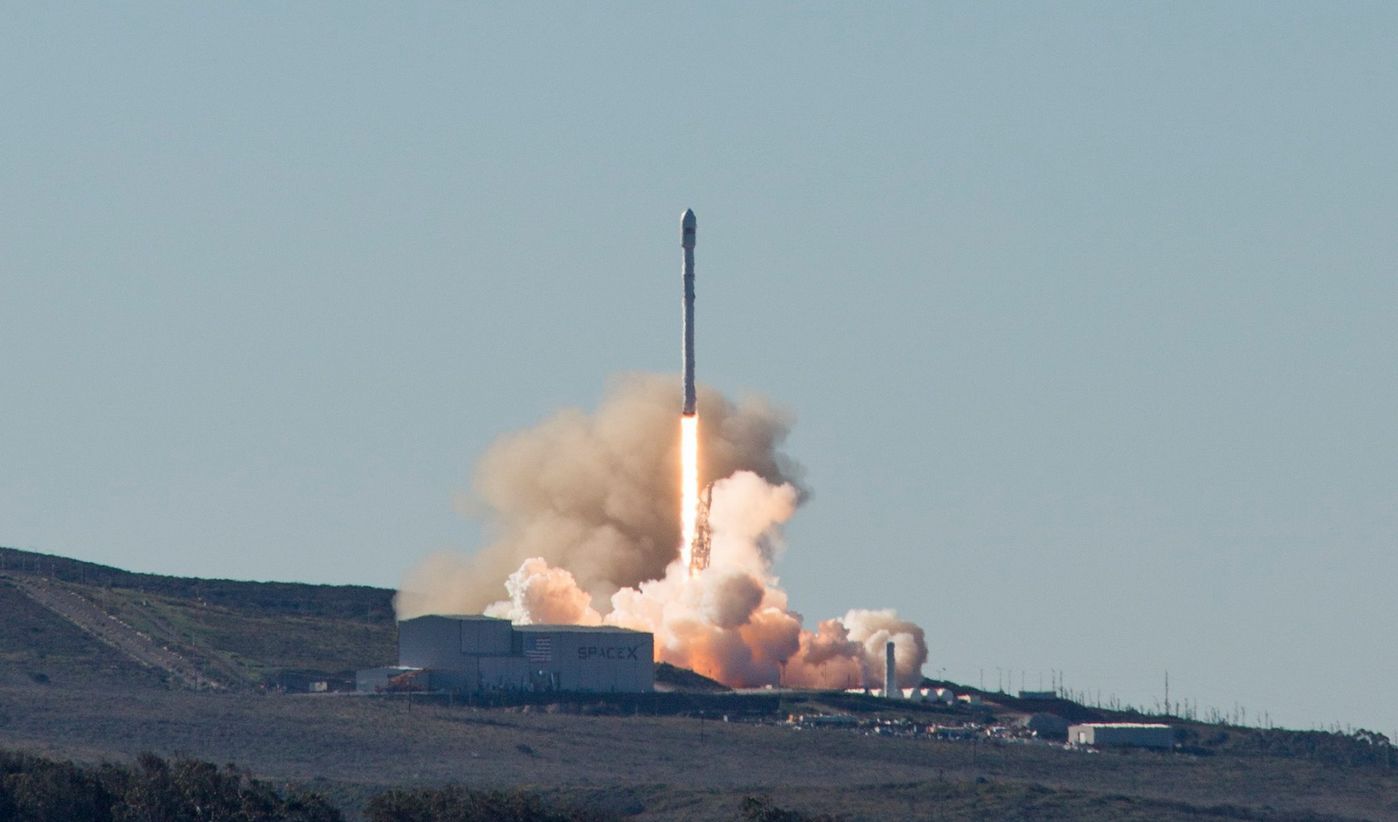
China’s newest and biggest heavy-lift rocket, the Long March 5 (Chang Zheng-5) lifted-off from the Wenchang launch centre on Hainan Island, off China’s southern coast, at 12:43:14 UT or 20:43 Beijing time on Thursday, November 3rd, carrying an experimental satellite designed to test electric-propulsion technology.

With a 25 tonne low Earth orbit payload capacity, the Long March 5 stands on a par with the current crop of heavy lift launch vehicles in operation around the world. The product of two decades of research and development, it is destined to become a centrepiece of China’s growing space ambitions.

Among its may missions, the Long March 5 will play a leading role in the construction of China’s upcoming space station, starting with the launch of the core Tianhe (“Harmony of the Heavens”) module in 2018. When completed in 2022, the 60-tonne station will comprise the core module supported by the Wentian (“Quest for the Heavens”) and Mengtian (“Dreaming of the Heavens”) pressurised experiments modules, all of which will be linked by a multi-port adaptor / EVA airlock.

Continue reading “Space Sunday: of moons, storms and rockets”

Space Update: Planet Nine, “signalling” stars and a quick round-up

Planet Nine, if it exists,could equal Neptune in size, and orbits the Sun 200 times further away than Earth. Credit: Caltech / R. Hurt
Planet Nine, if it exists,could equal Neptune in size, and orbit the Sun 200 times further away than Earth. Credit: Caltech / R. Hurt

In January and February 2016, I wrote about Planet Nine (or Planet X, George, Jehoshaphat, or Planet of the Apes, depending  your preference), the Neptune-sized world believed to be orbiting the sun on the very edge of the solar system in a highly eccentric orbit. Since then, the search for this mysterious world has continued, and while it has yet to be located, evidence that it exists has been mounting. Not only that, but astronomers now believe it might explain why the solar system is “tipped”.

The Hunt started after Mike Brown, a leading planetary astronomer at the California Institute of Technology (Caltech), and his colleague Konstantin Batygin developed a computer model which showed that the very eccentric orbits of six Trans-Neptunian Objects (TNOs) located in what is called the scattered disk,  a sparsely populated region of space between 30 100 AU from the sun, overlapping with the Kuiper belt, could have been due to the influence of a massive, distant planet. At the time, they noted that if the model was correct, other TNOs would likely  occupy equally distinct orbits.

A planet averaging about 10 times as massive as Earth, called Planet Nine could explain the paths of six distant objects in the solar system with mysterious orbits
A planet averaging about 10 times as massive as Earth, called Planet Nine could explain the paths of six distant objects in the solar system with mysterious orbits. Credit: Caltech / R Hurt

At the joint European Planetary Science Congress (EPSC) and American Astronomical Society’s Division for Planetary Sciences (DPS) in October, it was revealed more TNOs fitting the model have been discovered over the past several months. Two of them,  2013 FT28 and 2014 SR349, precisely fit the same type of orbit seen the original six objects used by Brown and Batygin model. Five more have been found in orbits which are effective perpendicular to Planet Nine’s believed orbit around the Sun, something predicted by the computer model.

All of this is helping to narrow down Planet Nine’s potential orbit around the Sun, and the arc of that orbit where it might be found. So much so that Batygin, Brown have teamed with original proponents for Planet Nine Chad Trujillo and Scott Sheppard to use the 8-metre Subaru Telescope atop Mauna Kea in Hawaii to carry out a  search of the night sky. Sheppard and Trujillo are also using two telescopes in Chile to search the possible sweep of the planet through the southern hemisphere’s night sky. And they are not alone.

The Brown / Batygin model for Planet Nine indicated the planet would cause some TNOs to ine in orbits perpendicular to the planet's own eccentric orbit around the Sun - and five such object have now been discovered (shown in teal, with the original TNOs possibly influenced shown in magenta. Credit: Caltech
The Brown / Batygin model for Planet Nine indicated the planet would cause some TNOs to lie in orbits perpendicular to the planet’s own eccentric orbit around the Sun – and five such object have now been discovered (shown in teal, with the original TNOs possibly influenced shown in magenta. Credit: Caltech

Also at the planetary conference, graduate student Elizabeth Bailey, using Brown and Batygin’s data presented a paper proposing how the odd tilt to the solar system’s major planets relative to the Sun might be due to Planet Nine.

With the exceptional of Mercury, all the major planets in the solar system orbit along a plane tilted by about six degrees from the Sun’s equator. This suggests either the Sun was somehow tipped on its axis in the past, or the planets have been pulled from their original alignment along the Sun’s equatorial plane. Of these two ideas, the preferred option has been for exotic interactions between the early Sun’s magnetic field and the primordial disk of gas surrounding it, inclining the latter, which then formed the planets. However, Bailey’s simulations suggest that a large body occupying Planet Nine’s predicted orbit could have had sufficient influence on the Sun over some 4 billion years to have slowly tipped it over by six degrees. Bailey’s hypothesis was supported by a  Brazilian team of astronomers, who used a different analytical method while working independently from her, and reached the same conclusion.

As it might be: estimates concerning Planet Nine's possible size, mass, etc., should it exist. Credit: Space.com / Karl Tate
As it might be: estimates concerning Planet Nine’s possible size, mass, etc., should it exist. Credit: Space.com / Karl Tate

Even so, some remain sceptical that the mysterious world exists. “I give it about a 1% chance of turning out to be real,” says astronomer JJ Kavelaars, of the Dominion Astrophysical Observatory in Victoria, Canada. Interestingly, his fellow researcher and collaborator Cory Shankman,  has created models with the exact orbits of the original six TNOs used by Brown and Batygin, and found that a massive planet would not maintain their tell-tale clustering for long periods.

Thus, the search for the solar system’s mysterious Planet Nine, continues.

ETs Phone Home?

Are aliens sending signals using their own stars? That’s what might be happening, according to astrophysicists Ermanno Borra and Eric Trottier, from Laval University in Quebec; although they admit it’s only one possible explanation for what they appear to have discovered.

It was in 2012 that Borra predicted intelligent aliens might use the light from their own stars to signal their existence to the cosmos. Using data from the Sloan Digital Sky Survey, Borra and Trottier analysed the spectra of 2.5 million stars to see if this might be the case – and found 234  which seem to be broadcasting a signal of the kind predicted by Borra.

The “signals” are pulses in the stars’ light, separated by a constant time interval. What’s more, all 234 stars are predominantly in the F2 to K1 spectral range, which is the small range of stars centred on the spectrum of our own life-supporting Sun, and thus the broad group of stars thought might support life on planets orbiting them.

The Sloan Digital Sky Survey telescope, New Mexico. Credit: SDSS / Fermilab Visual Media Services / NASA

However, as Borra and Trottier note in their paper – which has yet to be comprehensively peer-reviewed – the pulses could be the result of natural factors such as rotational transitions in molecules or the Fourier transform of spectral lines. It might even be due to rapid pulsations in the stars themselves. Nevertheless Borra and Trottier have tended to dismiss rotational transitions on the grounds that such behaviour isn’t common to these types of star. They also think it unlikely a Fourier transform is responsible.

Instead, they lead towards either the “signals”  being an artefact produced by data reduction on the part of the Sloan instrument, or the work of ET, with a slight emphasis towards the ET side of their thinking.  Others, having read their paper, are far more sceptical.

“It seems unlikely that 234 separate alien societies would be sending out such similar signals more or less simultaneously” Seth Shostak, a senior astronomer at the SETI (Search for Extraterrestrial Intelligence) Institute in Mountain View, California said. “It would be like expecting us to send the same signals as the Abyssinians — it doesn’t make a whole lot of sense.” Instead, Shostak leans towards the data reduction explanation; as does Occam’s Razor.

But a further possible explanation has been suggested: that the signals are due to highly peculiar chemical compositions in a small fraction of galactic halo stars which has  never been previously encountered. While not as exotic as aliens using their stars as signalling devices, should this prove to be the case, it would still be a remarkable new discovery.

Continue reading “Space Update: Planet Nine, “signalling” stars and a quick round-up”

Space Sunday: success, loss and safe modes

A colour-enhanced image of Jupiter's south pole, created by "citizen scientist" Alex Mai, as a part of the public Junocam project. using data from Juno's JunoCam instrument. Credit: NASA/JPL / SwRI / MSSS / Alex Mai - see later in this article for an update on the Juno mission
A colour-enhanced image of Jupiter’s south pole, created by “citizen scientist” Alex Mai, as a part of the public JunoCam project. Credit: NASA/JPL / SwRI / MSSS / Alex Mai – see later in this article for an update on the Juno mission

On Wednesday, October 19th, 2016, the European Space Agency (ESA) attempted, for them, a double first: placing a vehicle successfully in orbit around Mars (the Trace Gas Orbiter, or TGO) and landing a vehicle on the planet’s surface (the Schiaparelli demonstrator).

Launched in March 2016, TGO is the second European orbiter mission to Mars, the first being Mars Express, which has been operating around the red planet for 12 years. TGO’s mission is to perform detailed, remote observations of the Martian atmosphere, searching for evidence of gases which may be possible biological importance, such as methane and its degradation products. At the same time, it will to image Mars, and act as a communications for Europe’s planned 2020 Mar rover vehicle.

October 16th, 2016: the Schiaparelli EDM separates from ESA's TGO, en-route for what had been hoped would be a safe landing on Mars. Credit: ESA
October 16th, 2016: the Schiaparelli EDM separates from ESA’s TGO, en-route for what had been hoped would be a safe landing on Mars. Credit: ESA

TGO’s primary mission won’t actually start until late 2017. However, October 19th marked the point at which the vehicle entered its preliminary orbit around Mars.  Orbital insertion was achieved following a 139-minute engine burn which slowed the vehicle sufficiently  to place  it in a highly elliptical, four-day orbit around Mars. Early next year, the spacecraft will begin shifting to its final science orbit, a circular path with an altitude of 400 km (250 mi), ready to start its main science mission.

On Sunday, October 16th, prior to orbital insertion, TGO had bid farewell to the 2-metre diameter Schiaparelli  Entry, Descent and Landing Demonstrator Module (EDM), which it had carried to Mars. The EDM was specifically designed to gather data on entry into, and passage through, the Martian atmosphere and test landing systems in preparation for ESA’s 2020 rover mission landing. 

Schiaparelli's route to the surface of Mars. Credit: ESA
Schiaparelli’s route to the surface of Mars (click for full size). Credit: ESA

Once separated from TGO, Schiaparelli travelled ahead of the orbiter, entering the Martian atmosphere at a speed of 21,000 km/h (13,000 mph; 5.8 km/s / 3.6 mi/s), at 14:42 UT on October 19th. After using the upper reaches of the Martian atmosphere to reduce much of its velocity, Schiaparelli should have proceeded to the surface of Mars using a mix of parachute and propulsive descent, ending with a short drop to the ground, cushioned by a crushable structure designed to deform and absorb the final touchdown impact. Initially, everything appeared to go according to plan. Data confirmed Schiaparelli had successfully entered the Martian atmosphere and dropped low enough for the parachute system to deploy. Then things went awry.

Analysis of the telemetry suggests Schiaparelli prematurely separated from its parachute, entering a period of free fall before the descent motors fired very briefly, at too high an altitude and while the lander was moving too fast. Shortly after this, data was lost. While attempts were made to contact the EDM using ESA’s Mars Express and NASA’s Mars Reconnaissance Orbiter (MRO) it was not until October 20th that Schiaparelli’s fate became clear.

Images taken by MRO  of Schiaparelli’s landing zone revealed a new 15x40m (49x130ft) impact crater, together with a new bright object about 1 kilometre south of it. The crater is thought to be Schiaparelli’s impact point, and the latter the lander’s parachute and aeroshell.

In releasing the NASA images on October 21st, the European Space Agency stated,”Estimates are that Schiaparelli dropped from a height of between 2 and 4 km (1.4-2.4 mi), impacting at a  speed greater than 300 km/h (186 mph). It is also possible that the lander exploded on impact, as its thruster propellant tanks were likely still full.”

Point of impact: on the left, images of Schiaparelli's landing zone taken in May 2016 and on October 20th, 2016, superimposed on one another, the October 20th image clearing showing an impact feature. On the right, an enlarged view of the same two images, showing the impact feature and, south of it, the white canopy of Schiaparelli's parachute. Credit: NASA/JPL / MSSS
Point of impact: on the left, images of Schiaparelli’s landing zone taken in May 2016 and on October 20th, 2016, superimposed on one another. The October 20th image clearly shows an impact feature with a bright object to the south, thought to be Schiaparelli’s parachute canopy. On the right, an enlarged view of the same two images. Credit: NASA/JPL / MSSS

While the lander carried a small suite of science instruments which would have been used to monitor the environment around it for a few days following the landing, the major part of the mission was to gather data atmospheric entry and the use of parachute and propulsive descent capabilities. ESA believe this part of the mission to have been a success, even with minimal data gathered on the propulsive element of the descent.

In the meantime, TGO is currently on a 101,000 km x 3691 km orbit (with respect to the centre of the planet). It is fully functional, and will undertake instrument calibration operations in November, prior to commencing the gentle aerobraking manoeuvres designed to reduce and circularise its orbit around Mars.

Continue reading “Space Sunday: success, loss and safe modes”

Space Sunday: landings, launches and tiny worlds

An artist's impression of ESA's Trace Gas Orbiter approaching Mars on October 16, 2016, having just released the Schiaparelli lander demonstrator
An artist’s impression of ESA’s Trace Gas Orbiter approaching Mars on October 16, 2016, having just released the Schiaparelli lander demonstrator. Credit: ESA

Sunday, October 16th, 2016, marked the first in two important dates during the month for the European Space Agency. It  was at 14:42 UT that the Schiaparelli Entry, Descent and Landing Demonstrator Module (EDM) separated from its parent orbiter, the Mars Trace Gas Orbiter (TGO) as the two entered the final three days of their approach to Mars.

TGO / Schiaparelli  form the first part of the European Space Agency’s ExoMars mission, which represents an ambitious expansion of European studies of Mars by placing TGO in orbit around Mars where it will study the atmosphere, then following it in 2020 with a rover mission, for which Schiaparelli is a pre-cursor.

It’s been a mission a long time in the making – in the case of the still-to-fly rover mission, more than a decade has already passed since its inception, was a certain amount of the delay due to NASA. Originally, both TGO and rover were to launch aboard Russian vehicles, but a 2009 agreement with the US space agency resulted in a comprehensive re-design of both missions, which were to fly aboard / as part of US vehicles / missions (the TGO science was to have flown on NASA’s Mars Science Orbiter (MSO) mission, for example). However, NASA unilaterally cancelled the agreement at the start of 2012 due to cost overruns with the James Webb Space Telescope, forcing a further complete redesign of both TGO and rover vehicle.

Schiaparelli should touch down in the Meridiani Planum during the dust storm season

October 16th was an important milestone for the mission, as it saw TGO release the Schiaparelli  demonstrator in what was a textbook operation, watched via telemetry at mission control, with a nine-and-a-half-minute time delay separating events from receipt of data. It was  a single line of that data that indicated separation had been successful.

Schiaparelli will not proceed ahead of TGO, their paths slowly diverging, until Wednesday, October 19th, when TGO will enter its preliminary orbit around Mars. Over the  course of the next year, that orbit will be further and further refined until the vehicle is correctly positioned to commence its 5-year primary mission. For this, TGO will perform detailed, remote observations of the Martian atmosphere, searching for evidence of gases which may be possible biological importance, such as methane and its degradation products. At the same time, TGO will continue to image Mars, and act as a communications for both Schiaparelli and for the 2020 rover vehicle. 

At the same time as TGO enters that preliminary orbit, Schiaparelli will commence a much more hazardous journey to the surface of Mars. This will commence with the 2.4 metre (8ft) diameter EDM slamming into the Martian atmosphere at 21,000 km/h (13,000 mph; 5.8 km/s / 3.6 mi/s), where it will use a heat shield and atmospheric friction to rapidly decelerate.

Once through the upper reaches of the Martian atmosphere, the EDM will jettison the heat shield and deploy a parachute system from its protective aeroshell. This will carry it down to an altitude of several dozen metres above the surface, before the lander drops clear of the aeroshell.  Rocket motors on the lander will then fire, slowly bringing it to around 2 metres (6.6ft) above the ground, where they’ll shut down, allowing Schiaparelli to drop to the surface, the impact cushioned by a crushable structure designed to deform and absorb the final touchdown impact. The entry, descent and landing should take around 6 minutes.

Throughout the descent, Schiaparelli will record a number of atmospheric parameters and lander performance, with a camera system recording its descent. Once on the surface, it will measure the wind speed and direction, humidity, pressure and surface temperature, and determine the transparency of the atmosphere. It will also make the first measurements of electrical fields at the planet’s surface.

The EDM will only operate for a short time on the surface of Mars – between 2 and 8 sols (Martian days) is the estimate. Its small size, coupled with the limited amount of space within it, means it is not equipped with solar arrays to re-charge its battery systems. However, the core aim of the mission is to better characterise the Martian atmosphere and test critical descent and landing systems needed for future missions, rather than carrying out long-term surface studies.

The Schiaparelli EDM
The Schiaparelli EDM and science instruments which will analyse the environment on the surface of Mars – wind speed, atmospheric pressure and temperature, humidity, dust content, atmospheric transparency, and local electric fields

The planned landing point for Schiaparelli is Meridiani Planum, the region NASA’s Opportunity rover has been exploring since 2004. The EDM will be arriving during the dust storm season, which will provide a unique chance to characterize a dust-loaded atmosphere during entry and descent, and to conduct surface measurements associated with a dust-rich environment.

I’ll have more on TGO and Schiaparelli in my next Space Sunday update.

Continue reading “Space Sunday: landings, launches and tiny worlds”

Space Sunday: eyeball worlds, stellar cannonballs, water and rockets

A comparison of sunsets on Earth (l) and simulated on a watery Proxima-b, 4.25 light years away (r). While the parent star, Proxima Centauri, is a lot smaller than our Sun, it would appear much larger in the planet's sky due to the planet being a mere 7 million km from the star
A comparison of sunsets on Earth (l) and simulated on a watery Proxima b as it orbits Proxima Cantauri (r). While the latter is approximately one-seventh the diameter of our Sun, it appears much larger in Proxima-b’s sky, because the planet is just 7.5 million miles from its sun. Credit: PHL Arecibo

In August 2016, I wrote about the discovery of a Earth-size planet orbiting the Sun’s nearest stellar neighbour, Proxima Centauri, a “mere” 4.25 light years away.

The planet, Proxima b, has a mass roughly 1.3 times that of Earth and orbits its dwarf star parent once every 11.2 terrestrial days at a distance of just 7.5 million km (4.7 million miles). It is of particular interest to astronomers because it lies within Proxima Centauri’s habitable zone – the region around a star where it is neither too hot nor too cold for liquid water to exist on the surface of a planet, and where conditions might be conducive for life to arise.

The Earth-sized Proxima-B and its parent star
The Earth-sized Proxima b and its parent star. Credit: AFP

Which is not to say life does exist on the planet. Proxima Centauri is a red dwarf star, just 1.5 times bigger than Jupiter, and stars of that size are subject to massive stellar flares which could easily strip away a planet’s atmosphere, or at least leave it awash in ultra-violet radiation, which is not entirely agreeable for life to arise. What’s more, the planet is liable to be tidally locked with Proxima Centauri, leaving one side baked in perpetual daylight and the other in a frozen night. None of this makes it terribly amenable for life gaining a toe hold.

One of the big questions concerning the planet is how much liquid water it may have. Normally this can be determined by using the planet’s size and mass, and working from there. But while we have an estimate of Proixma b’s mass, there is no definite measurement of its size. Normally, this is done by measuring how much light a planet blocks out, from Earth’s perspective, when it pass in front of its host star. So far, this hasn’t been possible with Proxima b.

In the video above, by the Planetary Habitability Laboratory, Arecibo, the star and orbit are to scale, but the planet was enlarged (x30) for visibility. The planet is represented here as a mostly desert-like, tidally-locked world with shallow oceans and a strong atmospheric circulation allowing heat exchange between the light and dark hemispheres.

Instead, a team at France’s CNRS research institute has been working on simulations based on the “best guess” estimates gathered from the data which is available on Proxima-B, and their findings are intriguing.  This data suggests the planet could be between 0.94 and 1.4 times the size of Earth, depending on  its internal structure.

At the lower end of this scale (planetary radius = 5,990 km / 3,743.75 mi), the CNRS simulations indicate that the planet likely comprises a metallic core surrounded by a rocky mantle, with 0.05% of that mass accounted for by liquid water. While this might not sound a lot, it is worth pointing out that Earth, with a radius of 6,371 km / 3,982 mi has just 0.02% of its mass made up of liquid water. At the upper end of the scale (planetary radius = 8,000-9,000 km / 5,000 – 5,600 mi), the planet likely has a rocky centre surrounded by an ocean up to 200 km (125 mi) deep.

Any significant amount of free water on the planet could mean that the atmosphere is being renewed against loss from solar activity. However, the fact that the planet may well be tidally locked could mean that there is a strong atmospheric circulation between the “dark” and “light” sides of the planet due to the temperature differential between the two, giving rise to massive, hurricane-like storms. A further aspect of tidal locking is that if there is a significant amount of liquid water on the planet, it will have long-since frozen out into ice on the dark side.

Could Proxima-b be an "eyeball" world, staring at its parent star?
Could Proxima-b be an “eyeball” world, staring at its parent star? Credit: Beau, Rare Earth Wiki

This in turn leaves us with the equally intriguing possibility that Proxima-b is a potential “eyeball” world “staring” at its parent star.

“Eyeball” worlds are thought to be  tidally locked planets where the hemisphere facing the parent sun is thought to be baked dry under the unrelenting light of their sun, forming a “pupil”. Around this, close to the the day / night terminator, is an iris-like temperate region of land and water which extends back to the terminator between the day and night sides of the planet, where the water is frozen out into ice, forming the “white” of the “eye”.

None of these most recent findings point to Proxima-b being potentially habitable, and again, it’s worth remembering that even with water and warmth, Proxima b isn’t the most amiable environment in which life might gain a toe-hold. But what they do suggest is that even without life scurrying or swimming about on / in them, exoplanets could be remarkably exotic places, even by our own solar system’s standards.

New Shepard: One Step Closer to Tourist Flights

Blue Origin, the private space company launched by Amazon founder Jeff Bezos achieved another milestone on the road to starting their sub-orbital flights into space for tourists.

On Wednesday, October 5th the company launched another test flight of its New Shephard system of capsule unit and “propulsion module” in order to test the launch abort system of the capsule unit during flight. This system is designed to safely separate the New Shepherd crew capsule from the rocket booster in the event of an anomaly during flight, protecting a future crew and passengers.

The test saw the booster and capsule climb to 4,893 metres (16,053 ft) where, 45 seconds into the flight, the “full-envelope escape system” activated, separating the capsule from the booster, allowing its escape motors on the capsule to fire, accelerating it away from the booster at 400 mph in a 2-second burn. The capsule continued to rise to 7,092 metres (23,269 ft), before it started its decent, the parachute landing system deploying and bringing it to a safe touch-down.

It had been expected that the 70,000 pounds of off-axis thrust delivered by the capsule’s motors would seriously deflect the booster from its flight track and result in its complete loss. However, in a move that surprised many watching, the booster continued upwards to an altitude of 93,713 metres (307,458 ft) where, some 7.5 minutes into its flight, it  re-ignited its motor to execute a controlled vertical descent back to the launch pad and a safe landing.

If all goes according to plan, Blue Origin plans to launch its first passengers on a sub-orbital hop in which they get to enjoy around four minutes of weightlessness, in 2018. The price of tickets has yet to be confirmed. However, competitors Virgin Galactic and XCOR Aersopace are looking to charge US $250,000 and $150,000 respectively, when they commence operations.

Continue reading “Space Sunday: eyeball worlds, stellar cannonballs, water and rockets”

Space Sunday: water on Europa, Rosetta on a comet and Musk on Mars

Euorpa's icy, mineral-stained surface as imaged by NASA's Galileo mission - see bwlow (credit: NASA / JPL)
Euorpa’s icy, mineral-stained surface as imaged by NASA’s Galileo mission – see below (credit: NASA / JPL)

On Monday, September 26th, after some teasing beforehand, NASA provided an update on the venting of water by Jupiter’s icy moon, Europa.

As I noted in my last Space Sunday report, Europa is covered by shell of water ice, much of it discoloured by mineral deposits and by deep cracks, beneath which it is believed to have a liquid water ocean about 100 km (62.5 miles) deep. The ocean is believed to be made possible by tidal flexing enacted by the massive gravity of Jupiter as well as from the other large Galilean moons. This generates heat within Europa, and this heat stops the water from freezing solid.

In 2012, The Hubble Space Telescope (HST) captured what appeared to be a huge plume of water erupting some 200 kilometres (125 mi) above the surface of Europa, using its Space Telescope Imaging Spectrograph (STIS) instrument. The update offered on September 26th provided information on further plumes, strengthening the case of water existing under the ice crust of Europa in the process – a crust which may be far thinner than thought.

Europa transit illustration. Europa orbits Jupiter every 3 and a half days, and on every orbit it passes in front of Jupiter, raising the possibility of plumes being seen as silhouettes absorbing the background light of Jupiter. Credit: A. Field (Space Telescope Science Institute)

Over a 15-month period, astronomers used Hubble’s STIS to observe Jupiter and Europa in the ultra-violet spectrum. During that time, Europa occulted (passed in front) of Jupiter on 10 separate occasions. The observations were an attempt to examine a possible extended atmosphere around the moon, which is slightly smaller than our own. However, on three of the passes, astronomers witnessed what appeared to be plumes of water erupting from the surface – and in pretty much the same location as seen in 2012. Analysis of the plumes revealed they were made up of hydrogen and oxygen consistent with water vapour being broken apart by Jupiter’s radiation in a process known as radiolysis.

The plumes are not constant, but rather flare up intermittently, possibly as a result of the surface ice on Europa flexing in response to the same gravitational influences that are keeping the ocean beneath the ice from freezing out. This suggests that the icy crust is, at least around the region where the plumes are occurring, thinner than had been thought. This is important, because it could mean that any automated mission sent to Europa could have a fair chance of cutting its way through the ice to deploy a submersible vehicle which could then search for any evidence of life in Europa’s salty ocean – which contains between two and three times as much water as all of Earth’s oceans combined.

The Gentle Crunch: Rosetta Mission Ends

The European Space Agency’s Rosetta spacecraft said farewell on Friday, September 30th, bringing the 12-year mission that bears its name to a close.

Launched in 2004, Rosetta was a daring attempt to rendezvous with a short-period comet, 67P/Churyumov-Gerasimenko, then orbit it and study it as it swept through the inner solar system and around the sun on its (roughly) 6-year obit. The aim was to give us unique insight into cometary behaviour and – more directly – to study one of these tiny lumps of mineral and chemical rich rock “left over” from the solar system’s formation, and thus gain greater understanding as to how things came to be, and perhaps how life itself might have begun.

Rosetta, Europe's mission to unlock the secrets of the early solar system through the study of comet 67p-C/G, and the Philae comet lander (image: European Space Agency)
Rosetta, Europe’s mission to unlock the secrets of the early solar system through the study of comet 67P-C/G, and the Philae comet lander (image: European Space Agency)

Rosetta travelled almost 8 billion km (5 billion miles), including three flybys of Earth and one of Mars, and two asteroid encounters, before finally arriving at 67P/C-G in August 2014. In November of that year, The Philae lander was deployed in the hope of studying the comet from the surface and gathering samples of its material for analysis. Unfortunately, Philae’s anchoring mechanism failed, sending the little lander bouncing across the comet, until it came to rest in a location where it was receiving insufficient sunlight to recharge its batteries. Nevertheless, in the time it did have before its batteries were almost depleted, the washing machine sized lander some 80%+ of its science goals.

Meanwhile, Rosetta studied the comet in the long fall towards the Sun, and carried out an extensive mission of study, analysis and image capture, much of which has completely altered thinking around comets like 67P/C-G. For example, the mission discovered that water within the comet has a different ‘flavour’ to that of Earth’s oceans, suggesting that the impact of such comets with primordial Earth played far less of a role in helping start Earth’s oceans than had been thought.

The final descent: Rosetta’s OSIRIS narrow-angle camera captured this image of Comet 67P/Churyumov-Gerasimenko from an altitude of about 16 km above the surface during the spacecraft’s final descent on September 30, 2016. Credit: ESA/Rosetta/MPS for OSIRIS Team MPS/UPD/LAM/IAA/SSO/INTA/UPM/DASP/IDA.
The final descent: Rosetta’s OSIRIS narrow-angle camera captured this image of Comet 67P/C-G from an altitude of about 16 km above the surface, as the spacecraft commenced its final descent on September 29th, 2016. Craggy hills about 614 metres wide rise from a surface smothered in dust redeposited on the comet’s surface after being outgassed during its active phase. Credit: ESA/Rosetta/MPS for OSIRIS Team MPS/UPD/LAM/IAA/SSO/INTA/UPM/DASP/IDA.

As the comet became more active during its approach to the Sun, Rosetta found complex organic molecules – amino acid glycine, which is commonly found in proteins, and phosphorus, a key component of DNA and cell membranes – were present in the dust vented by 67P/C-G, reinforcing the idea that the basic building blocks for life may have been delivered to Earth from an early bombardment of such rocks. The mission also confirmed that the comet’s odd shape – two potato-like lobes of different sizes joined at a narrow waist – was the result of a very slow-speed collision very early in the comet’s 4.5 billion-year age.

In all the spacecraft  operated in the harsh environment of the comet for 786 days, made a number of dramatic flybys close to its surface, survived several unexpected outgassings, and made two full recoveries for potentially serious “safe mode” situations. However, all things must inevitably come to an end, and with its manoeuvring propellants almost exhausted, on September 29th, Rosetta set course for a gentle crash landing on 67P/C-G.

Continue reading “Space Sunday: water on Europa, Rosetta on a comet and Musk on Mars”