New Shepard NS-16 on the pad at Blue Origin’s launch facilities in Culberson County, west Texas. Credit: Blue Origin
On July 20th, 2021, the 52nd anniversary of Apollo 11 landing on the Moon, Jeff Bezos became the second billionaire to make a sub-orbital flight into space aboard a vehicle he had made possible, following on the heels of Sir Richard Branson (see: Space Sunday: Unity 22 flies). But whereas Branson took over an hour to make his trip up and back again aboard his space plane VSS Unity (including a leisurely club to launch altitude slung under the wing pylon of the carrier aircraft MSS Eve), Bezos made the trip in 10 minutes and 18 seconds, thundering aloft whilst sitting on top of his sub-orbital New Shepherd launcher.
This was the first of several notable differences between the two flights, some of which Blue Origin has done much to belabour over the last couple of weeks, and took time out to do so during Bezos’ flight.
Of these, the most notable is that while Branson’s Virgin Galactic may offer a longer overall experience, it comes at a cost of the altitude reached: around 86 kilometres. By contrast, the more powerful BE-3 engine of a New Shepard carries passengers in excess of 100 km, taking them above the Kármán line, which as I’ve noted before, is widely (but no exclusively) see as the boundary between Earth’s atmosphere and space.
A simplified diagram showing the NS-16 flight plan from launch through to landing with the booster and the capsule. Credit: Blue Origin.
How big a point this might be is debatable – in the United State, where both companies operate, the boundary is put at 80 km, which the Virgin Galactic flights clearly cross – and as I’ve noted before in Space Sunday, both altitudes mean that passengers on the two vehicles get to experience about 3 minutes in a micro-gravity environment and get to see more-or-less the same view out of their vehicle’s windows (albeit through much larger windows in the case of New Shepard, again as Blue Origin have belaboured of late.
NS-16, as the July 20th flight was officially designated, being the 16th flight of a New Shepard booster and capsule combination, technically also marks both the first time New Shepard has carried humans aloft, and marks the first flight of a fare-paying passenger aboard a commercial sub-orbital vehicle.
The New Shepherd NS-16 “crew”: Jeff Bezos, Mark Bezos, Mary “Wally” Funk and Oliver Daemon. Credit: Blue Origin
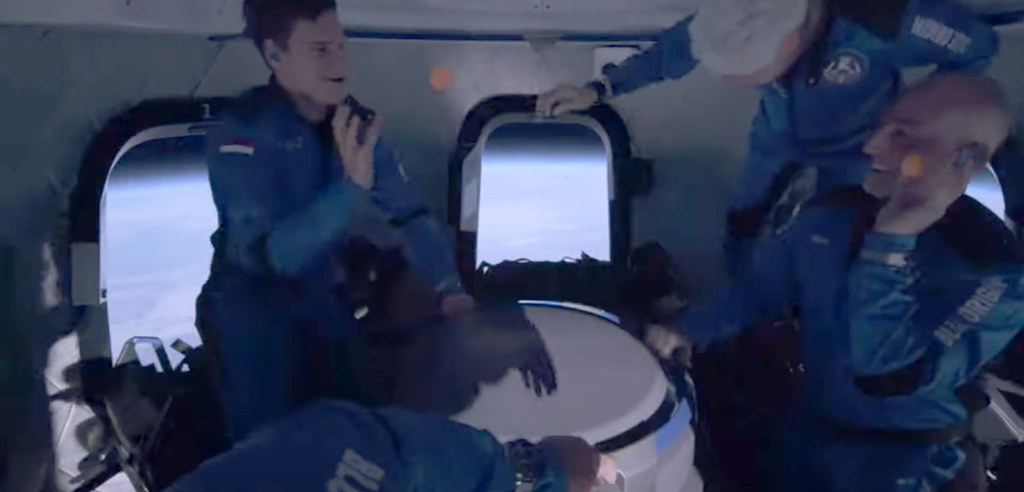
T18-year-old Dutch student Oliver Daemon was a late addition to the flight after the original winner of the auction for his seat had to postpone flying with Blue Origin. As Oliver’s father made the second-highest bid, the sat was awarded to him, and he gave it to his son. Oliver joined Bezos and his brother and venture capitalist Mark Bezos aboard the vehicle as the youngest person to date to fly into space, bookending the crew with the 82-year-old and utterly remarkable Mary Wallace *Wally” Funk, who would, with the trip, become the oldest person to date to fly into space.
The flight had been scheduled for a lift-off at around 13:00 UTC – although as was pointed out by the live stream commentary in the run-up to the launch, this was not a hard-and-fast launch time; as the flight would be sub-orbital, it was not constrained to a specific launch window in order for it to reach a required orbit.
“Wally” Funk gives a wave from her seat aboard RSS [Reusable Space Ship] First Step, the capsule atop NS-16, as she awaits the start of her sub-orbital flight. Credit: Blue OriginThe four passengers – and this is the correct term for them, as New Origin is an entirely automated vehicle that requires no flight crew – boarded the vehicle 30 minutes ahead of the planned lift-off time. A planned countdown hold at T -15 minutes became slightly drawn-out, causing the launch time to slip past the planned 08:00 (local) lift-off, but otherwise things proceeded smoothly.
With four minutes left in the countdown, New Shepard switched to fully automated control of itself, carrying out final flight control checks by gimballing its rocket motor exhaust and “waggling” the fins at the booster’s base, as the crew access arm was retracted. At zero in the countdown, the BE-3 motor ignited, taking some 7 seconds to run up to full thrust, at which point the holding clamps released, allowing the vehicle to launch.
NS-16 clears the launch tower. Credit: Blue Origin
From here, things proceeded rapidly and smoothly. Tracked by cameras both on the ground and aboard helicopters, the New Shepard vehicle ascended rapidly, reaching 6.2 km altitude in just 60 seconds.
At this point, the BE-3 throttled back as the craft passed through Max-Q, the period when the maximum dynamic pressures are exerted on the vehicle as it punches its way through the denser atmosphere building a shockwave around itself. Following Max-Q, a period of several seconds, the motor throttled back up to full power, pushing the craft through Mach 1.
Reaching apogee – the RSS First Step capsule (the fainter, lower object) approaches its maximum altitude, the booster already dropping back towards Earth. Credit: Blue Origin
At 2 minutes 20, MECO – main engine cut-off – occurred, the vehicle at an altitude of 58.5 km – high enough to see the curvature of the Earth – and still accelerating. Just a few seconds later, at roughly 78 km altitude, the capsule separated from the booster and entered its parabolic “coast” phase during which the four passengers experienced microgravity and were allowed to move around the cabin.
While the capsule continued upwards to a apogee of 108 km, the booster, being heavier, reached an apogee somewhat lower, then started a vertical descent back towards a landing pad using a mix of the fins at its base and “wedge fins” at its top that were deployed after capsule separation, together with gas-fired RCS systems to remain upright. Just under 7 minutes from launch, it passed generated the classic double boom of passing back through the sound barrier to sub-sonic speed, and at 1.2 km above the ground re-ignited its BE-3 motor to bring itself to a successful landing.
Oliver Daemon and Mark Bezos toss little balls to one another in micro-gravity as “Wally” Funk floats behind them aboard ESS First Step. Credit: Blue Origin
An image of a ridge line on the flank of “Mount Sharp” (Aeolis Mons) captured by MSL rover Curiosity on Sol 3167 (July 4th, 2021). A CGI model – to scale – of the rover has been superimposed on the image to show how the rover’s climb up the ridge might appear to someone watching it. Credit: NASA/JPL with additions by Seán Doran
Rovers on Mars continue to been busy as they trundle around the planet. While it has been there the longest, NASA’s Mars Science Laboratory (MSL) rover Curiosity has been somewhat out of the news, courtesy of it’s sister Perseverance and China’s Zhurong. However, it has recently re-grabbed the science news headlines thanks to a couple of studies.
Methane blips have pinged on Curiosity’s Tunable Laser Spectrometer (TLS) six times since the rover landed in Mars’ Gale crater in August 2012. These events have been seen as important, because methane is the by-product of two processes that share equal interest to scientists, because one is the result of organic processes – life – and the other, though inorganic in nature, points to geological activity closely tied to the presence of liquid water, a vital ingredient for past or present life as we know it to thrive.
A critical factor with methane is that once exposed to sunlight, it breaks down over a period of just 300-330 years, so for Curiosity to be able to detect it, it must have come from a relatively recent source – one that still may be active. The problem until now has been to locate that source – or even confirm Curiosity’s findings.
The European Space Agency’s Trace Gas Orbiter, part of the ExoMars mission, and currently studying Mars. Credit: ESA
The best placed tools for doing the latter are aboard the European Space Agency’s Trace Gas Orbiter (TGO), but to date, TGO has been unable to detect any methane within Gale Crater. The could either be because there isn’t any methane to be found, or the minute amounts – just 10 parts per billion (10 ppb) – is too small and too localised for TGO to accurately detect from orbit, and Curiosity just happens to be sitting practically on top of it.
In one of two reports released in June, members of the MSL’s extended science team they have pin-pointed the source location for the methane, and that the rover happened to arrive in Gale Crater at a point extremely close to it.
This was done by treating each point of detection as a discrete packet of methane, then calculating the wind speed and direction at the time it was detected. This allowed them to trace the parcels back through time to their possible points of emission. By doing this for all of the different detection spikes, they were able to triangulate regions where the methane source is most likely located- and one of them is just a few tens of kilometres to the north-west of “Mount Sharp” and Curiosity’s area of exploration.
Sadly while tantalisingly close to the rover, the point is still well outside of Curiosity’s route of exploration.
MSL Curiosity, imaged by the HiRISE camera aboard NASA’s Mars Reconnaissance Orbiter, on April 18, 2021. Credit: NASA/JPL
A second study coming out of Curiosity’s science data suggests that a process has been at work on Mars that has been both eradicating evidence for possible past life on Mars – and creation conditions in which new life might arise.
In short, when reviewing the result of samples taken of ancient mudstone, a sedimentary rock containing clay, taken from two points just 400 metres apart and believed to have both been laid down some 3.5 billion years ago. Both should have been very similar in nature, rich in clay, an important element in the search for life, as it is both created in the presence of water and is an excellent medium for storing microbial fossils. However, one of the samples contained just half the anticipated amount of clay minerals in comparison to the other, but a much higher concentration of iron oxides – the compounds that give Mars its rusty hue.
The researchers behind this discovery believe it is the result of one of the two areas of mudstone being exposed to brine: salty water that leaked into the mineral-rich mudstone and effectively leached the clays and other minerals out of them, effectively eradicating both the geological and possibly the biological record that might otherwise be present in the deposits. Given that evidence of potentially brine-rich outflows have been found elsewhere on Mars, this study suggests this process might be common to regions of the planet believed to have once housed bodies of water, possibly destroying any evidence of past life.
However, the process – called diagenesis – is not all bad news. While it may well help erase any record of past organic activity from parts of the surface or Mars, it may also have triggered new life processes under the surface, the salty water being a source of potential energy that could help kick-start new organic processes.
Image of the “Raised Ridges” that Ingenuity captured on its ninth flight. Credit – NASA / JPL
The findings of both of these studies are being used to inform the science mission of NASA’s latest Mars rover, Perseverance, allowing the science team to apply what has been found in Gale Crater to Jezero Crater, to better direct that rover towards places of interest.
“Percy”, to use the nickname for NASA’s latest Mars rover is also being assist in finding places of interest – and the best route to them – by the Ingenuity helicopter. This has now completed its 9th flight , during which it acted directly as an aerial scout for the rover, including the “Raised Ridges”, a feature that suggests it may one once had a water channel beneath it. Ingenuity has also identified a dune field that could result in “Percy” becoming bogged down – as happened with the MER Spirit rover in 2009/10 – ending its mission.
What is particularly fascinating about this work is that the information gathered by Ingenuity can be fed back to Perseverance and used by its auto-drive system to identify local hazards – rocks, etc – the rover can then navigate itself around without having to “‘phone home” for assistance from the Earth-based driving team.
Ingenuity’s view of the “Séítah” dune field on it’s ninth flight. Part of the helicopter’s landing gear can be seen on the left side of the screen. Credit: NASA / JPL
Meanwhile, China’s Zhurong rover is now 2/3rds of the way through its initial 92-day / 90 Sol mission. During that time, the rover has travelled a total of 450 metres, and on July 12th, 2021, it arrived at a special point of study – but one that is neither geological nor meteorological / atmospheric, the rover’s primary science interest.
Instead, the rover had arrived at the impact / landing point for the backshell and parachute that had helped it to reach the ground safely. Following it separation from these during descent, the rover had moved away from it under the power of its lander’s rocket motors ready to make a soft landing. The backshell and parachute continued downward to eventually land some 350 metres from the lander / rover.
Studying both the backshell and parachute helped engineers understand how well both handled the descent through the Martian atmosphere, something that can help inform future missions. At the same time, the rover imaged raised mounds in the region, which could be inverted impact craters or possibly small volcanic domes or other features could be the result of tectonic activity – their nature has yet to be made clear (one of which has been incorrectly labelled as a “outflow delta” in the video below).
A view from the tail boom camera on VSS Unity, during Virgin Galactic’s Unity 22 flight, July 11th, 2021. Credit: virgin Galactic
How would you really like to celebrate your birthday? We all have our own dreams of the perfect celebration – and for Sir Richard Branson, it meant becoming an astronaut just 7 days short of his 71st birthday.
Branson was one of six people who took to the skies over New Mexico in the first “full” passenger carrying flight of Virgin Galactic’s VSS Unity, in what amounts to one of the last test flights before the company starts flying fair-paying passengers on sub-orbital trips to the very edge of space.
Sir Richard Branson (2nd from right) and fellow “passengers” (all of whom had roles to play during the flight) Colin Bennett, Beth Moses (making her 2nd flight aboard VSS Unity) and Sirisha Bandla ahead of the Unity 22 flight, July 11th, 2021. Credit: Virgin Galactic
The flight – called Unity 22 to mark the 22 flight of the spacecraft christened by the late Stephen Hawking – took Branson, together with Lead Operations Engineer Colin Bennett and the company’s Vice President of Government Affairs and Research Operations Sirisha Bandla, both of whom were also making their first flights on the vehicle, together with Chief Astronaut Instructor Beth Moses making her return to space on the vehicle, to a peak altitude in excess of 86 kilometres. At the controls were veteran Virgin Galactic pilots Dave Mackay and Michael Masucci.
The entire flight was live streamed by Virgin Galactic in a special show hosted (rather cheesily, it must be said) by Stephen Colbert, although the stream was also carried by a number of You Tube channels such as NASASpaceflight.com, from whom some of the images used here were captured.
MSS Eve carries VSS Unity into the skies over New Mexico, July 11th, 2021. Credit: Virgin Galactic
Weather had initially interfered with things, forcing the take-off of the mated MSS Eve and VSS Unity to be delayed, but at 14:35 UTC, MSS Eve – named after Branson’s late mother, and to whom he credits his outlook on life and his drive to follow his dreams – took off from Spaceport America in New Mexico, Unity mounted on her main wing spar, to climb into a perfect sky above the Virgin Galactic base of operations.
The climb to the planned release altitude of 15 km took some 50 minutes, the two craft closely observed by chase planes. At ten minutes prior to release, both craft entered a final check-out phase of the flight, with Eve maintaining altitude as both her flight crew and Mackay and Masucci worked with ground-side Mission control to confirm all was in readiness for Unity’s flight. At this point, Unity also switched its internal power, allowing her flight control and avionics to be confirmed as ready for release.
The crew in Unity’s main cabin, with Branson forward left, and Moses, forward right, shortly before the release, July 11th, 2021. Credit: Virgin Galactic
With everything checked and ready, and Eve still holding steady, the pyrotechnics that would blow the retaining bolts holding Unity to Eve were armed. Thirty seconds later they fired, separate the two vehicle, and Unity entered a very shallow dive while Eve started a climbing turn to move away from the wake of Unity’s motor.
That motor fired 2 seconds after release, and within 3 seconds had doubled Unity’s forward airspeed to carry it through Mach 1. With the motor firing smoothly, the pilots placed the vehicle into its “Gamma Turn”, essentially pointing the nose straight up as it continued to accelerate.
VSS Unity is released from MSS Eve, observed by a chase plane. Credit: Virgin Galactic
At 31 seconds after release, Unity passed through Mach 2, climbing rapidly to reach Mach 3 at 55 seconds from release. Just over 10 seconds later, the motor shut down, but Unity continued to climb, and the flight crew initiated the “feather”, raising the vehicle’s tail booms relative to the hull by 60º.
“Feathering” allowed the craft to effectively “back flip” whilst still climbing, so the windows along the top of the cabin to face towards the Earth whilst the cabin itself entered a period of micro-gravity as Unity headed towards an apogee of approximately 86.77 km, where the flight crew used the reaction control system (RCS), small gas-powered jets, to re-orient the vehicle ready to start a belly-first drop back into the denser atmosphere.
An artist’s impression of VSS Unity with its tail boom “feathered” and the vehicle oriented for the drop back into the denser atmosphere. Credit: Virgin Galactic
This apogee point – 86-ish kilometres – has become a bone of contention between Virgin Galactic and Jeff Bezos / Blue Origin in the week or so since the Unity 22 flight was announced, as it is around 20 km below the Kármán line. The latter is recognised by many as being the divide between atmospheric flight from space flight, thus marking those who cross it as astronauts. As it is a line Virgin Galactic does not cross (but Blue Origin’s New Shepherd does), Bezos has denigrated Branson’s flight in comparison to his own, which is due to take place on July 20th.
However, whilst not reaching the 100 km mark, the Virgin Galactic flights do exceed 80 km altitude – which is regarded as the boundary between air and space by the US Air Force, NASA and the US Federal Aviation Authority – and so those flying with Virgin Galactic do qualify as astronauts. More to the point, an extra 20km of altitude doesn’t give passengers a more expanse view of Earth compared to 86 km, and the overall amount of time spent in micro gravity conditions aboard either vehicle is roughly the same.
Sir Richard Branson floats in the inverted cabin of VSS Unity, looking down at Earth. Credit: Virgin Galactic
SpaceX: the orbital launch facilities under construction at Starbase, Boca Chica, Texas, as the 7th section of the launch support tower is hoisted into place. Credit: Bocachicagal / NASASpaceFlight.com
SpaceX are driving ahead with preparations for their first starship / Super Heavy orbital flight – although whether the company will achieve the goal of making the launch prior to the end of July 2021, as recently re-stated by company president and COO Gwynne Shotwell – seems unlikely at this point in time.
Following the successful flight of starship SN15 on May 5th, 2021, the company has taken a step back from medium and high-altitude test flights to focus on tasks that are core to that first orbital attempt, with the on-going construction of the orbital launch facilities and fabrication of both starship prototype SN20 that will attempt the flight, and the Super Heavy booster that will lift it into the sky.
However, the booster to make the flight will not be the unit – Booster 3 – everyone had been watching so keenly through its assembly at the company’s Starbase facilities at Boca Chica, Texas. That honour will now go to Booster 4, still under construction.
A comparison between the sea-level Raptor engine (l) and the vacuum Raptor with its much larger exhaust bell (r). Three of each will be used to power orbital Starships, and 12 sea-level and sixteen vacuum motors will initially power Super Heavy boosters, rising to 16 of each as booster development progresses. Credit: SpaceX
Instead, Booster 3 is to be used for further ground tests designed to inform the internal design of Booster 4; a move that means having the latter booster ready to fly any time in the next month even more unlikely.
As I reported in Space Sunday: Selfies, Missions, Budgets and Rockets, a smaller section of a Super Heavy, designated BN2.1 has already completed cryogenic and hydraulic pressure tests designed to test thrust puck / tank integrity, and the tests with Booster 3 will expand on these. To this end, following the BN2.1 test mount was relocated to Orbital Test Stand A, one of the two launch stands previously used for starship flight tests. Then, on July 1st, and with the rig in place and ready to receive it, Booster 3 was rolled out of the fabrication facility and driven the two(ish) kilometres down the road to the launch area and then lifted onto the stand.
In the coming weeks, the booster – currently without any Raptor engines mounted on it – will likely be put through various proof tests using both liquid nitrogen and actual fuel loads to check the overall structural integrity of the entire design. Some have suggested that these tests might see the booster fitted with a group of sea-level Raptor engines (the test stand doesn’t allow for mounting the vacuum engines) for a static fire test. However, if Booster 4 is to be substantially different to Booster 3, then such a test could be of questionable value; thus, others have speculated that Booster 3 might actually be pressure tested to destruction using liquid nitrogen, as was seen during early tank tests with partial builds of the starship.
The 65-metre tall Booster 3 test article being moved from the Boca Chica fabrication facilities to the test and launch facilities, July 1st, 2021. Credit: NASASpaceFlight.com
Another reason for any launch attempt in the near future being unlikely is the simple fact the launch facilities are far from complete. The last several weeks have seen significant progress on the launch support tower, but the table on which a booster / starship stack will sit is far from complete.
Similarly, all the infrastructure needed to support launch operations – like propellant and consumable storage tanks and their associated piping are also far from complete. Thus far only four of the 7-8 required tanks have been installed and only one of those intended to store super cold liquid gases has received its insultation sleeve.
SpaceX orbital launch facilities construction: left – The base of the launch support tower with the angled ring of the launch table support structure just in front of it. Centre: the square foundations of the staging platforms for Super Heavy (uppermost) and starship. Lower right: the fuel tank farm – the metal tanks are for housing liquid oxygen and liquid methane, the grey tank behind them is a fuel tank sheathed by an insulation tank designed to contain liquid nitrogen to help keep the fuel stocks in a liquid state, while the large grey tank to the left is the water tank for the launch sound suppression system. Credit: RGV Aerial Photography
One aspect of the facilities starting to come on-stream is the generator farm that will be used to produce liquid oxygen for launches directly from the air around them. With five of the 10 massive (and themselves environmentally unfriendly) generators now commissioned, this farm will eventually power a process called air liquefaction, a process that splits air into nitrogen, argon and oxygen, cooling them to liquid states. The liquid oxygen will then be pumped to the nearby tank farm to be used to fuel starships and their boosters, and the liquid nitrogen will be used to cool the liquid oxygen and liquid a methane stored with the tank farm and keep them in their liquid state.
Virgin and Blue Origin Updates
Virgin Orbit has completed its first commercial air-launch, delivering a payload of seven small satellites successfully to orbit. Entitled “Tubular Bells Part One”, in recognition of the 1973 album by Sir Mike Oldfield and which arguably launched what would become the Virgin empire.
The company’s 747 carrier aircraft Cosmic Girl took off from Mojave Air and Space Port at 13:50 UTC on Wednesday, June 30th to climb to an altitude of 50km, heading out over the Pacific Ocean. On reaching a point some 80km south of the Channel Islands, the aircraft released the LauncherOne rocket, allowing it to drop clear before igniting its motor and accelerating to orbit.
Virgin Orbit’s Cosmic Girl with the Tubular Bells Part One LauncherOne rocket mounted under its wing, being prepared for flight in the early hours of June 30th Credit: Virgin Orbit
On board the rocket was a combined payload of four R&D CubeSats for the US Department of Defence, two optical satellites for SatRevolution, and the Royal Netherlands Air Force’s first military satellite, all of which were successfully deployed from the rocket some two hours after Cosmic Girl took off.
The wonderful thing about Virgin Orbit is that it literally can help transform people’s lives around the world. It can put satellites up to monitor illegal fishing, check on climate change, check on the ozone layer, connect the three billion people who are not connected. And the fact we can do it from anywhere in the world … to any orbit, is unique.
– Sir Richard Branson
Following that success, on July 1st, Virgin Galactic announced that July 11th will see the first test flight for SpaceShipTwo since the company was granted an update to the vehicle’s FAA licence allowing them to start flying fare-paying passengers later in the year, a flight will see the vehicle fly with both crew and four passengers – three members of the Virgin Galactic team, and company founder Sir Richard Branson.
Whilst not carrying fare-paying passengers, as will be the case with the upcoming Blue Origin sub-orbital flight on July 20th, the Virgin Galactic flight will mean that Branson will beat Blue Origin’s Jeff Bezos in making a sub-orbital flight and gaining his astronaut wings.
Once lifted to around 15-16 km attitude by its mothership, the MSS Eve, the VSS Unity will be released to power itself up to around 80-85 km altitude in a 10-minute flight during which those on board will experience between 2 and 3 minutes of micro-gravity before the vehicle makes an unpowered return to Earth to land like a conventional aircraft.
The crew of the July 11th Virgin Galactic test flight. From left: Chief Pilot Dave Mackay, Lead Operations Engineer Colin Bennett, Chief Astronaut Instructor Beth Moses, Founder of Virgin Galactic Richard Branson, Vice President of Government Affairs and Research Operations Sirisha Bandla and pilot Michael Masucci. Credit: Virgin Galactic
This 10-minute element of the flight by VSS Unity mirrors the overall flight time for the Blue Origin New Shepherd booster and capsule that will lift Bezos, his brother and an unnamed passenger who paid US $28 million to be the first fare-paying passenger flown by the company.
Also aboard that flight, which will take place on July 20th, will be a very special guest passenger: one other than “Wally” Funk.
Born in 1939, as Mary Wallace Funk, “Wally” is a remarkable woman. Obtaining her pilot’s licence when just 20 years of age, she was the first female civilian flight instructor training military pilots, the first female Federal Aviation Agency inspector, and the first female air safety investigator for the National Transportation Safety Board. Most particularly in this instance, she was one of the Mercury 13 group – more formally, the “Women in Space” Programme founded in 1960 by William Randolph Lovelace, a former NASA flight surgeon.
1995: seven of the “Mercury 13” were guests of Elieen Collins, the first woman to pilot a space shuttle, at the launch of that mission, STS-63. From left to right: Gene Nora Jessen, Wally Funk, Jerrie Cobb, Jerri Truhill, Sarah Rutley, Myrtle Cagle and Bernice Steadman. Credit: NASA via AP
Whilst lacking official government funding, but supported by NASA, the programme saw 25 women between the ages of 25 and 40 including Funk – despite the fact she was below the minimum age for consideration) – invited to take part in astronaut training. Of the 19 who enrolled, 13 graduated, with Funk the third best in the group and actually out-performing John Glenn, the first American to orbit the Earth, in some of the tests.
Although the term “Mercury 13” is often credited with being applied by the press at the time, the 13 women were actually known as FLATS – First Lady Astronaut Trainees (FLATS), although none actually ever flew into space. The term “Mercury 13” itself was first used by Hollywood producer James Cross in 1995 when comparing the 13 to the original Mercury Seven.
Wally Funk qualified as a pilot at the age of 20. She went on to become a civilian instructor of US military pilots, and gained more that 1,000 hours as an instructor on a range of aircraft. She earned her Airline Transport Rating in 1968, and became the first female FAA field examiner in 1971. Credit: unknown, via Blue Origin
Although she never flew into space as a part of any US programme, Funk has remained highly supportive of NASA and actually purchased a ticket to fly with Virgin Galactic when they start fare-paying flights later this year. However, in what might well have been a deliberate poke at Branson and his company, Bezos invited Funk to join his July 20th flight as his “honoured guest”.
“I’ll love every second of it. Whoooo! Ha-ha. I can hardly wait! Nothing has ever gotten in my way. They said, ‘Well, you’re a girl, you can’t do that.’ I said, ‘Guess what, doesn’t matter what you are. You can still do it if you want to do it and I like to do things that nobody has ever done.
– Wally Funk
While she will not orbit the Earth, in making the trip aboard New Shepherd, Funk will nevertheless become the oldest person to date to fly in space beating – again – John Glenn, who was 77 when he flew on the shuttle Discovery in 1988.
Hubble Update: NASA taking a “Careful and Deliberate” Approach
NASA is taking a slow and deliberate approach to restoring science operations on the Hubble Space Telescope, which has been out of service since mid-June when a payload computer malfunctioned.
As I noted in my previous Space Sunday update, attempts to find the source of the issue were shifting away from the payload computer itself and towards two other components in the telescope – the Command Unit/Science Data Formatter (CU/SDF) and the primary power regulator circuits.
Further testing of both units during the week has led NASA to the decision to switch either or both the CU/SDF and the power regulator to their back-ups – but they will do so slowly. over the course of the next week or so.
The first part of this work will be a review of the procedures for making the switch-overs will be reviewed to determine if any updates need to be made in respect of the telescope’s age and changes it has seen over the years. Once reviewed, the procedures will then be tested on a “high-fidelity simulator” to ensure their suitability for active use. Then as a final step, a decision will be made one switching over one or both of the CU/SDF and power regulators, and the procedures implemented.
I have given the team very clear direction that returning Hubble safely to service and not unintentionally doing any harm to the system is the highest priority, not speed. They’re being very deliberate in their analysis and their choices of what they do. There’s two layers of review of all the procedures they come up [with]. Although we’re all impatient to have Hubble back taking science, the highest priority is to be very careful and deliberate and not rush.
– Paul Hertz, director of NASA’s astrophysics division
Space Perspective: balloon rides to (almost) the edge of space (see below). Credit: Space Perspective
Virgin Galactic is now very close to commencing passenger-carrying sub-orbital flights with their SpaceShipTwo vehicle after the Federal Aviation Administration (FAA) updated the company’s existing launch licence which had previously restricted them to only flying a crew and “non-deployable” payloads aboard the vehicle.
The updated licence was awarded on June 25th, after the FAA had completed a review of the May 22nd SpaceShipTwo test flight, the first such flight to be flown from Spaceport America in New Mexico, Virgin Galactic’s base for commercial operations in the United States.
The granting of the licence doesn’t mean passenger flights will be commencing immediately, however. The company has three more test flights to complete, some of which will see them flying additional crew aboard the vehicles to help gain further experience in flying with a full compliment of people on the vehicle. One of these flights is liable to include Virgin Galactic’s founder, Sir Richard Branson.
We’re incredibly pleased with the results of our most recent test flight, which achieved our stated flight test objectives. Today’s approval by the FAA of our full commercial launch license, in conjunction with the success of our May 22 test flight, give us confidence as we proceed toward our first fully crewed test flight this summer.
Virgin Galactic SpaceShipTwo VSS Unity drops clear of the MSS Eve carrier aircraft at the start of the May 22nd test flight over New Mexico, data from which led to the FAA updating the company’s licence to fly the craft. Credit: Virgin Galactic
The price of a ticket for a 90-minute flight with Virgin Galactic is estimated to be US $250,000 – although this figure was first given in 2014, and may have changed in the interim, and the company hopes to bring the cost down to around US $40,000 within a decade. In the meantime, the likes of Angelina Jolie, Brad Pitt, Lady Gaga and Leonardo DiCaprio are said to be among the rumoured 700 initial bookings.
Given the additional test flights, Virgin Galactic will probably not start fare-paying flights until after Blue Origin has completed its first passenger flight. This is due to take place on July 20th, the 55th anniversary of Apollo 11 landing on the Moon, and will include one individual (yet to be named) who has paid US $28 million to be a passenger (see: Space Sunday: selfies, missions, budgets and rockets).
VSS Imagine, the first of of the SpaceShip III vehicle Virgin Galactic plan to operate, was rolled out on 30rh March, 2021. It will be followed by VSS Inspire, currently under construction. These are an updated design of the SpaceShipTwo vehicle the company has been flying to date, but have yet to be test flown. Credit: Virgin Galactic
Nor are space vehicles alone to be used for high altitude tourism. Space Perspective, a relatively new space tourism company, being founded in 2019, has confirmed it plans to offer flights of up to six hours in duration and to a maximum altitude of 32 km starting in 2024 using a balloon and capsule system.
The nature of the flights mean passengers will not experience a micro-gravity environment during the flight, but they will travel high enough to clearly see the planet’s curvature, and their experience will be a lot more sedate and with greater comfort.
This is because ascents will be at a gentle 20km an hour, thus taking 90 minutes to reach their maximum altitude, and the capsule will offer comfortable couches, room to move around, a bar and provide wi-fi connectivity with the ground. Once at altitude, the balloon will remain aloft for around 2 hours, prior to commencing a descent, splashing down close to a support ship that will lift the capsule out of the water to allow the passengers disembark, prior to them being returned to shore.
How Space Perspective plan to operate their balloon flights. Credit: Space Perspective
Space Perspective first announced their plans over a year ago, and on June 18th, they carried out a test flight of their Neptune One scale prototype capsule over Florida. In a 6-hour 39-minute flight, the capsule, slung beneath a helium balloon, lifted-off in the early morning, rising to a maximum altitude of over 33 km. After two hours, and in what mirrors planned operational flight, it then descended over the Gulf of Mexico to splash down 80 km off the coast of Florida, where it was recovered by ship.
This test flight of Neptune One kicks off our extensive test flight campaign, which will be extremely robust because we can perform tests without a pilot, making Spaceship Neptune an extremely safe way to go to space.
– Taber MacCallum, Co-CEO, Space Perspective
As well as passengers, Space Perspective plan to offer room aboard the capsule(s) for those wishing to carry out high-altitude studies of the atmosphere and weather.
An image released by Space Perspective and captured by a camera aboard their Neptune One scale prototype, some 33 km above the surface of Earth. Credit: Space Perspective
Hubble Still Down as Glitch Proves Hard to Resolve
NASA is continuing to diagnose a problem on the Hubble Space Telescope (HST). As I noted in my previous Space Sunday report, the primary payload computer stopped responding on June 13th, causing the science instruments to enter a “safe” mode. At the time, it was believed the problem was caused by a fault with one of the computer’s four 64 Kb read/write memory modules. however, and as I reported, an attempt to switch to using one of the other memory modules was unsuccessful.
As a result, further tests were carried out on June 23rd / 24th, with mixed results. On the one hand, they revealed that the core elements of the computer and its back-up, including the memory modules, have no significant issues. However, the tests also showed attempts to write data to any of the memory modules from either computer were failing.
NASA continues to try to diagnose the Hubble space Telescope’s recent issues. Credit: NASA
This tends to suggest the problem lies outside of the payload computers, so plans are being drawn-up to test other systems.
Chief among these are the Command Unit/Science Data Formatter (CU/SDF) and the primary power regulator circuits. The CU/SDF relays command through HST to specific systems and instruments, and also reformats data from the science instruments ready for transmission to Earth, while the main power regulator should deliver a consistent voltage to systems and instruments. If either are subject to issues, then they can trigger a switch to safe mode operations, as has happened. If the root cause can be traced to either, NASA will test the back-up and attempt a switch-over.
Sunrise as seen from the Tianhe core module of China’s Tinagong space station ahead of the arrival of Shenzhou-12. Credit: China National Space Administration / China State Media
Shenzhou-12, China’s first crewed mission to orbit in almost 5 years, lifted-off from the Jiuquan Satellite Launch Centre in northwest China at 01:22 UTC on the morning of Thursday, June 17th, heading towards the Tianhe core module of the country’s new space station.
Carried aloft by a Long March 2F booster, the mission comprises three taikonauts Nie Haisheng (mission commander) and Liu Boming, both of whom have previously flown in space, and rookie Tang Hongbo. Together, they will spend three months at the space station, putting it through a series of commissioning tests and operations.
The Long March 2F carrying Shenzhou-12 mission lifts-off from the Jiuquan Satellite Launch Centre, June 17th (UTC), 2021. Credit: China Stat Media
Following launch, the Shenzhou vehicle performed a rapid chase-and-catch with the Tianhe module, docking with it some 6 hours 32 minutes later. In doing so, it became the second vehicle to dock with the module, the first being the Tianzhou-2 resupply vehicle which delivered essential supplies and equipment to the fledgling space station at the end of May 2021.
Overall, Shenzhou-12 is the the third of eleven flights China has planned between now and the end of 2022 in order to complete the Tinagong station, the first having been the Tinahe module itself. These launches will include two science modules and additional Shenzhou crew and Tianzhou resupply missions.
The Shenzhou-12 crew aboard Tianhe. Form left to right: Tang Hongbo, mission commander Nie Haisheng and Liu Boming. Credit: China State Media
The flight of Shenzhou-12 also marked the first time China has used the chase-and-catch approach to orbital rendezvous. It is a technique both Russia and the United States have started to employ in order to more quickly deliver cosmonauts and astronauts to the International Space Station; for China, it meant reducing a typical two-day rendezvous time seen with the earlier Tiangong orbital laboratories to just the 6+ hours seen in this flight.
Prior to launch, the crew were treated to a parade and celebration by members of the People’s Liberation Army and their families (there is no real civil / military distinction in China’s human spaceflight operations), whilst their arrival and boarding the Tinahe marked the first time since May 2000 that two orbiting space stations have been simultaneously inhabited – back then it was the ISS and Russia’s soon-to-be-decommissioned Mir. Now it is the ISS and the nascent Tiangong station.
Ahead of the launch and during an international conference on space development, China joined with Russia in formally announcing the International Lunar Research Station (ILRS), intended to serve as ” a comprehensive scientific experiment base built on the lunar surface and on [sic] the lunar orbit”, inviting international partners to join them.
ILRS is seen as something of a competitor to the American-led Artemis programme, and during the presentation representatives of Russia’s Roscosmos and the China National Space Administration (CNSA) indicated that ILRS will (like Artemis) combine a Moon-orbiting space station with a surface base in the lunar south polar region.
First announced in March 2021, after Russia rejected US overtures to be a part of Artemis, the ILRS looks set to undergo a rapid cycle of development. China and Russia anticipate working together between 2021 and 2025 to select the preferred location for the lunar base, with actual deployment and construction to commence in 2026 and continue through until 2036. During the construction phase, the two countries plan to place a station into cislunar space which will act as a waystation between their orbital facilities in Earth orbit and the lunar base (China will use their Tiangong station at the “earth end” for flights to / from the Moon, and Russia will use its recently-announced new space station, which it intends to have operational by 2030).
An artist’s impression of the Russia-China ILRS, showing the main pressurised facilities in the foreground, solar power facilities to the right and communications arrays in the background. Credit: Roscosmos / CNSA
According to both countries, the focus of ILRS will be to “carry out multi-disciplinary and multi-objective scientific research activities including exploration and utilisation, and lunar-based observation.” They further indicated that the European Space Agency (ESA), Thailand, the United Arab Emirates and Saudi Arabia have all declared an interest in joining the project.
And if that weren’t enough, China has also announced it intends to develop the means to establish a long-term / permanent human presence on Mars.
Speaking at the same event at which the ILRS was officially confirmed, Wang Xiaojing, president of the China Academy of Launch Vehicle Technology (CALT), unveiled an ambitious programme that would see China extend is robotic exploration of Mars before moving to more extended automated missions using chemical rockets to deliver ISRU (in-situ resource utilisation) missions for the production of air, water and fuel through locally-available resources. From there, Wan indicated the country would start delivering payload missions to Mars aimed at supporting a human presence.
For actual crewed missions, Wan said China would use nuclear-powered “ferries” operating between Earth and Mars, dramatically reducing flight times. Built in Earth orbit, these would eventually become “cyclers”, with two or possibly three craft looping between the two planets, with crews and their equipment launching from Earth to join one for the trip to Mars, and then at the end of their mission hitching a ride home on another of the ferries as it swings around Mars.
No time frames for when all this might happen were given, and China has a huge mountain to climb in terms of technology development – ISRU system, life support systems, operating human missions in deep space (and with suitable solar / cosmic radiation protection). It also has to develop the planned nuclear thermal engines the “ferries” would use and gain experience in operating them and ensuring they don’t add radiation exposure risks to crews . All of this, coupled with the ILRS plans, likely means China will not be in a position to undertake any kind of human mission to Mars before the 2040s, even if Wan’s presentation turns into a programme.




 Inara Pey: Living in a Modemworld