The Furthest Star
My previous Space Sunday update ended with a note that NASA would be making an announcement at the end of March 2022 concerning a new discovery by the Hubble Space Telescope (HST) that could have repercussions for the James Webb Space Telescope (JWST), once it commences its scientific mission. Announced on March 30th, that discovery was revealed to be the imaging of the most distant individual star from Earth yet discovered. So distant, in fact, that it has taken the light from it 12.9 billion years to reach us. By contrast, the next oldest individual star we have detected using Hubble was born when the universe was already some 4 billion years old, taking 9 billion years to reach us.
Christened Eärendel, the Old English term for “morning star” (and, as Tolkien fans like me will know, was the name initially given to the half-human, half-elven navigator, prior to Tolkien changing the name of that character to Earendil), the star was discovered as a part of a HST programme called RELICS -the REionisation LensIng Cluster Survey, intended to capture to light from really far distant objects born not long after the Big Bang.
To do this, RELICS employs the phenomenon of gravitational lensing, whereby the mass of a huge object such as a galaxy or cluster of galaxies bend and focuses the light coming from objects far beyond them, allowing us to see them as magnified, arc-like objects. In this case, a cluster of galaxies called WHL0137-08 was found to be lensing the light of a galaxy far beyond them, drawing the collected light of that galaxy out into a slender crescent Hubble could see and which astronomers nicknamed the Sunrise Arc.

For the most part, the Sunrise Arc is blurred and instinct, like sunlight diffracted by the ripples on the surface of a swimming pool cast blurred clouds of light on the bottom of the pool. However, by coincidence, at the time the images of the Arc were recorded, Eärendel appeared directly on, or extremely close to, a curve in space-time that provided maximum brightening, allowing its light to stand out as an individual point within the blurriness of the Sunrise Arc – just like some rays of light can strike the surface of a swimming pool at precisely the right moment to avoid diffraction by the surface ripples and form pinpoints of light on the bottom of the pool rather than being blurred.
Initially it was thought that the star might in fact be a cluster, rather than a lone star, but careful analysis of Eärendel ‘s red shift has swayed astronomers towards believing it is most likely just the one star (although the potential for it to be a binary system hasn’t been entirely ruled out) of enormous size at least 50 times the mass of the Sun and correspondingly enormous luminosity.
Such is Eärendel age, that it at the time its light departed it, the star was likely only made up of primordial hydrogen and helium following the Big Bang. This makes it a prime target for study by JWST – which thanks to is infra-red capability can pick out more information about a target object than HST -, as doing so could reveal more about the state of the early universe and early stellar development.
However, such is the nature of things that – whilst referring to the star in the present tense, it’s important to note that it is very likely that while the most distant individual star observed by HST, Eärendel is not the oldest star yet found; in fact, it probably no longer exists. This is because such supermassive stars tend to burn through their available fuel stocks in mere millions of years, rather than billions. It’s therefore very likely that at some point when the light captured by Hubble was still making its way towards us, Eärendel either violently exploded into a supernova, or collapsed into a black hole – something we’ll only know for sure a few million years into our future.
The Nature of Sound on Mars
We’re all familiar with the concept of the speed of sound. Here on Earth and at sea level, with the temperature at 20ºC, sound travels at 343 metres per second (m/s). However, that is not an absolute; it varies according to the relative atmospheric temperature and density. At altitudes up to 20 km, the speed of sound slowly declines due to the thinning of the atmosphere; however, above 20 km, whilst the atmosphere continues to thin, its temperature actually increases, making it more excitable, and so the speed of sound increases once more.
Much the same was thought to be true on Mars, where the relatively thin atmospheric density close to the surface of the planet was thought to limit sound waves to around an average of 240 m/s (again, allowing for variations in temperature). However, what no-one expected was that the speed of sound would vary according to frequency – but that is what the Mars 2020 mission has revealed.
An international team of scientists reached this conclusion after analysing recordings made by one of two microphones mounted on the Perseverance rover. The SuperCam microphone mounted at the top of the rover’s mast is somewhat directional in nature in that turning / tilting the SuperCam unit allows the microphone to be pointed directly at sound sources, allowing it to record them with a good level of fidelity.

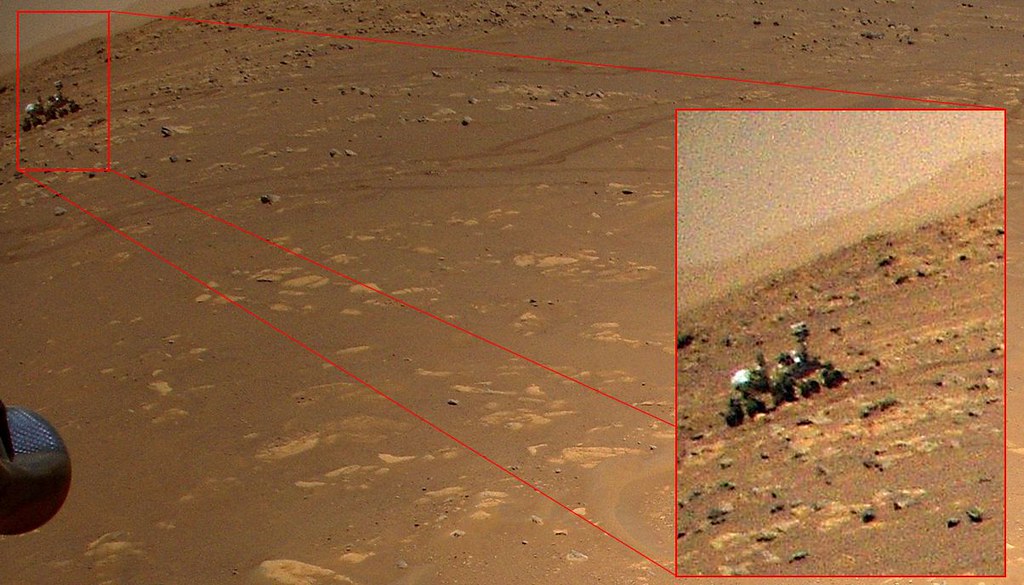
This is been done a number of time during the rover’s mission. For example, the camera has been pointed towards the Ingenuity Mars helicopter, allowing it to directly record the low-frequency beating of the helicopter’s rotors. It is also naturally pointing at rockets targeted for “zapping” by SuperCam’s laser. It has also been able to listen to tools and equipment operating at the end of the rover’s robot arm. All of these sounds have now been collectively analysed, and scientist have been surprised to find that while lower frequency sounds – such as the beating of Ingenuity’s rotors – travel at the expected Martian average of 240 m/s, sounds at frequencies greater then 240 Hertz, such as the higher-pitched click-click-clicking of the SuperCam laser actually travel around 10 m/s faster – the first time this has ever been observed.
The cause for this unusual difference is thought to be the result of the Martian atmosphere being largely carbon-dioxide. In studying the tenuous Martian atmosphere, scientists have discovered during the day, the heat of the Sun, deflected as it is by the surface of the planet, generates an unusual turbulence in the first 10 km of atmosphere above the planet. This turbulence has an unusual impact on the carbon dioxide that isn’t seen in Earth’s denser atmosphere: it allows higher frequency sounds to excite the carbon dioxide molecules a lot more than low-frequency sounds, allowing such higher frequencies to be more rapidly transmitted through the atmospheric medium.
Because this effect happens almost smack in the middle of the bandwidth of sounds audible to the human ear, it means that if we were able to stand out in the open on Mars and listen to something like a symphony being played a few 10 of metres away, rather than hearing all the notes collectively as we would on Earth, we’d hear the higher notes a second or so ahead of the lower notes, resulting in a discordant mess. However, a more practical outcome of this discovery is that engineers believe that by listening to the different frequencies within the sounds made by various pieces of audible equipment on the rover, they could potentially identify if that part of the rover is experiencing issues, and thus be forewarned that action might be required well before a potential failure occurs.
Continue reading “Space Sunday: distant stars, sounds on Mars, a return and a rocket”