The Artemis 1 Orion MPCV and its European Space Agency service module sit atop the first NASA Space Launch System (SLS) on Pad 39B at Kennedy Space Centre, a full Moon framed between the vehicle and one of the pad’s lightning towers. Credit: NASA
NASA’s Space Launch System (SLS) has finally cleared the last significant hurdle in the preparations to launch the first of the vehicles on its much anticipated lunar flight.
On Friday, June 24th, agency officials declared the test campaign for the maiden vehicle to be almost complete after it finally cleared the critical wet dress rehearsal (WDR) test on a fourth attempt – the first three in May each ending with issues that forced NASA to roll the vehicle and its mobile launch platform back to the Vehicle Assembly Building (VAB) at Kennedy Space Centre, Florida, so both could receive modifications.
The final dress rehearsal started on June 20th, and concluded 20 seconds early due to a leak in a hydrogen bleed line. While this did not compromise the test itself, it did prevent 13 of the planned 128 command functions from being performed as a result. Most of these had been previously tested, so the curtailing any testing of them during the WDR was not seen as cause for concern.
However, mission managers opted to perform one additional test prior to rolling the vehicle back to the VAB for final inspections and launch preparations. This will be a test of hydraulic power units used to gimble the nozzles of the vehicle’s solid rocket boosters to provide directional guidance while the boosters are firing. One it has been completed, the roll-back to the VAB will be carried out on July 1st.
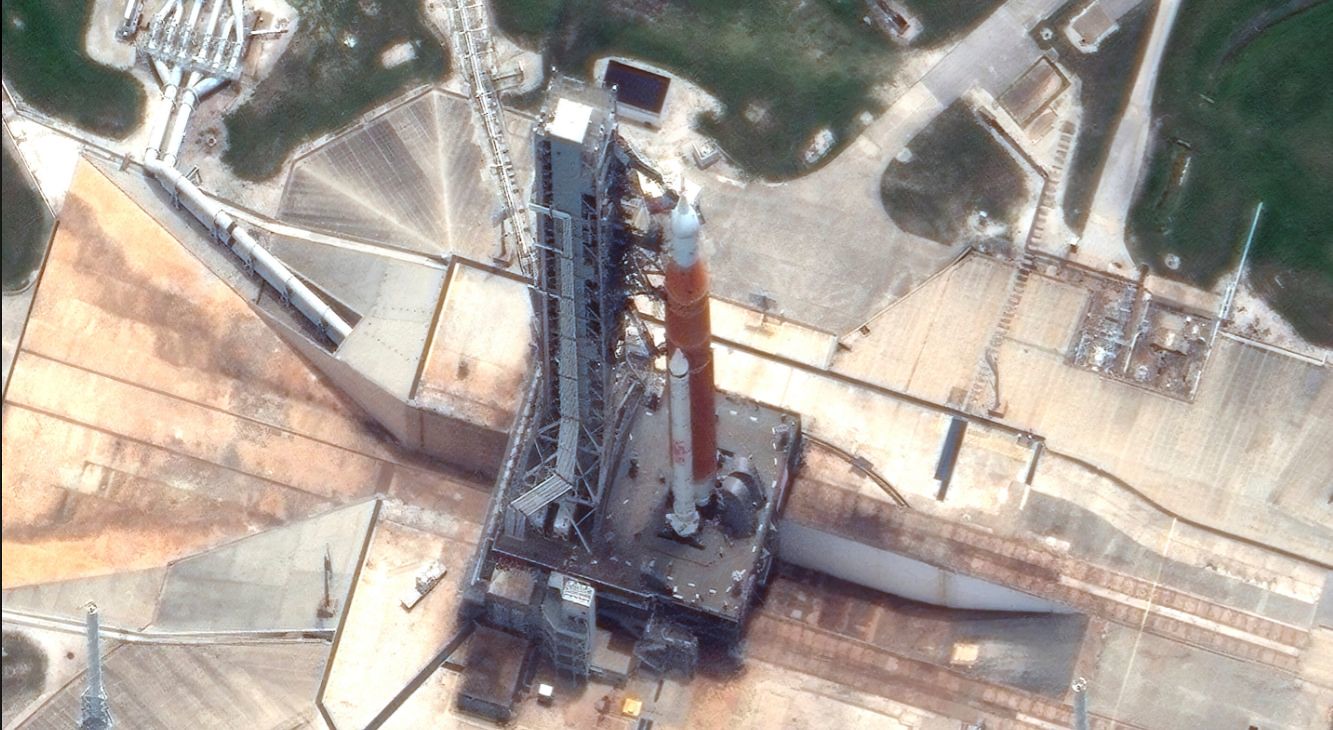
The Artemis 1 SLS vehicle sitting on its mobile launcher at Pad 39B, Kennedy Space Centre, imaged from orbit on June 18th, 2022 by a Maxar Earth observation satellite. Credit: Maxar Technologies
At the VAB, the vehicle and its launch platform will undergo a final post-WDR inspection, which will include replacing the seal responsible for the hydrogen leak. It’s expected that overall, the final check-out plus any required work will run through until early August. Providing nothing serious is found, the vehicle will be rolled back to the pad to commence 10-14 days final launch preparations. This will be in time to meet two immediate launch windows: August 23rd through September 6th (excluding the period August 31st-September 1st) and September 19th through October 4th, 2022.
The Artemis 1 mission is designed to fly an uncrewed Orion Multi-Purpose Crew Vehicle (MPCV) on 20+ day mission to cislunar space including 6 days in lunar orbit. It will be a preliminary check-out of Orion’s life support, propulsion, guidance and communications systems during an extended mission, prior to repeating the flight with a crew on board with Artemis 2.
CAPSTONE
On Monday, June 27th, NASA will be launching another mission to cislunar space.
The Cislunar Autonomous Positioning System Technology Operations and Navigation Experiment (CAPSTONE), is a 25 kg cubesat the size of a microwave oven designed to study what is called a lunar near-rectilinear halo orbit (NRHO) – an extended elliptical orbit around the Moon that will bring the satellite to within 1,600 km of the lunar surface before lifting it away to up to 70,000 km. It is a similar orbit to the one that will be used by NASA’s planned Lunar Gateway station.
While extreme, such an orbit allows for continuous communications with Earth and allows for extensive study of the Moon. When placed in a similar orbit, Gateway will allow astronauts to reach almost any point on the lunar surface using suitable landing systems.
The CAPSTONE cubesat sitting on an engineering bench during testing of its solar arrays. Credit: NASA / Dominic Hart
CAPSTONE is due to be launched from New Zealand aboard a Rocket Labs Electron rocket at 10:00 UTC om Monday, June 27th, 2022. As the Electron is not capable of delivering CAPSTONE directly to the Moon, it will use the company’s Photon kick stage to push the cubesat into an extended 4-month flight to the Moon, where it will enter orbit on October 15th. The extended, slow flight will allow CAPSTONE to carry out a range of tests prior to reaching the Moon and is not reflective of the kind of transit time crewed flights will require to reach lunar NRHO (5-10 days).
Once in orbit around the Moon, CAPSTONE will spend a further 6-months studying the NRHO environment around the Moon and in communication tests both with Earth and with NASA’s Lunar Reconnaissance Orbiter, which has been orbiting the moon since 2009.
SpaceX Triple Header with a Touch of Mystery
SpaceX carried out three near “back-to-back” launches over the weekend of June 17th-19th, albeit from different launch complexes:
On Friday, June 17th, a Falcon 9 lifted-off from Pad 39A at Kennedy Space Centre, carrying aloft the company’s latest batch of Starlink satellites for deployment.
On Saturday, June 18th, a Falcon 9 lifted the SARah-1 radar imaging satellite to orbit on behalf of the German military, after lifting-off from Space Launch Complex 4E at Vandenberg Space Force Base in California.
On Sunday, 19th, the third launch lifted-off from Space Launch Complex 40 at Cape Canaveral Space Force Station in Florida, ostensibly to place the commercial Globalstar FM15 into a “parking” orbit as a back-up for the company.
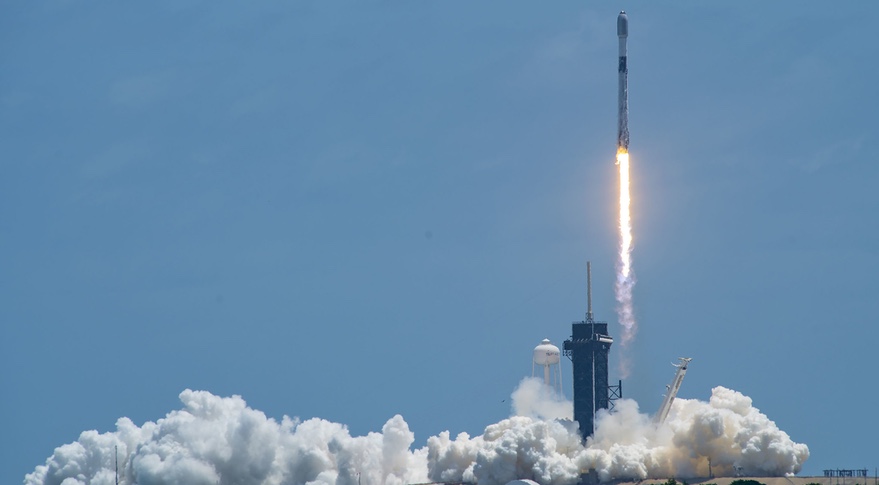
A Falcon 9 lifts off June 17 carrying a batch of Starlink satellites, the first of three launches SpaceX performed over a little more than 36 hours. Credit: SpaceX
While all three saw the successful return and landing of the Falcon 9 first stage of each booster, the June 19th mission has raised eyebrows due to the apparent secrecy around it. The Globalstar FM15 is a relatively small satellite – just 700 kg – which should have allowed the Falcon first stage to return to the SpaceX landing zone at Canaveral; instead it landed on a drone ship at sea, suggesting it was flying a heavier payload that required greater thrust to push it to orbit.
SpaceX also did not cover the launch with anything like the kind of live streaming they generally put out for their launches; what footage that was put out suggested the vehicle was carrying an additional payload adaptor, hinting at a further payload – although nothing has been said to confirm or deny this.
An artist’s impression of H260655b and H260655c orbiting their parent star. Credit: SciNews.
Two new “super Earth” exoplanets have been confirmed as orbiting a star just 33 light-years (10 parsecs) from our own, making them two of the closest rocky exoplanets to Earth to be thus far be located.
Such is their proximity, the planets – HD260655b and HD260655c – offer new opportunities for exoplanet and comparative planetology studies. They both orbit an M-type red dwarf star, the most common – and one of the oldest – types of star within our galaxy; these stars are both smaller and a lot cooler than main sequence stars like own own, but can also be quite violent in terms of their stellar activity. HD260655 is unusual amongst its brethren as it is somewhat brighter then most other M-type stars, given its comparatively small size. From Earth, it appears to reside within the constellation of Gemini, and is also known by a number of different catalogue designations, including Gliese 239 and Wolf 287.
HD260655b, the innermost of the two planets, zips around its parent at a giddying 2.8 terrestrial days; it is some 1.24 times the size of Earth and has 2.14 times the mass. HD260655c is much more “sedate” in its orbit, taking an entire 5.7 days to go around its parent; it is 1.53 times the size of Earth with around 3.1 times the mass.
The to planets are so close to their parent they are liable to be tidally locked, keeping the same side pointing towards the star all the time, and their estimated temperatures mean they are unlikely to support life: “b” has a temperature of around 435ºC, and likely has no atmosphere (although this is by no means certain), and “c” has an temperature averaging 284ºC – but may have a hydrogen-deficient atmosphere (so no water).
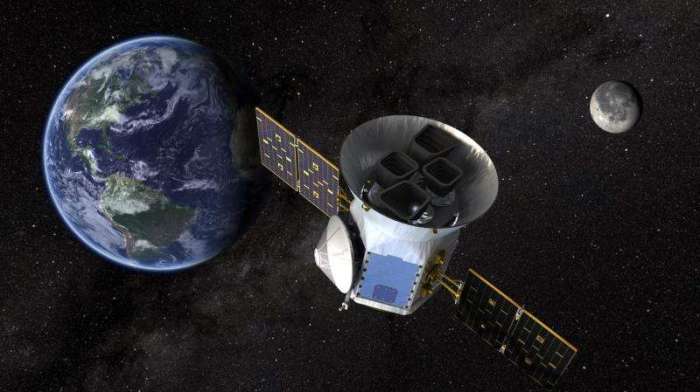
Artist’s impression of TESS in its “P/2” orbit. Credit: NASA
The planets were discovered in a 2021 review of data gathered by the NASA / MIT Transiting Exoplanet Survey Satellite (TESS) mission. Normally the confirmation process for such transiting planets – those that pass between their parent star and the point of observation to produce regular dips in the brightness of their star – can take a lot of additional work, including looking at other data about the star, repeating observations, confirming there has been no instrument error, etc. However, with HD260655, the process was accelerated because it had been tagged as having a possible planetary system in 1998 following observations using the HIRISE (now ANDES) instrument on the Keck telescope, and in 2016 following observations by the CARMENES instrument at the Calar Alto Observatory in Spain, and the data from these instrument-based observations did much to confirm the presence of both planets.
What is particularly exciting about these two worlds is the combination of their proximity to their star, its brightness and its proximity to our own solar system, all of which makes them ideal for study by the James Webb Space Telescope (JWST).
Among other things, JWST should be able to confirm whether or not either planet has an atmosphere and the composition of that atmosphere. Should it turn out that “b” has no atmosphere but “c” does, it allows for direct observation of the role of their star in characterising each planet over time, and the manner in which M-type stars influence atmospheric loss among their worlds; this in turn allows astronomers to gain a better understanding of the nature of exoplanets orbiting other M-Type stars. Finally, study of HD260655b and HD260655c and comparisons with the rocky planets of our own system could further add to our understanding of how planetary systems in general form.
Starship Update
On June 13th, the Federal Aviation Administration (FAA) issued its long-awaited Programmatic Environmental Assessment (PEA) concerning the SpaceX Starbase facilities at Boca Chica – and the summary is, neither the FAA nor the other government agencies that were involved in the study have come up with any significant environmental issues that would prevent SpaceX continuing with its current plans with the site.
The report doesn’t, however give SpaceX any immediate clearance to launch their first starship / super heavy orbital attempt. That requires a launch licence, which the FAA has yet to grant – and as a part of that process is that SpaceX demonstrate compliance with 75 action points raised by the PEA. Further, some of the action points will be subject to on-going review and could impact the company’s ability to secure launch licenses beyond the first. Further, the company may yet have to face direct action on the part of environmental groups in light of the fact that activities within the Boca Chica area – also a wildlife refuge – has already impacted some of the rare species living there.
Even so, it currently seems probable the SpaceX could be in a position to make their initial orbital launch attempt with a starship / super heavy combination in August 2022. As it is, the super heavy earmarked for the attempt – Booster 7 – has been equipped with its full complement of 33 Raptor engines, whilst its companion starship, Ship 24, is in the process of being fitted with its engines.
The massive “mechazilla” lifting mechanism on the launch support tower at the Starbase orbital facility, Boca Chica, was put through its paces again in mid-June, in readiness for lifting Booster 7 onto the launch table, and later stacking Ship 24 atop of it (seen bellow and to the left of the mechanism’s massive arms. Credit: BocaChicaGal / NASASpaceflight.comIn the next few weeks, we’re liable to see both Booster 7 and Ship 24 return to the launch area, with Booster 7 going through a range of static fire tests on the launch table before being mated with ship 24.
Meanwhile, at Kennedy Space, NASA has finally signalled growing (and, frankly, belated) concern about the SpaceX plans with the Pad 39A facility.
As I’ve previously reported, SpaceX resumed building a second super heavy / starship launch facility within the Pad 39A facilities the company leases from NASA. Of particular concern to NASA is the fact that SpaceX is locating the new launch platform so close to the existing Falcon 9 facilities, that the shockwave from a super heavy launch could conceivably damage the Falcon 9 pad and thus impact NASA’s ability to send crews to the International Space Station.
Pad 39A, Kennedy Space Centre, June 2022. To the left is the current Falcon 9 launch platform, sitting on top of the Apollo / Shuttle launch ramp. To the far right is the first section of the launch support tower for starship / supper heavy launches, showing the relative proximity of the two. Centre is a crane and a green structure, thought to be the start of work to install large water tanks between the two in order to deflect soundwaves from a super heavy launch away from the Falcon pad. Credit: @FarryFaz, Twitter
SpaceX appears to be trying to assuage NASA’s fears in part by installing what appears to be massive water tanks between the new launch facility and Pad 39A, possibly with the intent that the structure deflects sound away from Pad 39A. However, there is a greater threat involved in operating starship / super heavy which has not (in public, at least) been raised by NASA. To understand this threat, we need to go back to July 3rd, 1969.
That was the date on which the Soviet Union attempted to launch the second of its answer to America’s Saturn V, the N1 rocket, from the Baikonur Cosmodrome, Kazakhstan. However, seconds after lift-off the vehicle suffered a major malfunction, crashing back onto the launch pad. On impact, around 15% of the 2,400 tonnes of vehicle propellants detonated in a blast measuring 1 kiloton, obliterating the launch pad and scattering debris up to 10 km away. Fortunately, as the propellants were spread amongst 8 individual fuel tanks across the four stages of the vehicle, 85% did not detonate, but were burned in the ensuing deflagration; had they detonated, the estimated blast yield would have been closer to 7 kilotons – almost half the blast force of the first war time use of an atomic weapon (15 kilotons).
Super heavy doesn’t use multiple tanks. It effectively has two massive tanks that share a common dome (that is, the top end of one tank is the bottom of the other). This means that in the event of a catastrophic failure, it is exceptionally likely that any detonation will involve the entire 3,600 tones of propellants on super heavy alone, again yielding a blast in excess of 7 kilotons. Such a detonation on the ground or shortly after lift-off would not only level Pad 39A, it could cause at least moderate damage to the launch infrastructure shared by pads 39A and 39B.
Imagining Exoplanets Using the Sun’s Gravity
When it comes to astronomy, gravity can be a very useful tool thanks to the way it can affect light. Back in April, for example, I wrote about the use of gravitational lensing – the bending of light from an object far, far, away by the gravity of an object much closer – to give us our first glimpse of the most distant star from our own to have yet been captured.
The star, now called Eärendel, the Old English term for “morning star” – was imaged by the Hubble Space Telescope using the gravitational lensing effect of an intervening galactic cluster. However, a team led by Slava Turyshev, a physicist at NASA’s Jet Propulsion Laboratory, California, want to take the idea of gravitational lensing to a new level, using our own Sun to image distant worlds.
In this image from the Hubble Space Telescope, a luminous red galaxy (LRG) is surrounded by the Einstein Ring artefact created by the light from a much more distant blue galaxy being distorted by the LRG’s gravity. Credit: ESA / NASA
Turyshev and his team propose the use of a network of small satellites, preferably using solar sails, that could be deployed so as to image exoplanets using a 40 cm telescope in what they call the Solar Gravity Lens (SGL).
The idea has been in development for the last three years, and Turyshev’s team have determined how to resolved many of the idea’s specific problems. One of this is that while the Sun makes an excellent gravity lens, the corona is so bright it actually blots out the Einstein Ring – the circle of light created by the more distant object – such that it cannot be resolved. To fix this, the team determined that a satellite could, within a solar sail of the right size, use it as both a means of propulsion and effectively cover the Sun and this corona, revealing the Einstein Ring to the telescope. Determining the best size of the solar sail then allowed the team to calculate the mass and size of a satellite – thus allowing them to arrive at the optimal size for the telescope.
From that, the team have been able to work on a series of simulations based on the likely pixel size Earth-sized (or larger) would be produced at various distance up to 100 years years away, which in turn allowed them to simulate how such world would appear after processing their Einstein Ring and then deconvoluting the resultant image.
A simulation showing how Earth would look in a 128×128 resolution image captured by a 40-cm 30 parsecs away and using gravitational lensing similar to that produced by the Sun:. Left: the original 128×128 image; (c) as the image would look were it to be captured using SGL and then extracted from it Einstein Ring artefact; (r) as it would look after full deconvolution. Credit: Turyshev et al.
Further work is required to define the overall carrier spacecraft, but as Turyshev notes, SGL could provide us with insights into worlds beyond our solar system which might otherwise take years or even decades to accumulate.
Artemis 1 SLS on the Mobile Launcher 1 inside the Vehicle Assembly Building. Credit: NASA
Artemis 1, the planned first flight of NASA’s huge Space Launch System (SLS), is back on Pad 39B at Kennedy Space Centre and being prepared for another try at a full Wet Dress Rehearsal in what many are framing as a make-or-break for the new launch system. At the same time, the SLS programme has come under further critique by NASA’s own Office of Inspector General (OIG).
As I’ve noted in the past, the Wet Dress Rehearsal (WDR) is the final critical test for the SLS system, putting absolutely everything involved in a launch through its paces right up to just nine second before the rocket’s core RD-25 engines would light-off. The test is to ensure everything – the pad systems, the propellant loading systems, the rocket’s computers and avionics, the launch control systems, etc., are commissioned and ready for operational launch, with the data gathered from this first rocket going on to provide a baseline for checking future SLS vehicles as they go through pad preparations and launch in the future.
A graphic showing the tank filling which forms a core element of the WDR, currently scheduled for or around June 17yh, 2022. Credit: NASA
The first attempt at a WDR, back in April started with fanfare a high-profile roll-out of the pad by the first SLS, where it successfully completed a battery of tests prior to the WDR commencing, only to be followed by a series of issues that forced rocket and Mobile Launcher (ML-1) tower to be ignominiously rolled back to the Vehicle Assembly Building (VAB).
The June 6th roll-out was far more low-key, the rocket and ML own leaving the VAB atop the veritable crawler-transporter just after midnight and arriving at the pad in the morning sunlight. Since then, the vehicle and launcher have been going through check-out and connection to all the ground support systems, and a second WDR attempt is provisionally set for on or around June 17th, 2022.
In the meantime, NASA’s OIG has issued a report critical of another aspect of the programme: Mobile Launcher 2 (ML-2).
ML 1 was originally built for launching Saturn 1B and Saturn V rockets in the 1960s. It was then modified for space shuttle launches and again to handle SLS Block 1 launches. However, it is incapable of supporting launches of the bigger and more powerful SLS Block 1B and Block 2 vehicles (assuming the latter are built). So in 2018/19, NAS awarded a US $383 million contract to engineering firm Bechtel to supply a new Launcher – ML-2 – capable of supporting SLS Block 1B and beyond launches, with delivery slated for 2024, ahead of the then planned launch of Artemis 4, the first SLS Block 1B vehicle.
However, the OIG report reveals that ML-2 is spiralling out of control, with costs already exceeding US $440 million, and set to hit at least US $960 million, with doubt cast on Bechtel’s ability to deliver the Launcher in time for Artemis 4, even though that mission is unlikely to fly before later 2027 or early 2028.
Comparing ML-1 and ML-2. Credit: NASA
The report is primarily critical of Bechtel for multiple failures and lapses, but also points out NASA’s own folly in playing “yes man” to an accelerated Artemis programme. Originally, the US return to the Moon was to commence in 2028, but the Trump administration pulled that date forward to 2024; while that was clearly unachievable, NASA attempted to meet the goal. As a result, the ML-2 contract was awarded as “cost plus”, meaning that overruns would be met out of NASA’s pocket, rather than fixed price, which would leave Bechtel holding the purse for errors and delays on their part. NASA further compounded the issue by awarding the contract for the ML-2 design before the SLS Block 1B design had been finalised. As a result, the space agency immediately became liable for continued changes to the ML-2 design as the SLS Block 1B design evolved.
Currently, NASA is attempting to move the contract to a fixed price basis; unsurprisingly, Bechtel appear somewhat resistant to doing so.
FRBs: Far, Far Away – or a Lot Closer to Home?
First discovered in 2007, FRBs are intense, brief flashes of radio-frequency emissions, lasting on the order of milliseconds, thought to emit as much energy in a millisecond as our Sun does over three days – although such are the vast distances they must cover, by the time they reach us their signal strength is around 1,000 times less powerful than a mobile ‘phone signal being received from the Moon.
What causes FRBs is unknown. Most have been thought to originate outside our galaxy – although some have clearly originated within it. Many are heard only once; others appear to repeat on a highly random basis. By listening for and measuring some of the latter, it has been possible to localise their likely point of origin to an area of space. Then, using their dispersion measurement (DM) and overall red-shift, it has been possible to calculate their approximate distance.
ive hundred-metre Aperture Spherical radio Telescope (FAST. Credit:
The DM a measurement of the period between the high-frequency range of a radio burst reaching us and the lower frequencies, which tend to get more dispersed more the first they travel, and so take longer to reach us. It’s a small, but measurable amount. As the composition of interstellar space is known, this difference can be used to calculate signal attenuation over distance, and thus the approximate distance of the originating object from Earth.
This measurement can then be combined with the overall red shift exhibited by the signal to yield a similar distance result, thus allowing reasonable certainty as to how far away the originating object is. But that’s not the case with FRB 20190520B.
What is particularly interesting about this FRB is that taken on its own, its DM suggests it originates in a small galaxy beyond our own. However, when the DM / red-shift relationship is extrapolated, the result suggests the originating point is a lot closer to Earth – as in possibly within our own galaxy.
This might make 20190520B some weird outlier among FRBs – but as some have pointed out, it might also indicate to our entire assumptions about extra-galactic FRBs and the use of dispersion measurements as a kind of “cosmic yardstick” as being totally wrong; that we could actually be mistaking events occurring within our own galaxy that result in FRBs for something far more distant and exotic.
Right now, it’s too early to tell either way, but 20190520B has caused a considerable stir among astronomers, with many looking to step-up the search for more of these strange events.
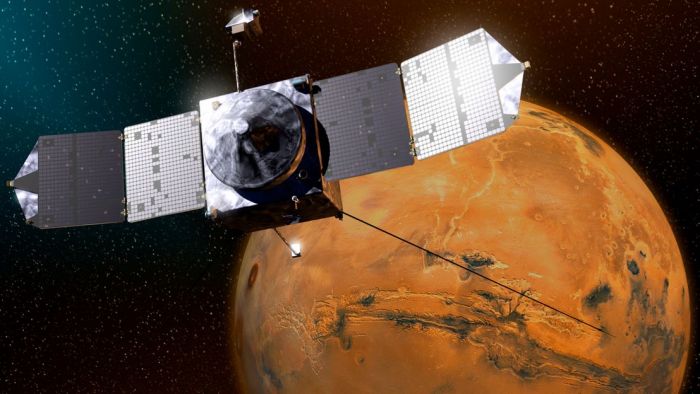
An artist’s impression of MAVEN as it looks down on Mars’ Vallis Marineris. The NASA mission, which arrived in orbit in September 2014, is studying the Martian atmosphere
NASA’s MAVEN Mars orbiter has been in orbit around the planet since September 2014. For the majority of that time, and following science commissioning (Sept-November 2014), the spacecraft has been studying the Martian atmosphere, yielding valuable science. Except for the past three months, that is.
On February 22nd, 2022 – ironically the day Shannon Curry, appointed to take over the role of MAVEN’s Principal Investigator in August 2021, was making a three-hour presentation on the vehicle’s science findings at the conclusion of its latest 6-month mission extension – when Things Went Wrong.
We finally finished the presentation, I turn my ‘phone back on, and our project manager calls me immediately. I’m thinking, he’s calling me to be like, ‘Congratulations, you did it, you’re doing great!’ And he was, ‘Shannon, we’re in safe mode.’
– Shannon Curry
Shannon Curry was appointed to the role of Principal Investigator for NASA’s MAVEN mission in August 2021, and steered the project through its most serious issue between February and June 2022. Credit; via Wikipedia
Regulars to Space Sunday will know that “safe mode” is when a spacecraft has encountered a condition that exceeds its programmed parameters / expectations, causing it to shut down most of its non-essential systems and services and ‘phone home with a call of “I’m in a spot of trouble, folks!”
Safe modes are rarely easy to diagnose and resolve remotely, with MAVEN (Mars Atmosphere and Volatile EvolutioN mission), the issue would prove to be almost catastrophic.
In order to both study Mars and communicate with Earth, MAVEN must periodically re-orient itself. Up until 2017, it did so by using one of two Inertial Measurement Units (IMUs) to calculate its position, attitude and rotation. However, from 2017 through until the end of 2021, MAVEN has been reliant on just one unit – IMU-2 – after IMU-1 experienced data issues.
By the start of 2022, IMU-2 was starting to show issues of its own, so a project was started to write new software to enable MAVEN to orient itself using the stars in what the mission team called “stellar mode”, a project that would take until late 2022 to complete. In the meantime, the vehicle was instructed to switch back to using IMU-1, with the power to the unit being periodically recycled to help with keeping it operating smoothly.
However, on February 22nd, 2022, with MAVEN oriented to communicate with Earth, a power recycle was started and IMU-1 crashed, and when IMU-2 automatically started, it had absolutely no idea of where it was, and MAVEN went into a loop of trying to restart IMU-1 after shutting down all science operations.
When it was clear IMU-2 was “lost”, and IMU-1 was not going to recover, risking MAVEN drifting out of communications alignment, the mission team took a desperate step: heartbeat termination.
That term is not just for dramatic effect: basically, it’s like ripping the cord out of the wall. We ordered the vehicle to shutdown and reboot its primary computer without switching to the back-up. When that failed, we had no choice but to then swap to the back-up and we’ve never been on that before.
– Shannon Curry.
Whilst the switch to the never-used back-up computer was a risk, it nevertheless allowed position data to be given to IMU-2 to ensure communications could be maintained with Earth. This allowed the mission team to accelerate the work on developing the “stellar mode” software.
On April 19th, the first version of the software was uplinked to MAVEN five months ahead of its due date. However, it could only be tested by shutting-down IMU-2. If the software failed, there was no guarantee either IMU would reboot, leaving MAVEN to drift out of its communications orientation within hours. Fortunately, the software demonstrated it could keep the vehicle correctly oriented, and the mission team were able to continue to refine the software and add the tasks required for MAVEN to use stellar mode for both communications and science operations.
In May, work had reached a point where the science instruments could each be brought out of safe mode and tested to ensure they had suffered no long-term damage. Then on May 28th, the order was given for MAVEN to fully transition all operations to use the stellar mode for navigation / orientation, allowing science operations to resume.
There will still be periods in MAVEN’s operations when it will have to rely on an IMU, but for now the mission team has brought the mission back from the brink of disaster, and are now focusing on ways in which the craft can better deal with possible data hiccups from the IMU systems.
Starship + Crew Dragon Update
Starship
The FAA report on the SpaceX starship facilities at Boca Chica, Texas, will now not be published until June 13th. In the meantime, it has been confirmed that the first orbital launch attempt will be undertaken by Ship 24 and Booster 7.
At the time of my last Starship update, Booster 7 had suffered a failure with a downcomer pipe, resulting in the booster being returned to the production facilities for examination, together with speculation that Booster 8 might replace it for the orbital launch attempt. However, repairs were made to Booster 7, enabling its return to the launch area.
Starship 24 undergoing liquid nitrogen cryogenic tests. A similar test at the end of May 2022 resulted in a header tank feed pipe failing, ejecting heat shield tiles from the underside of the vehicle. Credit: NASASpaceflight.com
At the end of Mays, Ship 24 was been rolled out to the test stands where cryogenic tests using liquid nitrogen commenced – only for a feed pipe connected to its LOX header tank to fail, throwing heat shield tiles off of the vehicle as the hull flexed. As a result, the pipe in question went through a rapid pipe redesign whilst on the test stand, with additional expansion joints being fitted to prevent any over-pressurisation.
With engines now being fitted to both ship and booster, and deliveries of liquid oxygen, liquid methane and liquid nitrogen being made to the tank farm, SpaceX appear confident the FAA report will give the green light for the orbital launch test – a test that will include a test deployment of Starlink satellites through the small payload slot.
This view exemplifies one of the issues SpaceX may still have with the Boca Chica launch facility. The orbital launch tower can be seen centre top; to the bottom left and in close proximity to the launch facilities, is the propellant and consumables tank farm, well within the blast radius should a starship / super heavy combination to explode at launch, the earth berm between tanks and launch stand notwithstanding. The horizontal tanks to the right of the upright tanks were installed after-the-fact in part to pre-empt concerns from the FAA on this matter. Credit: RGV Aerial photography
Even if this first flight test is a success (which is unlikely), it is perhaps important to note it is not a prototype test flight per se, but is rather an initial proof of concept. This is because the starship vehicle is far from its final configuration (Musk has announced first possible changes to the design). Nor is Ship 24 reflective of an “operational” starship: it has no means to carry the volume of payload promised (100-150 tonnes), the mechanism(s) required to support such a mass during launch, or the means to deploy it payload bay doors and their mechanisms. As such, there is a long way to go before starship reaches an actual prototype flight, with a lot more to prove. Even then, the realities of its promise are still highly questionable – something I hope to be looking at in a future Space Sunday.
As NASA moves forward with plans to return to the Moon under the umbrella of Project Artemis, it is now stirring the pot on ideas for sending humans to Mars once more.
There have been many proposals for crewed missions to Mars since the 1950s, and in the last thirty years we’ve had a fair plethora, from the utterly unworkable ideas put forward in the Space Exploration Initiative SEI) of the early 1990s through Mars Direct, NASA’s Sprint and Mars Semi-Direct outlines through to what amount to pipe dreams expressed by Elon Musk / SpaceX.
On May 17th, NASA published a video and documentation outlining a set of high-level objectives identifying four overarching categories for developing a Moon-to-Mars exploration strategy, including transportation and habitation, together with ideas for initial missions which, for those who have followed all the various plans for exploring Mars, come across as a fresh pulling together of some very old concepts.
NAS’s latest conceptual strategy for using technologies for Moon and Mars exploration. Credit: NASA
Managed by the Exploration Systems Development Mission Directorate at NASA Headquarters in Washington DC, the purpose of the publications is to generate feedback from both interested parties within the space industry and from the general public (closing date, June 3rd, 2022). However, the process will not result in NASA issuing any RFIs or undertaking any procurement activity as a result of industry feedback received.
These objectives will move us toward our first analogue Mars mission with crew in space and prepare us for the first human mission to the surface of the Red Planet. After reviewing feedback on the objectives, we will work with our partners to discuss input and finalise our framework this fall.
– Jim Free, associate administrator, Exploration Systems Development Mission Directorate.
In particular, the outline seeks to leverage capabilities that can be utilised / tested on the Moon and then extended to Mars, such as in-situ resource utilisation (ISRU) – although arguably, scaled ISRU for water, oxygen and propellant production is somewhat simplified on Mars, thanks to its atmosphere); and combining robotic and human systems.
The outline also provides insight into how NASA’s initial thinking on how to undertake initial missions and this is where echoes of past proposals comes in. In brief, these ideas include:
A “Transit Hab” capable of carrying crews of 4 between lunar orbit and Mars, using a mix of chemical and electric propulsion. Delivered to the Lunar Gateway station in the early 2030s, this vehicle would be capable of both conjunction and opposition trips to Mars.
The use of precursor cargo flights to deliver equipment and supplies to Mars ahead of any crewed landing.
Precursor crew ascent vehicle missions to provide the means for crews to return to Mars orbit at the end of their time on the surface and return to the transit vehicle.
An initial conjunction mission (previously referred to as a “Sprint” mission) with two astronauts spending just 30 days on the surface of Mars utilising a pressurised rover.
The first opposition mission with a 4-person crew spending 540 days on Mars utilising large lander-habitats.
NASA 2022 first crewed mission concept. Credit: NASA
To explain the difference between “conjunction” (/”Sprint”) and “opposition” missions to Mars:
Opposition missions refer to Earth and Mars being on the “same side” of the Sun in their orbits around the Sun (so the Sun and Mars are on “opposite sides” of Earth), allowing for the fastest transit time between the two planets – 180 to 270 days -, but which require crews to spend up to 540 days on Mars, for a mission duration of 900 days.
Conjunction mission refer to Earth and Mars being (more-or-less) on opposite sides of the Sun relative to one another, requiring a mission to “sprint” to catch Mars (usually by making a gravity-assist around Venus). These missions are of a shorter duration (600-650 days total), but restrict crews to just 30 days on Mars but with highly-variable transit times (200-400 days).
There are arguments on both sides of the coin for opposition / conjunction missions, but overall, the choice of a conjunction approach to the first mission is a little odd: it maximises transits times (620 days in space), minimises Mars surface time and requires a Venus sling-shot.
Mars transit options: conjunction (left) and Opposition (right). Credit: NASA
However, the most interesting aspect of the NASA outline is that for this initial landing, the two crew making the descent to the surface of Mars will do so within a pressurised rover. The reasoning behind this is to deal with the crew potentially being “deconditioned” as a result of the transit to Mars, and so will use the rover to reduce the amount of time they will need to take adjusting to conditions on Mars, limiting the amount of actual science they can perform in 30 days.
In actual fact, the idea of making a rover the lander for a crew isn’t new. The first complete Design Reference Mission proposal that suggested this approach was put forward in 2004 – by none other than film director James Cameron!
The lander-rover from the 2004 Cameron DRM, note the landing motors and fuel tanks and fore-and-aft cabins. Unlike the proposed NASA rover, this vehicle required a separate habitat module.
Cameron’s rover was admittedly far more massive that the vehicle NASA is suggesting in their outline, but it was part of an overall strategy involving transfer vehicles, deployable habitation modules, and the use of biconic vehicles to descend through the Martian atmosphere (SpaceX have copied the biconic approach with the shape of starship, although the overall landing is very different).
Similarly, the ideas of sending equipment / supplies and the vehicle that will get the crew off the surface of Mars and back to orbit are not particularly new. Zubrin, Baker, Wagner et al, developed the first modern plan for doing these in the Mars Direct mission plan – although in that, the crew would make the entire trip back to Earth within the very cramped confines of their ascent / return vehicle.
This proposal also laid out who the propellants for the craft could be manufactured on Mars, with the general idea being modified by NASA as a part of their Design Reference Mission proposals, such that the ascent vehicle would only carry the crew up to orbit and a waiting transit vehicle – albeit one much larger than its outline suggests.
As noted, the ideas presented in the NASA document and video are for discussion and feedback, rather than for presenting actual plans. As such, they will be something I’ll return to in the future; once more definition has been given to actual mission outlines, the use of ISRU, etc.
The CST-100 Starliner sits just 10 metres off the ISS, its nose open to expose its docking mechanism and forted port May 20th, 2022. Credit: NASA
Boeing’s CST-100 Starliner finally lifted-off from Space Launch Complex 41 at the Cape Canaveral Sport Force station on Thursday, May 19th, sitting atop a United Launch Alliance (ULA) Atlas 5 booster, in what is a critical test flight for the system, one that involves a rendezvous and docking with the International Space Station (ISS).
Called Orbital Flight Test 2 (OFT-2), the uncrewed mission is the second attempt to fly a Starliner vehicle to a successful docking with ISS – seen as a critical precursor to Starliner vehicles carrying crews to / from the ISS. The first attempt, carried out in December 2019 failed to rendezvous with the ISS after a software issue caused the vehicle’s orbital manoeuvring and attitude control (OMAC) thrusters to misfire repeatedly, leaving the vehicle with insufficient propellant reserve to make the rendezvous once the issue had been controlled. However, the Starliner – christened Calypso, and now earmarked for the first CST-100 crewed flight – still completed the orbital tests for the mission successfully, and made a safe return to Earth.
CST-100 OFT-2 lifts-off from SLC-41 at Cape Canaveral Space Force station, May 19th, 2021. Credit: NASA
Following lift-off at 22:54 UTC, on May 19th, the Starliner vehicle (currently unnamed) reached an initial orbit successfully. However, at 31 minutes after launch, things went slightly awry. At this point one of the vehicles 12 main OMAC thrusters was due to fire for 45 seconds to place the Starliner on the correct trajectory to commence its “chase” to the space station.
However, one second after firing, the thruster shut down. This triggered an automatic firing of a second thruster, which ran for 25 seconds before shutting down, leaving a third thruster completing the burn. Whilst of concern, the initial two thruster failures were not sufficient to prevent the mission continuing, and both NASA and Boeing are reviewing data to determine what the problem is – and whether the two faulty thrusters are still capable of firing correctly – the main OMAC thrusters being needed to de-orbit the vehicle at the end of its flight.
Sunlight flashes off of the hull of the CST-100 Starliner as it chases the ISS. Credit: NASA
Despite these teething problems, the Starliner “caught up” with the ISS on Friday, May 20th, having successful completed a series of tests whilst closing on the ISS. At 20:36 on the 20th, the crew on the ISS caught their first sight of the Starliner. The capsule steadily closed on the station before completing two “flyarounds”, allowing the ISS crew to observe the vehicle’s overall condition ahead of docking.
Utilising self guidance, the capsule then closed to within 180 metres of the space station before coming to a stop and then moving away once more in an “approach and retreat manoeuvre” intended to test the vehicle’s ability to carry out precise manoeuvres in close proximity to the station. After this, it resumed its approach towards the Harmony module and its docking port, coming to within 10 metres of the station when it was ordered to stop when mission control confirmed it was a little off-centre relative to the docking port.
Another view of the Starliner approaching the Harmony module of the ISS, May 20th, 2022. Credit: NASA
This eventually required the vehicle to back away from the station, correct its alignment and make a second approach – which was again halted at 10 metres from the station. This proved to be the start of an irritating period of minor issues with the docking mechanism at the front of the vehicle which ultimately delayed docking by 90 minutes, Starliner finally connecting with the ISS at 00:28 GMT on Saturday, May 21st.
Following docking, a further series of testes on the vehicle were conducted, and the hatches between station and capsule were finally opened at 16:04 GMT, allowing astronauts Robert Hines and Kjell Lindgren connect ventilation systems and move camera systems into the capsule. They also greeted the capsule’s main occupant: Rosie the Rocketeer, a mannequin occupying the commander’s seat in the capsule and equipped with various instruments to test how orbital ascent (and return to Earth) affect those riding in the vehicle.
The Starliner docked against the extended docking arm of the Harmony module – the latter retracts to pull the capsule against the docking port. Credit: NASAAlso on the flight is a plush toy of Jebediah Kerman, one of the four original characters from the space game Kerbal Space. The first Kerbal to officially make it to space, “Jeb” is the mission’s “zero-g indicator” for the flight. His presence was kept secret by the ground control team, so that he might be discovered by the ISS crew on entering the vehicle – Kerbal Space is apparently very popular among Boeing and NASA staff.
The Starliner is set to remain docked with ISS for 4-5 days before departing for a return to Earth. If declared a success post-analysis, OFT-2 should pave the way for the first crewed flight before the end of 2022. Called Crewed Flight Test, it will carry a crew of 3 (personnel still to be confirmed) to the ISS on a 10-day (ish) mission to the space station. That in turn should clear the way for operational flights with Starliner to start in early 2023.
Curiosity’s “Dog Door” and InSight’s Demise
Parts of the Internet have been all agog over the last few days, after NASA Tweeted images on May 18th captured by the Mars Science Laboratory rover Curiosity, labelled (perhaps a little unfortunately) as a “door shaped fracture” that offers (again, unfortunate wording) “a doorway into the ancient past” – terms that were taken just a little too literally by some.
A mosaic of 113 images captured by the MastCam system on NASA’s Curiosity rover captures the face of “East Cliff” on May 7th, 2022, (mission sol 3,466). The fissure of “Dog Door can be seen over to the upper left. This mosaic has been colour and light adjusted to give the same conditions as if the feature was being viewed on Earth. Credit: NASA/JPL
The images were part of a series captured by the rover on May 7th, during a survey of a sedimentary mound of rock layers dubbed “East Cliff”, and sitting on the flank of “Mount Sharp”, the 5-km high mound of material at the centre of Gale Crater. During the processing of 133 images taken of “East Cliff” using the rover’s MastCam, the science team noted an interesting fissure within the upper, most weathered layers of the mound.
Looking to be rectangular in shape, the fissure does appear to be door-like – although not one any human is going to be walking through, given it is just 29.1 cm tall and the maximum width of the feature in just 38.9cm (sizes which prompted NASA to call the feature a “dog door” as it is closer in dimensions to the front opening on a kennel).
A further mosaic from Curiosity taken on May 7th, 2022, showing the “Dog Door” fissure more centred (and circled) in the image. Again, the image has been colour / light adjusted for Earth lighting. Credit: NASA/JPL
However, while the fissure is real, it’s door-like appearance is the result of two key factors: the angle at which sunlight is striking the mound, which casts the back of the fissure into shadow, giving the impression it is some form of entrance; and the also pareidolia – the tendency for the human brain to try and interpret strange sights and objects by trying to perceive them as something familiar – in this case a door.
Such fissures are not actually uncommon within geological features like East Cliff, both here on Earth and on Mars. They are caused by the intersection of multiple vertical (from weathering under the influence of water / wind) with horizontal layering of rock such that the most exposed part of the result lattice break away, forming a shallow fissure with regular-looking sides.
An anaglyph close-up of the “Dog Door” with annotations indicating the approximate width, height, and depth of the open fissure. Credit: NASA/JPL
And the comment about being a “doorway into the past”? That’s simply a reference to the fact that the collapse that formed the fissure offers the opportunity to perhaps examine rocks that haven’t been so exposed to the ambient surface conditions of Mars and may have had a degree of protection from harsher solar radiation, and so might reveal further chemical / mineral clues to the ancient past of “Mount Sharp”.
It has also been announced that NASA’s InSight Lander mission, which has been operating on Mars since November 2018, but which tends to get overlooked in favour of the “sexier” rover missions, may be coming to an end as soon as mid-July 2022.
InSight, which I covered in-depth at its May 2018 launch (see: Space Sunday: insight on InSight, May 2018) has been carrying out studies into the interior of Mars, including the study of “Marquakes” that appear to take place deep within the planet. However, it has been suffering from a significant decrease in available power as a result of dust accumulation on the pair of 2.2 metre diameter solar arrays.
Comparative images showing how dust accumulated on InSight’s sollar arrays. On the left, one of the arrays 10 days after landing, looking fairly clean. On the right, the same array after just under 4 months on Mars. Credit: NASA/JPL
As I reported in 2021, such was the dust build up on the arrays, the electrical power generation on the lander has been reduced to just one-tenth of the 4.6 kilowatt-hours the arrays generated during the initial days of Mars operations, and is now insufficient to continue to meet the needs of all systems on the lander.
Because of this, the decision has been taken to start powering-down non-essential systems and instruments, the intention to leave only the seismometer positions on the surface of Mars working, together with the camera system mounted on the lander’s robot arm (which will be oriented to focus on the seismometer before the arm is shut down), and the lander’s communication system.
However, even with the reduction in power usage this will achieve, the mission team believe that power production levels will drop below the minimum required to keep the seismometer functioning by mid-to-late July; although sufficient power will still be generated to power the communications system through until possibly the end of 2022.
Despite being overlooked at times, InSight has far surpassed its planned 2-year primary mission, and has yielded a lot of information about the processes at work deep within Mars.
SpinLaunch Update
In November 2021, I wrote about Spinlaunch, a company that plans to use a 100-metre diameter vacuum accelerator to propel payloads of up to 200 kg on the first leg of their journey to orbit.
This would be achieved by placing the payloads and their rocket inside a ballistic projectile (total mass: 11.2 tonnes) which would then be spun-up to a speed of 8,000 km/h with the drum-like accelerator before releasing it along a guidance tube (think gun barrel) and out into the atmosphere to be hurtled to a altitude of 61 km, where the projectile splits open to release the rocket, which can ignite its motors and power its way to orbit.
The Spinlaunch prototype accelerator shown in scale to the statue of liberty. Credit: SpinLaunchThis may sound crazy – and there are a lot of issues / questions around the full-size implementation of the system – however, since October 2021, SpinLaunch has been carrying out increasingly ambitious sub-orbital tests using a 1/3rd scale accelerator operating at 20% of the full-scale system to launch projectiles (“simulators”) on ballistic flights to offer both a proof of concept for the idea and to gather essential data on its overall feasibility.
As a part of these tests, on April 22nd, 2022, Spinlaunch for the first time carried out a test launch of a simulator equipped with a camera system. The resultant video is impressive, showing the launch accelerator dwindling in size below the projectile as it climbs into the atmosphere at 1,600 km/h before starting its tumble back to Earth, where the video cuts out.
However, before watching the video be warned: a longitudinal spin is imparted to the simulator to help with stabilising it in flight (again akin to a bullet being stabilised by the rifling in a gun barrel), and this spinning might induce a sense of motion sickness in the sensitive.
The exact height reached by the projectile simulator has not been confirmed by SpinLaunch, but given the curve of the Earth can be seen, it would seem likely that the simulator reached several kilometres in attitude.
There is still a long way to go before SpinLaunch is close to being ready to start full-scale operations (and much to be proved before they do), but such has been their progress to date, NASA has signed-on to the project with the intent to fly at least one payload of their own on a sub-orbital launch so that they might gather data on system and payload performance.
More from China
May has been a busy month for announcements by China concerning its space ambitions. In the previous Space Sunday update, I covered the most recent news on China’s upcoming space telescope. It is just one of three initiatives to gain update / confirmation.
The first part of May saw a series of television interviews with CCTV, the state television network, Huang Zhen the chief designer at the China National Space Administration (CNSA) gave the first official confirmation of the multi-facetted work being put into developing a permanent human presence on the Moon.
In particular, the interviews gave the first official confirmation of China’s Manned Lunar Deep Space Exploration Project Office (MLDSEP), tasked with developing the technologies required to establish a permanent presence on the Moon – and to enhance those technologies, where relevant, for future crewed mission to Mars.
The interviews also touched upon – if only superficially – various aspects of the work MLDSEP is engaged upon. These include: the development of Earth-based training facilities for lunar hardware and operations; design and development on lunar hardware including: crewed lander vehicles, pressurised rover vehicles, payload landers, and what appears to be a lunar orbital space station similar in nature to NASA’s Gateway station, together with research into and research into in-situ resource utilisation capabilities to provide air, water, and building materials to support an expanding lunar presence.
A general graphic displayed by China state television during interviews with CNSA chief designer Huang Zhen, showing some of the lunar hardware CNSA are developing for human operations on the Moon. Credit: CNSA / CCTV
Then, on May 13th, another of China’s chief designers – Zhang Rongqiao, responsible for China’s highly successful Mars orbiter / lander / rover mission, Tianwen 1 – confirmed his team are deep into developing Tianwen-2, a decade-long two-phase, mission of enormous ambition.
The first phase of the mission, lasting 2 years, will see the vehicle launches and rendezvous with asteroid 469219 Kamo’oalewa, a quasi-satellite of Earth occupying a solar orbit close to our own..On arrival, Tianwen-2 will first perform a “touch and go” flyby similar to those used by Japan’s Hayabusa 2 and NASA’s OSIRIS-Rex, to gather samples from the surface of the asteroid.
Assuming a suitable location can be found; the vehicle will then attempt to anchor itself to the asteroid using a set of robot arms, and then drill into the asteroid to obtain a core sample. Tianwen-2 will then return to Earth and use the planet’s gravity to slingshot it on its way to its next target, but not before it has dropped off the samples from 469219 Kamo’oalewa for recovery and study.
The slingshot manoeuvre will set the vehicle on a 7-year journey to 311P/PanSTARRS, a so-called “active asteroid”, because it has properties seen within both asteroids and comets. Once there, it will orbit and analyse the asteroid for at least a year (possibly longer, depending on propellant reserves) using a range of cameras and spectrometers to glean insights into questions such as the mystery of the source of Earth’s water. Data gathered will be communicated back to Earth, although Tianwen-2 will not itself be returning. No images have been released as yet to show the proposed design of Tianwen-2.