Space Sunday: Mars rover round-up

Curiosity, NASA’s Mars Science Laboratory (MSL) continues its exploration and examination of “Vera Rubin Ridge” on the slopes of “Mount Sharp”.

Most recently, star- and swallowtail-shaped tiny, dark bumps in fine-layered bright bedrock have been drawing the attention of the rover’s science team due to their similarity to gypsum crystals formed in drying lakes on Earth – although multiple possibilities for the features are being considered alongside their potential for being formed as a result of water action.

The features pose a number of puzzles: where they formed at the same time as the layers of sediment in which they sit, or were formed later as a result of some action? Might they have been formed inside the rock sediments of “Mount Sharp” and exposed over time as a result of wind erosion? Do they contain the mineral that originally crystallised in them, or was it dissolved away to be replaced by another? Answering these questions may point to evidence of a drying lake within Gale Crater, or to groundwater that flowed through the sediment after it became cemented into rock.

“Vera Rubin Ridge” stands out as an erosion-resistant band on the north slope of lower Mount Sharp inside Gale Crater. It was a planned destination for Curiosity even before the rover’s 2012 landing on the crater floor near the mountain. The rover began climbing the ridge about five months ago, and has now reached the uphill, southern edge. Some features here might be related to a transition to the next destination area uphill, which is called the “Clay Unit” because of clay minerals detected from orbit.

In addition to the deposits, the rover team also is investigating other clues on the same area to learn more about the Red Planet’s history. These include stick-shaped features the size of rice grains, mineral veins with both bright and dark zones, colour variations in the bedrock, smoothly horizontal laminations that vary more than tenfold in thickness of individual layers, and more than fourfold variation in the iron content of local rock targets examined by the rover.

A mineral vein with bright and dark portions distinguishes this Martian rock target, called “Rona,” near the upper edge of “Vera Rubin Ridge” on Mount Sharp. The MAHLI camera on NASA’s Curiosity Mars rover took the image after the rover brushed dust off the grey area, roughly 5cm by 7.5 inches. Click for full size. Credit: NASA/JPL / MSSS

The deposits are about the size of a sesame seed. Some are single elongated crystals. Commonly, two or more coalesce into V-shaped “swallowtails” or more complex “lark’s foot” or star configurations. They are characteristic of gypsum crystals, a form of calcium sulphate which can form when salts become concentrated in water, such as in an evaporating lake.

“These tiny ‘V’ shapes really caught our attention, but they were not at all the reason we went to that rock,” said Curiosity science team member Abigail Fraeman of NASA’s Jet Propulsion Laboratory. “We were looking at the colour change from one area to another. We were lucky to see the crystals. They’re so tiny, you don’t see them until you’re right on them.”

“There’s just a treasure trove of interesting targets concentrated in this one area,” Curiosity Project Scientist Ashwin Vasavada of NASA’s Jet Propulsion Laboratory, adds. “Each is a clue, and the more clues, the better. It’s going to be fun figuring out what it all means.”

In January, Curiosity examined a finely laminated bedrock area dubbed “Jura”, thought to result from lake bed sedimentation, as has been true in several lower, older geological layers Curiosity has examined. This tends to suggest the crystals formed as a lake in the crater evaporated. However, an alternate theory is that they formed much later, as a result of salty fluids moving through the rock during periodic “wet” bouts in the planet’s early history. This would again be consistent with features previous witnessed by Curiosity in its past examination of geological layers, where subsurface fluids deposited features such as mineral veins.

The surface of the Martian rock target in this stereo, close-up image from the Curiosity rover’s MAHLI camera includes small hollows with a “swallowtail” shape characteristic of gypsum crystals. The view appears three-dimensional when seen through blue-red glasses with the red lens on the left. Click for full size. Credit: NASA/JPL / MSSS

That the deposits may have formed as a result of fluids moving down the slopes of “Mount Sharp” is pointed to by some of them being two-toned – the darker portions containing more iron, and the brighter portions more calcium sulphate. These suggest the minerals which originally formed the features have been replaced or removed by water. The presence of calcium sulphate suggests salts were suspended in any water which may have once been present in the crater. If this is the case, it could reveal more about the past history of Mars.

“So far on this mission, most of the evidence we’ve seen about ancient lakes in Gale Crater has been for relatively fresh, non-salty water,” Vasavada said. “If we start seeing lakes becoming saltier with time, that would help us understand how the environment changed in Gale Crater, and it’s consistent with an overall pattern that water on Mars became more scarce over time.”

Even if the deposits formed inside the sediments of “Mount Sharp” and were exposed over time as a result of wind erosion, it would reveal a lot about the region, providing evidence that as water became more and more scarce, so it moved underground, taking any minerals which may have been suspended within it along as well.

“In either scenario – surface or underground formation –  these crystals are a new type of evidence that builds the story of persistent water and a long-lived habitable environment on Mars,” Vasavada notes.

As well as offering further evidence of Gale Crater having once being the home of multiple wet environments, the presence of iron content in the veins and features might provide clues about whether the wet conditions in the area were favourable for microbial life. Iron oxides vary in their solubility in water, with more-oxidized types generally less likely to be dissolved and transported. An environment with a range of oxidation states can provide a battery-like energy gradient exploitable by some types of microbes.

Opportunity’s Mystery

As Curiosity explores “Vera Rubin Ridge”, half a world away, NASA’s Mars Exploration Rover (MER) Opportunity has reached 5,000 Sols (Martian days) of operations on Mars in what was originally seen as a 90-day surface mission.

A view from the front Hazard Avoidance Camera on NASA’s Mars Exploration Rover Opportunity shows a pattern of rock stripes on the ground, a surprise to scientists on the rover team. It was taken in January 2018, as the rover neared Sol 5000 of what was planned as a 90-Sol mission. Credit: NASA/JPL

Currently, Opportunity is investigating a mystery of its own: a strange  ground texture resembling stone striping seen on some mountain slopes on Earth that result from repeated cycles of freezing and thawing of wet soil. The texture has been found within a channel dubbed “Perseverance Valley” the rover is exploring in an attempt to reach the floor of Endeavour crater. This 22 km (14 mi) diameter impact crater has been the focus of Opportunity’s studies since it reached the edge of the crater in October 2011.

The striping takes the form of soil and gravel particles appearing to be organised into narrow rows or corrugations, parallel to the slope, alternating between rows with more gravel and rows with less. One possible explanation for their formation is that on a scale of hundreds of thousands of years, Mars goes through cycles when the tilt, or obliquity, of its axis increases so much that some of the water now frozen at the poles vaporises into the atmosphere and then becomes snow or frost accumulating nearer the equator and around the rims of craters like Endeavour.

Continue reading “Space Sunday: Mars rover round-up”

Commerce in High Fidelity

It’s been a while since I last looked at High Fidelity, however, there have been a number of developments on Philip Rosedale’s VR platform over the last several months, specifically related to the last HF subject I blogged about: currency and IP protection.

In August 2017, Rosedale wrote two blog posts on the company’s currency and IP protection roadmap, setting out plans to use a blockchain-based crypto-currency – the High Fidelity Coin (HFC). Since then, they’ve issued a series of blog posts tracking their ideas and developments towards building a blockchain centric currency / IP management capability.

For those unfamiliar with the concept, the attraction of blockchain systems is both their “openness” and their security. In short and simply put, a blockchain can be thought of as a completely decentralised database duplicated across the Internet, with the information held on it both immediately shared and reconciled across all instances of the database after any transaction, anywhere, any time. It is almost entirely self-managed, with nodes on the network of databases acting as “administrators” of the entire system.

All of this makes a blockchain environment transparent and exceptionally difficult to hack; it has no single point of data which can be corrupted, nor is it reliant on a single point of management for its continued existence. Thus, blockchain networks are considered both highly robust and very secure.

Following these initial posts, High Fidelity issued two further blog posts charting their steps towards building a blockchain based commerce system using the HFC as its crypto-currency, and which can provide a means of authenticating and a chain of ownership for valid digital goods (assets) within High Fidelity domains. These were:

  • A First Look at High Fidelity Commerce in Action, published in October 2018, demonstrating how their proposed approach, as a decentralised, independent service, would integrate into the shopping experience for people within High Fidelity domains.

  • An examination of their approach to handling worn assets (clothing / accessories), published at the start of November 2017. This included how worn assets would be technically managed (including allowing in-world / in-store demonstration / trial versions), and how the blockchain mechanism will not only handle the purchase of goods in HFCs, but provide certification of validly purchased goods which can be reviewed by any other user when examining the purchased item itself.

Then, in December 2017, the company launched a closed beta of Avatar Island, a shopping domain offering more than 300 avatar clothing and accessories from designers around the world for High Fidelity users to try in-world and, if they wish, purchase them. first environment within High Fidelity which starts to weave all of the threads from those earlier blog posts together into a whole.

Avatar Island is impressive on a number of levels, including the real-time, interactive ability to try on different items; the ability to resize accessories to fit, to share the shopping experience with a friend, etc. The items offered for sale within it are the first digital goods (assets) certified by HF’s Digital Asset Registry (DAR), a decentralised, publicly auditable blockchain ledger.

The DAR serves a number of functions: it uniquely identifies every digital asset on the system; it enables such goods to be  purchased with the High Fidelity Coin; and it serves as a record of transactions made by High Fidelity users. At its heart is the use of Proof of Provenance (PoP), which documents an asset’s chain of ownership, its characteristics, and its entire history, from certification onward. It’s a record which cannot be altered, deleted or denied, establishing an asset’s chain of ownership — its sale and resale — that sits entirely in the hands of the asset’s owner.

Furthermore, PoP can be used to authenticate digital assets in any High Fidelity domain – and even allow domain owners regulate the objects allowed into their virtual spaces (e.g. a restriction could be placed to only allow items in keeping with the theme of a space into it, or only allow items from approved vendors, etc.). Thus, DAR / PoP is potentially a powerful way of managing asset ownership, identification, purchase and use across High Fidelity’s distributed environment.

Since the start of February 2018, High Fidelity offers a means for users to pay one another in HFCs. Credit: High Fidelity

At the start of February 2018, the company announced they were launching the ability for users to pay one another directly in HFCs (so tips can be given to performers, etc.). To kick-start this, early adopters of High Fidelity (e.g. those who had signed-up and been involved in High Fidelity over the course of the last couple of years) have been awarded a range of HFC grants, made available through a server called the “BankofHighFidelity”.

Together, the HFC, DAR, PoP and the “BankofHighFidelity” provide a solid foundation for commerce within HF domains. Currently, there is no means to cash-out HFCs for fiat money, but given that High Fidelity is well aware of the powerful attraction of being able to do so (and allowing for regulatory adherence), it’s hard to imagine this would not be a part of the company’s plans.

As it is, the company has stated it plans to operate “BankofHighFidelity” as an exchange where HFCs can be exchanged for other crypto-currencies (I assume the likes of Ethereum and Gloebit) – a quite ambitious move in itself.

High Fidelity, approaching the second anniversary of its open beta, had laid down and impressive commerce roadmap for their environment with some impressive technical capabilities for “in-world” transactions and shopping. It’s not entirely clear how this approach might work a supply chain approach to commerce, something Linden Lab is attempting to build into Sansar, or even if High Fidelity is thinking along those lines.

Given these developments within High Fidelity and the fact that linden Lab are hoping to have their own approach to commerce in Sansar more firmly established later in 2018, – and allowing for the key differences between the two environments, it’ll be interesting to compare and contrast how each tackles commerce, digital rights, asset provenance, etc., down the road.

Space Sunday: rocket power and space stations

Dude, why’s my car in orbit? Musk’s cherry-red Tesla photographed from its payload mounting on the Falcon Heavy upper stage. Credit: SpaceX

On Tuesday, February 6th, SpaceX launched one of the world’s most powerful launch vehicles – in fact, currently, the most powerful launcher in operation since NASA’s massive Saturn V rocket by a factor of 2 in terms of lift capability.

I’m of course talking about the Falcon Heavy, which after years of development and launch delays, finally took the to skies at 15:45 EST (20:45 UTC) on the 6th, after upper altitude wind shear delayed the launch from its planned 13:30 EST lift-off time – which would have been at the start of the four-hour launch window required to send its payload on a trans-Mars injection heliocentric orbit.

Three cores, 27 Merlin engines, 5 million pounds of thrust. A remarkable shot of the lower part of the Falcon Heavy at lift-off, captured by Ryan Chylinski. Credit: R. Chylinski / SpaceFlight Insider

The run-up to the launch was handled fairly conservatively by SpaceX: Falcon Heavy is a complex system – effectively three individual Falcon 9 rockets which have to operate in unison. So much might go wrong that even Elon Musk was stating he’d be happy if the vehicle was lost after it had cleared the launch pad. This was not a joke: in September 2016, a pre-flight test of a Falcon 9 lead to the loss of the vehicle, its payload and massive damage to its Cape Canaveral launch pad, putting a dent in SpaceX’s launch capabilities at the time. A similar event at Kennedy Space Centre’s pad 39-A, the only launch facility capable of handling the Falcon Heavy, would be a massive setback for the company’s 2018 aspirations.

However, and as we all know, the launch proved to be flawless. All 27 engines fired as required, generating the same thrust as 18 747 running all their engines at full throttle, and the vehicle took to the air. Two minutes later, the “stack” reached the point of “max-Q”, the point at which aerodynamic stress on a vehicle in atmospheric flight is maximised (symbolised in a formula as “q” – hence “max Q”). At this point, were the rocket’s engines to continue to run at full thrust, the combined stresses could literally shake the vehicle apart; so instead the motors are throttled back, easing the strain on the vehicle, prior to them returning to full thrust as “max-Q” has passed.

The Falcon Heavy flight path. Credit: SpaceX

After passing through “max-Q”, the vehicle completed perhaps the most spectacular part of its flight. Their job done, the two outer Falcon 9 stages shut down their engines and separated from the core rocket. Then then re-lit their engines to boost them vertically to where both could perform a back-flip and then return for a landing at Cape Canaveral Air Force Station, just south of Kennedy Space Centre. So perfect was this aerial ballet that the two boosters landed almost simultaneously.

The central first stage should have also made a return to Earth after separating from the upper stage, landing aboard one of the company’s two autonomous spaceport drone ship (ASDS) – necessary because the stage had flown too far and too high to make a return to dry land. This was the only point of failure for the flight. Unfortunately, it over-burnt its propellants, leaving it without enough fuel to land on the floating platform. Instead, it slammed into the sea at an estimated 480 km/h (300 mph), some 100 metres (300ft) from the ASDS – the only notable failure in the launch.

Two from one: the moment at which two Falcon 9 cores are about to touch-down at Cape Canaveral Air Force Station following the February 6th, 2018 launch of Falcon Heavy. Credit: SpaceX

The second stage, however, performed perfectly, the payload fairings jettisoned, and the world got its first look at a car in space: Musk’s own Tesla Roadster, complete with a spacesuited mannequin (“Starman”) at the wheel, Don’t Panic – a reference to The Hitch Hiker’s Guide to the Galaxy – displayed on the dashboard. During the ascent, he was apparently listening to David Bowie’s Space Oddity played on the car’s stereo.

Right now, “Starman” and the car are en-route to a point out just beyond the orbit of Mars. It is is on a heliocentric (Sun-centred)  orbit, travelling between 147 million and 260 million km (91.3 million and 161.5 million mi) from the Sun, and passing across both the orbits of Mars and Earth in the process – but without actually coming close to either. It will continue in this orbit for millions of years. Continue reading “Space Sunday: rocket power and space stations”

Space Sunday: satellites, spacewalks and galaxies far, far away

IMAGE on its payload adaptor and being enclosed by its Delta II payload fairings, early 2000. Credit: NASA

In March 2000 a United Launch Alliance Delta 2 rocket lifted-off from Vandenberg Air Force Base, California. It was carrying NASA’s Imager for Magnetopause-to-Aurora Global Exploration (IMAGE), built by the South-west Research Institute (SwRI) Arizona, which was placed in a highly elliptical 1,000×46,000 km (625 x  28,750 mi) polar orbit, passing around the Earth once every 14.2 hours.

This orbit allowed the satellite to carry out its mission – to study the global response of the Earth’s magnetosphere to changes in the solar wind, the first ever such mission to be fully dedicated to an in-depth study of the magnetosphere – with great success. In fact, the mission was so successful, it was twice extended, from 2002 to 2005, and from 2005 through until 2010.

Or that was the plan. Unfortunately, on December 18th, 2005, the vehicle fell silent, missing a scheduled data transfer – which took place one average between once and twice a day. An earlier transfer the same day had passed without any indication the satellite was experiencing any problems. Despite numerous attempts to re-establish contact, IMAGE failed to resume contact with NASA’s Goddard Applied Physics Laboratory, responsible for managing the mission.

The mission was officially declared lost in September 2006. However, fault analysis suggested the satellite may have shut itself down as a result of a false indication of an short-circuit in part of its own power supply as the result of a ionised particle impact with it solid state power converter. This would cause the spacecraft to place many of its system in a “safe” mode. Engineers calculated that the vehicle could be recovered if the power converter could be tricked into resetting itself. Unfortunately, there was no means to manually trigger such a reset – but there was a potential for a reset to occur naturally.

Diagram of the IMAGE vehicle. The “tiling” on the visible sides and on the top of the craft are solar cells for generating power. Credit: NASA

As a result of its highly elliptical orbit, coupled with the Earth’s orbit around the Sun, IMAGE would spend an extended period in Earth shadow early in October 2007. If sufficient enough, the drop could trigger the desired reset.

Sadly, following the period of eclipse, no signal was received from the craft, and it was again considered lost. And it remained so, right up until January 2018, and the USA-280 spy satellite mystery.

In January 2018, the super-secret spy satellite no-one in the US government will admit to owning and code-named “Zuma”, was reported lost not long after launch. The nature of the mission and the mystery of its loss – which has still not been publicly confirmed – led radio hams and satellite trackers to scan the skies in attempts to locate the satellite’s transmissions.

On January 20th, 2018, one of these radio hams, Canadian Scott Tilley, detected S-band transmissions which he thought were from “Zuma”, and forwarded his findings to NASA. A  team from Goddard, using five separate antennae were able to confirm they were receiving transmissions consistent with expected frequency fluctuations in s-band broadcasts from IMAGE, on January 24th. Further, the signal had an oscillation consistent with the last known spin rate for IMAGE. Following this, on January 30th, analysis of further received data, the Goddard team were able to obtain an identification number from the craft: 166 – IMAGE’s “call sign”.

The challenge now is determining the spacecraft’s overall condition. This is a problem because the hardware and operating systems used to manage IMAGE no longer exist, so engineers are having to reverse-engineer current systems to analyse the received IMAGE signals. So far, this has allowed them to read some basic housekeeping data from the spacecraft, suggesting that at least the main control system is operational. The hope is that over the next several weeks, it will be possible to analyse IMAGE’s overall condition, and possibly even re-activate its on-board science systems. In the meantime, re-examination of old data recorded by Tilley and fellow satellite tracker Cees Bassa shows they picked-up transmissions from IMAGE in May 2017 and October 2016 without realising they had.

Discovering Planets in Another Galaxy

Exoplanets – planets orbiting stars other than our own – have been a subject of many of my Space Sunday reports. As of February 1st, 2018, 3,728 planets have been confirmed in 2,794 star systems, 622 of which have more than one planet. However, a study published on February 2nd, 2018 points to the first discovery of a planet in another galaxy.

Probing Planets in Extragalactic Galaxies Using Quasar Microlensing, by Xinyu Dai and Eduardo Guerras, a post-doctoral researcher and professor from at the University of Oklahoma’s Physics and Astronomy department, appeared in The Astrophysical Journal Letters. It outlines how the two used  Gravitational Microlensing to make their discovery, combining it with data on  a distant quasar known as RX J1131–1231, gathered by NASA’s Chandra X-Ray Observatory

RXJ1131-1231 is among the five best lensed quasars discovered to date. The foreground galaxy smears the image of the background quasar into a bright arc (left) and creates a total of four images — three of which can be seen within the arc. Image credit: NASA / ESA / Hubble / S.H. Suyu et al.

Gravitational Microlensing uses the gravitational force of distant objects to bend and focus light coming from a star. As a planet passes in front of the star relative to the observer (i.e. makes a transit), the light dips measurably, which can then be used to determine its presence. So far, 53 planets have been discovered within the Milky Way galaxy using the technique.

RX J1131–1231 is located 3.8 billion light years away and at its heart it has a super-massive black hole (SMBH). This has made it an ideal subject for a number of microlensing studies, including measuring the Hubble Constant – a fundamental quantity that describes the rate at which the Universe is expanding.

In this case, the team were able to use the microlensing properties of this black hole to observe line energy shifts among the quasar’s stars and study fluctuations within them which could only logically be explained by the presence of unbound – or rogue – planetary bodies between the quasar’s stars.

While none of the planets can be directly imaged, the team used the super computer facilities at the University of Oklahoma to analyse the high frequency of the microlensing signature. This provided them with some determination of the broad mass range of the planets, indicating they likely range in size from bodies roughly the size of the Moon up to planets at least the same size as Jupiter.

Prior to this study, the presence of planets in other galaxies had been hotly debated, with some doubting any such bodies could exist. Xinyu Dai and Eduardo Guerras have now opened the door for the discovery of planets far beyond our reach – abeit worlds beyond our ability to study them directly. Their work may also help refine our ability to detect planetary bodies much further afield in our own galaxy. What’s more, with the range of extremely large telescopes (ELT) currently under construction, such as the European Southern Observatory’s OWL (that’s “OverWhelmingly Large”) telescope, as well as new orbital facilities such as the James Webb Telescope, we’re bound to make more discoveries of planets within – and beyond – the Milky Way.

Continue reading “Space Sunday: satellites, spacewalks and galaxies far, far away”

Space Sunday: rockets, exoplanets landers and asteroids

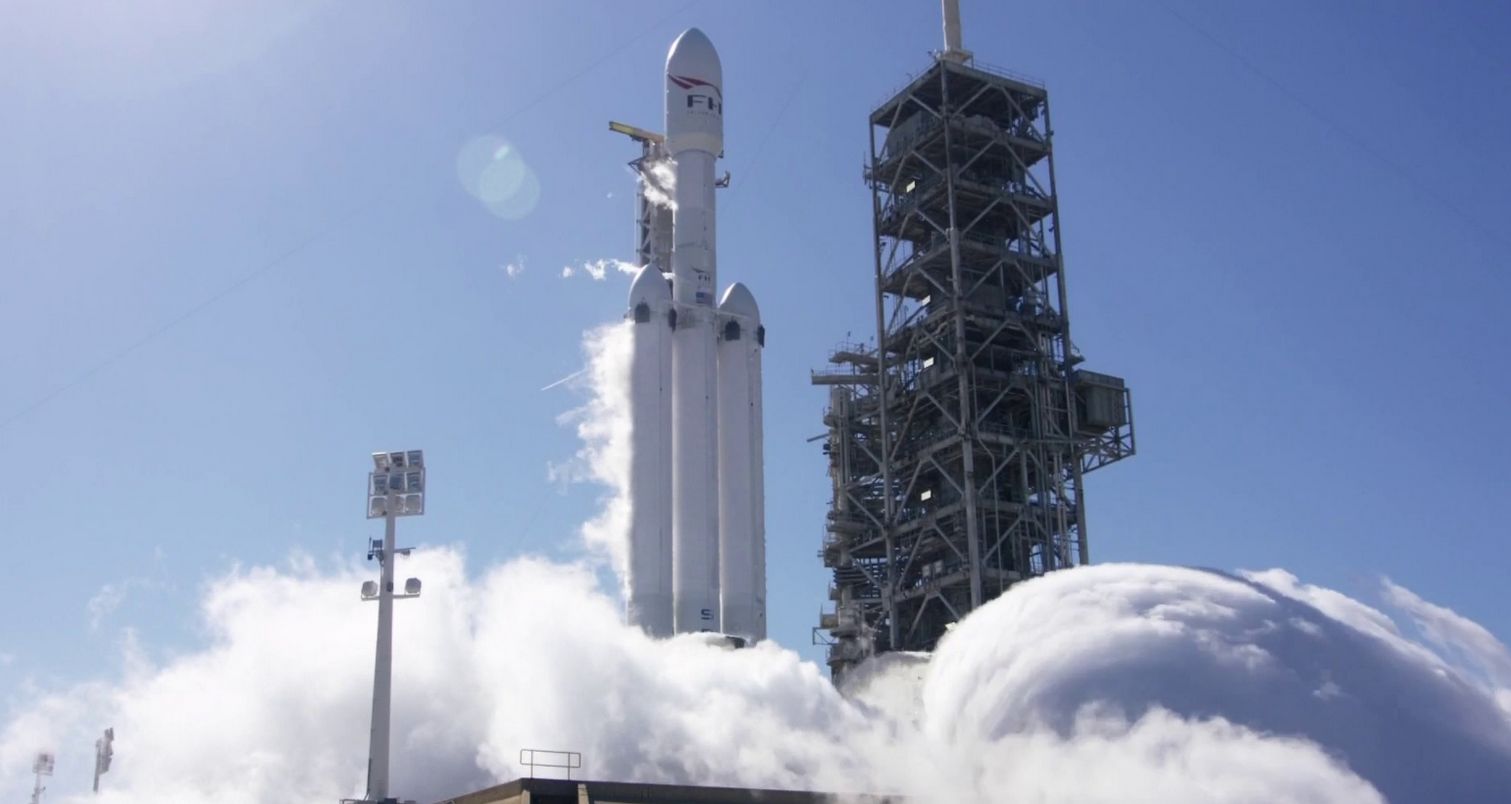
Fire in the hole! the Falcon Heavy’s 27 Merlin engines are test-fired on Pad 39A at NASA’s Kennedy Space Centre, January 24th, 2018. Credit: SpaceX

SpaceX faces a busy couple of weeks for the end of January and the start of February 2018. On Tuesday, January 30th, the company is set to launch Luxembourg’s SES-16/GovSat 1 mission on a Falcon 9 rocket from Launch Complex 40 at Canaveral Air Force Station on Florida’s coast. As is frequently the case with SpaceX missions, an attempt will be made to return the booster’s first stage to a safe landing  – this time at sea, aboard the Autonomous Spaceport Drone Ship Of Course I Still Love You in the Atlantic Ocean.

Then, if all goes according to plan, on Tuesday, February 6th, SpaceX will conduct the first launch of the Falcon Heavy booster which should be a spectacular event. As I’ve previously noted in these updates, Falcon Heavy is set – for a time at least – to be the world’s most powerful launch vehicle by a factor of around 2, and capable of lifting up to 54 tonnes to low Earth orbit, and of sending payloads to the Moon or Mars. The core of the rocket comprises three Falcon 9 first stages strapped side-by-side, two of which have previously flown missions.

For its first flight, the Falcon Heavy is set to send an unusual payload into space: a Tesla Roadster owned by Tesla and SpaceX CEO Elon Musk. It’s part of a tradition with SpaceX: mark a maiden flight with an unusual payload; the first launch of a Dragon capsule, for example, featured a giant wheel of cheese. If all goes according to plan, SpaceX hope to recover all three of the core stages by flying them back for touch downs; two of them on land, and one at sea using an Autonomous Spaceport Drone Ship.

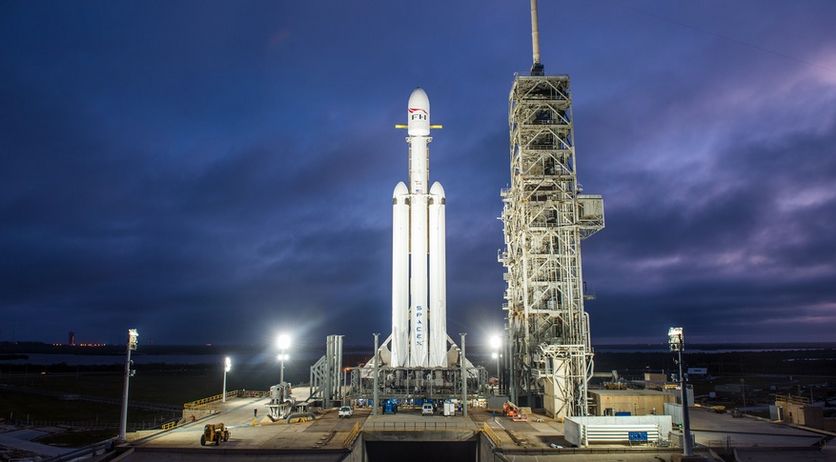
The Falcon Heavy is raised to a vertical position on December 28th, 2017 in a launch pad “fit test”. Credit: SpaceX

As part of the preparations for any Falcon launch, SpaceX conduct a static fire test of the rocket’s main engines.For the Falcon Heavy, this took place on January 27th, 2018. These tests have come in for criticism from some quarters as a high-rick operation. However, to date, SpaceX has not suffered a single loss as part of such a test, although in September 2016, a Falcon 9 and its payload were lost while the vehicle was being fuelled in preparation for such a test. For the Falcon 9, the test involves firing the 9 Merlin main engines for between 3 and 7 seconds; with the Falcon Heavy test, and possibly to obtain additional vibration and stress data ahead of the launch, all 27 engines were fired for a total of 12 seconds – almost twice as long as the longest test of a Falcon 9.

Assuming the launch is successful, it will pave the wave for Falcon Heavy being declared operational. The second launch will most likely carried a Saudi Arabian communications satellite into orbit, and the third flight of the Heavy undertake the launch of multiple satellites. All three launches will be watched closely by the US Air Force, who are considering using the Falcon Heavy as a potential launch vehicle alongside the Falcon 9, which was added to the military launch manifest in 2016.

TRAPPIST-1: Further Look At Habitability

Since the confirmation of its discovery in February 2017 (read more here), the 7-exoplanet system of TRAPPIST-1 one has been the subject of much debate as to whether or not anyone of the planets might be habitable – as in, have suitable conditions in which life might arise.

As I’ve previously reported, while some of the seven planets sit within their parent star’s habitable zone where liquid water might exist, there are some negative aspects to any of the Earth-sized worlds harbouring life or having the right conditions for life. In particular, their parent star is a super cool red dwarf with all internal action entirely convective in nature. Such stars tend to have violent outbursts, so all seven planets are likely subject to sufficient irradiation in the X-ray and extreme ultraviolet wavelengths to significantly alter their atmospheres and rendering them unsuitable for life. Further, all seven are tidally locked, meaning they always keep the same face towards their parent star. This will inevitably give rise to extreme conditions, with one side of each world bathed in perpetual daylight and the other in perpetual, freezing darkness, resulting in atmospheric convection currents moving air and weather systems / storms between the two.

Artist’s concept showing what each of the TRAPPIST-1 planets may look like. A new study suggests TRAPPIST-1d and 1e might be the most potentially habitable. Credit: NASA

However, on the positive side, TRAPPIST-1 is sufficiently small and cool that, despite their proximity to it, the sunward faces of the planets won’t be as super-heated as might otherwise be the case. This also means that the extremes of temperature between the lit and dark sides of the planets aren’t so broad, reducing the severity of any storms some of them might experience. Now a team of researchers have identified the more likely planets within the seven which might have conditions conducive for life.

This involved certain assumptions being made, such as all the planets being composed of water ice, rock, and iron, and – given some of the data concerning the planets, such as their radii and masses, are not well-known – a range of computer models having to be built.

In putting everything together, the team concluded that TRAPPIST -1d and TRAPPIST-1e might prove to be the most habitable, with TRAPPIST 1d potentially being covered by a global ocean of water. The study also suggests that TRAPPIST-1b and 1c have have partially molten rock mantles, and are likely to be heavily volcanic in nature.

In publishing their work, the team are reasonably confident of their findings, but note that improved estimates of the masses of each planet can help determine whether each of the planets has a significant amount of water, allowing better overall estimates of their compositions to be made.

Continue reading “Space Sunday: rockets, exoplanets landers and asteroids”

Space Sunday: lava tubes and politics

Lava tubes could provide ready-made tunnels for bases on the Moon and Mars – and tubes in the Canary Islands are already being used for ESA astronaut training. Credit: ESA/L. Ricci

One of the major issues in sending humans to the Moon – as the United States, China, Russia and Europe want to do (either individually or in some sort of joint venture among some of them) – is where, exactly, to send them. The Moon is an uncompromising place: without any discernible atmosphere or magnetosphere, the lunar surface is open to the full fury of both solar and cosmic radiation. This makes living there without adequate protection somewhat hazardous. Then there is the question of consumables – notably water.

Protection can be found in one of two possible ways: by covering a base under a substantial layer of lunar “soil” – more correctly called regolith – or by placing it underground. While the former is feasible, and could even be achieved via 3D printing, excavating the space needed for a base would be a hefty undertaking, requiring heavy equipment.

However, things could be eased if advantage could be taken of lunar lava tubes. These are natural conduits formed by flowing lava moving beneath the hardened surface of a previous lava flow,  draining lava from a volcano during an eruption. When the lava flow has ceased and the rock has cooled, they can form a long cave, or network of tunnels – some of which can break the lunar surface in what are called “skylights”, resembling  distinctive pits in a landscape. In recent years, over 200 of these pits have been discovered on the Moon’s near side, notably in the great lava plains around the equatorial regions, many of which have been confirmed as entrances to underground lava tubes.

Water is also present on Mars in the form of subsurface ice located around the polar regions – the only parts of the Moon where there is little or no sunlight. If it can be extracted, it could be invaluable to a human presence on the Moon: it could be purified and used for drinking; through electrolysis it could be broken down into its components, hydrogen and oxygen, with the latter used to help maintain the air within a base, the former used alongside carbon dioxide in processes for creating fuel stock space vehicles or surface craft. The difficulty is in accessing the water ice in volume. One way of doing so might be through drilling – although this would again be costly and slow. Another way might be through finding lava tubes which may have become repositories for water ice deposits. The problem is, until now, little evidence for polar region lava tubes has been found.

Philolaus Crater, roughly 70 km (40 mi) in diameter, close to the lunar North Pole, may house lava tubes that could hold the key to both the location of a future lunar base and to accessing subsurface water ice. Credit: NASA

Pascal Lee, the co-founder and chairman of the Mars Institute, a planetary scientist at the SETI Institute, and the Principal Investigator of the Haughton-Mars Project (HMP) at NASA’s Ames Research Centre – and, totally coincidentally, whom I’ve had the pleasure of meeting a number of times – reports he’s now discovered pits in the north polar region which could be indicative of lava tube skylights.

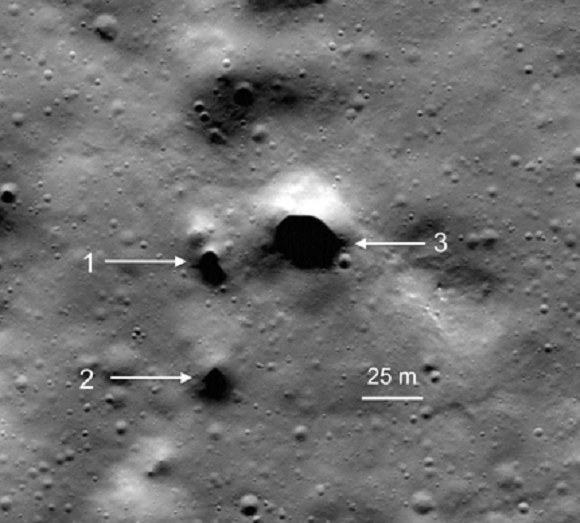
He found the pits while studying images gathered by NASA’s Lunar Reconnaissance Orbiter of the north-eastern floor of Philolaus Crater, about 550 km (340 mi) from the North Pole, on the lunar near side. They appear as small rimless depressions between 15 to 30 metres (50 to 100 ft) across, with completely shadowed interiors. Most particularly, the pits are located along sections of winding channels criss-crossing the crater floor. Called “sinuous rilles”, these are generally associated with collapsed, or partially collapsed, lava tubes, increasing the possibility they might be skylights leading to intact lava tubes.

“The highest resolution images available for Philolaus Crater do not allow the pits to be identified as lava tube skylights with 100 percent certainty,” Lee states, “but we are looking at good candidates considering simultaneously their size, shape, lighting conditions and geologic setting.”

Should they prove to be entrances to lava tubes, the pits offer an exciting prospect for lunar explorers. They could present a means to access sub-surface water ice – particularly if some of the tubes contain frozen water – which is not yet certain. They might also provide the necessary protection from radiation, making them an ideal location for a subsurface base. If there is water ice in the tunnels, solar collectors ranged on the crater floor could be used to channel heat into the tunnels to melt it, allowing it to be stored and used. A further benefit with Philolaus Crater is that it is one of the Moon’s younger craters, one of the few large craters formed during the Copernican Era formed within the last 1.1 billion years. Scientists located there would be able to study the Moon’s more recent evolution.

NASA Lunar Reconnaissance Orbiter image showing some of the newly discovered lava tube skylight candidates at Philolaus Crater. Credit: NASA/LRO/SETI Institute/Mars Institute/Pascal Lee

In terms of a location for a base, the crater has two additional benefits. The first is that as it is on the lunar near side, it will be in direct line of communication with Earth. The second is more poetic, as Lee himself notes:

We would also have a beautiful view of Earth. The Apollo landing sites were all near the Moon’s equator, such that the Earth was almost directly overhead for the astronauts. But from the Philolaus skylights, Earth would loom just over the crater’s mountainous rim, near the horizon to the south-east.

He continued, “Our next step should be further exploration, to verify whether these pits are truly lava tube skylights, and if they are, whether the lava tubes actually contain ice. This is an exciting possibility that a new generation of caving astronauts or robotic spelunkers could help address” says Lee. “Exploring lava tubes on the Moon will also prepare us for the exploration of lava tubes on Mars. There, we will face the prospect of expanding our search for life into the deeper underground of Mars where we might find environments that are warmer, wetter, and more sheltered than at the surface.”

Continue reading “Space Sunday: lava tubes and politics”