Space Sunday: rockets, rovers and spaceplanes

A Falcon 9 Lifts-off from SLS-40 at Cape Canaveral Air Force Station, carrying an Earth observation into a polar orbit – the first such launch fro CAS since 1969

SpaceX has been keeping busy over the last week.

On Sunday, August 30th, the company launched Argentina’s SOACOM-1B Earth observation satellite (and two other payloads piggybacking  on the flight) from Space Launch Complex 40 at Cape Canaveral Air Force Station, utilised a Falcon 9 first stage make its fourth successful launch and landing (returning to the SpaceX Landing Zone, also at Cape Canaveral, nine minutes after lift-off), after boosting the rockt’s upper stage and payload safely on its way.

The launch marked the first into a polar orbit – vital for Earth observing satellites as it allows them to pass over just about every point of Earth at some point during their orbits – from  Cape Canaveral since 1969. Such launches were suspended that year after a section of a Thor rocket launch came back to Earth over Cuba, allegedly killing a cow on impact, and causing something of an international incident.

This 333 second exposure captured via the 4m Blanco telescope at the Cerro Tololo Inter-American Observatory, shows at least 19 streaks crossing its line of sight created by the second batch of Starlink satellites launched November 2019. Credit: Clara Martínez-Vázquez and Cliff Johnson / CTIO

On Thursday September 3rd, and after delays due to weather, the company launched another Falcon 9 vehicle, this time from Pad 39A at Cape Kennedy.  It carried 60 Starlink Internet satellites into orbit, the rocket’s first stage successfully returning to Earth to land on the autonomous landing ship Of Course I Still Love You.

Starlink is designed to provide a global Internet service from orbit using a constellation of some 12,000 satellites operating in three “shells” (different altitudes) around the Earth. However, the system has come in for fierce criticism for the way  – with less than 1,000 satellites currently in orbit, it is already causing noticeable levels of pollution is is impacting astronomers.

While SpaceX has tried to minimise the amount of light the satellites reflect, CEO Elon Musk has also demonstrated a cavalier attitude towards the concerns of astronomers, and also towards those voicing concerns over the potential for the system to greatly add to the amount of debris orbiting the Earth over time,  particularly if SpaceX opt to expand the programme to a long-term goal of flying 42,000 Starlink satellites.

Also on September 3rd, the company completed the second successful Starship prototype launch from their Boca Chica, Texas, facilities. Starship is the upper section of their huge interplanetary launch vehicle that is central to Musk’s “plan” to “colonise” Mars (although initially the vehicle will be used to ferry cargo such as multiple satellites to orbit – for example, a single Starship could carry 400 Starlink satellites).

The second Starship prototype flight, utilising vehicle SN6 (which again only comprises the cylindrical fuel tank section of the vehicle, topped by a 23-tonne mass simulator, all powered by a single Raptor engine), was again to a modest 50 metres altitude, the same height as achieved during the SN5 prototype flight some 3 weeks ago. This was sufficient for the vehicle to clear the launch platform and translate a short distance to the landing area and make a successful landing.

As I noted following the SN5 flight (see: Space Sunday: Hops, glows, plans and Perseids), SpaceX plan to build out a test programme incrementally, moving from an unspecified number of low-altitude flights to flights of increasing height and complexity, including those using a “complete” prototype vehicle flying up to 20 km, allowing the vehicle’s horizontal descent and handling capabilities using the planned aerodynamic surfaces, as well as the vehicle’s ability to translate to a vertical orientation for landing.

Alongside the ongoing Starship prototype flights, SpaceX plan to commence test of prototypes of the reusable Super Heavy booster intended to push Starship vehicle reach orbit. The launch platform for the prototypes of these behemoths is currently being constructed at Boca Chica, as is the enormous “high bay” building where the prototypes will be assembled.

A conceptual image of a Super Heavy returning to land after launching a Starship vehicle. Elon Musk recently indicated the lower end of the vehicle will be revised to have just four landing legs rather than the 6 finned units seen in this image, and which will deploy in a similar nature to the three on the Falcon 9. Credit: SpaceX

Initial Super Heavy prototypes will be powered by just two of the enormously powerful Raptor engines, with the production vehicle likely being powered by 28 of the motors. This is reduction in the number of motors from 31 or 32, and this number may decrease further if SpaceX can further improve on the Raptor’s performance as they aim to try to operate it as an very of 250 tonnes of force (that’s well over half a million pounds of thrust) per motor. If this can be achieved operational Super Heavy boosters will have slightly more than twice the launch thrust as both NASA’s Saturn V rocket and the agency’s upcoming Space Launch System.

Musk reckons the the first Super Heavy prototype vehicle is liable to fly in early 2021. That’s also the year he has timetabled for the first Starship prototype flight to 20 km altitude flights.

Toyota’s Lunar Rover Gets a Name

Back in July 2019, I reported on an agreement reached between the Japan Aerospace Exploration Agency (JAXA) and the world’s second largest manufacturer of motor vehicles, Toyota, for the latter to develop a pressurised rover for use on the Moon.

Since then, both JAXA and Toyota have been working on the design and developing / testing elements of the vehicle, which has the goal of being powered by fuel cells and capable of an operational cruising range of up to 10,000 km (allowing it to practically circumnavigate the Moon on one set of fuel cells). At just over 6m in length and 5.2m wide, the vehicle is intended to provide some 13m³ (460 ft³) of living / working space for crews of 2-4 at a time, and will be delivered to the lunar surface by a dedicated automated lander to be built by Mitsubishi Heavy Industries.

An artist’s impression of the Toyota Lunar Cruiser showing it with its stowable solar cell arrays deployed to supply additional electrical power when parked, and an astronaut added for scale. Credit: Toyota

At the end of August, Toyota and JAXA announced the unofficial name for the rover: Lunar Cruiser, a nod towards Toyota’s Land Cruiser 4×4 utility vehicle, first developed in the 1950s and which are still in production today as luxury and capable SUVs. The Land Cruiser in turn has a heritage rooted in rugged 4×4 designs – notably America’s original Willy’s Jeep and the UK’s Land Rover (from which Toyota “borrowed” the first part of their 4x4s name).

Japan plans to fully develop the vehicle and its lander over the next 8 years, and make it available in support of human missions to the Moon, such as the Artemis programme.

China launches Secretive Space Plane

China launched an experimental reusable spacecraft on Friday, August 4th, following months of low-key preparations at the Jiuquan Satellite Launch Centre. It was delivered to orbit via a Long March 2F launch vehicle, with the launch reported by the Chinese state media Xinhua some three hours after the rocket lifted-off.

No images of the launch vehicle or the space plane have so far been released; however, orbital images of the Jiuquan facilities captured in July revealed modifications being made to a launch pad there, which suggest it has been updated to handle Long March Long March 4F with a 5 metre diameter payload fairing. This in turn suggests the Chinese space vehicle could be roughly comparable to the US Air Force X-37B automated space plane.
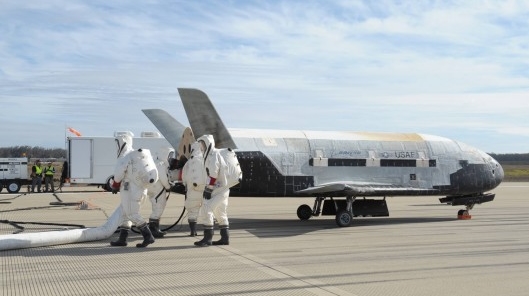
While little is known about it, the Chinese experimental space plane could be of a similar size ro the USAF’s X-37B space plane, seen here.

The vehicle remained in orbit for several days, during which time it is reported to have been used to test reusable technologies that will be used to provide  “support for the peaceful use of space” according to the Chines state media agency.

China first indicated it is in the process of a space plane in 2017. Under a “space operations roadmap” released at the time, the China indicated it plans to have a single stage to orbit (SSTO) space plane capable of taking off and landing horizontally. It’s not clear if the launch of this experimental vehicle was part of the programme, or a separate initiative. However, Chinese officials have indicated this will be the first in a series of launches of the vehicle to verify rapid re-launch and repeated use capabilities, and to reduce the country’s cost of payload access to space.

Space Sunday: Venus’ transformation, SLS and an asteroid

An artist’s depiction of Venus evolving from a potentially habitable water world to the hot desert it is today.
Credit: NASA Goddard

Venus has been the subject of a number of recent studies, one of the most intriguing of which suggests it’s runaway greenhouse effect was started by what might at first seem an unlikely candidate: Jupiter.

Our solar system is a place of mysteries, both in itself and in comparison with many exoplanet systems. While of the latter have Jupiter-size worlds, unlike our solar system, these tend to be found fairly close in to their parent planet (although there are some exceptions). It’s believed that these planets actually formed further out from their parent stars, but then migrated inwards under gravity, until a point of equilibrium / resonance was reached.

This idea of planetary migration has led to theories on how our own solar system may have developed early it its life, with one of them in particular being of interest here. Called the Grand Tack Hypothesis, it suggests that Jupiter likely  formed some 3.5 AU from the Sun (1 AU = the average distance separating the Earth from the Sun) – or about 1.5 AU closer to the Sun that its present orbit. During the initial evolution of the solar system, it gradually migrated closer to the Sun, perhaps getting as close as 1.5 AU –  a little further out from the Sun than the present orbit of Mars, before the combined gravities of the other outer planets – most notably Saturn – gradually teased it back outwards again, until that point of equilibrium / resonance was reached, leaving them all in the orbits we see today.

What is particularly interesting about the Grand Tack Hypothesis is that it accounts for a number of inconsistencies visible in the solar system today if it is assumed the planets all formed more-or-less in their current orbit sand never shifted very far from them. These can be summarised as:

  • Why is Mars so small when compared to Earth and Venus? If the planets all formed within or close to their current orbits, then most models built around this idea result in Mars being of a comparable size to Earth.
  • Why don’t we see a “super Earth” (or “mega Mars”) between the orbits of Earth and Jupiter? Again, models based on all the planets  forming in their present day orbits around the Sun indicate that there would have been sufficient accretion disk material in the region of Mars for a solid planet 1.5 times the mass of Earth (or greater) to have formed.
  • Why is the asteroid belt so relatively uniform? Again, if Jupiter formed 5-5.5 AU from the Sun, then the material within the accretion disk should have resulted  not only in a Earth-size Mars, or a possible “mega Mars”, but should also have resulted in the formation of many more planetismals or “mini Marses” forming, smaller than Mars as weknow it today, but potentially somewhat larger than the likes of Vista and Ceres within the asteroid belt.
Many models of solar system suggest that, had it not been for Jupiter migrating from it’s point of initial formation in towards the Sun and then back out again, our solar system would look very different today, with an Earth-sized (or larger) “mega Mars” and an asteroid belt that includes multiple “mini Marses”. Credit: Sean Raymond

A migration of Jupiter towards the Sun accounts for the first two of these inconsistencies in much the same way: as it moved in towards the Sun, Jupiter both “ate” a lot of the material of the accretion disk sitting between the current orbits of Earth and Mars and also “pushed” some of it inwards, helping in the eventual formation of both Earth and Venus.

Then as it reversed course, it “ate” more of the debris, whilst pushing some of it away. Thus, the inward and outward movements of Jupiter left only sufficient material occupying the area of Mars’ orbit to accrete and form a relatively small rocky world. By the same measure, this pushing / absorbing of material within what would become the asteroid belt meant that material was much more widespread and unable to accrete sufficiently in order to create multiple “mini-Mars” planetismals.

But what does this have to do with starting the extreme greenhouse effect on Venus? The answer to this is quite complex.

In effect, Jupiter’s motion inwards not only pushed material towards the Sun that helped Earth and Venus to form, it also became sufficiently close to them both to encourage them into exaggerated elliptical orbits around the Sun, which at the time was somewhat cooler and dimmer than it has been for most of its adult life. Thus, Venus likely formed within what was then the Sun’s habitable zone, allowing an abundance of liquid water to form across the planet’s surface, whilst its elliptical orbit meant it experienced significant seasonal changes during the course of it’s “year”.

In particular, whilst “close” to the Sun, during its “summers”, the ocean-rich Venus would be subjected to greater amounts of evaporation of water from its oceans, which would in turn be subject to greater amounts of UV radiation. This radiation would split the water vapour into elemental oxygen and hydrogen, with the latter easily stripped away from the planet’s atmosphere by the solar wind, leaving the oxygen to combine with carbon to form carbon dioxide, generating what is called a “moist greenhouse” effect.

Jupiter’s migration would likely have helped Venus initially develop into a substantially wet world – which in turn likely started it on its way to having the runaway greenhouse effect we see today. Credit: NASA

At the same time, the mass of water in the Venusian seas gave rise to a process called tidal dissipation which over time, gradually “dampened” Venus’ exaggerated orbit around the Sun, allowing it to be pulled into the kind of circular orbit it has today, eliminating the seasons whilst holding the planet closer to the Sun than it had been, further increasing temperatures and accelerating the moist greenhouse effect. This in turn would be aided but the Sun increasing in it radiative output, further accelerating the greenhouse effect as more and more water evaporated from the surface oceans, until the point of no return was reached.

A further result of the Sun’s increasing outflow of heat meant that its habitable zone was pushed outwards to encompass the Earth – but being that much further away from the Sun and under a greater influence of the gravities of the outer planets, Earth didn’t suffer either form that initial kick into a moist greenhouse effect, allowing it to maintain its seasons, and remain a more comfortably warm, wet planet.

It’s not 100% certain Jupiter’s migration was the kickerstarter for Venus’ greenhouse effect. There are, for example other mechanisms that may have dampened Venus’ orbital eccentricity without the influence of a massive planet like Jupiter – such as Milankovitch Cycles. But given the way the Grand Tack Hypothesis helps explain a good deal about the early solar system, it seem likely it may well have been responsible. And if it is correct, it has significant implications for any Venus analogues orbiting other stars and our understanding of the mechanisms at work in the development of exoplanets.

Continue reading “Space Sunday: Venus’ transformation, SLS and an asteroid”

Space Sunday: the Sun’s twin, going to the Moon & SpaceX

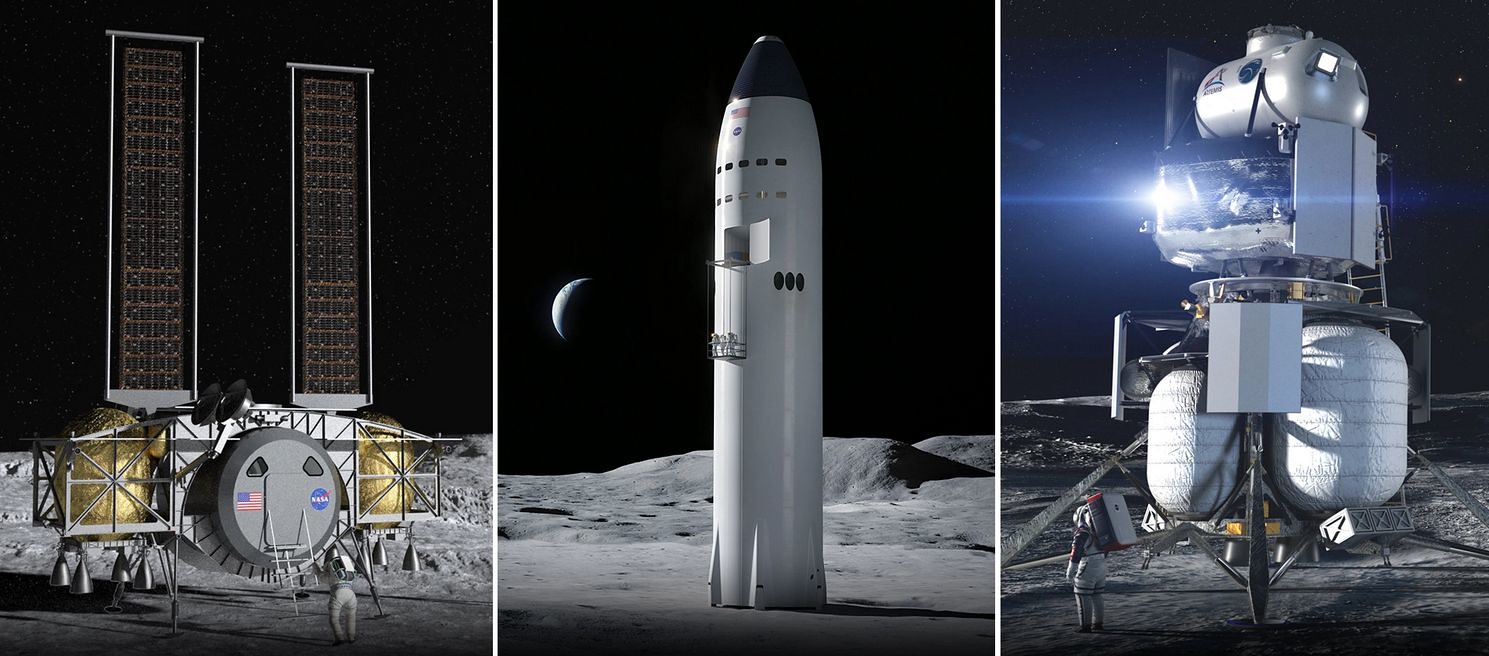
The three proposals for NASA’s Human Landing System vehicles under consideration of the US Artemis programme. Left: the Dynetics lander / ascent vehicle; centre: the modified SpaceX Starship; right: the National Team’s descent / ascent modules. Credit: NASA

In late April, NASA awarded funding to develop human landing systems for the agency’s Artemis lunar programme to three commercial groups: SpaceX, Dynetics and the so-called “National Team” of Blue Origin, Lockheed Martin, Northrop Grumman and Draper.

All three are taking different routes to supply vehicles capable of landing humans on the surface of the Moon and then returning them to lunar orbit for onward transit to Earth. For the initial mission, which NASA has time-tabled for 2024 – a highly ambitious date – one of the three vehicles must be capable of delivering a crew of two to the south polar regions of the Moon and then back to orbit.

On August 20th, 2020, the National Team delivered a full engineering mock-up of its proposal lander / ascent vehicle to NASA’s Johnson Space Centre (JSC).

For those familiar with the Apollo lunar lander, the National Team’s vehicle is a veritable monster, standing over 12 metres (40 ft) in height. It comprises three elements: a descent element that physically lands on the Moon and that is topped by the ascent element, both of which are helped down to the lunar surface by a transfer element.

The National Team design. From left-to-right: the transfer vehicle (Northrop Grumman), the descent module with the ladder and landing legs (Blue Origin), and the Ascent stage (Lockheed Martin). Credit: Blue Origin

It’s a combination of vehicles that build on a definable heritage. The descent element is being designed by Blue Origin using the technology the company has been developing over the last three years for its automated lunar lander, Blue Moon.

The ascent stage, meanwhile, is being developed by Lockheed Martin leveraging technology used in NASA’s Orion Multi-Purpose Crew Vehicle (MPCV), the capsule vehicle that will be used to ferry crews to and from Lunar orbit. Finally, the transfer stage uses technology and elements from Northrop Grumman’s automated Cygnus resupply vehicle serving the International Space Station (ISS).

The newly delivered mock-up will remain at JSC through until early 2021. It will be used by NASA engineers and astronauts to ascertain how the vehicle works, what is required, and helping engineers within the National Team to validate the team’s approach to getting crew, equipment, supplies, and samples off and on the vehicle.

In all, the three contractors were awarded a total of US $967 million that would be used to meet the costs of the first 10 months in developing each of their proposals of a Human Landing System (HLS). Of the three, the National Team took the lion’s share of the funding, some US $579 million. As well as delivering the engineering mock-up to JSC, the National Team is also preparing for a certification baseline review of their proposed design, with NASA expected to release a draft of the call for proposals for the next phase of the programme in early September.

For their design, Dynetics is also working with Draper and with Sierra Nevada Corporation, the developers of the Dream Chaser space plane. Their design is the smallest of the three proposed HLS vehicles – and potentially the most flexible. It is effectively a two-stage craft comprising a core lander / ascent vehicle of a squat design, supported by “drop tank” units that provide fuel for the initial stages of descent to the lunar surface, and which are jettisoned as their supplies are used.

The core craft is designed to carry crew or cargo down to the surface of the Moon and return crews back to orbit to rendezvous with an Orion MPCV or the Lunar Gateway. In addition, the uncrewed cargo variant is designed so that once cargo has been unloaded, it can be utilised as an additional module for a lunar base, providing a means for the base to be routinely expanded.

SpaceX – a surprise receiver of funding for HLS – is proposing the use of a modified version of its Starship vehicle, one sans aerodynamic surfaces, as these will not be required for operations to / from the surface of the Moon.

It is expected that NASA will de-select one of the proposals in early 2021, allowing the remaining two to continue. However, there has been a crimp put in plans: NASA requested some US $3.3 billion specifically to fund the HLS programme in fiscal year 2021, but under the proposed House budget, only US $670 million is allocated to HLS development, and the Senate’s budget proposal may not significantly raise this.

Was the Sun Once Part of a Pair?

A theory published in the Astrophysical Journal Letters on August 18th, 2020, dips into the theory that the Sun was once part of a binary pair.

The theory itself isn’t new: the Sun was one of a number of stars formed around the same time in the “local cluster”, and so may well have been twinned with another early in its life, before the gravitational influences of other stars in the cluster forced them apart. In fact, in 2018, astronomers from the Instituto de Astrofísica e Ciências do Espaço in Portugal announced they may have discovered it in the form of star HD 186302, some 184 light-years away – although this has yet to be proven.

An artist’s impression of the Sun (foreground) with its former twin. Credit: unknown

In the new publication, scientists from Harvard University point to the Oort cloud – a complex combination of a ring of icy planetesimals (the Hills Cloud) and a larger, more distant sphere of such objects, both of which lie beyond the heliosphere, as indicative that the Sun once had a companion.

Conventional thinking has it that the Oort cloud formed from debris left over from the formation of the solar system and its neighbours. However, models designed to show this have been unable to produce the expected ratio between scattered disk objects within the Hills cloud and outer Oort cloud objects. But if a relatively close stellar companion is introduced to the mix, modelling the formation of the Oort cloud elements and the distribution of objects within them becomes clearer, the paper’s authors claim.  Not only that: it may actually help explain how life on Earth started.

Oort cloud objects are rich in water ice and the minerals and chemicals essential to starting life. Having a stellar companion for the Sun dramatically increases the amount of perturbations that might ripple through the Oort cloud and send some of its objects to fall into the solar system – and potentially collide with Earth, bring that water and those compounds with them.

Continue reading “Space Sunday: the Sun’s twin, going to the Moon & SpaceX”

Space Sunday: Tenacity, Betelgeuse and a short round-up

The first Dream Chaser Cargo, set to fly in 2021, now has a name – Tenacity. Credit: SNC Inc

Dream Chaser Cargo is an uncrewed version of Sierra Nevada Corporation’s (SNC) Dream Chaser space plane, and it is drawing closer to commencing operations ferrying supplies and experiments to and from the International Space Station (ISS), with operations due to start in mid-to-late 2021.

The world’s only non-capsule private orbital spacecraft, Dream Chaser Cargo is designed to be launched atop a United Launch Alliance Atlas V booster, and land like a conventional aircraft. Once operational, it will be capable of lifting some 900 kg of material within its cargo space, and a further 4,500 kg in a detachable and disposable module called Shooting Star that attaches to the rear of the space plane and includes a docking system for linking to the ISS, as well as supplying electrical power to the Dream Chaser.

SNC’s uncrewed Dream Chaser Cargo, the Shooting Star module bearing the external cargo “box” for unpressurised loads. Credit: SNC Inc

Shooting Star can carry cargo both inside it, and in an external unpressurised unit. In addition, it can be used to hold some 3,500 kg of waste from the ISS, the module being jettisoned to burn-up in Earth’s atmosphere prior to Dream Chaser Cargo (which can also carry experiments back to Earth) making an atmospheric re-entry towards the end of a mission.

Now the first Dream Chaser vehicle has its wings and a name: Tenacity. The wings were delivered to SNC’s fabrication facility in spring 2020, and with work now cautiously resuming, the wings  – sans­ their outer skins – will be mounted on the vehicle’s air frame. During flight, the wings are folded against the fuselage so they can be contained within the payload fairings that protect the vehicle and its module during launch. After the fairings are jettisoned, the wings swing into their “flight” position so they can give Dream Chaser Cargo aerodynamic lift once back in Earth’s atmosphere.

Capable of fully automated flight, Dream Chaser Cargo has a significant advantage over the other ISS resupply vehicles capable of returning material to Earth – Dragon and Progress – in that it uses relatively “safe” fuels. This means ground crews can access the vehicle without having to wait for extensive safety checks to be completed, allowing delicate or time-sensitive cargo to be removed from the vehicle more quickly.

Betelgeuse’s Dimming: Explained But Still Mysterious

The orange giant Betelgeuse caused excitement in late 2019 / early 2020 when it went through a period of unprecedented dimming, even for a star as variable as it can at times be, its apparent magnitude (brightness as seen from Earth) reducing by a factor of 2.5 (or roughly 25-30%).

Side-by-side comparison of Betelgeuse’s dimming, as seen by the SPHERE instrument on ESO’s Very Large Telescope. Credit: ESO/M. Montargès et al.

At the time, the dimming sparked speculation the star may have gone supernova, and we might be about to see the light of that event – it having taken some 700 years to reach us. Most astronomers doubted this was the case, and were confident the star would return to its more natural brightness, as indeed it did 2020 (see: Space Sunday: an exoplanet, a star and an asteroid).

Now, examinations of observations made by the Hubble Space Telescope (HST) in late 2019 suggest the star’s dimming was most likely caused by the ejection and cooling of dense hot gases. What’s more, additional observations suggest Betelgeuse may be going through another dimming period out-of sync with its usual cycles.

Between October and November 2019, HST observed dense, heated material moving outward through Betelgeuse’s extended atmosphere at 320,000 km/h, and it was following these observations that the more dramatic dimming of the star was seen from Earth, notably around the star’s southern hemisphere. It’s now believed that jet stream of hot gas reached a point millions of kilometres from the star and rapidly cooled to form a cloud of dust between the star and Earth-based observers, giving rise to the star’s apparent dimming.

An artistic rendering of the outflow of plasma from Betelgeuse cooling into a cloud of dust that contributed to the star’s dimming. Credit: NASA, ESA, and E. Wheatley (STScI)

However, study of the HST data revealed something surprising: the stream of ejected gas did not originate at the star’s rotational poles, as current stellar models would suggest. Rather, the Hubble data indicates that Betelgeuse can drive off material from any part of its surface. The data also revealed that during the event, the star lost a considerable amount of mass – around twice the “normal” amount it loses in a given period, just from its southern hemisphere. This in itself makes what happened to Betelgeuse unique: nothing like it has been previously seen in 150 years of observations.

Whether or not this means we’re seeing a new stage in Betelgeuse’s life cycle is unclear, but the mystery doesn’t end there. This is because data gathered by NASA’s Sun-orbiting Solar TErrestrial RElations (STEREO) satellite appear to suggest the star is again dimming, and outside of its more cycles. Until now, Betelgeuse has had two cycles of dimming and brightening. The first runs for around 25 years, the other runs through 425 days. Both coincided during the 2019/2020 dimming, contributing it. Thus for the star to be dimming now puts it well inside the 425 day cycle. Exactly what all this means isn’t exactly clear, but it has sparked considerable interest and observers will continue to monitor it through the rest of the year.

Quick Round-up

The last week saw the 2020 Perseids meteor shower reached its peak as the Earth passes through debris left by the comet Swift-Tuttle. As is usual, the event resulted in many outstanding photos, including the one below.

August 11th/12th: a Perseid meteor streaks toward the bright planet Jupiter (to the right of the windmill) and its dimmer companion Saturn (to the left) in the countryside near Las Vegas. Credit: Tyler Leavitt

SpaceX

The next flight of the SpaceX Crew Dragon vehicle has been announced. Crew-1, the first “operational” flight will now targeted for October 23rd, 2020, when it well carry NASA astronauts Shannon Walker, Victor Oliver and Mike Hopkins, together with JAXA astronaut Soichi Noguchi as the nucleus of the Expedition 64 crew.

Originally scheduled for a late September / early October launch, the mission has been pushed back to allow additional time for the Russian Soyuz MS-17 mission to launch and rendezvous with the ISS.

The astronauts who will fly the NASA / SpaceX Crew-1 mission on or after October 23rd: NASA astronauts Shannon Walker, mission specialist; Victor Oliver, pilot; and Mike Hopkins, Crew Dragon commander; and JAXA astronaut Soichi Noguchi
After its 150m “hop”, Starship prototype SN5 has been rolled back for inspection and re-fit – possibly with the lengthened landing legs I mentioned in me previous space Sunday update. In the meantime, it appears that the next vehicle to make a test flight will be Starship prototype SN6. A further prototype, dubbed SN7.1, and comprising just a single fuel tank that uses new alloy end caps, is being prepared for a deliberate over-pressurisation test. This test vehicle has been dubbed SN7.1 in recognition of the SN7 tank section that was also tested to destruction earlier in the year.

However, most attention has turned towards prototype SN8, as it has been confirmed this will be the first of the prototype to be fitted with the upper section, nose cone and aerodynamic “wing” surfaces, and so will likely be used for the 20-km flight tests.

The Starship SN8 prototype elements: within the mid-bay building, the upper section and nose cone; arrowed the forward aerodynamic canards. Credit: RGV Aerial

NASA

Whilst still 7 months from Mars, NASA’s Ingenuity helicopter drone, a part of the Mars 2020 mission and stowed under the Perseverance rover, had its batteries charged up to 35% capacity on August 7th, one week after launch. The 8 hour trickle-charge operation marked the first time the helicopter’s batteries have been charged in the space environment, allowing the vehicle to be powered-up.

The action was taken so that mission managers could check-out the drone’s electrical systems following launch and allow it to report on its overall status. The battery level will be maintained at the 35% charge level throughout the cruise phase, with routine re-charges, in order to allow the helicopter’s electronics to be warmed by a regular flow of electrical power.

Transiting Exoplanet Survey Satellite (TESS) – due to hunt for exoplanets potentially orbiting hundreds of thousands of stars around us. Credit: NASA’s Goddard Space Flight Center/CI Lab

On July 4, NASA’s Transiting Exoplanet Survey Satellite (TESS) finished its primary mission, imaging about 75% of the starry sky as part of a two-year-long survey. In capturing this giant mosaic, TESS has found 66 new exoplanets, or worlds beyond our solar system, as well as nearly 2,100 candidates astronomers are working to confirm.

During the first year of operations, TESS observed the southern sky, while in the second year, it turned its attention to the northern skies.  Allowing the way, the mission team has been able to introduce numerous improvements. Among other things, these now allow the satellite to capture a high-resolution image of the stars around us once every 10 minutes, three times faster than at the start of the mission, while it can now measure the comparative brightness of thousands of stares every 20 seconds, rather than every two minutes. These latter captures will more readily reveal changes in brightness that might be the result of a star “wobbling” in its spin due to the presence of planetary bodies (although TESS’s primary means of locating possible exoplanets is via the transit method) or the results of outbursts like coronal mass ejections (CMEs).

With the completion of its primary mission, TESS is into an extended mission, the first phase of which will run through until September 2020.

Virgin Galactic’s Supersonic Ambitions

As if flying tourists into space wasn’t enough, Virgin Galactic has announced it has entered into an agreement with Rolls Royce to build a new supersonic airliner aimed at the “premium” flight market.

The new aircraft – as yet unnamed – will, the company claim, fly some 50% faster than the Anglo-French Concorde, with a cruising speed of Mach 3 – allowing a crossing of the Atlantic in around 2 hours. If realised, the aircraft will cruise at an altitude of 18 km (60,000 ft) and will be capable of carrying up to 19 passengers.

An artist’s impression of the Virgin Galactic Mach 3 airliner. Credit: Virgin Galactic / Rolls Royce

Yes, that’s right. 19. The aircraft is intended to capture a modest percentage of the premium (business and first class) air travel market, with Virgin Galactic CEO Sir Richard Branson stating the company only need to capture 5% of that market to turn a profit. Currently, the aircraft has completed a “mission concept” review study involving Virgin Galactic, Rolls Royce (building of the engines that powered Concorde), aviation experts and NASA.

No details on when the aircraft might fly have been given, with the craft’s overall shape, size, dimensions, etc., yet to move out of conceptual drawings.

Space Sunday: Hops, glows, plans and Perseids

SpaceX SN5 rises from its launch stand at the SpaceX Boca Chica, Texas, centre. Credit: SpaceX

SpaceX once again heads this week’s column after the Starship SN5 prototype became the first of the units to successfully make a “hop” into the air and back again, travelling some 150 metres up and several tens of metres sideways to navigate its way from launch platform to landing pad.

The flight of the “flying spray can” – the nickname derived from the vehicle’s cylindrical form topped by the nozzle-like 23 tonne ballast mass – only lasted around a minute once the Raptor engine fired, but the hop represented a huge leap forward for SpaceX in their development of the Starship vehicle.

As I noted in July, SN5’s unusual shape is due to it only comprising the section of the vehicle containing its fuel tanks, single raptor engine and landing legs. It lacks any upper sections (replacing by the ballast block) and the aerodynamic surfaces that will give Starship a lifting body capability during atmospheric operations. These will all be present in future prototypes, But for SN5, they are not currently required, as its initial flight(s) are purely about testing Starship’s ability to make a vertical descent and landing.

A starship cutaway showing the fuel tanks and engine bay (outlined in red) that form the prototype vehicle SN5, and the upper cargo / habitation space and aerodynamic surfaces that are not included on the current prototype. Credit: WAI (with additional annotation)

The successful test flight took place on Tuesday, August 4th – an attempt on Sunday, August 2nd was cancelled  due to unfavourable weather in the Boca Chica, Texas, area. Engine ignition came at 23:57 UTC (18:57 local time), the prototype rising vertically, but canted at a slight angle. This  was due to the initial prototypes being designed to operate with three Raptor motors, by SN5 is currently only fitting with one, offset from the vehicle’s vertical centreline, so the vehicle is canted (with the ad of the top ballast block) to compensate for the offset thrust from the motor, with small reaction control system (RCS) jets near the base and top of the vehicle occasionally firing to help maintain a stable flight angle.

As the craft rose, the Raptor motor was also gimballed (moved around like you move a joystick on a game controller, a common practice for rocket motors to allow them to use directed thrust to adjust a flight trajectory), vectoring its thrust so it could translate across to the landing pad for a successful landing.

Prototype nose cones being fabricated at Boca Chica. Credit: NASASpaceflight.com / BocaChicaGal

SpaceX released a video afterwards the flight showing the highlights. In it, SN5 can be seen lifting off, trailing a plume of vented cooling gas, the RCS jets visible as they fire to help maintain stability. The footage also clearly shows the Raptor’s offset exhaust plume moving as the motor in vectored, as well as the craft maintaining a brief hover at the apex of its flight before descending sideways and down towards the landing pad.

Cameras at the base of the vehicle show the landing legs being deployed, as well as a small, non-hazardous fire on the Raptor motor, likely the result of dust blown into the engine space at lift-off that subsequently ignited. This “inside” camera and one on the SN5 hull then captured the moment of landing and engine shut down.

Prototypes SN6, 7, and 8 are in development, and some of these will fly with the aforementioned forward / upper sections and flight surfaces in loftier (literally) and more complex flight tests. Currently, it not clear how many more flights SN5 will make. However, Musk has already indicated he would like to have Starship use a more “Falcon Like” set of landing legs to provide broader support when landing on uneven planetary surfaces, so SN5 might by used to test new landing leg configurations alongside testing of other prototypes.

Continue reading “Space Sunday: Hops, glows, plans and Perseids”

Space Sunday: Perseverance departs, Endeavour returns

The moment of ignition as the Atlas V booster lifts-off from SLC-41 at Canaveral Air Force Station, Florida, Thursday, July 30th, 20020. Credit: NASA TV

At precisely 11:50 UTC (7:50am EDT) an Atlas 5 rocket thundered into near-perfect skies over Cape Canaveral Air Force Station in Florida, carrying aloft NASA’s Mars 2020 on the first stage of its 7-month trip to the red planet.

The launch marked the last of the “big three” missions to launch during the 2020 opportunity, following on the heels of China’s Tianwen-1 orbiter / lander / rover mission and the UAE’s Hope orbiter mission. Carrying the Perseverance rover and Ingenuity helicopter drone, Mars 2020 is the most scientifically complex of the three missions, and potentially set to be the longest running of all three: providing it doesn’t fall foul of any major issues, Perseverance (Or “Percy” as some have dubbed it) could be operational on Mars for 12-14 years, thanks to its nuclear power supply.

A pictorial history of NASA’s successful Mars missions from Mariner to MSL / Curiosity, together with Mars 2020 and the proposed sample return and orbital ice mapper missions. Credit: NASA

In the days leading up to departure, there had been concerns the attempt might have to be postponed thanks to the approaching Tropical Storm Isaias, but on the morning of the launch, conditions couldn’t have been better. There was, however, some pre-launch excitement on the other side of the United States, where the Jet Propulsion Laboratory in (JPL) – mission control for the mission once en route to Mars, was lightly shaken by a local 2.9 magnitude earthquake just 30 minutes prior to lift-off.

Just under 2 minutes after launch, the Atlas V dispatched its four strap-on boosters, allowing the core stage to continue towrds low earth orbit. Less then 2 minutes later, with the vehicle at an altitude of 392 km, the payload fairings were jettisoned, exposing the payload to space. The Centaur upper stage then commenced its “chill down” phase, readying its motor for operation once the Atlas core stage had detached.

BECO and separation: a camera mounted on the Centaur upper stage captures the Atlas V core stage as it falls away following separation and ignition of the EL-10 engine. Credit: NASA TV

BECO – Booster Engine Cut-Off – came 4 minutes and 20 seconds after launch, the core stage separating to allow the Centaur commence its work with and initial engine burn to further raise the vehicle’s orbit around Earth before the RL-10 motor was shut down and the reaction control system (RCS) was fired a number of times to set the stage and the payload rotating along their longitudinal axis, a move designed to ensure the payload would be spin-stabilised during its cruise to Mars.

This part of the journey started some 90 minutes after launch, on the “night” side of Earth relative to JPL. As this point, the RL-10 re-ignited, pushing the Centaur and its payload into a Trans-Mars Injection (TMI) orbit around the Sun before the two separated. As there was no “live” video of the separation, mission managers had to wait for NASA’s Tracking and Data Relay Satellites (TDRS) and Deep Space Network (DSN) on the ground to acquire a direct signal from the payload and its cruise “bus” to confirm they were safely on their way.

The Mars 2020 rover Perseverance. Credit: NASA

This TMI engine burn ensured Mars 2020 would cross the orbit of Mars, but it would do so before the planet reached the same point in space. This was because had both been on a course to intercept Mars, the Centaur booster would crash into the planet, potentially contaminating it. Instead, Mars 2020 will make two mid-course engine burns from the motors on its cruise “bus”, shifting its trajectory onto that will intercept the planet, leaving the Centaur to fly harmless by.

As well as searching for signs of ancient microbial life and advancing NASA’s quest to explore the past habitability, Mars 2020 will also form the first half of a sample return mission – as I’ve previously noted, it is equipped to leave up to 23 sealed sample containers on the surface of the planet, at least one of which may be retrieved by a future NASA/ ESA sample return mission, although such a mission has yet to be formally approved by either agency. In addition, Perseverance carries with it experiments geared towards learning more in preparation for the future human exploration of Mars.

Mars 2020 is heading for the 49km diameter Jezero Crater on the edge of Isidis Basin in the Martian Hemisphere. The crater has evidence for it once being a wet environment, including a broad inflow delta where water once flowed into the crater from the Syrtis Major uplands that is the landing site for Mars 2020. Credit: NASA

The first of these forms a part of the SHERLOC (Scanning Habitable Environments with Raman & Luminescence for Organics & Chemicals) instrumentation. Primarily designed to seek organic compounds on Mars, SHERLOC also contains five small pieces of material that might be potentially used in the outer layers of a future Marts spacesuit. These will be monitored to see how well they deal with possible corrosion by Martian dust and atmosphere under the effects of solar radiation. As a part of its duties, the Mars Environmental Dynamics Analyser (MEDA) will also study the nature of Martian dust so engineers can make better decisions about materials to be used in spacesuits and surface equipment.

Then there is MOXIE – the Mars Oxygen ISRU Experiment – designed to produce oxygen out of the carbon dioxide that makes up 96% of the Martian atmosphere.

Mars Direct (1996): proposed using 6 tonnes of hydrogen carried to Mars by an uncrewed Earth Return Vehicle (ERV) to generate 112 tonnes of oxygen and methane using the 19th century Sabatier reaction. These could then be used propel the ERV (and crew) back to Earth at the end of a mission, while the generate could continue to produce oxygen and methane during the crew’s 700-day stay on Mars after they have arrived 2 years after the ERV. Credit: Orange Dot Productions / Mars Society UK

The idea has its roots in the 1996 Mars Direct mission profile developed by Robert Zubrin and David Baker. They recognised that the biggest encumbrance to a mission to Mars was the amount of fuel required to both get a crew to Mars and then bring them back to Earth. To reduce this, they proposed using the Martian atmosphere to produce both oxygen and methane that could be used to fuel the vehicle a crew would use to return to Earth – massively reducing the mass of a mission. The same technique could also be used to provide a human crew with additional oxygen supplies and fuel for surface vehicles once they get to Mars.

MOXIE is a more modest idea, designed to produce just oxygen from the Martian atmosphere. It’s a proof-of-concept designed to produce 22g of oxygen (O2) per hour with >99.6% purity continuously for around 1230 hours. If successful, it could pave the way for a much large nuclear-powered unit to be delivered to Mars that could be used to produce a large volume of stored oxygen that could be used to produce the atmosphere for a human outpost on Mars and as the oxidiser for powering Earth return vehicles. As with the Mars Direct proposal, the system could be extended to also produce Methane fuel.

The MOXIE experiment aboard Perseverance aims to produce oxygen from the Martian atmosphere. Credit: NASA

Mars 2020 is now en route to Mars in the “cruise” phase of the mission, during which it will study interplanetary space. The next tense moment for the mission comes on February 18th, 2021, when the craft arrive at Mars, and Perseverance and Ingenuity enter the “seven minutes of terror” of the Entry, Descent and Landing (EDL) phase, which should culminate in both being safely delivered to Jezero Crater on the surface of Mars.

A Dragon Comes Home

Sunday, August 2nd, 2020 saw the Crew Dragon Demo-2 mission make its return to Earth. Launched to the International Space Station (ISS) on May 30th, 2020 (see: Space Sunday: how to fly your Dragon) carrying NASA astronauts Bob Behnken and Doug Hurley, the mission was intended to confirm the SpaceX crew dragon vehicle is ready to commence regular crew-carrying flights too and from the space station.

Since then, the vehicle has been docked at the ISS, allowing Hurley and Behnken work as a part of the Expedition 63 crew rotation. In particular, Behnken carried out four EVA space walks alongside of Expedition 63 commander Chris Cassidy, marking them as the third and forth US astronauts after Michael Lopez-Alegria and Peggy Whitson to have completed 10 EVAs during their careers.

Saturday, august 1st, 2020: Crew Dragon Demo-2 backs away from the ISS at the start of a 19-hour journey home. With the nose cap open, the forward docking hatch is visible, with the four black dots of the Draco motors that would later perform the critical de-orbit burn visible around it. Credit: NASA TV

Undocking came at 23:35 UTC (19:35 EDT) on  August 1st, 2020, 19 hours ahead of the planned splashdown, although concerns about Tropical Storm Isaias initially meant that the undocking might have been delayed to avoid rough weather and seas in the Gulf of Mexico south of Pensacola, Florida.

Following departure from the ISS the Dragon vehicle, comprising the capsule Endeavour and its service module (called the “trunk” by SpaceX) that provides long-duration power, life support and primary propulsion, raised itself up and over the ISS to allow it to “drop behind” the space station in their relative orbits prior to dropping down into a lower orbit. This formed the first of several flight manoeuvres that placed the vehicle in the correct orbit before the crew took a meal and had a sleep period.

Endeavour’s main parachutes open as it makes its return to Earth on August, 2nd, 2020. Credit: SpaceX

Final preparations for the re-entry and splashdown commenced just shy of an hour before the vehicle started its descent into Earth’s atmosphere on August 2nd, with the unclamping of the “claw” mating capsule to trunk and relaying power, fluids and atmosphere from one to the other, allowing the capsule to separate from the trunk, which was left to burn-up in the upper atmosphere. Flying free, the capsule then flipped itself over to point its nose in the direction of flight once more. This facilitated the opening of the nose cap to expose the four forward-facing Draco engines.

The latter were then used in a 11-minute de-orbit burn that placed the vehicle on a path of descent into the denser layers of the Earth’s atmosphere. Immediately following this, and still under automated control, Endeavour re-oriented itself to put its heat shield pointing into the direction of travel as the nose cone cover closed and latched. This started a 20-minute descent phase through the upper atmosphere unless Endeavour reached a point where plasma generated by the increasing friction against the atmosphere reached a maximum, blacking out all communications for a 6-minute period.

The moment of Splashdown. “Thank you for flying SpaceX!”. Credit: SpaceX

By the time the blackout ended, Endeavour had reduced its velocity from some 28,000 km/h to just 640 km/h, slowing the capsule to a point where its two drogue chutes could be deployed, stabilising the vehicle in its descent and allowing the four main ‘chutes to be deployed. These slowed the capsule during its final couple of kilometres of descent to just 25.6 km/h, allowing it to splash down precisely on target off the coast of Pensacola.

SpaceX recovery teams using fast motor boats were quickly on the scene and proceeded to carry out checks on the vehicle and the air around it to ensure it was not venting toxic gases while others chased down a recovered the main and drogue parachutes. Check-out operations on the capsule, which is designed to float upright on the water, was somewhat impeded by idiots trying to get close to it in their own power boats, but the support crew were able to rig Endeavour with a recovery harness as the main recovery ship, the Go Navigator, approached in readiness to lift the capsule aboard.

Hoisting the Endeavour aboard Go Navigator as the fast support boats keep onlookers in their own boats at bay. Credit: SpaceX

This was achieved using the a-frame hoist at the stern of the ship, which lifted Endeavour out of the water and onto a special “nest”, a platform that could move the capsule to the crew egress area, an operation completed less than 30 minutes after splashdown.  – in less than 30 minutes after splashdown. Opening the vehicle’s hatch, however was delayed as a result of small traces of potentially toxic Nitrogen Tetroxide fuel vapours from the engine burns remaining in the service space of the capsule where things like the propellant tanks, etc., reside. To avoid risk, this area needed to be purged before the astronauts could exit the vehicle.

This meant it was a further 30 minutes after splashdown that Bob Behnken, the mission pilot,  and mission commander Doug Hurley could be lifted from the the capsule and transferred to the ship’s medical area, where NASA flight surgeons carried out a post-flight medical. After this, both men were given time to adjust back to Earth’s gravity, take a show, get into more relaxed clothing than their pressure suits. They then transferred to a helicopter that rendezvoused with Go Navigator to fly them to Pensacola Naval Air Station and onward transfer to Ellington Field Joint Reserve base and the Johnson Space Flight Centre to be reunited with their families.

NASA astronaut Bob Behnken gives a thumbs-up to the video camera after being helped out of Endeavour. Credit: SpaceX

Endeavour, meanwhile, will be taken back to SpaceX facilities where it will be refurbished and  prepared for the second operational Crew Dragon flight, following NASA’s change of mind and allow SpaceX to re-use their capsules for multiple crewed flights to the ISS. In the meantime, the first operational flight of Crew Dragon is set to fly NASA astronauts Shannon Walker, Michael Hopkins and Victor Glover, together with Japanese astronaut Soichi Noguchi to the ISS in September 2020.