Space Sunday: China’s ambitions, telescopes and SLS

Sunrise as seen from the Tianhe core module of China’s Tinagong space station ahead of the arrival of Shenzhou-12. Credit: China National Space Administration / China State Media

Shenzhou-12, China’s first crewed mission to orbit in almost 5 years, lifted-off from the Jiuquan Satellite Launch Centre in northwest China at 01:22 UTC on the morning of Thursday, June 17th, heading towards the Tianhe core module of the country’s new space station.

Carried aloft by a Long March 2F booster, the mission comprises three taikonauts Nie Haisheng (mission commander) and Liu Boming, both of whom have previously flown in space, and rookie  Tang Hongbo. Together, they will spend three months at the space station, putting it through a series of commissioning tests and operations.

The Long March 2F carrying Shenzhou-12 mission lifts-off from the Jiuquan Satellite Launch Centre, June 17th (UTC), 2021. Credit: China Stat Media

Following launch, the Shenzhou vehicle performed a rapid chase-and-catch with the Tianhe module, docking with it some 6 hours 32 minutes later. In doing so, it became the second vehicle to dock with the module, the first being the Tianzhou-2 resupply vehicle which delivered essential supplies and equipment to the fledgling space station at the end of May 2021.

Overall, Shenzhou-12 is the the third of eleven flights China has planned between now and the end of 2022 in order to complete the Tinagong station, the first having been the Tinahe module itself. These launches will include two science modules and additional Shenzhou crew and Tianzhou resupply missions.

The Shenzhou-12 crew aboard Tianhe. Form left to right: Tang Hongbo, mission commander  Nie Haisheng and Liu Boming. Credit: China State Media

The flight of Shenzhou-12 also marked the first time China has used the chase-and-catch approach to orbital rendezvous. It is a technique both Russia and the United States have started to employ in order to more quickly deliver cosmonauts and astronauts to the International Space Station; for China, it meant reducing a typical two-day rendezvous time seen with the earlier Tiangong orbital laboratories to just the 6+ hours seen in this flight.

Prior to launch, the crew were treated to a parade and celebration by members of the People’s Liberation Army and their families (there is no real civil / military distinction in China’s human spaceflight operations), whilst their arrival and boarding the Tinahe marked the first time since May 2000 that two orbiting space stations have been simultaneously inhabited – back then it was the ISS and Russia’s soon-to-be-decommissioned Mir. Now it is the ISS and the nascent Tiangong station.

Ahead of the launch and during an international conference on space development, China joined with Russia in formally announcing the International Lunar Research Station (ILRS), intended to serve as ” a comprehensive scientific experiment base built on the lunar surface and on [sic] the lunar orbit”, inviting international partners to join them.

ILRS is seen as something of a competitor to the American-led Artemis programme, and during the presentation  representatives of Russia’s Roscosmos and the China National Space Administration (CNSA) indicated that ILRS will (like Artemis) combine a Moon-orbiting space station with a surface base in the lunar south polar region.

First announced in March 2021, after Russia rejected US overtures to be a part of Artemis, the ILRS looks set to undergo a rapid cycle of development. China and Russia anticipate working together between 2021 and 2025 to select the preferred location for the lunar base, with actual deployment and construction to commence in 2026 and continue through until 2036. During the construction phase, the two countries plan to place a station into cislunar space which will act as a waystation between their orbital facilities in Earth orbit and the lunar base (China will use their Tiangong station at the “earth end” for flights to / from the Moon, and Russia will use its recently-announced new space station, which it intends to have operational by 2030).

An artist’s impression of the Russia-China ILRS, showing the main pressurised facilities in the foreground, solar power facilities to the right and communications arrays in the background. Credit: Roscosmos / CNSA

According to both countries, the focus of ILRS will be to “carry out multi-disciplinary and multi-objective scientific research activities including exploration and utilisation, and lunar-based observation.” They further indicated that the European Space Agency (ESA), Thailand, the United Arab Emirates and Saudi Arabia have all declared an interest in joining the project.

And if that weren’t enough, China has also announced it intends to develop the means to establish a long-term / permanent human presence on Mars.

Speaking at the same event at which the ILRS was officially confirmed, Wang Xiaojing, president of the China Academy of Launch Vehicle Technology (CALT), unveiled an ambitious programme that would see China extend is robotic exploration of Mars before moving to more extended automated missions using chemical rockets to deliver ISRU (in-situ resource utilisation) missions for the production of air, water and fuel through locally-available resources. From there, Wan indicated the country would start delivering payload missions to Mars aimed at supporting a human presence.

For actual crewed missions, Wan said China would use nuclear-powered “ferries” operating between Earth and Mars, dramatically reducing flight times. Built in Earth orbit, these would eventually become “cyclers”, with two or possibly three craft looping between the two planets, with crews and their equipment launching from Earth to join one for the trip to Mars, and then at the end of their mission hitching a ride home on another of the ferries as it swings around Mars.

No time frames for when all this might happen were given, and China has a huge mountain to climb in terms of technology development – ISRU system, life support systems, operating human missions in deep space (and with suitable solar / cosmic radiation protection). It also has to develop the planned nuclear thermal engines the “ferries” would use and gain experience in operating them and ensuring they don’t add radiation exposure risks to crews . All of this, coupled with the ILRS plans, likely means China will not be in a position to undertake any kind of human mission to Mars before the 2040s, even if Wan’s presentation turns into a programme.

Continue reading “Space Sunday: China’s ambitions, telescopes and SLS”

Space Sunday: selfies, missions, budgets and rockets

Zhurong and its lander. Credit: CNSA

You would be forgiven for thinking the banner image for this update is an artist’s impression of China’s Zhurong rover and its lander on Mars. But you’d be wrong – the image really was taken on Mars.

It is part of a batch of images the China National Space Administration (CNSA) have released charting the recent activities of their rover on the Red planet, and they are as remarkable as anything seen with the US rover vehicles, with others showing panoramic views around the rover and shots of its lander vehicle.

The Zhurong lander, part of China’s Tianwen-1 Mars mission., as seen from the rover vehicle at a distance of some 6 metres. Credit: CNSA

Captured on June 8th, the image of rover and lander was taken by a remote camera originally stowed in Zhurong’s belly, and which had been safely deposited on the surface of Mars some 10 metres from the lander, allowing mission control to remote capture the unique sight of a rover and its lander side-by-side.

Zhurong has now completed the first third of its initial 90-day mission on Mars, and is well into its survey of its surroundings within Utopia Planitia. In addition to the high-resolution cameras, used to produce these images, the rover is fitted with a subsurface radar instrument, a multi-spectral camera and surface composition detector, a magnetic field detector and a weather monitor.

A 360 panorama of the Zhurong landing site, captured by the Chinese rover prior to is descent from the back of its lander. Credit; CNSA

Ahead of the images released by CNSA, NASA released their own image of the Chinese rover and lander as seen by the HiRISE camera on the Mars Reconnaissance Orbiter  from an altitude of around 400 km.

Taken on June 6th, three weeks after Zhurong touched-down, the image clearly shows green-tinted lander (a result of the image processing, not the actual colour of the lander) sitting between two areas of surface material discoloured by the thrust of the lander’s outward-angled descent and landing motors. Zhurong itself can be seen a short way south of the lander, within the eastern arc of discolouration.

Captured by the HiRISE imager on NASA’s Mars Reconnaissance Orbiter on June 6th, this image shows the Zhurong lander surrounded by surface material discoloured by the lander’s rocket motors, with the rover sitting just to the south. Credit: NASA/JPL

And turning to NASA’s surface mission on Mars (specifically Mars 2020): on June 8th, the Ingenuity helicopter completed a 7th flight, this one error-free.

Lifting off at around 12:34 local mean solar time (roughly 15:54 UTC on Earth) proceeded south during the 63-second flight, covering a distance of around 106 metres before touching down at a new location.

Ingenuity captured this image of its shadow passing over the surface of Mars on June 8th, 2021 during its 7th flight. Credit: NASA/JPL

In difference to the 6th flight on May 22nd, which saw the helicopter encounter some anomalies (see: Space Sunday: Martian Clouds, Lunar missions and a Space Station), the seventh flight was completed with incident, once again raising confidence that the helicopter will be able to continue flying several more times.

Overlaid onto an image be NASA’s Mars Reconnaissance Orbiter are the routes for the first and second science sorties to be made by Perseverance. Credit: NASA/JPL

Now regarded as fully commissioned, Perseverance has put its duties as caretaker-watcher for Ingenuity largely behind it, as is now driving south and away its landing zone on its way to study a 4 square kilometre of crater floor, where it will examine two very different geological units and collect samples for analysis and for storage and possible return to Earth as part of a future mission.

“Crater Floor Fractured Rough” is a region of ancient bedrock, whilst “Séítah” (Navajo for “amidst the sand”) presents a mix of bedrock overlaid with more recent ridges and also sand dunes. The rover will perform a gentle loop through these areas, visiting “Crater Floor Fractured Rough” first then travelling through the ridgelands and then back up through “Séítah S” and Séítah N”, before heading for its next target, an area dubbed “Three Fours”.

ESA Looks to Venus and the Outer Planets

The European Space Agency has announced its goals for the next several decades in terms of robotic exploration of the solar system and cosmic science.

Announce on June 10th, the EnVision mission will carry a suite of spectrometers, sounders and a radar to study the interior, surface and atmosphere of Venus. The target launch period is May 2032, with the vehicle arriving in orbit around Venus in August 2033, where it will use the planet’s upper atmosphere to aerobrake into its final science orbit over a 3-year period, before commencing its four-year primary mission. It  is expected to cost around 500 million Euros.

ESA plans to further extend our knowledge and understanding of Venus with the EnVision mission, due to launch in 2032. Credit: ESA

While there has been no coordination between NASA and ESA in terms of mission selection, EnVision’s science mission is highly complementary to the two NASA missions – VERITAS and DAVINCI+ – also recently announced, covering aspects of Venus science they do not. Further, ESA will be flying science packages on VERITAS, and NASA will be providing the synthetic aperture radar for EnVision.

EnVision is the fifth M-class mission ESA has selected as part of the Cosmic Vision program. The first, Solar Orbiter, was launched in February 2020, and three others are in development: Euclid, a mission to map dark matter and dark energy to launch in 2022; Plato, an exoplanet search mission launching in 2026; and Ariel, an exoplanet characterisation mission launching in 2029.

In addition To EnVision, ESA intends to spend the next several decades developing  missions to follow after the Jupiter Icy Moons Explorer, that will help assess the habitability of the icy moons in the outer solar system and seek any biosignatures they may have. At the same time ESA intends to support further science endeavours aimed at increasing our understanding of our own galaxy and the likely state and development of the early universe.

Continue reading “Space Sunday: selfies, missions, budgets and rockets”

Space Sunday: the Sun, Venus and snippets

An annular eclipse with the Sun’s horns. Credit: unknown

Thursday, June 10th will bring forth an annular eclipse of the Sun that will be visible from  Western Europe and North America (weather permitting!).

An annular eclipse is when the distances from the Earth and the Moon and the Earth and the Sun are such that as the Moon comes between Earth and Sun, its disk is too small to completely “blot out” the Sun’s disk.

The event on June 10th will occur at a time when Earth is approaching aphelion – the point in its orbit furthest from the Sun (which it will reach on July 5th), and when the Moon has just passed apogee – the point in its orbit around the Earth when it is furthest from our world. This means that when seen from Earth, the Moon will have an apparent diameter of 29’ 34”, and the Sun 31’ 30”.

Note: you should never, under any circumstances look directly into the Sun, even when wearing sunglasses. Not even during an eclipse.

While annular eclipses are regarded as being less spectacular than a total eclipse, they do have a beauty of their own, and are actually far more common – and will become more and more common in the aeons to come, due to the fact that the Moon is very slowly edging ever further from Earth, and so is ever so gradually forever slipping beyond the “Goldilocks zone” where its apparent diameter will at times almost match that of the Sun’s to present us with a total eclipse.

Not that this will be any time soon – astronomers estimate that it will be another 1.4 billion years before this planet witnesses its last ever total eclipse.

For the event on June 10th, the good news is that the eclipse will be above the horizon for North America from Florida and  in an arc curving through the western and central United States and Canada to reach the Bering Strait, whilst in Europe a similar curve will run from the southern tip of Spain across all of Western Europe and parts of Eastern Europe before turning tightly over Russia to also reach the Bering Strait.

Path of the June 2021 annular eclipse

The bad news is the path of annularity, which offers the very best views of the eclipse, lies along a sparsely populated arc that runs across remote regions of Ontario, Hudson Bay, Northern Quebec and North-western Greenland before crossing the North Pole and ending at dusk on the Arctic shores of Siberia.

Even so, millions across the north-eastern half of North America, nearly all of Europe and Russia will see various stages of a partial solar eclipse, with parts of the United States being especially fortunate in being is the sweet spot for witnessing the a ‘sunrise horns’ eclipse, which will be visible for those up and about in the early hours in the Great Lakes down through the New Jersey-Pennsylvania/Delaware tri-state region..

Speeded-up ‘eclipse-rise’ as seen from Toronto, Canada. Credit: Stellarium

Those within this arc can project an image of the Sun onto a plain white surface using a telescope or binoculars in order to see the “horns” – an effect caused as the Moon passes partially across the Sun’s disk (see right).

Those outside the path of greatest impact should still notice a dimming in daylight during their local period of eclipse (times on the images here are all UTC, so adjust for your time zone).

Or, for possibly the easiest and safest way to view the eclipse – again, weather permitting – is to hop over to the Virtual Telescope Project, who will be hosting a live broadcast of the event starting a 09:30 UTC on Thursday, June 10th.

NASA to return to Venus

For the first time in more than three decades, NASA plans to send robotic mission to Venus, with two mission proposals selected for funding in the latest round of the agency’s Discovery programme.

DAVINCI+, or Deep Atmosphere Venus Investigation of Noble gases, Chemistry, and Imaging, will be led by the Goddard Space Flight Centre.  It will send a probe into the planet’s atmosphere, measuring noble gases and other elements that can provide information on how its runaway greenhouse effect developed. Cameras on the probe will hopefully provide high-resolution images of massive geological features known as “tesserae” on the planet’s surface that may be similar in form to Earth’s continents.

VERITAS, or Venus Emissivity, Radio Science, InSAR, Topography, and Spectroscopy, will be run out of the Jet propulsion Laboratory, and will map the planet from orbit using a synthetic aperture radar system. It will also search for infrared emissions that could help scientists determine if there is active volcanism on Venus.

Hardware for both missions will be built by Lockheed Martin at an estimated cost of US $500 million per mission, with both set to be launched between 2028 and 2030, although NASA will not award actual launch contracts for either until later in their development.

NASA is off to Venus with DAVINCI+ (l) and VERITAS (r). Credit: NASA

In being selected, the Venus missions elbowed their way past the Io Volcano Observer and Triton Trident missions which had also been under consideration for Discovery funding.

The first of these would have sent an orbiter to study the most volcanic place in the solar system, Jupiter’s moon Io, in and attempt to understand the role tidal heating plays in planetary formation. Meanwhile, the Trident mission would have sent a robotic vehicle on a flyby through the Jovian system en route to Neptune, where it would fly by the planet  – and through the atmosphere of it’s geologically active moon, Triton.

While Io Volcano Observer may get to fly in the near future, things are a little more complex for the Trident mission, as this requires a particular planetary alignment between Earth, Venus, Jupiter and Neptune, that allows it to use their gravities to gather the velocity needed to reach Neptune without the associated fuel load. Such alignments only occur once every 13 years. , with the next occurring in 2026/27, meaning the next opportunity for the mission will not come until 2039/40.

The DAVINCI+ mission entry and descent at Venus. Credit: NASA

However, NASA sees value in funding two Venus missions as both DAVINCI+ and VERITAS are very different in their science objectives, offering the potential to massively increase our knowledge of Venus for a comparatively small cost.

Another aspect that weighed in their favour is that both of the Venus missions can function as technology demonstration missions. VERITAS will host an updated version of a deep space atomic clock first flown on an Earth-orbiting spacecraft in 2019. This will assist in radio science observations and autonomous spacecraft manoeuvres. Meanwhile, DAVINCI+ will fly a new ultraviolet imaging spectrometer.

The decision  to go ahead with DAVINCI+ and VERITAS marks the first time dedicated US missions to fly to Venus have been funded since the Magellan radar mapper orbiter, which operated between 1989 and 1994. It also marks an interesting contrast: since 1989, NASA has spent some US $28 billion on  missions to Mars, whilst science spending on Venus has barely passed the US $3 billion in the same period.

Continue reading “Space Sunday: the Sun, Venus and snippets”

Space Sunday: Martian clouds, lunar missions and a space station

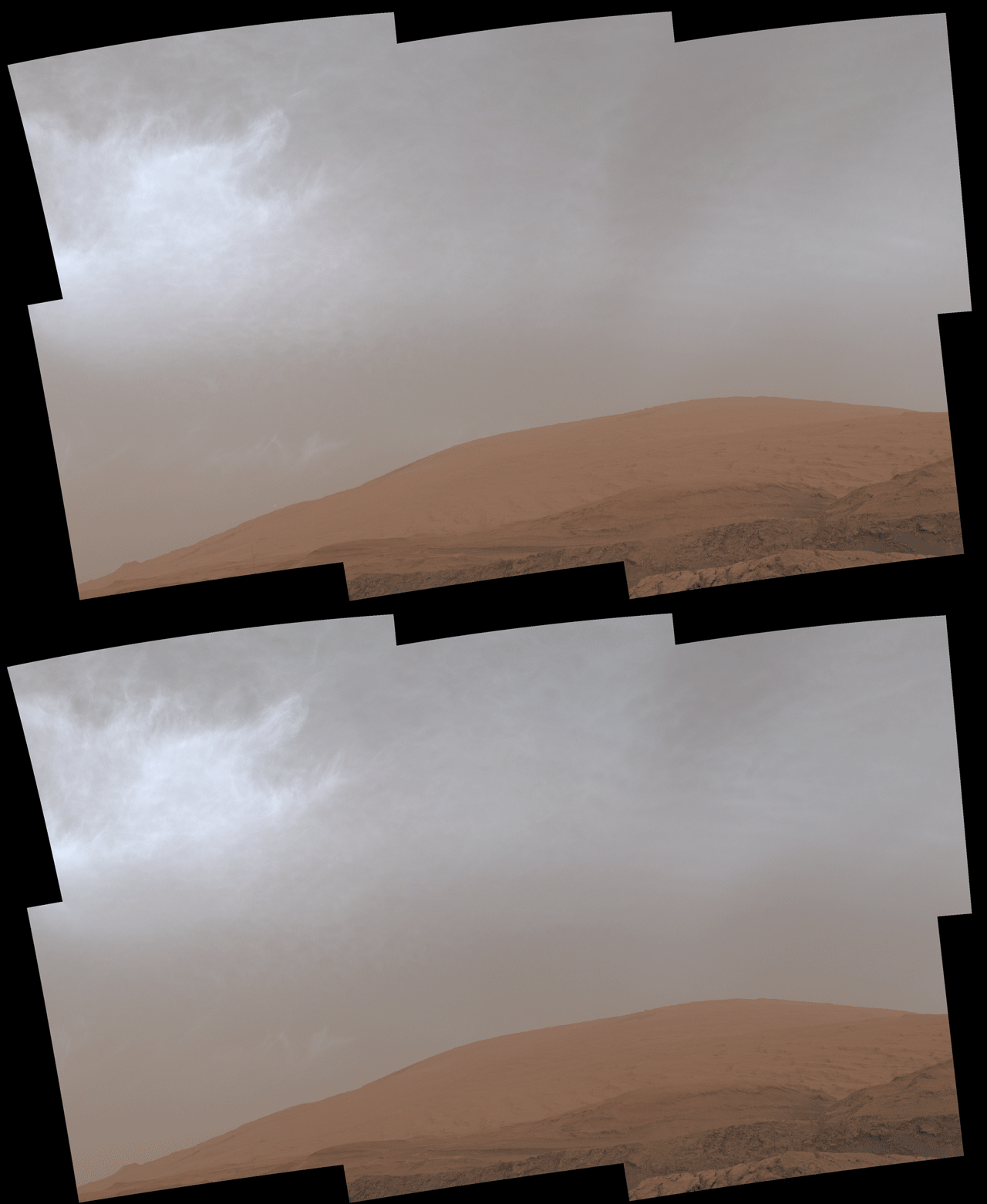
NASA’s Curiosity Mars rover captured these clouds during the twilight period on March 19, 2021, the 3,063rd Martian day, or sol, of the rover’s mission. The image is made up of 21 individual images stitched together and colour corrected so that the scene appears as it would to the human eye. The clouds are drifting over “Mont Mercou,” a cliff face that Curiosity has been studying on “Mount Sharp”. Credit: NASA/JPL

Clouds are rare on Mars, but they can form, being typically found at the planet’s equator in the coldest time of year, when Mars is the farthest from the Sun in its oval-shaped orbit. However, in 2019 – a year ago in Martian terms – the Mars Science Laboratory team managing NASA’s Curiosity rover in Gale Crater noticed the clouds there forming earlier than expected.

With the onset of winter in the region earlier in 2021, the MSL team wanted to be ready in case the same thing happened, training the rovers cameras on the sky around “Mount Sharp” to catch any evening cloud formations that might appear as the tenuous atmosphere cooled towards night-time temperatures.

Clouds moving over Mount Sharp, as captured by Curiosity on March 19th, 2021. Credit: NASA/JPL

What resulted are images of wispy puffs filled with ice crystals that scattered light from the setting Sun, some of them shimmering with colour. Visible through both the black-and-white lenses of the rover’s navigation cameras and the high-resolution lenses of the Mastcam system, the pictures captured by Curiosity might easily be mistaken for high-altitude clouds here on Earth.

And high altitude is precisely the term to use for this clouds. Most clouds on Mars largely comprise water vapour and water ice. They tend to occur some 60 km above the planet, although they can occur much lower – the massive shield volcano of Olympus Mons, for example, has oft been images with cloud formations around its  flanks, the product of differing atmospheric temperature regimes on the slopes.

However, the clouds seen by Curiosity are believed to be far higher than 60 km in the Martian atmosphere, and are thought to be largely composed of frozen carbon dioxide (dry ice). They occur during the twilight hours – although the mechanism that gives rise to them is not fully understood; but they are thin enough for sunlight to pass through them, catching the ice crystals and causing them to shimmer for a time before the Sun drops below their altitude, causing them to darken. This effect gives them their name: noctilucent  (“night shining”) clouds.

These clouds are best seen in the black and white images captured by the rover’s Navcams, as shown here. However, there is a second form of clouds best seen via Curiosity’s Mastcam colour images. These are iridescent, or “mother of pearl” clouds, rich in pastel colours.

Mother of Pearl clouds spotted by Curiosity in March 2021. Credit: NASA/JPL

They are the result of the cloud particles all being nearly identical in size, something that tends to happen just after the clouds have formed and have grown at the same rate. The colours are so clear, were you able to stand on Mars and look at the clouds, you’d see the shades with your naked eye, and they are another part of the beauty of Mars.

Ingenuity Hiccups During Sixth Flight

NASA’s Mars helicopter Ingenuity encountered some trouble on its sixth flight – the first flight of its extended mission  – on May 22nd.

The flight should have seen the helicopter climb to a height of 10 metres, then fly some 150 metres south-west of its starting point to reach a point of interest where it would travel south for 15 metres, imaging the terrain around and below it for study by scientists on Earth, before making a return to a point close to where it lifted-off.

This image was taken from the height of 10 metres by NASA’s Ingenuity Mars helicopter during its sixth flight on May 22, 2021. Credit: NASA/JPL

The flight was designed to be the first specifically targeted at testing the helicopter’s ability to be used in support of ground operations on Mars, offering the mission team the chance to determine if the area images might be worth a future foray by the Mars 2020 Perseverance rover.

However, 54 seconds into the flight, Ingenuity suffered a glitch that interrupted the flow of images from its navigation camera to its onboard computer. This meant that each time the navigation algorithm performed a correction based on a navigation image, it was operating on the basis of incorrect information about when the image was taken, leading to incorrect assumptions about where it was and what it should be doing.

This lead to Ingenuity pitching and rolling more than 20 degrees at some points during the flight as it struggled to return to its landing zone, post-flight telemetry revealed the helicopter experienced some significant power consumption spikes. However, it maintained its flight and  executed a safe landing just 5 metres from the intended touch-down point.

In a very real sense, Ingenuity muscled through the situation, and while the flight uncovered a timing vulnerability that will now have to be addressed, it also confirmed the robustness of the system in multiple ways. While we did not intentionally plan such a stressful flight, NASA now has flight data probing the outer reaches of the helicopter’s performance envelope That data will be carefully analysed in the time ahead, expanding our reservoir of knowledge about flying helicopters on Mars.

Håvard Grip, Ingenuity’s chief pilot.

Making the Moon a Busy Place

It’s starting to look like the Moon is going to be a terribly busy place. NASA’s Artemis programme is gathering pace in several areas – despite a degree of in-fighting among the principal US contractors – Russia and China have signed an accord that is liable to see them operating in the lunar south pole regions alongside the US-led mission (although the two will remain separate mission entities), whilst Canada and Japan have announced missions to the Moon as a part of the overall Artemis framework, and NASA is seeking ideas from lunar rover vehicles.

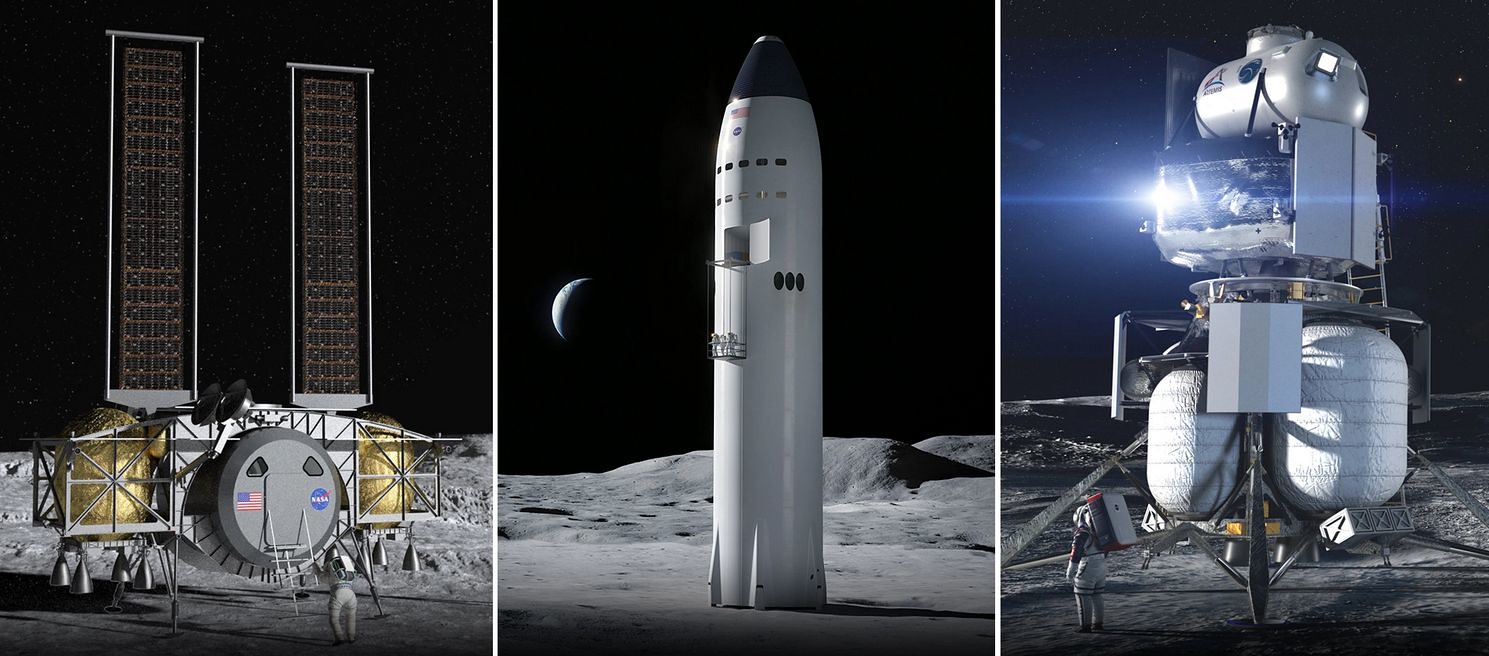
The in-fighting revolves around NASA’s April announcement that SpaceX will be granted a sole contract to develop the HLS – Human Landing System – the vehicle that will place humans on the surface of the Moon and return them to orbit. It was a contentious decision; the US agency had previously indicated that two contracts for HLS would be granted, with three players involved: a team led by Jeff Bezos’ Blue Origin, a team led by Dynetics, and the late-comer to the party, SpaceX.

The three proposals for NASA’s Human Landing System vehicles that had been under consideration for the Artemis programme. Left: the Dynetics lander / ascent vehicle; centre: the modified SpaceX Starship NASA has opted for; right: the National Team’s descent / ascent modules. Credit: NASA

There were several leading reasons for the decision – including the matter of cost. However, both Dynetics (potentially with the most flexible approach to HLS) and Blue Origin raised objections with the Government Accountability Office (GAO), which ordered NASA to cease any financial support to SpaceX (worth a total of US $2.9 billion) to the SpaceX effort until it has completed an investigation.

The US Senate has also weighed-in on the subject, with Senator Maria Cantwell (D-Wash.), chair of the Senate Commerce, Science and Transportation Committee, adding an amendment to the Endless Frontier Act which forms the backbone for financing the Artemis programme, requiring NASA put a further US $10 billion into HLS – whilst Senator Bernie Sanders (D-Vermont) went the other way by calling for the cancellation of the entire HLS programme, wrongly characterising it as the “Bezos Bailout”, and so doing what he does best; creating further division and confusion.

As it is, the GAO will release its findings on the matter in August, and while it is hard to ascertain the impact of the delay, it would likely further diminish NASA’s chances of achieving the original goal of a return to the Moon by the end of 2024.

NASA’s Nancy Grace Roman Space Telescope has been targeted for continued financial support by the Biden administration, potentially ending ill-conceived attempts by the previous administration to axe the project.  Credit: NASA Goddard Space Flight Centre / CI Lab

Continue reading “Space Sunday: Martian clouds, lunar missions and a space station”

Space Sunday: China, Mars and the Drake Equation revisited

A colour close-up captured by China’s Zhurong rover via its high-resolution cameras as they look over the rear deck, showing the main communications relay and one of the unfolded solar arrays. This image was captured before the rover deployed from its lander. Credit: CNSA

China’s Zhurong rover has commenced operations on the surface of Mars. The rover, which is slightly larger and heavier than NASA’s MER rovers Spirit and Curiosity, arrived on the surface of the planet on May 16th atop its lander vehicle (see: Space Sunday: China on Mars, JWST and a space tourist).

Since that time, the rover has been put through its first battery charging cycle after unfolding its solar panels, and then entered an initial telemetry-based check-out and commissioning phase that saw some of its core systems powered-up in readiness to commence operations, with similar checks being carried out on the lander.

An infographic on China’s Zhurong rover via AFP, with original material via CNSA and Chinese state media

This meant that it was not until May 19th that the China National Space Administration (CNSA) released the first images taken by the rover’s camera systems.

The first images to be released were those captured by Zhurong’s hazard avoidance cameras, which – and like their American counterparts – operate primarily in black and white. In particular, these images showed that the lander vehicle had successfully deployed the ramp Zhurong needed to descend onto the planet’s surface from the back of the lander.

The black-and-white images were followed by colour pictures captured by both the rover’s hazcam system and its high-resolution imaging system which is, again like US designs (and the upcoming EuroMars rover, Rosalind Franklin, mounted on a mast located on the rover’s forward section and capable of taken images of all of the rover’s surroundings.

China’s Zhurong (l) and America’s Perseverance (r) in a comparison image by CNSA

China has been fairly close-lipped about the lander and rover – although the entire Tiawen-1 mission is seen as an “international” mission by Chinese authorities -,  only releasing images via social media, etc., after the fact, with little or no fanfare beforehand. This meant it was Twitter snoops who first spotted the rover had actually deployed from this lander vehicle some time in the early hours of Saturday, May 22nd, UTC.

Andrew Jones was one of the first to spot CNSA images that showed the rover had rolled off the lander. However, CNSA quickly followed-up with more images captured by the rover, some of which were colour, and others were put together to form a “video” of the deployment process.

Andrew Jones was one of the first to spot China had announced Zhurong had driven off of its lander.

Now it is on the surface of Mars, Zhurong is expected to operate for a primary mission period of 90 sols (93 days) – which is likely to be extended if the rover completes that mission successfully. It will explore the area around its lander, using both it and the Tianwen-1 orbiter as communications relays, while carrying out research into the Martian weather and climate, and surface and sub-surface conditions.

The return of the first images from the rover sparked an appeal to the US Congress from NASA’s new Administrator, Bill Nelsen, who asked for a boost to the agency’s funding so that it might better manage deep space research and the planned return to the Moon in the face of the growing competition from China.

A colour picture from Zhurong’s hazcams as it roles down the ramp from the lander on May 22nd. Credit: CNSA

It has not all been smiles and roses for China, however. As  I previously reported, the country can in for international criticism for failing to handle the uncontrolled return to Earth of the 23-tonne core stage of the long March 5B core stage used to lift the Tianhe primary module of the country’s new Tiangong space station. Following up from that mission, China had planned to launch its first mission to Tianhe on May 19th.

This was to be the Tianzhou-2 automated resupply vehicle. A fully automated, 13-tonne vehicle, Tianzhou-2 was supposed to make an automatic rendezvous  and docking with Tinahe in advanced of the first crewed mission to the fledgling space station, which is due to occur in June, 2021; however, the launch was scrubbed as a result of “technical issues”. Initially re-scheduled for lift-off on Thursday, May 20th, the launch was again postponed, and has now been pushed back until Friday, May 29th.

A Chinese Long March 7 rocket carrying the Tianzhou-2 cargo ship rolls out to a launch pad at the country’s Wenchang Satellite Launch Centre on Hainan Island. Credit: CASC.

When Tianzhou-2 does eventually lift-off atop its Long March 7 booster, it will be carrying 6.5 tonnes of equipment and supplies for the first crew to visit Tianhe, and consumables for the station itself, and will remain docked through the 3-month period of the Shenzhou-12 crewed mission. During the crew’s visit, Tianzhou-2  will perform a set of automated undocking, free flight and rendezvous / docking manoeuvres as rehearsals in readiness for when the station’s science modules are launched.

Tianzhou-2 will depart Tianhe ahead of the Shenzhua-12 crew. The station will then be visited by a further automated res-supply vehicle and the Shenzhou-13 crew, over late 2021 / early 2022, for the Chinese are calling the “Critical Technology Validation Phase” of the station’s commissioning, verifying it is ready for the launch of the two science modules. These will take place in 2022, paving the way for full operations to commence from 2023.

Continue reading “Space Sunday: China, Mars and the Drake Equation revisited”

Space Sunday: China on Mars, JWST and a space tourist

An artist’s impression of the Zhurong rover unfolding its solar arrays shortly after its lander touched down on Mars. Credit: New China TV

On Saturday, May 16th, 2021, China became only the second nation in the world to successfully land a rover on the surface of Mars.

The 240-kg Zhurong rover touched down on the dunes of southern Utopia Planitia a few minutes after midnight, UTC (19:00 US Eastern on Friday, May 15th), some nine minutes after the lander and rover combination entered the Martian atmosphere.

The two form a part of the Tianwen-1 (Heavenly Questions) mission, operating alongside the mission’s titular orbiter, which arrived in Mars orbit in February this year. For the three months since that event, the orbiter has, as part of its overall mission, been surveying Utopia Planitia – a location first visited in the 1970s by NASA’s Viking 2 mission – in order for mission managers to confirm the best touch-down point for the lander / rover combination.

Following their separation from the Tianwen-1 orbiter, the lander and rover entered the Martian atmosphere protected by a heat shield and aeroshell, to commence an Entry Descent and Landing (EDL) very similar in nature to US Mars surface missions.

The CNSA mission control during the Zhurong lander. Credit New China TV

While China has successfully landed missions on the Moon – Chang’e 5 with its surface rover is still operating – a landing on Mars is far more complex in nature, simply because of the presence of an atmosphere that, while tenuous, nevertheless interacts with a vehicle to increase the potential for things going wrong.

However, Zhurong (named for a god of fire and of the south), completed the first part of its descent successfully, using the frictional heat generated be entry into the atmosphere to slow itself to a point where a supersonic parachute could be deployed by the aerodynamic backshell, which in turn triggered the jettisoning of the heat shield, exposing the lander / rover.

Approaching the ground, Zhurong deployed its landing legs whilst still attached to the aeroshell, prior dropping clear. once free, the lander’s rocket motor fired moving it clear of both the aeroshell and the parachute. As well as continuing to slow the craft in its descent, the rocket motor and the lander’s reaction control system worked with a downward-looking radar scan for potentially harmful surface obstacles, the motors then steering the craft away from them. The main motor then continued firing as the vehicle descended over its landing site, cutting out a couple of metres above the ground to let the lander make a soft, unpowered touchdown.

Carried out entirely autonomously, the landing appears to have been a complete success, although China has yet to confirm the precise time of touch-down or the overall status of the lander and rover. Following landing, the rover deployed its solar panels in order to commence charging its systems, while the mission control team work to carry out initial checks of the rover and prep its camera systems to take a complete a panoramic image of the landing area – although at the time of writing, images from the lander / rover had yet to be confirmed as being received.

Zhurong is roughly the size of NASA’s Spirit and Opportunity rovers  and like them, is solar-powered, although it is around 55 kg heaver. It carries a payload of six science instruments, including a laser-induced breakdown spectroscopy instrument for analysing surface elements and minerals, panoramic and multispectral imagers, a climate station, magnetometer and a ground-penetrating radar.

With an initial primary mission period of 90 sols (around 93 terrestrial days), the mission aims to return data on potential water-ice deposits, weather, topography and geology, complementing science carried out by missions from other space agencies. Given the nature of Mars missions and China’s record on the Moon with Chang’e 5, should the rover survive the initial primary mission period, its work on Mars will likely be extended.

James Webb Tests Mirror a Final Time, but Launch likely to be Delayed

The James Web Space Telescope (JWST) unfolded its massive mirror for the final time whilst on Earth in a last test before it undergoes preparations for launch.

The 6.5 metre diameter mirror is a complex mechanism made up of 18 hexagonal sections, 12 of which form the main part of the mirror and the remaining six form two fold-out elements on either side. For launch, the mirror is folded down against the main sun shield that will protect it from the heat and light of the Sun once it is in space., and the two flanking sections folded back against it.

The James Webb Space Telescope. Credit: NASA

The May 11th test saw the entire telescope supported by a special crane to simulate zero gravity, allowing engineers to run the software that will control the mirror’s unfurling using 132 individual actuators. These actuators raise the mirror, then unfold the side panels before gently bending or flexing the 18 individual mirror segments to align and focus them on the telescope’s secondary mirror that directs the light caught by the primary into the instrument aperture at the centre of the primary.

Following the deployment test, the mirror was returned to its folded and stowed position. Later this year, the 6.5 tonne 20 x 14 metre telescope will be stowed in a climate controlled shipping container for a 2-week trip to the European rocket facility at Kourou in French Guiana. Once there, it will be integrated into the payload fairings of a European  Ariane 5 rocket ready for a launch currently planned for the end of October.

That is, if the Ariane 5 cleared for launch.

Normally one of the most reliable launch vehicles on the market, the rocket has been grounded after the two last launches suffered issues with the payload fairing separation process – although the payloads from both flights were successfully place in orbit. Investigations into the issues are still in progress, but Arianespace has two launch commitments ahead of JWST, and so it is likely at the telescope’s launch will be delayed – the last in a long series of delays for JWST, all of which will hopefully mean that once it has been launched, the telescope will go on to be highly successful, operating in a halo orbit around the Lagrange L2 position on the opposite side of Earth compared to the Sun, and some 1.5 million kilometres from Earth.

Continue reading “Space Sunday: China on Mars, JWST and a space tourist”