RezMela: a training and simulation environment offering $500 in prizes

RezMela offers an interactive training and simulation environment in Kitely. Here I'm dealing with an air crash situation involving a power plant
RezMela is an interactive training and simulation environment in Kitely. Here I’m dealing with an air crash situation involving a power plant

Update, July 28th: As per the comment following this artilce, the competition deadline has been extended through until August 31st, 2014.

I recently received an e-mail concerning RezMela, a scenario-building tool intended for training and simulation hosted on Kitely, and which is currently running a competition with prizes totalling $500 USD up for grabs.

RezMela, currently in an alpha / beta mode, essentially allows subject matter experts to create and deliver interactive training within a virtual environment. It comprises a classroom-style theory space, where students can learn about and watch presentations on the subject being taught, and a practice space which is dedicated to learning-by-doing, through the use of immersive simulations.

The RezMela theory area, with the Command and Control board
The RezMela theory space, with the Creation and Control board

Simulations – referred to as scenarios in the RezMela documentation – can be rapidly developed and deployed using the Creation and Control (C&C) board. The C&C board provides the subject matter expert with access to a wide range of simulation “primitives” (not to be confused with the basic building blocks of OpenSim and Second Life). These RezMela “primitives” are trees and plants, buildings and structures, vehicles, terrains and so on, and a selection of different types of non-player characters (NPCs), which can be combined to create a required training scenario.

The C&C board presents simple 2D map on which icons representing the various “primitives” can be positioned, rotated, etc. As this happens, the actual simulation objects are placed out in the practice area of the RezMela environment, thus allowing a simulation to be quickly put together. Once the scenario has been built, additional elements such a weather, fires, smoke, dust, etc., can be added, and the time of day for the scenario set. When everything is ready, the scenario can be saved to the RezMela system, allowing it to be instantly recalled and created within the practice space at the click of a button.

The RezMela practice space. ther rock formation in the background houses the theory space classroom
The RezMela practice space. the rock formation in the background houses the theory space classroom

NPCs and Objects within a scenario are not necessarily static or empty shells. Building and structures can have interiors, lending themselves to many different uses, and student can interact with various objects and vehicles, while NPCs will respond to stimuli around them. As well as enabling easy creation of scenarios, the C&C board can also be used to deliver classroom videos and presentations on the subject matter.

Combining the theory and practice spaces allows subject matter experts to provide information and guidance on a specific learning / training environment within the theory space via the C&C board, and then monitor students’ performance in real-time as they tackle the challenges presented in the scenario in the practice area.

A prepared scenario being rezzed by the Creation & Control board. The pointing hand indicates the currently-selected object
A prepared scenario being rezzed by the Creation & Control board. The pointing hand indicates the currently selected object

Scenarios can be entirely created from scratch to suit a specific training / teaching requirement, or can be based on physical world situations, such as emergency or disaster management situations which have occurred, allowing students gain additional insight into such situations and events. The system can also be used for educational purposes as well, such as for teaching health and welfare or in teaching environmental matters and so on.

To help explain how the system works, DeepSemphore LLC, the company behind RezMela, have provided a range of videos and a slideshow introducing the basics of the beta system. There is also an in-world campus and workshop regions available to RezMela users where further information can be obtained.

Continue reading “RezMela: a training and simulation environment offering $500 in prizes”

Oculus VR Principal Scientist to address OpenSimulator Conference

2014 banner

On Tuesday July 22nd, Chris Collins, writing on behalf of the 2nd OpenSimulator Community Conference, announced that one of the keynote speakers at the event will be Dr. Steve LaValle.

Dr. LaValle, a professor of Computer Science at the University of Illinois, is the principal scientist for Oculus VR, and he will be addressing attempts to bring the Oculus Rift headset to the mass consumer market.

Dr. Steven LaValle (image: )
Dr. Steven LaValle (image: University of Illinois)

Since Palmer Luckey’s 2012 prototype demonstrated that smartphone-based advances in display and sensing technology can enable a lightweight, high field-of-view VR experience that is affordable by the masses, widespread interest has grown across many industries, research labs, and potential end users of the VR technology. Dr. LaValle’s talk will highlight ongoing technical challenges, including game development, user interfaces, perceptual psychology, and accurate head tracking.

He is certainly well-placed to be able to do so, having been working with Oculus VR since a few days after its successful Kickstarter campaign and has led its R&D efforts up to its $2 billion acquisition by Facebook in March 2014.

Commenting on Dr. LaValle’s appearance at the conference, Cris Collins, who is serving at the conference chair, said, “With all the excitement surrounding the Oculus Rift and other virtual reality technologies, we want the virtual reality community to know that OpenSimulator is a great platform for building the open metaverse.

“OpenSimulator has hundreds of thousands of registered users and a land mass twice the size of Second Life. It’s the only open source platform with an Oculus Rift ready viewer that already has hundreds of interconnected worlds operating in an emerging metaverse and thousands of worlds run privately by corporations, schools, government agencies, nonprofits, and individuals.”

About the OpenSimulator Conference

The OpenSimulator Community Conference is an annual conference that focuses on the developer and user community creating the OpenSimulator software.  Organized as a joint production by the Overte Foundation and AvaCon, Inc., the conference features two days of presentations, workshops, keynote sessions, and social events across diverse sectors of the OpenSimulator user base.

The 2014 OpenSimulator Conference will take place on the OpenSimulator Conference Centre grid on November 8th and 9th, 2014, with registrations opening on September 15th, 2014, and interested parties can sign up to receive an email reminder to register.

The conference will include four themed tracks and a Learning Lab for hands on hackerspaces, speedbuilds, and more:

About the Organisers

The Overte Foundation is a non-profit organization that manages contribution agreements for the OpenSimulator project.  In the future, it will also act to promote and support both OpenSimulator and the wider open-source 3D virtual environment ecosystem.

AvaCon, Inc. is a 501(c)(3) non-profit organization dedicated to promoting the growth, enhancement, and development of the metaverse, virtual worlds, augmented reality, and 3D immersive and virtual spaces. We hold conventions and meetings to promote educational and scientific inquiry into these spaces, and to support organized fan activities, including performances, lectures, art, music, machinima, and much more. Our primary goal is to connect and support the diverse communities and practitioners involved in co-creating and using virtual worlds, and to educate the public and our constituents about the emerging ecosystem of technologies broadly known as the metaverse.

 Related links


Blood and Laurels gains New York Times approbation

versuA month after its re-launch, Versu, the interactive storytelling platform, gained very positive feedback from the New York Times on Monday July 7th.

In Text Games in a New Era of Stories, Chris Suellentrop, the video games critic at the Times, describes the first title to be released under the new Versu label, Blood & Laurels, as seeming “to herald a new creative template that could be applied to nonfiction as well as fiction,” adding later in the article that it “offers is one of those quintessential video game moments, a first glimpse at something on the horizon.”

Blood and Laurels:  afocal point for a New York Times article on the resurgence of IF games
Blood and Laurels: a focal point for a New York Times article on the resurgence of IF games

The article itself is an examination of the Interactive Fiction genre, both looking back at the early days of text-based adventure games see as the origins of the genre, and at the state of play with the genre today as a medium enjoying a popular resurgence.

As with other reviews of the game, The New York Times piece underlines the feeling that with Blood & Laurels, one is less a reader and more a participant in a piece of theatre in which improvisation – both on the part of the reader and by the other characters – plays an important role in the unfolding scenes and in setting the direction the story may take.

In describing his experiences in reading / playing Blood & Laurels, Mr. Suellentrop also further expands on his comment about the “promise of what might come after it”, noting, “when I replayed the game, I didn’t feel that Marcus had become a different character when he decided to, say, betray Artus [one of the principal NPCs in the story]  rather than execute his commands. Instead, it seemed that I was just learning how he might behave differently under the vagaries of circumstance.”

This potential to offer different perspectives on behaviour within certain situations is possibly where a yet-to-be-tapped wellspring of opportunity may lie for the Versu engine in the future, something possibly reflected in Mr. Suellentrop’s comments about Blood & Laurels offering a glimpse of something on the horizon. Richard Evans himself spoke to this, as I reported back in May 2013, when he presented Versu: A Simulationist Interactive Drama, at the Games and Media Event at the Imperial College London.

Whether or not the Versu team can / will move to expand opportunities in which the engine can be used beyond the IF genre remains to be seen; which is not to say the engine can’t survive without moving away from the IF genre. Far from it; the combination of Versu and Prompter would appear to be opening the doors on broad new opportunities for IF writers.

Certainly, and considering the bumpy road Versu has so far endured, it’s good to see both it and Blood & Laurels continue to gain the attention of the games media with positive reviews and feedback. Long may it continue.

Footnote: Richard Evans will be speaking at this year’s Develop Conference, (Brighton, England, July 8-10th), where he’ll be examining the relationship between games development and AI research.

Related Links

Fallingwater at Seanchai

Fallingwater at night, Seanchai Library, Kitely

Back in mid-June, I mentioned that Fallingwater (Kitely) was relocating to the Seanchai Library core world there, the result of conversations between Caledonia Skytower, Shandon Loring and myself. In that report, I covered the physical move itself, relocating the house from a single region to the Seanchai 2×2 core megaregion.

Since then, and as time has allowed, I’ve been gradually re-working the place. Truth be told, I’d never really got it to a “completed” state in two years of having it on a region of its own, and the build really needed some TLC to get materials, etc., properly blended (I’d only just started messing around with them when I stopped working on the place in 2013). There was also much I was less than pleased with in the landscaping – such as the driveway up to the garages and Guest House, the river, and the falls, which I’ve always wanted to re-work.

A part of the revised drive with retaining walls and one of the smaller outdoor venue spots (right). Fallingwater, Seanchai Library, Kitely

As the house is now part of a themed estate (albeit one where each region effectively has a theme of its own), the land around the house needed a degree of blending so that it would fit the lay of the rest of the estate, and this gave me the excuse I needed to shovel through everything that I’d never really made the time to sort-out.

First and foremost. the falls received a complete face-lift. I’ve always been unhappy with how they looked throughout each iteration of the build, either in SL or Kitely; they never seemed to quite capture the spirit of the original. I’m a lot happier with the re-working. They’re still not “Fallingwater’s” falls – the rocks there are far more angular, but I think I’ve captured more of their “feel” at last.

The revised falls under the Great Room of the house. Fallingwater, Seanchai Library, Kitely

Reworking the land meant I could get rid of the two roads leading up the house and replace them with gravel paths with brick shoulders. One of these. I decided, should lead to a stone jetty offering plenty of mooring pace for boats (water is a major feature in the estate), and the other I reworked as the main path connecting the house to the rest of the estate, reach via a bridge spanning the mouth of the river, and which I nabbed from Shandon and reworked a little, adding some wood texturing.

As the house is to be a venue for storytelling, providing space for people to gather has been an important consideration. So to help with this, I decided to thin out the trees a little and provide a couple of open-air spaces which might be used for smaller gatherings. One sits in the curve of the completely re-work driveway (I hated the original in the build, and while I’ve not found any sign of the walls I’ve installed along the drive in the drawings I have of the real Fallingwater, I think they fit the place rather well. beyond the drive, and outside of the walled parking area is another area cleared of trees and which faces out over open ocean to the north, as another space for informal gatherings.

The new "north terrace house" with steps leadig down to the jetty and the Guest House visible in the background. Fallingwater, Seanchai Library, Kitely
The new “north terrace house” with steps leading down to the jetty and the Guest House visible in the background. Fallingwater, Seanchai Library, Kitely

Cale also requested that I provide a space which could be used for meetings, workshops, social events and suchlike, again in keeping with the overall design of the house. This left me stumped for a while, but in the end I came up with a combination of a large cantilevered terrace extending out over the ocean on the northeast side of the island, and a building styled after the Guest House and offering two connected rooms. hopefully these will together provide flexible space for hosting indoor and outdoor events. A set of steps leads down to another set of piers below, and a path arcs around the headland and down to a small cove.

This all sits well below the lie of the rest of the land on the north side of the island, and so hopefully also offers a feeling of isolation from the rest of the build – although a path does link it to the pool patio by the Guest House, the patio also having been extended to provide a further venue for small gatherings.

The jetties on the south side of the island and the house through the trees in the background. Fallingwater, Seanchai Library, Kitely

I’ve add new lighting to much of the outdoors areas – lamps which come on at dusk and turn off again at dawn – which hopefully add some more ambience to the place. There are still some nips and tucks to be taken care of, but overall, I think the major work is done – subject, of course, to Cale and Shandon being in agreement.

I doubt this is the end of my infatuation with Fallingwater; I rather suspect that were the opportunity to arise, I’d happily start fiddling with the SL version once more. However, where Kitely is concerned – given that I have so little time I can spend there – I’m really happy that Fallingwater has a new home and will be put to good use.

You can visit Seanchai Library in Kitely via the Seanchai Library Kitely web page or via a hypergrid teleport from any hypergrid enabled OpenSim grid via:  hop://grid.kitely.com:8002/Seanchai/144/129/29 (main arrival point, Fallingwater is to the northeast).

I "borrowed" a copy of one of the bridges connecting the various locations in the estate to provide a physical and thematic link between Fallingwater and the rest of the estate. Fallingwater, Seanchai Library, Kitely.
I “borrowed” a copy of one of the bridges connecting the various locations in the estate to provide a physical and thematic link between Fallingwater and the rest of the estate. Fallingwater, Seanchai Library, Kitely.

Google: all you need for your own VR experience is … cardboard

Google have released their first foray in to the world of immersive VR. They’re calling it Cardboard, because the do-it-yourself headset is made of … well, cardboard.

“Construct a VR viewer from everyday items you can find in your garage, online or at your local hardware store,” is the headline on the Google Cardboard website, complete with a picture of the necessary components.

Build your own VR heaset from cardboard, magnifying lens and a few other bits, and use it with your Android smartphone
Google Cardboard: build your own VR headset from cardboard, magnifying lens and a few other bits, and use it with your Android smartphone

And before you laugh yourself silly thinking this is another little joke from those pranksers who brought us GMail Blue in April 2013, it’s not. The heart of the system is a VR App designed to run on smartphones which can be mounted into the home-made headset.

Cardboard was unveiled at the Google I/O Developers Conference in San Francisco. the app takes advantage of a smartphone’s built-in accelerometers and gyroscopes to provide head tracking, and demonstration environments include a Hall of Mirrors and the opportunity to travel through Chicago. Users can also watch YouTube videos as if sitting in a movie theatre and explore 360-degree panoramic photos or run a series of VR experiments using Google Chrome on their ‘phones.  There’s also a software development kit which allows users to code their own immersive experiences.

“David Coz and Damien Henry at the Google Cultural Institute in Paris built a cardboard smartphone housing to prototype VR experiences as part of a 20% project. The results elicited so many oohs and ahs that they inspired a larger group to work on an experimental SDK,” the website explains, providing the “why” of the effort.

The finsihed headset with 'phone mounted
The finished headset with ‘phone ready to be fitted

Nor is the headset entirely low-tech. Although a phone is almost completely encased in the headset, the instructions provide a guide to making a trigger with a metal ring and a magnet and which uses the ‘phone’s magnetometer. Flicking the ring downward as items come into view allows you to select them.

VR headsets for smartphones aren’t exactly a new idea. We’ve had Kickstarter campaigns for the likes of Altergaze, and there are items like Durovis Dive. But Google Cardboard offers fun approach to things – the company noting that it can be worn with glasses, but that “you may want to cut flaps into both sides of the viewer. There’s a fold line pre-cut into both sides of the viewer to make this easier.”

For those who don’t want to be bothered with gathering all the bits and cutting cardboard to create their own headset, and just want to put the thing together and start enjoying VR on their smartphone, a pre-cut kit with all the necessary parts can be purchased from Dodocase!

Now all we need is SL Go with the Oculus Rift viewer code 😉 .

687 days on

CuriosityMonday June 23rd was notable in two worlds as a special occasion.

For the virtual world of Second Life, it marked the 11th anniversary of opening the doors to the public. On Mars, it marked the completion of Curiosity’s first Martian year on the planet (687 days).

To mark the event, NASA released a “selfie” of the rover as it sat next to a rock called “Windjana”, which was the site of the rover’s third drilling / sample gathering operation, in the region dubbed “The Kimberley”.

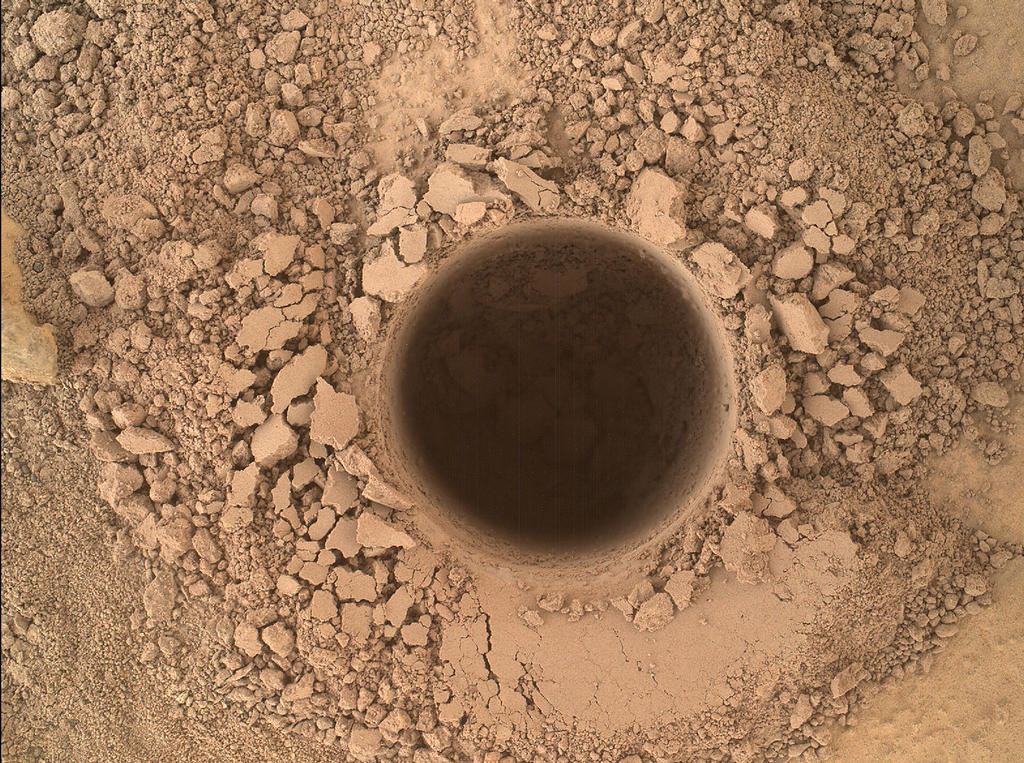
The images used in the picture were captured using the Mars Hand Lens Imager (MAHLI), located on the turret mounted on the rover’s robot arm, were captured on 613th Martian day, or Sol, of Curiosity’s work on Mars (April 27th, 2014, PDT) and Sol 627 (May 12th, 2014, PDT). Combined, they show the rover in a parked configuration together with the sample gathering hole cut into “Windjana”, the drilling operation having taken place on Sol 621 (Monday May 5th, 2014, PDT).

Curiosity's selfie: all of the rover except the robot arm is visible in this composite image made up of shots taken before and after the "Windjana" sample drilling - the hole from which is visible, lower left
Curiosity’s selfie: all of the rover except the robot arm is visible in this composite image made up of shots taken before and after the “Windjana” sample drilling – the hole from which is visible, lower left

Since that time, the rover has resumed the drive down towards “Murray Buttes”, the point where it is hoped Curiosity will be able to bypass a line of sand dunes and make its way onto the lower slopes of “Mount Sharp”, more properly called Aeolis Mons, the large mound occupying the central area of Gale Crater and the missions’ primary target for investigation.

Curiosity is now over half-way to “Murray Buttes”, with no further major waypoints to be examined on the route. however, due to the wear-and-tear on the rover’s wheels while traversing a part of “The Kimberley” and “Cooperstown” before it, the route southwards has been revised somewhat to offer smoother driving terrain for the rover.

The added wear-and-tear of the wheel first became something of a concern in February of this year, and later prompted a revision to in the planned route to reach the desired waypoint at “The Kimberley” and also in the rover driving team perfecting new techniques for driving the rover – such as by taking it backwards over some terrain.

The (Martian) year to date: from Bradbury Landing in august 2012, through “Glenelg” and “Yellowknife Bay” and onwards to “The Kimberley”, Curiosity’s travels in Gale Crater and, in white, the planned route to “Murray Buttes”.

Following its departure from “The Kimberley” on Sol 630 (May 15th, 2014, PDT), the rover drove almost continuously for a month, covering a further 1.2 kilometres 0.75 miles), and is still continuing onwards.

Although Curiosity’s route will carry it past the majority of the sand dunes between it and “Mount Sharp”, it will have to traverse an area of sand in order to reach its major target. To help with this, the rover’s Earthbound “stunt double”, dubbed the Scarecrow, was taken out to the Dumont Dunes in California’s Mojave Desert, near Death Valley, where it was put through a series of test drives over real and artificially constructed sand dunes and various terrains. This allowed engineers to examine the rover’s behaviour over softer terrain types, enabling them to better understand how the rover might react when encountering similar surfaces on Mars.

Continue reading “687 days on”