Space Sunday: touching the Sun and Martian organics

Parker Solar Probe. Credit NASA

The Parker Solar Probe has finally reached the atmosphere of the Sun.

The NASA spacecraft has spent more than three years winding its way by planets and creeping gradually closer to our star to learn more about the origin of the solar wind, which pushes charged particles across the solar system.

Since solar activity has a large effect on living on Earth, from generating auroras to threatening infrastructure like satellites, scientists want to know more about how the Sun operates to better make predictions about space weather, and gain a better understanding of the mechanisms at work in and around our star. Over the years, we’ve done this with a number of missions – but the most fascinating of all to date is the Parker Solar Probe, a NASA mission that has literally touched the face of the Sun.

The spacecraft – launched in 2018 – is in a complex dance around the Sun that involves skimming closer and closer to our life-giving star, and they sweeping away again, far enough to cross back over the orbit of Venus – indeed, to use Venus as a means to keep itself looping around the Sun in orbits that allow it to gradually get closer and closer, with the aim of actually diving into and out of the Sun’s corona, what we might regard as the Sun’s seething, broiling atmosphere.

In fact, the probe actually first flew through the corona in April 2021; however, it was a few months before the data to confirm this could be returned to Earth, and a few more months to verify it; hence why the news has only just broken about the probe’s success. One of the aims of pushing the probe into the Sun’s corona was to try to locate the a boundary called the Alfvén critical surface. This is the boundary where the solar atmosphere  – held in check by the Sun’s gravity – end, and the solar wind – energetic particles streaming outwards from the Sun with sufficient velocity to break free of that gravity – begins, creating the outwards flow of radiation from our star.

Up until Parker’s April 2021 passage into the corona, scientists has only been able to estimate where Alfvén critical surface lay, putting it at somewhere between 6.9 million and 13.8 million km from the gaseous surface of the Sun. As it passed through the corona, Parker found these estimates to be fairly accurate: the data it returned to Earth put the outer “peaks” of the boundary at 13 million km above the Sun’s surface – or photosphere; the data also revealed the boundary is not uniform; there are “spikes and valleys” (as NASA termed them) where the boundary stretches away from the photosphere at some points, and collapses down much close to it in others. While it has yet to be confirmed, it is theorised this unevenness is the result of the Sun’s 11-year active cycle and various interactions of the atmosphere and solar wind.
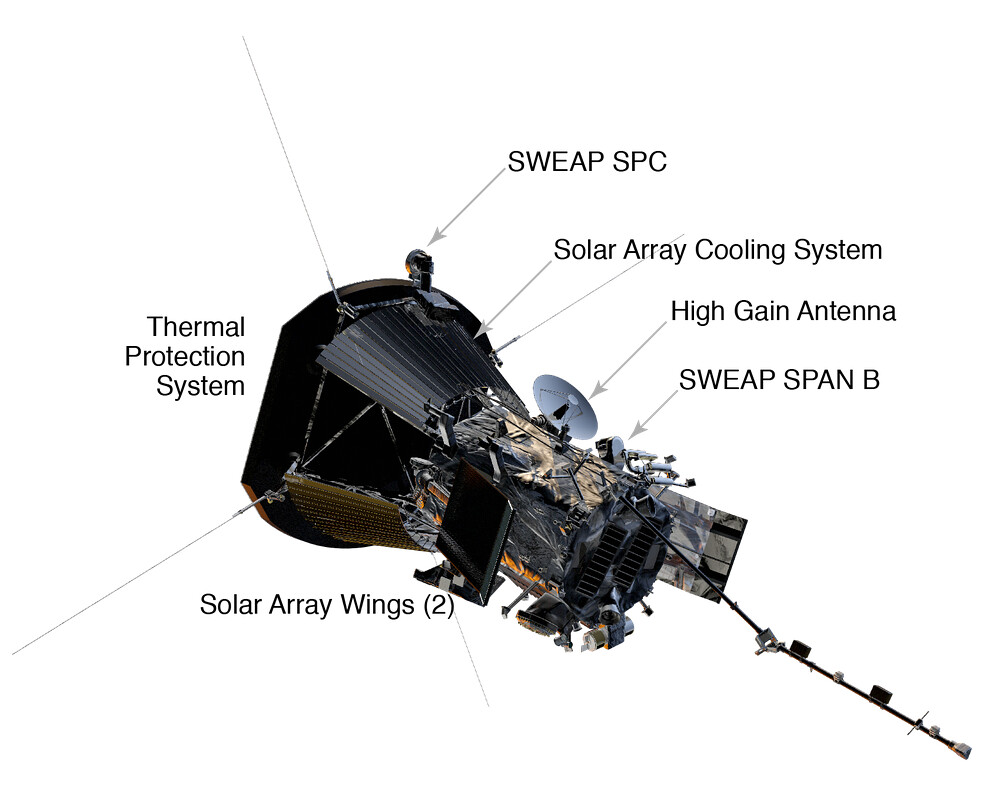
The Parker Solae Probe. Credit: NASA / I. Pey

The April “dip” into the corona lasted for five hours – as the mission goes on, future “dips” will be for longer periods). But give the spacecraft is travelling at 100 kilometres per second, it was able to gather a lot of data as it zipped around the Sun – and even sample the particles within the corona. The probe’s passage revealed that the corona is dustier than expected, the cause of which has yet to be properly determined, as well as revealing more about the magnetic fields within the corona and how they drive the Sun’s “weather”, generating outbursts like solar flares and coronal mass ejections (CREs), both of which can have considerable impact on life here on Earth.

To survive the ordeal of passing through the corona, where temperatures soar to millions of degrees centigrade, far hotter than those found at the Sun’s photosphere.  – Parker relied on its solar shadow-shield: a hexagonal unit 2.3 m across made of reinforced carbon–carbon composite 11.4 cm thick with an outer face is covered in a white reflective alumina surface layer. This shield is so efficient in absorbing / reflecting heat, whilst passing through the corona the sunward face is heated to around 1,370ºC, but the vehicle, sitting inside the shadow cast by the shield never experiences temperatures higher than 30ºC.

In addition to mapping the Alfvén critical surface, Parker’s April 2021 trip into the Sun’s corona, the probe also passed through a “pseudostreamer,” one of the huge, bright structures that rise above the Sun’s surface and are visible from Earth during solar eclipses. This was compared to flying into the eye of a storm the probe recorder calmer, quieter conditions within the streamer, with few energetic particles within it. Exactly what this means is again unclear at this time, but it does point to further incredibly complex actions and interactions occurring with the Sun.

Since April, Parker has dipped back into the corona twice more, with the November 2021 passage bringing it to around 9.5 million km of the Sun’s photosphere – although again, the data from that pass has yet to be received and analysed. The next passage in February 2022 will again be at roughly the same distance from the photosphere, with a further five passes to follow at the same distance in 2022/23, before a flyby of Venus allows Parker to fly even deeper in to corona. By December 2025, and the mission’s final orbits, it will be descending through the corona to just 6.9 million km from the photosphere.
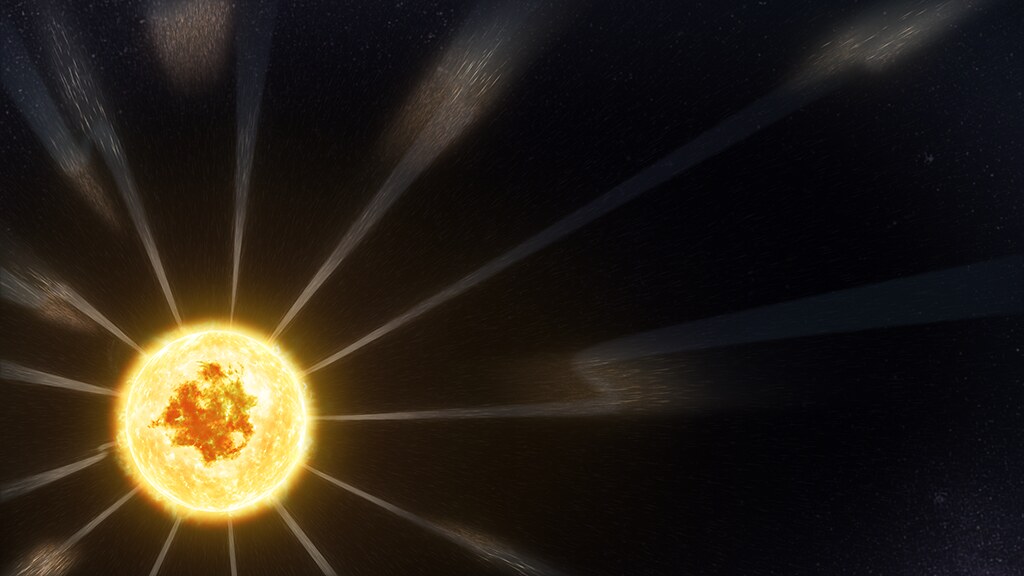
An artist’s depiction of magnetic switchbacks in the solar wind. Credit: NASA Goddard/CIL/Adriana Manrique Gutierrez

But that’s not all. Because Parker is in an elliptical around the Sun, it spends a part of its time much further away. This both allows the craft to dissipate absorbed heat from its shield, and for it to observe the Sun from a distance, giving scientists much broader opportunities to study the Sun, such as allowing them to study the physics of “switchbacks”. These are zig-zag-shaped structures in the solar wind, first witness by the joint ESA-NASA Ulysses mission that occupied a polar orbit around the Sun in the 1990s.

In particular, Parker’s observations suggest that rather then being discrete events, switchbacks occur in patches, and that these “patches” of switchbacks are aligned with magnetic funnels coming from the photosphere called called supergranules. These tunnels are thought to be where fast particles of the solar wind originate; so switchbacks may have something of a role to play in the generation of the solar wind or they may be a by-product of its generation or, given they seem to have a higher percentage of helium than other aspects of the solar wind, may serve a highly specialised role as a part of the solar wind.

Right now, scientists are unclear on what might be the case, or what actually generates switchbacks; but gaining clearer insight into their creation, composition and interaction with other particles in the solar wind, and with the Sun’s magnetic field might provide explanations for a number of solar mechanisms, including just why the corona is so much hotter than the photosphere.

Mars 2020 Mission Update

Scientists with NASA’s Mars 2020 Perseverance rover mission have discovered that the bedrock their six-wheeled explorer has been driving on since landing in February likely formed from red-hot magma. It’s a discovery with implications for our understanding and accurately dating critical events in the history of Jezero Crater – as well as the rest of the planet.

Even before the Mars 2020 mission arrived on Mars, there have been much debate about the formation of the rocks in the crater: whether they might be sedimentary in origin, the result compressed accumulation of mineral particles possibly carried to the location by an ancient river system, or whether they might be they igneous, possibly born in lava flows rising to the surface from a now long-extinct Martian volcano. However, whilst studying exposed bedrock at location dubbed “South Séítah” within Jezero, the science team noted a peculiar rock they dubbed “Brac”, selecting it as a location from which to collect further samples of Martian bedrock using the rover’s drill.

When taking samples of this kind, booth Perseverance and her elder sister, Curiosity, operating in Gale Crater half a world away, are both instructed to scour target rocks clean of surface dust and dirt that otherwise might contaminate samples. This is done by using an abrasion tool (think wire brush) mounted alongside the drilling mechanism. However, in checking the work on “Brac”, the mission team realised the abrasion process had revealed the rock was rich in crystalline formations.

Rather than going ahead and drilling the rock for a sample, scientists ordered the rover to study the formations using the Planetary Instrument for X-Ray Lithochemistry (PIXL) instrument  – which is designed to map the elemental composition of rocks. PIXL revealed the formations to be composed of an unusual abundance of large olivine crystals engulfed in pyroxene crystal, indicating the formations grew in slowly cooling magma, offering some confirmation that volcanism has at least be partially involved in Jezero Crater’s history. However, PIXL’s data also suggested the rock, once hardened, has subsequently altered as a result of water action – confirming free-flowing water also had a role to play in the crater’s past..

The crystals within the rock provided the smoking gun … a treasure trove that will allow future scientists to date events in Jezero, better understand the period in which water was more common on its surface, and reveal the early history of the planet. Mars Sample Return is going to have great stuff to choose from.

– Ken Farley, Perseverance Project Scientist

The Sample Return mission has yet to be fully defined, let alone funded, but is being looked at as a mission for the early 2030s, quite possibly with European Space Agency involvement. In the meantime, a question Farley and his colleagues would love to answer is whether the olivine-rich rock formed in a thick lava lake cooling on the surface of Mars, or originated in a subterranean chamber that was later exposed by erosion; knowing the answer to this could determine the early history of Jezero Crater and its surroundings.

This 60-second video pans across an enhanced-color composite image, or mosaic, of the delta at Jezero Crater on Mars. The delta formed billions of years ago from sediment that an ancient river carried to the mouth of the lake that once existed in the crater. Taken by the Mastcam-Z instrument aboard NASA’s Perseverance rover, the video begins looking almost due west of the rover, and sweeps to the right until it faces almost due north.

Also within the latest updates from the Mars 2020 team is the news that Perseverance has found organic compounds within the rocks of Jezero Crater and in the dust that covers them. This discovery was made as a result of a review of findings from the SHERLOC (Scanning Habitable Environments with Raman & Luminescence for Organics & Chemicals) instrument.

This does not mean that the rover has discovered evidence of past microbial life on Mars; these carbon compounds can be created by both organic and inorganic processes. However, the fact that they have been found at a number of locations explored by the rover means that the science team can map their spatial distribution, relate them to minerals found in their locations, and thus both further determine their organic / inorganic origins and trace the distribution of minerals, etc., within the crater.

Further, the fact that compounds like these have been identified by both the Curiosity and Perseverance rovers means that potential biosignatures (signs of life, whether past or present) could be preserved, too. IF so, then assuming they exist, there may come a time when one our other rover might happen upon them.

Continue reading “Space Sunday: touching the Sun and Martian organics”

Lab announces change to e-mail preferences for Group notices

Tuesday, December 7th, 2021: Linden Lab have announced a forthcoming change to e-mail notification preferences in respect of the receipt of Group notices received via e-mail when users are not logging in to Second Life.

To quote the blog post in part:

We will soon be adding an option to email notification preferences. Currently, you can choose to receive IMs in your email when you are not logged in to Second Life. There will now be an additional setting that controls whether you receive Group notices in e-mail.
We are rolling this change out in stages. If you change your settings, it may be up to two weeks before it takes effect.
The default for the new setting affecting Group notices will be OFF. If you wish to receive Group notices in email, you will need to visit the web page and opt in.
This change is motivated by feedback from our community as well as residents frequently marking Group Notice emails as spam.  We want emails to our residents to be as relevant and useful as possible.

via Linden Lab

The ability to opt-in to receiving Group notices can be found on your account dashboard at secondlife.com (there is a direct link provided in the official blog post), under Account → Change Email Settings.

Note that this is an option subject to multi-factor verification when accessing it, and the option includes a check box and dedicated Save button that must be clicked in order to update any changes, as per the image below.

As from December 15th, 2021, anyone wishing to receive Group notices as e-mails when they are not logged-in to SL will have to explicitly update their account e-mail options in order to do so

Finally, and as per the comment in red on the Change Email Setting page, and the note within the official blog post, this option must be checked by anyone who wishes to continue to receive Group notices via e-mail when not logged in to Second Life, from December 15th onwards. Also note:

  • From December 15th the IM’s to e-mail preferences setting within the viewer will no longer be valid; only the web page options will work to change these preferences. Until the option is removed from the viewer, attempts to use the Preferences option to change the setting will return an IM directing users to the web page).
  • This change does not see any change in the current cap on IMs-to-e-mail caps. However, if Group notices are set to off (the default), the cap should only apply to off-line IMs, rather than counting both IMs and group notices.

Looking at the Second Life Search facelift

Second life Search home page

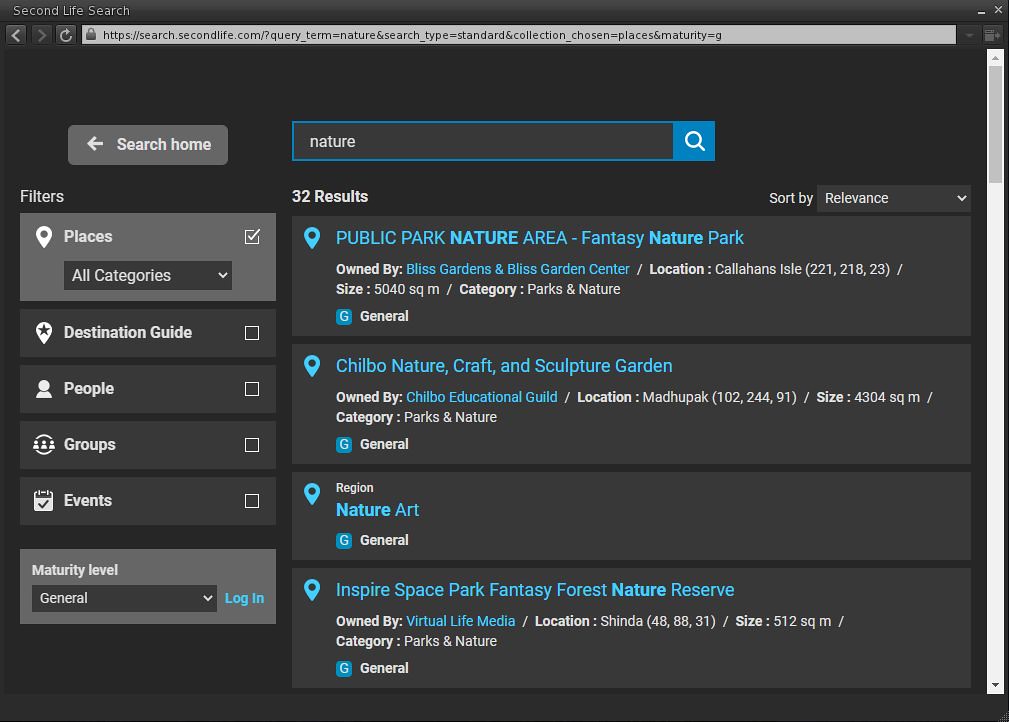
On Monday, November 22nd, 2021, and following on from comments made by Reed Linden at the November Web User Group meeting, Linden Lab launched the new look for Second Life Search (as seen both via the web and in the viewer). The launch was accompanied by a blog post – New Look for Search – that outlined the update, with several screen shots of various aspects of search return displays, etc., and a resident-launched forum thread discusses the changes.

Before going any further, it is important to note a couple of points, even though in general terms they have been noted:

  • This is an update to the web pages / style sheets defining how search and search results are displayed. It does not mark any changes in how the actual search algorithm works – so things like relevancy in search results, etc., will not be altered or improved as a result of this facelift.
  • However, a further overhaul of search which does include tightening the algorithm and improving results / relevancy and general performance will be initiated in 2022. This will apparently utilise third-party Search tool development expertise external to LL in an attempt to get a “first class” search implementation.

I’ll admit my first reaction on seeing the new search home page, both in the viewer and on the web page was, “ugh!” It was a shock to see the minimalism of Flat Design, even though this has been common to operating systems for a good while now, and has been something LL has started pushing towards. Frankly, it is not something I personally like as I find it bland and, in some executions, not particularly intuitive. However, if LL do want to make their product more in-line with current aesthetics with operating system and application design, and if they are serious about making SL more accessible through mobile / portable devices as well as modern desktop operating systems, then the move is understandable.

I’m not going to comment too much on functionality here, simply because this is a makeover, not a change in quality of returns of searches, etc. I’ll save such comments until after the complete overhaul of Search has been completed. So here are some fairly basic thoughts on the visuals.

Search in the Viewer benefits from not displaying the Classifieds (unless scrolled to via the bottom bar), but suffers from a lack of immediately-visible results

Home Page

Pros:

  • Looks clean, options easy to identify, and the colour change when and option is selected is good approach for those who may have visual impairments that make seeing checks in boxes difficult.
  • The left-side tabulation for high-level search categories is better than the old drop-downs, with the tailored options for each category are a further good moves.

Cons:

  • A terrible waste of space in the banner area, which is particularly noticeable when viewing Search within the viewer. Frankly, the SL logo looks as if it is about to be swallowed by the Great Charcoal Void.
  • Do the left sidebar tabs really need to be so broad, given the font size and the depth of each tab?

Results Listings

Pros:

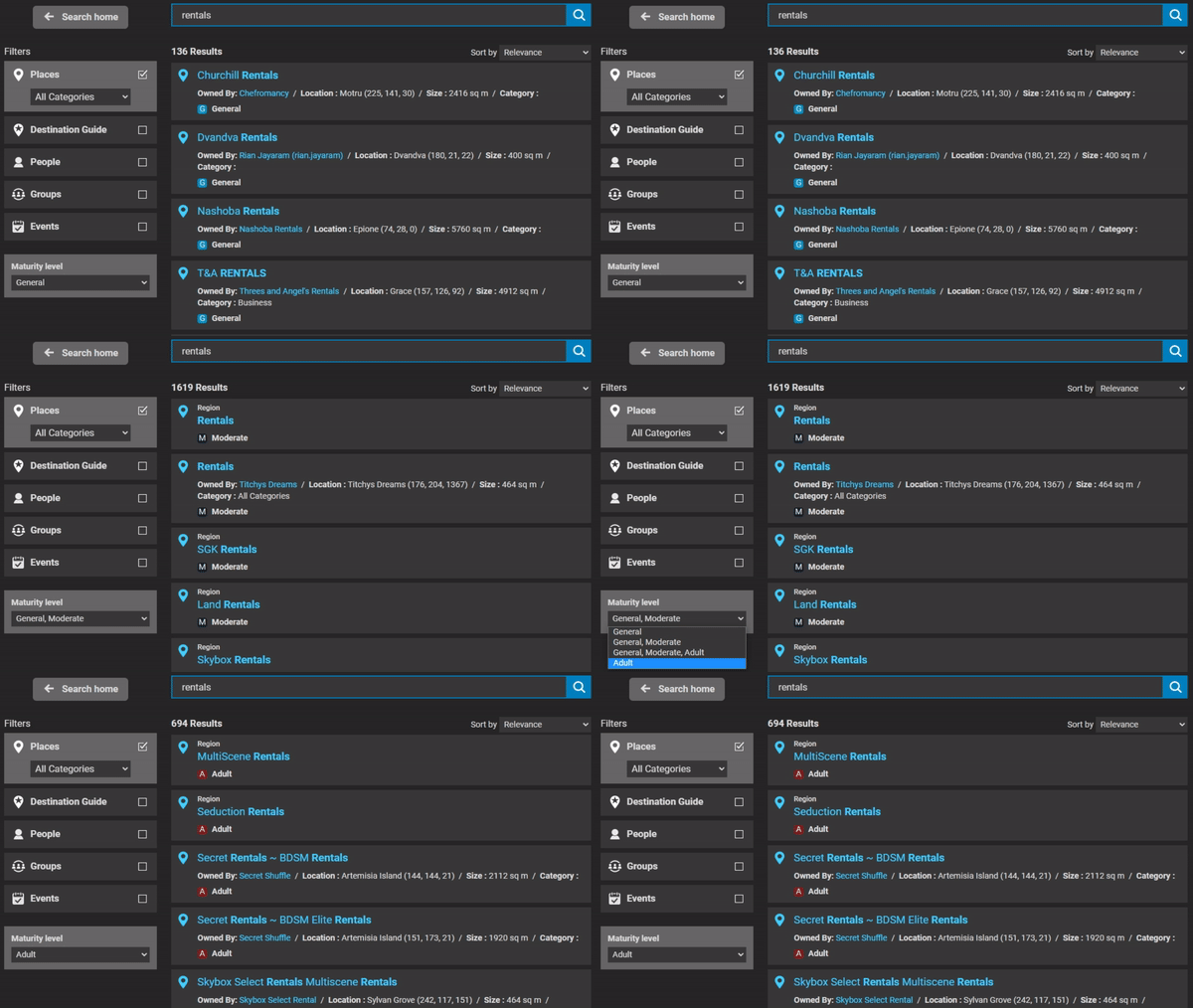
  • Much better listing layout and improved readability. The left-side tabs are useful to have, together with Maturity ratings.
  • Changes impacting the list of results (such as changing the Maturity rating) are responsive and obvious.
  • As a largely legacy search user when it comes to search places, I’m not sure if the linking to Place Pages for additional information is new or not, but if it is, then it’s a good move even if Place Pages are drastically under-utilised and in need of Lab TLC.
  • Tucking thumbnails into the result title helps to compress the amount of space taken by individual results.
Search page responsiveness on actions appears good

Cons:

  • The last point made, the number of results displayed before scrolling is required is an annoyance, and something of a step back. Yes, individual items in a set of returns are a lot more readable, thanks to a larger, cleaner font, but this does come at a price.
  • In this, the fixed column width with two sidebars also doesn’t help. Why not make Classified part of the left sidebar below the items already there? Or make them a toggle off / on option so the display area for results could expand sideways and allow for a few more results to be displayed before scrolling becomes necessary?
  • There are also some informational elements lacking (such as traffic); should they return, this could further impact the number of returns.

General Thoughts

At the end of the day, any UI change is going to cause consternation of varying degrees and for a variety of reasons: most of us are prone to react negatively to changes we perhaps hadn’t been expecting; plus we all tend to consider ourselves armchair UI experts. Search is a particularly emotive subject as it is a tool that is especially important to some for their business, etc., and thus doubly hard to balance out to satisfy all needs. As a more “casual” user of Search, and spending a good portion of the day playing with it, I can live with the shortfalls and can appreciate the improvements, and will await further changes to see how things fair.

A fond “farewell” to our favourite Second Life Gridbun

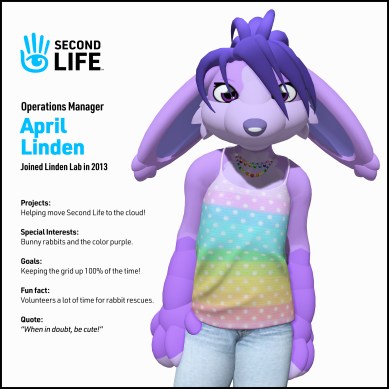
April Linden’s info page in the SL17B “Meet the Lindens” campaign designed to provide SL residents with short profiles on 47 Lab employees who volunteered to take part. Image courtesy of Linden Lab

November 5th 2021 finds me an unhappy / happy bunny Second Life bunny supporter.

Unhappy, because the day marks the last working day April Linden has with Linden Lab, and the grid will be the poorer for her departure. Happy, because the day marks the start of a new chapter in her life and career.

For those (can there be any?) unfamiliar with April, she has, for the last seven years, been a member of the Lab’s Engineering Team, the group of engineers responsible for keeping the servers that run all of SL’s various services purring (or grinding) along.

For the last few years she has been managing that entire team – and has used that position to keep Second Life users informed of all that goes on – the good and the bad – with SL’s servers and systems. In this regard, she has been our Number One Gridbun – so called because of her instantly-recognisable purple bunny avatar.

I’m the manager of the Second Life Operations team! It’s my team that helps keep the servers that run Second Life running. It’s my job to make sure they’re well fed, have the coolest toys, and know that going on vacation is okay!

– April Linden, in her official profile

With some 20 years experience in systems engineering environments, April was one of the many Lab employees who came to the company by way of first being a resident user of Second Life. Her attraction to the platform came via the empowerment it gives people to express themselves positively in a variety of ways. For April this was both the freedom to create (she had her own regions as a user), and – perhaps more importantly – because Second Life gave her the opportunity to undertake self-exploration in a safe, open environment without fear of repercussion, as she noted in 2018:

I come from a background – well, I’ll just be frank, where LGBT issues were not to be discussed, and it was through Second Life that gave me the power and the anonymity and the courage, really, to learn more about myself. And Second Life gave me the power to make my life so much better.

– April Linden

In this respect, April is a living example of the Lab’s recognition and support of people’s right to positively express themselves within an environment that embraces diversity.

April probably came to the notice of many Second Life users through her informative and insightful blog posts that would explain What Went Wrong and Why (what I call her W4 blog posts) after significant issues.

The bunny and the wizard: April Linden poses with her former boss, Oz Linden for an SL16B  session

Reporting on technical issues and resolution had always been somewhat spotty where the Lab was concerned.  During the “old, old” days of the Second Life website and blog, updates were fairly frequent – potentially due to the need for “Black Wednesdays”, when the grid would be down for between 6 and 8 hours on that day for deployment purposes (and often longer if things did go sideways). However, some time around 2008/9, communications became somewhat splotchy across the board, and technical updates a rate thing. Frank Ambrose (F.J. Linden) attempted to reverse this, up until his departure from the Lab at the end of 2011, but it was not until April took up the mantle once more that we were given informative and engaging blog posts on W4 situations.

And I really do mean informative and engaging – April has a way with words coupled with a deep understanding of the hardware and architecture running Second Life that she could communicate what had happened and what had been done to both rectify a situation and to try to prevent its recurrence in a way that many, many, users came to appreciate. So much so that, after particularly disruptive events, the first question that tended to be asked at User Group meetings tended to be, “Will April be blogging about what happened?”

In this respect, April did much to follow through on the re-opening of Lab / user communications initiated by Ebbe Altberg after he took over as the company’s CEO, and helped give users the confidence that communications really were opening up after a noticeable period without them.

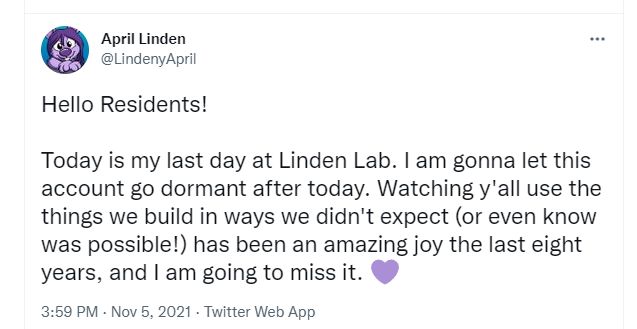
April’s farewell announcement

Most recently, April has been key to leading the Engineering Team through out Project Uplift – the work to lift, transition and place all of SL’s complex systems and services from a dedicated operational environment and into “the cloud” and Amazon AWS hardware and infrastructure. With the completion of the physical moves, she and her team have been engaged in the post-uplift work to better bed systems into their new environment and leverage new monitoring and engineering capabilities offered by AWS.

April announced her departure via Twitter, and the news was immediately responded to with a wave of well-wishing mixed with regret at see her leave the Lab. And it its true, April will be missed – not just because of her blog posts, but also because of her bright outlook and irrepressible positivity.  Whoever takes over from her has some awfully big (bunny) shoes to fill.

To April, I can only repeat what I said in my own reply to her tweet – that I wish her every success with her new career path and all the very best for the future. BUT – I’m not going to say “goodbye”, as I’m absolutely sure that she’s find the time to remain a part of Second Life as an active resident.

Grumpity Linden talks Second Life to Le Journal du Net

Second Life banner piece for the October 25th issue of JDN

Cube Republic pointed me towards an article appearing in the French on-line newsletter, Le Journal du Net (JDN), a reference site for corporate executives produced by media group CCM Benchmark. The interview is also referenced on the Lab’s official In the Press page. Entitled Second Life’s annual GDP is $650 million, the article is the banner piece for the October 25th issue of JDN, the piece in places makes for interesting reading whilst also covering ground with which many SL users may already be familiar.

The piece starts with a discussion of the recent rise of “the metaverse” as a catch-all buzzword among tech companies from Epic Games to Facebook, and outlining the fact that much of what is now being hyped was similarly hyped 18-20 years ago, with Second Life one of few platforms that actually attempted to achieve it, and which should now, by rights, be regarded as a forerunner and living example of what “the metaverse” might be.

From here, she draws on a key differentiation between Second Life and the vision Zuckerberg’s company is offering – and the barriers they may well face.

I think they themselves realized that the reputation Facebook has forged over time can be a barrier. This lack of confidence in the company exists and there will have to be a number of levers of confidence to allow those who wish to explore these virtual worlds. But it is still too early to get a clear idea. At Second Life, we ensure the privacy of our residents. For example, some assume their homosexuality in Second Life, but we know that some may live in areas of the world where their sexual orientation could lead them to prison. We are therefore extremely vigilant on this issue of data security. With the immense wealth of data in the hands of the digital giants, it will be necessary to ensure the protection of the privacy of the users of these virtual worlds.

– Grumpity Linden (aka Anya Kanevsky, Linden Lab’s VP of Product), talking to French newsletter JDN

Later in the piece, she goes on to make a key point that has helped Second life achieve its longevity and which seems to be a point missed in many of the discussions / statements by other companies wishing to stake their claim to a vision of “the metaverse”:

Everything in [Second Life] was created by our residents and not by Linden Lab employees. We just play the role of facilitator. This represents our vision of the metaverse. I don’t see how creating different games that would be connected to each other could be akin to the metaverse. In my eyes, this is content created by companies for users. For the metaverse to exist, it must be created and managed by the people who live there.

– Grumpity Linden talking to French newsletter JDN

The more familiar waters sailed by the piece include things like the 200,000 monthly unique log-ins SL enjoys, the uptick in engagement seen during the core months of the Sars-CoV-2 pandemic (and that the Lab feel they are seeing many of those who turned to the platform to remain even as the freedom to get out and about in the physical world gets easier, even if at a reduced number of hours per session). It is in these discussions that the article’s headline – SL having a GDP of US $650 million – is references, and that in 2020, users collectively withdrew a total of US $73 million from the platform (potentially hinting at an overall rise in general revenue flowing into / through the Lab over 2019),

Whilst being cagey on the Lab’s overall financial footing, the point is made that it has been profitable for a long time. This sits alongside a comment on the way in which the lab has attempted to be responsive to changing economic needs by realigning where and how it generates its income from the platform. Tilia Pay is also touched upon, together with its importance to Second Life – if not its potential as a revenue generator for the Lab as a whole; an honest assessment is also given on Sansar and immersive VR – which also hints towards the Lab’s vision looking to a future that is broader than any reliance on VR headsets.

While a number of early adopters shared their enthusiasm with us, we also observed resistance from some users. Many were not thrilled with the idea of ​​carrying these VR headsets that are quite heavy and require enough space at home to be able to use them. If virtual reality allows for an immersive and incomparable experience, we observed that few of our residents were ready to wear these helmets for more than thirty minutes. So we plan to keep trying new things around virtual reality, but VR isn’t the only possible future for Second Life.

– Grumpity Linden talking to French newsletter JDN

In terms of this broader view of the future for SL in particular, Grumpity notes the need to provide access to it “on all platforms and on different devices,” even if the experience in accessing SL is not identical across all such platforms / devices.

The article itself is relatively short, but covers some good ground in a manner that will met the needs of JDN’s general readership. It provides a good “executive summary” approach, transmitting its core information without undue exposition. In closing the piece, the journalist, Adrien Tsagliotis, offers a quote from Grumpity that mirrors something I’ve long believed myself (and is actually evidence by the reality of SL’s user numbers), and which stands as something all those hyping “the metaverse” should perhaps keep in mind:

We have observed over the years that the population as a whole is not necessarily open to living this immersive experience in a virtual world. Once the hype around the metaverse is behind us, I think we’ll observe that not everyone is necessarily interested in experiencing virtual worlds.

– Grumpity Linden talking to French newsletter JDN

Opinion: LL, NFTs and a “WTH?” moment in Second Life

via Linden Lab

On Thursday, October 21st, Linden Lab took to their blog and to social media to announce the Zenescope x Second Life Sweepstake. Featuring some 40 NFTs – non-fungible tokens – the announcement met with a certain amount of “WTH?” reactions, my own among them.

The NFTs concerned are produced by Epik, and are focused on a series of digital images related characters from the Zenescope Entertainment’s “Grimm universe” (that is, characters somehow connected to stories associated with the Brothers Grimm).

Some may recall that Zenescope (and Epik) are in a partnership with Linden Linden that launched on August 4th with the opening of the “Zenescope Metaverse” in Second Life; a place promoted by LL as “bursting with magic and mystery” where people could “Experience storytelling and comic books in a whole new way”, a “huge” region “so highly detailed that it might just take several visits to see everything”, but which I found decidedly underwhelming.

The sweepstake is a continuance of that partnership, and marks a further extension of it that many SL users may not have been aware of, so I’ll just dip into here to offer a little more context.

As a part of this partnership, October saw Epik start to offer through their Epikprime marketplace, NFTs tied to nine individual Zenescope character images (apparently sponsored by LL) in various quantities. So, for example The Gretel and Belle images each have 1,000 NFTs (with each NFT having a minimum price of $27.00) while the Sky Mathers image only has 125 NFTs (with each NFT having a minimum price of $147.00.

For sweepstake prizes, I believe LL has taken 10 each of the NFTs bound to the Belle, Gretel and Cinderella images, and a further 10 from a “Halloween” image to be issued on October 25th.

What is an NFT?

VERY simply put for the purposes of this article: an NFT is a digital “certificate of authenticity” created using blockchain technology that represents an easily-reproduceable digital item (a piece of art or music, a game, a document or photograph, etc.), recording the provenance of that item – its origination (creator, date + time of creation, etc), and its subsequent chronology of ownership / custody location in the digital ether. 

It is the uniqueness of the data in the NFT that generates its value, not the item to which is bound, which can still be copied and shared just like any other file on the Internet.

One of the character image / NFTs purchase pages on the Epik Marketplace – Gretel is one of the characters for which NFTs are being offered as prizes in the sweepstake

When it was launched, the Second Life / Zenescope / Epik partnership was framed by LL as a part of a drive to expose SL to potential new audiences. But as noted, the “Zenescope Metaverse” revealed itself as a tepid environment, and even now, some 2.5 months later shows no sign of delivering on  hyperbole surrounding its launch, or present itself as a gateway into SL for Zenescope readers. Of course, that could change quickly – I’ve no idea what LL / Zenescope have planned; but right now it does feel like a hollow promise, and combining it with the sweepstake event leaves one feeling the whole LL / Zenescope / Epik partnership is decidedly lopsided and lacking in reciprocity¹.

Insofar as the sweepstake itself is concerned, another cause of a “WTH?!” reaction came when reading the rules for entry as published by the Lab. To whit:

[winners] may be required to execute and return an affidavit of eligibility, a liability release and, where lawful, a publicity release within seven (7) days of date of issuance

– from the Winners Notification section of the sweepstake rules

And:

Each winner, by acceptance of prize, except where legally prohibited, grants permission for Sponsor and its designees to use his/her name, address (city and state), photograph, voice and other likeness and prize information for advertising, trade and promotional purposes without further compensation, in all media (including digital media) now known or hereafter discovered, worldwide in perpetuity, without notice or review or approval.

– from the General Conditions section of the sweepstake rules

Obviously, given NFTs are intended to prove the provenance of a digital collectable, the recording of the owner’s identity in some form is to be expected. However, that the Lab – a company that has traditionally prided itself on respecting its users’ anonymity – should offer the suggestion that any personal information might be requested could be passed to whomever they designate (such as Zenescope and Epik) for purposes of their advertising and promotion, makes for uncomfortable reading².

For me the biggest “WTH?” reaction, however, came with the idea that Linden Lab – a company that oft wears its social conscience on its sleeve  – would opt to engage with a technology (blockchain) and format (NFTs) that has been repeatedly shown to be environmentally unsound.

The most common blockchain environment used to create and curate NFTs is Etherium. According to the Digiconomist website, a single Ethereum transaction, such as creating an NFT or selling it, a carbon footprint of about 33.4 kg of CO2 – the equivalent to 74,000 Visa card transactions or watching 5700 hours of You Tube videos, – and consumes enough electrical energy to power an average US household for a period of 6 days³. Others put the impact of individual NFT transactions even higher, indicating the “minting” of an NFT produces up to 83 Kg of CO2 and consumes up to142 KWh of electricity (enough to power the average US house for around 12 days), with an subsequent transactions generating an average of 48 Kg of CO2 each.

So, if I’m reading the Epik marketplace pages correctly, if all 5,125 “Zenescope x Second Life” NFTs currently being promoted. are all minted, they will generate a total carbon footprint of 171,175 kg (using the Digiconomist figures), with a further 33.4 Kg added with each sale or other transaction related to each of them. By comparison, were 5,125 print of the images to be made and individually shipped anywhere in the world, each would only generate (according to Quartz and others) a carbon footprint of just 2.3-2.6 Kg, it’s a far more ecologically responsible option.

True, printed copies removes the animated uniqueness of the actual images – but this could be compensated for by the prints being individually signed and numbered by the artist., something that would also help the prints maintain there resell value. And you’re thinking any such resale value would be less than that of any NFT equivalent, let’s just be honest: these particular NFTs really aren’t going to set the NFT collector market on fire and demand stellar prices.

But if LL feels it must jump on the NFT hype train, then I cannot help but agree with this tweet on the subject:

SecondLie may be a parody account with a slick hand for the snark – but it can also offer clear and honest commentary

Obviously, this is in many ways easier said than done, but there are potential opportunities to be had:

  • It would demonstrate LL’s engagement with and support of their own users and platform, removing the perception they are simply “shilling” (to use a term that has popped up in several places in reference to this sweepstake) for a third party.
  • Properly promoted and broadcast, the availability of NFTs produced through SL could speak to the world about relevance of the platform as a place of creative endeavour and expression, potentially encouraging other artists from all walks to come and give it a go.
  • It could be combined with other opportunities for outreach and promotion to more broadly demonstrate the “multi-role” nature of Second Life in addressing use-cases from all walks of life, and offer a place of relaxation, learning, fun, business, and so on at a time when others are still struggling to define what they mean by “metaverse”.

As it is, this “sweepstake” is generating a lot of “likes” and “loves” on social media – although it is hard to tell if this is the result of people actually reading the associated blog post / wanting to winner one of the prizes, or simply the result of instinctively clicking the “like” / “love” icon in response to a posting from an official SL social media account. Whether it results in the Lab seeing this particular offer a “success” and thus worth possibly repeating, or whether they’ll heed the largely negative comments that have similarly left on said social media posts and so think twice about any repeat, I’ve no idea. Purely from my own perspective, I’d rather they didn’t run with any repeat, and instead continue to devote their time and effort on those things that are actually going to raise broader awareness of SL’s continued presence, vitality and relevance – and which can encourage people to come and experience the platform for themselves.

  1. It was recently pointed out to me that Aura Linden recently opened a viewer repository focused on puppeteering, something which has lead to some wild speculation on my part. Might this be a means LL are looking to use within the Zenescope region to allow visitors to “Experience storytelling and comic books in a whole new way”, through the use of NPCs based on the characters being promoted via Epik? Given the state of the repository code, this does seems an awfully long guess (and so probably wrong).
  2. I have actually contacted LL on this and the idea of distributing personal information, but have yet to receive a reply.
  3. And if you think that is bad, Bitcoin is even worse: Digiconomist estimate a single transaction carries a carbon footprint equivalent to 1,880.406 Visa card transactions or watching 141,404 hours of You Tube videos, while consuming enough electrical energy to run an average US household for two months!