Dio beta launched – and it might be more than it seems

LL logoUpdate, February 19th, 2014: dio was discontinued by Linden Lab on February 19th, 2014. Links to the dio website, etc have therefore been removed from this article.

Linden Lab has officially launched dio, the latest in its new product line, in a beta release on Tuesday 29th January.

dio has been subject to much speculation since the original website was accidentally left accessible to enquiring noses back in May 2012. More recently, the site has been extensively updated, giving some clues as to what it is about.
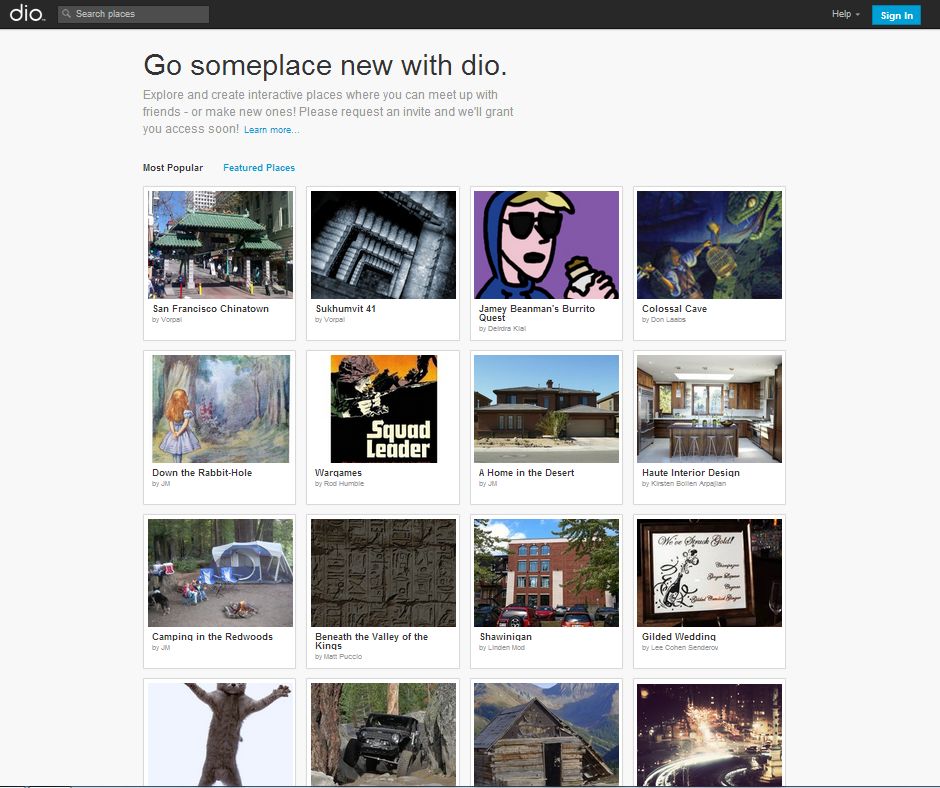
The new Dio website homepage - launched on 29th January (click to enlarge)
The dio website homepage – launched on 29th January

The press release announcing the launch reads in part:

In dio, you create places by adding text, photos, videos, and interactive objects into interconnected ‘rooms’ that give spatial context to the content you share. You can keep your places private, share them with friends and family, or allow everyone to explore and enjoy them. Live and persistent chat allows you to socialize with other users as you discover and explore dio places together and see what those who came before you had to say. In the future, dio users will be able to monetize the dio places they create, enabling them to profit from their own creativity.

The Learn More link on the site provides more information on the site, and there is an introuctory vdieo to accompany the launch.

Within dio, users can create places – such as their own homes – or recreate events in their lives, such as their wedding, or make picture-based games, and so on, and then select how to share them. All of these aspects cane be combined, as dio Producer Bo Barfield explained in an interview with Forbes Magazine to mark the launch:

You can combine these game-like experiences in places where they traditionally wouldn’t be. As an example, a hotel that’s trying to find a new way to advertise and make money can recreate their hotel in dio, and then make a short and easy game that takes a few minutes. Say Clare Danes lost her beloved emerald earrings. Find it somewhere in the hotel, and you get a free bottle of champagne with your stay. It’s using gamification in a richer way. It’s not just about getting badges or achievements: It gets customers imagining themselves in your hotel or whatever it is you’re trying to market.

Questions as to how dio will be monetised, both for the Lab and for users, are also answered – to a point – within the  Forbes article, where Barfield states:

We want to implement revenue sharing with the content creators of dio to give people an incentive to create interesting spaces. We’re going to give them a cut of the advertising revenue that they bring.

We’ve seen that work exceptionally well in Second Life, where users can monetize their own creation…. If I create a dio place that’s very compelling and is getting lots of traffic, then I’ll be able to monetize that as a share with Linden Lab.

So it would appear to be that dio is perhaps the Lab’s most ambitious product to date, aiming at a very broad cross-section of users, from individuals through to businesses.

Interestingly, the dio Terms of Service still make reference to the use of Linden Dollars. Given the website is still beta, this may be down to the fact that the ToS is still boilerplated from the Second Life ToS – a point I’ve previously made. While I’m still somewhat drawn to this being the case, it is nevertheless interesting to speculate where and how Linden Dollars might be linked to dio, and what form any cross-pollination between dio and Second Life (were there to be any) might take.

Also accompanying the launch is a set of video tutorials on You Tube.

The response from Frobes’ contributor Carol Pinchefsky is broadly positive towards the platform. Those wishing to sign-up can do so (it’s free), either by using their Facebook account or using their e-mail address.

I’ll be looking at dio in-depth in an upcoming article.

Related Links

Blocksworld – LL’s latest acquistion

LL logoI actually missed this yesterday, despite tending to look-in on LL’s Press Room on a daily basis. I did so yesterday, but Pete Linden must have been waiting until I’d done so before slipping the announcement that LL have acquired Blocksworld in their latest move in the world of “shared creative spaces”

Blocksworld is created by Boldai AB, a team of three programmers who jokingly refer to themselves as being, “From the country that gave you Minecraft and the country next to the country that invented Lego”, and is described as, “A perfect mix of Lego and Minecraft.”

Currently available for the iPad – although the Bodai website suggests there are (or were) plans to port the game to other platforms – Blocksworld allows users to create 3D models of just about anything they can image from a set of defined shapes / tools such as cubes, wedges, rockets, wheels, motors These models – which can be cars, planes, animals, people, spaceships, etc., come alive with realistic physics simulation, and users can play, interact with, or even blow-up their creations.

Commenting on the acquisition, Linden Lab’s CEO, Rod Humble, said, “Blocksworld is a great fit with what we do at Linden Lab,” said Rod Humble, CEO of Linden Lab. “It’s a very user-friendly complement to our portfolio of shared creative spaces. We’re happy to have the Blocksworld team join Linden Lab and are looking forward to bringing Blocksworld to the App Store worldwide soon!”

As with Creatorverse, a key aspect of Blockeworld is the ability for users to share their creations with others to explore, play with, and modify / remix them to make them their own.

Blocksworld looks designed to appeal to the creatively minded of all ages, with an intuitive, easy-to use interface. To promote the product, the team behind it last year produced as couple of video trailers, one of which – the “Honest Trailer” is a slight tongue-in-cheek piece which promotes the product in an imaginative and fun way which perfectly encapsulates the product and fixes it firmly in one’s mind.

…Perhaps LL should let the Boldai team brainstorm how to promote SL?

Related Links

Versu: Regency England with murder, ghosts and romance

Update January 3rd, 2012: following posts on the Versu FAQ from myself and Ciaran Laval, the FAQ has been removed from the Versu website.  The Dio Help page still remains available for that product – at least for the present!
ALL logofter my brief look at the Versu and Dio websites on New Year’s Eve, I poked a little deeper into the Versu site, taking time to paw over the FAQ, which sheds a little more light on things than I’d initially realised.

As has already been indicated by Rod Humble, Versu is an interactive storytelling medium which relies on strong character interaction, with the plot and character behaviours driven by the actions and reactions of the player through their character.

The Versu website placeholder from Linden Research, December 2012

Versu will initially be browser-based only, although there are expectations at the Lab that a tablet version will be available in the future. Access will apparently be – initially, at least – via Facebook, with the FAQ stating that there is a “limited number” of development accounts available for those wishing to access the game without going via Facebook. The game is largely text-based, again has already been indicated, but will include images of the other non-player characters in the immediate vicinity of the player’s character.

Versu's stories will initially be set in Regency England (1811-1820)
Versu’s stories will initially be set in Regency England (1811-1820)

The initial story appears to be a murder mystery, and features a choice of principal characters – “Lucy” or “Miss Bates”. The FAQ indicates that two additional stories are in development, “A ghost story and a romance story in the same time period (Regency England [1811-1820]) are already partially drafted and will be presented at launch.” It goes on to say that, “In the future, we will also include episodes from other settings — anything from spy thrillers to comedy to noir detective stories. Anything that involves strong character interaction is a good fit for the Versu engine.”

Progress through the story is up to the player. For example, a player can select from a list of available scenes, then chose to interact or not. How they interact with the other non-player characters will shape how those characters react to the player in the future (so flinging a bread roll at Mr. Quinn may not endear you to him). If a player chooses not to interact, the story will still progress, making for interesting variations in gameplay – particularly on the “what if” department (“What if I’d left dinner before X, and gone to Y?”; “what if I’d selected A instead of B?” and so on).

Interestingly, some progress through the story is down to what amounts to random chance. To quote the FAQ again, “Whether a character spills something by accident, or selects one conversation gambit or another, might be the result of randomization.”

Progress through gameplay is also marked by the player’s character completing assigned tasks, which doubtless help guide the player through the story to one of several potential conclusions. Progress through tasks can be reviewed via an “Achievements” page.

Games will be entirely self-contained, such that while there are several potential ways to reach the denouement to a story, and the story itself has a number of different endings depending on choices made and actions taken, the cast list will remain the same for each. Thus, any characters previously “killed off” will be brought “back to life” at the start of the next game.

There are also some limitations with the game:

  • The initial release will be single-player only; multiplayer capabilities (such as playing together in different roles or working with other players to resolve a story) are planned for the future
  • There will be no option to save gameplay with the initial release.

Also, players will not initially be able to generate their own characters. However, the FAQ indicates that this is again planned for the future and will include the ability for players to, “Define your own character, complete with appearance and expressions, personal preferences and unique dialogue options”.

An interesting note with Versu is that the Terms of Service refers to user-generated content (section 4.4). This may simply be because the ToS has been largely boilerplated from Second Life, and thus may not be indicative of how the ToS will appear one it has been fully edited. However, the linked DMCA page is similarly “Versu’d”, so it does raise a question as to what user-generated content might be applicable, particularly if Versu is to fit under the Lab’s umbrella of “Makers of Shared Creative Spaces”.

Is section 4.4 of the ToS simply a reference to a player’s ability to generate their own character and character image, or is it something more?  Again, could the FAQ reference that, “Anything that involves strong character interaction is a good fit for the Versu engine”, mean that the engine might be opened to third-party developers for future stories?

The Facebook access is also interesting, as mirrors what appears to be Dio’s preferred access mechanism (at least initially). As such, it would seem that both Versu and Dio are an attempt by LL to tap-into the large, potentially ready-made Facebook audience. Currently, there is no real indication as to how either will be leveraged from the point of view of generating revenue, although a few thoughts have sprung to mind on that subject.

All told, the website give more information on Versu than I’d initially given it credit, as does the “Help” option on Dio provides a little more information there. Hopefully, and depending on access, I’ll have more information on both in the near future.

Linden Lab’s Dio and Versu websites appear

Update, February 19th, 2014: dio and Versu were discontinued by Linden Lab on February 19th, 2014. Links to their websites, etc have therefore been removed from this article.

Update January 1st, 2013: I finally took a proper look through the Versu FAQ and have provided further information in a new report.
LL logoLinden Lab have slipped out the initial cuts of the Dio and Versu websites. Currently, there is nothing on the corporate website relating to the latest items in the new product line-up from the Lab, although Dio caused a stir early in 2012 when a nascent website bearing the name was accidentally made public.

Neither of the new websites give much away – Versu in particular is rather bland, but both point to the new products potentially approaching a point where they’ll be launched in the near future.

The Versu website placeholder from Linden Research, December 2012

Versu will be the first product to emerge from the Lab directly as a result of their acquisition of LitleText People, also early in 2012, and has previously been described by Rod Humble in a Techcrunch article as, “Procedural interactive storytelling. Basically you set the motives and the behaviors of the individual characters and the plot gets generated as you go, and each time it’s different.”

Techcrunch themselves interpret this as meaning, “The idea here is to tap into collaborative storytelling, something that’s been gaining in popularity in online spheres, as evidenced by the traction social writing startup Wattpad has seen. But with Versu, Linden Lab adds a gaming element to interactive storytelling that essentially allows players to create their own characters which then write themselves. It seems like a smart way to capitalize on the observer tendency that’s turned Second Life players into story watchers.”

The new website, as shown above, currently gives little away, however, this is liable to change as the release / beta / however LL opt to launch, draws closer.

The new Dio website, by contrast, has more in the way of content. This is unsurprising, as it appears that Dio is actually the next product on the runway to follow-on from the launches of Patterns and Creatorverse. However, whether the content is genuine or simply placeholders for testing purposes is unclear, at least to me, as I’m not a Facebook user – and Facebook is required to log-in to the site (if log-ins are indeed open).

Again, in talking to Techcrunch in November, Humble described Dio as, “A web experience called Dio that’s really hard to explain, which I like. It’s sort of like Second Life without the graphics, or Facebook but trying to be more of a creative space.” He goes on, “So it’s a web experience and you create your space, but within the spaces, everyone has their own avatar and avatars carry inventory. The way you navigate from space to space is via doors, and you can make things like a MUSH [multi-user shared hack] or hobby space very easily.”

The new Dio website homepage (click to enlarge)

As noted above, logging-in to the Dio website requires a Facebook account, and even the “request an invite” button leads to the Facebook log-in page. Whether the latter is intentional or not is currently unclear; however, limiting log-in to Facebook may limit Dio’s appeal to SL users, but would obviously open it out to the entire Facebook community, potentially raising its visibility.

Clicking on any of the options on the home page is possible, but again, little is given away as to what they do, or to provide more insight into the site than Humble’s description to Techcrunch.

One of the options ("albums"?) within the Dio website
One of the options (“albums”?) within the Dio website

Some of these options allow you to drill down further, but overall, it is currently hard to see how things link together and how “avatars” and “carrying inventory” fit within the scheme of things. Options then range from games through what appear to be tour guides, to business portfolios, to collaborative projects, discussion groups and personal photo albums, making Dio something of a melting pot of ideas and potential uses.

For those interested / curious about the directions LL is taking vis-a-vis new products, then these two websites are potentially to the two to watch as 2013 unfolds, even if right now, they raise more questions than they answer.

Related Links

Patterns: updated Genesis release now being sold directly through the Lab’s Patterns website

LL logoUpdate, October 9th, 2014: Linden Lab announced that development work on Patterns has been discontinued.

On Friday December 21st, Linden Lab announced it is now selling Patterns directly through its own website at BuildPatterns.com. Until now, the first of Linden Lab’s new products to be released had only been available via Steam, requiring those wishing to purchase it to set-up an account with Steam prior to being able to download Patterns.

Patterns: development isn't a case of "either/or" with Second Life (image courtesy of Linden Research Inc.)
Patterns: now available directly from Linden Lab at BuildPatterns.com (image courtesy of Linden Research Inc.)

In a press release announcing the move, Linden Labs state:

Today, the updated Patterns ‘genesis release’ is available at BuildPatterns.com at a 50% discount for adventurous early adopters. Since the genesis release of Patterns was first launched in October, updates have expanded the game with new substances you can destroy, build with, bounce, and slide on; new formations you can create to blow things up or cover surfaces with ice; new planets to explore; and more … Buyers of the Patterns genesis release will receive all updates up to and including version 1.0 at no additional cost.

Initial take-up of the product appears to have been strong, with many non-SL users already signed-up to Steam downloading and engaging with the game, leading to a fairly lively Patterns community on the BuildPatterns.com website. Many have also produced their own videos of the game in use and have put forward suggestions and ideas for the development of the game. Feedback has been such that Linden Lab has routinely issues updates and improvements to Patterns, many of which incorporate ideas and feedback obtained about the game and its user interface.

Commenting on the reception and take-up of the game in the press release, Rod Humble says: “Patterns is still in its infancy, but it’s been great to see the early positive reviews and the fantastic things that our founding players have already created … There are lots of exciting developments on the roadmap for Patterns in 2013 as we progress towards version 1.0, and we’re happy to be able to give interested early adopters more ways to get into the game at this early stage.”

The new release of Patterns marks the sixth update to the game and includes:

  • Contact Bomb explodes on contact.
  • Time Bomb goes off after a short while
  • Trigger Bomb and Plunger allows you to set it off remotely
  • Ice Bomb spreads ice all over the blast radius
  • Proxy Bomb build it and it will go off
  • Kiln and Forge that enables you to take a substance and turn it into another substance. Turn clay to brick for example
  • Visual updates to the sky
  • New day night cycle measured by sun and moon
  • An assortment of visual effects for physical substances
  • New character animations.

A video has been produced to provide an overview of the new features.

The video also provides an overview of some of the forthcoming features in 2013. Chief among these will be the ability to share creations and builds with other users of Patterns, and to download and modify builds by others. Whether or not this will see a means for people to monetize their creations in the future remains to be seen; certainly, this has been mentioned in the past where the new products are concerned, and particularly with reference to Creatorverse, so it is not unreasonably to assume Patterns may well also be moving in this direction.

Also coming in 2013 – and which most definitely has been repeatedly requested by Patterns users is multiplayer support.

The caption says it all (courtesy Linden Lab)

There are no time frames for the delivery of either the capability to share builds or multiplayer support – which is entirely in keeping in the Lab’s philosophy of not assigning dates to feature deliveries. However, that both are going to appear in 2013 is liable to make those already actively engaged with Patterns very happy.

Related Links

“Creatorverse Lite” now on Android

LL logoOn Monday 17th December, Linden Lab launched “Creatorverse Lite” for iOS. I commented at the time that we’d likely see the same occur with the Android and Kindle flavours – not that it took any particular insight to work that one out. Really it was a case of “when” rather than “if”.

Well, apparently, it was December 19th, although I swear it must’ve been late-on in the day when the announcement came, as I checked the Lab’s PR page, late yesterday afternoon (UK time) and there was bugger all about it then. Ho hum.

Anyway, “Creatorverse Lite” is indeed now available as a free download on Google Play, As with the “lite” version for iOS:

This free version of Linden Lab’s shared creativity app allows users to explore and play with the entire Creatorverse galaxy – every creation made and shared by users of the full Creatorverse app on any platform. To remix others’ creations or create and share their own, users will continue to need the full, paid version of Creatorverse.

Creatorverse Lite - includes a button to upgrade to the "full" version as the usual price
Creatorverse Lite – includes a button to upgrade to the “full” version as the usual price

Both the iOS and Android versions of the “Lite” product include an on-screen button enabling people to download the “full” version on payment (currently $4.99 / £3.14 / 3.86 Euros).

Related Links