I generally keep an eye on the Lab’s corporate website, but confess that things have been such that over the last month, other things have been keeping me occupied so I’ve been a little lax in my checks; however, the Lab have refreshed the Leadership section of the company’s About Page. I’m not sure precisely when this happened, but it appears to have been some time towards the end of August 2014, or early September.
The updated Leadership section of the page sees an expanded management team list complete with photos for all of those on it, rather than the mix of photos and the “creation” images previously found against individual bios.
New to the page (but not necessarily to the Lab) are photos and bios for Rob Anderberg, Senior Director of Development, Pam Beyazit, Senior Director of HR, Scott Reismanis, Director of Digital, and Peter Gray, Director, Global Communications.
LL’s management team: LL’s management team: Rob Anderberg, Pam Beyazit, Scott Reismanis (of Desura fame) and Peter Gray (tow row) join Ebbe Altberg, Kelly Conway, Don Laabs (Danger Linden), Landon McDowell (Landon Linden) and Jeff Petersen (Bagman Linden) (bottom row) on the Lab’s corporate website management page
They all join the familiar line-up of Ebbe Altberg, Kelly Conway, Don Laabs, Landon McDowell and Jeff Petersen.
Gone from the management list is John Laurence, VP of Product, although his LinkedIn bio still records him as working at the Lab (and he was still listed as a member of the management team in August 2014). if he has in fact recently left the Lab, he succeeds Lee Senderov, formerly the Lab’s VP of Marketing, as the most recent departure from the Lab’s management team; Ms Sederov having moved on from the Lab around April 2014 to join Shopular as the Head of Marketing there.
The list of board members remains unchanged since Will Wright’s departure towards the start of 2014.
These updates both reflect changes to the Lab’s management structure and a gradual re-tuning of the corporate website itself, which also saw the removal of the Beta Sign-up option from the menu bar at the top of each page some time around the end of August, and which had previously seen the tag-line “Makers of Shared Creative Spaces” replaced by “Build Worlds With Us” some time in July or August 2014.
A final potential point of interest on the corporate site lies in the Careers Page, which has a list of ongoing career opportunities most likely linked to the Lab’s planned staff expansion to help in the development of their next generation platform. The point of interest is that two of the current positions – for a Senor Software Engineer and a Senior Software Engineer, Avatar – are referred to as being located in Cambridge, Massachusetts, rather than at the Lab’s Boston office, as one might expect. Does this signify that some of the work on the new platform is being carried out somewhat separately from the Lab’s core activities on the East Coast? Time may tell.
In May of 2014, Landon Linden, aka Landon McDowell, the Lab’s VP of Operations and Platform Engineering, wrote a blog post on the reasons why a series of issues combined to make Second Life especially uncomfortable for many.
At the time, and as many bloggers and commentators – myself included – noted, the post came as a refreshing breath of fresh air after so long without meat-and-veg communications from the Lab in terms of what is going on with the platform and why things can go wrong.
Now Landon is back explaining how the Lab’s Ops team responds to issues within their services, the communications tools they use – and why the tools are so effective.
An Inside Look at How The Ops Team Collaborates is once again an interesting and informative piece, delving into not only the technical aspects of how the Lab respond to problems within their services, but which also encompasses the very human aspects of the dealing with issues – handling emotions when tensions are high, opening the window for those not directly involved in matter to keep an eye on what is happening so that they can also make better informed decisions on their own actions, and more.
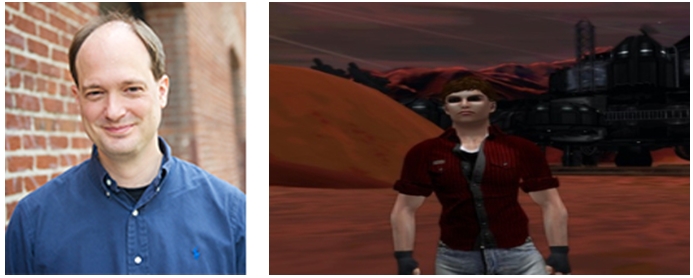
Landon McDowell, the Lab’s VP of Operations and Platform Engineering and his alter-ego, Landon Linden
The core of the Lab’s approach to incident communications is the use of text chat (specifically IRC) rather than any reliance on crash team meetings, the telephone and so on. Those who deal with the Lab on a technical level won’t be surprised at the use of IRC – it is a fairly strong channel of communication for the Lab in a number of areas; but what makes this post particularly interesting is the manner in which the use of IRC is presented and used: as a central incident and problem management tool for active issues; as a means of ensuring people can quickly get up-to-speed with both what has happened in a situation, and what has been determined / done in trying to deal with it; as a means of providing post-mortem information; and as a tool for helping train new hires.
These benefits start with what is seen as the sheer speed of communication chat allows, as Landon notes:
The speed of text communication is much faster. The average adult can read about twice as fast as they can listen. This effect is amplified with chat comms being multiplexed, meaning multiple speakers can talk intelligibly at the same time. With practice, a participant can even quickly understand multiple conversations interleaved in the same channel. The power of this cannot be overstated.
In a room or on a conference call, there can only be one speaker at a time. During an outage when tensions are high this kind of order can be difficult to maintain. People naturally want to blurt out what they are seeing. There are methods of dealing with this, such as leader-designating speakers or “conch shell” type protocols. In practice though, what often prevails is what one of my vendors calls the “Mountain View Protocol,” where the loudest speaker is the one who’s heard.
In text, responders are able to hop out of a conversation, focus on some investigation or action, hop back in, and quickly catch up due to the presence of scroll back. In verbal comms, responders check-out to do some work and lose track of the conversation resulting in a lot of repeating.
He also notes that not everyone is involved in a situation right from the start. Issues get escalated as they evolve, additional support may be called-in, or the net widened in the search for underlying causes, requiring additional teams to be involved, or the impact of an incident spreads. Chat and the idea of “reading scrollback” as the Lab calls it, allows people to come on-stream for a given situation and fully au fait with what has occurred and what is happening in a manner not always possible through voice communications and briefings, and without breaking the ongoing flow of communications and thinking on the issue.
The multiplexing capabilities of chat also mean that individuals can disengage from the main conversation, have private exchanges which, while pertinent to the issue, might otherwise derail the core conversation or even be silenced in something like a teleconference – and those engaged in such exchanges can still keep abreast of the central conversations.
For an environment like the Lab, where operations and personnel are distributed (data centres and offices located in different states / on different coasts, not everyone working from an office environment, etc.), chat has proven a powerful tool, although one that may take time getting to grips with, as Landon notes about his first exposure, saying:
I … just sat there staring at the screen wondering what the hell had just happened, wondering what the hell I had gotten myself into. I thought I was a seasoned pro, but I had never ever seen an incident response go that smoothly or quickly. Panic started to set in. I was out of my league.
However, the benefits in using it far outweigh any need for a degree of gear shifting required by ops staff in learning to use the approach. As Landon states in closing his comments, “when it works it is a wondrous thing to behold, a ballet in a war zone, beautiful, terrifying, and glorious.”
This is another great insight into what happens inside the Lab, and as such, the post makes very worthwhile reading, whether or not you have a background in Ops support.
We’re all aware that the Lab is developing a “next generation” virtual worlds platform. It’s been the subject of much debate, speculation, supposition and more.
The confirmation that the Lab were working on a new platform came during a TPV Developer meeting on June 21st, when it was mentioned almost as an aside by the Lab’s CEO, Ebbe Altberg. In the period of the SL11B celebrations, mention of it also appeared in a number of on-line media publications.
However outside of these interviews and comments, there appeared to be no formal announcement about the new platform. Well, not until July 11th, anyway; that was when the Lab issued a press release about it.
Linden Lab has confirmed that it is developing the next generation virtual world that will be in the spirit of Second Life, an open world where users have incredible power to create anything they can imagine and content creators are king. With 2015 targeted for a beta, the new virtual world will go far beyond what is possible with Second Life, and Linden Lab is actively hiring to help with this ambitious project.
“Second Life is the most successful user-created virtual world ever,” said Ebbe Altberg, Linden Lab CEO. “Eleven years after first opening, it continues to thrive with more than a petabyte of 3D content created by users, a strong economy of user-to-user transactions in which tens of millions of dollars are paid out to creators every year, and an active community that spans the globe. There is a massive opportunity ahead to carry on the spirit of Second Life while leveraging the significant technological advancements that have occurred since its creation, and no company is better positioned to create this than we are.”
It doesn’t provide any more in terms of specifics than perhaps most SL users tracking the subject are already aware. However, it does at least pull together several key statements concerning the new platform, made throughout the epic forum thread on the matter, into a single reference source:
Linden Lab’s priority in building the next-generation virtual world is to create an incredible experience and enable stunningly high-quality creativity that’s easily accessible across multiple platforms. In order to not constrain development toward those goals, complete backward compatibility with everything created over Second Life’s 11-year history has not been set as an absolute requirement from the outset. However, Linden Lab does plan to make certain essential elements transportable for existing Second Life users, including users’ Linden Dollar balances, identities, and social connections. It’s likely that more modern content from Second Life, such as meshes, will also be transferrable to the new platform, but the specific details of compatibility will be addressed as development progresses.
You can read the entire release, including comments on the future of Second Life, on the Lab’s official press page.
On Monday July 7th, Linden Lab CEO Ebbe Altberg and the Lab’s Director of Global Communications, Peter Gray, met with members of the education community to answer questions on the future of education in Second Life.
The video is embedded below, and the transcript is time stamped against it for reference. When reading / listening, please remember:
This is not a word-for-word transcript of the entire meeting. While all quotes given are as they are spoken in the recording and the audio files, to assist in readability and maintain the flow of conversation, not all asides, jokes, interruptions, etc., have been included in the text presented here
If there are any sizeable gaps in comments from a speaker which resulted from asides, repetition, or where a speaker started to make a comment and then re-phrased what they were saying, etc, these are indicated by the use of “…”
The transcript picks-up with the first question asked.
0:04:42 Aldo Stern (AS): Will the educational discount be stable over time, so that education organisations can take [it] into account for their budget cycles? So I think that reflects right off of the top one of the things that people will have a concern about.
0:05:00 Ebbe Altberg (EA). Yes. Well, it’s very unfortunate that back in the day … that the discount was taken away. I thought it was very fortunate that it was re-instituted before I showed-up here, and I can tell you we have absolutely no intent whatsoever to make the pricing worse for you guys. none whatsoever.
And over time, as some of you have heard about, we’re starting work on a next generation platform, I think that ultimately an extremely large and vibrant and successful virtual world, prices have to come down all the time.
Today, we’re constrained by a number of factors: technology, business models, what have you, and user experience, that sort-of limits the size of the market for a product like this. for example, if we were to cut prices in half, we would have to get at least twice the number of users – or more, actually – to end up with the same revenue. Right now, I’m not convinced we have a product that could attract two extra users at half the price.
But I’d be happy to lower prices to get more users and make it up in volume, once we know we have a product that can achieve that. I think it’ll be an interesting conversation at that time, especially with the educational sector. would an even lower price … let’s say we take the current discount that you have, which I think is about a hundred and fifty bucks for a region; if we cut that in half again and say it’s seventy-five bucks, would we have twice as many of you buying simulators? If that’s the case, then it might be worthwhile for us to do; but if it only increases by 5% the number, then it’s just hurting us and our ability to invest in the future.
But I feel very confident in stating that we’re not going to mess with the current pricing you have in a negative way for you.
0:07:55 AS: I think that’s very encouraging to us, and I wanted to ask if anybody had any further comment before the next question?
0:08:08 Comment: Well, it is encouraging to hear that; but I think there are a number of related issues that make the current platform problematical for educators, and a number of questions we’ve identified I think will get at that, if you want to move down the list.
Ebbe Linden (Ebbe Altberg) and Pete Linden (Peter Gray) at the meeting with representatives from the education and non-profits community
0:08:26 Comment: I did want to say something about the pricing real quick. If you did lower the price for educators you might not see the number of buyers go up right away, because I’m not sure if you understand how the education funding cycle works, and probably everyone in the room here can explain that much better than I can. But that is the issue: getting into the funding cycle ahead of time to make sure that you have funds available for your projects. So if you implemented that today, cutting it in half again, you have to give the education community time to get that in their budget and make that happen.
0:09:27 EA: Absolutely, and there’s way to solve that. I could say, it’s a hundred and fifty bucks now and it’s 75 bucks starting next quarter, so you can put it in your plans. how much advanced notice do you need to be able to get it into your budget cycle?
0:09:48: About a year.
0:09:49 EA: My lord! (Chuckles).
0:09:53: And that’s why, when the funding was cut, it was so devastating, when the discount was cut, because no-one had enough notice to get their funding back up to what they needed, and so it was very frustrating for a lot of educational folks.
0:10:14 EA: I understand. I can’t even begin to understanding the reasoning behind why that whole thing happened. I’m just very glad it was reversed before I came here, otherwise I would have done that myself. So you can at least be confident that we’re not going to make that mistake again.
On Wednesday July 2nd, 2014, the Firestorm team hosted a special question and answers session to discuss the future of Second Life. The event was held to try to disperse some of the concerns and misinformation circulating about SL’s future in the light of the news that Linden Lab is developing an additional virtual worlds platform which is being planned to run alongside Second Life.
Attending the session from Linden Lab were Oz Linden, in his capacity as Technical Director for Second Life and Pete Linden, the Lab’s Director of Global Communications.
The session took the form of an initial discussion between host Jessica Lyon and Oz and Pete Linden, which sought to address some of the core concerns which have been raised and address some of the broader misconceptions which have resulted (such as Second Life no longer being developed and / or no longer having the staff needed to support it). This was then followed by a Q&A session led by Lette Ponnier, who posed questions which had been left on the Firestorm blog post announcing the meeting or directly to her via IM during the session or relayed to her from the live stream audience.
As always, Chakat Northspring recorded the entire event, and her video is embedded here – my thanks as always to North.
In addition, the audio from the meeting has been broken down into a number of individual topic areas, and placed throughout this transcript to allow people to listen to the audio whilst reading, if preferred, and to save on scrolling up and down between text and video.
When reading / listening, please remember:
This is not a word-for-word transcript of the entire meeting. While all quotes given are as they are spoken in the recording and the audio files, to assist in readability and maintain the flow of conversation, not all asides, jokes, interruptions, etc., have been included in the text presented here
If there are any sizeable gaps in comments from a speaker which resulted from asides, repetition, or where a speaker started to make a comment and then re-phrased what they were saying, etc, these are indicated by the use of “…”
The audio files have been slightly edited to remove lengthy pauses in order to assist the flow of the conversations when also reading the text.
The following links can be used to quickly jump to individual sections of the transcript:
On Friday June 6th, Emily Short announced through her blog that Versu, the interactive fiction engine she and Richard Evans developed while working at Linden Lab, and which was cancelled as a part of the Lab’s product review in February 2014, will now continue, and that Blood & Laurels, the interactive novel she has been working on for 15 years, will be launched on June 12th.
Following the announcement of Versu’s cancellation by the Lab, many of us speculated whether it might be allowed to live on separately to the Lab’s involvement, and Emily herself confirmed she was talking to the Lab on matter of IP. However, hopes this might happen seemed to have been completely dashed in March, when the Lab said no to any idea of selling the IP involved. However, they’ve since had a change of heart.
The notification that this is the case came in the form of a blog post which first appeared on the new Versu wesbite, and then reblogged on Emily’s site, which is where I came across it.
Versu was lauched to considerable acclaim prior to being cancelled by Linden Lab. Now it is set to continue (image from the Versu website)
Until February of this year, the Versu project had its home at Linden Lab, exploring the possibilities of interactive storytelling with advanced character AI by Richard Evans (Sims 3, Black and White) and dialogue modeling by Emily Short (Galatea, Alabaster), as well as work by authors Jake Forbes (Return to Labyrinth) and Deirdra Kiai (Dominique Pamplemousse).
When the Lab decided to refocus its offerings and cut support for Versu, the project was only three days from launching a Roman political thriller called Blood & Laurels. Blood & Laurels represented a significant step forward in complexity and depth from previous Versu stories: a large cast of characters, a richly branched two-part storyline, and over 240,000 words of interactive content — of which a player is likely to see only about 7% in a given play through. Character behaviour and relationships were modeled with at least as much fidelity as in earlier examples, but in a context with much higher narrative stakes. What other characters think of you affect whether your character lives or dies, thrives or fails — and those relationships are driven by both large and small decisions.
After Versu’s cancellation, it looked for a long time as though neither the underlying technology nor the finished stories had a future. However, we are delighted to be able to announce that Linden Lab has negotiated a new arrangement that will allow us to release these stories and explore a future for the engine.
The Versu blog post reveals that Blood & Laurels has been made possible by a language called Prompter, which is used by Versu and has been designed by Graham Nelson of Inform fame. Graham is also now a part of the new Versu team, joining Emily and Richard Evans.
Emily Short and Richard Evans are joined by Graham Nelson, the man behind the Inform IF system, and the creator of the Prompter language used by Versu
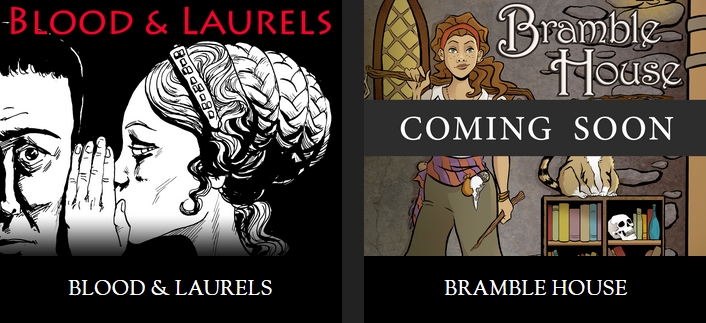
Blood & Laurels is set to be followed by Bramble House, an interactive fantasy story written by Jake T. Forbes, the author of Return to Labyrinth, a four volume graphic novel sequel to the Jim Henson film Labyrinth, and the English-language versions of the best-selling manga series Fullmetal Alchemist, Fruits Basket, One Piece and others.
Bramble House focuses on the character of 15-year-old Penny, who is “bound in service to the witch Stregma, forced to deal with everything from mundane dishwashing to evicting monstrous guests”. In it, the reader takes on the role of Penny, progressing through various situations and events in two stories set within the Bramble House world.
There is no publication date available as yet for the title.
Blood and Laurels (due June 12th) and Bramble House will be the first two titles released under the new Versu banner (from the Versu website)
The new titles will be appearing on the iOS platform. At the time of writing, it is not clear as to whether there are still plans to make Versu and its titles available for the Android platform; the website only goes so far as to state, “While we would like to support Android, we do not currently have an Android version available.”
This is excellent news for all with an interest in or passion for interactive fiction. Congratulations are extended to Emily, Richard and Graham with the launch to this new venture, and kudos, as well, goes to Linden Lab for reversing their decision on the Versu IP and allowing the project to continue.
Be sure to listen-in to an upcoming edition of the Drax Files Radio Hour interviews, when Drax will be talking to Emily Short about interactive fiction, Versu and more!
 I generally keep an eye on the Lab’s corporate website, but confess that things have been such that over the last month, other things have been keeping me occupied so I’ve been a little lax in my checks; however, the Lab have refreshed the Leadership section of the company’s About Page. I’m not sure precisely when this happened, but it appears to have been some time towards the end of August 2014, or early September.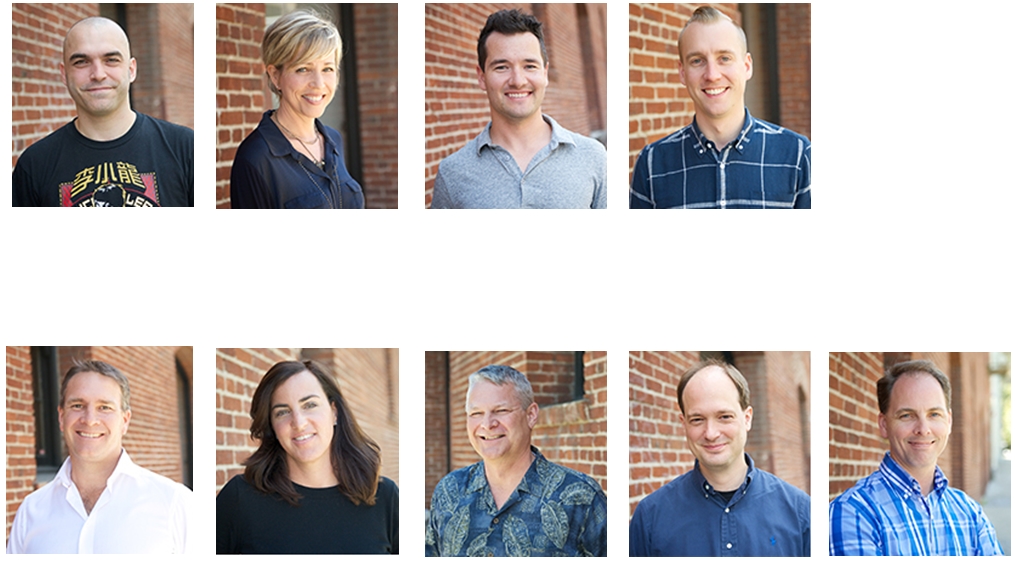



 Inara Pey: Living in a Modemworld