Speaking at the Meet the Lindens series at SL12B on Thursday, June 25th, Danger Linden (Don Laabs), Senior Director of Product, Virtual Worlds indicated that, having been running both Second Life and the Lab’s next generation virtual worlds platform (code-named Project Sansar) had relinquished management of the latter to his boss – Bjorn Linden (Bjorn Laurin), the Lab’s (relatively speaking) new Vice President of Product.
Mr. Laurin’s appointment slipped in somewhat under the radar around the end of March, 2015, most likely at the end of March / beginning of April. His official bio at the Lab reads:
Bjorn Laurin, the Lab’s VP of Product, directly managing Project Sansar
Bjorn Laurin serves as the VP of Product for Linden Lab, and to that role he brings more than a decade of Web, mobile, and social networking industry experience. Prior to joining Linden Lab, Bjorn held several high-level management positions at MySpace and Yahoo!. His previous roles include VP and General Manager of Mobile at Myspace, VP of Product for Tagged, and VP of Product for Peel.
Before that, he was Director of Mobile for Yahoo!, where he launched the company’s first mobile advertising solution in the Americas, Asia Pacific, and Europe. Bjorn studied Economics and Social Geography at the Universities of Uppsala and Stockholm, Sweden.
Mr. Laurin’s time at Yahoo! spans almost a decade, during which he worked in Sweden, the UK and the USA. He was at Myspace for some 3 years, with a year-long stint at Fox Interactive Media between the two.
That Mr. Laurin has such an in-depth and extensive background in mobile technology and services may have some Second Life users questioning his appointment on the grounds that “he has no experience” with virtual worlds. While the latter may be true, the Lab does have plenty of experience with virtual worlds, and Mr. Laurin has a lot of experience in product development and delivery, and in management – all of which would appear to be ideal qualifications for the role at the Lab.
Furthermore, it’s worth remembering that the Lab’s next generation platform is designed to be accessible through multiple means and services – of which, mobile will be a central part (it is, after all, something Second Life users have been wanting), ergo, having someone with the knowledge and experience on managing mobile related projects in a senior position at the Lab makes a lot of sense.
So, a belated welcome to Mr. Laurin from those of us in Second Life, and a quick note to say I’ll have more on Project Sansar in an upcoming article.
Now into its second year, the Silicon Valley Virtual Reality (SVVR) Conference opened on Monday, May 18th. Among the presentations and panel discussions that marked the day’s events was a 20 minute piece by Linden Lab CEO Ebbe Altberg, intriguingly entitled The Future of VR is User Created.
Ebbe Altberg: address the 2015 SVVR audience on May 18th, 2015
The presentation can be found in this official SVVR video, starting at the 39:00 mark. It was also recorded by Ruthalas Menovich, whose video I have taken the liberty of embedding below. Timestamps in the summary that follows in this article refer to Ruthalas’ video.
Those who may have been hoping to gain more of an insight into the Lab’s Next Generation Platform (aka Project SANSAR) will perhaps be disappointed by this presentation. As the title suggests, it isn’t so much focused on the Lab’s NGP, but rather on user generated content (UGC).
Thus, it forms something of an exploration of the potential of UGC within VR environments, as seen through the focusing lens of Second Life, and what Second Life has taught the Lab about some of the potential constraints posed by both supporting UGC and Second Life itself, which the Lab are now seeking to address. In doing so, it also touches upon some of the broader challenges facing platform providers as well, particularly in areas such as the state of VR technology itself, issues of monetisation for users, etc.
I’ll likely have some comments of my own on SANSAR in an upcoming article. For now however, I’m restricting this piece to a summary of Mr. Altberg’s presentation, with timestamps to the relevant points in Ruthalas’ video for those wishing to listen to them in full.
00:31 – 02:28: Democratising Content
The premise here is that the power of VR will be in democratising content – making VR such that those who wish to can create and share content among friends and audiences; not just necessarily in having it fed to consumers by high-end organisations with considerable technical skills.
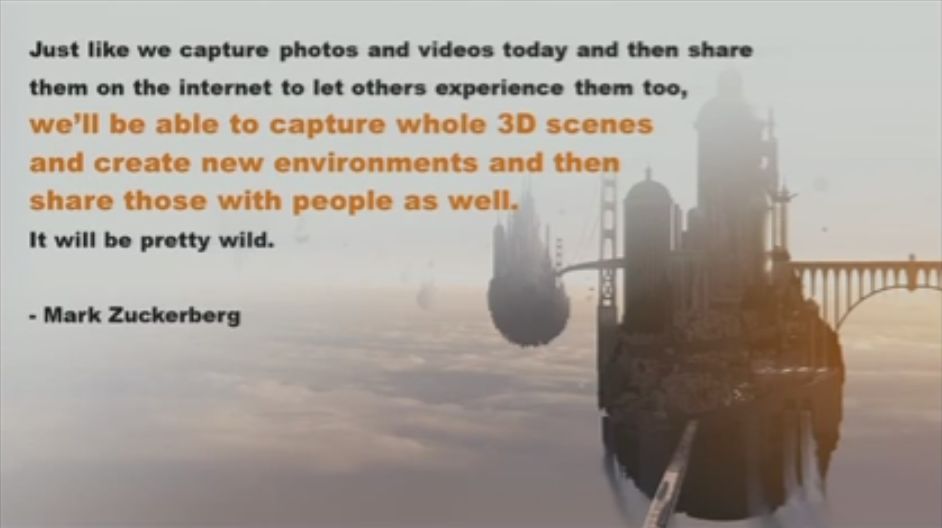
As a demonstration of this, he quotes Mark Zuckerberg, and points to the idea that just as self-expression is a natural part of our physical lives – how we decorate our homes, the clothes we wear, the interests we pursue – so too is it important for VR to allow us similar levels of self expression, such as through the freedom to create the environments we enjoy. In support of this view, he also points to the enormous popularity of sites on the Internet which today enable us to express ourselves through the content we crate, be it video, photography, the written word, or other mediums.
Mark Zuckerberg on VR’s potential, quoted by Ebbe Altberg at SVVR
02:28 – 14:30: UGC in Second Life and the challenges within SL
The focus moves on to Second Life and the challenges faced by anyone looking to enter the immersive VR environment with UGC.
Here he covers the rich diversity of user-generated content, which not only covers a huge range of interests and activities – social, educational, training, healthcare, business, entertainment, etc., and fulfils a massive variety of needs – homes, fashion, hobbies, landscaping, and so on -, but which is extraordinarily successful for both the company operating the platform and those providing the in-world content and services. In this he again cites the fact that in 2014, creators and providers redeemed some US $60 million from Second Life. The varying business models and their limitations – such as land – are mentioned.
The Lab’s work on making SL compatible with the Oculus Rift headset is touched upon, and a fair caveat is given on the aspect of performance. Ebbe notes that the work has to date really been more a useful tool for demonstrating to creators the difference between witnessing their creations on-screen and being immersed within them.
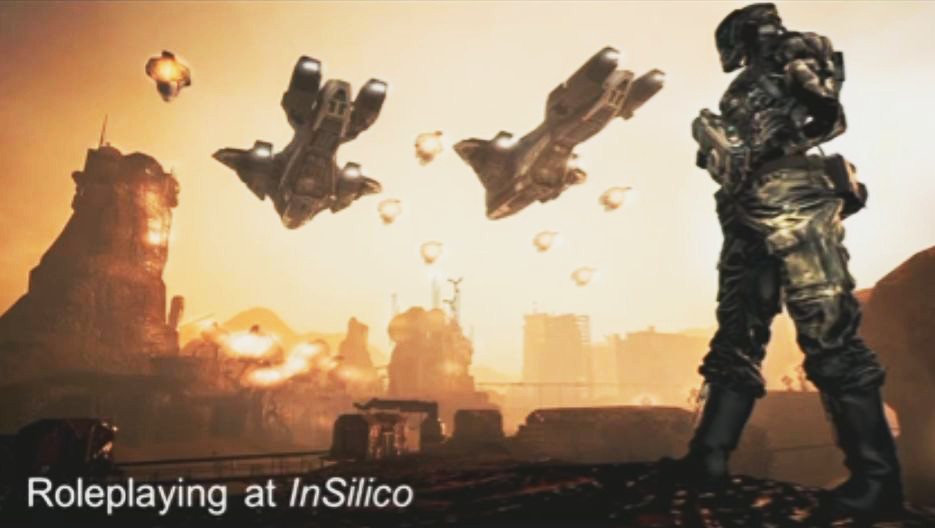
The InSilico RPG was mentioned to help illustrate the wide variety of SL UGC
The limiting factors of Second Life are also discussed. Again, the land revenue model and its limitations (including scalability) are mentioned, as are the limits of region concurrency numbers and the challenges of trying to hold really large-scale gatherings in-world. The fact that user-generated content can itself be a problem is also mentioned; that users don’t necessarily know how to properly optimise their content to be efficient in terms of rendering and running, so the Lab will need to find a way to optimise that content.
Broader challenges in presenting an environment which allows everything that Second Life already does are also touched upon – such as issues of compliance and control given what are collectively vary large amounts of money flowing through the platform (with a GDP of half a billion US $ a year) supported through a floating exchange used to convert real-world currency into game tokens and back again, in order to ensure money laundering, etc., isn’t an issue.
Ease of use is also touch upon; not just in terms of SL’s own notorious learning curve, but also in the fact that VR itself is still very much a fluid environment in terms of technology and the devices which might be used within it – controllers, headsets, peripherals, etc – It simply isn’t clear (outside of head mounted displayed themselves) as to exactly what will come into commonplace use and what, out of all that is being suggested, developed, trialled or hyped, will fall by the wayside.
On May 3rd, I posted about the speculation circulating concerning two trademarks the Lab registered in April 2015 for “SANSAR” (US serial no 86593259) and “Project Sansar” (US Serial no 86593254), and whether there might be related to the Lab’s Next Generation Platform for Virtual Experiences.
At the time I indicated that I’d already approached the Lab on the matter, but has not received any feedback, I also pointed out that in October 2014, the Lab registered the domain name “projectsansar.com”.
The Lab have now responded, both directly to myself, and via Twitter.
In is e-mail I received on Tuesday, May 5th, Peter Gray, the Lab’s Director of Global communications said:
Hi Inara,
Project Sansar is the internal code name we’ve been using for the new platform, and we do plan to use that name externally in its early stages (like the invite-only alpha we begin this summer). However, this is just the project name, and we anticipate changing it prior to launching the platform to everyone.
best, Peter
Shortly after I received the e-mail, the Lab also tweeted:
Confirmation of NGP’s interim name via a Tweet and an e-mail
That the name might be more an interim measure than a final operating name seemed to be indicated by the fact the domain name registration took place in October 2014, around the time the Lab was starting to indicate they had an internal name for the project. However, speculation as to the final name was understandable, given the trademarks were filed in April 2015 – although this obviously also converges with the Lab’s plans for a closed alpha to start-up later in the year, and so also fits with the name being the codename for the product.
I do still have some questions on the matter with the Lab; should I gain further replies, I’ll of course publish them here.
For the last several days, speculation has been circulating on whether the name SANSAR might be the name of the Lab’s new next generation platform for virtual experiences.
Speculation first came via a post made to the SL Universe forums, and has since appeared on both the Profile feeds and forums, relating to trademarks filed by the Lab on April 10th, 2015, namely:
In addition, in October 2014, Ascio Technologies, Inc., filed a domain name registration for projectsansar.com listing Linden Research as the Domain Administrator.
As has already been indicated in some of the responses to the forum posts referring to the trademarks, Sansara was one of the early names considered for Second life (being derived from Samsāra, which occurs in both Buddhism and Hinduism, and, perhaps more particularly where SL is concerned, was used by Hermann Hesse in his 1922 novel Siddhartha as a reference to the “world of illusion”), and currently lives on as the name of SL ‘s oldest and largest mainland continent. Whether “SANSAR” is a play on this is unclear – it might just as easily be an acronym.
Within Second Life, Sansra refers to the oldest and largest mainland continent. The word was also considered as one of the possible names for SL back when the Lab was first working on things. whether “SANSAR” as used in the the new trademarks filed by LL is a play on this is unclear
The description of both trademarks is identical, and for those preferring to read it in a single pass rather than via the filings with the US Trademark office, it can be found on the Legal Force website, from which I’m quoting below:
Entertainment software, namely, software that is used for providing multi-player access to an on-line game environment; computer game software; virtual reality game software; computer graphics software; software that is used for providing multi-user access to an online 3D virtual environment; computer 3D virtual environment software, namely, software for use in creating, manipulating and participating in 3D virtual environments.
Advertising and marketing services, namely, developing and distributing electronic marketing materials.
Online financial services, namely, offering a fictional-dollar-denominated credit card to charge online purchases.
Communication services in the nature of text messaging and electronic mail services used in playing on-line computer games; communication services in the nature of text messaging and electronic mail services used in an online virtual environment.
Entertainment services, namely, providing an on-line computer game by means of communications networks; entertainment services in the nature of providing an on-line multi-player electronic computer game; entertainment services, namely, providing an on-line computer game that may be accessed by means of communications networks.
Computer services, namely, hosting an on-line 3D virtual environment featuring a wide variety of user-defined subject matter and hosting an on-line 3D virtual environment featuring a wide variety of user-defined subject matter that may be accessed by means of communications networks; design and development of multimedia and three dimensional virtual environment software.
Most of this reads pretty much as description for Second Life – so the applicability for a new virtual experiences platform is fairly obvious, and hence the speculation that is circulating.
However, what really does pique interest in this description – beyond whether or not it pertains to the Lab’s new platform – is not the description of the environment, but the description of “online financial services”. The Lab has already indicated that Linden Dollars would be supported on the new platform, however, the description of a fictional-dollar-denominated credit card to charge online purchases suggests a new mechanism by which good and services within the new platform can be purchased, and by which the Lab might generate revenue.
Whether the name reflects the actual name for the Lab’s new virtual experiences platform or purely an interim project name (or even both, as may be the case given the two trademarks), is unclear. Sansar itself is a popular name for organisations related to the Asian continent (including SANSAR, the South Asian Network Supporting Awareness and Research based in Canada), so brand recognition, if this is to be the name, might be interesting in some quarters.
I approached Linden Lab for a comment on the matter, but have yet to receive a reply. Should one be forthcoming, I’ll update this article.
SL Go proved itself very popular among SL users running low-end hardware
On Thursday, April 2nd, it was announced that SL Go, the streaming service for accessing SL provided by OnLive, is to shut-down on April 30th alongside OnLive’s other consumer services. The reason for this is because OnLive has sold the IP and patents associated with the services to Sony Computer Entertainment.
Since the news broke, there have been numerous calls made for Sony to maintain SL Go as a service, including an on-line petition. However, as painful as it is, all such calls and petitions to Sony are unlikely to succeed, as I explained in a recent blog post.
In that article, I also considered whether or not the Lab might invest time and effort in offering something that might fill the void. At the time, I thought the answer to this would most likely be “no”, as the Lab seem to have enough on its plate already with Second Life and its next generation platform.
But the more I think about it, the more I feel that the Lab should endeavour to offer some kind of “SL Go replacement”.
One potential means by which they might do so could be via Amazon AppStream.
Obviously, there are issues involved in providing such a service beyond the physical provisioning. Anything which requires some form of external hosting is going to incur costs, for example. However, the flip side to this is it’s fair to say the SL Go has demonstrated that if users believe they are getting a beneficial service, they are willing to pay for it, providing the price is not prohibitively high.
Certainly, there are a wide range of potential benefits to be had from such an endeavour, particularly if implemented through something like Amazon AppStream:
It offers an easily scaled means by which the Lab could provide an “SL streaming service” to users on low-end hardware and those on mobile devices – something long demanded by SL users
It could provide the means by which SL could be accessed through web browsers – again, a long-desired means of attracting new users to the platform who might otherwise be put off by having to download and install the viewer
It obviously means that those SL users on low-end systems can enjoy the full graphical richness of SL in the manner LL would like to see all users experience it
It could help those preferring to run older operating systems – such as Windows XP – to continue accessing SL even after they might otherwise be unable to even install the viewer
It might even help the Lab map and test options which might be beneficial for their nascent next generation platform.
While developing such a service might not necessarily be easy, the Lab isn’t entirely without any experience in this area. As I and many others have pointed out, in 2010 they did experimenting with streaming the viewer, using the Japanese company Gaikai (coincidentally purchased by Sony Computer Entertainment in 2012), which delivered the viewer to web browsers, as shown in the video below. If there is anything remaining of this work at the Lab, it might possible to put it to work through something like Amazon AppStream.
That said, there is a lot for the Lab to consider in attempting to fill the forthcoming void that will be left by SL Go. And while I would not be at all surprised to learn they are already doing so, they might still require some encouragement to take things beyond just considering options. Something which might encourage them, or at least demonstrate to them that there really could be a worthwhile demand for such a service, could be for users to politely speak up.
One way to do this might be to add your name to the existing petition – I would hope someone at the Lab is keeping an eye on it.
Another could well be to leave a positive and polite comment on the subject following this article, as (and all ego aside) I do know eyes at the Lab pass over this blog (just as they do many others).
There is no guarantee that Lab will move to provide some kind of “SL Go replacement”, but on the other hand, as someone once said, nothing ventured, nothing gained.
On Wednesday, March 18th, Ebbe Altberg gave the keynote presentation at the 8th annual Virtual Worlds Best Practice in Education conference, which runs through until Saturday, March 21st inclusive, in both Second Life and OpenSimulator.
Ebbe Altberg: opening keynote at the 2015 Virtual worlds Best Practice in Education conference, March 18th
His key address lasted a little over an hour, in which he outlined the Lab’s approach to education and non-profits, provided some insight into what Lab’s future plans, and discussed further information on the Next Generation platform. Following this, he entered into a Q&A session, which ran beyond the main session time, switching from voice to text chat in the process.
The following is a transcript of his initial comments and review of the Lab’s relationship with the education sector, his overview of Second Life as it is today, a look to the future, and his concluding comments. I have produced a separate transcript dealing with his comments on the next generation platform.
As well as including the official video, embedded below, I’ve included audio playback of each part of Ebbe’s talk for those who prefer to listen while reading. Timestamps to both the audio segments and the video are provided.
[00:00 / 02:55] First off, I’m really, really happy to be back at the VWBPE. Last year, I was pretty much brand new at Linden Lab, and we’ve had a year since then, and a lot of good and interesting things have happened that we’ll talk about. Like you heard in the introduction, we’re going to leave plenty of time at the end for Q&A so that we can talk about all [the] things that are on your minds.
Changes at the Lab
[00:38 / 03:34] So, since last year there have been a lot of changes at the Lab, We have simplified the portfolio of products that we are working on. Since I was here last year, we’ve discontinued work on six products [actually five (that were known about): Creatorverse, dio, and versu, and Patterns and Desura].
The little “Dorito man” headed off into the sunset in October, as Patterns followed Creatorverse, dio and Versu in being axed from the Lab’s nascent product portfolio. It was followed in November by news that Desura had been sold.
[01:02 / 04:00] So we have a much more focused company now, and we’re focused on things that are all relevant to user generated content, either through Second Life, or blocksworld, or through this next generation platform you have yet to see but we’re working on very, very hard to bring to you all.
[01:21 / 04:30] So focus has greatly improved. The other thing I wanted to talk about is some of the improvements made in Second Life. Performance and quality has greatly improved over the course of the last year, with the CDN work and the HTTP pipelining work some of you may have heard of, which should make access to worlds snappier than it used to be. i still feel we still have a lot to do to make it even more performant, but we’ve made great strides in that area.
[02:04 / 05:01] We also brought you the ability to experience Second life with the Oculus, so you can get sort-of an introduction to virtual reality if you have a chance to get your hands on an Oculus device.
The Lab’s Relationship with Users
[02:19 / 05:18] And we’ve also, I think, made a lot of improvements in how we market ourselves, how we’re connecting with you and many other customers and different audiences. I would say that when I showed up here a year ago, the relationship between the Lab and customers and partner was not great; and I think that’s improved greatly. We’ve spent quite a bit of effort, particularly Pete and myself, but also many other Lindens, socialising with you all, talking to you about what we can do better, how we can do things differently, better understand what you’re trying to accomplish. and so I think today, the relationships between us and you are much improved.
The Media, SL and VR
[03:19 / 06:18] We’ve spent quite a bit [of time] talking to the press; Pete and I have spoken to many. I would say a year ago, that was a difficult thing to do; Second Life was seen as old and not particularly relevant. Since the, we’ve had a tremendous boom and boost in all things virtual reality. It sort-of kicked-off with the big acquisition Facebook did when they acquired Oculus for two billion, and when the world started to realise that virtual reality was something that could be achievable much sooner than people [who] had been working in this area had previously thought. So there has been a massive acceleration in people’s mind of what virtual reality can and will do.
[04:16 / 07:15] So now it’s pretty easy to find people who want to talk to us, whether partners or press, about what we’re doing, and people are realising that our experience running Second Life is actually extremely valuable now that virtual reality and virtual worlds are all a sort-of hot topic again. So it’s very exciting for all of us to have the rest of the world sort-of get re-introduced and re-energised by what’s possible in virtual reality.
The Lab and the Education Community
[04:50 / 07:50] We’ve also spent quite a bit of time focusing and understanding education specifically in the context of Second Life, and also understanding it so that we can do a better job with our next generation platform to meet your needs in even better ways. And it’s absolutely clear that the capabilities of 3D and virtual experiences such as visualisation and simulation, and the ability to interact within those environments is an extremely strong component of how we can improve learning and teaching.
[05:33 / 08:32] We see evidence over and over again of how it’s proven that people can more quickly understand subject matter, content and experiences much better and much faster with much better retention of information, if they can experience something in a virtual context where they can do things, not just read or watch.
300+ Organisations and Success Stories
[06:00 / 08:58] We have well over 300 organisations that are taking advantage of our discount programme for educators and non-profits. I think there used to be more than that in the past, and we’re looking forward to making that grow back as we do a better job of meeting your needs.
[06:26 / 09:24] And we continue to hear over and over again just great stories from the community of educators about what they’re doing in Second Life, the success they’re having in Second Life to teach and learn all kinds of subjects from languages to chemistry to economics to health. The stories just keep going and going, and that’s really motivating for us to hear these success stories.
[06:56 / 09:54] And we started a thread on our forum, and I know there’s quite a few stories elsewhere out there, especially on [the] VWBPE.org site. so please continue to share these stories and successes with us; it helps motivate people, it energises us, and also helps us learn what we can do to help you be even more successful.
Collaborating with the Community and Prioritising Needs
[07:25 / 10:24] Like I said, we’ve spent quite a bit of time collaborating and communicating with various groups in the educational community in Second Life, and that’s absolutely great. It’s a great group of people to interact with, and often times I’ve asked these groups to work together to come up with the things that they find [as] the most important things for us to work on.
[07:54 / 10:53] Sometimes it can be difficult for us to filter all of the ideas and wishes and needs from a community as large as yours, and when you take the time to collaborate among yourselves to further refine priorities and needs for us, it helps a lot. We have to do less guesswork to understand what really matters to you all.
[08:19 / 11:17] I’d particularly like to thank Serenek Timeless, Aldo Stern, JJ Drinkwater Lorelei Juno who, at the end of last year took that request to heart and talked to … more than 60 educators to come up with a sort-of prioritised list of issues and concerns and opportunities for us to think about and focus on to help you all. so I’ll speak to some of these, and what I don’t speak to, obviously feel free to ask questions about afterwards in the Q&A session.
Platform Pricing and Discounts
[08:57 / 11:56] One thing that comes up quite frequently, and probably because we’ve made mistakes in the past, is the question about pricing. I just want to make it very clear that we have absolutely no intention of repeating the mistake we did in the past of removing the discount or increasing the pricing.
[09:17 / 12:15] So we have absolutely nointention whatsoever to make it more costly for you.
[09:22 / 12:21] We spend no time thinking how to make it more costly for you. We spend actually quite a bit of time thinking about how we can make it less costly for you; and it might be difficult to do in the context of Second Life, but we will try. But as we think about the next generation platform, this is something that’s thought about from the beginning, about how we can make it more economically feasible for more people to participate.
Content Creation and Creators
[09:51 / 12:49] Another thing that comes up is the ability to easily create content. you know, simplified building and scripting capabilities so that all users can create something.
[10:07 /13:06] We do think of creators in sort-of three categories of users that we believe we have to meet the needs of. You have the sort-of artisan or professional people that can create some really high-end experiences. We have the hobbyist, which I would say is where there’s a lot of them in Second life, who don’t necessarily have a formal background in 3D or animation or CGI, but are able to use Second life to create incredible things.
[10:43 / 13:41] And then we have the vast majority of people, who we call “customisers”; they don’t necessarily create original content, but they take bits and pieces by shopping or finding or being given items that they can then place, whether it’s to get dressed or to make their space laid-out just as they like it. So they don’t necessarily make the chair, but they put the chair where they want it. It’s sort-of like real life; most of us don’t build the clothes and cars and homes that we live in and use every day. We’re customisers, most of us; we get dressed in clothes that others make, and that’s probably how it’s going to be in the virtual space as well.
[11:30 / 14:28] We do want to make it as easy as possible for people to create content and contribute content. and I don’t expect there to be huge changes in Second life in this area, although we are working to improve the ability to import content from the outside world.
[11:50 / 14:48] As we think about the next generation platform, which I will talk about more later on, we’ll make a number of difference I’ll speak about then. But the scripting language will change, support for third-party will be very important to us; but I’ll talk about that in a bit.
New User Experience (1)
[12:08 / 15:06] Another thing [is] an improved and customisable new user experience, including entry points. This is something I’ve spoken about before. We feel it’s important to make it very easy for the creators of an experience to be able to attract an audience to come directly to that experience without the need of having to go through some generic front door to get going.
The Lab wishes to move away from the idea of a centralised, generic new user experience within the next gen platform, to something over which experience creators have more control – this might filter into Second Life
[12:39 / 15:37] And so we will continue to think about that in the context of Second Life, of how can we bring back notions we’ve had in the past of community portals or some such, and also how SL URLs, or SLurls, can be optimised to be [a] more efficient way of bringing users directly into a particular place. I would say the SLurl today is kind-of a crooked path to come on-board from from the outside world.
[13:10 / 16:09] So we want to improve all these things, so it is easier for all of you to bring users into the experiences you want them to come into.



 Inara Pey: Living in a Modemworld