Space Sunday: a Martian Hope and Heavenly Questions

An artist’s impression of the UAESA Hope satellite in orbit around Mars. Credit: Mohammed bin Rashid Space Centre

late July and early August mark the period of the 2020 Mars opposition launch window, once again offering opportunities to send missions to the Red Planet. This period occurs once every 26 months, when the orbits of Earth and Mars are both on the same side of the Sun (so Mars and the Sun are on “opposite sides” of Earth, hence the name “opposition”) and positioned relative to one another (with Earth “catching up” with Mars as they both move around the Sun) such that the flight time from Earth to Mars is at its shortest – around 6-7 months.

Because of this, these periods tend to be fairly busy, and 2020 is particularly so, with three missions heading for Mars. The most prominent of this missions in terms of publicity is NASA’s Mars 2020 Perseverance rover, scheduled for a July 30th 2020 launch. The second is China’s ground-breaking orbiter / lander / rover mission (of which more below), whilst the third  – and first to launch – is possibly the most overlooked of the three: the Hope, or Al-Amal, orbiter mission developed by the United Arab Emirates.

Hope under assembly at the Mohammed bin Rashid Space Centre (MBRSC). Credit: MBRSC

Hope is a remarkable mission for the UAE; the mission was announced in 2014, literally as the country formed its fledgling space agency, employing just 75 people – a number that has since grown to 150. At that time the UAE had developed and flown – in partnership with other nations – a total of 5 communications satellites and two Earth observation platforms, so the idea for the country’s new space agency setting its sights on Mars was seen as incredibly ambitious.

However, over the course of the last six years the United Arab Emirates Space Agency (UAESA) has worked steadily on the the project, and has drawn on space development expertise in France, Japan, the UK and USA both for its own development and for the Hope spacecraft, moving the project forward and at minimum cost – just US $200 million.

The Mohammed bin Rashid Space Centre, Dubai, UAE, headquarters for the Hope mission and the UAE’s space efforts, on the night of the Hope mission launch. Credit: UAE television

Roughly cubic in shape, Hope measures 2.37m wide and 2.90m in length and has a mass of just under 1.4 tonnes (including its propellant fuel load). Solar-powered, it is billed as the “first true weather satellite for Mars” and is intended to develop a complete picture of the Martian atmosphere.

To do this, the satellite has a primary mission period of a full Martian year (approx. two terrestrial years), with the option for mission extensions through to 2025. During this time, the spacecraft will study the Martian climate and weather on a daily basis from a 55-hour equatorial orbit around the planet that will vary between 20,000 and 43,000 km from the planet’s surface. This high orbit will afford it the best view of weather patterns in both the northern and southern hemispheres, and observe how weather patterns interact along the equatorial regions of the planet. In particular, Hope will be able to study seasonal weather  / climate cycles and record weather events in the lower atmosphere such as dust storms, and the weather at different geographic areas of Mars.

To achieve this, the mission carries a relatively modest number of science packages compared to other missions, comprising:

  • The Emirates eXploration Imager (EXI): developed with assistance from two US research facilities, this is a multi-band camera capable of taking high resolution images with a spatial resolution of better than 8 km. Equipped with a set of 6 filters, it can image in both RGB colour wavelengths and in the ultraviolet bands, and measure properties such as water, ice, dust, aerosols and abundance of ozone in the Martian atmosphere.
  • Emirates Mars Infra-red Spectrometer: developed with the assistance of the Arizona State University, this is an interferometric thermal infra-red spectrometer. It is designed to examine temperature profiles in the Martian atmosphere and record ice, water vapour and dust in the lower to mid-level of the atmosphere.
  • Emirates Mars Ultraviolet Spectrometer (EMUS): is a far-ultraviolet imaging spectrograph for measuring global characteristics and variability of the Martian thermosphere.

As well as carrying out a genuine science mission that will produce data that will be of significant use for future missions up to and including eventually sending human to Mars, Hope is also seen as an inspirational programme intended to “send a message of optimism to millions of young Arabs” and encourage them to consider careers in science, technology, engineering and maths (STEM).

Nor, given the traditional conservative nature of Arab nations, is this inspirational element of the mission directed solely at young men: the deputy project manager and lead science investigator for the mission is Sarah Amiri, who is also is the Chair of the United Arab Emirates Council of Scientists. She has managed the mission’s objectives and overseen the development and integration of the mission’s science packages, and and will continue in that role throughout the mission. Her role is seen as pivotal to encouraging other Arab nations in allowing women greater access to leadership roles and in encouraging young Arab women to consider STEM-based studies and careers.

Left: the H-IIA launch vehicle on the pad at T -25 minutes before launch on Sunday, July 19th. Right Top: Hope mission managers watch the launch preparations from the main control centre at the Mohammed bin Rashid Space Centre while (right lower), engineers monitor data being received from the satellite.

Continue reading “Space Sunday: a Martian Hope and Heavenly Questions”

Expressive art at Palazzo di Basilique in Second Life

Palazzo di Basilique

Currently on display at the Palazzo di Basilique, the skyborne gallery space at Basilique, is a joint exhibition by April (Agleo Runningbear) and Loegan Magic, two very different but very engaging artists.

Loegan has been active in Second Life for over a decade, but has been engaged in Second Life photography for the last two years – and has made a stunning impression on the scene in that time. His work is richly evocative and wrapped in narrative – often on a personal level, featuring as it can images of himself in setting that simply speak volumes.

Loegan Magic

For this exhibit, he provides a selection of monochrome images he refers to as Vintage Virtual, which he describes as, “photo’s taken in a virtual world using today’s technology with the purpose of creating something that has a nostalgic feel.” To call these enchanting pieces would be an understatement: each more than succeeds in Loegan’s aim, offering a picture that holds that sense of nostalgia / history; these are pieces that give the strongest impression of looking back into past times, times that might have been familiar to our grandparents.

Loegan Magic

They are also pieces that are personal in nature. Each is accompanied by a text element that offers words to the story found within the image. Most have been composed by Loegan, these are revealing in their depth, reflecting as several do on his own life and his relationship with his SL partner, Rachel Magic (larisalyn). Even those with a wider context – such as the lyrics from Pink Floyd’s Bike strongly suggest a personal element.

Known as April Louise Turner in the the physical world, Agleo is a woman of many colours – artist, shaman, teacher, poetess, to name but four – who presents her work under her own name and the title ArtShifter. She is a gifted portrait artist and caricaturist, as she demonstrates here with a selection of thirteen portraits of well-known celebrities, all of whom should be instantly familiar.

April (Agleo Runningbear)

With pieces created between 2013 and 2020, this an engaging series of images that capture the very essence of their subjects. From Argentinian surrealist painter, designer and author Leonor Fini, to a blue-tinted Yves Saint Laurent (a piece I’m still a little embarrassed to say put me in mind of Isaac Asimov when I first saw it from a reasonable distance at La Maison d’Aneli earlier in the year), they really are marvellous, graceful images, the majority of which prove the old saying that the eyes are the windows of the soul, the sense of depth within the eyes Bowie, Mercury, Dali, Nicholson and Fini is quite stunning.

Presented in collaboration with Focus Magazne and gallery, these are two very different displays of art from two very different artists that also perfectly compliment one another. Loegan’s art can be found at  the front of the gallery ballroom, above the terrace, with April’s work on the terrace at the back of the gallery ballroom.

April (Agleo Runningbear)

SLurl Details

A vicarage, two computers, poetry, a cat and a Batman!

Seanchai Library

It’s time to highlight another week of storytelling in Voice by the staff and volunteers at the Seanchai Library. As always, all times SLT, and events are held at the Library’s home, unless otherwise indicated. Note that the schedule below may be subject to change during the week, please refer to the Seanchai Library website for the latest information through the week.

Sunday, July 19th: 13:30: Tea-Time with Miss Marple

Anyone who murdered Colonel Protheroe,’ declared the parson, brandishing a carving knife above a joint of roast beef, ‘would be doing the world at large a favour!’ It was a careless remark for a man of the cloth. And one which was to come back and haunt the clergyman just a few hours later – when the colonel was found shot dead in the clergyman’s study. But as Miss Marple soon discovers, the whole village seems to have had a motive to kill Colonel Protheroe.

Tea-Time with Miss Marple

Seanchai Library draws to a close a 6-week run featuring Agatha Christie’s Miss Jane Marple, with The Murder at the Vicarage, the novel marking her first appearance in print.

Monday, July 20th, 19:00: Colossus

Gyro Muggins reads the 1966 future cold war novel by Dennis Feltham (DF) Jones.

Charles Forbin has dedicated ten years of his life to the construction of the supercomputer, Colossus, rejecting romantic and social endeavours in order to create the United States of North America’s (UNSA, a nation encompassing both America and Canada) first artificially intelligent defence system.

Colossus is capable of taking and analysing data rapidly, allowing it to make real-time decisions about the nation’s defence needs. But the system soon exceeds even Forbin’s expectations; it is able to take far more information and process it far faster than he and his team at the Colossus Programming Office believed would ever be possible.

Such is the system’s apparent abilities, the President hands off full control of the UNSA’s ballistic missile capability, together with other defence protocols, to Colossus and makes the announcement to the world that he has ensured peace.

But then the USSR announces that it has a defence supercomputer of its own – Guardian – with capabilities similar to that of Colossus. Then the two computers demand they be allowed to communicate directly – and proceed to do so at a rate that is well beyond the understanding of their respective development teams. 

And neither system takes it kindly when Forbin and his Russian opposite number, Academician Kupri, both disable their ability to communicate directly and then seek to remove them from control of UNSA and USSR nuclear missiles…

Tuesday, July 21st:

12:00 Noon: Russell Eponym, Live in the Glen

Music, poetry, and stories in a popular weekly session at Ceiluradh Glen.

19:00: Poetry by Request

With Caledonia Skytower at Ceiluradh Glen.

Wednesday, July 22nd, 19:00: Whittington

Caledonia Skytower reads Alan Armstrong’s 2006  Newbery-Honor winning tale.

Whittington is a roughneck tom cat who arrives one day at a barn full of rescued animals and asks for a place there. Present at the barn is a menagerie of animals and young Ben and Abby, whose grandfather owns the barn and does the rescuing.

To earn his place, Whittington tells the tale of his famous ancestor, the nameless cat who brought Dick Whittington to the heights of wealth and power in 16th-century England. In telling his story of how his ancestors saved and elevated Whittington, this tom-with-a-chip, elevates another little boy above his fear of learning to read.

Thursday, July 23rd, 1900: Batman!

With Shandon Loring. Also in Kitely – from the main Seanchai World grid.kitely.com:8002:SEANCHAI.

Speedlight: group functionality and other updates

via Speedlight

It’s been a little over a month since my last update on Speedlight, the browser based Second Life client, so here’s a quick round up of the major updates since then.

Note that unless otherwise stated, the following notes apply to the browser version of Speedlight, as at the time of writing they had yet to be applied to the dedicated Android app version or (so far as I’m aware), the beta iOS app version.

Group Support

Perhaps the most noticeable update to the browser version of Speedlight since June is the expansion of Group related capabilities, specifically:

  • Search your groups.
  • View group notices and send  group notices.
  • Leave a group.
  • Invite someone into a group.

Obviously, all group actions are subject to the group permissions assigned to your role within the group.

Notes:

  • Groups are accessed via the Group option in the Speedlight client menu.
  • The Group option will display your current groups as a searchable list, via the Search option at the top of the list.
  • When using Speedlight on a mobile device, the group list is displayed as an overlay to the main group information display, and is shown / hidden by tapping the Groups>> link displayed at the top of the options menu.
  • Tapping on the name of a group in the list will open the Group Info panel, shown below (and auto-close the Group list mobile devices).

The updated group display panel showing: 1. The pre-existing Group Chat button; 2. the new Group Notices button; 3. the Button to Join / Leave a group; 4. the Group Invite button.

Group Notices

Note: at the time of writing, the group notices functionality was only available to the browser version of Speedlight (any browser / device).

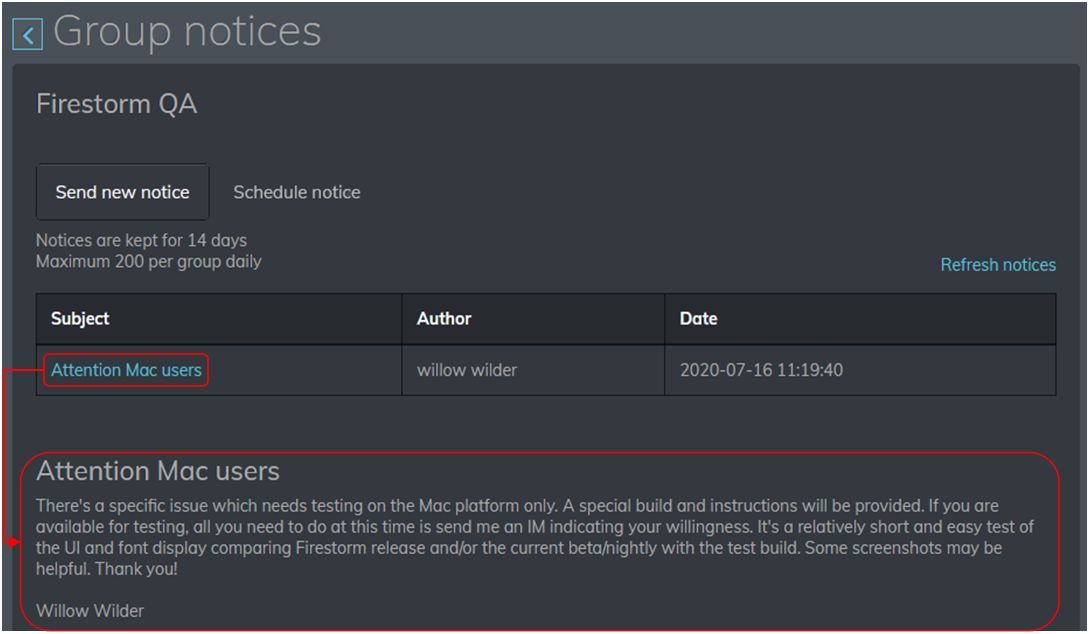
  • To view your group notices, click / tap the Group Notices button.
  • The Group Notices panel will open and load any available notices.
  • Click / tap on any notice to display it below the list of available notices.
  • Note that notice attachments cannot presently be viewed / opened, but are listed in the text of the notice.

View a group notice in the Speedlight browser version

The Group Notices panel has two buttons associated with it:

  • Send New Notice – described below.
  • Schedule a Notice – this option is either awaiting implementation or a Gold / Patreon subscription option. As I currently do not have either of the latter, I was unable to check, ergo it is excluded from this article.

Send a Group Notice

Subject to group permissions you can also create and send group notices from Speedlight:

  • From the Group Notice panel, click the Send New Notice button at the top of the panel.
  • The New Notice panel is display. Here you can:
    • Enter a title for the notice.
    • Enter the text of the notice. Note the character counter will turn red if you exceed the 512 character count for a notice, and the text beyond that point will be truncated when the notice is sent.
  • Click the Send Notice button when you’re ready to send your notice.

Send a Group Invite

Subject to group permissions you can send a group invitation to one or more users from Speedlight:

  • From the Group Info panel, click the Invite to Group button.
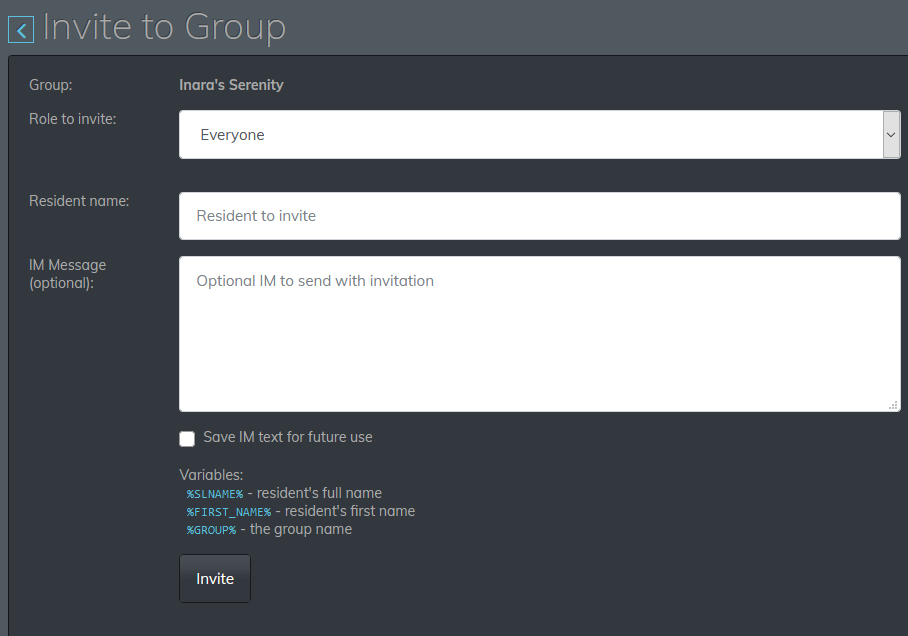
  • The Invite to Group panel is displayed.

Speedlight Invite to Group panel

  • Role To Invite: select the required role (if available) that will be offered in the invite.
  • Resident Name: enter the avatar name of the person whom you wish to receive the invite.
  • IM Message (optional): if you wish, you can send the person you are inviting an IM alongside the group invite – such as an explanation on why you’re sending it, etc.
    • Note you can use the listed variables to personalise the IM. For example, clicking the %FIRST_NAME% option will precede your IM with the recipient’s first name, while %GROUP% can be used to display the group’s name in the IM.
  • When you’re ready to send the invite, click the Invite button.

Additional notes for group invites:

  • Pressing ENTER after typing the recipient’s name will actually send the invitation, so if you want to send an IM with the invite, be sure to click / press TAB / tap to position the cursor in the IM field.
  • You can also append “sent from Speedlight” to the invite IM (and any other initial session IM you send to someone) by going to Settings in the left menu and then checking Append “Sent from SpeedLight” to my IMs (first message of the conversation only) .

Other Updates

Search Functionality

The Search functionality has been tweaked so that you can now:

  • Search for friends in your Friends List.
  • Search for IMs in you IM history by sender’s name.
  • Search for a group in your groups list (as described above).

Teleport Offers

You can now accept / decline teleport offers via the Notifications bar.

Multi-Line Text Entry (Chat and IM)

Both IMs and local chat accept multi-line text entry – use SHIFT-ENTER to start a new line / offer a paragraph break.

RLV Support

RLV support is now available to Speedlight Gold and Patreon users. However, it is not clear if this is Marine Kelley’s RLV API or Kitty Barnett’s RLVa API.

Android and iOS App Versions

  • The Android version has yet to receive the multi-line text input option and the group updates, as noted. However, it has received a series of bug fixes and allows errors or issues to be reported back to the developers.
  • The iOS version version of Speedlight is available for Speedlight Gold and Patreon users, and requires Apple’s TestFlight app to be installed on the device using it.

Feedback

The group updates are good to have, with the promise of more to come. Further performance improvements are in the offing as well, apparently. This may well be a good thing, as it appears the issue from April of an avatar refusing to stop moving once set in motion in the 3D World view, is back, and once again requires a relog to stop it. I’ve no idea how widespread this issue is, or if it is encountered on Android devices (as my poor little Nexus 2013 HD cannot run Speedlight’s 3D rendering, being stuck on Android 6.0.1), but for me, it is consistent and appears to be a regression. I shall await further updates with interest.

Related Links

Bryn’s mythical creatures in Second Life

Bryn Oh: Mythical Creatures

Now available at her Immersiva arts region, is Bryn Oh’s latest presentation Mythical Creatures, which is will have an official opening on Sunday, July 19th, 2020.

Perhaps the best way to describe this collection of 21 pieces is as a series of art collectibles, in that they come with a unique property, which I’ll get to shortly.

This was a fun project where I researched 20 legendary, mythical or creatures of folklore from around the world and re-imagined them. Some are well known such as the Dragon or Phoenix, but then there are more obscure ones like the Nariphon or the horrifying Manananngal.

– Bryn Oh on Mythical Creatures

Bryn Oh: Mythical Creatures

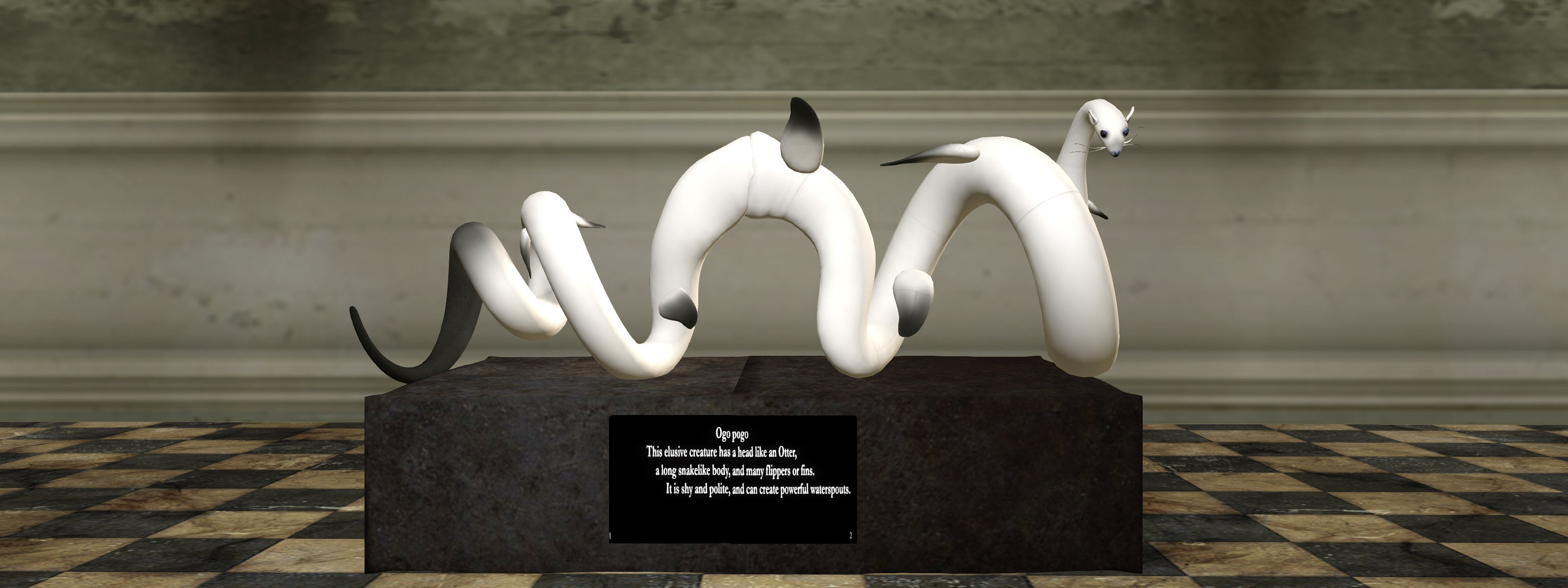
Each creature is presented as a 3D sculpture on a plinth bearing a brief description of the creature’s form. More detailed descriptions of the creatures and their histories, drawn from multiple sources, hang from the ceiling of the hall behind each of the sculptures. As Bryn notes, some of the creatures are very well known; others may ring bells without necessarily being something we’re actually deeply familiar with, whilst others are liable to be entirely new to us. For me, examples of the latter two would be the Baba Yaga – something I’d heard of, but not actually researched, and the Tatzelwurm, a creature I’d never heard of.

As well as the Russian Baba Yaga and Swiss Tatzelwurm mentioned above, the collection comprises: from Greek / Roman mythologies Capricorn, Cerberus, the griffin, Medusa, and the phoenix; from Japanese mythology: Jorōgumo, Kitsune and Ōmukade; from multiple folklores and mythologies: the dragon and the mermaid; together with the banshee (Irish mythology), the ettin, the kraken (Scandinavian), La Sayona (from Venezuela), the manananggal (Philippines), the nariphon (Buddhist legend), the Canadian Ogopogo, and the Chinese qilin.

Bryn Oh: Mythical Creatures

And in case you’re wondering why I reference 21 pieces, but only list 20 creatures, that’s because there is a bonus item in the collection, the Bryn Oh.

Bryn Oh is a pale white moth girl born on the Internet. She has curved glowing horns, cyberpunk interface plugs, wings or a neko tail. She is queen of the moths and creates stories and worlds with hidden meaning inside. She has magic and when threatened she can deform her enemies or launch them high in the air. She is drawn to music but often lurks on the outside listening and never dancing. Other creatures find her strange an melancholy.

– the description of the “Bryn Oh”

What is special about these creature is the manner in which they have been created in two parts: “left” and “right” as you look at each of them. Gacha machines within the exhibition halls allow visitors to obtain a random “left” or “right” half of a creature. Any “left” part of a creature can be combined with any “right” part of another creature to create an entirely new one. The clever part here is that whichever combination of to parts is put together, the descriptive text on the two plinth halves will always seamlessly combine to offer a description of the new creature.

Bryn’s own notes on combining a “left” and “right” half from two sculptures to creature a new creature

Thus, it is possible to creature any of the original creatures in the exhibition by collecting all of the different halves – with up to 441 combinations of creature to be created. Further, to help in the joining process, the individual halves have been scripted so that when placed together, they will correctly align and join.

Another interesting aspect of these creatures is the sources Bryn has drawn upon to creature their “mini biographies” hanging in the exhibition halls, and the manner in which set portrays some of them. With Medusa, for example, the focus is very much on her violation at the hands of Posidon – and for which Athena unfairly punished the young and beautiful girl, turning her into the monster with whom we are more familiar.

Bryn amongst her creations

As noted, Mythical Creatures officially opens on Sunday, July 19th, 2020, with a special event starting at 15:00 SLT. Skye Galaxy will be providing the music, supported by Semiiina. And when visiting, keep an eye open for Bryn’s flying machines that have appeared in her own mythologies and her floating / falling bricks that have also featured in her past work, and both of which – together with the design of the exhibition hall, very much hook Mythical Creatures into her universe.

SLurl Details

An ethnographic exhibition in Second Life

Ethnographic Exhibits of Two Cultures from the Republic of Panama

Available now at the Community Virtual Library, and with its official opening towards the end of July 2020, is Ethnographic Exhibits of Two Cultures from the Republic of Panama.

A collaboration between Nexus Dot, a  cultural anthropologist, and co-curator and media specialist Shiloh Emmons, the exhibit represents two decades of ethnographic research Nexus has made studying two groups indigenous to the lowland tropical rain forests of Panama, the Guna and the Emberá, examining their life styles, culture, art and religion.,

Located on a sky platform, the exhibition comprises six main components that examine both the Guna and the Emberá from several perspectives, including their cultures, the Mola art of the Guna, Emberá cosmology, ecology, and shamanism, and more. In addition, the exhibition presents photos of the Emberá Drua heritage ecotourism project, and offers an ethnobotany examination of how these lowland cultures of Panama make use of plants.

Ethnographic Exhibits of Two Cultures from the Republic of Panama

The aim of the exhibition is two-fold:

  • To communicate Nexus’ work in studying these two groups of people over a span of two decades, and the place and role of such cultures in the world today.
  • To provide the non-profit community and education system with a template of how scientific research can be transformed into an engaging, multimedia 3D virtual experience that resonates with scientists, educators, and interested Second Life residents.

The video below serves as a general introduction to the exhibit.

Based in both Panama and Idaho, USA, Nexus earned his MA in anthropology at the University of Oregon, where he specialised in the ecology and cosmology of tropical indigenous cultures, and where he also spent time as a graduate teaching fellow. Whilst he does hold that MA in anthropology, his work in studying the Guna and Emberá is very much born of personal passion, rather than being funded directly as a part of a set academic study.

Most of my research is self-funded, although I have executed a number of projects for agencies and institutions as a consultant. Often these projects were involved with ecological l or socio-economic components, so there is a link there. I’m also a geospatial analyst, and have been involved in computer mapping and handling data like the COVID map system; I’m actually at my farm in the countryside of Panama at the moment due to the general quarantine.

– Nexus Dot discussing his work

As a long-time user of Second Life who had been largely absent the platform several years, it was the current SARS-CoV-2 situation that encouraged Nexus back, with the idea of experimenting with the platform to see how well complex material like a professional anthropological paper might be translated into an engaging, multi-media learning tool, and a meeting with Shiloh started the ball rolling with the exhibit.

Ethnographic Exhibits of Two Cultures from the Republic of Panama

The exhibition is open now informally to visitors, with the formal opening taking place on Sunday, July 26th – of which more below.

Ahead of that, however, on Sunday, July 19th, Nexus will gives a short presentation about his work, and discuss the value of the anthropological perspective. The specifics of this event are:

The formal opening on July 26th will be split between the exhibition space and the CVL meeting place, and comprise the following schedule and activities:

  • 11:20am: the exhibition will be available for those wishing to visit it ahead of the opening activities.
  • 11:50am: Beragon Betts will introduce Nexus Dot at the CVL meeting place.
  • 12:00 noon: Nexus will present  Mola art and aesthetics among the Guna people.

Arisia Vita will will provide music ahead of the presentation, and people will again be able to visit the exhibition following the presentation, with both Nexus and Shiloh on hand. Those attending this event are asked to take their seats in the CVL meeting place no later than 5 minutes prior to the presentation commencing.

For me, the talks are the meat, the exhibit well it is the teaser so to speak; although the exhibit has taken on something of a life of its own! We’ve tried to ensure people can still appreciate the exhibition should they be unable to attend the presentations.

– Nexus Dot discussing his work

Ethnographic Exhibits of Two Cultures is an engaging exhibition, rich an detail and information, and an absolutely must see for anyone with an interest in anthropology, ethnography or culture.

SLurl Details

Cookie, the home of CVL, is rated Moderate.