Logos representative only and should not be seen as an endorsement / preference / recommendation
Updates from the week through to Sunday, March 1st, 2026
This summary is generally published every Monday, and is a list of SL viewer / client releases (official and TPV) made during the previous week. When reading it, please note:
It is based on my Current Viewer Releases Page, a list of all Second Life viewers and clients that are in popular use (and of which I am aware), and which are recognised as adhering to the TPV Policy.
This page includes comprehensive links to download pages, blog notes, release notes, etc., as well as links to any / all reviews of specific viewers / clients made within this blog.
By its nature, this summary presented here will always be in arrears, please refer to the Current Viewer Release Page for more up-to-date information.
Outside of the Official viewer, and as a rule, alpha / beta / nightly or release candidate viewer builds are not included; although on occasions, exceptions might be made.
Official LL Viewers
Default viewer 2025.08 – 7.2.3.19375695301 – maintenance update with bug fixes and quality of life improvements – December 2.
Notable addition: new VHACD-based convex decomposition library for mesh uploads.
Yes, there’s been a lot in this column about Project Artemis and the US-led programme to return humans to the Moon, and while it might make Space Sunday sound a bit like a scratched record (Artemis..,Artemis…Artemis…), there is good reason for this: there’s a lot of news about the entire programme, from the anticipated launch of Artemis 2 and its crew on a trip around the Moon and back, to the focus of the main part of this article: major changes to the Artemis programme as a whole; so bear with me!
NASA’s current Administrator, Jared Isaacman, continues to surprise and impress despite concerns over his non-NASA activities and involvement with favoured space contractors. In my previous Space Sunday article, I covered Isaacman’s direct and open approach to the problems endemic to the Boeing CST-100 Starliner programme, and to the core of NASA’s management responsible for managing it (with two of the most senior resigning in the aftermath).
Following the press conference on that matter – which included the reading out of a letter to all NASA staff- Isaacman was present at a February 27th, 2026 Project Artemis update which carried its own surprises whilst signalling a change in direction for the programme – potentially putting it on a far better footing that had previously been the case.
The update saw a number of significant announcements:
The much-criticised Space Launch System (SLS) is not to be cancelled as yet – something many outside NASA have called for, despite there being no currently-available launch vehicle that can match its capabilities (see: Space Sunday: of Artemis and Administrators).
However, SLS will be changing, with one significant element – the Exploration Upper Stage – now cancelled.
As a result of the Exploration Upper Stage cancellation, the Block 1B variant of SLS will no longer be part of the SLS enhancement programme, nor, potentially, will be the even more powerful Block 2 version.
NASA will attempt to raise the launch cadence for SLS from approximately once every 3 years to once every 10 months.
Artemis 3 is no longer a lunar landing mission, but will be an Earth-orbiting test flight involving at least Human Landing System vehicle.
The original Artemis 3 lunar landing mission is therefore redesignated Artemis 4, but the time frame remains a (optimistic) 2028.
SLS Changes
Much of the critique surrounding SLS has been on the matter of launch cost, which stands at some US $2.5 billion per vehicle. However, these costs are based on the overall development of SLS and Orion, and are not simply the physical cost of get a specific launch stack off the pad. This is something many of the louder voices raised against SLS – notably those from the SpaceX corner – tend to ignore when pointing to the “lower” cost of something like Starship, which is put at around US $100 million per launch. In this, it needs to be pointed out that this has yet to be proven, as Starship has yet to actually achieve orbit, and even then, launch costs for NASA could be as much as US 1.3 billion, when all of the required tanker launches and the launch of the (also unproven) orbital propellant station the Starship HLS will require just to get itself to the Moon.
That said, SLS is a costly launch mechanism; in 2023, the US Government Accountability Office (GAO) issued a report stating SLS was “unsustainable” at current spending levels, and suggested that launch costs could increase over time to as much as US $4 billion as a result of the technical complexity of the system, plans to try to extend its capabilities and its low launch cadence.
Exploration Upper Stage and “Near Block 1” SLS Development
Dropping the Exploration Upper Stage (EUS) from the SLS development curve should address some of these concerns over rising costs.
EUS was due to debut with the Block 1B development of SLS, providing it with a more powerful and capable upper stage than the current Interim Cryogenic Propulsion (ICPS) upper stage. As it is now cancelled, NASA is pivoting away from the Block 1B version of SLS in order to develop a “near Block 1” upgrade, which will use a new upper stage in place of both ICPS and EUS.
The original planned evolution of SLS, from the current Block 1 version for crewed launches through a cargo variant of the same vehicle to the Block 1B version utilising the EUS in both crewed and cargo versions, through the evolved Block 3 design with more powerful solid rocket boosters. Under the new plan, NASA will replace the Block 1B version with a “near Block 1” enhanced variant. Credit: NASA
Just how much this will save is open to debate: some US $3 billion has already be spent in developing EUS, and there will obviously be costs involved in developing a commercially-based replacement for it and ICPS. But there are other another compelling reasons for replacing EUS with a unit more in line (if more powerful) than the ICPS: simplicity of overall design and design and continuity of experience.
The Block 1 SLS is now a known creature, foibles and issues all taken as read. It’s a vehicle NASA is continually gaining knowledge and understanding in operating. Block 1B, with the EUS, it’s extended core stage elements (extended interstage and the enlarged universal stage adaptor) is a different beats, liable to demonstrate different flight characteristics and dynamics as well as introducing new elements which could have their own teething problems. Sticking with an only slightly modified vehicle to supersede the current Block 1 vehicle, reduces many of these factors, allowing NASA to “standardise” the SLS design and continue to gain data, knowledge and understanding on / of its characteristics incrementally. This was pretty much how things were handled back in the Apollo era, and the approach has a lot going for it, a point acknowledged during the briefing.
After successful completion of the Artemis I flight test, the upcoming Artemis II flight test, and the new, more robust test approach to Artemis III, it is needlessly complicated to alter the configuration of the SLS and Orion stack to undertake subsequent Artemis missions. There is too much learning left on the table and too much development and production risk in front of us. Instead, we want to keep testing like we fly and have flown. We are looking back to the wisdom of the folks that designed Apollo. The entire sequence of Artemis flights needs to represent a step-by-step build-up of capability,
– NASA Associate Administrator Amit Kshatriya
Exactly who will provide the replacement for ICPS / EUS and what form it will take was now discussed at the briefing. However, it was made clear that all of NASA’s contractors and partners in Artemis were consulted through the driver to redirect the programme, and all have been supportive of the moves – even Boeing, who stand to lose the most with the EUS cancellation, whilst SpaceX and Blue Moon have both opted to “accelerate” the development of their HLS systems.
Perhaps two of the strongest potential contenders for producing a new upper stage for SLS are United Launch Alliance (ULA) and Blue Origin.
ULA already has the powerful cryogenic Centaur V upper stage. Centaur is a venerable launch vehicle stage with a lot of expertise behind it, with the Centaur 5 already forming the upper stage of ULA’s Vulcan-Centaur rocket. Blue Origin, meanwhile, has the upper stage of their New Glenn booster. Whilst a “new kid on the block”, the stage has already proven itself reliable on two high-profile flights for New Glenn, and will shortly be back in action for a third flight, thus experience is quickly being gained in its operation. Further, blue Origin are already looking to develop an enhanced version of the stage in line with their plans for an even more powerful variant of their New Glenn vehicle, thus there is potential here as well.
Neither Centaur V nor the New Glenn upper stage would be suitable for SLS straight off the shelf, but using them as either a basis for a new stage design or developing a variant off of an existing design (Blue Origin) could significantly reduce the costs and time involved in developing and testing a new SLS stage.
Launch Cadence
Another mitigating factor when it comes to reducing overall costs is the decision to try to launch SLS on a greater cadence than has thus far been seen. Isaacman would specifically like to see an SLS / Artemis launch once every 10 months, putting Artemis almost on a similar launch cadence as Apollo. Doing so will likely increase Artemis costs, but it also brings some very clear benefits:
Personnel expertise. Gaps measured in years between launches can result in personnel expertise loss as people become tired of waiting for the next launch and seek a career move elsewhere, taking their expertise with them. A faster launch cadence with clear mission objectives is more likely to keep more of that expertise in-house at NASA for longer.
It makes Artemis potentially more robust, presenting NASA with a chance to present a clear roadmap for achieving the goals of establishing a lunar base and maintaining a human presence there. Clear time frames and mission objectives also help Congress in allowing the money to flow into NASA to support the programme.
Of course, achieving such a cadence is no easy task; thus far, Artemis 1 and Artemis 2 (of which more below) have demonstrated that, like it or not, SLS and its ground support systems are extremely complex and subject to technical issues which can so easily upset launches.
Artemis 3 – No Longer Aiming for the Moon
The decision to “divert” Artemis 3 to an Earth orbital mission was perhaps the biggest surprise in the update – although “divert” is not entirely correct.
What is proposed is the insertion of an additional Artemis / SLS launch between what is currently Artemis 2 and what would have been Artemis 3, the first crewed lunar landing in the programme. That mission – presumably utilising the same crew – will now effectively become Artemis 4, with the new Earth-orbital mission taking the name Artemis 3.
An infographic outlining the revised Artemis missions (2 through 6), with the Artemis 2 crewed mission around the Moon and back (2026) at the top; the new Artemis 3 mission (2027) centre and the first three crewed lunar landing missions (Artemis 4 through 6). Credit NASAThe aims of the revised Artemis 3 mission – scheduled for a 2027 launch – so far comprise (additional mission goals may be added as the mission requirements are further assessed):
On-orbit rendezvous and docking with one or other (or possibly both) of the current Human Landing System vehicles in development: Blue Origin’s Blue Moon Mark 2, and the nascent SpaceX Starship-derived HLS.
Perform integrated checkout of life support, communications, and propulsion systems on both HLS vehicles and assess their suitability / practically for zero gravity operations.
Carry out comprehensive tests of the new extended extravehicular activity (xEVA) suits to be used both with Artemis as as a replacement for the current generation of US EVA suits on the International Space Station.
This is actually a smart step on NASA’s part, and harkens back to the Apollo era and specifically, the Apollo 9 mission.
Artemis 3 will focus on earth-orbit rendezvous with either Blue Origin’s Blue Moon Mark 2 HLS or the SpaceX Starship HLS (depending on which is available at the time) or both (if both prove to be ready for testing – which right now looks unlikely in the case of the SpaceX HLS). Credit: NASA
Under the original Artemis plan, no provision was made for any on-orbit human testing of the SpaceX HLS vehicle ahead of Artemis 3. Instead, SpaceX were obliged to send and uncrewed HLS lander to the Moon and conducted an automated landing (or possibly 2) – but there were no provisions for any crewed testing of the vehicle prior to Artemis 3.
Conversely, Blue Moon Mark 2, with its longer lead time (not being required – in theory – until Artemis 5 under the previous plans, and now Artemis 6 under the revised approach) would have undergone Earth orbit crewed testing prior to being used for lunar operations.
As such, this new step offers a means by which both vehicles (assuming both are ready for a 2027 launch) can be properly tested in Earth orbit, where the risks to the crew are potentially reduced, simply because they can use Orion to make a fast return to Earth. Thus, both can be properly assessed, including any shortfalls they might exhibit in advance of any attempt at a lunar landing. This is something that is clearly much better for all concerned than otherwise sitting and crossing fingers, as would have been the case with the original Artemis 3 mission.
Other Changes
Additionally, the Artemis Update indicates further changes within NASA’s operating structure as a whole with a drive to rebuild core competences and to better oversee commercial contracts and be more hand-on with commercial partners (as indicated in the Starliner press briefing). Key to this will be the implementation of standard processes right across the space agency, not just covering Artemis, but all commercial partnership and space projects.
Further, the space agency will embark on a process of new and more extensive involvement with Congress to keep them appraised of progress with SLS and Artemis, and has already embarked on a restructured process of negotiating with commercial partners and engaging them in NASA’s decision-making processes.
Whilst nothing should be definitively drawn from it, it is somewhat interesting that the new SLS upper stage designed to replace both ICPS and EUS (seen in the centre, above, with Orion attached) has a marked similarity to the New Glenn upper stage, seen to the right Orion and powering the Blue Moon Lander Mark 2 to orbit.
In the meantime, the NASA announcement has received a largely positive reaction from observers and stakeholders, and the approach it advocates potentially helps put Project Artemis on a much more realistic footing to achieve its goals.
Artemis 2 SLS Rolled Back to the VAB
As I reported in my previous Space Sunday update, Artemis 2 suffered another setback in plans to get a crewed Orion space vehicle on a 10-11 day free return flight to the Moon (with a day spent in a high Earth orbit beforehand) off the ground in March.
The Crawler-Transporter edges the Artemis 2 SLS stack and mobile launch platform into one of the two massive high bays of the VAB at Kennedy Space Centre near the end of an 11+ hour journey back from the launch pad. Credit: NASA livestream
The issue this time resides within the helium pressurisation system within the rocket’s Interim cryogenic Propulsion Stage (ICPS), which is required to get Orion to orbit and plays a role in meeting all of the mission’s planned goals. As I noted at the time of writing that update, NASA felt there were two potential routs to resolving the issue: by leaving SLS on the pad at Kennedy Space Centre’s Launch Complex 39B (LC-39B). Or rolling the entire stack back to the Vehicle Assembly Building (VAB), where a more comprehensive examination of the issue could be performed.
It was decided the latter was the better choice of action, and so on February 25th, 2026, the Artemis 2 launch vehicle and its Mobile Launch Platform were slowly and gently rolled back to the VAB atop one of the famous Crawler-Transporters.
A view from inside the VAB as Artemis 2 arrives. Note the curved gantries either side of the upper parts of SLS. These can be extended outwards (as can other levels within the high bay) to encapsulate the rocket and provide ease of access to its vitals for engineers. Credit: Cameron (@nyoomtm)
The physical move of the rocket and its launch tower structure commenced at 14:38 UTC, and took over 11 hours to complete, the Crawler-Transporter inches the entire structure into one of the VAB’s massive high bays inch by inch with incredible precision given the overall size of the Crawler-Transporter and its payload. The night-time arrival also afforded some unique views of the entire stack edging up to and then entering the VAB.
Currently, the hope is to correct the helium pressure issue in time to get the rocket back to the pad so it can meet an April 1st through 6th (inclusive) launch window. However, more extensive rectifications to the helium system, if required, will be left for the next SLS vehicle which will carry the crew selected for the new Artemis 3 mission to orbit.
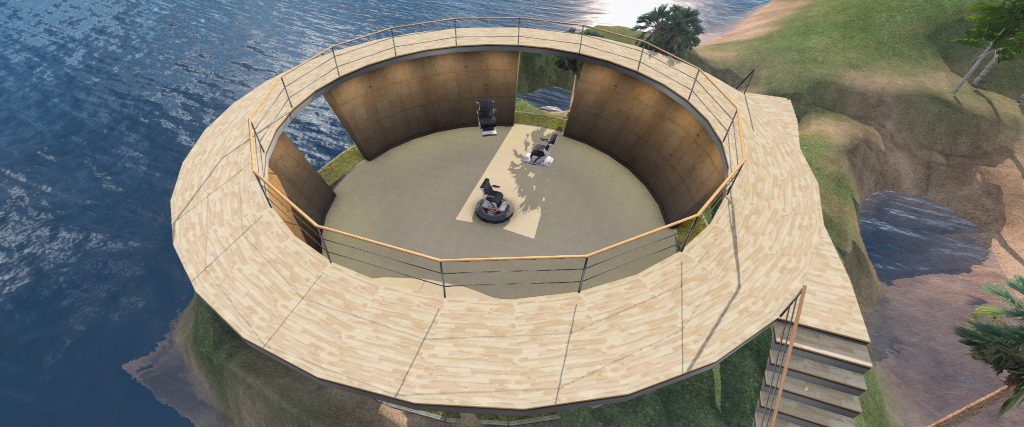
Hippotropolis Theatre: home of the OSD/TPVD meeting
The following notes were taken from:
Pantera’s video (embedded at the end of this article) and my chat log of the Open-Source Developer (OSD) meeting held on Friday, February 27th, 2026, together with my chat log of that meeting.
Please note that this is not a full transcript of the meeting but a summary of key topics.
The OSD meeting is a combining of the former Third Party Viewer Developer meeting and the Open Source Development meeting. It is open discussion of Second Life development, including but not limited to open source contributions, third-party viewer development and policy, and current open source programs.
This meeting is generally held twice a month on a Friday, at 13:00 SLT at the Hippotropolis Theatre and is generally text chat only.
Note: The OSD/TPV meeting has tended to occur in the same week as the content Creation User Group meeting over the last several months, resulting in a lot of repetition of information between the two meetings (and combined summaries on this blog). An attempt is being made to break this cycle by having the next OSD/TPV meeting on Friday, March 6th, 2026 before reverting to the usual every other week format (so the meeting after that will be March 20th, 2026) – thus putting the OSD/TPV meeting and the CCUG on alternate weeks.
Official Viewer Status
Default viewer 2025.08 – 7.2.3.19375695301 – maintenance update with bug fixes and quality of life improvements – December 2.
Notable addition: new VHACD-based convex decomposition library for mesh uploads.
Introduces the ability to moderate spatial voice chat in regions configured to use webRTC voice.
Second Life One Click Install viewer 26.1.0.21295806042, January 26, 2026 – one-click viewer installation.
Upcoming Viewers
Viewer 2026.01
Remains the current viewer development focus with the release of the beta (RC) version, although this will be shifting more to 2026.02.
The velopack one click installer / updater is not in the initial beta, and may now in fact slip to 2026.02.
2026.01 includes a high priority fix for specific Bluetooth headset configurations which will benefit WebRTC.
Now available as an alpha viewer (above).
As the name suggests, triggers a one-click install / viewer update process.
Also includes improved monitoring / logging of viewer freezes and crashes, etc.
Viewer 2026.02
2026.02 remains on track for the “Flat” UI and font updates.
It now also includes the WebRTC voice moderation capabilities (as seen in the project viewer) to help align viewer-side WebRTC updates more with the hoped-for server-side deployment (see below for more).
This viewer might additionally receive some backported updates to texture streaming.
No Alpha / Beta viewer is available as yet for this release..
Example of the upcoming flat UI. Via: Geenz Linden / Github #4681/2
Viewer 2026.03 -“SL Visual Polish” (SLVP)
2026.03 had been looking to an April release, however, it might slip back to 2026.04. Part of the decision-making on this is related to upcoming server-side updates to EEP and glTF which are seen as being required prior to SLVP shipping.
It will likely to include:
The “long baking” SSR improvements that were started last year. This version of the viewer will likely have a long beta soak time to allow feedback on these changes to be gathered.
PBR specular for residents who are more familiar with the old Blinn-Phong workflow. This will:
Include another texture slot (tint of the specular reflection).
Work with metallics.
Follow the glTF specification, but will likely initially be without glTF overrides, as this requires server-side work.
HDR controls in EEP so residents can decide how bright or dark things should be. This work does require simulator-side updates. This will likely initially have server-side support on Aditi (the Beta grid).
It may additionally include:
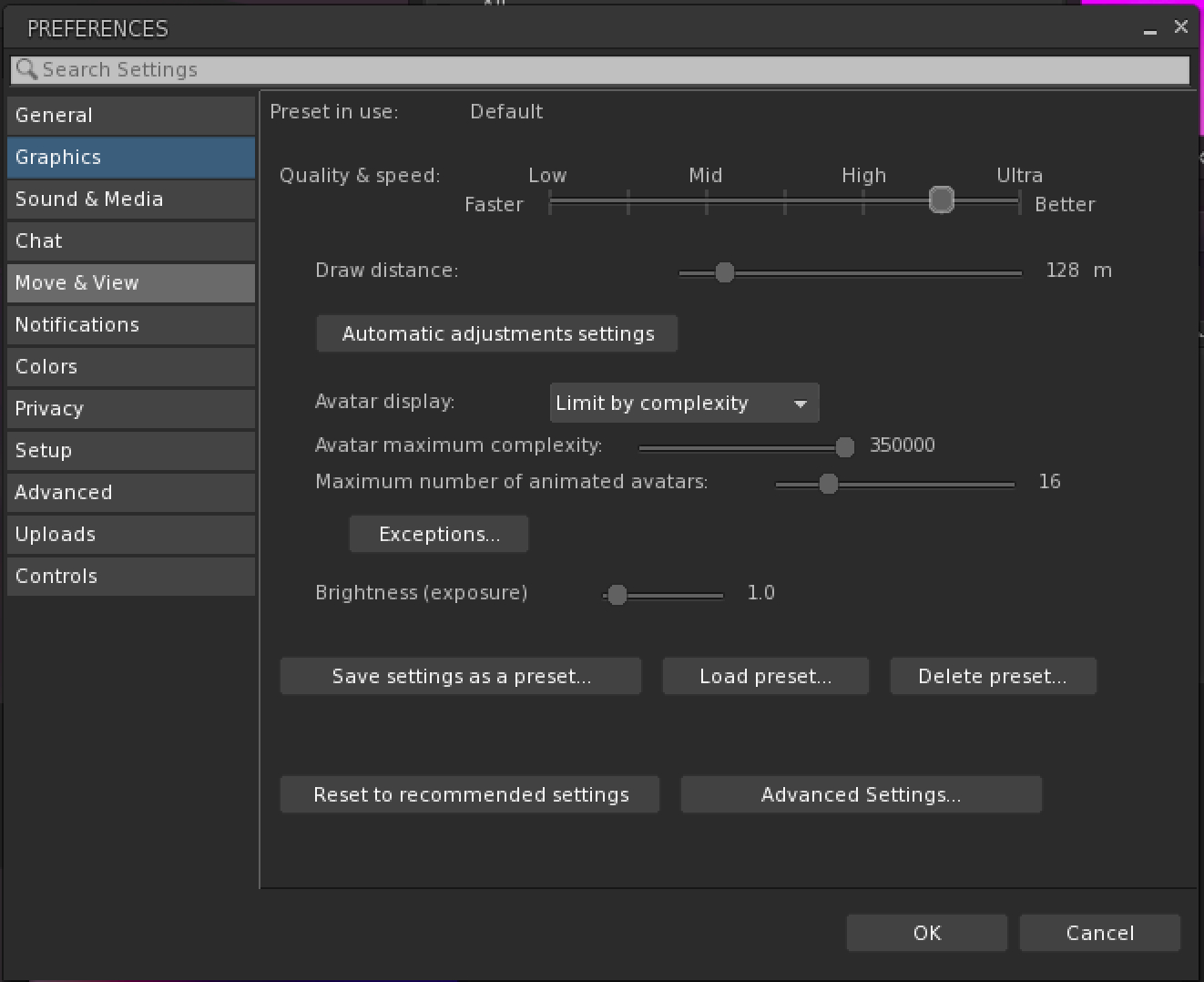
Further mirrors optimisations and a new “Ultra” quality setting that will enable a system mirror for water. A caveat on this work is that while this “water mirror” might up the quality of water reflections, it will do so at a performance hit; SSR for water will always be faster and less intensive.
Inclusion of an emissive strength setting for PBR.
Firestorm hosted a Townhall recently, with Lab presence, to try to determine why a percentage of Firestorm users remain reluctant to move away from a 6.x version of that viewer to a PBR-supporting version. The predominant issues appear to be concerns over performance and the degraded water visuals seen with PBR viewers.
One aspect of people refusing to move is hearsay: “X said PBR sucketh and has poor performance, therefore I will not even try it”, regardless as to whether this might be true for them or not; another is, potentially, people’s general unwillingness to change from what they like.
Exactly how to address such issues / beliefs/perceptions is no easy task.
A suggestion was made to have “toggle” in the viewer so users can determine which rendering system they wish to use (e.g. “legacy” or “PBR”). This is far more complicated than it sounds, requiring continued support of two rendering pipes in the viewer, potentially leading to multiple complications and the potential content breakage. As such, it is not going to happen.
Geenz Linden is continuing to work with texture streaming and resolutions, with some of the work possibly surfacing in 2026.02 as noted above. He further noted that:
Work is not stopping at texture streaming improvements; the Lab is laying plans to deal with some of the “bigger performance bullet points”.
It is known that PBR has introduced performance bottlenecks, many of which have been dealt with, others of which still need work. To this end, the Lab may start running Tracy “very, very regularly” to identify bottlenecks so they can be addressed.
The hope is that when adding a new PBR feature / capability, at least one existing bottleneck will be corrected.
As noted in the 2026 week #5 OSD meeting, there are potential changes coming to the viewer build chain. These involve updates to CMake and a Pull Request relating to vcpkg. The latter is still under review, and is likely to be implemented “bite by bite”, rather than all at once. It will also be likely to go into its own branch and not emerge until after the SLua /Linux viewer work reaches release status, so as to not over-complicate things for TPVs.
TPV Developer Henri Beauchamp (Cool VL Viewer) suggested splitting the viewer’s main thread so that the rendering code can be separated from messaging and objects updates, thus smoothing frame rates in the viewer.
Geenz Linden indicated that this had been looked at by a Product Engine engineer, and that it was felt that doing so would help out massively with porting the viewer to other graphics APIs.
However, actual work on this has not as yet started, as there is a need to “chip away” at getting approval together with a need to avoid disrupting existing releases.
Such is the scale of the work, it could involve “a few quarters” of effort to implement.
It was noted that while some multi-threading has been introduced to the viewer, this is mostly “lighter work” more easily removed from the main thread, which still does most of the heavy lifting via a single CPU core.
The last point rotated into a more general discussion on the viewer, threads, the future potential for removing coroutines and fibers in favour of “actual” threads, etc. Please refer to the last 10-15 minutes of the video.
Grid-Wide WebRTC Deployment
This was targeting a March 2026 deployment, following the usual simulator-side deployment process (a selected RC channel or channels for the first deployment, followed by deployment to all remaining RC channels usually a week later, then a final deployment to the SLS Main channel, usually a week after that).
However, it now appears hat the deployment is likely to be delayed, although no specifics have been given on why or when. .
Linden Homes 2026: Copperfield Heights with the estate winter season
The first Linden Homes release for 2026 has arrived in the form of Copperfield Heights. This is the first release of Linden Homes that is designed from the ground-up to mix units that can be obtained by Plus, Premium and Premium Plus subscribers within the same regions, thus fully deserving the term community. in that it allows a reasonably free mixing of the different subscription tier within one estate theme.
The mixing of different home sizes – from 512 sq metre parcels through to 2048 sq metres – is something that Second Life subscribers have been requesting for a while, and in that respect, it is good to see the Lab responding to such requests. The (perhaps) saddening element in the new theme is that – once again – it is 100% Americana. There’s nothing wrong with it other than it would be nice to see themes that cast their net wider in terms of international appeal given that the majority of such attempts – the “Victorian”, “Mediterranean”, “Chalet” and “Alpine”/”Tudor”/”fachwerkhaus” – all offer Anglo-European ideas through the decidedly American viewing lens.
Linden Homes 2026: Copperfield Heights – Glenwood
The overall style for Copperfield Heights is described as “Craftsman” in design – so a mix of stone, wooden framing, wood siding and slate / tile roofs set out in a suburban setting complete with sidewalks, with the general landscape of the regions able to change with the seasons – an update first introduced with the Aspen Ridge theme homes. As can be expected, the house styles all utilise PBR, giving them a good, modern finish, with a total of 12 styles, eight of which have additional open-plan variants. Size of parcel / available designs is governed by a user’s subscription tier, with both the 1024 and 512 sq m units also available to Premium subscribers should they wish for larger outdoor spaces, as well as the 2048 sq m units, and the 512 and 1024 sq m styles available to Premium.
The following is a summary of the styles available within the theme.
Key Design Elements
As noted above, all of the styles have a stone / wood design. In addition:
All feature a covered porch to the front aspect.
None of the 512 sq m designs offer a fully open-plan alternative, although the Laurel is offered open-plan on its own.
Most – but not all styles include a fireplace.
Several styles include a cupboard / storage space opening under the stairs which could easily be used as a teleport space to carry people to a “basement” in the sky as a possible alternative use.
512 sq m Styles
Glenwood: a 2-storey house with double frontage. A central front door provides access to a large front hallway which could serve as a room space with a staircase (with cupboard under) to the rear running cross-wise up the the extended loft space. Three further rooms open off of this, two to the right, one to the left, framed by wood arches. Upstairs is a single large(ish) room.
Laurel: a 2-storey house with a central front door providing access to a single large floorpsace with dogleg stairs (with under-stairs cupboard), leading to a large full-width bedroom to the front of the house and a small box-room bathroom space to the right aspect.
Linden Homes 2026: Copperfield Heights – Maple Grove
Maple Grove: a single-storey house. Inside is a single large room with fireplace, with a smaller open space opening off of it to the rear and providing access to a back door. The latter provides access to a smaller porch with open-topped trellis work. A small box room with windows to the front aspect completes the house.
Prairie: a 2-story house with double front and a central front door. This provides access to a large room to the right of the house, complete with stairs running up to the loft space and with two connected rooms opening off of it via doorways to the left. The stairs provide access to a single bedroom space.
1024 sq m Styles
Blueridge: a single-storey design with the front door offset to the right front, accessing a large front-to-back open-plan space which could be split into two rooms. A rear side door provides access to a further small covered porch. Two further rooms can be accessed via their own doorways, one to the left side aspect of the house and the other to the rear.
Linden Homes 2026: Copperfield Heights – Blueridge / Sunridge
Sunridge: a variation on Blueridge featuring a large main room and a single small front room.
Cedarwood: a 2-storey design with full width the front door offset to the right. This accesses three interlink ground floor spaces, the first of which features stairs to the upper floor with galleried landing providing access to three moderately-sized rooms.
Hazelwood: a variation on the Cedarwood, presenting a large, open plan ground floor, with the upper floor landing extended to leave 2 rooms facing one another across an open space that could be turned back into a room space.
Meadowbrook: a split-level roof design, the front door and covered porch running to the left of the house. The front door provides access to a living room space with open access to a rear room potentially suitable as a dining room / kitchen. A doorway provides access to a second room at the rear of the house, itself with a doorway providing access to the remaining ground–floor room at the front of the house (which, surprisingly, cannot be accessed directly from the living room). The stairs provide access to two similarly-sized rooms, each with windows to the rear aspect.
Millbrook: a variation on Meadowbrook, with a large open-plan ground floor surrounding a central stairway, and the upper floor providing a large open space at the top of the stairs and a single room.
Linden Homes 2026: Copperfield Heights: Sunnydale / Hollowdale
Sunnydale: a 2-storey rectangular design with the front door offset to the left providing access to an entrance hall with stairway, the hall flowing neatly into three open-pan spaces, one to the front and two to the rear aspect of the house. This design also includes and under-the-stairs cupboard while the dogleg stairs provide access to an open space to one side, which might conceivably be converted into a windowless room, and a single bedroom space with door.
Hollowdale: a variation on the Sunnydale, providing a single large open-plan ground floor layout.
2048 sq m Styles
Oakridge: a large, 2-storey house with a deep, semi-covered front porch providing front door access and plenty of seating space. The front door provides access to a large living area running through to a full-width kitchen / dining space to the rear with further access to a conservatory and dogleg stairs running to the upper floor. The conservatory has access to a small side porch, while the stairs lead up to an open-plan galleried bedroom space and a weird corner room ripe for a bathroom and potentially a lot of head bumping against angled walls!
Willowridge: a variation on the Oakridge, with a large open-plan interlinked ground floor, and single open plan galleried upper floor.
Linden Homes 2026: Copperfield Heights: Oakridge / Willowridge
Pinecrest: a 2-storey house with a gable-roofed front door accessing a large central room with fireplace to the rear and stairs to the upper floor to the left side. A wooden arch provides access to a conservatory extending off the right side of the house, whilst to the left, at the foot of the stairs, a doorway provides access to a further ground floor room. The upper level is a single, large open-plan space.
Maplecrest: a variation on Pinecrest with a single large open-plan lower floor built around a central staircase.
Linden Homes 2026: Copperfield Heights: Prairieview / LakeviewPrairieview: a 2-storey double-fronted ranch-style house with a central front door. Inside, a large central hall provides access to large rooms to either side framed by wood-beamed openings and a reasonably-sized separate room to the left side as the hall continues through to a rectangular wood-and-glass conservatory to the rear. A staircase rising up the right rear of the house provides access to a large, open upper landing which in turn provides access to two bedrooms to the left and right of the house. The central area of this landing could conceivably be turned into a third (if windowless) room.
Lakeview: a variation on Prairieview, offering a large open-plan lower floor of two linked area and the conservatory to the rear, and a single vary large bedroom-come-bathroom space upstairs accessed via double doors, together with an open space.
Woodland: a 2-story house with offset front entrance. The front door provides access to three interlinked open spaces, the largest of which features a fireplace and a dogleg stairway to the upper floor. The rearmost of the three rooms provides back door access to a second covered porch. Upstairs, a large landing area provides access to a single large room to one side and two smaller rooms on the other.
Linden Homes 2026: Copperfield Heights: Woodland / Oakland
Oakland: a variation on Woodland, offering a single large open-plan ground floor area and the upstairs providing two large bedroom spaces.
General Thoughts
The mixing of subscription tiers into a single community is a neat idea, and the new homes appear to be gaining a lot of traction / interest. Some of the styles within the theme are nice enough; but if I’m honest, the re-treading of similar ideas across different themes (stone and wood siding, slate tile roofs, etc.), even with the improvements such as PBR and the regional season changing, it’s hard to escape a certain degree of ah! Same-ol’ same ol'”. For example, whilst different in style, these homes still nevertheless put me in mind of the “Traditional”, “Victorian and “Log Home” styles (albeit it in a different setting to the latter), whilst the overall region landscaping and design brought with it echoes of Ridgewood Enclave and the “Aspen Ridge”, “Newbrooke”, and “chalet” themes.
Linden Homes 2026: Copperfield Heights
True, making things truly unique in terms of landscaping, etc., is hard – the physical world is replete with repeated ideas for suburban living, as we know; but having some real variance would be nice. Or maybe I’m just being a sourpuss – or it’s starting to feel like Linden Home themes are reaching saturation point (how about more updates for existing themes rather than prioritising new themes?). Whatever the case with me, if you do have a Second Life subscription account then the best way to make your mind up is to go visit the Copperfield Heights demo areas at the BelliHub Linden Home Demo area and at the Second Life Welcome Hub and try them on for size – or explore the available regions on foot or via a bicycle or other vehicle.
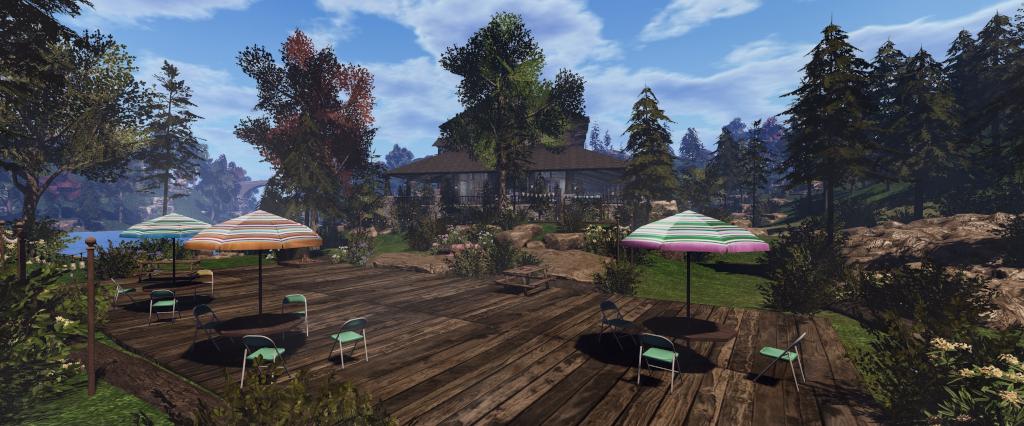
Campwich Forest grounds: location for the Monthly Mobile User Group (MMUG)
The following notes were taken from the Thursday, February 26th 2026 Monthly Mobile User Group (MMUG) meeting. These notes should not be taken as a full transcript of the meeting, which was largely held in Voice, but rather a summary of the key topics discussed.
The meeting was recorded by Pantera, and her video is embedded at the end of this summary – my thanks, as always to her in providing it.
Please note: the meeting experienced assorted voice issues and drop-outs, making transcribing difficult, with some of the issues also resulting a poor sound quality in the video recording.
Meeting Purpose
The Mobile User Group provides a platform to share insights on recent mobile updates and upcoming features, and to receive feedback directly from users.
These meetings are conducted (as a rule):
The last Thursday of every month at 12:00 noon SLT.
Meetings are open to anyone with a concern / interest in the above topics, and form one of a series of regular / semi-regular User Group meetings conducted by Linden Lab.
Dates and times of all current meetings can be found on the Second Life Public Calendar, and descriptions of meetings are defined on the SL wiki.
SL Mobile (Beta) version 2026.2.1079 (A) / 0.1.1079 (iOS) – February 24 – Object chat support and Bubble Chat updates; single tap interactions (see below for more).
Allows chat and incoming IM’s to be viewed over the in-world scene (for approx. 8 seconds), and enables tap-to-reply.
In the initial iteration, tapping a message to reply will take the user back to the menu to show the keyboard.
Release 2026.2.1079 (February 23rd) added:
Bubble chat enhancement to display object names & support messages from objects.
Object chat support (but not, as yet, llDialog support (see below for more on this).
Single tap interactions – no need to use a long press to interact with avatars and objects. Tapping on an avatar or object should generate a blue outline around them indicating they have been selected, together with a basic menu of options which can be expanded via the More option for a full context menu.
It is hoped that these features will help users understand more of what is going on around them whilst also allowing for better interactions and social engagement through chat, etc.
All three features will be enhanced in future releases (such as by making it possible to respond to Bubble chat without have to go via the Chat menu, resolving issues of objects occluding one another and preventing one-tap / “chick through” interactions, for example).
This work should allow for fixing other issues as well, such as adjusting the camera position so that it doesn’t end up on the wrong side of a wall, for example.
All of these features have received generally positive feedback from users attending the meetings.
Upcoming Updates
AI integration:
Currently, when creating a new account, a user will receive a canned welcoming message on logging-in to SL.
However, new users are responding to the message – which the service is not capable of ‘seeing” or making a response -something that might upset new users because it appears like they are being ignored.
To this end, Brad Linden is working on hooking this process up to a chatbot so that users at lease get the sense of a meaningful exchange (and might thus be encouraged to contact others around them).
LL utilises crash reports supplied by Google and Apple to identify specific crash bugs / issues for rectification. This work has seen a noticeable improvement in SL Mobile’s stability on Android, although so new crash issues have crept in as well. As such:
Further Android crash fixes can be expected in the next release(s).
Work is ongoing to deliver the same of iOS.
Work is finally starting on adding support to SL Mobile for llDialog, to ensure support for interactive dialogue menus associated with scripted items. This is fairly involved work, so no target date for possible release is being given at this time.
Synchronising chat history across Mobile and the viewer: again, this is a complex task, but “good progress” is being made.
Localisation in the app (local country languages) is underway, but also no tentative release date for the the initial work as yet.
Supported languages will likely be the same as those supported in the viewer.
Feedback and assistance with localisation (e.g. ensuring idioms translate, etc.), will be sought from users wishing to help with the work, once the first iteration of the work surfaces in the app. Such feedback should be made via the SL Feedback Portal.
This work will also allow manual setting of a preferred language, rather than simply having the app simply utilise the language set in the device operating system.
Voice improvements – particularly WRT making the initialisation of Voice in the app less disruptive for users trying to enable it. This work is currently with QA.
General Q&A
At least one user has reported incidents of Mobile suffering from freezing at times – although this is not tied to time of day or specific activities, but the reporter does have a high ping rate as they are across the Atlantic from SL.
This particular issue has been hard to repro at the Lab (due to a lower ping rate & less in the way of message dropping. etc?).
There are also a number of fixes in the works for crashes, lock-ups etc., one (or more) of which might incidentally resolve the issue. Beanie Linden (Mobile QA lead) is going to have further goes at trying to repro the issue and, if possible, test it against these fixes.
A question was asked about what kinds of data is collected by the app, and for a clarification as to what the “track your activity across other apps” pop-up means.
Rather than gathering user data, this capability is more aligned with the ongoing drive to try and push new users to try the SL Mobile app via advertising – e.g. to gather data and information related to the ads and to those signing-up in response to the ads. The idea here being to help determine the efficacy of such advertising / drives.
A general discussion on feedback relating to to positive benefits of Bubble Chat and object chat, and ideas for future enhancement (e.g. toggle options to turn it on and ) – some, if not all of which are likely to be looked at in the future as the capability further matures.
Pususaari – Where spring feels gentle, February 2026 – click any image for full size
I’ve had a something of a rough couple of weeks, the result of which has been very little time in-world, other than parking myself at the occasional user group meeting and trying to keep up with “routine” posts here. So, as things have decided to improve, I decided to ease back into blogging visits and bits by returning to a location that has been a recent favourite for me: Pususaari.
To be honest, I didn’t arrive at this decision all on my own, my friend Cube Republic poked me with the news that the region had once more been reworked by holders Lu and Leelou Von Perkle (Lu Carrillo and LeeLou Graves respectively), and this served to encourage me to hop over and have a look around once more.
Pususaari – Where spring feels gentle, February 2026
This marks my third visit to the setting, which carries the name Pususaari – Where spring feels gentle, the others having been in April 2025 and again in December 2025. With those visits – as with this one – I could not help be feel at home within the region.
Romantic island for dates and quiet moments. Soft light and gentle nature invite you to relax, wander and connect. Discover a cosy café, hidden seating spot, open verandas, beaches, animals and a unique lighthouse landmark watching over the shore.
– Pususaari About Land Description
Pususaari – Where spring feels gentle, February 2026
The cosy café and lighthouse of the About Land description face each other across the gentle, sandy sweep of a shallow bay on the south side of the region. The café forms the region’s Landing Point on the eastern side of the bay, whilst the lighthouse stands at its western extent.
The latter appears to have been decommissioned some time ago; the lantern is off and the glass of the light room is heavy with grime and dirt to the point of being opaque. Now the only illumination the lighthouse seems to provide is that of a hand-held lamp. This sits on a round table on the lighthouse gallery, a wooden chair alongside it offering a perfect look-out point, although getting up to them appears to require a bit of a jump!
Pususaari – Where spring feels gentle, February 2026
The bay and is guardian lighthouse and café are in turn overlooked by an artist’s studio/ retreat sitting up on one of the island’s wooded peaks. It can be reached by walking inland from the café, passing through a gap in the fence backing the beach and then climbing the lower slopes of the peak to where a wooden stairway and deck provide access to the upper slopes and the studio.
Inland, the region is split into two by an east-to-west flowing channel crossed by two bridges. The first of these is reached via an easy walk through a low-lying meadow beyond the slope leading up to the artist’s studio. On the north side of the water channel, this bridge is watched over by a working windmill.
Pususaari – Where spring feels gentle, February 2026
The latter forms a part on a small homestead farm on the north side of the setting, joining with a Tuscan-style farmhouse and outbuildings bordering another sweep of meadowland, horses cattle, horses, pigs and chickens making up the livestock being tended.
The farmhouse is ideally placed to overlook the beach running along the north coast of the region, a waterside summer gazebo offering a retreat of the hard work of the day on the beach, while an outdoor dining space complete with pizza oven offers a further corner of delight for the farm owners and their family.
Pususaari – Where spring feels gentle, February 2026
The western end of the north beach cuts a little more deeply into the land, and sandy walk leads inland and up to the second bridge across the region’s water channel. This provides access to the back of the wooded hill where the artist’s studio is located.
A steep grassy climb runs up over the hill, allowing explorers to make their way back to the studio. An easier walk around the shoulder of the hill offers a path to an old shack on the coast, the deck of which has long since claimed by the load seal population, whilst the interior offers a further retreat for romantics.
Pususaari – Where spring feels gentle, February 2026
A couple of wrecked boats suggest the waters around the island can be a little capricious in their treatment of passing vessels while at the same time offering further points of interest to those exploring the region – and, in the case of one of the boats – for the local pelicans!
All of the above leaves a lot unsaid about this iteration of Pususaari – the level of detail to be found throughout, the mix of local waterfowl, the many places to sir and pass the time alone or in company – and, of course, plenty of opportunities for photography.
Pususaari – Where spring feels gentle, February 2026
So – why not go see for yourself?
SLurl Details
Pususaari – Where spring feels gentle (Bisous, rated Moderate)







 Inara Pey: Living in a Modemworld