On Tuesday, September 22nd, the grid’s main SLS channel was updated to simulator maintenance release 548903, containing updates related to the cloud uplift work which contain no user-visible changes.
There are no RC deployments planned for the week.
SL Viewer
The Bormotukha Maintenance RC viewer, version 6.4.8.548890 dated September 18th, was promoted to de facto release status on Tuesday, September 22nd.
The rest of the official viewer pipelines remain as follows:
Current release viewer version 6.4.7.546539, dated August 11, promoted August 17, formerly the Arrack Maintenance RC viewer – No Change.
Release channel cohorts:
Mesh uploader RC viewer, version 6.4.8.548061, September 8.
Love Me Render RC viewer, version 6.4.8.547427, August 21.
Project viewers:
Project Jelly project viewer (Jellydoll updates), version 6.4.8.547487, issued August 26.
Custom Key Mappings project viewer, version 6.4.5.544079, June 30.
Copy / Paste viewer, version 6.3.5.533365, December 9, 2019.
Project Muscadine (Animesh follow-on) project viewer, version 6.4.0.532999, November 22, 2019.
Legacy Profiles viewer, version 6.3.2.530836, September 17, 2019. Covers the re-integration of Viewer Profiles.
360 Snapshot project viewer, version 6.2.4.529111, July 16, 2019.
Cloud Uplift
There is a known issue with Navmesh retrieval on cloud-hosted regions on Aditi.
The Lab believe they have a solution for the outward e-mail issue with cloud-based regions. However, due to the way in which Aditi regions are set-up, testing of the fix is being carried out elsewhere, but the hope is the fix will be usable once there are user-accessible regions on Agni that are running on AWS services.
In Brief
There is no update on the Group chat / IM failure issue (see BUG-229219).
The majority of the meeting focused on a general discussion on region crossings – notably with vehicles – and the assorted problems that can arise, including the inconsistencies in some things like object entry and group access are handled (the former can prevent vehicle and avatar entry, whereas the latter can allow a vehicle into a region / parcel, but then eject the driver / passenger, obviously resulting in problems).
The Muse, September 2020 – click any image for full size
In February 2020, we visited The Muse, a Homestead region designed by the superbly named “United Nerds of Building” (see: Finding The Muse in Second Life). Earlier this month, I received a note from Liss Beattie, that The Muse’s owner, Tribish Tammas, has both relocated and redesigned The Muse, so we took the opportunity to hop over and take a look.
Still occupying a Homestead region, The Muse retains some elements from the design we saw back in February, whilst also offering an entirely new look. As with the previous design, The Muse remains split between a core ground-level build and a sky platform, with the stated aim of the region being to offer a “space for couples, lovers, and friends to relax and spend time together”.
The Muse, September 2020
The main landing point is located in the the ground-level setting, on the south side of the region. Backed by a flat-topped bluff with grassy slopes to its seaward side, the landing point sits within the ruins of an ancient building – perhaps an aged temple – with a westward view towards the surrounding mountains. These sit beyond a small island that appears to have been formed by the local water cutting a channel to separate what had once been a headland.
Reached via a stone bridge that arches between two weather-beaten and somewhat decrepit gates, this little island is home to one of the elements seen within the previous design: an open-air Elven Ballroom.
The Muse, September 2020
The bluff behind the landing point runs east and then north, forming a low-lying table of land, its landward faces formed by rocky cliffs over which a waterfall tumbles to feed a stream that winds its way across the region. In doing so, it neatly cuts the lowlands into two unequal parts. On one of these sits a single barn, converted to an adult play area, surrounded by a sea of flowers. On the other, close to the rocky plateau, is a more expansive ruin that sits close to a place that winds up to the top of plateau.
Two bridges span the stream,providing easy passage between the two parts of the lowlands, while a third bridge reaches across a further channel of water to reach a north-eastern island.
The Muse, September 2020
The north-eastern island has a backbone of cliffs against which the intriguing bulk of The Retreat from The Looking Glass sit.. In the last iteration of The Muse we visited, this formed a mystical library. Now it fulfils more of the role of being a home, its westward aspect commanding a view across the region’s lowlands, ruins, barn and Elven Ballroom all visible among the trees sprinkled across the landscape. Also visible from this vantage point is a large garden bar sitting at the north end of the main island, a comfortable walk from both this house and the barn.
The sky platform is reached via teleport from the landing point (you’ll need to accept the region’s experience when asked). As per the previous iteration of the design, it offers a large dance floor with and animated finish and now bracketed by a pair of floating islands – one the teleport point, the other offering space for Tai chi exercise. It is watched over by a blue whale that swims through the air above it, and the eye of a large moon that slowly orbits the dance floor along with the stars and nebula of skybox surrounding the platform.
The Muse, September 2020
Throughout both settings, ground and sky, are numerous opportunities for dancing and / or sitting and relaxing, whilst on the ground, the islands are nicely rounded-off by a natural sound-scape.
One of the charms of The Muse when we last visited was the manner in which it comprised a series of individual vignettes loosely woven together by the setting in which they sat, rather than presenting a truly contiguous whole. It was both eclectic and yet complete, the various areas offering their own individuality but nevertheless flowing together as a whole.
The Muse, September 2020
This new iteration presents farm more a feeling of being a contiguous whole at ground level, a single environments with multiple points of interest. On the one hand, this means the current Muse perhaps lacks the eclectic mix of the old, but on the other, it means it offers its own unique look and feel – that of a temperate island that has seen the passage of time and human habitation, and is now a retreat from the pains and pressures of the world, ready to greet and comfort all who visit it.
It’s time to highlight another week of storytelling in Voice by the staff and volunteers at the Seanchai Library. As always, all times SLT, and events are held at the Library’s home in Nowhereville, unless otherwise indicated. Note that the schedule below may be subject to change during the week, please refer to the Seanchai Library website for the latest information through the week.
Monday, September 21st: Anything You Can Do
Gyro Muggins reads Randall Garrett’s (writing as “Darrell T. Langart”, one of his many pen-names) story of an alien encounter first published in serial form in 1962.
What do you do when you finally make contact with E.T. after it crash lands on Earth and you find that, unlike Hollywood, it’s not here for reasons of conquest- but that, despite its clear intelligence, it just doesn’t care about the destruction and death it wreaks across a city, because its norms of behaviour are so thoroughly – well, alien – compared to ours, and its sheer power means very little can actually harm it?
Well, you obviously take a man and rebuild him – but not with bionics; rather you do so purely biologically- so that he can match anything the alien can do. But then, when you’ve done so, is your creation still human?
Tuesday, September 22nd:
12:00 Noon: Russell Eponym, Live in the Glen
Music, poetry, and stories in a popular weekly session at Ceiluradh Glen.
19:00: Two Celtic Tales
Willow Moonfire reads two short stories
In Teig o’Kane and the Corpse we follow the tribulation of a young Irishman who doesn’t want to commit to adulthood – until he finds himself with a talking corpse latched onto his back that demands he finds it a grave by morning, or find the corpse forever on his back.
The Witch of Lok Island tells the tale of Houarn and Bella, a young couple who want but a simple life, with a cow and a pig to rear and a home in which to live. So Houarn sets out to find the means by which they might, only to learn of a beautiful lake-dwelling fairy, and determines to find her and seek her aid. But is her willingness to do so genuine or something else – and might it be that Bella has some magic of her own that might help rescue Houarn from his foolishness?
Wednesday, September 23rd / Thursday September 24th, 19:00: The Princess Bride
Anyone who lived through the 1980s may find it impossible – perhaps even inconceivable – to equate The Princess Bride with anything other than Rob Reiner’a 1987 film of the same name, adapted for the silver screen by none other than the novel’s author, William Goldman. And yet, there is so much more to the tale.
Goldman frames his story as a tale written by (the fictional) “S. Morgenstern” that his father read to him when he was but a boy. On reaching adulthood, he claims he looked forward to nothing more pleasing than sharing this masterly tale with his own son, only to discover that rather it being a swashbuckling tale, “Morgenstern’s” original was actually a plodding political satire on his “homeland” of “Florin”. The tale he remembered from his young years was actually the result of his father just reading the “good bits” of the story, and ignoring the rest.
Determined his son and other youngsters should benefit from his father’s approach to the tale, Goldman claims (by way of footnotes in the book) that he decided to produce an abridged version of “Morgenstern’s original focusing on just the “good bits” his father would read. And so it was that (his tale-around-a-tale goes), The Princess Bride: S. Morgenstern’s Classic Tale of True Love and Hight Adventure was born.
So, as recently requested by Seanchai library attendees, join Caledonia Skytower as she presents the best, best bits of this charming tale of Buttercup, Westley, Inigo and all over the course of two evenings.
Thursday, September 24th, 21:00: Seanchai Late Night
Finn Zeddmore presents contemporary Sci-Fi Fantasy from sources including Escape Pod. Light Speed, and Clarkesworld on-line ‘zines.
Logos representative only and should not be seen as an endorsement / preference / recommendation
Updates for the week ending Sunday, September 20th
This summary is generally published every Monday, and is a list of SL viewer / client releases (official and TPV) made during the previous week. When reading it, please note:
It is based on my Current Viewer Releases Page, a list of all Second Life viewers and clients that are in popular use (and of which I am aware), and which are recognised as adhering to the TPV Policy. This page includes comprehensive links to download pages, blog notes, release notes, etc., as well as links to any / all reviews of specific viewers / clients made within this blog.
By its nature, this summary presented here will always be in arrears, please refer to the Current Viewer Release Page for more up-to-date information.
Note that for purposes of length, TPV test viewers, preview / beta viewers / nightly builds are generally not recorded in these summaries.
Official LL Viewers
Current release viewer version 6.4.7.546539, dated August 11, promoted August 17, formerly the Arrack Maintenance RC viewer – No Change.
Release channel cohorts:
Bormotukha Maintenance RC viewer updated to version 6.4.8.548890 on September 18th.
Recently opened at Niccoli Sweetwater’s Basilique region is a joint exhibition of art organised by the Focus team, and featuring the work of Looker Lumet and Sophie Marie Sinclair (Perpetua1010), both of whom are artists new to my eyes. This is something of a “split level” exhibition of work, the core being located at Basilique’s skyborne exhibition and event space, Palazzo di Basilique, with some of Looker’s work also appearing at the ground level Galleria rotunda.
Located on the Lago di Garda terrace at the rear of Palazzo di Basilique, Sophie Marie Sinclair presents Yellow Expressions, a portfolio of her physical world art with – as might be expected from the title – something of a yellow theme running through them.
Basilique: Sophie Marie Sinclair (Perpetua1010)
Sophie’s background is perhaps as fascinating as her art. A graduate of the Academy of fine Arts Vienna, she is also by turn a cartoonist, having had a particular focus on political satire, an author and a ghost writer for certain well-known comedians. As a painter, she is an experimentalist in terms of materials she uses, but has a leaning towards plaster, glue, terracotta, stones, bones, ash, charcoal, and the use of natural pigments.
Sophie describes her artistic focus as being on the nude body and also abstract art, and the former is certainly demonstrated in Yellow Expressions, which features 10 studies of the male and female form, most of which appear to be pen or charcoal drawing finished in a water or ink wash to provide the natural yellow tone within them, with one piece (Mind N) offering the suggestion of a more oil-like and textured / layered finish that also involves richer hues.
All ten pieces are superbly rendered, their finish highly suggestive of being produced on porous plaster rather than canvas, something that gives them a highly tactile sense, whilst their neo-classical styling presents them as pieces that would fit any home environment admirably.
Basilique: Looker Lumet
Straddling the upper terrace at the front of Palazzo di Basilique and the ground-level Galleria rotunda, Looker Lumet offers a selection of his Second Life landscape photography (although he also produces avatar studies and portraits as well), with 12 pieces on the terrace, eight of which are also offered within the Galleria. I’m not entirely sure of the reason for this, although I assume it is to allow visitors to Basilique itself to view an art display without them necessarily being aware of the exhibitions up at Palazzo di Basilique.
Either way, Looker’s landscape work is rich in atmosphere, with the pieces offered in this selection perhaps leaning more towards darker tones and hues, some of which are fitting, given the theme (such as with The Graveyard in the Forest), whilst with others it offers a genuine and fitting depth of broodiness that emphasises Nature’s changing moods or the overall tone of the piece in question (see Abandoned and Seasight).
Which is not to say this is a “heavy” exhibition in terms of colour and tone: there are several brighter pieces that stand as memories of happy times on the beach or the splendour of a day’s sailing, all of which stands as an engaging exhibition.
Basilique: Looker Lumet
I gather both Sophie’s and looker’s work will remain at Basilique through until mid-October.
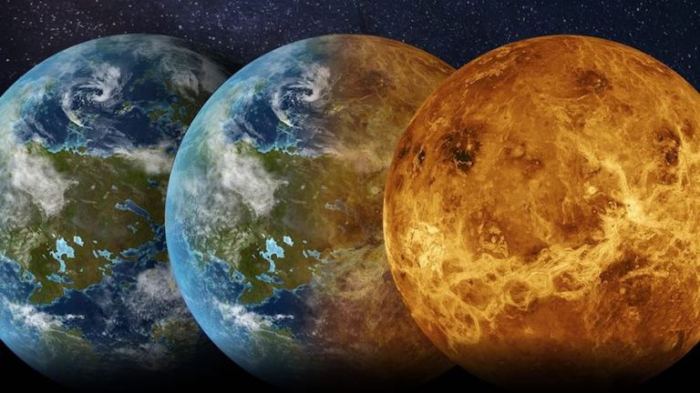
Venus, the second planet out from the Sun and roughly the same size of Earth, is well known for being the prime example of a runaway greenhouse effect. Shrouded in dense, toxic clouds that hide its barren surface from view, the planet has an average surface temperature 464°C, its dense, carbon-dioxide dominant (96%) atmosphere places an average pressure on that surface around 92 times the mean pressure at sea level here on Earth – or roughly the same pressure as exerted by the sea at a depth of 900 metres (3,000 ft).
Yet, as I’ve recently reported (see: Space Sunday: Venus’ transformation, SLS and an asteroid), there is evidence to suggest that Venus started life as a warm, wet planet with liquid water seas of its own, only to be started on the road to becoming the hothouse we know today thanks to Jupiter’s wandering influence.
However, if this theory is correct, and Venus was once warm and wet, the question of whether it was sufficiently so to give rise to the earliest forms of basic life becomes a very real one – as does what might have happened to that life as the planet started its long transformation in the superheated, super pressurised world we see today.
Did the changing conditions simply wipe out any microbes that may have arisen there, or did those microbes themselves have been transformed, moving to the upper reaches of the Venusian atmosphere where they could survive on the heat from both the Sun and rising from through the planet’s atmosphere without necessarily being dry roasted, while drawing on the minerals and chemicals also floating within the high-altitude clouds?
The idea of entirely atmosphere-borne forms of life on planets like Venus and Jupiter is not new, but this past week, the potential for some form of organic activity on Venus became a lot more real with the detection of a compound this is usually the off-shoot of organic processes within the mid-levels of the Venusian cloud layers.
Phosphine is a colourless, flammable, very toxic gas compound made up of one phosphorus and three hydrogen atoms (PH₃). It is most commonly produced by organic life forms, thus its presence within the atmosphere of Venus raises the tantalizing possibility that something is alive in that atmosphere – although it should be noted, it can also be created artificially.
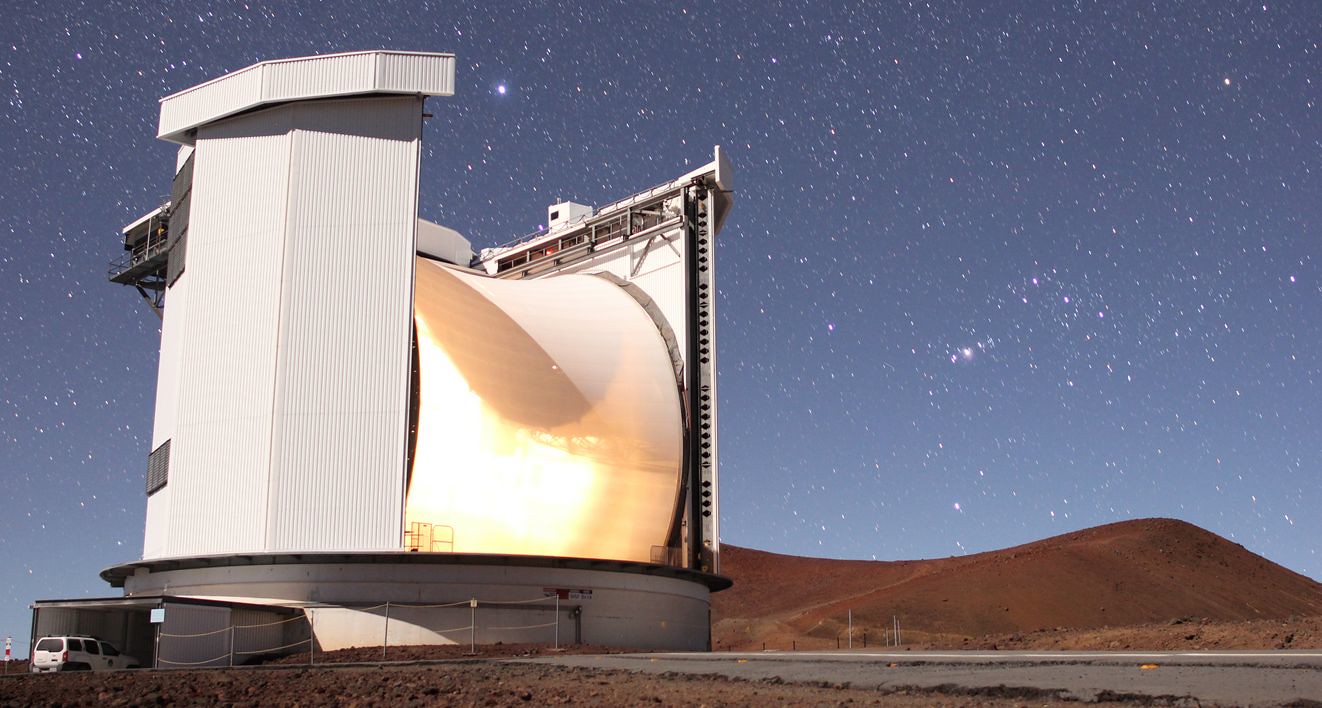
The detection of phosphine in Venus’ atmosphere was made by an international team using two different telescopes in different parts of the world. The team, led by astronomers working out of Cardiff University in the UK, first identified the compound using the James Clark Maxwell Telescope (JMCT), located in Hawaii. They then turned to the Atacama Large Millimetre/sub millimetre Array (ALMA) in Chile, equipped with more sensitive detectors than JCMT, to confirm their findings.
The James Clark Maxwell telescope, Hawaii. Credit: Will Montgomerie/EAO/JCMT
It’s important to note that while the phosphine has been identified, the team responsible for identifying it are not jumping to the conclusion it means there is life within the Venusian atmosphere. While – in our experience – it is generally the result of organic interactions, it can be produced in the laboratory, as noted, through chemical interactions – and Venus is a veritable chemical hothouse.
What is surprising is the amount of phosphine calculated to be in the cloud layer: roughly 20 parts per billion. While a comparatively tiny amount, it is astonishing to planetary astronomers because it’s long been assumed that if any phosphorus existed in Venus’ atmosphere, it would long ago have bonded with oxygen atoms, of which there are a lot around Venus, albeit the majority being bound within the dominant carbon dioxide.
Following their discovery the team, led by Jane Greaves of Cardiff University and ideo Sagawa at Kyoto Sangyo University, Japan, sought potentially natural means for the formation of phosphine around Venus. These included things such as chemical reactions in the atmosphere driven by strong sunlight or lightning, or the interaction of chemicals coming from volcanic activity, or delivered by meteorites. However, none of these mechanisms could account for the volume of phosphine Venus appears to have.
Even so, this doesn’t necessarily mean that the phosphine is the result of tiny Venuisan organisms; as the team note, it could be the result of as yet unknown photochemistry or geochemistry mechanisms within the planet’s atmosphere or the planet itself.
Although we concluded that known chemical processes cannot produce enough phosphine, there remains the possibility that some hitherto unknown abiotic process exists on Venus. We have a lot of homework to do before reaching an exotic conclusion, including re-observation of Venus to verify the present result itself.
– Study member Ideo Sagawa
Obviously, to determine whether or not biotic or abiotic processes are responsible for the phosphine, further study – preferably close-up – of Venus’ atmosphere is required. Although further Earth-based observations from Earth can help confirm the volume of phosphine within the planet’s atmosphere, satellites orbiting Venus will offer a far more complete picture, simply because they can study the planet in detail over the course of years, building up a complete picture of its composition using spectrographic analysis.
Two Venus missions – VERITAS, the Venus Emissivity, Radio Science, InSAR, Topography, And Spectroscopy orbit and DAVINCI+, an atmospheric penetrator, are already being considered by NASA as planetary missions among missions to other destinations, with one of this group of proposals due to be selected in April 2021. Either could help sniff out the phosphine and potentially help identify its cause. Japan’s Akatsuki orbiter may also help in further studies of phosphine around Venus.
The private company Rocket Lab has been developing plans to mount its own mission to Venus for some time, using their Electron rocket, which has been operating since 2018, and their new Photon upper stage, which made its début in august 2020. Rocket Lab founder and CEO Peter Beck believes that Venus has been undervalued as a place for stud (although there have been some 30 fly, orbital and lander missions since 1962).







 Inara Pey: Living in a Modemworld