
After a period of delay, NASA’s Origins, Spectral Interpretation, Resource Identification, Security, Regolith Explorer (OSIRIS-REx) is due to attempt the collection of a 60 gram (2.1 oz) sample from the surface of 101955 Bennu, a carbonaceous near-Earth asteroid, on Tuesday, October 20th.
Originally scheduled for August 2020, the attempt to gather the sample requires the space craft to slowly descend to within “touching” distance of the asteroid using a robotic arm. If successful, the sample gathering will open the door for OSISRIS-REx to complete the remainder of its mission before making its way back to Earth where the sample can be analysed.
Launched in September 2016, OSIRIS-REx is one of two such asteroid sample return missions currently in progress, the other being Japan’s Haybusha 2 mission (the original Hayabusha mission also returned samples from an asteroid – but they only amounted to around 1 milligram of material).
Having been launched well ahead of OSIRIS-REx, Hayabusha 2 is actually on its way back to Earth from asteroid 162173 Ryugu, with which it rendezvoused in June 2018. It spent 18 months surveying the asteroid, depositing four micro-rovers on its surface before gathering samples blown off of the asteroid by the force of a kinetic impactor (think bullet), allowing it to collect a mix of surface and sub-surface material. Currently, Hayabusha 2 will deliver its cargo back to Earth during a fly-by on December 6th, 2020, after which it may be tasked with a further sample return mission.

OSIRIS-REx reached it’s target, Bennu, at the very end of December 2018 and has spent most of the intervening time studying the asteroid in detail. Both Bennu and Ryugu are of interest to scientists for a number of reasons: they are both part of a class of asteroids that are believed to have been around since the formation of the solar system, and so they could help us learn more about that period.
Both are also in the Apollo asteroid group, meaning they routinely cross Earth’s orbit, and thus present a potential collision risk, and at 1 km diameter for Ryugu and just under 1/2 a km for Bennu, an impact from either would not be a Good Thing for Earth. So, another reason for sampling them is to determine their composition (and by extension, allow us to draw conclusions about the composition of other large Apollo asteroids) that may help make a determination of how to deal with them should that threat of impact become real (in fact, there is a chance that Bennu in particular might impact Earth between 2175 and 2199).
Finally, samples from both might offer clues as to how life-forming materials reached the surface of Earth.
Bennu has proven particularly intriguing for scientists. For one thing, it has proven to be entirely unlike anything that had been anticipated; rather than being relative smooth, with crater pits and sand-like regolith (surface material), Bennu revealed it is a boulder-strewn place with rocks in places comparable to mountains relative to its size, many of them placed so closely together, any attempt to gather samples near them would like result in a loss of the vehicle. This required a more extensive survey to determine potential sample sites, with five initially being identified, before these were narrowed to two, the primary, Nightingale, and a back-up.
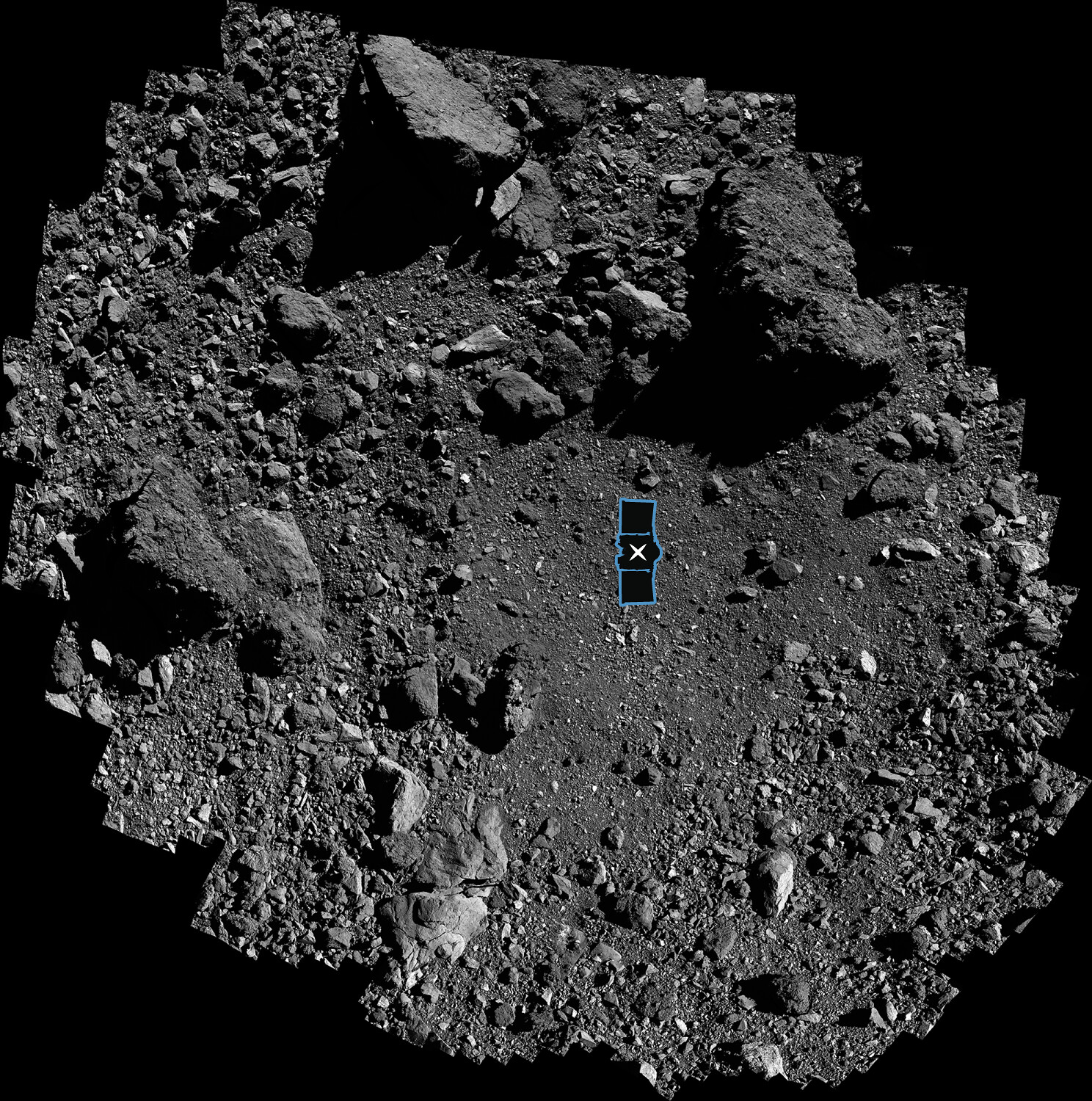
The asteroid also demonstrated it can emit plumes of material from within itself when in the “warm” part of its 1.2 year orbit around the Sun. However, one of the most surprising discoveries was the identification of six bright boulders on the asteroid’s surface which, when subjected to spectroscopic analysis, revealed themselves to be of the same materials as boulders on Vesta, the second-largest asteroid in the solar system, surveyed by the NASA / ESA Dawn mission.
It’s believed that the presence of these rocks indicates that Bennu started life as part of a larger body – an asteroid or planetesimal – within the asteroid belt beyond Mars, where it was in collision with a fragment of Vesta, depositing material from the latter on its surface. That event, or another similar collision, led to a “catastrophic disruption” within Bennu’s parent, creating Bennu itself and sending it on its way into the inner solar system to be caught in an orbit much closer to the Sun.
The asteroid has also revealed itself to be particularly rich in carbon-bearing material, which can tell us how much water it may have contained (and how much might still be present as sub-surface ice). What is particularly interesting here is that many of the boulders on Bennu contain mineral veins composed of carbonate – which on Earth often precipitates from hydrothermal systems that contain both water and carbon dioxide. Some of these rocks are located around the Nightingale sample recovery area. The presence of such carbonate strongly suggests that Bennu’s parent body, whether asteroid or small planetary body,was likely hydrothermally active. This has in turn given rise to the prospect that any sample returned by OSIRIS-REx might contain organic material.
Continue reading “Space Sunday: OSIRSIS-REx: sampling an asteroid”


 Inara Pey: Living in a Modemworld