The following notes were taken from the Tuesday, October 4th, 2022 Simulator User Group (SUG) meeting. They form a summary of the items discussed and is not intended to be a full transcript. A video of the entire meeting is embedded at the end of the article for those wishing to review the meeting in full – my thanks to Pantera for recording it.
Server Deployments
At the time of writing, there was no published deployment plan for the week.
On Tuesday, October 4th, the Main SLS channel were restarted with no deployment, leaving them on simulator release 574921.
On Wednesday, October 5th, the simhosts on the RC channels should receive simulator release 575421, which did not have an release notes available at the time of writing
This is the release from week #39, which was ultimately postponed as a result of an 11th hour bug showing up in QA testing.
These release should contain two new functions llGetObjectLinkKey (specified under llGetLinkKey) and llSHA256String.
Available Official Viewers
The Performance Floater / Auto-FPS project viewer updated to version 6.6.5.575378, on October 4th.
The rest of the current crop of official viewers remains as:
Release viewer: version 6.6.4.575022 – hotfix for Crash at ~LLModalDialog() – promoted September 15 – no change.
Maintenance 3 RC viewer, version 6.6.5.575257, September 23.
Maintenance P (Preferences, Position and Paste) RC viewer version 6.6.5.575055 September 19.
Project viewers:
Puppetry project viewer, version 6.6.3.574545, issued on August 30.
Love Me Render (LMR) 6 graphics improvements project viewer 6.6.2.573263, July 21.
Experience KVP Change
Rider Linden offered a heads-up on a forthcoming change to Experience Key Value Pairs (KVP), which can be used to store large amounts of data related to an experience in-world, and make them accessible anywhere, any time, within the experience. Rider described the changes thus:
We are doing some work on the Experience KVP. The new tech that we are using doesn’t let us easily monitor the number of bytes that have been used be any particular experience. SO the proposal that is on the table is that we change the limit to a number of keys [and]:
A field would be tacked on to the end of llCountKeysKeyValue() that would be the allotted number of keys.
llDataSizeKeyValue would be changed to return the number_of_keys*4096 (which is the maximum size of the value that a key can store.
– Rider Linden
This sparked a discussion, and those who use experiences – or use the KVP table in an experience for any form of data storage, should refer to the video [29:21-end] in order to gain the full context of the proposed change and the discussion.
In Brief
BUG-232037 – “Avatar Online / Offline Status Not Correctly Updating” has been a bone of contention for many for the last few months, Commenting on the issue, Rider linden there are at least a couple of points in back-end communications where the problem might occur, but it will take time to properly diagnose.
Viewer-side: as noted in recent TPV Developer meeting summaries, there is a lot of work going on on the viewer build side of things (move to github for repositories, tool and library updates, etc. Whilst not strictly a part of the SUG meeting, Signal Linden wanted to get a couple of points out for viewer devs to note. One of these points relates to 3rd party code contributions to LL, the other on a library location under the new github structure:
So, some minor early notes wrt to opensource development. We are reviewing our contributor license agreement (CLA) and the process for collecting signatures. Ideally, I’d like for the CLA to be able to be signed in PRs on github. This will take some work with legal, and I don’t have anything definitive yet 🙂
Also, if you are not on the opensource-dev mailing list, the llsd python serialization library has been moved to its own repository; https://github.com/secondlife/python-llsd We are also starting to finally get the PyPI packages updated for autobuild.
So, October has rolled around for 2022 (why do the years seem to speed up the older you get?), and with it, inevitably, comes Halloween and thoughts of ghosts, monsters, hauntings, and more, together with their familiars in the form of pumpkins and black cats, bats and spiders.
It’s a time of year when it is hard to avoid such things in Second Life, where the Americanisation of Halloween has very deep roots. Call me a humbug or grumpy so-and-so, but by-and-large I tend to find all that goes on around October 31st largely a bit tiresome and repetitive – although there are exceptions that get me to park my case of grumps at the door and go with the flow – such as the Calas Halloween build (which will be popping up in these pages very soon) and, for 2022 Cica Ghost’s Pumpkins and Things.
Cica Ghost, October 2022 – Pumpkins and Things
Just as with Cica’s September installation of Pink Fairytale took a light-hearted look at fairy tales and childhood stories (see: Cica’s Pink Fairytale in Second Life), so Pumpkins and Things offers an easy-going look at the Halloween period, and the aforementioned creatures, witches and so on – albeit with a little warning from the Master of Macabre himself, Edgar Allen Poe.
Caught under a pumpkins sky (do make sure your viewer is set to Use Shared Environment, this is a setting where black flowers offer toothy, maniacal grins, and large worms slither (some with very human-like arms, hands and faces) as they tower over a landscape of twig-like trees, pumpkin flowers, large pumpkin houses, a blocky little town and the toothy flowers – some of which resemble spiders sitting on sticks, whilst Cica’s black cats are to be found throughout (together with some of Cica’s trademark sit points and dances!).
Cica Ghost, October 2022 – Pumpkins and Things
Again, like Pink Fairytale, this is an installation to be seen and enjoyed, rather than described or shown in still shots. Monsters they may be, but it’s hard to believe any of the characters sitting within Pumpkins and Things would actually do anyone any harm – hence, perhaps the little warning from Mr. Poe, as used by Cica for the installation:
Believe nothing you hear, and only one half that you see
Used in a short story by Poe in 1845, the quote became very closely associated with the California gold rush at the end of the 1840s, when it stood as a admonishment against believe everything said or written about concerning the ease with which the gold rush lead to riches. Here, as well as possibly underlining the idea that for all their looks and teeth and strangest, the characters in Pumpkins and Things really mean no harm, the words might be taken as a little poke to remind us that no-one should really take the Halloween period too seriously, and simply have fun!
On October 2nd, 2022 Jade Koltai informed us that Serene Footman, her long-time creative partner in bringing together some of the most outstanding region builds witnessed in Second Life, passed away from cancer in August 2022.
To my regret, Serene and I were not closely acquainted in Second Life; although we did exchange IMs at times, and chatted on a few topics. However, I didn’t actually need to converse with him to hear his voice or appreciate his heart: both could be seen and felt through every single region build he and Jade presented to Second Life for the enjoyment of everyone who visited them.
I first became familiar with Serene and Jade’s work back in 2015, when they opened Furillen, a Homestead region modelled on a small isle of that name and itself laying off the coast of Gotland, Sweden’s largest island. By turn a quarry, then a military installation and more recently a conference centre, Furillen’s history was richly and evocatively caught in Serene and Jade’s build – and build that set the tone for almost all of their subsequent designs, as well as loaning its name to Serene’s blog.
I say “almost”, because the next design the pair produced was very different to any physical world location (although it did include a reproduction of London’s Battersea power Station), as it offered an engaging and unique homage to English rock band Pink Floyd with Pink Floyd Ate My Sim.
But it was with the representation of physical world locations that Serene and Jade’s partnership became most well-known, with designs encompassing La Digue du Braek (found in France), Khodovarikha (Russia), Isle of May (Scotland), Louisiana’s Black Bayou Lake, Rummu quarry in Estonia, Chesapeake Bay, Ukivok in Alaska, North Brother Island, New York, to name just some – with both Serene and Jade also producing individual region designs also based on physical world locations as well.
The major points of all of these designs, alongside them being modelled on places people would likely otherwise have little or not opportunity to visit in the physical world, was the fact they were richly detailed and offered superbly imaginative interpretations of the places on which they were based, given the limitations (notably physical space) found within SL Homestead (and even Full) regions.
A further aspect of these builds which helped distinguish them from other region builds lay in the amount of additional information Serene would provide on them and their physical world namesakes through his Furillen blog which remains (for the time being at least), an excellent reference work in its own right.
Serene was also a gifted photographer, and his images were subject to exhibitions in Second Life, as with 2019 Retrospective, which I reviewed here, and which demonstrated Serene’s wonderfully understated and eye-caching technique.
To give people the opportunity to remember Serene, his work, and her partnership with him, Jade has returned Isle of May – one of Serene’s favourite builds – to Second Life, and visitors are encouraged to drop in and recall Serene’s presence in Second Life, the beauty of his work and the joy he brought to all of us in visiting these wonderful creations.
My condolences to Jade and to Serene’s family and friends.
Related Links
Isle of May (Overland Hills, rated Moderate) – limited time only
Logos representative only and should not be seen as an endorsement / preference / recommendation
Updates from the week through to Sunday, October 2nd, 2022
This summary is generally published every Monday, and is a list of SL viewer / client releases (official and TPV) made during the previous week. When reading it, please note:
It is based on my Current Viewer Releases Page, a list of all Second Life viewers and clients that are in popular use (and of which I am aware), and which are recognised as adhering to the TPV Policy. This page includes comprehensive links to download pages, blog notes, release notes, etc., as well as links to any / all reviews of specific viewers / clients made within this blog.
By its nature, this summary presented here will always be in arrears, please refer to the Current Viewer Release Page for more up-to-date information.
Note that for purposes of length, TPV test viewers, preview / beta viewers / nightly builds are generally not recorded in these summaries.
Official LL Viewers
Release viewer: version 6.6.4.575022 – hotfix for Crash at ~LLModalDialog() – promoted September 15 – no change.
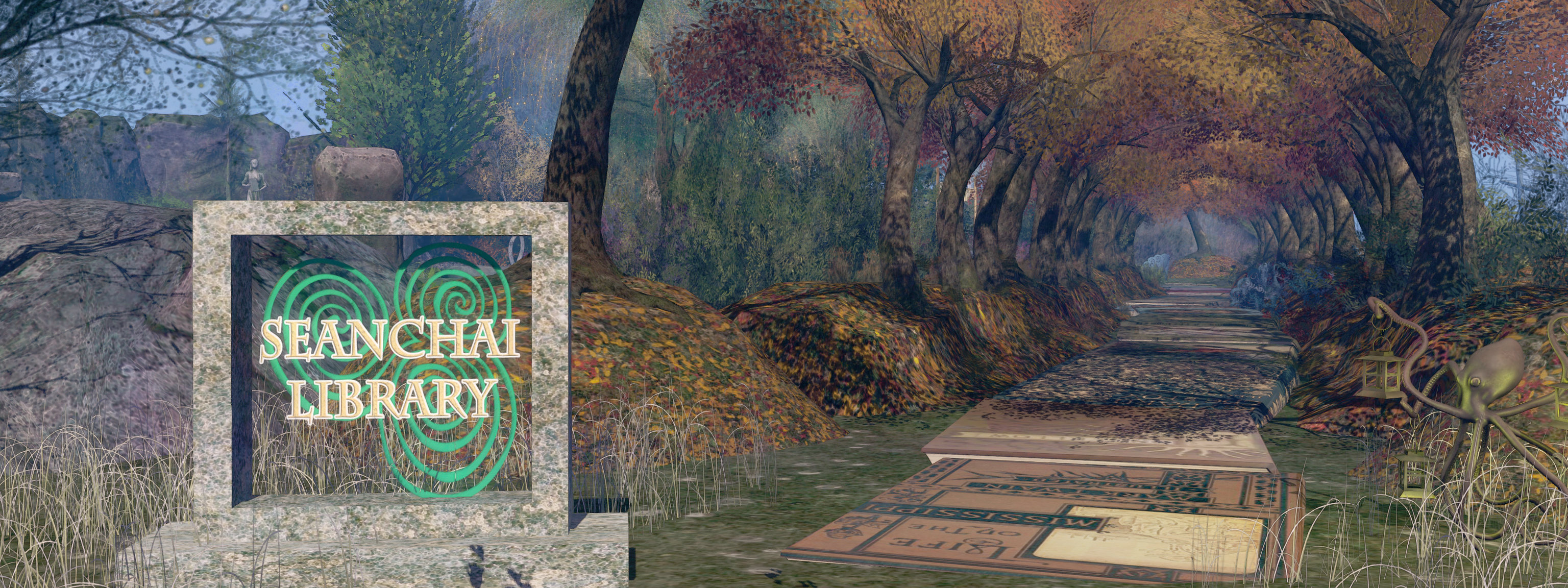
It’s time to highlight another week of storytelling in Voice by the staff and volunteers at the Seanchai Library – and this week previews the launch of a very special event.
As always, all times SLT, and events are held at the Library’s home in Nowhereville, unless otherwise indicated. Note that the schedule below may be subject to change during the week, please refer to the Seanchai Library website for the latest information through the week.
Two New York Police Department detectives investigate a series of suspicious deaths across New York City. These are revealed to be the work of a race of intelligent beings descended from canids, called the Wolfen.
The novel is told from the point of view of the human characters as well from the Wolfen themselves. The savage killing of two New York City policemen leads two detectives, a man and a woman bound together by a strange, tough passion, to hunt down the wolfen – once called werewolves.
Sophie has the great misfortune of being the eldest of three daughters, destined to fail miserably should she ever leave home to seek her fate. But when she unwittingly attracts the ire of the Witch of the Waste, Sophie finds herself under a horrid spell that transforms her into an old lady. Her only chance at breaking it lies in the ever-moving castle in the hills: the Wizard Howl’s castle.
To untangle the enchantment, Sophie must handle the heartless Howl, strike a bargain with a fire demon, and meet the Witch of the Waste head-on. Along the way, she discovers that there’s far more to Howl—and herself—than first meets the eye.
Caledonia Skytower reads Diana Wynne Jones novel.
Wednesday, October 5th, 19:00: Seanchai Flicks – Spooky Edition
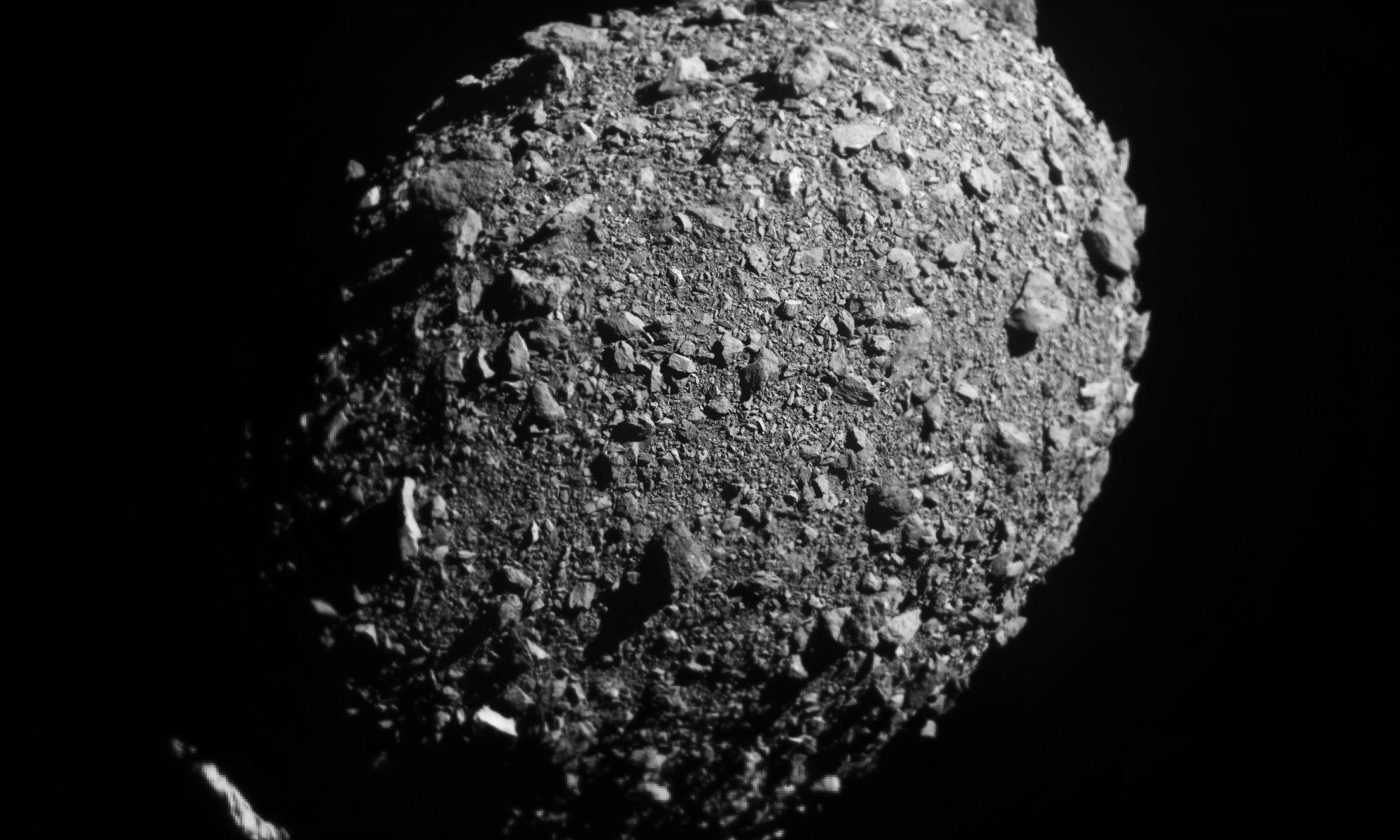
A high resolution image of Dimorphos made by stacking the last images received from DART. Credit: Eydeet on Imgur.
On Monday, September 26th 2022, NASA’s DART (Double Asteroid Redirection Test) spacecraft, massing 570 kg slammed into the 160-m diameter, roughly 5 million tonne asteroid Dimorphos as the latter orbited its parent asteroid, Didymos.
As I outlined in my previous Space Sunday update, the aim of the mission was to test the ability of a vehicle launched from Earth to alter the orbit of a near-Earth object (NEO) purely through the transfer of kinetic energy, in order to prevent a collision between planet and NEO.
Didymos / Dimorphos are NEOs. They orbit the Sun every 2.11 years, hopping across the orbit of Earth in the process and swinging out as far as the orbit of Mars before heading back towards the Sun, Didymos and Dimorphos are ideal subjects for such tests because the former’s orbit around the Sun can be accurately tracked, as can the latter’s near-circular 11.9 hour equatorial orbit around Didymos.
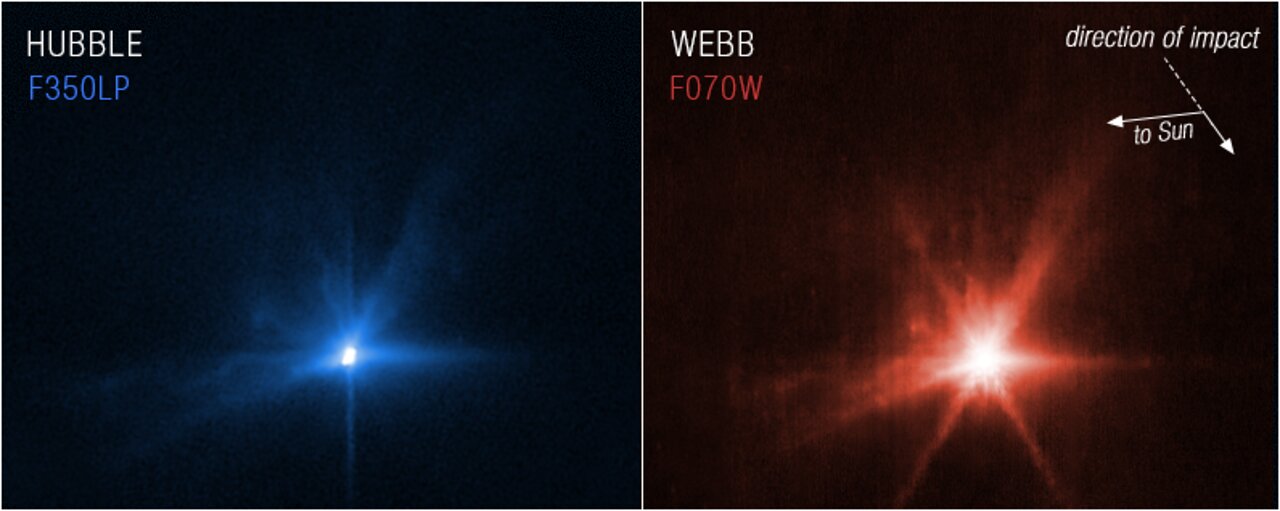
Images of Dimorphos captured simultaneously by the Hubble (l) and James Webb (r) Space Telescopes several hours after DART struck the asteroid. These images mark the first time the two observatories have taken simultaneous images of the same target. and show the spread of material ejected materials Credit NASA, ESA, CSA, and STScI
At the time of impact, DART was travelling at around 22,530 kmh, and its impact with the asteroid was described as the equivalent of “a golf cart ramming into the Great Pyramid of Giza”.
Prior to the impact, NASA indicated they expected the head-on collision between spacecraft and asteroid should slow the latter’s orbital velocity around Didymos by around 1% – or 10 minutes. This might not sound a lot, but it should result is a clearly observable change in Dimorphos’ orbit.
The impact was observed from a number of vantage points – including aboard DART itself, thanks to DRACO, the Didymos Reconnaissance and Asteroid Camera for Optical navigation, which recorded the spacecraft’s approach all the way up to impact (and loss of signal), a host of ground-based telescopes and both the Hubble and James Web space telescopes. In addition, a fly-by cubesat called Light Italian CubeSat for Imaging of Asteroids (LICIACube) built by the Italian Space Agency and released by DART roughly two weeks prior to the impact, should be returning post-impact images of Dimorphos in the next few days.
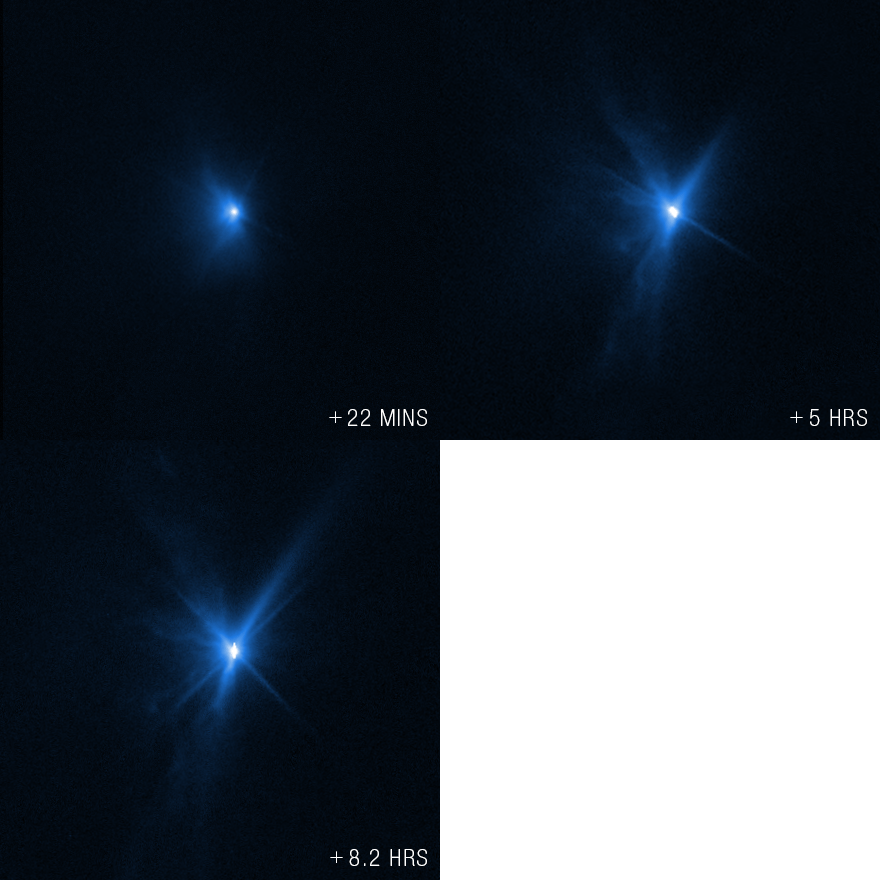
An animation of images captured by the Hubble Space Telescope following the DART impact with Dimorphos, showing the spread of ejecta following the strike. Credit: NASA, ESA, CSA, and STScI
While scientists know a reasonably amount of the orbits of Dimorphos and Didymos, there is far more that is not known about either – such as their overall composition. As such, what would happen as a result of the impact was also unknown – and as seen from the likes of Hubble and James Webb and telescopes on Earth, the impact appeared much brighter than had been expected.
In particular, Hubble and JWST were both able to monitor and image the ejecta generated by the impact. Being able to do this is an added science goal for the mission, as analysis of the streaks of ejecta captured in both visible and infra-red wavelengths will help determine the asteroid’s likely composition and structure.
However, it is still going to be a while for the overall results of impact to be fully calculated, although initial estimates of the change in Dimorphos’ orbit might be known within a week or two following the collision.
China’s International Aspirations
China is looking to build partnerships for its upcoming missions to the moon and deep ventures into the solar system, while omitting mention of (current?) main partner Russia.
Speaking at the International Astronautical Congress (IAC) in Paris on September 21st, 2022, Wang Qiong of the Lunar Exploration and Space Engineering Centre under the China National Space Administration (CNSA) stated that China was open to proposals for science payloads aboard its Chang’e-7 lunar south pole orbiter / lander mission, and the Chang’e-8 in-situ resource utilization test mission, as well as already having the participation of Sweden, Pakistan, the UAE (in the form of a small rover) and the European Space Agency (ESA) for the 2024’s Chang’e-6 mission.
In addition, China is working on a number of deep space missions for which international co-operation is welcomed in the form of:
Tianwen-2 (2025), a near-Earth asteroid sampling mission which will also visit a main belt comet.
Tianwen-3, a Mars sample return mission.
Tianwen-4 (2029) a mission to Jupiter (with a fly-by Uranus).
Finally, China is looking for further partners in the International Lunar Research Station (ILRS) programme to establish a permanent robotic and later human-occupied moon base in the 2030s.
However, the presentation avoided mention of China’s current partner in ILRS: Russia. Per an agreement signed in June 2021, China and Russia are nominally equal partners in the project, and up to Russia’s invasion of Ukraine, ILRS was referred to as a joint China-Russia programme (Russia was not represented at the IAC due to their on-going aggression in Ukraine).
It’s not clear if the conspicuous absence of Russia from China’s presentations signifies sensitivity to the situation in Ukraine and Russia’s isolation, or a change in Chinese thinking towards their engagement with Russia – although there is speculation the latter is the case.
Be it in space or elsewhere, China has a very realistic view of Russia and partnering with Moscow has never been Beijing’s most preferred outcome, for the two countries are not natural partners. This uneasiness is well reflected in their joint ILRS, which still remains little more than a coordination mechanism rather than a bold undertaking sharing a common goal. In moving forward, however, Beijing now seems to be increasingly confronted with a difficult dilemma: turn the relationship into a real partnership or drop it altogether.
– Marco Aliberti, European Space Policy Institute (ESPI)
Thus, given Russia’s current standing in the world, a partnership with Moscow could limit China’s ability to attract new, potentially more auspicious, international partner.
In Brief
Artemis 1
It now appears that the first launch of NASA’s new Space launch System rocket in the Artemis 1mission is unlikely to occur prior to November 2022 – although speculatively, the mid-to-end of October launch window remains possible.
Thanks to the arrival of hurricane Ian, NASA was forced to roll the massive rocket and its launch platform back the Vehicle Assembly Building (VAB) at Kennedy Space Centre overnight on Monday, 26th, / Tuesday, 27th September 2022 in what was (literally, given roll-back commenced at 23:00 local time on the 26th) a 11th hour decision.
As a result of the roll-back, NASA has opted to replace the batteries on the vehicle’s flight termination system (FTS) – the package which destructs the rocket should it veer off-course during its ascent through the atmosphere.
A dramatic shot of Artemis 1 arriving at the Vehicle Assembly Building shortly after 7:00am local time in Florida on Tuesday, September 27th, 2022, even as the weather front of Hurricane Ian moves in. Credit: Greg Scott
This is a non-trivial task, and given the technicalities involved, NASA managers have indicated getting the work completed and returning the rocket to the pad before the end of October could be difficult. Should the launch slip into November, opportunities for that month exist from November 12th through 27th.
Crew 5
Hurricane Ian has also impacted the NASA / SpaceX Crew 5 ferry mission to the International Space Station (ISS). The 4-person crew – comprising NASA astronauts Nicole Mann and Josh Cassada together with Japanese astronaut Koichi Wakata and Russian cosmonaut Anna Kikina – had been scheduled for October 3rd, but has been pushed back to October 5th as a result of the storm.
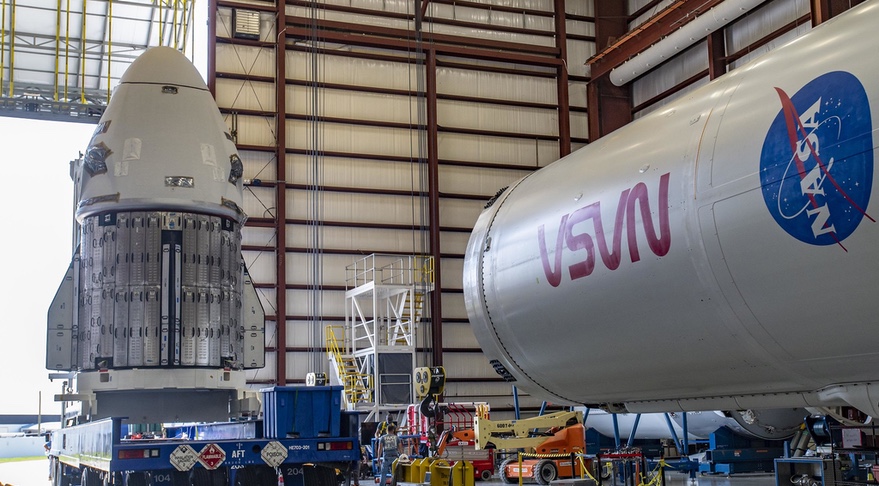
The Crew 5 Dragon vehicle and its Falcon 9 booster being prepared at the SpaceX facilities, Pad 39A, Kennedy Space Centre. Credit: SpaceX
This is something of a historic mission – Mann will be the first woman to reach space, and Kikina will be the first cosmonaut to fly to the orbiting lab with SpaceX.
Hubble: NASA and SpaceX Consider Dragon Servicing Mission
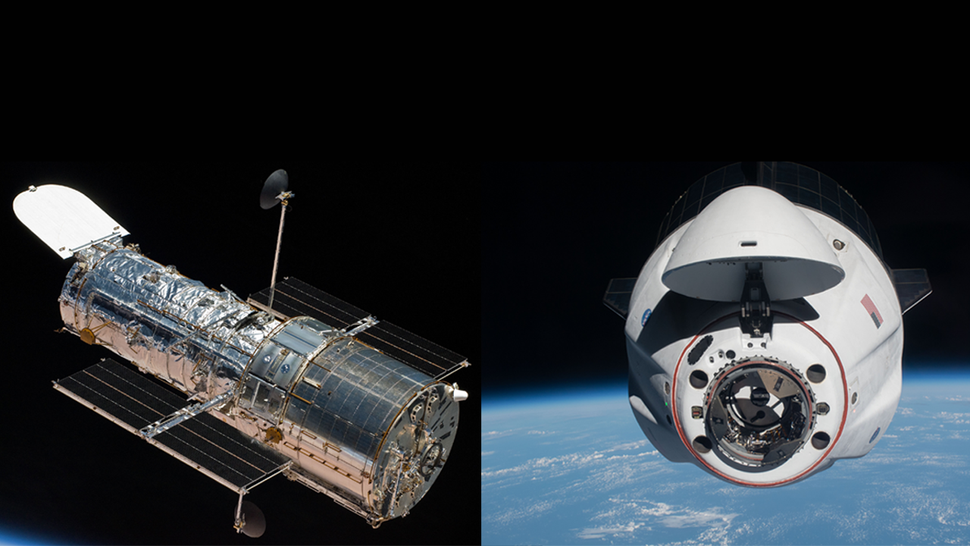
NASA and SpaceX are carrying out a study to see if it would be possible to use the latter’s Dragon vehicle to reach the Hubble Space Telescope (HST) and boost its orbit – and, if Crew Dragon is used, deliver a crew to HST to carry out basic, but essential servicing.
From its launch in 1990 through until 2011, HST had to be routinely visited by the space shuttle to allow astronauts carry out essential servicing and the replacement of aging parts, as well as use the shuttle’s reaction control system to periodically raise Hubble’s orbit around the Earth.
NASA and SpaceX are studying the feasibility of using the latter’s Dragon vehicle to boost the Hubble Space Telescope’s orbital altitude, and possibly deliver a crew to Hubble to carry out servicing operations. Credit: NASA
However, in 2011, the shuttle was retired, leaving NASA without a vehicle capable of servicing the observatory, was has lowered its orbit by some 60km compared to when it was launched as a result of atmospheric drag. Unless countered, this drag will continue until HST will tumble uncontrolled into the denser atmosphere and break-up in the mid-2030s. To avoid this, NASA is planning a controlled de-orbit mission to HST using an automated vehicle in 2029/30, ensuring it burns-up safely and any surviving debris falls into the Pacific Ocean. By contrast, should a servicing / orbital boost be possible with Dragon, then Hubble’s operational life could be extended by up to 20 years.
Even so, such a mission by Dragon – crewed or otherwise – will not be easy; as noted, HST is specifically designed to be services by the space shuttle, and while a capture mechanism was installed during the very last shuttle servicing mission to Hubble, it is intended to be used as a part of the de-orbit mission mentioned above. But should the study show a Dragon-based boost / service mission is feasible, it could come at little to no cost to NASA.
This is because billionaire Jared Isaacman, who has already financed and commanded the Inspiration4 mission and who is financing a series of further crew flights on Crew Dragon under the Polaris project, has indicated he believes a mission to Hubble would be a worth goal for Polaris – and he is actively involved in the study.




 Sophie has the great misfortune of being the eldest of three daughters, destined to fail miserably should she ever leave home to seek her fate. But when she unwittingly attracts the ire of the Witch of the Waste, Sophie finds herself under a horrid spell that transforms her into an old lady. Her only chance at breaking it lies in the ever-moving castle in the hills: the Wizard Howl’s castle.