Nitroglobus Roof Gallery, July 2023: Kitten – Fourth Wall
July 2023’s exhibition at Nitroglobus Roof Gallery, operated and curated by Dido Haas, sees the return of Kitten (Joaannna), who this time brings her engaging monochrome photography, complete with a considered touch of depth of field to the gallery’s main hall, having previously appeared within the Annex (see: A Kitten’s Noir world in Second Life)
Fourth Wall is a considered study on the nuances of this artificial construct of the stage (and which might be seen to extend into the world of photography in a considered manner), and how that wall might be broken.
Within stagecraft, the term fourth wall refers to the convention by which actors focus their attention primarily on the dramatic world they inhabit, regardless of the presence of the audience (in what Konstantin Stanislavski called “public solitude”), as if an imaginary wall lies between the, preventing the audience from being seen. At the same time, that wall can be breached in both a subtle manner and also very directly.
Nitroglobus Roof Gallery, July 2023: Kitten – Fourth Wall
In modern times, the latter is most obviously seen where a performer clearly and directly addresses their audience. however, the more subtle breaching has always been present on within stage performances: whilst the physical presence of the audience might well be ignored, their energy and reaction to what they are seeing is not; instead, that energy and response is used by those on stage to inform and modulate their performance, even though they might never directly break the fourth wall.
With Fourth Wall, Kitten takes as her foundation the idea of a photoshoot. This style of photography folds within it a kind of fourth wall of its own; the models and set exist very separately to the viewing audience, yet they are connected by the presence of the camera itself. Thus, that imaginary wall can be breached both through subtleness and by direct engagement: the former by the fact the mere presence of the camera represents a pseudo-audience, one the models can use to imagine the responsive energy of any actual audience to their time and effort, using it to further inform and modulate their performance. At the same time, they can opt to directly breach the divide, simply be looking the camera in the lens and / or adopting a pose suggesting they are directly addressing who might be on the other side of the image.
Nitroglobus Roof Gallery, July 2023: Kitten – Fourth Wall
By mixing the poses and the “between takes” images, Kitten blends both ways in which the fourth wall is broken – but in doing so, she also leaves us with a conundrum to explore: how much of the breaching is intentional and how much of it is “accidental” (to use Kitten’s term) – the more subtle playing of (and with) the observer’s unseen presence and how it might be influence the model’s behaviour?
However, as Kitten notes herself, there is also a wider context and questioning here, one directed towards Second Life as a whole. As she notes, SL is, when all is said and done, an artificial environment. Yes, it is immersive and allows us to adopt role / personas. But it also allows us to breach the separating wall of the screen if we so wish – but how much more might we reveal more subtly? And what does this say about our relationship / understanding of this environment?
Nitroglobus Roof Gallery, July 2023: Kitten – Fourth Wall
Rounded out by a new lighting set by Adwehe, Fourth Wall is rich in visual content and in the expression of ideas and questions.
Logos representative only and should not be seen as an endorsement / preference / recommendation
Updates from the week through to Sunday, July 2nd, 2023
This summary is generally published every Monday, and is a list of SL viewer / client releases (official and TPV) made during the previous week. When reading it, please note:
It is based on my Current Viewer Releases Page, a list of all Second Life viewers and clients that are in popular use (and of which I am aware), and which are recognised as adhering to the TPV Policy. This page includes comprehensive links to download pages, blog notes, release notes, etc., as well as links to any / all reviews of specific viewers / clients made within this blog.
By its nature, this summary presented here will always be in arrears, please refer to the Current Viewer Release Page for more up-to-date information.
Note that for purposes of length, TPV test viewers, preview / beta viewers / nightly builds are generally not recorded in these summaries.
Official LL Viewers
Release viewer: Maintenance S RC viewer, version 6.6.12.579987, dated May 11, promoted May 16.
July 1st, 2023 saw the launch of a new space telescope – the European Space Agency’s (ESA’s) Euclid – on one of the most intriguing space missions yet started.
Classified as a M(edium)-class mission within ESA’s Cosmic Vision campaign, Euclid was originally to have been launched via Russian Soyuz ST-B; however, following Russia’s invasion of Ukraine, ESA ended all partnerships with Roscosmos, the Russian space agency, and the mission was – with NASA’s assistance – shifted to using a SpaceX Falcon 9 rocket launching out of NASA’s Kennedy Space Centre (KSC), Florida.
Following a flawless launch from Pad 39A, KSC at 15:12 UTC, the booster lifted the observatory to orbit, the second stage of the rocket successfully sending it on its way towards the Earth-Sun L2 Lagrange point, with the telescope will commence observations, in a 30-day gentle transit. Along the way, the instruments and systems on the spacecraft will be powered-up and go through check-out procedures so as to be ready for commissioning as the craft arrives at the L2 position.
For those unfamiliar with the term, the L2 position is one of five points of equilibrium for small-mass objects under the gravitational influence of two massive orbiting bodies (points where the gravitational influences of the larger bodies effectively “cancel one another out”). Also known as libration points, they are: the L1 position sitting between both bodies, but nearer the smaller than the larger; L2, located on the opposite side of the smaller body relative to the larger; L3, located on the opposite side of the larger body relative to the smaller; and L4 leading the smaller of the two in it orbit around the larger, and L5 trailing.
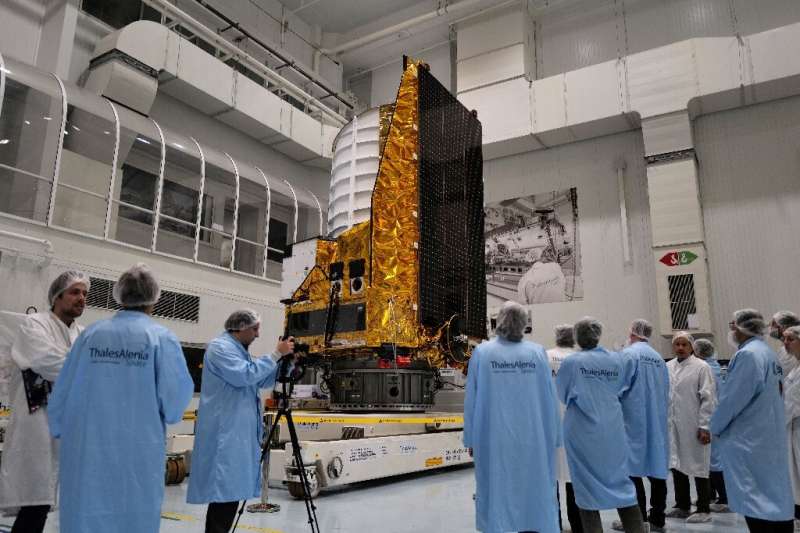
The Euclid spacecraft, pictured before being sent to Florida, will blast off on a mission to find out more about the ‘dark universe’. Credit: Airbus / ESA
Those familiar with the Lagrange points will likely recognise the L2 position as being the focal point for the James Web Space Telescope (JWST) in its journey around the Sun. On arrival, Euclid will enter a similar 1-million km wide elliptical orbit around the L2 position in a manner which will prevent it ever falling into Earth’s shadow. once in place, the 1.4 billion Euro spacecraft will spend a nominal 6 years within this orbit using a combination of a visible light camera and a near-infrared spectrometer/photometer in an attempt to gain a better understanding of dark energy and dark matter.
Sometimes (often in bad science-fiction) conflated as the same thing, dark matter and dark energy are two different entities. In simple terms, dark matter is a hypothetical form of matter with a physical mass, and thought to account for the so-called “missing mass” of the universe (some 85% of its expected mass). The “dark” of the name refers to the fact that it does not absorb, reflect, or emit electromagnetic radiation, making it extremely difficult to defect. However, various gravitational effects which can be observed can only take place if there is more matter involved than can be detected – thus implying dark matter’s existence.
Dark energy, however, is an unknown form of energy which was first suggested in 2011. Up until that point, it had been believed that the expansion of the universe – the result of the big bang – was slowing imperceptibly down through the aeons, the result of the gravitational mass of the billions of galaxies within it gradually overcoming the momentum imparted to them by the big bang. However, careful analysis of the measurement of numerous supernovae suggest that the expansion of the universe is actually accelerating – which could only be due to some unknown force acting on all the galaxies. Thus, the concept of dark (again meaning hard / impossible to directly detect) energy was born, a force potentially responsible for as much as 68% of the total energy contained with in the present-day observable universe.
Animation of Euclid (purple) in a halo orbit around the the Earth-Sun L2 position (light blue), as seen from “above” and following launch from Earth (dark blue). Credit: Phoenix777 utilising data from ESA / NASA
To try to better pin down both dark matter and dark energy, Euclid will use its instruments to chart some 2 billion galaxies across one third of the night sky relative to Earth, capturing light that has taken up to 10 billion of the universe’s 13.8 billion-year lifespan to reach us. In doing so, it will measure their shape and the degree of red shift evident, whilst also using the effects of gravitational lensing on some to reveal more data about them. From this, it is hoped that astrophysicists might be able to construct a model to explain how the universe is expanding which might both explain the nature and force of dark energy and potentially offer clues as to the actual nature of dark matter – the mass of which must be having some impact on dark energy as it pushes a the galaxies.
However, this is going to take time; from the start of operations in a couple of months, it will take the Euclid team 2 years to gather sufficient data which can start to be meaningfully analysed. After that, it will take four years of gather additional data which might be used to refine and improve the initial analyses, and offer up at least some answers.
Urine is a Key to Mars
If humans are to travel to and from Mars, there are a number of issues which need to be addressed, among them the issue of drinking water for the 6-9 month trips to / from Mars (assuming the use of chemical propulsion).
One of these is how to supply the crew with water. NASA state that trained astronauts required 4.4 litres of water per day for drinking, food preparation, hygiene and cleaning. For a crew of four going to Mars that’s between 3.16 and 4.75 tonnes of payload mass alone (+ reserves for emergencies on top of that). While that mass might also be used to supplement a vehicle’s radiation shielding, the fact remains that carrying large amounts of water is just so much deadweight compared to other, more efficient means of providing radiation protection (such as Kevlar and high density polyethylene, or HDPE). To make water efficient, it needs to be recycled.
This is already the case on the International Space Station (ISS). As a part of the Environmental Control and Life Support System (ECLSS), the US / International element of the ISS has long been able to supply recycle water back into usable drinking water (the Russian segments of the station rely more heavily on resupply from Earth for water, as the Russian saw this as the easier solution to developing efficient and space-taking recycling systems).
The Brine Processor Assembly (BPA), prior to its transfer to the ISS in 2022. Credit: NASA
Within the US ECLSS are two water recycling systems – the primary Water Purification Assembly (WPA), which literally plucks water out of the station’s atmosphere in the form of condensate, sweat, exhale water molecules, water drops escaping during food processing and other acts, and water used for hygiene, and the Urine Processor Assembly, a subset of the WPA, which does exactly was that name suggests.
However, both systems have always been limited in their efficiency (the UPA to just 85% of all urine being recycled to a state where it is properly purified water). But over the last several years, various improvements have been made to the systems, raising their overall efficiency to 93.5%. In particular, urine recycling efficiency was raised to 87% through improvements in 2019/2020 and by cycling the semi-clean water through the primary WPA system to produce purified water suitable for drinking. However, a sticking point remained urine brine – a mix of water and body chemicals which could not be put through the WPA, but was simply tanked and disposed of.
Now water can even be extracted from that brine for recycling, thanks to a new addition to the ECLSS recently installed on the ISS and which has been undergoing evaluation. Called the Brine Processor Assembly (BPA), it is a combination of filter membranes and a heating system. The former traps the chemicals in the brine whilst allowing the water through. The water is then heated by the elements in the unit, forming a humid air flow which is then fed to the WPA, where the water is extracted alongside that gathered from other humid air captured by the WPA, and purified for re-use.
The result: up to 98% of all water consumed or used on the international segments of the ISS can now be recycled – an additional 4.5% compared to pre-BPA amounts. This is significant because NASA has always seen a 98% water recycling capability as a break-point for long duration space operations. It doesn’t eliminate the need for some measure of reserve supplies – but it drastically reduces the additional mass of water that might otherwise need to be carried, bringing the potential for crewed missions to Mars a little step closer to being practical.
Kondor Art Centre: Janus Falls – Auguries of Innocence
Having opened on June 29th, 2023 at the main gallery area of the Kondor Art Centre operated and curated by Hermes Kondor, is an evocative and provocative exhibition by UK-based Janus Fall.
Combining classical poetry, digital images, global current affairs, the increasing dichotomies of society, and reflections on human nature, Auguries of Innocence is a visual essay of juxtapositions and contrasts offered as commentary on the current downward spiral of intolerant, insensitive, judgemental otherism (of others) and denial (of others and also of things like our impact on matter of climate change, etc.) which is too quickly becoming the accepted state of being within large portions of modern societies (particularly those known for their previously more liberal lean), when we really should by now know better.
Kondor Art Centre: Janus Falls – Auguries of Innocence
The exhibition takes its title from the 132-line, single stanza poem of the same name by William Blake. Like much of Blake’s work, the poem did not gain recognition until well after his death in 1827; in fact, despite being written in the early 1800s and going to be frequently quoted (particularly the opening four lines), it didn’t actually see the light of publication until the late 1860s.
In content, the poem might be seen as a plea by the poet for humanity to do better, lest we lose all we have been given under the judgement of God. In this it contrasts the cycle of nature, wherein the world is constant reborn and remade, all the time growing in both nurturing innocence and experience / interconnectedness, with the cycle of humanity, in which we are born into that same innocence of nature, only to push it aside as we grow into adulthood, replacing it with self-serving corruption and inhumanity towards others and nature.
However, the poem is not only notable for its content, but also in its structure, which is as intentionally complex as the subject matter it contains. Throughout its length, Blake frequently switches both rhyming schemes (e.g. alternative rhyme to rhyming couplets) whilst mixing different forms of meter (e.g. trochee and anapest) with the predominant iambic meter, whilst also using a range of literally tools such as alliteration, repetition, metaphor and – most notably – juxtaposition and paradox.
Kondor Art Centre: Janus Falls – Auguries of Innocence
Within this structure, the opening four lines act as both an overall introduction to the poem’s concepts and also offer guidance on how the imagery within the rest of the poem should be interpreted. Within Janus’ exhibition, those four lines perform something of the same purpose; working with a diary extract written by a 16-year-old girl seeking to escape the war engulfing her country, they offer both an introduction to the images presented within this exhibition and give context in how they should be viewed both cognitively and physically. In terms of the physical, they – and the extract from the diary – are to be found on the left front wall of the gallery as you enter it, to form a potential starting point for viewing the mages, encouraging visitors to progress from there and around the lower floor to the stairs and the upper level, thence back down to complete the circuit and finishing at the artist’s final notes and Memorial to a Woman in a Field.
The images are striking, Janus reflecting the diversity of styles and techniques Blake uses within his poem within each of her images. Where he uses metaphor, alliteration and simile, she uses technical and artistic approaches such as motion blur, superimposition and Chiaroscuro. However, most strikingly, Janus matches Blake’s use of juxtaposition within her images, most notably through the placement of the natural beauty of the women in her images against their backdrop. Whether drawn from images initially captured in Second Life or the result of digital manipulation of images produced outside of SL (and possibly using AI toolsets?) matters not.
Kondor Art Centre: Janus Falls – Auguries of Innocence
There is so much to unpack in these pieces, that it is possible to end up writing a treatise. The aforementioned Memorial to a Woman in a Field for example, offers so much to consider, from the manner in which it presents what should be harmony between people and humanity and nature, through to the way it offers a subtle reflection of Blake’s deeply held Christian beliefs whilst rejecting the constructs of organised religion for the manner in which it encourages the corruption of self through the promotion of judgemental intolerance and denial of anyone who can be branded as “others” – something which we can still see only too well within modern society.
However, rather than ramble on, I think Janus herself does more than enough to present her work as it should be seen and understood. Certainly, Auguries of Innocence does much to offer a questioning challenge to us, one with which Blake himself would doubtless agree: given it is now over 200 years since he wrote the opening lines of his poem, isn’t it about time we finally started putting aside self-centred and social indifference / cruelty to one another and tried to be better, both for the benefit of others and the world as a whole?
On Friday, June 30th, 2023 saw the fourth in a series of Lab Gab special events take place for the SL20 Birthday celebrations, featuring featuring Patch Linden and the Moles of the Linden Department of Public Works (LDPW).
Unlike the other summaries in this series, this article focuses on the work of the Moles and the projects they are currently working on and which have recently been launched or will be launched in the near future. Broader questions on individual interests, hopes for the future of SL, subjects (such as the SL20B Sweepstakes) covered in more depth in other Sl20B Lab Gab sessions are not included below. As always, timestamps to the video are included within each topic / sub-topic, allowing comments made to be heard in full.
Short interviews with a number of the Moles covering what they do and how they became members of the LDPW team. These discussions fold-in to them some of the points below.
Who or What are the Moles?
Officially called the Linden Department of Public Works (LDPW), originally formed in 2008, Moles are residents from all over the world hired by Linden Lab as independent resident-contractors to undertake Lab-led projects.
Their work was originally focused on the Mainland, adding the infrastructure – road, bridges, etc., and the landscaping, as noted in the official LDPW wiki page, although they actually do a lot more than this.
Notable major projects carried out by the Moles include:
Development of residential centres such as Nautilus City and Bay City and Bellisseria; development of the Lab’s various games accessible through the Portal Parks.
Involvement in special development projects for both Second Life (e.g. Bento, Animesh, EEP, PBR), and partnership developments (e.g. Zenescope and Motown Experience), that latter under the banner of Second Life Studios.
In keeping with their name, Moles were originally given a mole avatar, complete with hard hat. However, over the years, most have moved to having a more individual and personal look, although some say with their Mole look.
As well as being paid for the work they do, Moles also receive and allowance from the Lab, which is primarily intended to go towards the cost of uploads (texture, animations, mesh objects, etc)., but which can also be put towards developing their individual looks.
How to Become a Mole
Positions in the LDPW are open to application by residents who believe they are qualified to work in the team, and the team may also approach specific residents and ask if they would consider joining them.
Applications are made by dropping a résumé (note card or email) of qualifications / experience (including links SLurls, Flickr, You Tube, etc.) to Derrick Linden (derrick.linden-at-lindenlab.com) or to Patch Linden (patch.linden-at-lindenlab.com).
Applicants have to go through a former interview process.
Successful applicants get to pretty much choose their hours of work – providing agreed tasks are completed on time.
As they are from around the world, this can allow some projects to move forward on almost a round-the-clock basis.
Those who are more fully-rounded in skill sets – content creation, scripting, etc., – are encouraged to apply, but LL will also take on specialists.
Motivated, outgoing, communicative people with a passion for SL and willing to self-teach themselves new skill sets are particularly considered.
Planning for SL20B started during SL19B, commencing with a review of what worked / didn’t work at SL19B, and initial discussions on the 20th anniversary theme.
The initial planning process for the theme (/build aesthetic) and size of the event took around 3-4 months.
The size of the event means there are 321 exhibits – many of them interactive -, compared to 150 just five years ago. The increase in event space has meant some exhibit parcels (around 100) could be offered at 4096 sq m.
The focus for the last few SLB events has been not only to encourage people to share in the theme, but to present exhibits that reflect their passions / interests: art, music, community activities, etc.
SL20B is also the first SLB event to include the Adult community (also at the Shop and Hop as well). To achieve this, there was a lot of direct canvassing / encouraging of Adult communities to come and participate, rather than just leaving it to people to apply. As well as the Adult region exhibits, there have also been events hosted on them.
Discussions within the LDPW team are already in progress to discuss how the Adult presence can be grown in future SLB events, including the possibility of having an “official” event stage within the Adult regions.
Patch Linden:
Given it is the 20th anniversary, the decision was decided to refresh some of the “core” SLB builds (such as the Tapestry of Time) and also the Shop and Hop regions to be more in keeping with the event theme and also to offer fresher designs for future events.
The New Shop and Hop region design will be retained and “themed up” for future events.
Dreaming Mole:
The concept of the Welcome Area was to present a setting which reflects both the theme of the event and suggests important factors for the future – sustainability, etc., whilst also acting as a natural information hub and viewing area.
The landing point was placed so that people would see the structure before them and be encouraged to walk towards it, along the Community Gallery Walkway.
The overall inspiration for the build was modern architecture and the work of architects such as Oscar Niemeyer.
Senra is the brand name giving to the upcoming new Bento / Bakes on Mesh complaint starter / new avatar series specifically developed via the Moles as a Lab project, and which were initially previewed at SL19B in 2022.
Come with a complete set of accessories: hair, skins, clothing, attachments, shoes, etc. All of which will be presented as a full library of content within the viewer (as a part of the overall Library).
The first phase of the release will feature two human avatars + accessories, etc., referred to as Jamie (female) and Blake (male).
The second phase of work has already started and will include anthro, allowing Senra to cross over into “other areas.”
The launch is provisionally targeting middle-to-late-July.
Prior to the launch, effort will be made to get the developer’s kit (devkit – covering clothing, accessories, skins, etc.) and licensing agreement made available to SL content creators who wish to develop content and sell it into the Senra ecosystem.
Screen caps of the Senra Jamie and Blake avatars. Note: as these are screen caps (as I was unable to be in-world for the session), noassumption as to the overall quality / looks of the Senra avatars should be assumed on the basis of these images
Initially grew out of a need to have somewhere to demo the Liden Home themes and styles for those wishing to “try before they buy” a Premium / Premium Plus account.
The grew into an idea to also provide further information on Bellisseria and from there grew into a complete Welcome Hub for new users.
However, the primary focus is to provide information on Bellisseria for existing resident and give insight into Premium Subscriptions via an in-world means.
BelliHub: Linden Homes demo area at the BelliHub
As they were in development at the same time, some of the work put into the BelliHub Welcome Area was used to inform the design within the the Welcome Centre at the new Welcome Hub.
The Welcome Hub with its nine regions is designed to provide a more complete experience for incoming new users, which in part came off the back of the fact that many people coming into SL will go through the older Welcome and Social islands and think that that was all there is to SL, and leave.
So the Hub is intended to both introduce new users to both the viewer and using an avatar and to encourage them to understand there is much more to discover about Second Life and the events and activities which take place in SL, while at the same time not locking them into a specific path or hierarchy of things they have to go through in order to better understand SL.
The above is very much assisted through the presence of mentors and the video and general info boards they can opt to use or skip over, depending on their knowledge and abilities.
The only really “key lessons” within the Welcome Centre of the Hub are moving, talking, and interacting with objects. The rest is intentionally free-form.
[Video: 50:23-51:00] The overall design of the Welcome Hub is intended to be modular in that options, features, areas, can be swapped in / out with others, and the overdesign expanded, etc., as required.
A question was asked about refreshing Mainland terrain textures. There is an off-shot of the current PBR Materials project to allow such materials to be applied to SL, and – with noted caution about ensuring consistency of appearance, etc., – this will include Mainland. Details of the PBT project and the terrain project can be found in my CCUG summaries; also see this official sneak peek. Image credit: Linden Lab
Who is Magellan Linden?
Magellan Linden is The Great Explorer of Second Life (who was once said to have vanished during his explorations, but does pop-up from time-to-time) is a construct, rather than an individual, but as revealed in the session, Abnor Mole loans his voice to Magellan!
Natthimmel, July 2023 – click any image for full size
It was back to the Homestead region of Natthimmel, held by Saskia Rieko to witness the latest design by her SL partner Konrad (Kaiju Kohime) after seeing a tweet by Laskya Claren (who also assisted with the notecard introduction to the build). To be honest, it’s a setting that would have attracted my interest, but Laskya’s tweet helped me to note it sooner rather than later, given it is by Konrad and Saskia – who are establishing a solid reputation for region designs representative of physical world locations (for example, see: A Night Sky with a touch of history in Second Life) – and the fact that for this particular build they mix three of my non-SL interests: astronomy, theoretical space science and science-fiction as the springboard for the imagination. However, Laskya’s tweet was timely in that it pushed me towards visiting sooner rather than later.
The astronomy comes from the use of the Gliese 581 system as a inspiration for the build and its associated story. This is a dwarf star (M spectral type) located some 20.5 light-years from our own solar system, and which in 2005 was discovered to have one of the smallest extrasolar planets ever found orbiting it. Called Gliese 581b (the “b” indicating it to be the first planet known to be orbiting the star, whilst “Gliese” referencing the 1957 catalogue in which the star was record – even though it has been observed well before that year). It is actually one of three planets currently known to be orbiting the tiny star, with three other potential planets – Gliese 581d, Gliese 581f and Gliese 581g – thought to have been discovered later proving to be the result of stellar upsets within the star affecting the instruments on Earth attempting to locate exoplanets around it.
Natthimmel, July 2023
From these fact, the region spins off a story of the future discovery of artefacts on the outermost of the three Gliese 581 planets, Gliese 581e (as all the planets in the system are tidally locked with their parent star, always keep the same face towards it, the observed artefacts could not be surface features moving as a result of Gliese 581e’s axial rotation). This discovery leads to a crewed mission to the system aboard the UESS Rocinante, thus bringing in the first sci-fi reference, the Rocinante being the hero ship from The Expanse series of novels and stories by “James S. A. Corey” and the associated TV series (as well as also being a classic literary reference to adventures, Rocinante also being the name of Don Quixote’s horse).
A second sci-fi reference also lies in the text with the reference to ansible communications – a term first coined (and subsequently built upon) by Ursula le Guin, and used by many sci-fi authors, including Orson Scott Card. It is also in the notecard that the reference to theoretical space science appears, the Rocinante using an Alcubierre Drive for interstellar propulsion.
Natthimmel, July 2023
This introductory notecard actually serves as a mini short story in is own right, rather than just and introduction to the setting. In doing so, it sets up the imagination, offering a framework by which we might – if we so choose – explore the setting: what actually happened aboard the Rocinante? Were the note affects on the crew the result of the indicated damage to the drive system or something else? What caused the vessel to crash on the planet? Systems failure? Human error? Deliberate malfeasance by a member of the crew? Were the logged reports of alien creatures the result of genuine sightings or further hallucinations?
Thus, visitors can opt to put themselves in the role of the recommended salvage / rescue mission; or, if preferred, as members of the Rocinante’s crew encountering this strange world on which they have been cast – be it Gliese 581e or somewhere deep within a rip in the fabric of space/time brought about by the failure in their drive system. Or, if preferred, visitors can simply use the eerie, other-worldly environment for photography; there are no rules here in that respect. However, one thing I would recommend is to visit using the local environment settings (World → Environment → Use Shared Environment) and with the viewer’s Advanced Lighting Model enabled (Preferences → Graphics → make sure Advanced Lighting Model is checked – no need to enable shadows).
Natthimmel, July 2023
A different but engaging location which, whilst entirely imaginary, nevertheless folds into it some nice touches of science fact and theory wrapped into an engaging visit.