2023 SL Puppetry project week #6 summary

Puppetry demonstration via Linden Lab – see below.  Demos video with the LL comment “We have some basic things working with a webcam and Second Life but there’s more to do before it’s as animated as we want.”

The following notes have been taken from chat logs and audio recording of the Thursday, February 9th, 2023 Puppetry Project meetings held at the Castelet Puppetry Theatre on Aditi. These meetings are generally held on alternate weeks to the Content Creation User Group (CCUG), on same day / time (Thursdays at 13:00 SLT).

Notes in these summaries are not intended to be a full transcript of every meeting, but to highlight project progress / major topics of discussion.

Project Summary

General description of the project and its inception:

LL’s renewed interest in puppetry was primarily instigated by Philip joining LL as official advisor, and so it really was about streaming mocap. That is what Philip was interested in and why we started looking at it again. However since Puppetry’s announcement what I’ve been hearing from many SL Residents is: what they really want from “puppetry” is more physicality of the avatar in-world: picking up objects, holding hands, higher fidelity collisions. 
As a result, that is what I’ve been contemplating: how to improve the control and physicality of the the avatar. Can that be the new improved direction of the Puppetry project? How to do it?

Leviathan Linden

  • Previously referred to as “avatar expressiveness”, Puppetry is intended to provide a means by which avatars can mimic physical world actions by their owners (e.g. head, hand, arm movements) through tools such as a webcam and using technologies like inverse kinematics (IK) and the  LLSD Event API Plug-in (LEAP) system.
    • Note that facial expressions and finger movements are not currently enabled.
    • Most movement is in the 2D plain (e.g., hand movements from side-to-side but not forward / back), due to limitations with things like depth of field tracking through a webcam, which has yet to be addressed.
  • The back-end support for the capability is only available on Aditi (the Beta grid) and within the following regions: Bunraku, Marionette, and Castelet.
  • Puppetry requires the use of a dedicated viewer, the Project Puppetry viewer, available through the official Second Life Alternate Viewers page.
  • No other special needs beyond the project viewer are required to “see” Puppetry animations. However, to use the capability to animate your own avatar and broadcast the results, requires additional work – refer to the links below.
  • This project is taking in a lot of additional ideas – animation standards, improving the current animation system, enabling truer avatar / avatar and avatar object interactions such that it is likely to evolve into a rolling development, with immediate targets for development / implementation as they are agreed upon, to be followed by future enhancements.
  • As such, much of what goes into the meetings at present is general discussion and recommendations for consideration, rather than confirmed lines o development.
  • There is a Puppetry Discord channel – those wishing to join it should contact members of LL’s puppetry team, e.g. Aura Linden, Simon Linden, Rider Linden, Leviathan Linden (not a full list of names at this time – my apologies to those involved whom I have missed).

Bugs, Feature Requests and Code Submissions

  • For those experimenting with Puppetry, Jiras (bug reports / fixes or feature requests) should be filed with “[Puppetry]” at the start of the Jira title.
  • There is also a public facing Kanban board with public issues – those experiencing issues can also contact Wulf Linden.
  • Those wishing to submit code (plug-ins or other) or who wish to offer a specific feature that might be used with Puppetry should:

Further Information

Meeting Notes

Animation Streaming

  • Leviathan Linden has been experimenting with animation streaming over the viewer’s animation channel, such that whatever is sent from the controlling viewer is played directly by all receiving viewers without any further processing of the animations by those receiving viewers.
  • This had been discussed in previous meetings as a potential means of lightening the load of animation data processing individual viewers would have to perform, reducing the potential performance impact in situations where animation synchronisation is important. It also lays something of a further foundation for more procedural-based animation processing, allowing viewers to work smarter – sending less data more frequently, which will in turn help enable synchronised animations through puppetry, such as spontaneously sharing a high five.
  • With this initial test, featuring just one viewer using puppetry and one receiving it, actually revealed a more noticeable lag in streaming compared to individual processing and playback of received animation data. It is not clear at this time whether this would worsen in situations where multiple puppetry animations are being streamed / received.
  • The videos were initially posted to the restricted-access Second Life Content Creation Discord server, and then combined into a single video by Kadah Coba, which is reproduced here as an animated GIF – my thanks to Kadah for the work in combining the videos.
Puppetry streaming test: top – animation played in one viewer (large image) with data sent for processing by a receiving video (inset). Bottom: the same animation played on the same viewer and then streamed to the receiving viewer (inset) and played on receipt without any additional animation processing.
  • Leviathan notes this is a very quick and dirty test, requiring “some hackery” within the viewer’s animation code, but does not (as yet) require any changes to the server-side puppetry management code.
  • Further refinement of the code is required, together with further testing to see if the approach can be smoothed / improved, as such, the work is not currently fit for integration into the Puppetry Project viewer, although it has been suggested it might be offered as a temporary, separate test viewer to allow broader testing.
  • On potential issue is that the streaming is currently dependent on the reliability of the originating viewer; if it is running at a low FPS, potentially causing the receiving viewers see a “choppier” result with lagging and smooth animations within the stream.

LSL Integration

  • See: OPEN-375: “LSL Functions for reading avatar animation positions”.
  • Rider Linden has been working on an LSL API to control animation on an avatar.
Conceptually it would behave like LEAP from LSL. The simulator will send the animation instructions down to the targeted viewer which will perform the IK and animation, and then send the results back as though they were coming from any other LEAP plugin. Targeting objects should be possible with the API (although I’ll add a world position/rotation parameter so you don’t have to do the math yourself).

– Rider Linden

  • This work is possibly best described as moving a step towards enabling an avatar using puppetry to reach out and pick up an apple by allowing a script to position the avatar’s hand at the location of the apple, from where the user can use a supported capture tool to “pick up” the apple.
  • The envisioned actions would be: the user move their avatar’s arm towards the apple, the apple detects the collision between the avatar hand and itself and attaches to the hand as if it has been directly picked up.
  • Further work is required involving collisions between the apple and the avatar’s hand, so the apple knows it is being “grabbed”. This might be achieved by using an existing collision event as the trigger for attachment, or an entirely new event.
  • One problem is to avoid having multiple extra collision objects bouncing around the physics engine for every single attachment point on an avatar (55 in total), which would add-up, performance-wise, very quickly.
    • One suggestion for mitigating this is that as region knows where your hand is (which is true with the attachment update stream), it could be possible by implementing a new “grab” action that works in the physics simulation for picking up small objects; however, it would likely need some hint/magic on the viewer to render the object “at the hand” rather than “near the hand”..
  • Beyond this, there is also additional work to allow avatar-to-avatar interactions via puppetry – such as the aforementioned high five – which involves addressing some permission issues.

In Brief

  • Concern was raised that emphasis on puppetry over the traditional canned animation assets is that it could make SL inaccessible for some (because of the need for additional motion capture hardware, a possible need for more powerful client computers, etc). In response, those at the meeting pointed out:
    • The approach being taken by the Lab is not new – it has been a common factor (albeit implemented in a verity of ways) within games for well over a decade, and is used in multi-player games without participants being “lagged” to the point where gameplay is broken.
    • What is being proposed with Puppetry is not even “new” (in the broadest sense); rather it is adding a further layer of animation capabilities to Second life which can enable a greater sense of interactivity to the platform.
    • In terms of hardware, it was further pointed out that while some at the meeting are using VR hardware – headsets and peripherals – all that is actually required to start leveraging the capabilities (and as LL have demonstrated in the animated GIF forming the banner of this summary is a basic webcam.
  • In a more general conversation, it was pointed out by those at the meeting and the Lab engineers that:
    • Whilst things like streaming puppetry animations may at times result in more visible lag / animation desynchronization, it offers so much more in the way of avatar interaction with the world, it would be more than worthwhile.
    • This work is purely about puppetry and interactivity; it does not actually alter the way more general animations – walking, standing, etc., work, as the underpinning locomotion engine within the simulator and how the viewer calculates motion based on data from the simulator is not being altered.
    • Instead, the LSL API (and the LEAP API?) will enable general avatar orientation and attachment point orientation / movement to ensure that arm correctly reaches out to “grab” the apple mentioned above, by effectively running in conjunction with the locomotion engine.

Date of Next Meeting

  • Thursday, February 23rd, 2023, 13:00 SLT.
2023 RFL of SL Fantasy Faire and SL living Applications

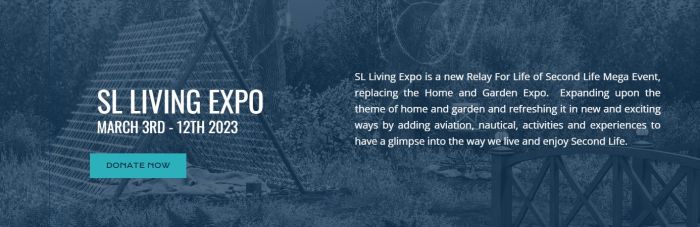
via the SL Living Expo website. Click to go to the ACS donations page

The American Cancer Society (ACS) Relay for Life Second Life (RFL of SL) campaign for 2023 is ramping up in preparation for two mega events: Fantasy Faire 2023 and SL Living Expo 2023

As per the banner above, SL Living Expo is a new signature event for RFL of SL, taking over from the Home and Garden Expo. It will offer a new opportunities for creators, performers and artists whilst introducing the worlds of Second Life aviation and nautical activities to the rich mix of homes and gardens which have formed the backbone of the Home and Garden Expo.

The event will open its doors on Friday, March 3rd, 2023 and run through until Sunday, March 12th, 2023, and right now the organisers are looking for applications in the following areas:

Participants and Sponsors: SL Living Expo is a great way for your store, community or group to showcase their talents and connect with thousands of people.  For creators, stores, communities and groups, booths start at just L$ 1,000 for an 8m x 8m unit and 100 LI, and run through to L$10,000 for 32m x 32m and 700 LI. All booths must provide at least one vendor with 100% of proceeds being donated to ACS / RFL of SL.

Those wishing to raise their visibility further / offer greater support for RFL of SL / ACS can do so by becoming a Landing Hub sponsor (L$ 20,000) or Event Region sponsor (L$ 5,000 – although both have limited availability.

  • Full details on participant packages can be found here.
  • Full details on available sponsor packages can be found here.
  • All applicants for participant or sponsorship packages should also read the Expo Participant Rules.

Regions at SL Living Expo will all be themed, with a total of five themes:

  • Seaside – with vibes of a New England seaside village, this region has a mix of land and sea, perfect for maritime, beach and water-loving folk.
  • Countryside – for laid back and easy living, our Countryside region is great for equestrian and farming communities.
  • Fairgrounds – for community, family and fun-loving groups, the fairgrounds region will feature rides and games to keep folk attendees entertained.
  • City Life – put put the pedal to the metal on the paved streets and watch the tall buildings and busy city life will provide lots of entertainment.
  • Mountainside – take to the air and fly through the mountains as they overlook rest of the region.

Performers: Entertainment has also been an important element of RFL of SL It helps to both attract visitors and helps raise donations. The SL Living Expo is looking for DJs, live performers, group performers (dance troupes, etc.), game show/trivia organisers, speakers/presenters/class leaders, and more.

Artwalk: SL Living Expo provides a chance for artists across the grid to share with us their talent and creative minds.  Successful applicants will be given two stands to display and sell their work. One piece of art must be placed in an ACS vendor with 100% of proceeds of sales donated to ACS / RFL of SL, while the other can be used for personal sales.

Further general information can be found at the SL Living Expo.

Fantasy Faire 2022 banner

Fantasy Faire

The largest fantasy-related event to take place in Second Life, Fantasy Faire 2023, will run from Thursday, April 20th, 2023 through until Sunday, May 7th, 2023 inclusive. As usual, there will be the expected rich mix of events, activities, stores and regions to explore.

However, in a change to past events, Fantasy Faire will focus on entertainment events and performances across the three weekends it spans, with the weeks in between left more for exploring and shopping. Hopefully, this will offer a packed programme throughout the weekends to accommodate visitors from around the globe and keep them entertained.

In particular, the Faire is seeking dancers, actors, music & magic makers. If you are interested, then drop by the Fantasy Faire Performance Application form before Sunday, February 26th, 2023, when applications will close.

For updates and news on Fantasy Faire, be sure to keep an eye on the Fantasy Faire website.

An artistic Pas de Deux in Second Life

Galerie L’autre Monde: Hermes Kondor – Pas de Deux

The pas de deux (“step for two”) is a dance for two people, generally male and female and most readily identified as a core element within a ballet performance.

Starting with the entrance (entrée), which is both the prelude to and opening of, the dance, the classic grand pas de deux comprises five parts. Once the principals have positioned themselves and the dance commences, so comes the adagio (or adage – “slowly”), in which the ballerina performs elegant, often slow and sustained movements, as she is supported by the danseur; he in turn strives to maintain poise and an effortless strength through lifts and turns whilst also being a graceful “mobile barre” helping her through the intricacies of her steps.

From the unity of the adagio, the dancers separate to perform their variations; dancing independently and perhaps almost competitively to one another, the danseur first, with the ballerina responding to him. Then comes their reunion within the coda (tail), playing back elements of the dance seen in the previous elements of the dance whilst building towards the final musical climax.

Galerie L’autre Monde: Hermes Kondor – Pas de Deux

With a ballet, the grand pas de deux is considered the highlight, performed by the principal dancers to great acclaim. For Hermes Kondor, the pas de deux is the focus of a new exhibition of his digital art, available for viewing at Galerie L’autre Monde, curated by Lady Anais (Anais Yuhara), at The Uzine.

Assuming it is not re-dressed for each exhibition – this was my first visit to Galerie L’autre Monde (“another world”), so I admit I’m unsure as to whether or not the setting was specifically designed for Hermes’ exhibition – the gallery itself is quite remarkable. It takes the form of what appears to be a series of bombed-out (or partially demolished) structures surrounded by trees and caught under a twilight sky, it presents a most unique backdrop for the exhibition, encouraging visitors to wander around and through broken buildings and deserted remnants to find what may be mounted on walls and within sheltered corners, hidden until onw comes upon them.

Galerie L’autre Monde: Hermes Kondor – Pas de Deux

Pas De Deux is another series by Hermes in which he utilises a combination of Midjourney AI and Photoshop o produce a series of digital images. I recently noted my personal reservations around how those behind the programme have a cavalier attitude towards matters of copyright – something we should all be aware of; but Hermes offers us another sterling demonstration of what can be produced as genuinely original art when care is applied, and which have a depth and richness which as a unique as anything produced completely by hand.

Appearing to have been etched into burnished metal plates, these are truly gorgeous pieces, partially atonal in terms of their use of black and white. Each comprises two figures caught in a moment of motion and passion. The fluidity and richness of their interplay of steps and moves is beautifully presented through the use of white upon their darkened, etched forms, a whiteness which also evokes spotlights against the darken backdrop of their stage and further enhances their fluidity as it is reflected liquid-like across the floor beneath their feet.

Galerie L’autre Monde: Hermes Kondor – Pas de Deux

This richness of motion is further emphasised with the bright colours of fire burning their way through each piece, a blazing trail of illumination tracing the motion of arm, leg or body, or billowing in a rising flame, visually underscoring the passion and life within the dance, and the heat and passion doubtless felt by the dancers, if not towards one another, but almost certainly between each of them and their craft. In this, I found some of the images evocative not just of ballet, abut also of the raw heat of the flamenco.

Beautifully conceived and executed, Pas de Deux is a glorious collection of digital images from a master in his craft.

SLurl Details

Going west in Second Life

Les Salines, February 2023 – click any image for full size

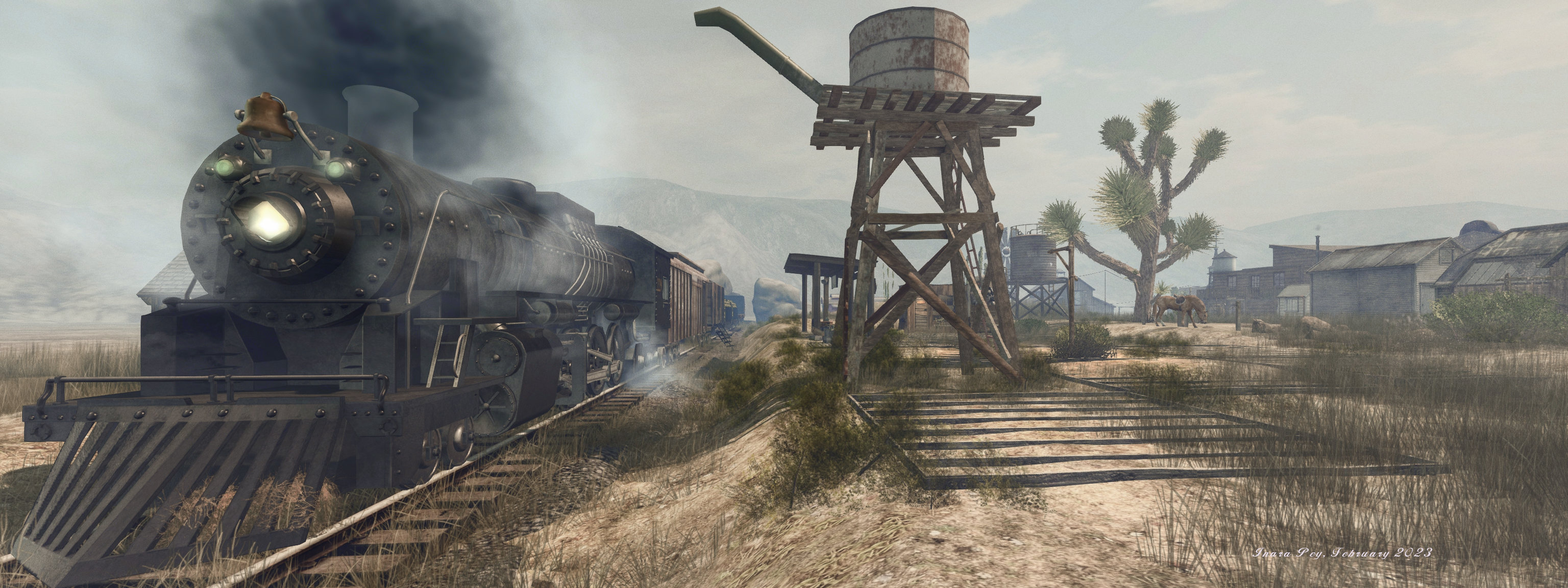
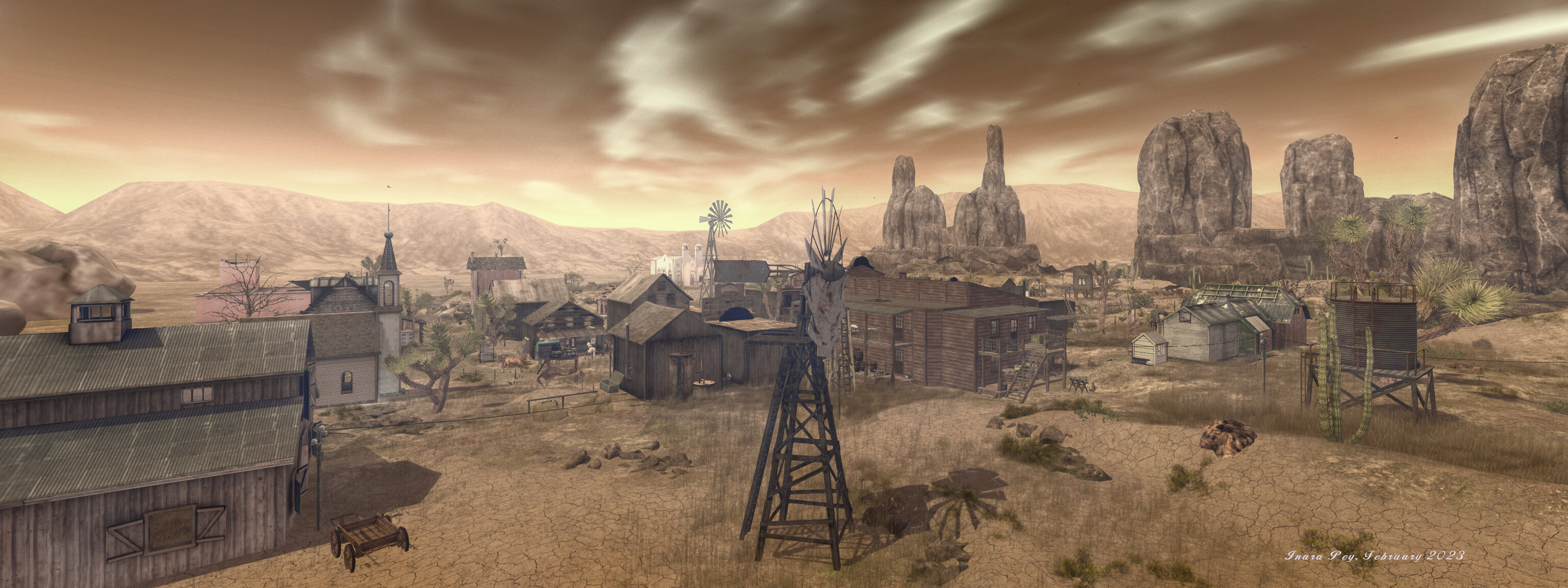
Shawn Shakespeare suggested I might like to drop into Les Salines, the latest region design from the pairing of Tolia Crisp and Dandy Warhlol (Terry Fotherington), offered under Tolia’s Frogmore brand. And for those who like westerns, it might well hit the spot.

Apparently located on the edge of the “Mojave Desert Refuge, Arizona”, Les Salines offers an interesting and curious mix. On the one hand, it has all the look and feel of the Old West: a town sitting on a desert plain, its wooden buildings lining a couple of rutted tracks, the earth packed and hardened by the passage of uncounted hooves and wagon wheels. Sidewalks are little more than boards fronting the various businesses and laid out over the bare earth between them – doubtless offering little in the way of dry footfalls when the rains decide to pay a visit.

Les Salines, February 2023
Frogmore presents Les Salines: A full region, wild west adventure from Tolla Crisp and Terry Fotherington. Everyone is welcome at Les Salines and Frogmore group members have rezz rights. The town is jam packed with details with visits to the saloon, bank, blacksmith, photo studio, general store, hotel, and much much more! Be sure to check in with the sheriff as well! Everyone is also welcome to join their photo contest and a notecard is available at the landing.

Les Salines Destination Guide entry

A sign indicates the town was founded in the 1860s; but precisely what caused settlers to establish it is unclear, but a mine (or quarry) might be responsible, perhaps being the site of a gold mine; or perhaps, given the local waters, it became a natural place for stagecoaches heading west to pause in their journeys; or perhaps that same water made it a suitable point where the locomotives could quench their huffing thirst.

Dominated by a large hacienda overlooking the town (and another a short distance away, apparently long deserted, Les Salines may equally have grown up as a result of a railhead being established here in order to ship cattle eastwards for and the hungry bellies of America’s growing cities.

Les Salines, February 2023

Whatever the reason, the town, with its fancy signage façades over its various businesses, has clearly seen better days. Their walled flanks and flat roofs all look tired under the heat of the Sun, and stage and brush is starting to intrude into the heart of the town, suggesting its population might be in decline.

The founding of this town is just one of its mysteries; another is the period it represents. On the one hand, the buildings, the stage and reliance on horses and wagon points to a time perhaps in the latter part of the 19th century – say the 1880s or 1890s. This is perhaps supported by the photographer’s studio (photography having moved west in the decades following the US Civil War) and the presence of the rail lines.

Les Salines, February 2023

However, the train sitting on them appears to be hauling fright cars from a more recent era, whilst the overhead cables which switchback their way down the main street look more akin to carrying electrical power than in echoing the taps of a telegrapher’s touch on his key. Not that any are actually hooked-up to any of the buildings their poles stand alongside as they zigzag over the street.

Further mystery is added by the fact that while the Mojave sits mainly within California, it does extend out and east into both Arizona and Nevada – although the Desert Refuge (aka the Desert Wildlife Refuge / Reserve, founding in 1936) sits within the Arizonan corner of the Mojave (a place also, and coincidentally, home to the infamous Groom Lake and also Nellis Air Force base.

Les Salines, February 2023

Of course, Les Salines doesn’t have to reside anywhere in the US west (hence the sign noting in sits on the edge of Nowhere!), but these little suggestions give the setting a sense of mystery and mixed age when allow the imagination to run free when visiting. They also offer lots of opportunities for informal RP for those so minded – although the primary aim is to present a photogenic location; and as the Destination Guide notes, there is a lot to see, indoors and out.

I will note that with shadows enabled I did find my viewer struggled a couple of times when flycamming and / or loading textures, but on the whole, Les Salines makes for an interesting and engaging visit.

Les Salines, February 2023

SLurl Details

2023 SL SUG meetings week #6 summary

Angel Mist – The Cloud Garden, December 2022 – blog post

The following notes were taken from the Tuesday, February 7th, 2023 Simulator User Group (SUG) meeting. They form a summary of the items discussed and is not intended to be a full transcript. A video of the entire meeting is embedded at the end of the article for those wishing to review the meeting in full – my thanks to Pantera for recording it.

Server Deployments

  • On Tuesday, February 7th 2023, the simhosts on the Main SLS channel were restarted without any change to their simulator code, leaving them on release 577734.
  • On Wednesday, February 8th, 2023, the RC channels will also be restarted without any version update.

Available Official Viewers

There have been no updates to the current list of available official viewers, leaving them as:

  • Release viewer: Maintenance Q(uality) viewer, version 6.6.9.577968 Thursday, February 2, 2023.
  • Release channel cohorts:
  • Project viewers:
    • PBR Materials project viewer, version 7.0.0.577997, February 2, 2023. This viewer will only function on the following Aditi (beta grid) regions: Materials1; Materials Adult and Rumpus Room 1 through 4.
    • Puppetry project viewer, version 6.6.8.576972, December 8, 2022.

In Brief

  • The announcement about the Group Chat History gave rise to a discussion on the capability and making it more robust and deeper (e.g. be presenting more than just the last hour of group chat when used), together with general improvements to chat history management (timestamps, etc.). Please refer to the video for the full context.
  • BUG-229675 “Stopping llSetKeyframedMotion should always succeed and never shout an error” was again raised and noted as a not unreasonable request. Again, please refer to the video for further details.
  • Wednesday February 1st issues: a post-mortem on these was published on Thursday, February 2nd – please read it here for specifics.

Reflections on life’s cages in Second Life

Artsville Gallery: Ava Darkheart – Cages – Birth

I was led to Cages, an installation by Ava Darkheart at Frank Atisso’s Artsville Galleries entirely by chance. The intention had been to drop into Chuck Clip’s The Book of Caligula; however, a SLurl error on the Artsville blog directed us 1,000 metres higher than Chuck’s installation, dropping us neatly into Ava’s exhibition. It was actually serendipitous – Cages had opened in mid-January, and I’d totally missed the announcements about it – and so might actually have missed it entirely before it closes on March 5th, 2023, had it not been for the mis-direct.

Perhaps the easiest way to describe this 6-part installation is as an essay in art, a story of the one journey we all have no choice but to make: that of life.

However, rather than charting this journey in as Shakespeare did, through the seven stages from birth to death (As You Like It Act II, Scene 7) or as a reflection of both admiration and ultimately ironic sense of despair on the human condition (Hamlet Act II, Scene 2), Ava instead presents a set of vignettes which encourage us to consider six aspects  – six “cages” – of life which may both constrain us and also define us as individuals. In doing so, she challenges us to consider a range of subjects, natural and social / societal.

Artsville Gallery: Ava Darkheart – Cages – Emotions

Presented around a central foyer / event space, the installation comprises six numbered rooms, which can be visited in numerical order, if so desired, although outside of the first room, it is not unreasonable to say the others might be visited howsoever the feet wander. The entrance to each is marked by white chevrons on the floor of the foyer hall, and whilst blank from the outside, can be seen to be a keyhole from within each room – a rather nice metaphor, perhaps for the keys to life and unlocking understanding.  Alongside each entrance, Ava sets out the title of the cage presented within, together with a short text piece to challenge the grey matter into action in considering each vignette.

In total, the six themes, in their default order, are: birth, the body, roots / the family, emotions, work, and the brain. Each offers a static vignette representing the core focus. Each is carefully considered with very little within it to be overlooked, with both obvious and more metaphorical elements awaiting discovery.

Artsville Gallery: Ava Darkheart – Cages – The Body

Take Birth for example: the baby floating within the cage is clear enough, as might be the seabed-like setting in which both reside (suggestive of amniotic fluid and the pre-birth “memories” some claim to have of floating within their mother’s womb) – but don’t miss the little red-crowned crane frozen in mid-dance as a potential stand-in for the stock of childhood stories. Then there is the cocoon bag sitting to one side; not only does the name evoke thoughts of the womb within the womb, it allows us, via our avatars as they sit within it, a means to recapture a sense of warmth, protection and nourishment which carried us into the world.

Some of the commentary is more direct – such as the text panel for The Body’s Cage (The Flesh), speaking as it does so eloquently on matters of gender and the growing divide between personal identity and the increasing (and unbalanced) demands for conformity / regression to purely binary outlooks some in society are demanding (despite nature as a whole rarely being truly binary). Meanwhile, there is such a subtle play on human relationships offered within The Roots Cage (The Family); contrast the reproduction of The Last Supper on the wall behind the family group, the babe-in-arms – and the look on the face of the man with burger and coffee in his hands as he keeps his head and eyes turned away from the conversation; and don’t overlook the little bench outside with its lone light, and all that might say about familial separation and loneliness.

Artsville Gallery: Ava Darkheart – Cages – Emotions

I could work my way through all six – the use of the peacock, the Jaguar, the apple tree and colours with The Untamed Cage, and so on – but this is an installation designed to get the visitor’s grey matter churning on the subjects and their motifs, and as such, I really have said far too much here. As such, I do recommend a visit before Cages draws to a close in early March

SLurl Details