Of Inventory, art and the artist in Second Life

Nitroglobus Roof Gallery, May 2026: Manoji Yachvili/Nomore – Inventory

I’ve covered the art of Manoji Yachvili (formerly Onceagain, now Nomore) on numerous occasions in this blog, as I have with many of the exhibitions at her formerly public Onceagain gallery. So I was a little surprised to hear (through the grapevine, at least) that she had taken the decision to withdraw somewhat from the SL art world, disbanding her Onceagain art group and stating she would not be exhibiting her art in-world any more.

Of course, we all reach points in our lives when we feel either a need for a radical change in our lives or work (or both), or that what we’ve been doing for so long is less the centre of our personal or creative expression, and we need to take a step back. However, we’re also free to have changes of heart within those decisions to a greater or lesser degree. So it is that Manoji/Nomore has taken up the challenge to present one more exhibition of her work, hosted by Dido Haas in the main halls of her Nitroglobus Roof Gallery.

Nitroglobus Roof Gallery, May 2026: Manoji Yachvili/Nomore – Inventory

Entitled Inventory (with the sub-title of What is Hidden Inside an Inventory), this is both something of a personal exhibition of pieces that many otherwise never have seen the light of day beyond Manoji’s eyes, and an exploration of art and the identity of the artist. It might also, to so degree, be seen as asking questions that are not only relevant to an artist, but to all of us in the modern world.

Not only finished works, but images, studies, tests, attempts, detours, forgetings. An accumulation that precedes the final form and often remains invisible. The inventory is the place where thought exceeds production, and production exceeds what is shown.
An artist thinks more than they create, and creates more than they exhibit. Of what emerges into the light, only a selected portion remains, filtered by time, context, and the gaze of others. But does what is not shown truly cease to exist?
Is it necessary for everything to be visible in order to be legitimized? The very meaning of the word “artist” lies within this tension.

– From the artist’s notes accompanying of Inventory

Nitroglobus Roof Gallery, May 2026: Manoji Yachvili/Nomore – Inventory

Thus, framed around the walls of Nitroglobus we have images and pieces, some perhaps near completion, others only partially complete or abandoned experiments, all drawing on different themes yet drawn together through Manoji’s familiar use of colour. Recovered from deep within the artist’s inventory, they present insights into the range of Manoji’s art and her willingness to experiment with forms, colour and presentation.

As pieces long hidden inventory, these pieces are used to frame an initial set of questions of their existence and “legitimacy” – just because they have been buried within inventory and thus unseen, does this make them less art than those pieces which did escape inventory’s confines and openly displayed? If they remain hidden and archived, and never seen by others, does this mean they never really existed? How do questions like this reflect on the artist behind the art? That so much remained hidden somehow lessen their own status, or does the fact they are prepared to judge their own work and/or pushing it to one side enhance their artistic reputation/ability?

Nitroglobus Roof Gallery, May 2026: Manoji Yachvili/Nomore – Inventory

Beyond this, the exhibition also seems to offer a broader subtext for artists and the rest of us to consider. This can be particularly seen within the wall of Polaroid-like shots with their hashtag elements as they both encourage us to remember who we are and question things from the role of the artist through to the devil of the moment – the use of AI (which somewhat circles back to the questions of archiving raised in the artist’s notes accompanying the exhibition: yes, art might be preserved (or accidentally lost) through digital archiving, but it might also be put at risk of corruption by the devouring need of AI and its image harvesters).

Richly engaging visually, whether or not one delves into the artist’s own notes or attempts to identify potential subtexts and meanings, Inventory is a captivating exhibition – and I hope it is not forever Manoji’s last.

SLurl Details

LL partner with Essential Inventory to bring Second Life users “more”

via Linden Lab

On Tuesday, May 5th, 2026, Linden Lab announced a new partnership with Essential Inventory to bring Second Life subscribers and users “more discovery, more rewards, and more ways to experience everything the grid has to offer”.

With this new partnership, Second Life Subscribers (Plus, Premium and Premium Plus) and user will be able to benefit from the following:

Second Life subscribers:

  • Five curated gifts every month across a variety of categories – with the first gifts becoming available at 12:00 noon SLT on Tuesday, May 12th, 2026 at the ACCESS shopping event, and at the  dedicated Essential Inventory Premium Gifts region.
  • Early access to some of Second Life’s most popular shopping events – with the first early access opportunity being Sunday, May 10th, 2026 at the ACCESS shopping event.

All Second Life users:

  • Access to a new publication – What’s Hot in Second Life – which will be published every Tuesday at 1:00 SLT.
    • What’s Hot in Second Life is intended to be a curated guide highlighting “the most exciting and relevant content across the entire Second Life ecosystem”.
    • The first issue is currently available on the Essential Inventory website.

More About Essential Inventory

Essential Inventory began as a community-driven discovery platform of the kind encouraged by the Second Life Creator Partnership Programme. Whilst there are few details relating to the group(s) running Essential Inventory, the website does include the following information:

  • Founded in September 2022.
  • Boasts 3 million views over a 20 month period, with 285,487 site sessions in August 2025.
  • Has over 3,000+ e-mail subscribers.
  • Offers paid advertising for brands, etc., including “social boost packages”.
  • A “one-time free coverage” option to help promote a brand or event through Essential Inventory.
  • A “free/paid recurring event coverage” option to promote recurring events through Essential Inventory.

To find out more, visit the site directly.


Astoria’s Zen-on-water in Second Life

Astoria, May 2026 – click any image for full size

I first visited Astoria, a Homestead region held by Eromara Vita and Dots (Dotties Stoop), in December 2024 (see: Astoria’s wintertime in Second Life), and had intended to make a return view a lot sooner. However, things have been what they were, so to speak, and so May 2026 marks my first opportunity to make good on that hope of a revisit; and it turns out that being able to do so now is rather serendipitous for me, as the region had, for spring 2026, been redressed as a most pleasant Zen environment – oriental themes for region designs being a favourite for me.

Step into a sanctuary of stillness, where nature and serenity meet. Whether you seek meditation, a yoga session, or a moment of silence away from the noise of daily life, this tranquil space offers the perfect escape. Come as you are. Leave renewed.

– Astoria’a About Land description

Astoria, May 2026

In this iteration, the region stands as a series of six small islands, each of which features Alex Bader’s excellent Zen Garden building kit (a personal favourite of mine) as the foundation for their overall look. Arranged in a rough circle, the islands are in turn surrounded by an off-region range of rugged, forested hills which enfold them in a gentle hold, cutting them off from the rest of the world somewhat and adding to their sense of tranquillity.

Separated by deep, clear waters, five of the six islands are connected one to another by a mix of bridges and stepping stones, allowing visitors to move between them without getting wet. However, the sixth is somewhat separated from the others in that no stepping stones or bridge runs across to it.

Astoria, May 2026

This separation appears to be by intent rather than any oversight in providing either a bridge or stepping stones, as it stands as a venue for music events (the next being May 15th and featuring Bsukmet – click the information board on the island for a direct Landmark). Given this use, the island is also a little different in appearance to the others, being formed as a stage, with a dancefloor of stones floating before it on the water for dancing.

The Landing Point for the region is located on the tallest of the six islands. This is topped by a small teahouse offering views out over the other islands. A short gravel path with seating links the teahouse with steps leading down to the water’s edge. Here, stepping stone branch out from the island to provide the means to get to two more of the islands.

Astoria, May 2026

One of these island is home to a shrine which has suffered some external damage. However, Buddha still sits serenely inside while a statue of Bishamonten (a Japanese form of the Indian god Vaisravana) outside, keeping his proper place and guarding Buddha. A short bridge connects the shine island with a small, flat island topped by a gravel circle with a place to sit and a bamboo fountain.

Buddha is also to be found on the other island which can be reached via the stepping stones from the Landing Point. Here, he resides outdoors in the lee of a tall rock. A pillow is placed before him for those wishing to meditate with him, while a yoga mat on the other side of the rock offers the opportunity for exercise. The entire island takes the form of a small Zen garden looped by gravel paths with water features and places to sit.

Astoria, May 2026

A long span of a bridge allows the Zen garden walk to continue on the last of the larger island in the group. This is again low-lying and offers places to sit and contemplate, the peace only broken by the slow clunk of another bamboo fountain as its arm fills with water before dropping to deposit the water into another little stream.

As well as the islands and their walks, the waters here also present points of interest for photographers: lanterns float on the water under a bridge and among lilies; a small dragon fountain sits on a rock rising from the waters, whilst a large water dragon appears to be keeping an eye on the Landing Point and teahouse. The gardens also have lots of little touches to bring them to life without every breaking from their sense of serenity.

Astoria, May 2026

In all, another engaging and pleasant design from Dots and Ero.

SLurl Details

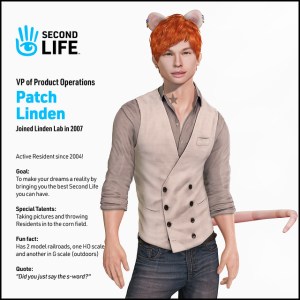
Patch Linden departs Linden Lab

Eric Nix (aka Patch Linden, in-world). Via Linden Lab

On Tuesday, May 5th, Linden Lab announced that Senior Vice President of Product Operations, Patch Linden (known in the physical world at Eric Nix), is to depart the company after some 20 years.

No precise reason for his departure has been given, other than the fact it comes as part of a reorganisation of the Product Operations and Customer Success divisions, both of which have been under his remit.

Patch originally joined Second Life as a resident user in 2004, running his own business in-world. In September 2007, he officially joined the Lab as a support agent, rising to a support liaison. From there he moved to the Concierge team, and was gradually promoted to manage that particular team. Following this, he shifted his focus to the role of Operations Support Manager for around a year before joining the Product division, which has the responsibility for defining the features, etc., found within Second Life.

Whilst a part of the Product division, Patch developed the Land Operations team, which includes the Linden Department of Public Works (LDPW). He also became the prime mover with the Land Operations team and LPDW in establishing and expanding the Linden Homes offerings for subscriber users, and developing the Bellisseria content land (and water) masses.

Patch Linden, circa 2017, via Linden Lab

In 2018, he established the company’s support office in Atlanta, Georgia, and in 2020 he oversaw the move to larger office space in Atlanta, which was interrupted by the COVID-19 pandemic, and then in 2019, he was promoted to Vice President, Product Operations.

In this role he became part of the troika of Senior Vice Presidents (along with the Senior VP of Product and the Senior VP of Engineering responsible for overseeing Second Life’s continued development on behalf of the company’s most senior management and board. As Senior VP of product Operations, he has been responsible for managing some 5 teams, including the LDPW.

Path has generally enjoyed popularity among many Second Life users, often appearing at public and special events – such as Meet the Lindens sessions at the Second Life Birthday celebrations, as well as the likes of the annual Virtual Worlds Best Practices in Education (VWBPE) event, and has been featured in a number Lab Gab sessions. As such, he will be missed by many.

Whilst the blog post implies Patch will be departing the Lab, a check on his account in-world suggests he may already have actually left (or at the very least, the Patch Linden account has been “retired”), as it appears to be no longer available – which is generally a sign an employee has left the company. However, whether he has departed or has yet to, I wish him well in his future endeavours.

Update: not long after this piece was published, Eric Nix’s name and image were removed from the Lab’s About page, further confirming his departure.

Be ready: WebRTC goes grid-wide in Second Life, May 5th, 2026

via Linden Lab

As indicated in a recent official blog post, the WebRTC voice service is due to complete its deployment to the entire main grid (Agni) on Tuesday, May 5th, 2026.

Currently available across around 25% of the grid on RC channels, the full deployment of WebRTC will see the completion of the initial phase of converting Second Life to a Voice service that is not dependent on a third-party supplier (Vivox) and can be directly maintained and enhanced by Linden Lab, opening the door to a potential range of new capabilities in the future (such as voice-to-text).

The WebRTC project started roughly two years ago, when the Lab first publicly made known it was looking to move Voice services away from a reliance on Vivox and the SL Voice plug-in for the viewer to something more modern and potentially capable. WebRTC (RTC=”real-time communication”) was selected as it is something of a “defacto standard”, being built-in to most web browsers and supporting  wide range of real-time communications tools in common use.

Since then the project has taken time to mature and reach a point where the Lab is confident it can be fully deployed across the grid without too much risk of disruption, particularly now that people are increasingly using viewers which have adopted WebRTC in their more recent versions (which was a particular problem for Firestorm with its large user-base, where because WebRTC was somewhat linked to the arrival of PBR and the performance impacts that caused, many users opted to remain with “pre-PBR” versions of the Firestorm viewer which also did not have the requisite support for WebRTC).

What This Means

  • Firstly, if you do not use Voice at all, then probably not a lot.
    • If you are using a recent (i.e. from around mid-2024 onwards) viewer version, you’ll most likely already have WebRTC support even if you never actually use it.
    • If Voice has never been a part of your SL and you’re on a viewer version without WebRTC support, you can allow other factors and viewer updates determine your upgrade path.
  • If you do use Voice, and again are on a “recent” version of a viewer, then you again don’t need to do anything; the change to grid-wide availability of WebRTC occurs on the simulator / server side of things, so there is no need to upgrade your viewer.
    • That said, if you want to have the latest bug fixes for WebRTC, and are not already using it, then you should consider updating to the latest release version of the official viewer, or whether your preferred TPV has incorporated the fixes in either a release or beta/RC version.
  • As the legacy Vivox system is decommissioned, viewer versions reliant on that service will lose all Voice functionality. This is a mandatory backend change by Linden Lab that cannot be altered or bypassed by third-party viewers. So if you wish to continue to use Voice and are on an older version of your preferred viewer, you should update to a WebRTC-capable version in order to smoothly continue using Voice.
  • If you regularly use the SL Mobile App, again there is nothing you need to do; the App already supports WebRTC.
  • One of the more noticeable impacts of the full deployment will be with peer-to-peer (P2P) Voice communications. During the transitional period, when both WebRTC and Vivox have both been operational on the grid, cross-system P2P communications between WebRTC and Vivox have not always functioned correctly. With the full deployment of WebRTC, this will no longer be an issue.
  • Similarly, other points of confusion (and possible disconnects) as a result of moving between regions running the two services will also be eliminated, as WebRTC will be the primary service across all regions.

Adding Capabilities

Moving forward, the WebRTC service will continue to be enhanced. In fact, as a part of this work, WebRTC viewer-side voice moderation capabilities are already being tested on the grid using the Second Life 2026.02 Release Candidate (RC) viewer available via the Alternate Viewers page.

Voice moderation provides the following capabilities to authorised users (e.g. Group moderators): mute or unmute individual participants; mute or unmute all users in a voice channel; manage disruptive or unintended background noise. Further:

  • WebRTC voice moderation is already available in some TPVs, so check the release notes on the most recent versions (including any beta/RC versions) of your preferred viewer to see if this is the case.
  • The official 2026.02 RC viewer with the voice moderation capabilities will be promoted to release status in the near future, allowing the code to be picked-up and incorporated in all TPVs as and when they update.

As well as voice moderation tools, and as noted above, WebRTC offers the potential for other capabilities such as voice-to-text, etc., to be added. In fact, experiments with voice-to-text have been underway within the Lab for some time, although the focus on getting the initial WebRTC fit for full deployment means that this work is far from complete and has yet to make it to a publicly-accessible project or RC viewer. Given this, it may be a while before the capability surfaces for public testing.

In the meantime, if you wish to keep up-to-date with WebRTC development, it is frequently a subject for discussion at the following user groups:

2026 SL viewer release summaries week #18

Logos representative only and should not be seen as an endorsement / preference / recommendation

Updates from the week through to Sunday, May 3rd, 2026

This summary is generally published every Monday, and is a list of SL viewer / client releases (official and TPV) made during the previous week. When reading it, please note:

  • It is based on my Current Viewer Releases Page, a list of all Second Life viewers and clients that are in popular use (and of which I am aware), and which are recognised as adhering to the TPV Policy.
  • This page includes comprehensive links to download pages, blog notes, release notes, etc., as well as links to any / all reviews of specific viewers / clients made within this blog.
  • By its nature, this summary presented here will always be in arrears, please refer to the Current Viewer Release Page for more up-to-date information.
  • Outside of the Official viewer, and as a rule, alpha / beta / nightly or release candidate viewer builds are not included; although on occasions, exceptions might be made.

Official LL Viewers

  • Default viewer  – One-Click Installer = 26.1.1.23806384790 – April 10 – No change.
  • Second Life Release Candidate (RC) viewer: Flat UI – 26.2.0.25021396775, April 29 -“flat” UI and font update – New.
  • Second Life Project Viewers:

LL Viewer Resources

Third-party Viewers

V7-style

V1-style

Mobile / Other Clients

  • SL Mobile iOS version  0.1.163391, April 28 (Android update pending at the time of writing).

Additional TPV Resources

Related Links