Space Sunday: starships, volcanoes and Voyagers

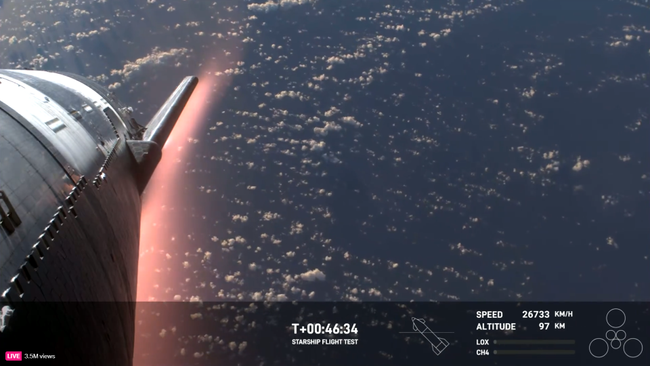
Plasma starts to form around the Starship’s thermal protection system as the vehicle starts to re-enter the denser part of Earth’s atmosphere, March 14th, 2024. Credit: SpaceX

Thursday, March 14th, 2024 saw SpaceX attempt the third Integrated Flight Test (IFT-3) of its massive Starship / Super Heavy launch system after the Federal Aviation Administration (FAA) granted a limited launch license to the company on March 13th.

Despite SpaceX and its followers hailing the first two launch attempts as “successes”, the short-order loss of both vehicles within 4 minutes of the launch of IFT-1 and which either vehicle achieving its core milestones in IFT-2, meant that both of those flights were extremely limited in their “success”. As a result of both, SpaceX spent considerable time reviewing the launch profile for the vehicles and making changes and improvement to both the Starship craft and Super Heavy. These resulted in IFT-3 being a broadly successful – although the loss of both vehicles at different points in the flight meant it was not an unqualified success.

Following lift-off at 13:25 UTC, with an initially perfect firing of all 33 Raptor engines on the booster, the stack of rocket and starship passed through Max-Q, the period where both experience maximum mechanical stresses as they ascend through the atmosphere, within the first minute of flight.
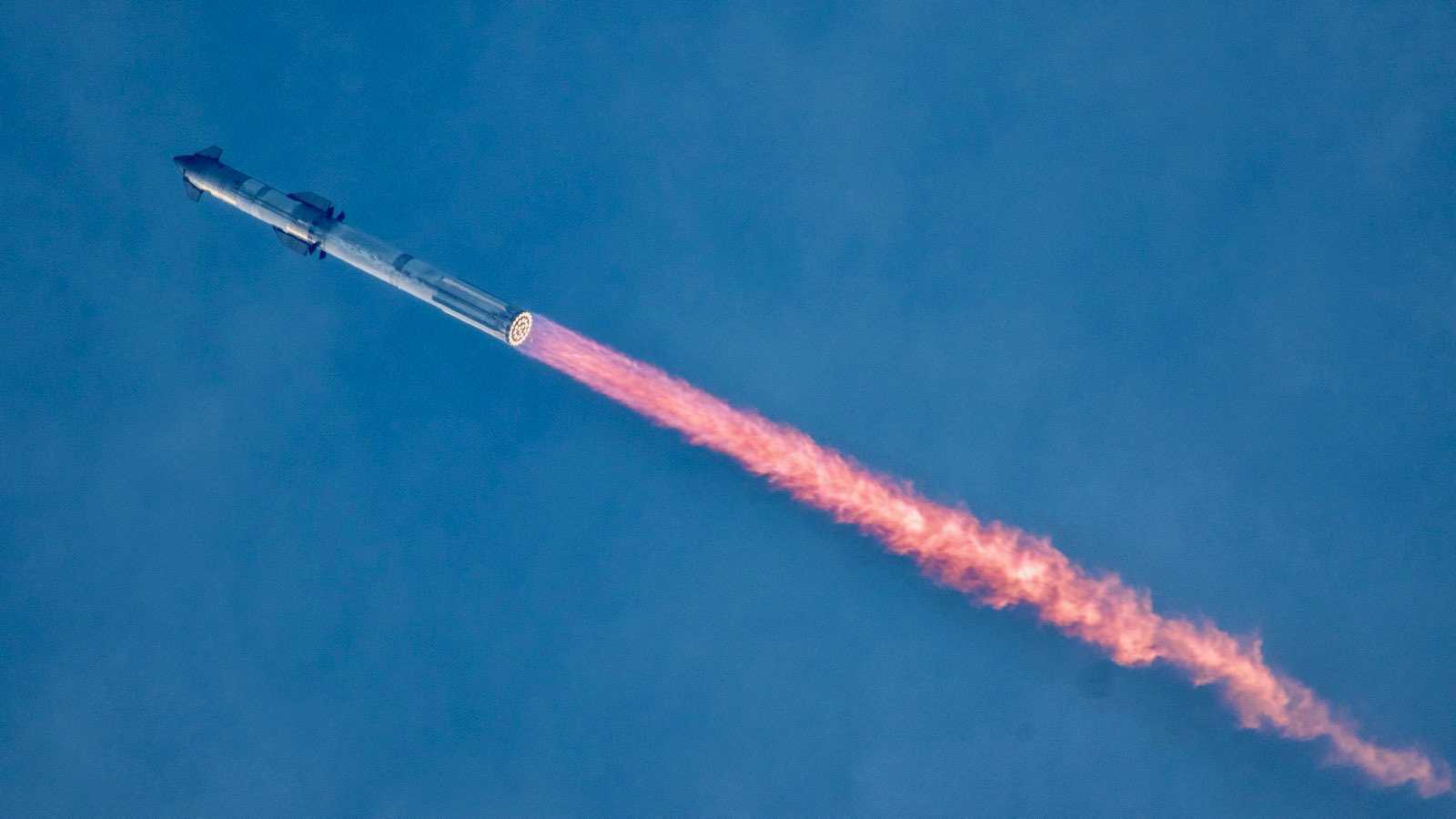
A clean burn: all 33 Raptors are at work as the IFT Starship / Super Heavy combination move towards Main Engine Cuto-Off (MECO). Credit: SpaceX

Even so, at 2:42 into the flight, the engines on the booster shut down and two seconds later, the starship upper stage ignited all six of its engines in a “hot staging” manoeuvre, separating from the booster after the engines had fired. This went a lot smoother than evidenced in the second launch attempt in November 2023, and the booster was this time able to change direction and execute an successful “boost back” burn – using the motors to kill its ascent velocity and push it back towards the launch site.

However, it was during the boost-back that possible hints of engine issues appeared: several of those recording and reporting on the launch noted that some of the engine exhaust plumes were tinged green, indicative of one or more engines consuming itself (green indicates the copper used in the engines is being consumed), a long-term issue with the Raptor 2. Nevertheless, the booster successfully re-oriented itself and started a planned engine-first descent towards the Gulf of Mexico and a splashdown.

For this to happen, the booster needed to slow itself by a further re-lighting several engines in a braking manoeuvre roughly a kilometres above the water. Whilst three engines did ignite, two immediately failed, and the vehicle was destroyed less than 500 metres above the Gulf – although it is not clear if the flight termination system was triggered or the booster blew itself apart. At the time of destruction, it was travelling with sufficient velocity to hit the water at 1,112 km/h.
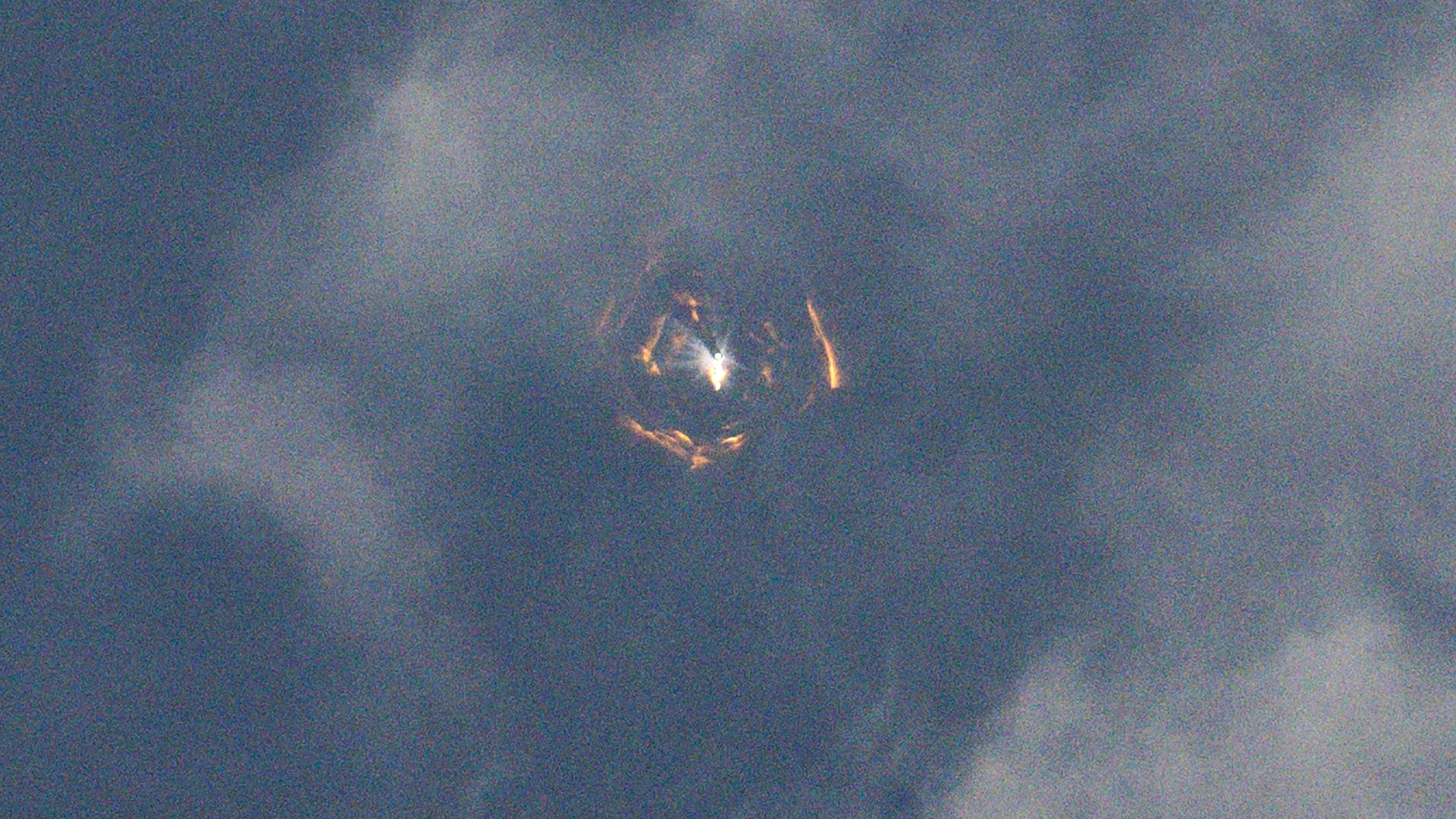
A successful hot staging: with the super Heavy booster engines still glowing brightly, the Starship vehicle separates and moves away, the shockwaves of its exhaust ringing both vehicles after a successful engine start-up while still attached to the booster. Credit: SpaceX

Starship went on to achieve orbit, on course for a splashdown in the Indian Ocean. Travelling at around 240 km above the Earth, the vehicle carried out a test of the “Pez dispenser” payload bay door – a slot in the vehicle’s hull at the base of the payload bay and specifically designed to eject Starlink satellites (these being almost the only payload for Starship at present). Also tested was a so-called “propellant transfer” test, shunting a small amount of liquid oxygen between the vehicles’ main and header tanks.

However, SpaceX cancelled the vehicle’s planned de-orbit burn with one of its Raptor engines and instead allowed the vehicle to “go long”, continuing along its orbital track until gravity until drag caused it to re-enter the  denser part of the atmosphere for a hoped-for splashdown. In the event, and following an initially very successful re-entry, the vehicle broke apart at an altitude of around 65 km.

The orbital flight segment of the test was impressive whilst also raising questions as to Starship’s future orbital flight dynamics. Notably, throughout its half orbit of the Earth, the Starship was in a state of continuous “bbq roll”, that is, spinning around its longitudinal axis (and making it seem like the Earth was constantly looping around it on videos). Such rolls are not uncommon on space vehicles when in sunlight, as they help spread the thermal load of the Sun’s heat over the vehicle’s outer skin, preventing uneven heating (or overheating).

In the first few seconds of flight: not the white ice enveloping the Super Heavy booster and the back of Starship -the result of the hulls of both forming the outer walls of their cryogenic tanks and being so cold frost ice forms on the metal, indicative of its poor thermal regulation. Credit: SpaceX

In this respect, Starship is especially vulnerable to such thermal stresses: it is completely reliant on cryogenic propellants which tend to revert to a gaseous state (and require venting to prevent tanks being over-stressed), and it is made of stainless steel, and extremely poor thermal insulator. This is compounded by the fact that the hull of the vehicle is also the the outer surface of the propellant tanks, so outside of the thermal protection system (TPS) tiles coating one side of the vehicle and designed to protect it during re-entry in to Earth’s atmosphere, there is next to no thermal insultation between the vehicle’s propellant reserved and the Sun, thus leaving rolling the vehicle as the simplest means of regulating internal temperatures.

Even so, the rate of roll, combined with its continuous does raise questions: was the rolling seen on this flight simply an overly precautious desire to limit thermal blooming inside the vehicle, or will it be part of starship SOP in the future. If the latter, then there are going to be some significant issues to address (how are to starships supposed to pump propellants being them in they have to roll like this once mated and the fuel to be transferred from one to the other is being exposed to a severe Coriolis effect as a result of the spin? Was the spin in this instance the cause of the planned de-orbit burn being cancelled because a smooth flow of propellants to the motor to be fired could not be guaranteed?

That said, the vehicle did perform its own mini “propellant transfer”, pumping a small amount of liquid oxygen between its own tanks. However, the overall value of this test is perhaps not as significant as some SpaceX fans have stated, given it is a long way short of the 100+ tonnes of propellants at a time that will need to be transferred between vehicles when it comes to sending the proposed Starship lunar lander to the Moon .

But leaving such thoughts aside, the one undoubted spectacular element in the flight were the initial phases of re-entry into the denser atmosphere, when cameras mounted on the vehicle’s control surfaces were able to video the build-up of super-heated plasma around the craft as it slammed into the atmosphere. While this has been filmed from within various space vehicles (Apollo, shuttle, etc.), this is the first time (I believe) it has ever been recorded from outside the vehicle going through re-entry.

Another unique element of the vehicle demonstrated prior to re-entry was the use of vented gas as a means of controlling the vehicle’s orientation. As noted above, cryogenic fuels tend to “boil off” and turn gaseous unless kept perfectly chilled. This gas must then be vented in order to prevent it becoming too voluminous and rupturing its containment tank (hence why rockets using cryogenic fuels are constantly venting gasses prior to launch following propellant loading & then having to be constantly “topped off”). However, rather than just letting go of this gas in space as they do on the ground, SpaceX channel it through a series of “cold thrusters” around the starship vehicle, enabling them to use the vented gas to “steer” the vehicle, avoiding the need for more traditional (and mass-using) thrusters systems requiring their own tanks of hypergolic propellants or gas.

While overall successful, the loss of both vehicles does mean a mishap investigation overseen by the FAA has been triggered, which may delay the planned launch of another test flight originally targeted for just a few weeks time. Even so, SpaceX are to be congratulated with the results overall, carrying the company as they do a modest step forward in the system’s development.

Continue reading “Space Sunday: starships, volcanoes and Voyagers”

2024 week #11: SL TPVD summary: new approach to voice in SL

Burnt Toast Café and Tavern, February 2024 – blog post

The following notes were taken from my audio recording and chat log transcript of the Third-Party Viewer Developer (TPVD) meeting held on Friday, March 15th, 2024. My thanks as always to Pantera for recording the TPVD meeting and providing the video, which is embedded at the end of this article.

  • The TPV Developer meeting provides an opportunity for discussion about the development of, and features for, the Second Life viewer, and for Linden Lab viewer developers and third-party viewer (TPV) / open-source code contributors to discuss general viewer development. This meeting is held once a month  the third or fourth Friday, at 13:00 SLT at the Hippotropolis Theatre.
  • In regards to meetings:
    • Dates and times are recorded in the SL Public Calendar.
    • Commence at 13:00 SLT on their respective dates.
    • Are conducted in a mix of Voice and text chat.
    • Are open to all with an interest in either content creation or viewer development.
  • The notes herein are a summary of topics discussed and are not intended to be a full transcript of either meeting.

Official Viewers Status

[Video: 00:00-1:31]

No updates since the start of the week, leaving the available official viewer as:

  • Release viewer: version 7.1.3.7878383867, the Emoji Viewer, issued February 15, promoted March 1st, 2024 – NoChange.
  • Release channel cohorts (please see my notes on manually installing RC viewer versions if you wish to install any release candidate(s) yourself).
    • glTF PBR Materials Maintenance-2 RC viewer, version 7.1.4.8149792635, March 11, 2024.
    • Maintenance X RC (usability improvements), version 7.1.4.8148263040 , March 11, 2024.
    • Maintenance-W RC (bug and crash fixes), version 7.1.4.8113624779, March 6, 2024.
    • Maintenance Y RC ( My Outfits folder improvements; ability to remove entries from landmark history + Maint Z RC integration) updated to version 7.1.4.8114240508, March 6, 2024.
  • Project viewers:

General Notes

  • The “most likely” RC viewer in line for promotion to release status is the glTF / PBR Maintenance 2 viewer, with the hope it will be promoted in week #12.
  • After this, the next glTF viewer will be the Featurette viewer (which may surface as an RC viewer by the end of March 2024), which will include:
    • Geenz Linden’s work on Mirrors, including his latest updates to the capability.
    • Cosmic Linden’s work on applying glTF materials to terrain.
    • Updates which will allow the glTF / PBR swatch boxes in the Build / Edit floater display previews of the materials being selected, rather than grey boxes.
    • The first series of additional glTF extensions – Index of Refraction.
    • Initial work on 2K textures support (which does not include BoM, as this would require a significant update to the Bake Service).

WebRTC Voice

[Video: 1:49-15:03]

  • A new project intended to move Second Life away from reliance on the Vivox voice service and plug-in, and to using the WebRTC communications protocol (RTC=”real-time communication”).
  • WebRTC is something of a “defacto standard”, being built-in to most web browsers and supporting  wide range of real-time communications tools in common use (e.g. Google Meet), supporting audio, video and data communications.
  • In terms of audio / voice (the primary focus here), WebRTC has a number of standard features expected of audio communications services (such as automatic echo cancellation, better noise cancellation and automatic gain control, etc.) and offers much improved audio sampling rates for improved audio quality.
  • Work has already progress so that WebRTC supports all of the current SL Voice capabilities (e.g. region Voice, parcel Voice, peer-to-peer, ad-hoc and group capabilities, muting, etc.).
  • In addition, work has been put into securing the use of WebRTC Voice against attempts to eavesdrop, etc., and to route peer-to-peer communications via an internal server to avoid revealing user’s IP addresses to the risk of doxing, etc.
  • WebRTC will be supplied within the viewer using a library and wrapper. This will mean no requirement to run a third-party voice plugin (SLvoice.exe, as supplied by Vivox) going forward.
  • The switch to WebRTC also opens the door to adding new features and capabilities to SL Voice, some of which have been long-requested.

Current Status

  • WebRTC currently works alongside Vivox, with the Lab working to make the transition over as painless as possible, with the simulator end of support being switched to WebRTC on a limited basis to start, with the switch being thrown for all regions once there is a high enough confidence that the majority of users are on viewers with the new WebRTC code + wrapper.
    • However, once regions have been switched to use the WebRTC capabilities, viewers still running the Vivox plugin will not be able to access Voice services on them, as the WebRTC back-end does not recognise the Vivox plug-in.
    • Voice Morphing is also not part of the initial implementation.
  • There are test viewers with the necessary viewer-side WebRTC support (not yet at Project or RC status), and regions on Aditi, the Beta grid (webRTC1 and webRTC2) with the back-end support.
    • It is possible that, going forward and to allow broader testing, a region on Agni (the Main grid) could be set-up for WebRTC testing (as with the current Echo Canyon for SL Voice).
  • Wiki documentation is in progress, and includes links to the test viewers (currently Windows and Mac OS) + a public code repo and other information. Note, this is subject to further update.
  • There is a dedicated WebRTC board on the SL Feedback Portal where issues, etc., can be reported / raised for discussion.
  • It was noted that there are various complexities and problems being worked out (e.g. safeguarding peer-to-peer Voice as noted above, issues with maintaining Voice during  / after region crossings, etc.).

Mesh Download Cost Discount

[Video: 39:30-42:38]

  • As recently reported, how the download weight (“cost”) of mesh objects is calculated will be changing.
  • The net effect of this is around a 15% reduction on the download weight.
  • This should result in a reduction of the overall Land Impact for many (but not necessarily all) in-world mesh objects.
    • However, it should not be taken to mean the overall LI for an object will be reduced by 15%; while the dominant factor in calculating an object’s Land Impact, it is not the only factor, as such the amount of LI reduction will always be dependent on the impact of the other costs associated with a mesh (rendring cost, physics cost, etc.).
    • As I’ve noted in a recent project summary, Animesh objects are excluded from any Land Impact reduction, for example, as they have their own LI calculation).

In Brief

  • Some discussion on adding PBR support to Bakes on Mesh. While this is not ruled out, it was again stated that it would require a significant overhaul of the Bake Service, and has some major lead-in questions on how to best go about the work that would need to be addressed before an work could be initiated.
  • PBR Terrain:
    • At its basic, this is PBR layers, but for high-end computers, it can leverage triplanar mapping for improved repeats / quality.
    • There is also a change to how texture repeats are handled, in order to avoid issues at region boundaries.
    • A reminder that it is a viewer-side feature at presents (with a server-side control flag for enabling), piggybacking off the existing terrain tools. As such, there is no fallback from PBR terrain to texture terrain, its on or the other.
    • The PBR terrain support will initially be limited to Private regions and estates; it will not be available to Mainland.
  • A discussion on reflection probes (such as having a probe within a probe – don’t do this) and observed problems, e.g. BUG-234815 (via Github archive)
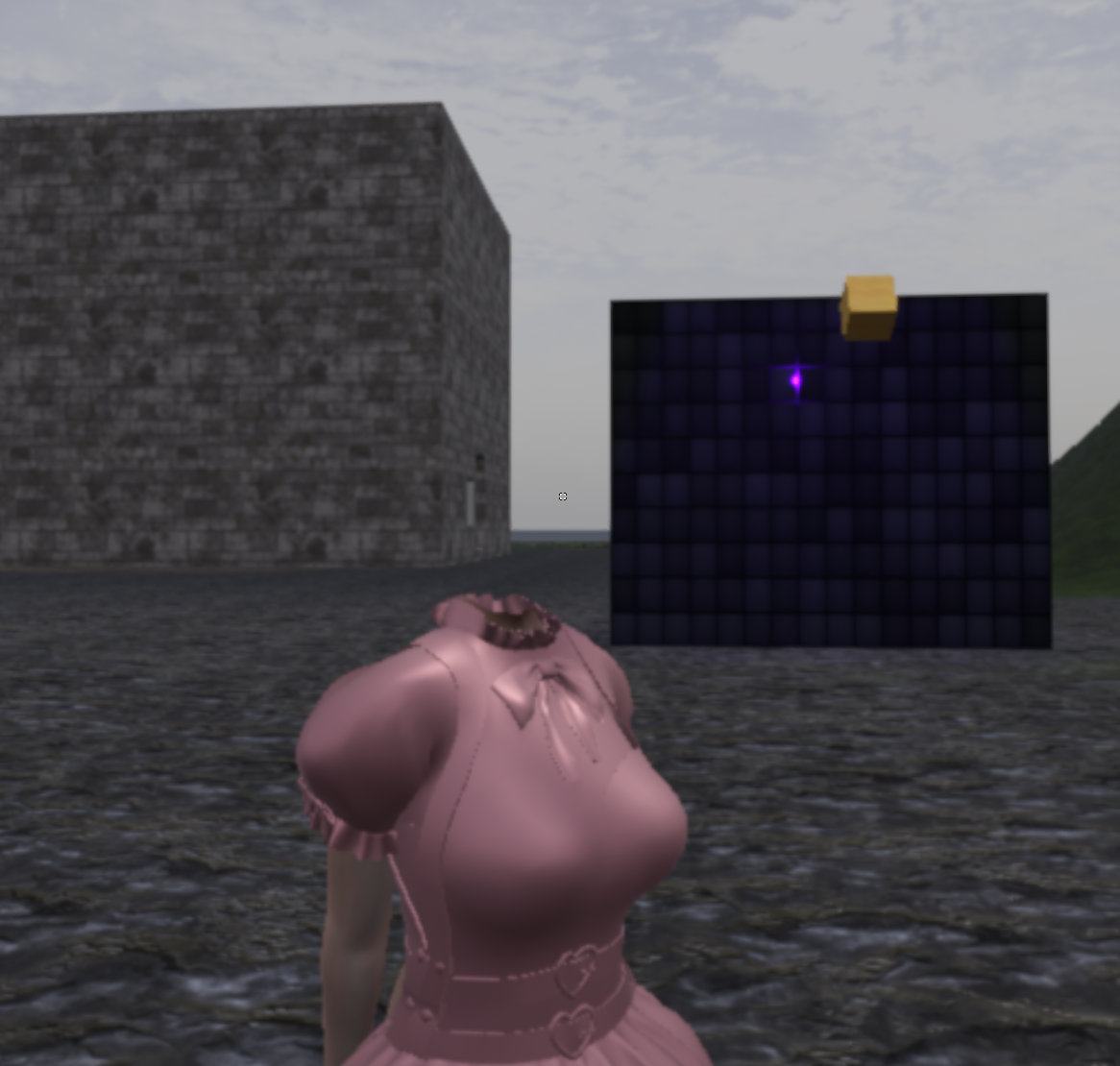
  • A – slight – issue of losing your head when using the upcoming Mirrors capability from Mouselook (see: BUG-234342 via Github archive).
Don’t do this at home, kids! Viewing oneself using the upcoming Mirrors feature when in Mouselook…
  • A discussion on emojis / unicode / Display Names.
  • A discussion on avatar complexity, policing, limitations, impact of allowing avatars to effectively be given a “free pass” in terms of proper optimisation  / LI accountability, and developing a terminology to help users (and creators?) properly understand the impact their avatars can have on general viewer performance.

Next Meeting

† The header images included in these summaries are not intended to represent anything discussed at the meetings; they are simply here to avoid a repeated image of a gathering of people every week. They are taken from my list of region visits, with a link to the post for those interested.

VWBPE 2024 What’s up With the Lab: Grumpity, Kali and Signal Linden

via VWBPE

Update: March 16th, 2024: Regarding SL Voice and capabilities, as mentioned in the latter part of this summary, please also refer to: 2024 week #11: SL TPVD summary: new approach to voice in SL for information on the new WebRTC for Voice in SL.

On Thursday, March 14th, 2024 Grumpity Linden, the Lab’s Senior Vice President of Operations, along with Kali and Signal Linden joined Phelan Corrimal for the annual Above the Book session at the Virtual Worlds Best Practice in Education (VWBPE) conference, entitled What’s Up At the Lab.

The function of the session is to explore what’s “new” at Linden Lab  / with Second Life and their impact on educators and non-profit organisations using the platform.

The following is a summary of the session covering the core topics raised. The notes provided have been taken directly from the official video of the session, which is embedded at the end of this article. Time stamps to the video are also provided to the relevant points in the video for those who wish to listen to specific comments.

Notes:

  • This is a summary, not a full transcript, and items have been grouped by topic, so may not be presented chronologically when compared to the video.
  • Timestamps are included to allow a direct jump to a subject / comment.

A Little Background

Grumpity Linden: is responsible for the Second Life Product and Engineering teams. She originally started at LL whilst working for The Product Engine, and was involved in the development of Viewer 2 (as designed by 80/20 Studio), prior to joining LL full-time in 2014. Her role covers all aspects of product development and platform engineering, and as well as having a strong technical background, she also brings a strong element of interpersonal skills and psychological expertise to the Lab’s management team via her studies at the Johns Hopkins University.

Kali Linden: is now a Director of Engineering at the Lab, reporting into Grumpity, specifically focused on the Lab’s web properties (e.g. lindenlab.com, secondlife.com, the Marketplace, etc.) and associated UI and API design. She has a keen focus on matters pertaining to content creation and also in working in the non-profit sphere, describing herself as a “Nonprofit-preneur” as well as a “Nerd-Gamer”.

Signal Linden: is the Director of the Second Life Server and Viewer engineering and development teams. He has been involved with Second Life since 2008, and joined Linden Lab in 2015 by way of the likes of Amazon. He is a strong believer in the potential of virtual worlds, and a keen proponent of open-source software and collaborative development. He has perhaps most recently been visible as the communicator of, and driving force behind, the Lab’s moves to the use of Github to manage viewer development and issue tracking for their engineering and development environments.

Product Development Path

The glTF™ Roadmap

[Video: 4:43-19:26]

  • When SL introduced mesh import (2011), the COLLADA (Collaborative Design Activity) interchange file format  interactive 3D applications was selected for use within SL for importing mesh models to the platform. This decision was based on its widespread (at the time) use and recognition as an international standard (ISO/PAS 17506).
  • Since then, content creation and the industry have moved on, and the glTF (graphics library Transmission Format) has been developed over the last decade by the Khronos Group (also responsible for COLLADA), as  a standard file format for three-dimensional scenes and models. Recognised and adhered to through the industry, it is the specification of choice for Second Life to move to using.
  • Linden Lab views glTF adoption as a combination of:
    • Making the platform more accessible to a wider pool of content creators (as in theory, content made for X or Y in adherence to the core glTF specification (currently version 2.0 (no extensions) for SL) could be dropped directly into SL “as is” subject to licensing)
    • Making the actual import and use of glTF objects and scenes adhering to the specification pretty much a drag-and-drop capability.
  • While the techniques involved in glTF content production may be more complex, it is hoped that by adhering to the specification, content creators and users in SL will have great access to more accurate documentation to support the learning process, and have access to a broader set of libraries / tools presenting the means for that drag-and-drop capability with items and objects arriving in SL and looking vastly different to how they appear in authoring tools.
  • Physically based rendering (PBR) for materials was the first step in glTF adoption, and required a large-scale overhaul of the SL rendering engine. With its deployment and update, LL are now looking to to build out glTF support and capabilities.
  • Notably, the work now allows LL the opportunity to investigate  – and potentially implement – the support of  importing of entire glTF scenes (object, scripts, animations, etc., as noted above) into SL and have them stored as a recognisable asset.
    • This requires another significant overhaul of SL to support glTF hierarches, and so is liable to be a long-term project.
    • However, work on scene import and its associated requirements is due to start around mid-2024.
  • Note: this conversation included the export of glTF scenes from SL to elsewhere. As Linden Lab are still investigating requirements for permissions, etc., plus determining what will be required to allow scene import, no definitive answer on this could be given at this point, and so I’ll do no more than mention it here. Please refer to the video below if interested in the conversation.

SL Mobile

[Video: 30:02-36:28]

  • SL Mobile remains in closed Alpha testing (Premium Plus users only) and the current testing is generating a lot of feedback.
  • The initial focus was on rendering – with work still on-going – to ensure scenes and avatars could be rendered with a fidelity similar to that of the viewer and robustly.
  • This saw limited functionality in other areas to start with, but the functionality is being built out, and will continue to be built out and enhanced. Recent updates include:
    • Start a new chat from any chat screen
    • On the Nearby Chat screen, see how many people are nearby.
    • Streaming audio support.
  • As the functionality is built out, LL plan to start looking more broadly at Mobile use-cases (e.g. bringing-in new users, which requires considering a set of capabilities – signing-up, getting in-world, making connections, etc.) which are different to many of those sought by existing users (e.g inventory sorting).
  • Some capabilities found in the viewer will not be available in Mobile “for a while” (e.g. building), and core capabilities required for content creation (e.g. mesh importing) may well remain bound to the desktop.
  • That said, basic object interactions – sitting on objects, driving vehicles, etc., – will be supported.
  • In terms of broadening the existing SL Mobile user base, the hope is to do so “in the first half” of 2024.
    • More widespread usage does require more thought around interactions with third party environments (app stores, Tilia for L$ management, etc.) before such expansion can take place.

On-Boarding New User Experience

[Video: 36:40-42:34]

  • With the introduction of the Senra avatars in 2023, LL added a web-based avatar customisation flow as a part of the on-boarding process. This process continues to be refined, wit the idea remaining that new users will start with Senra and its available clothing and accessories (LL supplied or via user creators), but eventually move to other systems.
  • However, it is recognised that in-world avatar customisation is “hard”, so to further assist in new users gaining familiarity with in-world avatar customisation, LL are – as has been suggested by existing users – looking to implement a similar, easy-to-understand flow to customising avatars in-world.
    • This does require a series of back-end changes to systems to be made, so will still be a while in come.
    • It will, by necessity, given the huge range of options available in avatar customisation, be somewhat constrained it terms of trying to build a more complex look, but it should allow use users to make changes to their avatar and produce a good result.
  • As a part of the on-boarding process, LL is looking to improve the registration API that is provided to Community Gateways for on-boarding users directly. No firm decisions on what might be updated and why, but the Lab is interested in hearing from Gateway Communities, those using the Reg API on the changes they would like to see. suggestions via the Second Life Feedback Portal.

General

  • Scripting [Video: 19:27-24:52]:
    • The last two years have seen LL become more responsive to requests for more scripting capabilities and functionality.
    • The plan is to continue with this, and those with specific requests – even if made in the past – are asked to use the Scripting Requests board on the Second Life Feedback Portal to do so.
    • Interoperability with external API (e.g. web APIs) is often being considered on a request basis.
  • Voice in Second Life [Video: 24:56-29:50]:
    • It is acknowledged that SL’s voice capabilities (powered by Vivox) have been largely unchanged since their introduction in 2007 (and Vivox has long since ceased active support on Linux).
    • LL are looking to improve Voice capabilities in SL with technologies which will enable the addition of new functionalities – such as new capabilities in-world such as adding scripted control of voice capabilities.
    • As with PBR and glTF, the work currently under consideration for Voice in SL would be foundational as / when decisions are made and projects start rolling, allowing capabilities and options to be built up over time.
  • Marketplace [Video: 42:40-43:56]:
    • In line with the work on SL Mobile, the Marketplace / web team are working on trying to make the Marketplace responsive on Mobile, enabling shopping via ‘phone or tablet and also improving the MP’s appearance on the viewer’s in-built browser.
    • Marketplace Search is also going to see further improvements (e.g. additional filtering).
    • Also see my more recent Web User Group summaries.
  • Feedback move from Jira to Github  / Canny [Video: 44:14-48:30]:
    • The decision to move away from Jira was primarily due to Atlassian (who produce the Jira software) changing their licensing model, making an open-ended system available to all SL users prohibitively expensive for the Lab.
    • Github Issues was selected as the core replacement tool due to it both it being a good collaborative tool or developers and users, and it is a key tool used within the likes of viewer (open-source and simulator code development.
    • Canny was settled on for the general user-facing front-end the Feedback Portal) as it has “good” integration with Github, and has a range of tools which allow information to be grouped and displayed (e.g. Marketplace bug / issues; viewer bug reports, projects such as Combat 2.0, etc.).
    • It also allows for a wider range of feedback to be given, and for prioritising work in terms of popularity of ideas, identifying issues that can be widely beneficial and rapidly implemented, etc.
    • The Feedback Portal provides general user access to tickets; those with Github accounts (e.g. open source or third-party viewer developers) can access the Github issues side of the system (with some security / sensitive data exceptions) via their Github accounts.
    • The switch-over was completed in mid-February 2024.

The VWBPE 2024 conference in Second Life

via VWBPE

The 2024 Virtual Worlds Best Practice in Education (VWBPE) conference takes place between Thursday, March 14th and Saturday March 16th, 2023 inclusive. A grass-roots community event focusing on education in immersive virtual environments, VWBPE attracts 2200-3500 educational professionals from around the world each year. Its primary goals are to foster discussion on, and learning about educational opportunities presented through the use of such virtual spaces, a defining core values and best practices in doing so, including:

  • Helping to build community through extension of learning best practices to practical application of those ideas and techniques;
  • Providing networking opportunities for educators and the communities that help support education; and
  • Offering access to current innovations, trends, ideas, case studies, and other best practices for educators and the communities that help support education.

In the context of the conference, a “virtual environment” is an on-line community through which users can interact with one another and use and create ideas irrespective of time and space. As such, typical examples include Second Life, OpenSimulator, Unity, World of Warcraft, Eve Online, and so on, as well as Facebook, LinkedIn, Twitter, Pinterest or any virtual environments characterised by an open social presence and in which the direction of the platform’s evolution is manifest in the community.

Every year, the event has an over-arching theme. For 2024 this is Mythic Origins, which the organisers describe thus:

Mythic stories can provide a way to engage students in critical thinking and analysis, as well as developing their creativity and imagination. Mythic origins can provide students with a deeper understanding of their own cultural heritage and how it has evolved over time. It allows us to explore the origins of our socially constructed myths and legends that have inspired educators and their various works.
Join us as we all share experiences and successes in how virtual technologies used in the classroom have helped shape education for the better.
VWBPE 2023 – The Main Auditorium

Programme

As with previous VWBPE conferences, this year’s event includes speakers, workshops, presentations, social activities and more.

The best way to find out what is going on over the three days of the conference is through the VWBPE programme page,  However, here are some of the highlights of major events (note: all times SLT and held at the main auditorium unless otherwise stated):

  • Thursday March 14th:
    • 08:00-08:50: Kick-off event at the VWBPE Gateway.
    • 12:00 Noon-12:50: What’s Up at the Lab?
    • 13:30-14:00: The VWBPE Parade, commencing at the VWBPE Gateway.
    • 16:00-17:00: Keynote Address: Mythic Origins of Metaverse Myths – Wagner James Au.
  • Friday March 15th:
    • 08:00-08:50: Keynote Address: The Hero’s Journey of Learning Transformation in the Digital Age – Nellie Deutsch (Ed.D) / Nellie Homewood
  • Saturday March 16th:
    • 18:00-19050 SLT: Closing ceremony.

If you cannot get in-world to attend any of these or the other major talks and presentations at the conference, note that you can watch them via You Tube – check the VWBPE website for the full schedule of live streams.

WWBPE Wetlands Visitor Centre

Region Themes and Facilities

For 2023, the conference returns from space, where it has been for the past couple of years, to a more Earthly setting, presenting a series of biomes in which events will be held and people can explore and play. These comprise:

  • Canopy Biome (Canopy Point): a canopy biome is a forestry ecosystem characterised by a dense layer of vegetation at the top (the canopy), under which can be found a diverse forest ecosystem.
  • Rainbow Basin: an ecosystem found within a basin or depression within the Earth’s surface, often characterised by wetlands, rivers, lakes, with the environment ranging from dry through to very wet.
  • Jungle Habitat: a tropical forest environment generally characterised by high levels of rainfall and warm, humid temperatures. These are often among the most biodiverse ecosystems on the planet.
  • Meadow Biome (Floating Meadows): a meadow biome is characterised by a mix of forest and meadow habitats, generally in temperate zones with moderate temperatures and rainfall.

The four regions form a square and feature the main auditorium straddling there adjoining corners. They are supported by:

  • Grasslands Biome – home to the VWBPE Gateway.
  • Badlands Biome (Badlands Wild): badlands are characterised by their rugged, eroded landscape, featuring ravines, canyons and buttes. They tend to be semi-arid in nature. Here they are also home to the Rock Theatre Workshop.
  • Wetlands Marsh: an ecosystem characterised by a combination of shallow water, emergent vegetation and saturated soils. Here they are also home to several of the VWBPE social venues.
  • Desert Hinterlands: a region receiving very little rainfall, resulting in a dry, arid environment, often with high daytime temperatures and very low night temperatures. Home to the Oasis Lecture Theatre and The Ruins Workshop.
  • Tundra Expanse: a cold, treeless biome form in the Arctic and Antarctic regions, characterised by low temperatures, strong winds and little precipitation and vegetation limited to shrubs, mosses, lichens and the like, the ground being generally frozen. Home to the Quadrivium and the Hearth Lecture Theatre.

The VWBPE Gateway

At the VWBPE Gateway you can find information on the conference – including the schedule for the day, a Swag Bag which includes the conference teleport HUD for easy access to all locations and venues, information on the biomes comprising the conference regions, and more. And, of course, VWBPE volunteers are on hand to answer your questions!

Core Facilities and Locations

Within these regions the following core facilities for the conference can be found – but please refer to your conference Swag Bag (and teleport HUD!) for full  information on all locations and facilities at this year’s conference.

VWBPE 2023: The Hearth

To keep up-to-date with the conference, be sure to check the VWBPE website daily.

Additional Links

2024 SL SUG meetings week #11 summary

Soulstone, February 2024 – blog post

The following notes were taken from the Tuesday, March 12th, 2024 Simulator User Group (SUG) meeting. They form a summary of the items discussed, and are not intended to be a full transcript, and were taken from a chat log (thank you, Yuzuru!) and the video embedded below, recorded by Pantera – my thanks as always for her work.

Meeting Overview

  • The Simulator User Group (also referred to by its older name of Server User Group) exists to provide an opportunity for discussion about simulator technology, bugs, and feature ideas.
  • These meetings are conducted (as a rule):
  • They are open to anyone with a concern / interest in the above topics, and form one of a series of regular / semi-regular User Group meetings conducted by Linden Lab.
  • Dates and times of all current meetings can be found on the Second Life Public Calendar, and descriptions of meetings are defined on the SL wiki.

Simulator Deployments

Upcoming Simulator Release

  • The next RC update (scheduled for week #12) is Hearts & Flowers, which will go to the BlueSteel RC channel. This mostly comprises internal (non-user visible) updates, together with these user-visible additions:
    • llSetLinkSitFlags/llGetLinkSitFlags – allow you to adjust the sit flags for a prim. It supports the existing two SIT_FLAG_ALLOW_UNSIT and SCRIPT_ONLY.
      • At some future point, SIT_FLAG_HIDE_AVATAR should also be added, so you don’t need to play an animation that squishes the avatar so they aren’t visible in something like a very small vehicle.
    • A feature for estate managers that will allow them to schedule automatic region restarts (see below).
    • A new constant in llSPP PRIM_SIT_FLAGS it will contain all the sit flag information, (including ALLOW_UNSIT and SCRIPTED_ONLY (the two older constants will still be available).
    • A new capability to load item inventory lists via HTTP (so items with large contents will load faster when accessed, although this will require a viewer update as well).
    • A fix for avatars going into an animation thrash between falling and flying when using llSetHoverHeight() from an attachment.
  • The next update after that will likely be called Spring Break. This might include notecard searches.

Schedule Region Restarts

Once fully deployed as a part of the Heart & Flowers simulator update (see above) this:

  • Will allow region and estate owners / managers schedule region restarts via the region console in the viewer (when updated).
  • Allows schedules to be set on a Daily or Weekly basis (e.g. every day at 06:00 SLT; Monday & Thursday at 17:00, etc.)
  • Has “vaccination” period of +/- 5 minutes of the selected restart time, so that all regions in an estate don’t suddenly restart at exactly the same time.
  • Allows any scheduled restart to be cancelled in the same manner as existing manual restarts.

Viewer Updates

On Monday March 11th:

  • The glTF PBR Materials Maintenance-2 RC viewer updated to version 7.1.4.8149792635.
  • The Maintenance X RC (usability improvements) updated to version 7.1.4.8148263040.

The rest of the current official viewers in the pipe remain as:

  • Release viewer: version 7.1.3.7878383867, the Emoji Viewer, issued February 15, promoted March 1st, 2024 – No Change.
  • Release channel cohorts:
    • Maintenance-W RC (bug and crash fixes) updated to version 7.1.4.8113624779, on March 6th, 2024.
    • Maintenance Y RC ( My Outfits folder improvements; ability to remove entries from landmark history + Maint Z RC integration) updated to version 7.1.4.8114240508, March 6, 2024.
  • Project viewers:
    • No updates.

Game Controller Update

  • No news from Leviathan Linden – he’s been busy on other tasks.
  • Rider has included the simulator support Leviathan has written into his Combat regions on Aditi (regions Gallipoli and Thermopylae) so those engaged in the Rooty Tooty Shooty Society (RTSS) testing his updates to the SLCS (Second Life Combat System) can try things out.

Simulator Main Loop Breakdown

  • Monty Linden has published details of the simulator main loop (where time deltas occur and state changes and housekeeping tasks are organised), as a high-level breakdown of the loop and a description that relates simulation back to the viewer’s Statistics floater.

In Brief

  • In the previous SUG meeting, there was a request to help solve the problem of cheaters sitting on competition vehicles. Someone sits on the object and uses a HUD with llSetVelocity() or other calls to push the vehicle faster than it would normally go. As there have been wider requests for such a fix for dynamic non-vehicle objects, he sought feedback on other situations wherein objects are messed with by “pusher HUDs”.
  • A discussion on scripting hover height changes which also segued into a discussion on swimming within Linden Water and improving the user experience (particularly for new users, who mix expect to start swimming in water, rather than sinking to the sea floor and walking, before morphing into a discussion on Pathfinding and its limitation. This continued through the meeting from around 12:11 SLT through to about the end of the meeting.
  • As animations were mentioned, Brad Linden noted that there are features in the GLTF spec for rigged meshes and animations that LL wants to support, and will want to provide some “best effort” interoperability of those assets with existing skeletons and animations (e.g. animation retargeting, individual bone scaling). However, all of the details and schedule for this work are currently TBD.

† The header images included in these summaries are not intended to represent anything discussed at the meetings; they are simply here to avoid a repeated image of a rooftop of people every week. They are taken from my list of region visits, with a link to the post for those interested.

2024 SL viewer release summaries week #10

Logos representative only and should not be seen as an endorsement / preference / recommendation

Updates from the week through to Sunday, March 10th, 2024

This summary is generally published every Monday, and is a list of SL viewer / client releases (official and TPV) made during the previous week. When reading it, please note:

  • It is based on my Current Viewer Releases Page, a list of all Second Life viewers and clients that are in popular use (and of which I am aware), and which are recognised as adhering to the TPV Policy. This page includes comprehensive links to download pages, blog notes, release notes, etc., as well as links to any / all reviews of specific viewers / clients made within this blog.
  • By its nature, this summary presented here will always be in arrears, please refer to the Current Viewer Release Page for more up-to-date information.
  • Note that for purposes of length, TPV test viewers, preview / beta viewers / nightly builds are generally not recorded in these summaries.

Official LL Viewers

  • Release viewer: version 7.1.3.7878383867, the Emoji Viewer, issued February 15, promoted March 1st, 2024 – No Change.
  • Release channel cohorts (please see my notes on manually installing RC viewer versions if you wish to install any release candidate(s) yourself).
    • glTF PBR Materials Maintenance-2 RC viewer, version 7.1.4.8149792635, March 11, 2024.
    • Maintenance X RC (usability improvements), version 7.1.4.8148263040, March 11, 2024.
    • Maintenance-W RC (bug and crash fixes) updated to version 7.1.4.8113624779, on March 6th, 2024.
    • Maintenance Y RC ( My Outfits folder improvements; ability to remove entries from landmark history + Maint Z RC integration) updated to version 7.1.4.8114240508, March 6, 2024.
  • Project viewers:
    • No updates.

LL Viewer Resources

Third-party Viewers

V6-style

  • Black Dragon for Windows updated to version 5.1.1 (PBR) on March 10 – release notes.
  • Restrained Love Viewer updated to version 2.9.34 March 11, 2024 – release notes.

V1-style

  • Cool VL viewer updated to 1.32.0.13 (PBR), March 9, 2024 – release notes.

Mobile / Other Clients

  • Speedlight updated to version v31(?) March 4 – No release notes.

Additional TPV Resources

Related Links