Space Sunday: volcanoes, going to the Moon and a helicopter

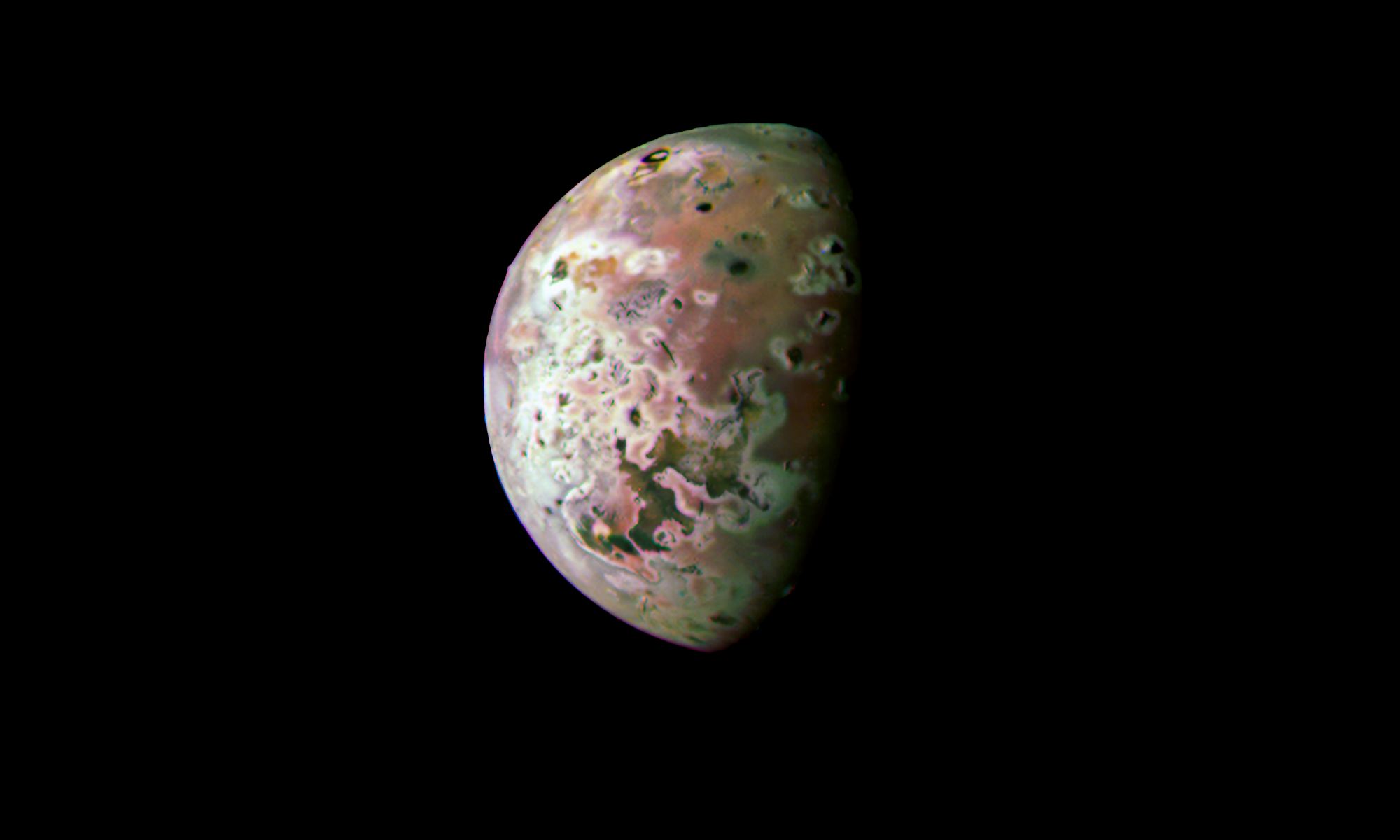
A true colour image of Io’s sunlit limb, imaged by NASA’s Juno spacecraft at the end of July 2023. The image has been subjected to enlargement and clean-up. Credit: NASA/JPL / Thomas Thomopoulos

When it comes to the Galilean moons of Jupiter, we tend to focus a lot of attention on the icy moon of Europa due to the potential of it being home to a subsurface ocean. However, Europa is not alone in being a fascinating place among these four moons; between it and Jupiter sits Io, the most geologically active place in the solar system – and that’s just one of the facts relating to it.

As the 4th largest Moon in the solar system and the third largest of the Jupiter’s Galilean moons, Io is slightly larger than our own Moon and has more than 400 active volcanoes across its surface. In addition, it has both the highest density and strongest surface gravity of any moon in the solar system. Its extreme volcanism is powered by gravitational flexing, the result of Io constantly being pulled in different directions by the gravities of Jupiter and the other three Galilean moons generating tidal heating deep in Io’s core, the same mechanism which is thought give Europa it’s possibly liquid water ocean. but on a much hotter and more violent scale.

Io’s volcanism is such that the almost constant lava flows mean the moon’s surface is constantly being re-formed outside of its volcanic peaks, whilst the allotropes and compounds of sulphur carried to the surface by both eruptions and lava flows give rise to the moon’s unique colouring. In addition, many of the volcanoes pump material high enough above Io to form a strange, tenuous atmosphere, noticeably more dense around such eruptions than elsewhere. This ejecta also gives rise to a large plasma torus around Jupiter.

Juno’s science instruments – click for full size. Credit: NASA / JPL

The Jovian system has been the subject of extensive study by NASA’s Juno mission since it originally arrived in its extended orbit around the planet in July 2016. Since then, the vehicle had made more than 50 complete passes around the planet in a roughly polar orbit, and some of those have periodically allowed the spacecraft to observe the major moons of Jupiter, including Io. Two of the most recent of these flybys – in May and July 2023 – focused on Io, once again revealing the moon is incredible detail.

The May 16th, 2023 flyby brought the Juno spacecraft to just 35,500 km of Io, allowing the imagers on the spacecraft to capture the moon simultaneously in both visible light wavelength and in the infrared, revealing a stunning amount of details on the moon’s volcanism.

In July, Juno passed even closer, at just 22,000 km from the moon’s surface. This allowed an actual eruption to be imaged by the spacecraft – not the first time this has happened, but one which captured Io’s “old faithful” once again in action.
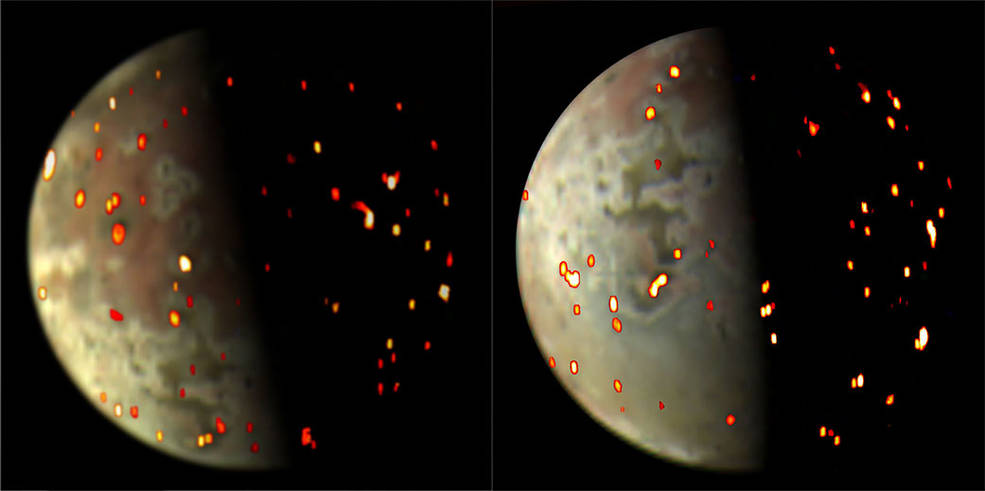
Io as seen by the Juno spacecraft in May 2023 in both natural light, overlaid with and infrared image showing hotspots of volcanic activity. Credit: NASA/JPL

“Old faithful” is the name given to the Prometheus Patera, a volcanic pit on the side of the moon facing away from Jupiter (Io is tidally locked to Jupiter), an area given to near-continuous eruptions which have been observed by both of the Voyager spacecraft, together with  Galileo, and New Horizons, as well as Juno. Outflow from the eruptions in the pit covers an area of almost 7,000 square km, and it causes an observable plume of material rising up to 100 km above the moon’s surface.

What is particularly remarkable about Juno’s images of Io and the other Galilean moons is not only the amount of information they are providing, but the fact the spacecraft wasn’t ever designed to study them; its instruments were specifically designed to uncover secrets of Jupiter’s atmosphere and interior. But as remarkable as these images are, they are just a foretaste of what is to come.

Three more even closer flybys of Io will come in October and December before the spacecraft makes its closest approach of the mission to date, passing just 1,500 km above the Moon’s surface. Meanwhile, to mark Juno’s May and July 2023 flybys, NASA released a video offering a “starship captain’s” view of Io as the spacecraft passed around Jupiter’s limb. The music featured in the video is from Juno to Jupiter, by Vangelis. This was the Greek composer’s last studio album prior to his passing in May 2022, and the last of a series of albums and shorter pieces he wrote for both NASA and ESA between 2001 and 2021 and born of his almost life-long passion for science and space exploration.

Russia Heads Back to the Moon

At 23:10 UTC on August 10th, 2023 (09:10, August 11th, local time) a Soyuz 2.1b/Fregat booster lifted-off from Russia’s far eastern Vostochny Cosmodrome to mark the first lunar mission Russia has undertaken in 47 years. Originally called Luna-Glob, the mission is designed to place a robust lander within the crater Boguslawsky in the lunar South Polar Region.
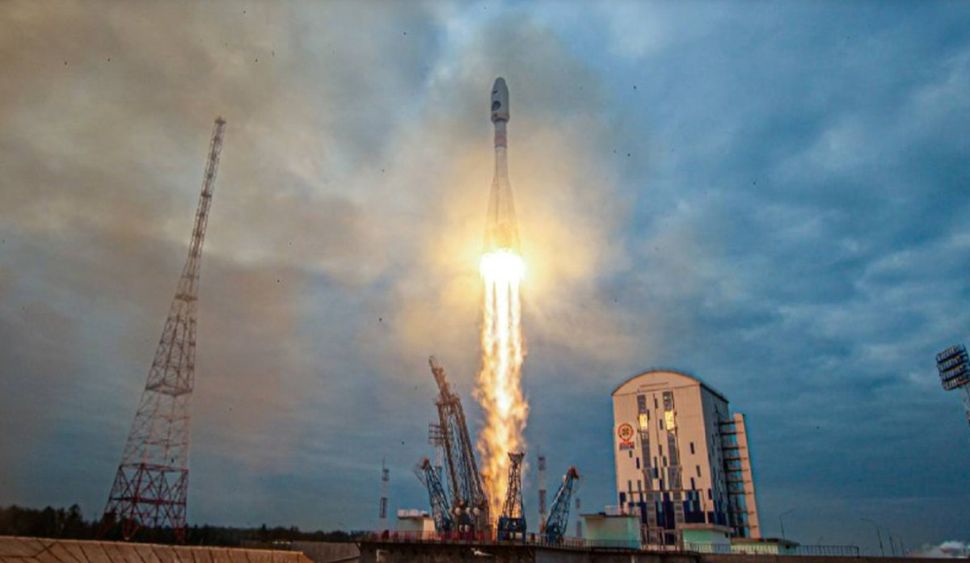
A Soyuz-Fregat rocket lifts off from the Vostochny Cosmodrome, August 10th 2023 (UTC), carrying the Luna 25 mission

Initial concepts for the mission started in 1998, and Russia had planned to garner international involvement, looking to partner with (at various times) the likes of the Indian Space Research Organisation (ISRO), the Japan Aerospace Exploration Agency (JAXA), the European Space Agency and the Swedish National Space Agency (SNSA) and the project gradually matured. However, given the 20+ year gestation for the mission, ISRO and JAXA switched to their own lunar-focused programmes whilst SNSA eventually partnered with China, flying their LINA-XSAN instrument aboard Chang’e 4 in 2019. ESA also withdrew from cooperation with Russia as a result of the invasion of Ukraine.

As a national mission, the project and its lander were renamed Luna 25, intended to suggest a direct lineage back to 1976’s Luna 24 sample return mission. It was launched very much in the public eye: Russia Television broadcast and streamed the event live in a 90-minute programme which featured the launch itself, coupled with a strange mix of a choir of young children singing under a huge photograph of Yuri Gagarin, a candlelit display.
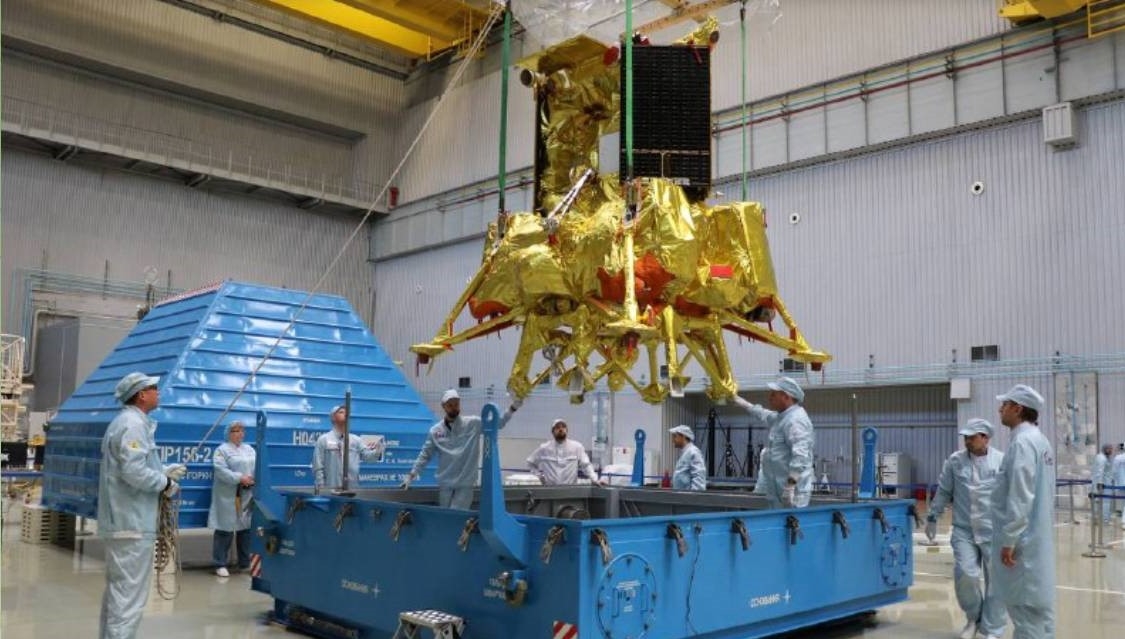
The Luna 25 lander as it is being placed within its shipping container container ready for transfer to the Vostochny Cosmodrome. Credit:  NPO Lavochkin

Filmed at the Exhibition of Achievements of National Economy, Moscow, this portion of the programme also featured interviews with cosmonauts Oleg Artemyev and Oleg Blinov and more music, this time from Russian rock/pop group UMA2RMAN.

The mission is seen as the starting point for Russia’s own renewed lunar aspirations. A prime aim of the spacecraft is to test new landing technologies and systems which could be used in future missions to the Moon, including those by crews – in this respect, Artemyev and Blinov discussed the development of lunar habitats from a small-scale outpost (with artwork supplied by Roscosmos) through to a large-scale base (with a rendering by Russia Television, rather than anything official).

A rendering of a Russian lunar outpost, as seen on Russia Television during the Luna 25 launch. Credit: RT / Roscosmos

As well as lander research, the 1.7-tonne lander will conduct studies of  the upper layer of the lunar regolith, appraise the ultra-thin lunar atmosphere and search for signs of water ice in the south pole region. To achieve this, the upper platform of the lander contains 30 kg of science payload. The landing itself is scheduled for August 21st, 2023, after a spiral cruise out to the Moon, and which means that Luna 25 should touch down some two days ahead of India’s Chanrayaan-3 lander launched in July and which achieved its initial orbit around the Moon on August 6th.

Continue reading “Space Sunday: volcanoes, going to the Moon and a helicopter”

A view through an Azure Window in Second Life

Dwejra, August 2023 – click any image for full size

Malta stands as a small but proud island nation within the Mediterranean Sea. For much of Human history, it’s location roughly in the middle of that sea has made it hugely strategically important across successive civilisations. From the Phoenicians and Carthaginians through the likes of the  Romans and Greeks through to French and British to name but a few, it has been claimed by many and inhabited since around 6000 BCE. Indeed, until 1963, it was home to what were regarded as the oldest free-standing structures on Earth: the Megalithic Temples of Malta, although the title was taken by the structures at Göbekli Tepe, Turkey – a location also featured in SL courtesy of Konrad (Kaiju Kohime) and Saskia Rieko – see A Night Sky with a touch of history in Second Life.

As well as being steeped in history, Malta is also an archipelago of stunning natural beauty and uniqueness – including having its own endemic sub-species of bee (from which its current name name might be in part derived). The coastlines of Malta’s two major islands have a number of captivating bays, cliffs and more – but potentially one of the most engaging (particularly in terms of tourism) lies on Gozo, Malta’s second largest island. It is that of Dwejra, and it is this location Moonstone (Hecatolite) has chosen to reproduce as a public space in Second Life.

Dwejra, August 2023

Moonstone’s Dwejra, however, is not one that portrays the bay as it is, but rather as it was up until March 8th, 2017: the place famous for the the massive and impressive Azure Window, a huge natural arch 28 metres tall, carved into a limestone promontory extending outwards from the island’s coast.

Sadly, both arch and promontory were lost as a result of a particularly violent storm which struck the island in 2017. However, through her work, Moonstone has ensured we can for a time appreciate it in-world in a manner very similar in appearance to how it stood for most of it’s roughly 200-year history, if minus the spray and foam almost always present as a result of the ebb and surge of the tide breaking over remnants of the cave to which it is believed the Window once provided access prior to the entire cave collapsing into the sea to leave the arch standing alone.

Dwejra, August 2023

However, the Azure Window is not the only natural formation for which Dwejra is famous. There is also Qawra, the Inland Sea and its associated Blue Hole dive site just offshore, said to have been one of Jacques Cousteau’s favourite places to dive.

Qawra is a saltwater lagoon marked by a gently shelving shale beach to one side and high limestone cliffs on the other, through which another archway provides passage for seawater, fish and marine life  – and small fishing boats, the lagoon offering a safe harbour from the latter, its beachside area now the home to a small village.

Dwejra, August 2023

The Inland Sea is very much in evidence within Moonstone’s Homestead design, complete with arched tunnel winding through the cliffs to reach the open waters. In addition to these natural sights (and sites!), it includes some of those built by human hands which have become associated with the location. There is the little fishing enclave huddled on the protected shoreline of the Inland Sea whilst behind them on a grassy rise sits a small chapel, perhaps representative of St. Anne’s Chapel – itself famous for being located close to cart tracks connecting Dwejra to Il-Mixta, one of several locations scattered across Gozo which are believed to be the sites of the island’s earliest settlers.

Across the landscape from the church and sitting on another low hill is a house which is perhaps representative of the house from which the area takes its current name (others of which include Doviera and Dueira). Between the house and the village and the chapel the land forms open fields and grazing typical for the region in the – physical world, and  Moonstone has clearly used a line of cliffs to the east and false road tunnel through them to give the impression that were one to pass through the tunnel, they’d find themselves within the greater landscape of Gozo island as a whole.

Dwejra, August 2023

The village is mostly empty building shells (hardly surprising, given this is a homestead region), but for those willing to explore the foot of the cliffs curling away from the Inland Sea and around the house on its west side might find a route up to their flat tops. If you do, and continue your explorations along the rugged back of the cliffs, you’ll doubtless find a couple of adventure activities awaiting in the form of hang-gliding and cliff diving (off the promontory beyond the Azure Window). Also awaiting discovery back down at sea level is a small rock pool typical of many to be found around the islands of Malta. This one is set out for a little quiet sunbathing whilst those fancying a swim ca do so via a buoy bobbing a few metres offshore from the pool’s surrounding ring of rock.

It would have been nice to see the Dwejra Tower featured in this build. Constructed in 1652, it is one of several coastal watchtowers built to keep an eye out for (and warn against) the arrival of raiding corsairs, and it sits atop the cliffs within observation distance of the Inland Sea and the former Azure Window. However, these towers were of a particular design (and Homesteads do have limited Land Capacity to play with as already noted), so finding a design which fits the look and doesn’t gobble LI isn’t going to be easy, so its absence is both easy to forgive and doesn’t, push come to shove, detract in any way from the finished build.

Dwejra, August 2023

In all, Dwejra in Second Life is beautifully realised given the constraints of region size in SL, and more than captures the look and feel of its namesake. Rich in photographic opportunities and offering opportunities for the aforementioned activities, it is a place which should be visited and appreciated by all Second Life explorers.

SLurl Details

  • Dwejra (Love Temptations, rated Moderate)

Art and emotion: Theresa Hermit in Second Life

St Elizabeth’s University Original Campus Gallery: Theresa Hermit

Saturday, July 29th, 2023 saw the opening of an exhibition of photography and art from the physical world by Theresa Hermit at the Original Campus Gallery within St. Elizabeth’s University.

I believe this is the first time I’ve witnessed Theresa’s work, but am unsure as to whether this is her first complete exhibition, or the first to be widely advertised. The term “introducing” is used in the advertising, but I gather from chatting with Pat Wheelwright, Director of Residential Living at St. Elizabeth’s, that Theresa has displayed her work there in the past (she is also both the university’s Art History teacher and current president), but these may have been limited in terms of audience, being only advertised within the university’s membership. Either way, I’m glad to have had the opportunity to witness this exhibition, which offers quite the showcase for Theresa’s multi-faceted artistic talents.

St Elizabeth’s University Original Campus Gallery: Theresa Hermit

In the physical world, Theresa holds a Bachelor of Fines Arts (BFA) degree and has recently completed her Master of Fine Arts (MFA). For those not clear on the difference between these and the Bachelor of Arts (BA) and Master of Arts (MA), the latter two usually centre on the scholarly, academic and critical study, whilst the BFA and MFA centre on professional artistic practice within the chosen field of study. Her work encompasses multiple mediums including watercolour (including gouache), oil, and printmaking, whilst also enjoying drawing and  – as demonstrated in this exhibition – photography, where she also develops her own images as well as taking them.

The latter is located on the ground level of the gallery space – the exhibition covering a total of three floors within the gallery – presenting a fascinating series of black and white photographs, mostly taken at a farm in Connecticut. These show a keen eye for composition whilst the use of black and white film brings a sense of time and age to the buildings, furniture and hardware which is sublime in giving a deeper sense of narrative and history that might otherwise have not been apparent.

St Elizabeth’s University Original Campus Gallery: Theresa Hermit

Within this selection are also images quite fittingly captured at a property once owned by Edward Steichen. He was both a pioneer in the craft of fashion photography and, more particularly in this case, often credited with elevating photography into a recognised art form – and I have little doubt that were he to view the images here, he would embrace them as such.

The middle and upper levels of the gallery  – and the stairways linking them – are host to a selection of Theresa’s paintings covering a range of subjects. In this, and as Theresa herself notes, she is not so much led by the artistic opportunity of something she sees, but by the emotional response she feels towards what she sees. This is perhaps most clearly seen within Darkness Falls, a painting of sunflowers set against a backdrop of smoke / dust, painted as a personal response to the events of September 11th, 2001.

St Elizabeth’s University Original Campus Gallery: Theresa Hermit

Theresa also notes that she eschews “realism” in many of her paintings in favour of her emotions (what she refers to as her work being “representational”), and this further adds a personal depth to her paintings. Again, take GGP Wedding; this is a reflection of the wedding of Theresa’s great-grandparents, taken from a photograph of that event. Within it, the newly weds are shown almost ghostlike; figures and details blurred – a perfect reflection of an event that might be recalled from a time when the eye and mind were too young to capture and imprint all that was seen firmly into memory, allowing the details to become misty over time.

What is also striking about this exhibition are the notes Theresa provides (click the small, wall-mounted signs offered close to the entrances of all three levels of the gallery space). These offer a richness of information, examining the origins of the photographs and paintings, the influences that helped inform their creation, and insights into the approaches she takes to her work. These notes help carry us into Theresa’s creative processes in a very personal way.

St Elizabeth’s University Original Campus Gallery: Theresa Hermit

A genuinely personal, engaging exhibition, and my thanks to Cayla (YumiYukimura) for the invite to visit!

SLurl Details

An aquatic Waterfall Café in Second Life

The Waterfall Café, August 2023

‘Twas off to explore a quarter full region build recently, after SunShine Kukulcan passed a tip suggesting a multi-level setting I’d enjoy exploring – and she was right!

Designed and built by Katie (Katie Luckstone), The Waterfall Café is an engaging setting which, whilst predominantly occupying the sky, captures the richness and beauty of undersea realms, combining them with a sense of fantasy (and a twist of sci-fi in places) to present a location alive with colour and with an engaging sense of life and wonder, all intended to offer a retreat-come-hangout for all those wishing to escape from the “norm” and relax with friends.

At the time of my visit, The Waterfall Café offered five locations open to the public: The Kraken (which is a very good place to start explorations),  Waterfall Café itself, Mystic Café, a a ground level coastal setting, and the Night Train. These are all connected via a teleport system (which also provides access to a non-public – I presume – work area), although it is possible to move between The Kraken and the Waterfall Café on foot, which I’d suggest is worthwhile.

The Waterfall Café, August 2023
As you step into this café, you will be transported to a world of whimsy and wonder. The aquatic theme infuses every aspect of the space, creating a visually stunning and immersive experience. Whether you prefer to sit in the main dining area or explore our secret underwater dining area, you will be surrounded by a mystical atmosphere that is both calming and captivating. As the sun sets, the mood shifts to a more intimate and romantic vibe, perfect for a cosy dinner for two on the night train which adds an extra touch of mystery and adventure.

– The Waterfall Café About Land description

The Kraken is a small lounge area offered in vibrant greens and with turquoise walls suggestive of a cavern below the waves. In keeping with its name, the lounge has a distinct octopi theme – although one not in any way menacing -, although the leaf-like seats set out before the bar offer an interesting elven-like counterpoint. The bar itself is a novel affair: those serving drinks are able to do so whilst relaxing on pool loungers floating on the water flowing outwards from where it falls from the rocks behind the bar (doubtless helping to keep the bottled beverages on the shelves there nicely cool), the bar itself holding said water in check, preventing it from soaking the feet of those occupying the leaf chairs.

Just through the doors of this curiously inviting lounge is a teleport disk connecting with the rest of the location, and a tunnel with water flowing outwards over its stone floor directing feet down to where The Waterfall Café awaits.

The Waterfall Café, August 2023

The end of his tunnel takes the form of a L-shaped passageway, the waters descending from above spreading to form a pool over the paved floor to a depth of a few centimetres, allowing vines and plants to form a floating carpet. Windows line the passageway’s walls, mixing views out to a coral reef with wall-mounted tanks to one side, whilst windows and doorways look inwards toward the rest of Café on the other as tables and chairs – some suspended from the ceiling – long both arms of the passageway present places to sit pass the time.

At the far end of the longer arm of this passageway is a huge watertight door. Swung back against its big hinge, it suggests a secret lying beyond, thus beckoning visitors to step through. But while it does indeed hide a secret, it should not be the immediate focus for explorers. Rather, that lies around halfway along the passage’s length, and the open rectangle of a stone doorway as it provides access to what had at one time been a large vaulted hall.

Lit by the phosphoresce of sea plants and the light of aquariums, the chamber has been split into two levels through the addition of a wooden floor. This leaves the lower level as something of a large entrance hall serving four small rooms and passages leading deeper into the Café. Each of the smaller rooms offers an intimate, private space, lit by water from tanks (or possibly windows to the world outside – you decide!), whilst one of the passages leading the way deeper into the Café passes over a glass panel through which the ocean floor can be seen, together with dolphins swimming by, unconcerned by whatever might be going on above their heads.

The Waterfall Café, August 2023
Aged wooden stairs climb to the added floor above where, under the vaulted ceiling a more open and decidedly sci-fi looking seating area awaits, comfortable armchairs floating serenely under their own power. Aquariums and animated digital murals set into the archways around the room’s side give the impression of it being exposed within the oceans depths, while alongside the stairs climbing up to it, a further doorway provides access to a large viewing area, modelled to look like a cave with one wall again apparently open to the sea – or at least separated from it by an near invisible transparent wall.

Beyond this first hall with its two floors, the Waterfall Café offers more visual delights in the form of multiple chambers of varying sizes and styles. I could potentially wibble on at length about these, but I’ll save you the pain because, frankly, the entire complex really should be witnessed first-hand. Just be sure to take your time in exploring, as these are spaces where careful camming is required in the larger space in order to appreciate the amount of detail they contain, and where there is a wealth of artistic expression on Katie’s part deserving of discovery.

The Waterfall Café, August 2023

One of these inner halls of the Café forms the “official” landing point for the location, providing another of the teleport disks. There are the only (in the case of the Night Train and Mystic Café) or most obvious (in the case of the ground level locations) for getting to see the rest of the location’s public offerings.

Both the Night Train and Mystic Café are much smaller that The Waterfall Café. The former offers an intimate ride through a night-time setting aboard a train carriage comprising its own private dining area and lounge / bedroom, whilst the latter presents a pavilion-like café-bar sitting within an otherworldly garden. It’s a dreamy setting, perhaps only lacking a dance system for those so inclined but which does offer an interesting selection of music (local sounds, not the audio stream), featuring extracts from the soundtrack of Beetlejuice.

Finally – almost – there is the ground-level coastal area. Sitting under a turquoise night sky, it is home to a number of tiki-style cabins with solid walls, all open to the public and the largest of which sits out over the waters, proudly raised on stilts which anchor it to a small rocky outcrop. It’s a romantically-inclined setting suggestive of tropic island paradises – and one that hides a secret. It find it through discovery, you’ll need to backtrack to the big watertight door at The Waterfall Café; but I’ll leave you to discover it in piece.

The Waterfall Café, August 2023

All told, a deeply satisfying visit – and my thanks to SunShine for the pointer!

SLurl Details

(Loveless Unity is rated Moderate)

2023 SL viewer release summaries week #31

Logos representative only and should not be seen as an endorsement / preference / recommendation

Updates from the week through to Sunday, August 6th, 2023

This summary is generally published every Monday, and is a list of SL viewer / client releases (official and TPV) made during the previous week. When reading it, please note:

  • It is based on my Current Viewer Releases Page, a list of all Second Life viewers and clients that are in popular use (and of which I am aware), and which are recognised as adhering to the TPV Policy. This page includes comprehensive links to download pages, blog notes, release notes, etc., as well as links to any / all reviews of specific viewers / clients made within this blog.
  • By its nature, this summary presented here will always be in arrears, please refer to the Current Viewer Release Page for more up-to-date information.
  • Note that for purposes of length, TPV test viewers, preview / beta viewers / nightly builds are generally not recorded in these summaries.

Official LL Viewers

  • Release viewer,  version 6.6.13.580918, formerly the Maintenance T RC viewer, promoted July 14th – No Change.
  • Release channel cohorts (please see my notes on manually installing RC viewer versions if you wish to install any release candidate(s) yourself).
    • No updates.
  • Project viewers:
    • No updates.

Note: The Alternative Viewers page appears to have suffered a hiccup, listing version 6.6.12.579987 as the “Win32+MacOS<10.13” RC viewer.  However:

  • The Win 32  + Pre-MAC OS 10.3 viewer was version 6.6.13.580794, promoted to release status on July 5th, and no subject to further update.
  • 6.6.12.579987  was the version number assigned to the Maintenance S RC viewer (primarily translation updates), originally issued on May 11th, and promoted to de facto release status on May 16th.
  • This entry on the Alternate Viewers page is therefore ignored on my main Viewer Releases Page.

LL Viewer Resources

Third-party Viewers

V6-style

  • No updates.

V1-style

  • Cool Viewer Stable release updated to version 1.30.2.23 on August 5 – release notes.

Mobile / Other Clients

  • No updates.

Additional TPV Resources

Related Links

The art of Raven Arcana in Second Life

Raven’s Eye Gallery

Today I’m shining a spotlight on the art of Raven Arcana, a Second life photographer-artist whose work I’ve seen featured a some ensemble exhibitions, but until June 2023, hadn’t really had the opportunity to focus on her work  in these pages. That was when her themed exhibition Destination Unknown opened at Artsville Galleries – although again, time being what it is, I also didn’t actually get the opportunity to write-up that exhibit at the time of its opening. However, at the time of writing this piece it remains available to visitors for a while longer, and so is touched upon here as well.

Raven’s primary gallery space is located with her own region of Clandestine, which is also dedicated to the Digital Arts Gallery, a collective of SL artists and bloggers. Thus, Raven’s gallery can either be reached directly or via the teleport area available at the DAG event space, which also provides access to other galleries and locations within the region (which are outside the scope of this article). For ease of reference, all SLurls to places specifically mentioned here can be found at the end of this article, rather than also being embedded in the text, per my usual approach.

Raven’s eye Gallery: Raven Arcana

Occupying a 2-storey space set within its own skybox, Raven’s Eye Gallery offers a rich introduction to Raven’s photography for those who might not be familiar with it. At the time of my visit, the lower floor presented a diverse selection of Raven’s landscape work, with all of the images beautifully evocative whilst demonstrating an eye for framing that within some rightly eschews so-called “golden rules” of composition in favour of a broader and more fitting artistic balance.

These are images which also demonstrate Raven’s talent for post-processing and effect, with some finished with photograph-like clarity and others treated to resemble watercolours or oils. A particular attractiveness in some of the latter lay in the way Raven has captured the spirit of the Impressionist and Romance landscape painters, the style and finish selected by Raven for each piece is perfectly matched to its focus and subject.

Raven’s eye Gallery: Raven Arcana

The landscapes continue on the upper floor – which at the time of my visit was only partially laid out – but are mixed with pieces that are more thematically inclined. Future Sunset, for example, would appear to offer a direct link to Destination Unknown, itself a powerful selection of pieces focused on climate change / global warming and the inherent threat they contain to life and civilisation. Meanwhile, When Fiction Becomes Reality presents a powerful commentary on the (predominantly patriarchal) suppression of women’s rights, whilst Biker’s Paradise offers an unapologetic celebration of the freedom and joy to be found travelling the open road.

I’m not sure how much longer Destination Unknown will remain open to the public – my apologies to Raven for not previously covering it in these pages; as such I’d recommend a visit alongside a trip to Raven’s Eye Gallery during August 2023, in the hope you get to see it before the next exhibition replaces it at Artsville. That said, make no mistake, a visit to Raven’s Eye is well worth the time for anyone with an appreciation for art.

Raven’s eye Gallery: Raven Arcana

SLurl Details

Note that Clandestine is rated Adult.
