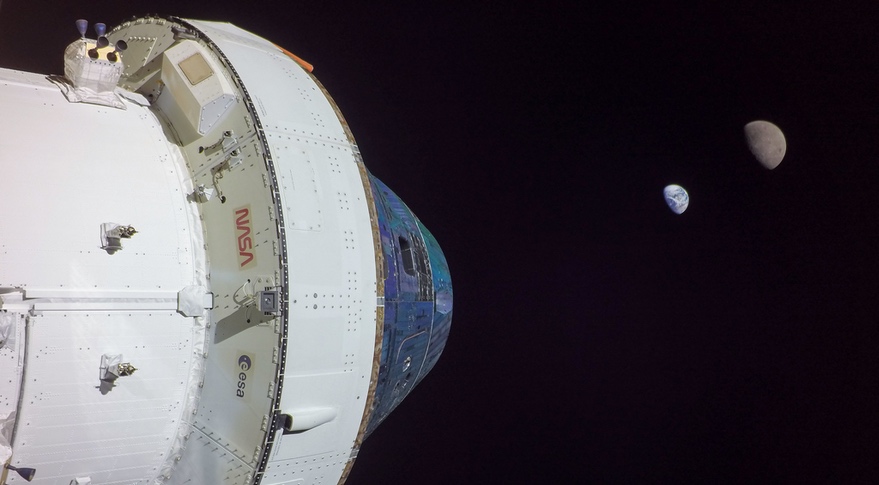
Captured from a camera mounted on one of the service module’s solar arrays, this shot show the Artemis 1 Orion vehicle heading back to the Moon on November 29th, 2022, with both the Moon (44,949 km distant from the vehicle) and Earth (435,230 km from the vehicle) visible. Credit: NASA
NASA’s uncrewed Artemis 1 mission has started its return to Earth. Having reached the furthest distance on November 28th, the vehicle started back towards the Moon as it travels along its distant retrograde orbit (DRO). Along the way it completed a further series of flight tests of both its manoeuvring systems and flights systems, including Callisto, NASA’s voice recognition software (based on Amazon Alexa) designed to assist crews during flight operations.
On Wednesday, November 30th, the vehicle completed the first of three engine burns to start it on it way back to Earth. This was an “orbit maintenance burn” designed to maintain Orion’s trajectory as it headed back to the Moon, and to decrease its velocity, allowing the Moon’s gravity play a greater role in the craft’s trajectory. At 95 seconds, this burn ran for slightly longer than originally planned, allowing mission engineers gather additional data to characterise the impact of the vehicle’s thrusters and their radiative heating on the spacecraft’s solar array wings to help inform Orion’s operational constraints.
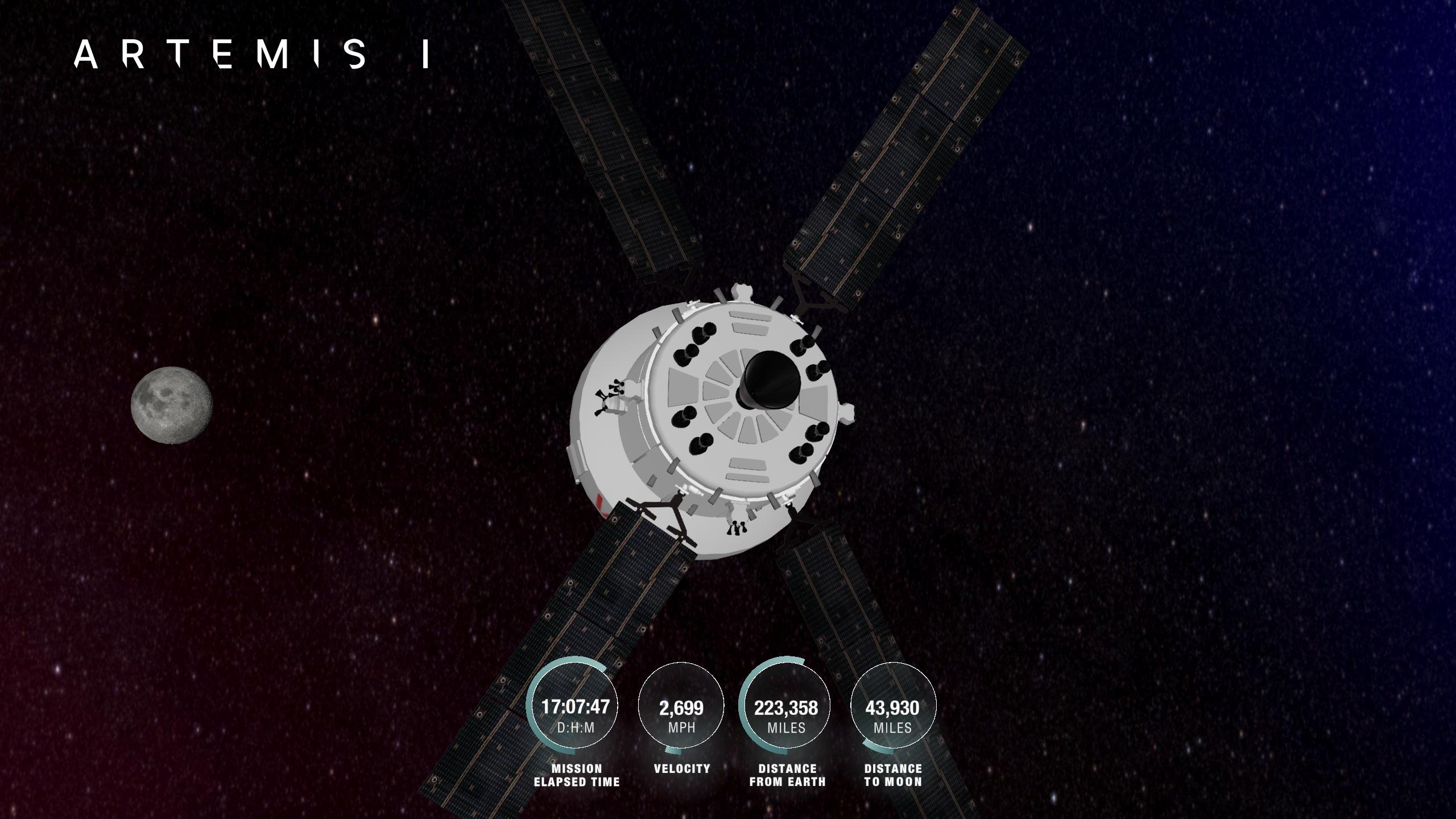
Created using NASA’s AROW – The Artemis Real-time Orbit Website – this image shows a view of the Artemis vehicle as it heads back towards the Moon on November 29th, 2022. Credit: NASA
On Thursday, December 1st, Orion completed the more critical DRO exit burn, slowing it further and “bending” its trajectory so it make a close passage around the Moon, bringing it to 127 km above the lunar surface, a point it will reach on Monday, December 5th.. At this point Orion’s service module will fire its main engine to exit lunar orbit to move into a trans-Earth Injection (TEI) flight path that will see it reach Earth on December 11th, when it will enter the atmosphere for a splashdown in the Pacific Ocean.
As well as testing the flight system, NASA has used the flight back towards the Moon to capture further stunning images and video, with the agency also releasing a high-speed “mission highlights” video covering the mission’s launch and flight to the Moon and into DRO.
JWST and Keck Continue to Reveal Titan
In my previous Space Sunday update, I noted that the James Webb Space Telescope (JWST) has returned to full operations following the correction of an issue with its Mid-Infrared Instrument. The event was marked by the release of images captured by the instrument of Saturn’s largest moon, Titan.
Since then, NASA, the space Telescope Science institute and the Keck observatory have released further stunning images of the moon, these taken with JWST’s Near Infrared Camera (NIRCam).
In the first, two images of the moon are placed side-by-side captured using different filters. They reveal both the lower reaches of the moon’s methane-heavy atmosphere. The second reveals how NIRCam can look through the murk of such an atmosphere to see the surface of the moon. Both images reveal intriguing aspects of the moon.
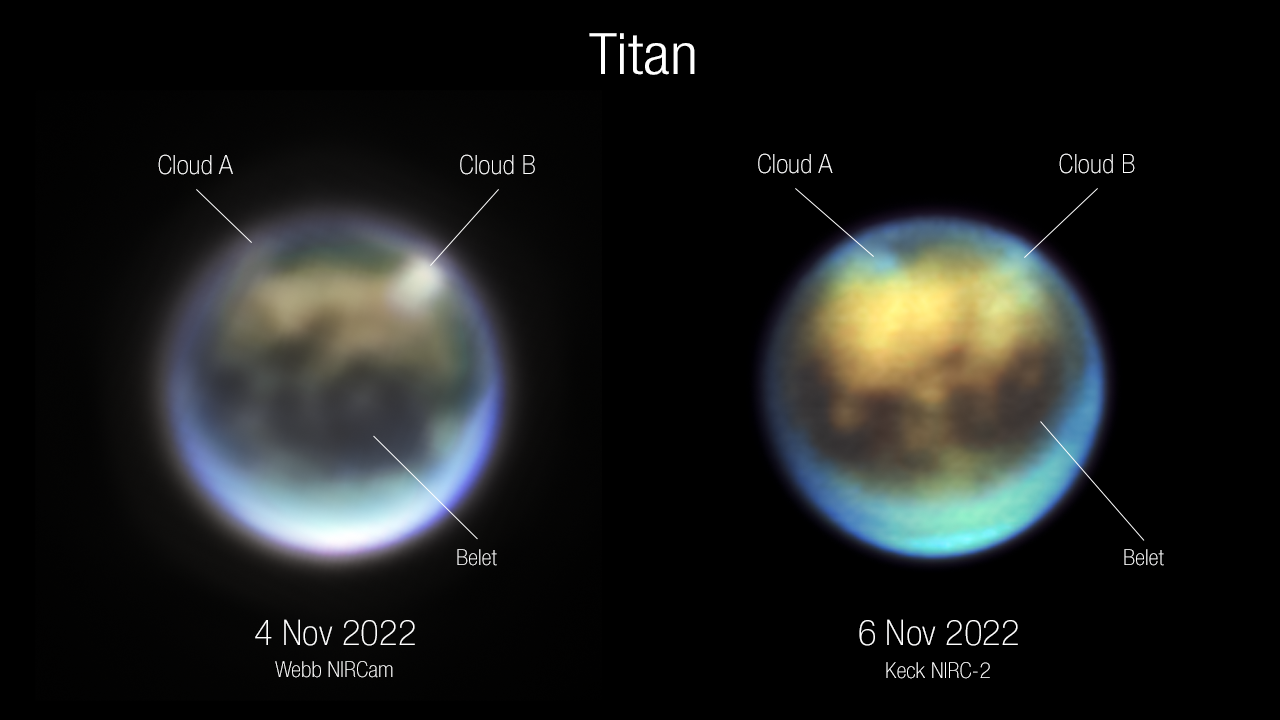
Titan, as images by JWST’s NIRCam, showing (l) the lower atmosphere and (r) the surface. Credit: NASA
On the first, NIRCam reveals two clouds, labelled “A” and “B”, whilst the second reveals some of the known surface details of the moon including Kraken Mare, believed to be a methane / hydrocarbon sea, and above which, intriguingly, “cloud A” had formed, suggesting it might be a weather system. Also imaged was Belet, a range of dark dunes and a bright albedo feature of uncertain nature, called Adiri.
The clouds were of particular interest because they can validate long-held predictions from computer models about Titan’s climate: that clouds would form readily in the mid-northern hemisphere during its late summertime when the surface is warmed by the Sun. Further, observing how the clouds move or change shape might reveal information about the air flow in Titan’s atmosphere.
To this end the JWST team observing Titan contacted colleagues at the Keck Observatory, Hawai’i who were about to start their own infra-red observations of Titan. They agreed to carry out a similar series of observations of the moon to allow for comparative science studies to be carried out.
On the left, the James Webb Space Telescope Nov. 4, 2022, observations of Titan; on the right, Keck Observatory’s view two days later. Credit: NASA / Webb Titan GTO Team and Keck Observatory
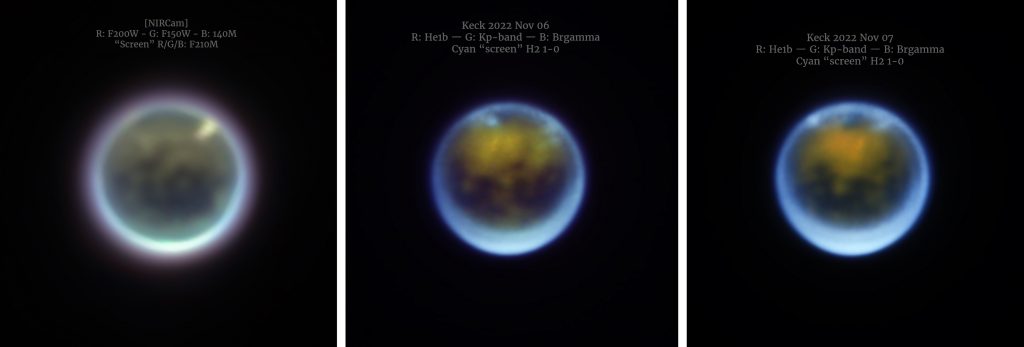
The result is a series of images which appear to show the formation, movement and dissipation of the same cloud formations over the course of several days (November 4th-7th), offering the potential for those promised insights into climate and weather around Titan – although astronomers caution the clouds seen by Keck might be of different origin.
NIRCam isn’t the only JWST instrument which gathered data on Titan during the observation period. The Near-Infrared Spectrograph (NIRSpec) examined the light reflected by Titan’s atmosphere to gather its spectra, which will allow scientists map what compounds are present in the lower atmosphere — including a strange bright spot over the moon’s South Pole, which has been a source of puzzlement for astronomers and planetary scientists.
On the left, the James Webb Space Telescope Nov. 4, 2022, observations of Titan; in the middle, Keck Observatory’s view two days later; on the right Keck’s view Nov. 7, 2022. Credit: NASA / Webb Titan GTO Team and Keck Observatory
China Sets a National Record for Taikonauts in Orbit
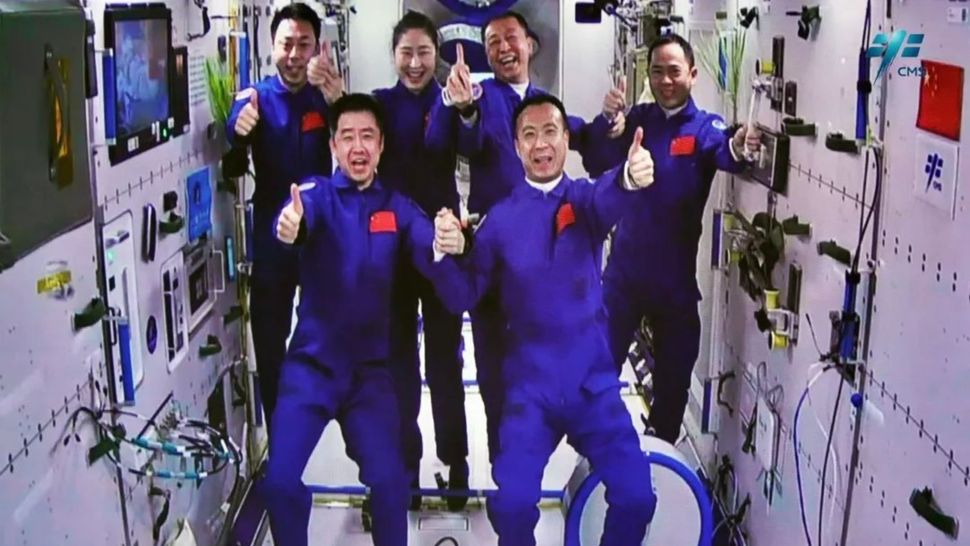
China had six tiakonauts in orbit for the first time this week as the crew of Shenzhou 15 joined their colleagues of the Shenzhou 14 mission aboard the nation’s new space station of a handover of station operations.
Fei Junlong, Deng Qingming and Zhang Lu departed Earth on 29th November 2022 atop a Long March 2F rocket at around 15:08 UTC on November 29th. The vehicle docked with the forward docking port on Tiangong’s docking hub 6.5 hours later. Following the required post-docking checks, the hatches between station and vehicle were undogged and opened a 23:33 UTC, allowing the Shenzhou 14 crew welcome their colleagues onto the station.
The Shenzhou 14 crew and their newly-arrived Shenzhou 15 crew members, November 29th, 2022. Credit: CMSE
The new crew will be aboard the station for 6 months, and after their welcome and a rest period, they joined Shenzhou 14 team is preparing the station for their stay, carrying out a range of small but essential maintenance work using equipment flown to the station aboard the Tianzhou 5 resupply mission in November.
With the hand-over work completed by Sunday December 4th, the Shenzhou 14 crew departed the station aboard their vehicle at 03:01 UTC. Once clear of the station, they performed a series of fast return de-orbit procedures, allowing them to soft-land within the Dongfeng landing area in the Gobi Desert in the Inner Mongolia Autonomous Region nine hours later at 12:00 noon UTC.
Their return marked the most successful crewed mission to date for China, with 180 days spent in orbit, three spacewalks, a space lecture and overseeing multiple tests of the station, the arrival of both the the station’s science modules, the manoeuvring (and eventual undocking) of the Tinazhou 4 automated resupply vehicle and the arrival of Tianzhou 5.
A recovery team as the crew return capsule of Shenzhou 14, after it soft-landed in the Dongfeng landing area in the Gobi Desert. Credit: CMSE
The Shenzhou 15 crew are liable to be even busier. Among their tasks, they will be expected to carry out or monitor over 100 experiments both within the science modules and outside, across the six months of their stay. They will also be carrying out three or four EVAs (spacewalks) which will bring new challenges, including “parallel operations” each taikonaut outside the station working independently to the other, with the crew member aboard the station balancing the needs of both EVA crew. Then are scheduled to return to Earth in May 2023.
SpaceX Starship Update
On November 29th, SpaceX completed a second static fire test on its Super Heavy Booster 7, the booster earmarked to try to carry one of the company’s Staship vehicles to orbit – and once again things did not go as quite as planned.
Lasting 13 seconds, the test was 3 seconds longer that the first static fire test, performed on November 14th, although it involved three fewer engines: 11 compared to the 14 used in the November 14th test. However, like the first test the firing resulted in damage to the orbital launch facility, gouging clunks of concrete from under the base of the launch table, hurling them into the air where they might strike the vehicle or the launch facilities.
As I noted following the November 14th test, the flying debris is the result of both an insufficient sound suppression system (SSS) and provision of a flame deflector. The former is best known for deluging a rocket launch platform with thousands of litres of water in order to absorb the sound of the rocket engines which might otherwise be deflected up against the rocket to damage it. However, it has an additional function: to “drown” the launch platform and the area beneath it to protect them from the searing blast of the engine exhausts at lift-off.
The flame deflector performs a similar role in protecting launch facilities from rocket engines by deflecting the exhaust plumes out and away from the launch stand (and also carrying the excess water (and steam) from the SSS away from both the platform and rocket, further lessening the risk of damage to either. Part of the sound suppression system used by NASA for Space Launch System rockets is shown being tested in the video below. This element protect the concrete base on the launch facility, with water also being directed down the central flame deflector seen within the trench used to channel heat, steam and sound away from the launch platform. A second suppression system (not seen in this video) is built-in to the mobile launch platform itself, to give it the aforementioned protection from the heat of the SLS four main engines and two SRBs at launch.
However, SpaceX has thus far eschewed and flame deflector and has opted for a spray system of water and nitrogen gas delivered through pipes within the circular launch table on which the super Heavy / Starship combination sits. Already upgraded since its initial installation, this system appears adequate in terms of sound suppression, but does not properly protect the concrete apron directly below the rocket engines from their full fury.
Whether this remains the case with all Starship / Super Heavy launch facilities remains to be seen: this first orbital launch facility is very much a prototype. However, the lack of consideration for any form of flame deflection mirrors a similar decision not to initially equip the launch stand with another basic requirement of a launch facility: burn-off igniters which resulted in the July 11, 2022 spin-start test explosion under Booster 7.
Following the November 29th test, two of the booster’s Raptor engines were swapped out at the pad, although it is unclear whether his was the result of damage from the materials flung upwards and outwards from the apron during the test or as a result off other motor issues. After this work had been completed, Booster 7 was disconnected from the launch platform and returned to the production area. This may again be to allow further damage inspections to be carried out, by is likely equally to allow the rest of the booster’s aft skirt to be fitted.
At the same time as Booster 7 has been under test, Ship 24, which is due to be mated to it for the launch attempt, has been undergoing repairs at the sub-orbital launch platform where it has been completing its own series of static fire tests. The results of these tests appear to have been fed back into the assembly of Ships 25 and 26, the next vehicles in the series.
SpaceX has indicated they are still planning a further 20-sec 33-engine Raptor static fire test prior to any launch attempt, which will also include a further autogenous repressurisation test (feeding cooled gasses from the engines back up into the propellant tanks to maintain their pressure as their contents are used). This coupled with the fact that the Federal Aviation Administration has yet to issue a launch license, means that the launch attempt is unlikely to come before 2023.
On Sunday, December 4th, 2022, Bay City will once again be hosting their annual Christmas Tree Lighting and fund-raising event. With it comes an opportunity to support Child’s Play Charity, a 501c3 non-profit organisation offering on-line communities such as the Bay City Alliance the ability to help seriously ill children around the globe during their hospital stays with the purchase of games and gaming equipment.
Activities will commence at 13:00 SLT and run through until 16:00 SLT, taking place at the Bay City fairgrounds. On offer will be:
Live entertainment by performers Evee Blackstar and FrankLee Anatra, and music by DJ GoSpeed Racer.
A skating party around the base of the tree.
The tree lighting itself.
Refreshments and fun.
Funds will be raised via a silent auction that will run through until the close of the event. On offer is an impressive range of items kindly donated by designers and creators from across Second Life. Bids are made via vendor, and should your bid be exceeded by another, your Linden dollars will be automatically refunded. You can, of course, increase your bid if you wish. Items will be awarded to the highest bid when the auction closes.
In addition, donation kiosks are be provided in the Fairgrounds for those who would like to support Child’s Play without participating in the auction.
Bay City Tree Lighting 2022
About Bay City and the Bay City Alliance
Bay City is a mainland community, developed by Linden Lab™ and home to the Bay City Alliance. The Bay City Alliance was founded in 2008 to promote the Bay City regions of Second Life and provide a venue for Bay City Residents and other interested parties to socialize and network. It is now the largest Bay city group, and home to most Residents of Bay City. To find out more, contact Marianne McCann in-world.
Bay City and the Bay City Alliance and Child’s Play
Bay City and the Bay City Alliance have a long history of fund-raising for Child’s Play, and in 2016, they received special recognition by the charity, being awarded Silver Level sponsor on the Child’s Play’s website.
Subcutan Art Gallery: Sophie de Saint Phalle – Cyborgs
Currently open through December 2022 is Cyborgs, an installation by Austrian artist Sophie de Saint Phalle (Perpetua1010) located within her Subcutan Art region At its heart Copper plate etchings and lithographs, although they are framed in a much broader story.
Leave the security and assurance of your spoiled civilization and immerse yourself in the fantastic and futuristic world of Cyborgs and dangerous creatures.
– Cyborgs by Sophie de Saint Phalle
The full story behind the exhibition can be obtained from the information giver board at the landing point. In short, it is the far future and humanity is now an interstellar civilisation. However, it has also faced numerous wars with other civilisations, some of them possibly biological / genetic in nature, so humans have been left weakened and in need of cybernetic enhancement in order to survive, eventually reaching a point where children are conceived in vivo and assigned to full cyborg bodies which define their role in their civilisation.
Subcutan Art Gallery: Sophie de Saint Phalle – Cyborgs
Within the exhibition, the images represent a group of these human-cyborgs now forced to live bound to a single planet, where limited genetic materials are of ever increasing importance, as does the need for these human constructs to express their humanity.
Set within an environment representing the landscape of the planet to which they are confined, the installation comprises two parts: the landing point and events area – the installation opened with 6 hours of music – with the second containing the art itself. when visiting, it is essential you have Advanced Lighting Model enabled (Preferences → Graphics → make sure Advanced Lighting is checked), and preferably use the local environment (World → Environment → make sure Used Shared Environment is checked).
Subcutan Art Gallery: Sophie de Saint Phalle – Cyborgs
Within the art area, the etchings and lithograph are presented mounted on a series of granite-like blocks. At least two copies of each etching is presented, generally on the same block (or a neighbouring block), with each version of an etching given a different finish. They form expressive and very human aspects of life – people at work, people resting from exhaustion, male and female alike. None of them looks particularly “cyborg-like”; rather, but for the title given each piece, these could be studies of fully flesh-and-blood humans.
And it is in this that the power of the art lies: the rich suggestion of largely artificial beings trying to express (or recapture?) their essential humanness through art and carvings; seeking to reconnect with their species heritage and origins.
As well as the images, the landscape includes figurines intended to represent the races which may have forced humanity down this evolutionary path, the creatures they have had to tame – and the artificial bodies into which they have been forced based not on will or desire, but as a result of genetic make-up and algorithms about which they had no knowledge even as the life-forming decisions were being made about their futures.
Subcutan Art Gallery: Sophie de Saint Phalle – Cyborgs
Sophie’s work is always evocative and captivating, and Cyborgs offers a further dimension to her work displayed in Second Life, whether you opt to view the pieces as etchings in their own right or within the framework of the installation’s wider narrative. When visiting, do also consider using the teleport disk to visit the other exhibition spaces Sophie has created within her Subcutan arts region (about which you can read about in my January 2022 review).
SLurl Details
Cyborgs, Subcutan Art Gallery (Ocean Island, rated Adult)
Village de Roqueblanche, October 2022 – blog post
The following notes were taken from my audio recording and chat log of the Content Creation User Group (CCUG) meeting held on Thursday, December 1st 2022 at 13:00 SLT. These meetings are chaired by Vir Linden, and their dates and times can be obtained from the SL Public Calendar.
This is a summary of the key topics discussed in the meeting and is not intended to be a full transcript.
Note: unfortunately, my recording software failed at the 50 minute mark of the meeting, so the end of the meeting and the after-meeting discussion were not recorded, so some discussion points are missing from this summary.
Official Viewers Status
Available Viewers
On Friday, December 2nd, the PBR Materials project viewer updated to version 7.0.0.576966 on Friday December 2nd. This viewer will only function on the following Aditi (beta grid) regions: Materials1; Materials Adult and Rumpus Room 1 through 4.
The following reflect the rest of the current official viewers available through Linden Lab.
Release viewer: version 6.6.7.576223 – MFA and TOS hotfix viewer – November 1 – No change.
Performance Floater / Auto-FPS project viewer, version 6.6.8.576737, November 28.
Maintenance P (Preferences, Position and Paste) RC viewer version 6.6.8.576812 on Monday, November 28.
VS 2022 RC viewer, version 6.6.8.576310, issued November 4 – utilises Visual Studio 2022 in the Windows build tool chain.
Project viewers:
Puppetry project viewer, version 6.6.3.575529, issued on October 12.
Love Me Render (LMR) 6 graphics improvements project viewer 6.6.2.573263, July 21.
General Viewer Notes
The Lab is aiming to get the Maintenance P RC viewer promoted to release status before year-end.
glTF Materials and Reflection Probes
Project Summary
To provide support for PBR materials using the core glTF 2.0 specification Section 3.9 and using mikkTSpace tangents, including the ability to have PBR Materials assets which can be applied to surfaces and also traded / sold.
To provide support for reflection probes and cubemap reflections.
The overall goal is to provide as much support for the glTF 2.0 specification as possible.
The project viewer is available via the Alternate Viewers page, but will only work on the following regions on Aditi (the Beta grid): Materials1; Materials Adult and Rumpus Room 1 through 4.
Bugs and regressions continue to be reported via the project viewer on Aditi, and it is now unlikely the project will advance to a release state before early 2023 (end of 2022 always seemed ambitious).
Despite hopes to the contrary, a lot of legacy content is impacted when rendered via the glTF PBR path, largely as a result of using linear alpha blending.
As a result, LL are working on turning to smooth around some of the edge cases without having to introduce a code fork in the viewer between “legacy” alpha handling and PBR alpha handling.
The aim remains to preserve as much of the appearance of legacy content under PBR rendering and reflection probes, without necessarily being slaved to preserving its looks over time. The major exception to this is would be situations where PBR rendering reveals seams between layers.
However, if it proves necessary, an “opt out” button will be provided to switch out of linear alpha blending.
mikkTSpace tangents affect all objects rendered in the PBR viewer. Unfortunately, due to the way mesh data has been stored prior to the PBR viewer, this means that creators wishing to get exactly the same results in their mesh models as they saw in their tool of choice (e.g. blender, etc.) when building their models, they will need to re-upload those models. This might result in a slight increase in the object’s Land Impact, if done.
This does mean, however that all tangents on uploaded meshes will be correctly handled going forward.
Capabilities will change with the PBR viewer: for example, there will be a basic glTF materials editor within the viewer; texture will rotate from a corner, rather than the centre (per the glTF specification extension for texture transforms); the upload will allow for the upload of individual materials from a glTF file.
Bakes on Mesh and Materials
Providing materials support to Bakes on Mesh has been a long-standing request which has been thus far resisted by the Lab on the grounds of the impact it would have on the Bake Service – both in terms of code updates and the potential number of servers used.
However, at the CCUG, Runitai and Vir floated the idea of materials on Bakes on Mesh being added – but only for the PBR rendering path. This would “drastically” cut down on the amount of back-end work required to make materials on BOM possible, and would mean that all avatar wearables would be Materials-capable.
This is not something that has been currently road mapped for implementation at any time by LL, and it would require time and effort to determine a mechanism to manage it, but the support were there for it, it is something that might be considered.
If this work was carried out, it might also pave the way for terrain painting – another popular request.
As PBR Materials is released, it will become the focus for SL going forward; whilst efforts will be made to ensure “pre-PBR” contact continues to look right, whether or not work is put into trying to “pull” legacy materials content into PBR is questionable, simply because the layered complexity of the underpinning code =, the updating / altering of which can result in content breakage.
In Brief
As noted in the summary of the last meeting, there are reports that the PBR project viewer generating some 10% more CPU temperature and 17% more GPU temperature.
LL are working on updates they hope will see any GPU increases return to the levels of the current release viewer.
Issues with CPU temperature are not believed to be related to PBR, but more to general texture rendering, where a couple of errors have crept in and are being actively corrected.
LODs and Land Impact:
Lower value LODs on models. Some creators attempt to “game” Land Impact by having extremely low values as their low-end models, thinking they are “never seen”; unfortunately, these are seen by people running SL on very low-end machines and thus can account for new users feeling SL “looks rubbish due to the official viewer defaulting to a RenderVolumeLODFactor of 1.25.
The RenderVoumeLODFactor setting will be more dynamic be default in the upcoming Performance Floater / Auto FPS viewer, although extremely lower LODs on models should still be avoided.
More broadly, LL is still considering how to better adjust the Land Impact system and the mesh uploader so that creators are not penalised for creating accurate LODs on their models (one of the goals originally stated for project ARCTan).
Linden Lab will be closed over the holiday period from end of business on Friday, December 23rd, 2022 through until start of business on Tuesday, January 3rd, 2023 (except for urgent support cases).
WQNC, December 2022 – click any image for full size
At the start of the year I made a return visit to WQNC, an iteration of the Wo Qui Non Coin region design by Maasya I first visited in September 2021. With the end of 2022 approaching, Shawn Shakespeare suggested I make a return and witness the current version of the setting, which has relocated since my January 2022 visit, and downsized to a Homestead region.
Not that the downsizing makes a difference; Maasya has a talent for creating captivating settings, and whilst this one may well be within a Homestead, that certainly remains true. In fact, I would suggest that it is perhaps a design that speaks closely to her self-described isolationist nature.
WQNC, December 2022
The setting takes the form of an east-west oriented island, a slender finger of rock rising from the surrounding seas, cut almost all the way through by a canyon, the western end of which blocked by a high table of rock, and what would otherwise by the open eastern end partially enclosed by a high-rise apartment building of indeterminate age.
It is at the foot of this high-rise that visitors initially find themselves, standing knee-deep in tidal waters lapping a small beach. This gives the impression of literally having just arrived – whether by boat or by swimming or simple luck on having survived some event, is hard to tell. However, the overall design of the location does suggest some form of apocalyptic upheaval may have taken place.
WQNC, December 2022
A tunnel passes under the foot of the apartment building to provide access to the canyon beyond. A teleport sign is mounted on one wall of this tunnel; at the time of my first visit, this provided access to the skybox, but on my return visit it appeared to have restricted access, as attempting to use it left me floating in the air within the tunnel.
Beyond the tunnel, a path winds through the canyon – a street winding through tall buildings backed against the rock walls of the natural canyon, such that they form their own man-made gorge. Neon and LED lights glow from street lamps and signs on the buildings and signs, some of which are mounted on metal poles to span the width of the road like latter-day Torii gates – much of the signage suggests this island street lies somewhere amidst the string of islands which make up the nation of Japan.
WQNC, December 2022
Follow the path to its western end, and the rock walls close to a narrow stair leading upwards, the bottom end marked by a traditional Torii gate. Ancient-looking lamps (fitted with LED or neon illumination) light the steps as they climb to the western table of rock to where a shrine is guarded by a pair of stone kitsune.
Quite where the power for the lights is coming from is a mystery as this is hardly a bustling thoroughfare; the buildings are heavy in vines, shrubs have claimed ledges and windowsills and also the rooftops – together with the odd tree have claimed. Thus, there is a sense of this strange location having been deserted a long time ago – although quite why is for your own imagination to determine; to me, there is a hint of a global catastrophe having overtaken a city (or the world), leaving this enclosed alley with its cliffs of buildings as the sole survivor of a drowned township.
WQNC, December 2022
The sense of mystery prevalent throughout the setting is added to by the ambient sound system; a distant sound of electronic drumming reverberates through the air, mixing here and there with echoes of music coming from somewhere – including one decidedly season tune. Also mixed in with the hissing crackle of electrical shorts from fallen power lines. Alongside of this is a sense of isolation and separation, as if this might be the last remnant of civilisation.
In this, and as noted above, the setting might be seen as a reflection of Maasya’s nature; her Profile defines her as someone preferring her own company, and perhaps not overly friendly towards strangers. This is something I can actually attest to, having been summarily banned from the region (without much of a prior warning) as a result of standing still for too long whilst taking photos during my visit; so I would advise visitors to keep on the move, just in case!
WQNC, December 2022
Outside of this (while at the same time keeping it in mind), the region is as photogenic and eye-catching as Maasya’s previous builds and well worth witnessing.
November 30th, 2022 saw the opening of the latest arts centre within the broader selection of galleries spaces and art walks making up the Corsica South Coasters, a group which includes the NovaOwl Gallery and the South Corsica Art Trail, both of which I’ve written about in these pages, and CK’s Corner.
The new facility is located on a sky platform and is called – appropriately enough – the Cloud Galleries. It has been created by arts patron Owl Dragonash, and offers 10 galleries spaces available for rent use by artists.
Cloud Galleries: Owl Dragonash
For the opening, se were occupied by:
Elan (Ineffable Mote) – primarily paintings from the physical world at the time of my visit.
Michiel Bechir – Second Life landscapes.
Anna Maria (AnnaMaria Lysette) – avatar studies.
Prins (Skylog) – images from Second Life.
Suzen JueL (JueL Resistance) – physical world art.
Pau (Paula Sieberi) – abstract expressionism.
KayLy (Kayly Iali) – animal and pet paintings from the physical world.
Jaminda Moon (Jaminda) – Second Life landscapes.
Raisa Reimse (RaisaReimse) – Second Life landscapes and images.
Owl Dragonash – Second Life landscapes.
Cloud Galleries: Raisa Reimse
Set within a garden, the gallery units are all built to the same style, offering split-level display space indoors, and a small outdoor display / sitting space to the rear.
Unit rentals are set at L$100 a week for 50 LI. CasperLet rent boxes are located at the rear of each studio, should one be available. General enquiries on availability and other requirements for using the gallery units should be passed to Owl Dragonash.
Cloud Galleries, November 2022
As a part of the broader Corsica South Coasters, Cloud Galleries can form part of a wider visit to locations in the group, and can be enjoyed alongside group music events and activities. Details of the group and everything going on within it can be found on the Corsica South Coasters website.



 Inara Pey: Living in a Modemworld