The caves and caverns of Rosehaven in Second Life

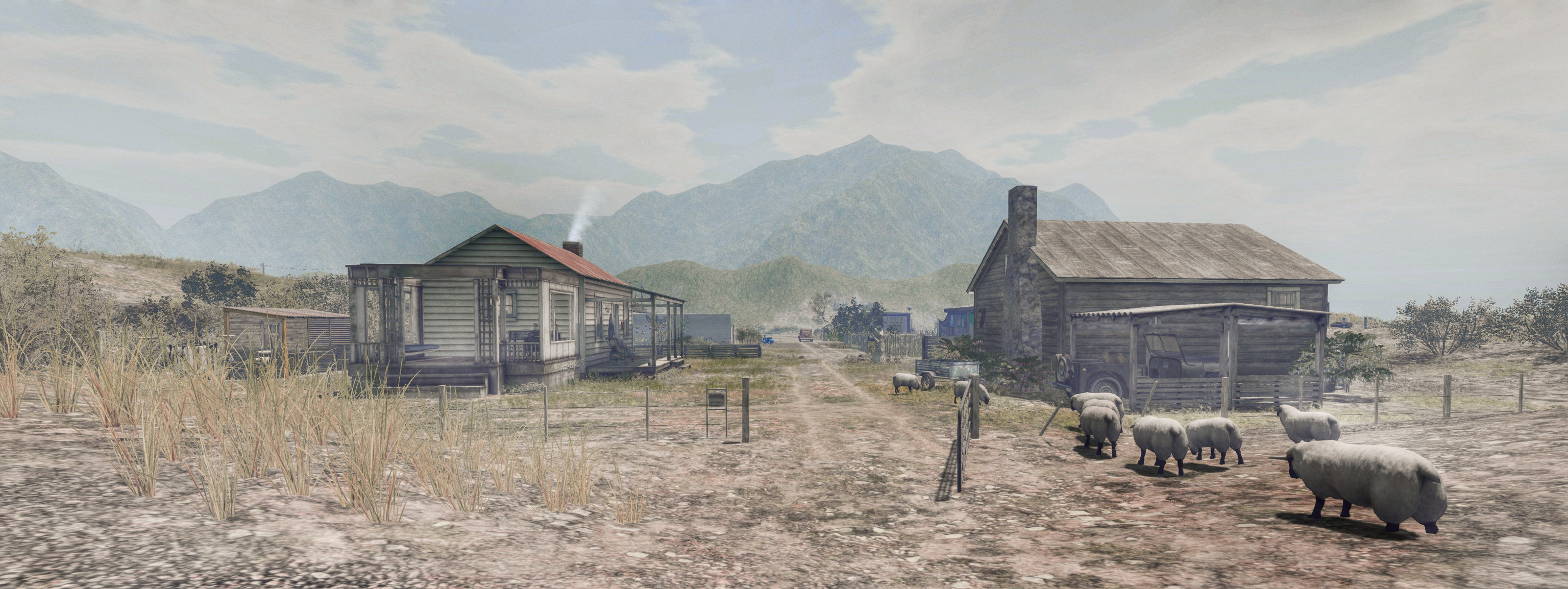
Clair View Ruins and caves, The Realm of Rosehaven, September 2022 – click any image for full size

The Realm of Rosehaven  (operated by SelenaAnansi and Serra Anansi) is one of the oldest fantasy / medieval themed residential and role-play communities in Second Life. Totalling 15 regions, it offers a rich mix of private and public spaces, it is a place with much to see and discover; a place that can be called home by those with a focus on fantasy.

We offer you a place to hang your hat, rest your feet, and let the stress of the outside world fade away in a fantasy British Isles styled setting.  Architecture and themes are inspired by fairy tales, lore, myths, and possibly your dreams.  Medieval and fantasy clothing is welcomed and encouraged; however, there is no set dress code.
Rosehaven is a land of magic and dreams – the living embodiment of imagination and creativity, where humans, elves, fae, shapeshifters, and other creatures can peacefully coexist among the mist-covered lands.

– From the Realm of Rosehaven website

Clair View Ruins and caves, The Realm of Rosehaven, September 2022

I was drawn to the estate after learning about the extensive network of caves, caverns, tunnels and places of mystery and magic which offer the Second Life explorer much to see and – well, explore.

This is a network with many points of entry (and exit!), which exists underground, under the sea and in the air, the various elements linked by an experience which allows for relatively seamless teleport movement between locales. Given the multiple points of entry, how and where a traveller may come by the system is a part of the fun of discovery; it might be a case of noticing a shadowed archway between houses and then walking through it, or finding a ladder leading down into the bowels of the earth from the basement of a public building, or even the ornate doors at the foot of a cliff which open at the touch of a hand rather than the utterance of “Mellon!

Clair View Ruins and caves, The Realm of Rosehaven

For the purposes of my explorations, I opted to go the easy way – via the entrance below the Temple of the Oracle at Clair View Ruins (designed by designed by Snow Kelley). Step through the stained glass of the portal, and your voyage begins at the Cavern of Inner Wisdom; pay attention to local chat for a clue on how to proceed – but before you do move onwards, take the time to explore the halls built within the cavern. And when you are ready to travel onwards, don’t be fooled when confronted by an apparent blank face of rock after following the Cavern’s whispered instructions.

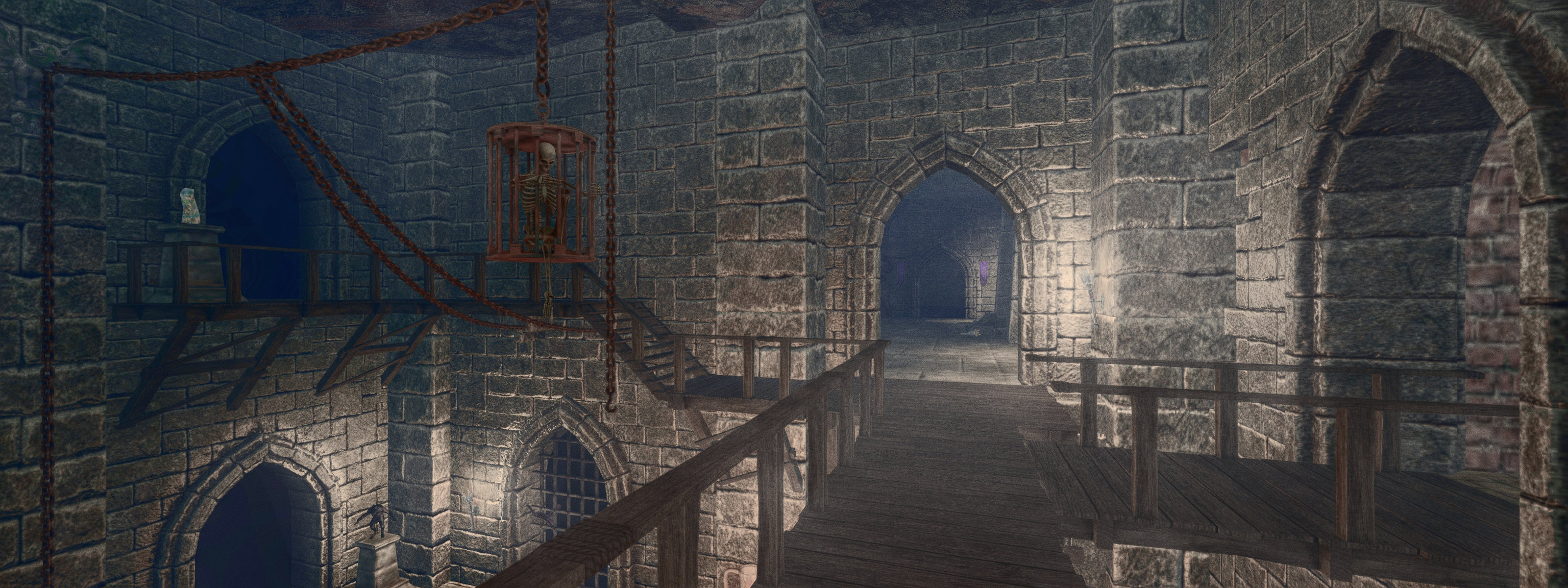
Beyond this first cavern lies an underground fortification, a place of hewn and shaped stone walls, where broad stairways of wood and stone connect different levels and long halls and shadowed arches hint at further destinations. Designed and built by Talus Ravenheart, it sits as a kind of hub with multiple opportunities of onwards exploration. But again, before stepping through any of the archways, take a moment to explore the passages also offered, because again there are places here to be discovered: catacombs with the memory of one passed, a broken wall leading to natural caves beyond which in turn lead to further secrets and spaces awaiting discovery.

Clair View Ruins and caves, The Realm of Rosehaven, September 2022

Such is the nature of this “hub” (for want of a better term), that describing what might come next is impossible, thanks to the multiplicity of options for onward travel available. And even if there were a proscribed route, providing a blow-by blow description of what might be found would spoil the experience of exploring the cave and caverns for yourself. Suffice it to say that as you select arches and routes and shaded tunnels, so might you find yourself in the abode of a practitioner of magic or the hideaway of pirates or tunnels adorned with crystals, leading the way to elven halls – or more besides; each one designed by one or more of the residents of Rosehaven, and thus given an individual flavour.

Along the way it is possible to come across interactive elements in various places and rooms as well – so should you find yourself in, say, a cellar where grapes are pressed into wine (to name but one) – be sure to mouse-over anything that looks like it might not actually fit with the rest of the room / cavern. Also, given that any route might lead you to an alley or dungeon or gateway or stairs leading to the world beyond the caves, the tunnels offer a unique means for discovering and exploring public spaces within the broader Realm; just remember that teleports into the network may not always be a portal or hidden in shadow; some might lie behind an innocent-looking door…

Clair View Ruins and caves, The Realm of Rosehaven, September 2022

Whether used for exploration or for role-lay, the caves of Rosehaven add a further dimension to this engaging community, and are more than worth a visit.

SLurl Details and Links

Art and allegories in Second Life

The Vordun: Allegories of Artemisia, September 2022

Recently opened at The Vordun Museum and Gallery, operated and curated by Jake Vordun, is a stunning exhibition of art from the physical world offering a celebration and exploration of the life and work of Artemisia Gentileschi (1593-1656) also known as Artemisia Lomi), one of the most accomplished artists of the Baroque period, (c. 1625-1740).

Born in Rome on the 8th July, 1593, the eldest child Prudenzia di Ottaviano Montoni and noted Tuscan artist Orazio Gentileschi, Artemisia took up art at an early age, and was producing professional works by the age of fifteen. Like her father, she followed the innovations set by Caravaggio – such as the use of real models – whilst also developing a natural eye for the use of the brush and in the mixing of paint and use of colour to depict the female figure with a naturalism which extended beyond the more idealistic approach of her male peers.

Artemisia Gentileschi: Self-Portrait as the Allegory of Painting, 1638–39. Via: wikipedia

Initially regarded more out of curiosity than in recognition of her skills – she came to wider public knolwedge as a result of the trial of artist Agostino Tassi, who raped her when she was 18 – by the time she was in her early twenties, she had become the first woman accepted into the  Academy of the Arts of Drawing in Florence.  As her work gained a broader audience, so to did her career flourish through patronage and hard work, her art carrying her from Florence back to Rome, thence to Naples – and even to England and the court of King Charles I.

As well as its depth of realism, her work is notable for its focus on women from myths, allegories, and the Bible, with many featuring herself as one of – if not the – protagonists. Her art eschews the more accepted view of the female form – that of a gentle, sensitive, vulnerable creature – to instead present women as figures of power, strength, and the equal of men.

The exhibition at The Vordun – entitled Allegories of Artemisia – is an extensive look at Artemisia’s work offering one of the most unique gatherings of reproductions of her art to been seen outside of the printed page.  A collaborative display by Jake Vordun (producer), Marina Münter (vivresavie) – curator; Paul Gils (ObertonX) – research assistant; and Cibele Cibernética (profetadigital) – graphics designer, it is a multi-room exhibit made all the more abosrbing by its non-linear approach to Artemisia’s life and art, one which – in the words of those responsible for the exhibition:

[Traces] a parallel between the the characters she depicted in her paintings and her own life, the visitor gets the chance to experience real scale works by her and artists from the same period, given the chance to analyse visually the aspect of her work.

From the introduction of Allegories of Artemisia

The Vordun: Allegories of Artemisia, September 2022: Judith Beheading Holofernes (left: Caravaggio, c.1599; centre: Artemisia Gentileschi, c. 1614-20; right: Artemisia Gentileschi, c.  1612-13)

On accessing the exhibition from the gallery’s main hall, vistors should follow the route through the opening to the right. This takes a route through a series of rooms, starting with a general introduction to Artemisia Gentileschi, followed by a series of self-portraits that help into introduce both the artist and the artistic tradition of a painter focusing on a subject more than once during their career.

From here, further rooms offer reproductions of some of Artemisia’s more noted works drawn from biblical stories (including from deuterocanonical books of the Old Testament), together with reproductions of the same subject by her male contemporaries – thus providing that opportunity to directly compare the work of Artemisia with her contemporaries, and appreciate both the uniqueness of her depiction of female characters and the depth of naturalism found within her work.

Wall text in each room help contextualise the subjects of the paintings and also to provide historical / biographical information (such as on Artemisia herself or her father) where relevant. This set of rooms culminate in a three-part section dealing with the deuterocanonical character of Judith which include both Judith Beheading Holofernes and Judith and Her Maidservant. This in itself is an exquisitely framed and presented series of images – some of them the most famous of the Baroque period – forming an exhibition-within-an-exhibition.

The Vordun: Allegories of Artemisia, September 2022

Beyond these initial rooms lies a large hall that brings together further pairings and small groups of paintings by Artemisia and other artists of her period (one of which includes a piece by one of her few female contemporaries – Elizabetta Sirani), and well as individual pieces by Artemisia. This is bracketed to one side by two further “themed” sub-sections entitled Church Commissions and Mary Magdalene.

Throughout the exhibition there is a wealth of information carefully brought together by the organisers. Each painting is presented with a plaque supplying the title of the piece, the name of the artist, the approximate time in which it was painted, and where it resides today. In  typical Vordun style, these plaques can be clicked to display their information in local chat. Meanwhile, the main hall includes a timeline of Artemisia’s life, defined in terms of the recognised periods of her work as an artist, and the notable events within them, together with a small display of works by other artists and inspired by her work and life.

The Vordun: Allegories of Artemisia, September 2022

Since its inception, the Vordun has presented a series of long-duration, richly immersive exhibitions that seek to replicate the experience gained within a physical world museum, whilst presenting exhibits which either cannot be reproduced in the physical world or, if they do have something of a  physical world analogue, are far more accessible than their counterpart might be. All of this makes The Vordun an engaging visit, and Allegories of Artemisia adds to this enormously.

When visiting The Vordun, do be sure to accept the local experience and specifically for Allegories of Artemisia, make sure your viewer is set to Used Shared Environment.

SLurl Details

2022 week #37: CCUG meeting summary – updated

Endless: Birdlings Flat, July 2022 – blog post

Update, September 19th, 2022: in response to the discussion concerning the upcoming mesh new starter avatars and encouraging creators to help develop an ecosystem of clothing and accessories for them (see In Brief, below), Alexa Linden forwarded the following comment to me:

Linden Lab plans to release devkits for our new Default Avatars after we’ve gone live with them. We’re waiting to make sure everything goes smoothly and no tweaks are needed. Once we’re happy with the results we’ll work on the documentation and devkits to make them available for ALL creators interested in supporting these avatars.

Alexa Linden, Septmber 19th, 2022


The following notes were taken from  my audio recording and chat log of the Content Creation User Group (CCUG) meeting held on Thursday, September 15th 2022 at 13:00 SLT. These meetings are chaired by Vir Linden, and their dates and times can be obtained from the SL Public Calendar.

This is a summary of the key topics discussed in the meeting and is not intended to be a full transcript.

Official Viewers Status

  • Release viewer: version 6.6.4.575022 – hotfix for Crash at ~LLModalDialog() – promoted September 15 – NEW.
  • Release channel cohorts (please see my notes on manually installing RC viewer versions if you wish to install any release candidate(s) yourself).
    • Maintenance P (Preferences, Position and Paste) RC viewer version 6.6.4.574750, issued September 6.
    • Maintenance 3 RC viewer, version 6.6.4.574727, September 1.
  • Project viewers:
    • Puppetry project viewer, version 6.6.3.574545,  issued on August 30.
    • Love Me Render (LMR) 6 graphics improvements project viewer 6.6.2.573263, July 21.
    • Performance Floater project viewer, version 6.5.4.571296, May 10.

Materials and PBR Work

Please also see previous CCUG meeting summaries for further background on this project.

  • Tangent spaces:
    • The glTF 2.0 standards are very specific about where tangent spaces are expected to be and behave. To this end, Second Life will use mikkTSpace tangents at least for PBR support.
    • There are internal discussions going on at the Lab as to whether this should be retroactively applied to existing meshes. If this is the case, meshes will have to be re-uploaded in order to have the correct tangents, do to the way bounding boxes are currently handled (the DA upload changes the coordinate frame of the original mesh, resulting in tangents being generated which do not match the normal map).
    • As it is, use of mikkTSpace tangents does increase Land Impact (LI), as the tangents are being stored inside the mesh alongside the normal information.  However, LL are currently running experiments to see if the tangents can be generated and stored without altering LI.
    • Until it is shown whether or not these experiments work, LL is requesting holding off on discussions about possible LI increases until they know what the likely scenarios is.
    • Alongside of mikkTSpace, this project will use per pixel binormal generation.
  • There is a mismatch between the colour space handling swatch in the viewer’s material’s editor and the glTF specification; the latter all calls for these colours to be in liner space, and in the viewer they are in SRGB space. This means that the values displayed by the swatch does not match the values which would be typed into a tool like substance Painter. It’s not currently clear how this mis-match will be handled.
  • Viewer:
    • Transparency and double-sided materials are now supported in the PBR development viewer.
    • To maintain commonality with the glTF specification, albedo in the PBR viewer is now called base colour.
    • Access to the PBR development server is via the Content Creation Discord channel, and requests to join that channel should be made in person at CCUG meetings. I am no longer able (at LL’s request) to furnish such information.
  • Again, this project is only focused on the materials elements of the glTF 2.0 specification, it does not including glTF mesh model import – although there is potential traction for this be a follow-on project, with the goal of eventually replacing COLLADA support for mesh uploads.
  • Ideally the Graphics team would like to structure work such that elements of the glTF 2.0 specification can be selected and then implemented within Second Life, thus presenting an “extensible” means of support the standard.

Puppetry Update

Please also refer to:

Notes:

  • Jiras from the Lab and users will now be available in the public Jira for ease of reference.
  • Meetings are held on Aditi (the beta grid) at the Castalet region Puppetry Theatre on alternate Thursdays at 13:00 SLT. The next meeting will be on Thursday, September 22nd, 2022.
  • Some users have been looking at using OpenXR  for Puppetry and enjoying some success.

In Brief

  • The New Linden Lab mesh New Starter avatar (see here for more): the project has reached the stage of the Lab (through the LDPW) generating a fixed set of content to support the avatar, which will be made available through the Library.
    • There is – as Patch Linden has indicated – the potential for content creators to be encouraged to support this new body and potentially provide a support ecosystem of clothing and accessories – although this will require a dev kit.
    • It’s been suggested that some existing clothing / accessory creators be invited to help test the new avatar.
    • Mention of the new mesh avatar triggered an extended discussion on the current state (and, for creators) pitfalls of the current multi-body / head marketplace and providing content, content efficiency, etc. As a more philosophical discussion (at this point in time) than a clear set of opportunities for improvements, the discussion largely falls outside of this summary.

Next Meeting

  • Thursday, September 15th, 2022.

Cica’s Pink Fairytale in Second Life

Cica Ghost: Pink Fairytale – September 2022

Every one loves a fairy tale, the opportunity to escape to a world where our imaginations can be exercised, to explore to lands far away, share in adventures and see good triumph. Fairy tales are stories we gain exposure to at an early age, and the four words that so often start them tend to remain with us forever – something English author Sir Philip Nicholas Outram Pullman once noted,  both in terms of the memories hearing the words can evoke and the escape they offer.

This power of fairy tales is the subject of Cica Ghost’s latest region-wide art installation which opened on September 12th. It takes as its foundation that quote from Pullman – an author who has perhaps enjoyed renewed exposure to a public courtesy of the BBC adapting his coming of age, multiverse-spanning trilogy His Dark Materials into a television series.

Cica Ghost: Pink Fairytale – September 2022
Once upon a time lasts forever.

– Sir Philip Pullman

Entitled Pink Fairytale, the setting offers an environment in keeping with its name: a pink landscape beneath a pink sky;  a place where pink flowers and trees climb towards the sky, and where the buildings and features of the setting resemble cakes and edibles topped with icing, and the cups of a carousel appear to be filled with ice-cream or some other delight, marking them as a haven for allowing the child inside to revel.

This is a place populated by animals and characters who in turn suggest stories and tales to the active imagination, where thrones with ears await a king and queen – or perhaps a princes and princess – the jug between them perhaps bringing forth thoughts of magic lamps. Elsewhere a princess can indeed be found, together with an entourage of geese – also often characters found within fairy tales –  and watched over by a elephant which, if not fairy tales, when certainly other famous childhood stories.

Cica Ghost: Pink Fairytale – September 2022

Scattered with little vignettes such as these and complete with Cica’s many places to sit or dance or – in the case of the bubble-burping fumaroles – float. Pink Fairytale is another light and fun installation form a Second Life artist who consistently offers us a reasons to smile. So, should you decide to hop over and experience Cica’s work first hand, do please consider making a donation to help her continue to keep us smiling.

SLurl Details

Linden Lab acquires CasperTech for Second Life

On Wednesday, September 14th, 2022, Linden Lab announced it has acquired CasperTech, the multi-product and service company founded by Casper Warden.

Established around 13 years ago, CasperTech is perhaps most famous for its business support services such as CasperLet (for rentals) and – most particularly – CasperVend, a comprehensive, easy to use networked vending and sales management system for Second Life, together with a number of products from rezzing systems through to security orbs. The company even made a foray into providing an on-line market presence as an alternative to The SL Marketplace, in for the form of PrimBay – a service I looked at back in 2013, and which had been designed for merchant operating in SL and other virtual worlds.

Over the years, CasperVend in particular has proven a reliable service to merchants across Second Life, providing a comprehensive range of in-world point-of-sale and produce redelivery solutions, backed by a tools and capabilities that have made the system indispensable to SL content creators and merchants in the sale of their goods.  It is this service which likely featured largest in the Lab’s decision to acquire CasperTech.

Commenting on the acquisition in the official announcement, Patch Linden stated:

This acquisition will ensure that all of the existing CasperTech services in Second Life will continue to operate without interruption into the foreseeable future, but it also opens up brand new opportunities to vastly improve the experience for our users as our next step in the CasperTech and Second Life journey.  
You can expect to see the same great services that you know and love continue on, with all of the same functionality you enjoy today, but with closer integration into the Second Life ecosystem – and as such, an even more reliable and convenient experience.
We wouldn’t have gone forward with this move if we weren’t absolutely confident that it will be a positive change for all Residents and CasperTech customers.

Understandably, the Lab acquiring a business such as CasperVend is liable to raise concerns among those using the service. To this end, the Lab have opened a forum thread where questions and  / or concerns can be raised, and replies provided directly by the Lab – if you do have questions, either as a user of CasperVend or other CapserTech services and products, please ask your questions there; there is no guarantee questions asked in the comments following this article may not be answered.

In  addition, and broadcast shortly after the announcement, a pre-recorded Lab Gab session was streamed featuring both Patch Linden and Casper Warden,  and it is embedded below.

Links

2022 SUG meetings week #37 summary

Luane’s Underwater World, July 2022 – blog post

The following notes were taken from the Tuesday, September 13th, 2022 Simulator User Group (SUG) meeting. They form a summary of the items discussed and is not intended to be a full transcript. A video of the entire meeting is embedded at the end of the article for those wishing to review the meeting in full – my thanks to Pantera for recording it.

Server Deployments

For the most up-to-date information, please refer to the deployment forum thread.

  • On Tuesday, September 13th, the simhosts on the Main SLS channel were re-started without any deployment, leaving them on simulator version 574550.
  • On Wednesday, September 14th, all simhosts on the RC channels will receive a fix for BUG-232593 “Mesh physics shapes changing unexpectedly when rezzed on a 574611 sim”. This fix should not involve any other changes to the simulator version.
    • In short, there was a change that attempted to correct some bounding box calculations and in a couple cases it would wildly change the mass and centre of gravity.

Available Official Viewers

On Tuesday, September 13th, the Izarra Maintenance RC, version 6.6.4.574885 (dated September 9th) was promoted to de facto release status.

The rest of the current official viewers remain as:

  • Release channel cohorts (please see my notes on manually installing RC viewer versions if you wish to install any release candidate(s) yourself).
    • Maintenance P (Preferences, Position and Paste) RC viewer version 6.6.4.574750, issued September 6.
    • Maintenance 3 RC viewer, version 6.6.4.574727, September 1.
  • Project viewers:
    • Puppetry project viewer, version 6.6.3.574545, issued on August 30.
    • Love Me Render (LMR) 6 graphics improvements project viewer 6.6.2.573263, July 21.
    • Performance Floater project viewer, version 6.5.4.571296, May 10.

In Brief

  • Display names not updating correctly (see this grid status update): this may be related to a back-end server issue, rather than a table update issue, but is apparently still under investigation.
  • A general discussion on scripted access to block lists – although the use case wasn’t clearly explained (e.g. scripted access to one’s own block list – or others of others (and if so why & what about the potential for breach of privacy?)). This is now pending a feature request to clarify.
  • BUG-231802 “Prevent vehicles from entering parcels their riders cannot access”, together with providing a means for a viewer to request all active ban lines within a region – work still pending, and Leviathan Linden (the Linden Formerly Known As Andrew) offer some insights into the complexities of managing parcel ban collisions, which leads to further discussion wound into other topics.
  • BUG-232468 “[Feature Request] llGetObjectLinkKey() – A remote equivalent of llGetLinkKey()” –  may well by in the next-but one (or two) simulator maintenance update.
  • For specifics, please refer to the video below.