Walking The Inner Path in Second Life

Art Korner Gallery: Selen Minotaur – The Inner Path

Update, June 27th, 2022: Art Korner has Closed.

Who looks outside, dreams; who looks inside awakes

Carl Jung, October 1916, Letters, Vol 1, page 33

These are the words Selen Minotaur has chosen to frame her exhibition The Inner Path, which opened within a skybox gallery space at Frank Atisso’s Art Korner Gallery on March 17th 2022.

The quote is from one of a series of letters Jung wrote during correspondence with Fanny Bowditch Katz, an American woman who had suffered a severe breakdown following the death of her father in 1911 (she she was 37 at the time), and who was referred to Jung for treatment in 1912. At the time Jung wrote these words, she had actually ceased direct therapy under his guidance (for which she had travelled from the US to Switzerland in order to receive), but she and Jung continued to correspond in regards to her condition for several years.

Art Korner Gallery: Selen Minotaur – The Inner Path

Over the years these words have become relatively well-known, appearing as they do on posters and pictures of the motivational kind. This is actually a shame, because in reducing Jung’s words to something to be framed and / or hung on a wall, we reduce their essential truth from something to be genuinely explored to a statement we can look at and nod towards sagely in a strokey-chin moment and without ever progressing further towards understanding and moving beyond that affliction.

And what is that affliction? Our increasing inability to really understand who we are by looking within. We are complex beings, each with his or her struggles, hurts, wants, needs, conflicts. At some point, we all have what Jung refers to as a “confrontation with the unconscious” that can leave us lost, vulnerable, uncertain, lonely, depressed, isolated, empty, and more. Indeed it is something that can happen ore than once through our lives – and something increasingly exacerbated in the way we are persistently bombarded by ideas that the path to happiness and peace lay through the acquisition of wealth and things, that we can never truly or fully be happy unless we have X, Y or Z and / or that spirituality can never be achieved unless we conform to this or that doctrine, and so on.

Yet, as Jung knew only too well – thanks to his own experiences in 1913, and which affected him through the next several years, helping to formulate his ideas through self-examination, military service and in trying to help patients like Fanny Bowditch Katz – the genuine path to understanding ourselves, to gaining balance (mental and spiritual)  – lies within ourselves.

Art Korner Gallery: Selen Minotaur – The Inner Path
I realise the under the circumstances you have described you feel the need to see clearly. But your vision will become clear only when you can look into your own heart.
Without, everything seems discordant; only within does it coalesces into unity. Who looks outside, dreams; who looks inside awakes.

Carl Jung, October 1916, Letter, Vol 1, page 33.

Through the seven rooms of The Inner Path, Selen similarly challenges us through images and props and metaphor to look within, to understand what makes us who we are, and undertake a journey of self and release. Starting in greyscale monochrome and progressing through the first hints of tone and hues and finally arriving in full colour, these are images that reflect elements of the journey, the rooms in which they hang additionally presented with sculptures and pieces intended to tip our thinking back and forth, encouraging responses and interpretations rather than presenting outright directions.

Art Korner Gallery: Selen Minotaur – The Inner Path

Some of the symbolism might at first seem easy to grasp: the progression from greyscale to colour reflecting our rise to self-awareness, the presence of yin/yang representing acceptance of the “negatives” and “positives” we possess, and so on. However, things here are far more nuanced, the metaphors more subtle than might at first seem to be the case, as with the words within the first room and the sculpture of the caged figure (the latter, for example juxtapositioning the idea that as long as we look inward, we will remain caged and confused, trapped within self, with the reality of Jung’s words that only through continued navigation of self heart (/soul), can we genuinely start to reach any sense of understanding, balance and release).

The inner path we travel when we look within ourselves is unique to each of us, even if  – should we compare – there are similarities in encounters we each have along the way. As such, just as Selen offers suggestions and uses visual metaphors throughout The Inner Path, and prompts rather than explicitly directs, so I am reluctant to impinge more of my own thinking on all that is offered through this installation.

Instead, I encourage you to go along yourself when free of physical distractions, and walk the halls of The Inner Path with open eyes and mind, giving your inner self a chance to speak as the images and setting prompt. And don’t be surprised if you find yourself passing through the rooms more than once, as this is an installation which, if we allow it, will speak to us constantly.

Art Korner Gallery: Selen Minotaur – The Inner Path

SLurl Details

Serene’s Dyrhólaey in Second Life

Dyrhólaey, March 2022 – click any image for full size

For some reason, my favourite places on Earth seem to be islands. On numerous occasions in these pages I’ve mentioned that facts that I have spent time in Hong Kong both in childhood and as an adult, and that I consider Sri Lanka a kind of “spiritual home”. Another place – vastly different to either of these two – that holds a special attraction for me is Iceland.

Dyrhólaey, March 2022

It’s a place I’ve been fortunate to be able to visit several times, most of them initially spent in and around Reykjavík on arrival before heading north by air to Akureyri (the so-called “Capital of North Iceland” with a spectacular approach to the airport running down the fjord), and thence onwards by road to the Mývatn region and the great volcanic caldera and fissure zone of Krafla (where tours are available of the geothermal power plant as well as out onto the lava landscape that is indescribably stunning). So when Shawn Shakespeare informed me Serene Footman has settled on another part of Iceland for his latest region offering, I had to hop across and take a look.

For his latest 2022 build, Serene has chosen Dyrhólaey (“Door Hill Island”), a place almost directly opposite my stomping ground (so so speak) of Akureyri, being located on Iceland’s southernmost reach of coastline. It’s a part of the island I’ve not personally visited – although it, the village of  Vík í Mýrdal and the area around Katla have been on the list of potential visits for a future return to the island.

Dyrhólaey, March 2022

Dyrhólaey started life around 100,000 years ago as an island resulting from a volcanic eruption. Today, it forms a small promontory sitting between the North Atlantic to the south and the Dyrhólaós estuary to the north. Rising some 120 metres above sea level, it runs eastwards and links to the Reynisfjara, the black sand beach that runs west from the mainland, and which in 1991 was ranked one of the ten most beautiful non-tropical beaches in the world, and in 2021, the 6th best beach in the world.

With views across the beach towards the Reynisdrangar that sit off-shore to the east and inland toward the glacier Mýrdalsjökull and the uplands of Katla, Dyrhólaey is a popular attraction for both tourists and Icelanders alike, being a 2-hour drive from Reykjavík. However, the two things that make it most notable is the sweep of the beautiful – if at time treacherous – Reynisfjara sands, complete with their basalt columns, and the a gigantic black arch of lava standing in the sea that gave the promontory its name.

Dyrhólaey, March 2022

The latter two – the basalt columns and the great arch – are features of Serene’s build, but rather than confining himself to the landscape around Dyrhólaey, he brings together elements from across Iceland (and another from the imagination) to capture the sprit of the island. As  he notes in his own blog post, Iceland has many waterfalls, a good many of which are stunning.

To honour theses waterfalls, Serene includes a set of high falls within the build whilst also mentioning the glorious Svartifoss (“black waterfall”) which lay 140 km east of Dyrhólaey. It’s an apt choice to mention: the falls drop over a set of basalt columns of a similar nature to those at Reynisfjara – columns that have influenced many an Icelandic architects, one of whom built the unmistakable Hallgrímskirkja church in Reykjavík (a building with which I’m very familiar, the bed and breakfast we use during visits being located a short walk away, on the route down to the harbour area.

Dyrhólaey, March 2022

Iceland is a genuinely dramatic country – and one that isn’t the easiest to visualise, not when it comes to trying to fit that drama into the 65,536 square metres and just 5,000 LI available within a Homestead region.

However, from the high cliffs through gathering the black sands of the beach around the base of the cliffs, from the tough grass that makes a good portion of the island’s vegetation to representing its rich diversity of wildfowl and birds – and even the hardy Icelandic ponies – to the off shore rocks that capture the spirit of Reynisdrangar, this is a region that does so admirably. Even the touch of American architectural visualisation inspired by  Alex Hogrefe fits right into the setting; while he may not be a son of Iceland, Hogrefe’s  work is very mush in the style of forward-thinking Icelandic architects.

Once again, a marvellous visualisation by Serene – so be sure to see it while you can!

Related Links

2022 SUG meetings week #12: summary

Sous le ciel de Paris, February 2022 – blog post

The following summary notes were taken from the Tuesday, March 22nd, 2022 Simulator User Group (SUG) meeting. It forms a summary of the items discussed, and a video of the entire meeting is embedded at the end of the article – my thanks to Pantera for recording it.

Server Deployments

There are no planned deployments for week #12,  although all channels will be restarted  – Main on Tuesday, March 22nd, RCs on Wednesday, March 23rd, 2022.

Available Official Viewers

All official viewer pipelines remain as follows:

  • Release viewer: version version 6.5.3.568554 – formerly the Maintenance J&K RC viewer, promoted Monday, February 28 – No Change
  • Release channel cohorts (please see my notes on manually installing RC viewer versions if you wish to install any release candidate(s) yourself).
    • MFA RC viewer, version 6.5.4.569309, issued on March 15.
    • Performance Improvements RC viewer version 6.6.0.569349, dated March 14.
    • Lao-Lao Maintenance RC viewer, version 6.5.4.569191, issued on March 11.
  • Project viewers:
    • Performance Floater project viewer, version 6.4.23.562625, September 2, 2021.
    • Mesh Optimizer project viewer, version 6.5.2.566858, dated January 5, issued after January 10.
    • Legacy Profiles viewer, version 6.4.11.550519, dated October 26, 2020.
    • Copy / Paste viewer, version 6.3.5.533365, dated December 9, 2019.

In Brief

  • BUG-231876 “llRequestSimulatorData() frequently and silently fails” – a fix has been developed for this issue and is currently with QA for testing. If all goes well, the fix should be in an RC update in the next week or two. Leviathan Linden described the issue thus:
The problem was introduced after overhaul to the ScriptDataCache implementation.In short: when the cache was full then pending requests could sometimes be invalidated by a new request. There was not enough distinction between a valid but not yet expired value and a valid but not yet harvested by its request value.
The ScriptDataCache is currently limited to 8192 slots. Not all dataserver functions use it, but yes the only data therein are dataserver requests. Some dataserver requests used to use the cache but have been migrated over the years to use different web services instead of actually hitting the dataservers themselves. the DataServerCache size with my recent fix: only 1024 slots. The size of the cache shouldn’t really matter all that much when it is working correctly. That is… its size is really there to protect the dataservers from overload.
  • Monty Linden is poking at region crossing issues, but no updates.  This sparked further general discussion on region crossings.  Please refer to the video.
  • General discussion about two bugs that occur when the viewer is minimised, but where the simulator should really have authority (and thus the issue not occur):
    • BUG-202856 “Rotating a sitter’s rotation by script does not update their global rotation at the server if the sitter has their viewer minimised.”
    • BUG-230616 “A user’s scripts and attachments do not load in a region if they are teleported while their viewer is minimized. The server shows no attachments, scripts, script memory or timing.”

Firestorm 6.5.3: performance and photos (and more!)

On Monday, March 21st, 2022, the Firestorm team released version 6.5.3 of their viewer.
This is a significant update to Firestorm, containing major new elements aimed at helping to improve viewer performance / the user experience.  As such, these elements for the major focus for the notes below.

As per usual, it also brings Firestorm closer to the current official SL release viewer by including a number of updates and capabilities previously released by LL. Again, from an end-user perspective, one of the most noticeable of this is likely to the incorporation of the 360º snapshot capability,  which is also looked at in detail below.

Also as per usual, Firestorm 6.5.3 includes additional fixes and updates directly from the Firestorm team to also improve the user experience. Not all of these are covered in the notes below, and readers are referred to the official release notes alongside of this article.

Table of Contents

Installation

  • There is no need to perform a clean install with this release if you do not wish to.
  • Do, however, make sure you back-up all your settings safely so you can restore them after installing 6.5.3.

Splash Screen Update

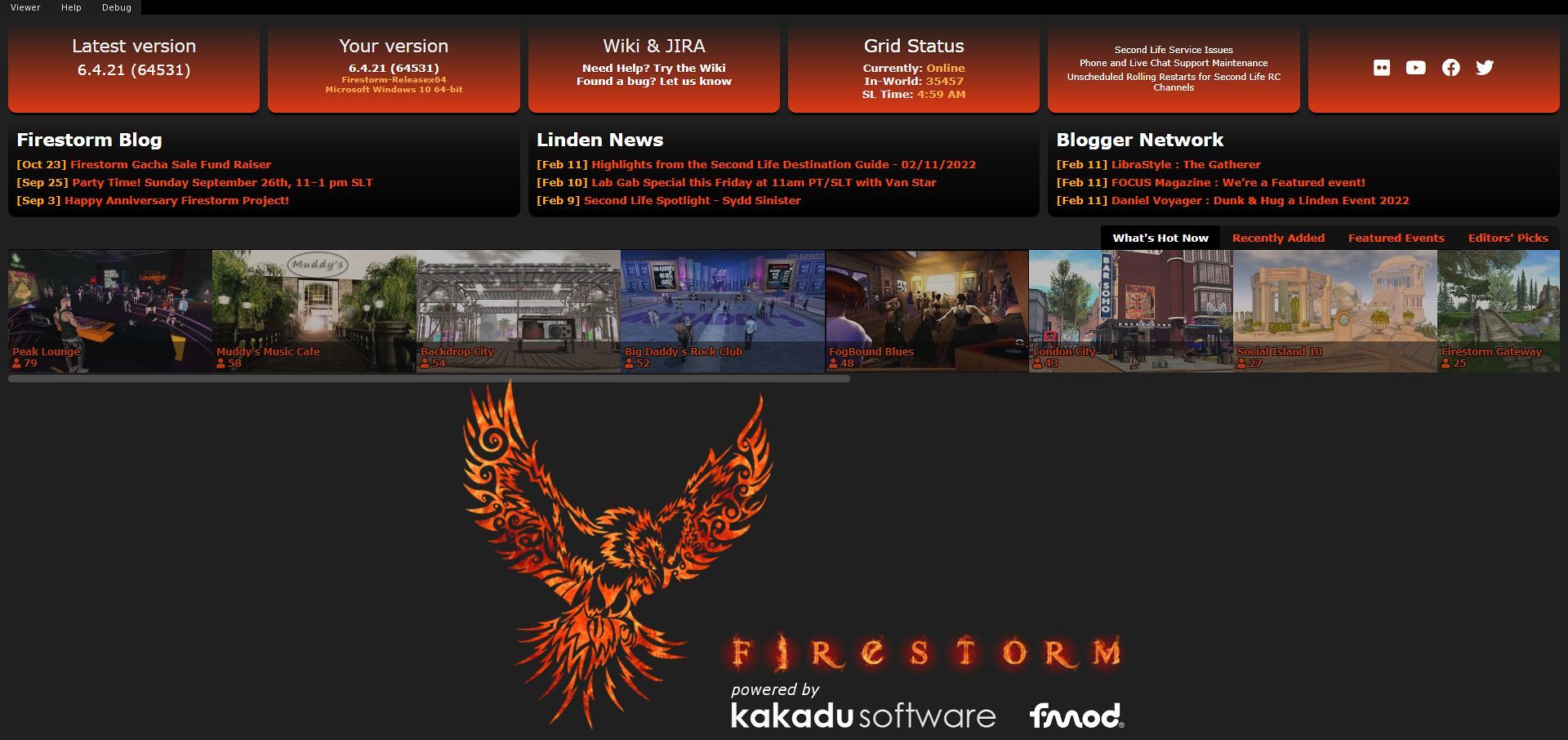
Whilst not strictly part of the 6.5.3 release, having been prototyped with and added to the 6.4.21 release, Firestorm now has a new splash / log-in screen. It incorporates elements familiar to Firestorm users and also to users of viewers that use splash screens more closely modelled on Lab’s own.

In all, the “new” Splash screen can be split into five elements:

  • A set of six panels at the top, four of which are Firestorm-specific (version details, wiki and  Jira links, and on the far right, Firestorm social media links), and two related to official SL information (grid status data and links to information on current grid issues, LL support and grid status updates).
  • A three-panel selection of blog links from the Firestorm blog, the official SL Featured News blog and the SL Blogger’s Network.
  • An expandable scrollable list of currently-popular destinations in Second Life (complete with a count of recent visitors).
    • These are drawn from the What’s Hot Now (default), Recently Added, Featured Events and Editors Picks sections of the Destination Guide (the corresponding links on the right of the panel to select these).
    • Clicking on any of the displayed thumbnails will provide further information on the destination in a pop-up floater, complete with the option to Visit This Destination after logging-in.
  • The Firestorm & associated software logos.
  • The log-in panel at the bottom (unchanged, and not shown below).

The updated Firestorm splash screen (click for full size)
Linden Lab Viewer Parity

This release brings Firestorm up to parity with the official viewer release 6.5.2, and so includes updates seen in the following official viewer releases:

  • Mac Voice hotfix viewer, version 6.5.2.567427, dated January 13th, 2022.
  • Cache + 360º Capture viewer, version 6.5.1.566335, dated December 7th, promoted December 15th – see below for more on the 360º capture.
  • Maintenance RC viewer version 6.5.0.565607, dated November 10th, promoted November 15th, 2021.
  • The Apple Notarisation Fix viewer, version 6.4.23.564172, issued September 24th and promoted October 15th, 2021.
  • CEF update viewer, version 6.4.22.561752, dated July 24th, promoted August 10th, 2021.
  • Fernet Maintenance RC, version 6.4.21.561414, dated July 14th, promoted July 19th,  2021.

More Robust Encryption of Login Credentials

In line with changes from Linden Lab, the way Firestorm encrypts your log-in credentials has been changed  to make it more robust and to reduce the number of times stored passwords will have to be re-entered. The update to the new method is automatic on logging-in to SL for the first time using Firestorm 6.5.3; however, it means that should you switch back to using an older version of Firestorm, you will have to re-enter your credentials.

Note: this update is not in any way related to multi-factor authentication in the viewer, which is currently in RC testing in the official viewer.

360º Snapshots

Linden Lab’s 360º snapshot capability allows you to capture of 360º degree panoramic images of environment around your avatar / camera position (if freecamming). The images are automatically processed by the viewer so that they can be uploaded to most platforms supporting 360º panoramic images (e.g. Flickr, Meta), and for embedding into blogs that support 360º images (such as WordPress).

Within Firestorm, the capability can be accessed in one of three ways (Firestorm have disabled the shortcut option of CTRL-ALT-SHIFT-S, as this combination is bound to opening the viewer’s Debug settings):

  • Via Avatar → 360 Snapshot.
  • By clicking on the links seen in the expanded Preview image view of the Snapshot floater.
  • Via a toolbar button (when enabled in a toolbar area).
The 360º snapshot viewer and two of the means of accessing in – via the the Avatar menu and the toolbar button (must be added to your toolbar)

Taking an image comprises a few simple steps:

  1. Position your camera.
  2. Select the image quality – for finished images you’ll need to set High or Maximum quality using the radio buttons.
  3. Click the Create 360º Image button to generate a preview in the floater’s preview panel.
  4. Click on the preview image and drag it around to ensure what you’re seeing is what you want / that things like textures have actually rendered correctly.
  5. Check the Hide All Avatars option, if required – if not, the process to include all avatars present, which could be blurred if they are moving at the time the image elements are  captured.
  6. When you are satisfied with the preview, click Save As… to save it to your hard drive, renaming it if / as required.

Note: if you change the image quality, you must also click Create 360 button to update the preview AND image capture process to the new image quality, before clicking Save As… once more.

Further information on the capability can be found in the following blog posts :

Improve Graphics Speed (Experimental)

Overview (please read!)

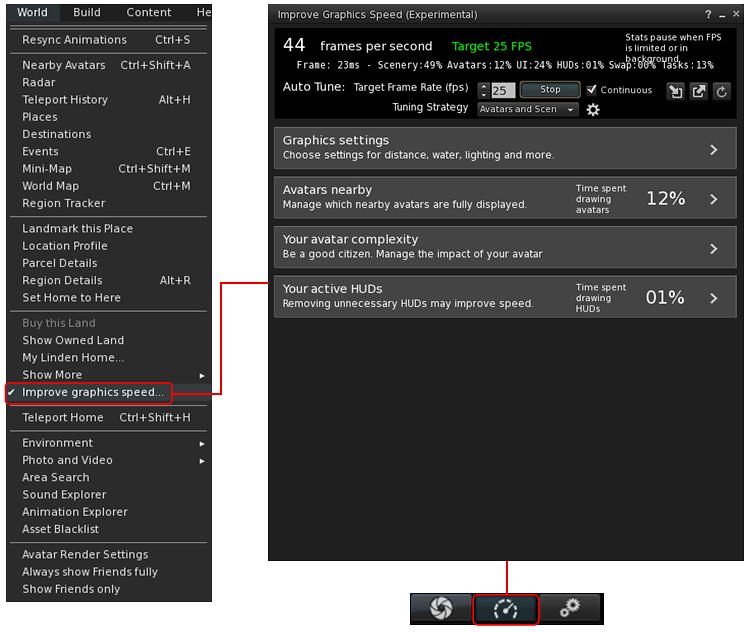
This is a new UI floater Developed by Beq Janus. It brings together a range of viewer graphics options and is intended to help keep you better informed of the viewer’s performance in terms of frame rates, rendering, etc.), and make your own adjustments to suit the environment you’re in. It is also intended to help users be better informed about viewer performance.

The floater comprises three core elements:

  • The Frame / Performance Summary.
  • An Auto Tune Capability.
  • Four additional floater panels that can be used together / individually and independently of Auto Tune. These bring together some of the most commonly-user graphics / rendering options, allowing you to make changes quickly and easily to manually adjust performance, including defining how avatars around you are individually rendered, and lowering to load your own avatar places on both your system and those of the people around you.

This section is intended to provide an overview to the new floater, and offer general notes on the various options and their use. When reading it, please remember:

  • The entire panel – and particularly the Auto Tune capability – is experimental. Options presented may well change over time (such as in reference to LL’s own performance improvement work).
  • While intended to try to optimise the viewer’s performance, please note: these options  will not magically make elderly (e.g. 6+ year old) computers with outdated CPUs / GPUs suddenly zoom along at rates seen with the latest high-end gaming rigs; everything is very much dependent on the capabilities of your hardware.
  • Also, and in respect of Auto Tune:
    • While it will try to maintain your frame rate at the expense of other settings (such as overall graphics quality). So, depending on your system, the frame rate selected, the complexity of the scene, you may find other aspects of your experience suffering.
    • Does not run on Mac M1 systems at present.
  • If you experience particularly awkward results or are unhappy with how the in-world scene looks, you can disable all performance optimisation, and the floater includes the means to quickly load / revert to any Graphics Presets you have previously set-up.

Accessing the Floater

The Improve Graphics Speed floater can be accessed in two ways:

  • Via World → Improve Graphics Speed.
  • Via a toolbar button (when enabled in a toolbar area).
Accessing the Improve Graphics Speed floater

The various options and panel displays are examined in the sections below.

Continue reading “Firestorm 6.5.3: performance and photos (and more!)”

The week with Seanchai Library – March 21st-27th

Seanchai Library

It’s time to highlight another week of storytelling in Voice by the staff and volunteers at the Seanchai Library. As always, all times SLT, and events are held at the Library’s home in Nowhereville, unless otherwise indicated. Note that the schedule below may be subject to change during the week, please refer to the Seanchai Library website for the latest information through the week.

Monday, March 21st, 19:00: When They Saw

Having graduated from the juvenile education system, Ana Mia decides to join her sister as a part of Fort Hope’s Midnight Guard. Fort Hope is a stronghold, protecting its inhabitants from Earth’s alien invaders; and the Midnight Guard forms the eyes, ears and guardians of the stronghold’s Wall.

Without the Guard and without the Wall of the stronghold, the aliens would be free to harvest humanity, using their ships and the Coyotes who form their eyes and ears in opposition to the Midnight Guard.

But now things have changed. Now Ana is something more, as she notes herself:

I never expected to be abducted. But here I am, standing onboard Their ship, facing Them down for the first time in my life, seeing the true face of the Earth’s invaders from another world.
My task is simple: to act as Earth’s emissary and negotiate peace. But it is far more complicated than it seems. I know nothing of politics, and even little of persuasion, but I have no choice. I must do this to keep my friends, and my world, safe. I cannot afford to fail humanity.

Join Gyro Muggins as he reads the second volume of Kody Boye’s When They… saga.

Tuesday, March 22nd

12:00 Noon: Russell Eponym

With music, and poetry in Ceiluradh Glen.

19:00: Haroun and the Sea of Stories

Caledonia Skytower reads the fifth of Salman Rushdie’s major publications and his first since The Satanic Verses. 

Written for the younger reader, but with plenty with it suited to older ears, it is of an allegorical nature and addresses a number of societal problems, particularly those found in the Indian subcontinent.

Dedicated to Rushdie’s son, the book looks at the issues it raises – including that of censorship (unsurprisingly, given the reaction following the publication of The Satanic Verses in 1988) – through the eyes of Haroun Khalifa, the son of a doctor and master storyteller.

Both father and son are struck by afflictions related to Haroun’s mother deserting them; Haroun has a form of attention-deficit disorder, whilst his father is prone to bouts of depression. Both can only be relieved of their afflictions should Haroun’s mother, Soraya, return.

Before then, however, Haroun is set for an adventure and discovery.

Wednesday, March 23rd: Dark

No readings.

Thursday, March 24th 19:00: Thursday Night Science Fiction

With Finn Zeddmore.

Sunday, March 27th: Volume XIV

Seanchai Library Celebrates 14 Years of Stories in Virtual Worlds – check the Seanchai blog for further details.

Purple’s Artistic Dark Paradise in Second Life

Art Street Gallery: Purple Leonis – Dark Paradise

Currently open for viewing at Vally Ericson’s (Valium Lavender’s) Art Street Gallery is a small, engaging exhibition of art by Purple Leonis (Nel4481). Entitled Dark Paradise, it comprises just ten images (more’s the pity, given the gallery space and the beauty of the art), each of which is rich in motif and story, touching on period settings and fantasy.

I have always enjoyed Purple’s work, as she always uses pose, colour, light and setting in her images to communicate with us by painting an entire story within each image. It is an approach Purple uses to both provide single-framed narratives and entire tales spread across multiple images. Within Dark Paradise, she provides a mix of both.

On entering the wing of the gallery where the exhibition is framed, one encounters a trio of images, a couple in formal wear, he standing, she sitting, in a traditional photographic pose oft seen in the early days of photograph, a closer shot of the woman seen in the first image, this time with her eyes covered by what appears to be a jewel-encrusted mask, and the third a woman in red, surrounded by billowing waves of red fabric. All three are in many respects “classic” portraits and might be taken as such.

Art Street Gallery: Purple Leonis – Dark Paradise

From here the images change in tone, becoming more fanciful – and I use this word in terms of “fantasy” – as we progress, introducing magical motifs (mushrooms, ravens); genuine flights of fancy (drifting on a bunch of hand-held balloons), to genuine trips of fantasy (alien creatures, centaurs) and finally a series suggestive of vampires. Thus, we appear to have thematically frame images that exist individually or in smaller groups connected by theme (the couple and the woman in the first two images, the vampire theme in the final three).

However, all ten images are linked in a broader theme: the entire setting suggests that we are within a room within a grand house; the pictures of the walls a mix of family portraits and strangely themed images chosen by whoever live here – perhaps the couple in the first image.

Thus we have something of a sense of the familial here, while the furnishings, colours and fixtures learn into the Gothic in a way, leading us toward the vampiric elements in the final three images, and so we’re gently led into the idea we are perhaps in a dream, an unfolding story, progressing from the first image which (either deliberately or not is down to the artist to say) is called The Beginning, and progressing around the final trio and their darker theme of blood and death / the undead.

Art Street Gallery: Purple Leonis – Dark Paradise

True, some of the images appear out-of-place to theis core vampire idea – floating on a bunch of balloons, centaurs, strange creatures – but how many dreams are entirely linear and without non-sequitur flashes? Plus, look at the tone of the more fantastical images: the centaur is linked to death (and thus the undead), for example, the monster in Cavaliere could be mindful of a vampire in its “true” form as beloved of monster movies) so even these images are perhaps not so far removed from the idea that we are entering the dark paradise of dreams and imagination.

I would have personally preferred to have seen this exhibition continued through more of the gallery space, such is the depth of narrative in the images, but don’t let the brevity put you off; Dark Paradise is a thoroughly engaging pocket exhibition.

SLurl Details