Logos representative only and should not be seen as an endorsement / preference / recommendation
Updates from the week ending Sunday, September 12th
This summary is generally published every Monday, and is a list of SL viewer / client releases (official and TPV) made during the previous week. When reading it, please note:
It is based on my Current Viewer Releases Page, a list of all Second Life viewers and clients that are in popular use (and of which I am aware), and which are recognised as adhering to the TPV Policy. This page includes comprehensive links to download pages, blog notes, release notes, etc., as well as links to any / all reviews of specific viewers / clients made within this blog.
By its nature, this summary presented here will always be in arrears, please refer to the Current Viewer Release Page for more up-to-date information.
Note that for purposes of length, TPV test viewers, preview / beta viewers / nightly builds are generally not recorded in these summaries.
Official LL Viewers
Release viewer: version 6.4.22.561752, formerly the CEF update viewer, dated July 24th, promoted August 10th – No change.
It was back to Dido Haas’ Nitroglobus Roof Gallery for the second time in less than a week, this time to visit Dido’s Space in the gallery (follow the bare footprints on the floor from the landing point to find it), where Greek photographer-artist Mihailsk makes his second appearance in a 3-month period, this time to offer a selection of new pieces under the title Red Sky.
Mihailsk is relatively new to the SL art scene in terms of exhibiting his work – his first such exhibition was actually the July appearance at Nitroglobus mentioned above, which took place in the main gallery space (see: Mihailsk’s Baptism of Fire in Second Life). The smaller Red Sky offers both an expansion on what made that exhibition so attractive whilst also contrasting very strongly with it.
In writing about Baptism of Fire I noted that Mihailsk – Miha to those close to him – produces work that is avatar-focused, but not necessarily avatar-centric. That is, whilst an image may include an avatar and framed in such a way to draw the eye to that avatar, it is the overall composition – pose, expression, surroundings – be they indoors or out – use of lighting and colour, etc., that are as equally as important in telling the story within the image, rather than sitting merely as a backdrop. With Red Sky, this is equally if more more true, with each of the pieces featuring – as the title of the exhibition suggests – a red sky of a deep crimson hue which serves to additionally frame the emotional depth of each image.
Nitroglobus Roof Gallery: Mikailsk – Red Sky
Colour is oft used to define or evoke emotions and emotional responses; we talk in terms of someone “seeing red” when exceptionally angry, or of having a “black mood” or being caught in “the blues”; we believe muted tones and colours help evoke feelings of calmness or help people to relax, and so on. Red is especially evocative, as it generates so many responses / emotions / feelings. As noted here, it is often used to represent the stronger emotions of anger and rage, but at the same time it can also express the more tender – love, compassion, care; it can also express danger, the need to be careful or to keep away and, conversely it can emphasise attractiveness and wanting to attract through its use in the clothes we wear.
In his eight pieces, Miha offers six expressions / emotions with which were are all familiar: love, joy, longing, power, pain and danger, together with two pieces – Balance and Visualisation – that speak to broader themes. Within each image, the red sky / backdrop serves to reflect and enhance the sense of emotion already present through the use of other colours, pose, framing, and overall composition.
It is here that the contrast with Baptism of Fire is most evident: were the images there used darker or muted tones / monochrome shading that coalesced within each piece to express their emotion; here it is the strong contrast between the sky and other colours present – green, yellow, the tones of nature, etc., that frames the emotion. But at the same time, the use of colour / tone / shading in this way offers the same strength of narrative context through both exhibitions.
Nitroglobus Roof Gallery: Mikailsk – Red Sky
Writing in his liner notes for Red Sky, Miha states, “We are a part of the environment around us, not the main theme.” This is again evident through his work seen within this collection: the poses are natural in form, capturing simple gestures, etc., any one of us might naturally make in any situation; thus they are devoid of any sense of intentional construction, but appear as moments of life caught in a blink of a shutter, avatar and setting forming a natural balance. And here too, the crimson skies also play a role, for crimson is oft referenced as the colour of blood, the oil in our machine, so to speak, that keeps us running; thus we are reminded both through the emotional content of these pieces and the use of colour that life is not just about participating in it, it’s about experiencing it to the fullest extent we can.
SpaceX Starbase, Boca Chica, September 7th, 2021: to the left, Booster 4 stands on the launch table, the launch support tower standing over it. To the top right is Starship 20 sitting on sub-orbital pad B, with the lower half of Booster 3 (the upper tank section of which was cut off and removed in August. Credit: RGV Aerial Photography
SpaceX is continuing to move towards a first flight-test ready stack of its massive Super Heavy vehicle and a proof-of-concept Starship payload carrier – although there is still some way still to go before an actual launch attempt can be made.
Following the test stacking of Booster 4 and Starship 20 on the launch table back in August (see Space Sunday: the Ups and Downs of Space Vehicle Development), Booster 4 was rolled back to the production facilities at the company’s Starbase centre at Boca Chica, Texas, to undergo a number of revisions.
Chief among these has been modification to the vent valve system, nominally used to allow excesses gaseous oxygen and methane to be vented from the rocket’s tanks as it naturally “boils off” due to temperature differentials the vehicle experiences when fuelled ahead of a launch. In particular, the vents for the booster’s lower tank now have covers that direct any gas downwards along the rocket’s body, and the vents for the upper tank force the gas outwards and away from the rocket.
Booster 4 re-departs the production facilities at Starbase to drive the 1.5 km down the road to the launch facilities Credit: StarshipGazer.com
This suggests that SpaceX plan to use the release of gas from the tanks as a means to help control the orientation of the rocket during its descent back through the atmosphere in a manner similar to a more traditional reaction control system (RCS). If this proves to be successful, it means SpaceX have further reduced Super Heavy’s mass by avoiding the need for separate RCS systems and tankage.
Another issue with rockets is that as the fuel tanks empty they lose internal pressure, and this can interrupt the steady flow of propellants to the engines. To prevent this, most launch systems utilise a reserve of helium that can be fed into the tanks as the propellants are burnt, maintaining the necessary tank pressure. To remove the mass created by a helium system, SpaceX have opted to use the rarer option of autogenous pressurisation. This draws a small flow of heated propellants before they reach the engines, and feeds this flow – in gaseous form – back up the outside of the rocket via dedicated pipes to be returned to the fuel tanks to re-pressure them.
The new vent systems and the piping of the autogenous pressurisation feeds where clearly visible as Booster 4 was rolled back to the orbital launch facilities on Tuesday, September 7th, and hoisted back onto the launch table, with the speculation iit may remain there until the actual launch attempt.
Two views of Booster 4 showing the revised excess gas vents from the top of the lower tank tank and the autogenous pressurisation feed pipes, Also visible is the black mass of the QD Arm. Credit: What About It
When this will be is unclear; the operation to hoist the booster into position showed the launch table itself is still being completed, being wrapped in scaffolding. It’s also not clear how much of the necessary propellant and electrical feeds have been installed in the launch support tower – although the Quick Disconnect (QD) arm that actually feeds propellants into the starship vehicle and provide it and the booster with electrical power has been installed (with further additions to come). Similarly, the actual tank farm that will supply consumables – water, propellants, etc., – to the pad to enable launches.
Even so, SpaceX CEO Elon Musk has suggested an initial static fire test with Booster 4 could come within the next week. Even if the majority of the required plumbing, etc., is in place, this seems possibly ambitious, given that such a test will likely only come after at least one each of cryogenic propellant loading / pressurisation tests to ensure the system is ready for any static fire test.
How many static fire tests might be run is unclear; its unlikely that SpaceX will want to fire all 29 engines in the first test but will likely build up to it – perhaps starting with the three motors at the centre of vehicle, followed by a firing of all nine of the middle engines before progressing to firing all 29 engines. And it should be remembered any of these tests, from pressurisation through the engine firings, could result in the rocket sustaining damage or even being completely destroyed.
Booster 4 being gently lowered into the launch table ring mount at the Starbase orbital launch pad. Notes the amount of construction scaffolding still in place. Credit: Nic Ansuini / NASASpaceflight.com
After the August stack test, Starship 20 was moved from the the orbital launch pad to sub-orbital launch pad B, where it has been undergoing an extensive examination of its thermal protection system (TPS) designed to protect it during entry into the atmosphere. The tiles on this system appear to have suffered more than the anticipated amount of stress / damage due to it being lifted up onto the booster by its snout in order to be stacked on the booster, requiring a lot of them to be replaced and others refitted / re-aligned. This work is now drawing to a close, but does point to a need for the tile system to be more robust during vehicle moving / operations.
Most recently, the vehicle has been receiving the six Raptor motors that will power it. This has sparked speculation that once this work is complete, Starship 20 could be ready to start its cryogenic and fuel pressurisations tests ahead of static firing test – again, possibly the inner three first, then all six.
How it started and how it is going: two shots indicating the number of Starship 20 heat shield tiles that needed to be completely replaced (red tags) or which required refitting / realigning (green tags) following the operation to stack and remove the vehicle on its booster in August. Credit: NASASpaceflight.com
A final element key to any launch attempt (and the full booster static fire test) is the granting of permission and a licence by the Federal Aviation Administration, which appears to be rightly determined not to be rushed into giving the OK whilst it is still conducting an extensive review of the Starbase facilities and their overall suitability for Super Heavy / starship launches in the event of an accident (particularly after the airborne explosion of SN11in march 2021 resulted in debris falling to earth 8 km from the SpaceX facilities and close to a populated area).
I returned to Bella’s Lullaby in September after hearing from Shawn Shakespeare that region owner Bella (BellaSwan Blackheart) has given her Homestead region a make-over. I was pleased to find that in redesigning the setting, Bella has retained much that made the region so appealing at the time of my first visit in June 2021 (see The Calm of Bellla’s Lullaby in Second Life), most noticeably the feeling of openness and sense of space, which in this iteration is undoubtedly aided by the split between land and water within the region, the latter splitting the former into three islands.
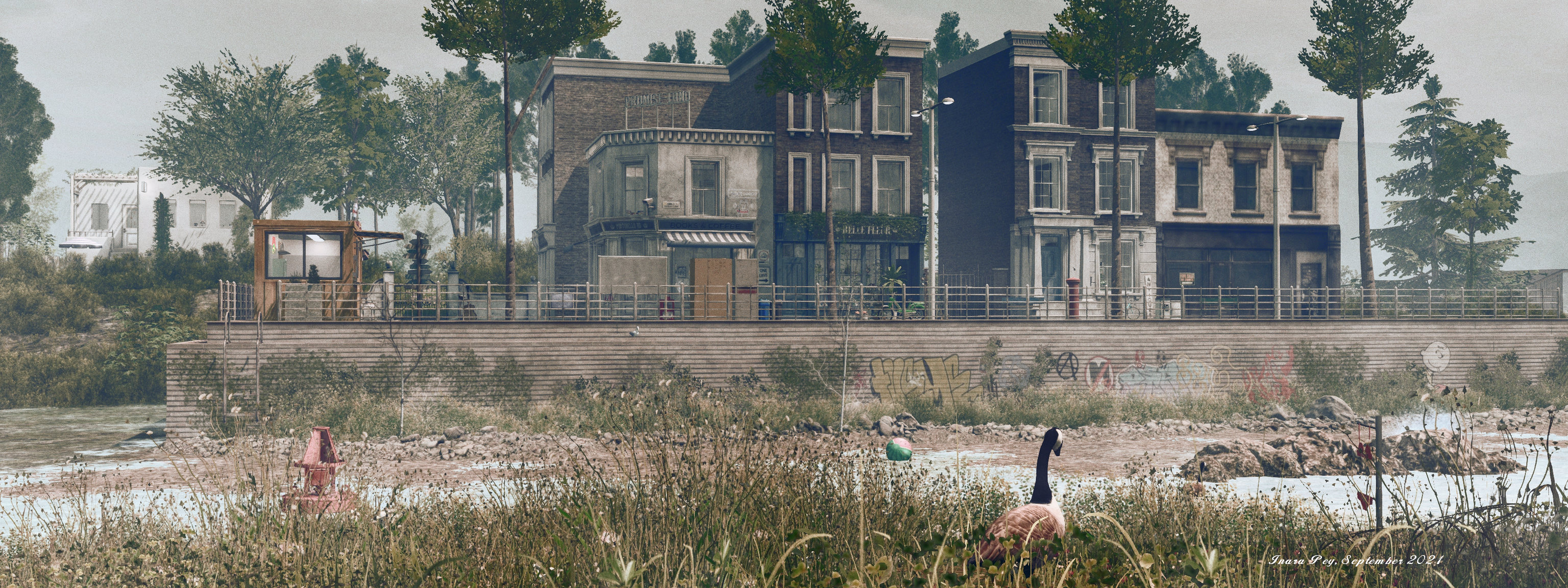
This openness allows for the largest of the three islands to be the home of a small waterfront business district that doesn’t crowd out the region in any way. It sits on a brick-built promontory that extends out over the water to provide a view to the west out over one of the smaller islands as well as being the home of the region’s landing point. All but one of the premises in this little precinct have been outfitted, giving them an added sense of presence, the one that has been left empty (the result of LI limits being reached?) doesn’t look out-of-place, thanks to the clever placement of a For Sale by Owner sign stuck in a window.
Bella’s Lullaby, September 2021
Behind the main parade of shops to the east, and at the end of the little cobbled roadway that leads around them, stand a pair of metal gates those familiar with the previous iteration of Bella’s Lullaby might recognise (one of several items carried forward to this iteration, allowing a visual sense of continuity between the two). These gates provide access to a stony path that rises to a grassy, tree-shaded trail that runs southward behind the main buildings, a friendly This Way sign marking the way, the northern end of the path being marked by an artist’s studio, guarded by a group of vociferous chickens.
A couple of places it sit can be found along the trail, whilst its southern end turns westward once more, providing access to a small cabin overlooking the southern waters, and a long headland. Here, the trees give way to a narrow meadow of wild flowers that offers more places to sit and relax, including a swing close to the water’s edge. Two small children’s windmills turn lazy sails in the breeze, while a little sail boat fashioned out of a piece of broken wood maintains remarkable calm in the face of the breakers close by.
Bella’s Lullaby, September 2021
Watched over by the tall white finger of a lighthouse and with the ghostly sounds of a piano playing, the headland is a restful place in which to spend time, A small deck extends out into the channel here, and the little motorboat sitting alongside it gave me cause to wonder if it could be used to reach the remaining two islands in the group – but no, it instead offers a further place to sit. Instead, the way to the other two islands appears to be a matter of wading / flying (as a landing point is set, an attempt to double-click TP will return you to it).
The central island offers low rise of grass topped by another reminder of the region’s past iteration: a trailer-built refuge that now sits alongside a small and quite spartan hut, the two perhaps set aside for a touch of fishing in the surrounding waters as well as for sunbathing down on the island’s cosy deck (and the cabin includes the essential requirement for fishing or lying in the sun: a cooler stocked with drinks!
Bella’s Lullaby, September 2021
The northern island rises from the water like a green dumpling, a grassy, rocky hump topped by shrubs, a weeping willow and an old chapel, apparently long deserted except for its own piano that will play when touched.
The best way to reach this northern island is via the shallows that sit between it and the north end of the main isle. It looks like a bridge might have once spanned this channel, but for some reason this seems to have been pulled up and dumped over the shrubs of the smaller island to form an overgrown route up to the chapel, watched over by a statue of a mother and her child. Or perhaps this wooden walk is all that remains of what had once been a more substantial link between the two islands; the story is yours to make.
Bella’s Lullaby, September 2021
Finished with a rich sound scape, with multiple opportunities for photography, Bella’s Lullaby remains an engaging visit,
Owl Dragonash is a genuine tour de force in Second Life: she curates art, organises events and artists across various venues; she organises music events (and arranges musicians for exhibitions and the like); she provides PR support to galleries and groups; she has her own blog with a focus on music, art and places to visit, and she brings an incredible amount of energy, shining enthusiasm and dedication to all that she does.
She is, in equal measure to all of the above, a gifted Second Life photographer-artist. It’s therefore a pleasure to be able to write about an exhibition of her own work she is self-hosting at her Hoot Suite Gallery in Bellisseria.
I always find visits to boutique galleries in SL a pleasure, as they offer compact exhibitions one can easily take in and appreciate. In this, Linden Homes of Bellisseria add to this simply because the fact that they are held within a house means they give a relaxed, informal air to exhibitions held within them (and the open “open plan” styles available in the Chalet and Fantasy themes potentially makes their use as exhibition spaces even more attractive).
Hoot Suite Gallery: Owl Dragonash, September 2021
With Owl hosting her own exhibition – simply entitled Owl’s Photos – this sense of relaxation is further enhanced as the visitor wanders from room, simply because it is Owl’s work offered within her own informal space, one of the rooms and the garden lightly furnished, encouraging the sense we’re being invited it to spend a while visiting. The front room of the house has been given a gentle décor of flower that lead the eyes naturally to the single image within it; an image Owl has cleverly framed so as to suggest it is a doorway (or portal) leading to a world awaiting discovery – thus perhaps offering a touch of metaphor to passing through the doorway of the viewer and into the world of Second Life.
This is a portfolio that indicates Owl and I share a common love of images that feature both water in SL and Second Life wildlife. More to the point, however, it is a collection that naturally demonstrates Owl has an eye for capturing a moment in time on her travels, and has developed a deft touch in post-processing her images. In a couple of cases, they also show she is not afraid to experiment with her work (Playing, located in the back garden, and Half Knit on the upper floor), adding to the depth of her work.
As they do cover places Owl has visited in her travels, these are pictures that remind us of the richness and diversity of our world, featuring places such as Bellisseria and Elvion, and which stand as a reminder of places now passed into history (such as Serena Falls and Veneta Silurum), and and personal view of those that endure as timeless, beloved locations, such as AM Radio’s The Far Away, which is featured in a stunningly atmospheric image by Owl.
Hoot Suite Gallery: Owl Dragonash, September 2021
Mixing landscapes and topics that lie close to Owl’s heart, and offering a rich demonstration of her talent as a photographer-artist, Owl’s Photos will remain open through until October 1st, and is a recommended visit.
One Summer / Saltwater, September 2021 – click any image for full size
September has arrived and with it, thoughts in the northern hemisphere are once more turning to the Autumn, a fact reflected in the gradual seasonal change being witnessed across many public regions within Second Life. Given autumnal themes are now on the ascendant in-world, I decided to hop along to a double-header of regions that sit firmly rooted in the tropics and a world of Sun, sand and sea.
One Summer and Saltwater are a part of interconnected Homestead regions that share a continuous theme throughout: that of a group of rocky islands, an archipelago possibly created more by natural water erosion rather than having anything volcanic in their origins (although some of the rock formations making up the islands could easily be seen as having volcanic origins).
One Summer, September 2021
The regions sit in an east-west orientation, a meandering channel of water almost dividing them one from the other. “Almost” because a broad sand bar cuts cross the water at their southern extremes, providing a natural bridge between the two, although it is one that might not always be there. Dotted by shallow pools watched over by pelican and heron alike, all doubtless looking out for any snacks caught within the waters, the causeway has the look of being tidal in nature, and prone to vanishing as the latter returns.
The work of Krys Vita, her SL partner Tre (TreMeldazis), the two regions have individual landing points (which can be found jointly at the end of this article, rather than embedded within it), thus allowing for individual visits. However, to fully appreciate them, I’d suggest making the time to visit them side-by-side. They are also regions where donations are welcome – but not for their upkeep: funds are accepted by RFL kiosks located on the back of the signs for each region, allowing them to support the American Cancer Society’s off-season fund-raising in Second life.
Saltwater, September 2021
Of the two regions, One Summer is probably the easier to explore simply because its various islands (and saltwater swamp, the sandy floor of which also appears to have been exposed by the low tide) are connected by bridges and boardwalks. These provide the means to pass over the waters separating the island and reach the grassy trails winding around and over them and thus reach various points of interest. The latter range from small places to sit and relax through to the large beachfront spa located on the western side of the region.
Across the water / causeway, Saltwater offers a more diverse – if a little harder to get around – setting. Here the islands are fewer in number, and the larger two are somewhat sinuous in nature and without bridges connect them. The waters of Saltwater are also broader in nature – and given the extensive moorings and pier-built workshops, warehouses and café found to the region’s eastern extremes, deeper than those found within One Summer. Certainly, the piers are home to a number of vessels, including a deep keeled sailing boat and sports fishing cruiser, and more sail boats are anchored in a little bay nestled mid-way along the the sinuous island than forms one end of the causeway linking Saltwater to One Summer.
One Summer, September 2021
I didn’t spot any boat rezzers or similar in bouncing and camming around Saltwater (which is not to say they aren’t there; fallible me is fallible me), so getting to / from the southern island and the causeway connecting it to One Summer and the other islands in the Saltwater group appears to be a case of flapping your arms or camming to a convenient chair and sitting in it. However, the island with the region’s landing point is connected to the sand bar east of it by way of a low board walk, and a further board walk connects sand bar to the piers and moorings, thus making exploration on foot and between them possible.
The local environments for the two regions aren’t quite in sync – whilst similar, the Sun does go for a brief walk across several degrees of sky on crossing between them -, and I did find myself bouncing off of the odd plant here and there as well as being able to walk on the water at one point (all in One Summer). But while these elements made for interesting distractions, they didn’t in any way spoil my visit. As seen in the photos here, as well, both regions lend themselves to environment settings other than their own.
Saltwater, September 2021
Finished with a matching sound scape and, as already noted, offering the opportunity to support ACS / RFL of SL, One Summer and Salt Water make for an idyllic tropical visit.
With thanks to Shawn Shakespeare for the nod to Saltwater.





 Inara Pey: Living in a Modemworld