Logos representative only and should not be seen as an endorsement / preference / recommendation
Updates for the week ending Sunday, June 21st
This summary is generally published every Monday, and is a list of SL viewer / client releases (official and TPV) made during the previous week. When reading it, please note:
It is based on my Current Viewer Releases Page, a list of all Second Life viewers and clients that are in popular use (and of which I am aware), and which are recognised as adhering to the TPV Policy. This page includes comprehensive links to download pages, blog notes, release notes, etc., as well as links to any / all reviews of specific viewers / clients made within this blog.
By its nature, this summary presented here will always be in arrears, please refer to the Current Viewer Release Page for more up-to-date information.
Note that for purposes of length, TPV test viewers, preview / beta viewers / nightly builds are generally not recorded in these summaries.
Official LL Viewers
Current Release viewer version 6.4.3.542964,, dated May 29th, promoted June 2nd, formerly the FMOD Studio RC viewer – No Change.
Cascadia, June 2020 – click any image for full size
Zakk Lusch recently invited us to pay a visit to Cascadia, a Homestead region he has designed with the assistance of Lilly Noel and Jimmeh Obolensky. The name appears to be taken from the Cascadia bioregion, a theoretical region / country that, were it to come into existence, would extend down through British Columbia, Washington state and Oregon, and inland potentially as far as Utah, although more modest proposals limit it to the the Cascade Mountains.
In particular, this means the bioregion follows the line of the US / Canadian Pacific Northwest coastline, and it is in the spirit of this coastline that the region has been modelled. It offers the suggestion of a coastal headland backed by high mountains, a place where the local highway briefly winds between the two maws of tunnels to offer an expansive view of the northern Pacific.
Cascadia, June 2020
One of the first things to note in general about the region is that it is in part residential, with three private homes located on it. However – and I assume this is a genuine comment – the note card that is delivered to visitors at the landing point states, “While all of the homes on the sim are indeed occupied by Residents, we strongly encourage you to enter these homes and disturb the occupants!”
That said, given the three homes do not intrude into the public areas of of the region, it is possible to enjoy explorations without having to worry about trespassing into people’s homes.
Cascadia, June 2020
Like the coast on which it is modelled, this is a ruggedly beautiful setting, if the drop from high mountain peaks to foothills is perhaps a little abrupt. The landing point sits to the north-east on a deck build over a cove that cuts its way into the landscape. The deck is part of a cosy roadside area just across the highway from the local motel and gas station. The highway appears to be El Camino Real (The Royal Road) – otherwise known as Route 101, suggesting the setting is towards the northern end of the American stretch of the Cascades.
Running out from one of the two tunnels mentioned above, the road points south to pass between the landing point and the motel before making a hard turn to point westwards, passing over a bridge that spans the mouth of the landing point’s cove. In this, the highway offers the best route of initial exploration, although once across it, further paths of exploration open up.
Cascadia, June 2020
One of these routes is a gravel track that offers a way along the south-eastern headland to one of the private homes. The latter might easily be mistaken for a café given the OPEN sign hanging alongside the door, but the furnishing and washing hanging on the line outside confirm it is a residence, a small and rough beach bordering it on two sides. Just before the path along the headland reaches it, it passes steps that descend down to a ribbon of beach that points westward, under a line of low cliffs that also see the continuance of a branch of the gravel path above which in turn sits the second of the region’s homes.
This second house sits on a square of rock between gravel and highway, trailing a tail behind it that narrows to a point where stone steps connect path and highway, a wooden bridge alongside crossing the waters to where the third house sits on its own island, offering an impressive view back across the region.
Cascadia, June 2020
Cascadia is a photogenic, natural region that is given added life by the inclusion of static figures, each of which has been perfectly placed: the tourists pausing in their journey to take in the view, the cyclist taking a break from a ride along the coast, shoppers and storekeepers in the little roadside area, and so on.
There are also touches of humour to be found within the region – the advert for a shady lawyer, for example – together with numerous places to sit, some more obvious that others. For the latter, be sure to follow the signs for the woodland walks; one might lead you to a camp site being watched over by an unexpected visitor!
Cascadia, June 2020
An engaging and considered design well worth the time needed to explore and appreciate it. Our thanks to Zakk for the invitation, an apologies for taking a while to accept it.
Currently open at the Michiel Bechir Gallery, curated by Michiel Bechir, are three exhibitions of art indirectly linked by themes, making for an interesting excursion for patrons of art in Second Life. On the ground floor, and in the north and south halls respectively, are selections from the portfolios of Hazel Foxtrot and Pavel Stransky, each of whom offer pieces largely focused on landscape images.
Hazel’s work appears to be largely without post-processing, a fact that leaves them with a raw and – in an age where every image of Second Life is expected to be subject to PhotoShop and GIMP – refreshing naturalness to them. This is not to imply I have anything against the post-processing of Second Life images – such treatment can be used to add significant depth to an image or even transform it. However, it is refreshing to see images that have not been so treated, as they capture the places Hazel has visited as they might be seen on a first visit.
Michiel Bechir Gallery: Pavel Stransky
Across the gallery, Pavel Stransky also presents works also largely focused on landscapes, although in difference to Hazel, he does use post-processing. This allows Pavel to present his work in a variety of styles: oil painting, water colour, photograph – all of which are highly effective in their presentation and in given that depth mentioned above, to each and every piece in the selection.
On the upper floor of the gallery is Balance, a join exhibition by Jessamine2108 and Zoe Ocelot. Offering a mix of words and images, it is a reflection on the current SARS-CoV-2 pandemic and its impact around the globe – but perhaps not in the manner you might expect. As has been noted in the news, the lock-down that has impacted the majority of the world has served to have a significant impact impact on pollution, leading to cleaner air within and beyond cities, and also cleaner water that can benefit humans and animals alike.
Michiel Bechir Gallery: Balance
Thus, through images taken and selected by Jessamine2108, and the words presented by Zoe, the two artists to offer their own view of how the pandemic is affecting humans and Nature alike, with an emphasis on the idea that – as one of the natural brakes on human activity – the pandemic is helping to bring the Earth back into balance.
While that balance may be – in the scheme of things – short-lived overall, Balance serves as a reminder than Nature actually doesn’t require human kind; that – as the artists note – the rest of world moves on as humans huddle and hide in their corners.
Michiel Bechir Gallery: Balance
And the link between the lower level exhibitions and Balance? All of them remind us of how important open spaces and the freedom to travel are to us and – hopefully – how much better we should be as caretakers of beauty present in the worlds around us.
The “ring of fire” of the June 21st annular eclipse as seen from Taiwan. Credit: unknown, distributed via Twitter.
For parts of East Africa, the Middle East and Asia, the 2020 summer solstice of June 21st was marked by an annular eclipse of the Sun.
Solar eclipses – when the Moon passes between the Earth and the Sun – take a number of forms, of which the most spectacular is, of course, a total eclipse. These occur when the distance between the Earth and the Moon is such that entire disk of the Sun is covered by the Moon, and the Moon’s shadow – called the umbra – falls directly onto the Earth’s surface, reducing the landscape directly below it to a state of dusk-like darkness called Totality. And just before that period of Totality, that can last several minutes, the solar corona is displayed as a beautiful halo of pearly white light.
A combination of pictures showing the June 21st eclipse as seen from (top l to r) Kurukshetra, Allahabad, Bangalore; (bottom l to r) Kolkata, New Delhi, Bangalore. Credits: Jewel Samad, Manjunath Kiran, Sanjay Kanojia, Dibyangshu Sarkar, Sajjad Hussain/AFP via Getty Images
However, as the Moon’s orbit around the Earth is elliptical rather than circular, for a total eclipse to occur, the Moon needs to be around 379,100 km from Earth. At this distance, the conical shadow of the Moon (the umbra) is sufficient for us to witness Totality. When the Moon is further away from Earth – say at the 381,500 km of the June 21st, 2020 event – , we have an annular eclipse, in which the Moon’s umbra “falls short” of reaching the Earth’s surface. This means that only around 99-99.5% of the Sun’s disk is covered by the Moon when observed along the path of the umbra, leaving the Sun and Moon appearing as a “ring of fire” hanging in the sky. It is this “ring of fire” that makes an annular eclipse the second most spectacular type of solar eclipse.
The needle of the Burj Khalifa, Dubai, magnificently set against the backdrop of the June 21st 2020 eclipse. Credit: unknown, distributed via Twitter
This particular event began at 03:45 UTC on June 21st, 2020, with the Moon “cutting in” to the disk of the Sun, and ended at 10:34 UTC as the Moon moved clear of the Sun. However, the period of maximum eclipse – the time at which the “ring of fire” might be seen – occurred at 06:54 UTC and was visible along a narrow track of the eclipse path just 21 km wide for around 35-60 seconds. Even so, it was still spectacular for those who witnessed it.
For people north and south of this narrow band of passage, the eclipse varied in nature from a partial ring of fire (where the disk of the Moon is jut off-centre enough relative to the Sun for the ring not to be completed) to a partial eclipse (where the disk of the Moon partially sits between the Earth and the Sun, but leaves a fair amount of the latter visible.
As direct viewing of the Sun is dangerous, ahead of the event, Astronomers Without Borders – a global group based out of the United States – worked with regional governments and astronomical groups and societies in Africa to get 16,000 pairs of solar glasses distributed to help people view the eclipse safely. For those well outside the path of the event who wished to witness it, the eclipse was streamed through You Tube and other platforms by a number of organisations such as SLOOH.
The track of the June 21st 2020 eclipse. The central orange band marks the track along with the “ring of fire” could be seen. Credit: timeanddate.com
Eclipses are seasonal in nature, and generally occur in pairs: one lunar – when the Earth is between the Sun and the Moon, so that the later moves within the Earth’s shadow. This annular solar eclipse was preceded by a penumbral lunar eclipse on June 5th. However, and somewhat unusually, it will be followed by a further penumbral lunar eclipse on July 4th / 5th. A penumbral eclipse is one where the Moon is only within the outermost extent of the cone of Earth’s shadow, dimming it as it reflects the Sun’s light, rather than blocking sunlight falling on it entirely.
The next pair of eclipses will take place in November / December 2020, with a penumbral lunar eclipse on November 30th and a total solar eclipse visible from Chile and Argentina occurring on December 14th. For now, here’s a video of the June 21st event.
Six Billion Earths?
A new study from the University of British Columbia estimates that there could be as many as six billion Earth-type planets in the Milky Way galaxy orbiting within the habitable zone of stars with the same G_Type spectral class as our own Sun.
This may seem a surprisingly high number, but it requires context. In this case, it is estimated our galaxy has 400 billion stars of which some seven percent are G-Type. This means that if the study’s findings are correct, Earth-type planets orbiting in the habitable zone of G-Type stars averages out as just 0.18 per star.
Could Earth have as many as 6 billion “cousins” orbiting G-Type stars? Credit: NASA
The study findings are based on extrapolations from the data on 200,000 stars in the Kepler Space Telescope catalogue, with some adjustments to calculations.
The adjustments were required because Kepler used the transit method of exoplanet detection: watching for regular dips in a star’s brightness. However, given that a large planet will cause a correspondingly greater dip in a star’s brightness than one the size of Earth, the Kepler data is naturally biased towards finding larger planets. Further, it is possible that the dips caused by Earth-sized worlds could be mistaken for transient data rather than actual planets. So to handle things, Michelle Kunimoto, one of the researchers in the study used a technique called forward modelling.
I started by simulating the full population of exoplanets around the stars Kepler searched. I marked each planet as ‘detected’ or ‘missed’ depending on how likely it was my planet search algorithm would have found them. Then, I compared the detected planets to my actual catalogue of planets. If the simulation produced a close match, then the initial population was likely a good representation of the actual population of planets orbiting those stars.
– Michelle Kunimoto, University of British Columbia
It’s time to highlight another week of storytelling in Voice by the staff and volunteers at the Seanchai Library. As always, all times SLT, and events are held at the Library’s home, unless otherwise indicated. Note that the schedule below may be subject to change during the week, please refer to the Seanchai Library website for the latest information through the week.
Seanchai Library takes a short break is the unfolding events of The Murder at the Vicarage to spend a little time in Miss Jane Marple’s garden in St. Mary Mead to bring to us some of the shorter stories of her adventures.
18:30: Magicland Storytime: More Folk & Tall Tales
Caledonia returns to the Golden Horseshoe to celebrate both Father’s Day, and the Horseshoe’s renovation with unbelievable adventures.
Monday, June 22nd, 19:00: Spock’s World
Gyro Muggins reads Diane Duane’s take on a classic figure from science fiction.
In the 23rd Century…
On the planet Vulcan, a crisis of unprecedented proportion has caused the convocation of the planet’s ruling council, and led to Starfleet ordering the U.S.S. Enterprise to the planet in the hope that its first officer, and Vulcan’s most famous son, can help overcome the issues the planet faces.
As Commander Spock, his father, Sarek, and Captain James T. Kirk struggle to preserve Vulcan’s future, the planet’s innermost secrets are laid open, as is its people’s long climb to rise above their savage pre-history, merciless tribal warfare, medieval-like court intrigue to develop and adhere to o’thia, the ruling ethic of logic, and to reach out into space.
For Spock, the situation means he is torn between his duty to Starfleet and the unbreakable ties that bind him to Vulcan. Confronted by his own internal conflicts, he must quell them and prevent his world – and possibly the entire United Federation of Planets – from being ripped apart.
Tuesday, June 23rd
12:00 Noon: Russell Eponym, Live in the Glen
Music, poetry, and stories in a popular weekly session at Ceiluradh Glen.
19:00: The Bridge of San Luis Rey
With Willow Moonfire.
On Friday noon, July the twentieth, 1714, the finest bridge in all Peru broke and precipitated five travellers into the gulf below.
Thus begins Thorton Wilder’s second, and 1928 Pulitzer Prize winning novel. Influenced in part by Wilder’s own conversations with his deeply religious father, and inspired by Prosper Mérimée’s one-act act play, Le Carrosse du Saint-Sacrement, Thorton described the novel as a means to pose the question, “Is there a direction and meaning in lives beyond the individual’s own will?”
The bridge of the novel’s title and opening is a fictional Inca rope bridge, and its collapse is witnessed by a Franciscan friar, himself about to cross over it. A deeply pious man, Brother Juniper finds his faith challenged by the tragedy, and as a result embarks upon a “mission” to prove that it was divine will rather than chance that led to the deaths of those who fell with the bridge.
Over the course of six years, he compiles a huge book on the lives of those who perished, much of it obtained through interviews with those who knew them, in an attempt to to show that the beginning and end of the lives of those lost in the tragedy might be a a window into the will of God, and that the beginning and end of every life is in accordance with God’s plan for the individual.
Thus, within his book, he records the lives of those killed, as presented in succeeding chapters of the novel, mapping all that led them to their fate. The novel itself weaves a story through time, from the opening tragedy, then back to the lives of those who perished, then forward to the book’s reception by the church, then back once more to the events that immediately followed the tragedy and before Brother Juniper embarked on his quest.
Through this, we not only witness the lives of those lost, but also Brother Juniper’s own fate as a result of his efforts – a fate itself foretold within his book, and which again leaves one pondering the question Wilder set in writing the novel: is there indeed direction in our lives beyond our own will – and if so, is it rooted in the divine, or humanity’s own attitudes of a given time?
Wednesday, June 24th, 19:00: The Phryne Fisher Mysteries
Corwyn Allen brings us stories about Kerry Greenwood’s Australian heroine of the 1920s, possibly made popular to a globe audience through the Australian Broadcasting Corporation’s series, Miss Fisher’s Murder Mysteries.
Phryne Fisher is rich, aristocratic and far too intelligent to be content as a flapper in the Jazz Age. She collects men, fast cars and designer dresses. she flies, dances, shoots and has a strong bohemian outlook on life. But no matter how delicious the distractions, Phryne never takes her eyes off her main goal in life: bringing down villains.
Thursday, June 25th, 19:00: “Oh, and, uh, one more thing…”
Shandon Loring takes us into the cigar smoky and trenchcoated world of police detective lieutenant Columbo, perhaps most famously embodied by the late Peter Falk, and here given life through the fan fiction of T. J. Cluedo. Also in Kitely – grid.kitely.com:8002:SEANCHAI).
Konecta Art Gallery: Gonzalo Osuna’s Personal Collection
Gonzalo Osuna (Jon Rain) is the director of Konecta Radio, a streaming radio service based out of Bilbao, Spain. Offering a 24/7 service, Konecta has been streaming into Second Life and to the world since 2012. Gonzalo is also a patron of the arts in Second Life, and offers two gallery spaces at Konecta’s in-world home.
The first, on the ground level is an invited artist exhibition space. At the time of my visit, and through until June 28th, this is home to an exhibition by artist Dhyezl,entitled Travel Diary: Among Sand and Sea. On offer is a baker’s dozen of images depicting, as the name suggests, views that predominantly feature views that incorporate the sea and sands.
Konecta Art Gallery: Dhyezl
From tropical islands through to pyramids rising from a desert, it’s a mixture of landscapes from around Second Life, the majority of which are rendered in sun-washed tones that, with the more desert-like images, does much to add to their atmosphere and depth, giving them a richness of environment.
Other images in the set offer their own unique elements : the suggestion of clouds racing the sky over a coastal headland,the ageing, haunted beauty of a deserted fun fair as it fades into the arms of nature and more, all awaiting appreciation.
Konecta Art Gallery: Dhyezl
On the upper floor of the gallery is a special exhibition curated by Ciara Orssinni entitled AmoureRouge. Comprising images obtained from the real world, it is described thus:
The red colour is always a sign of passion, danger, blood, sensuality, sex, and without a doubt it transmits strength with is own pulse.These photographs, studied by Ciara Orssinni from several aspects reflect all of those adjectives and much more – what everyone wants to imagine. Welcome to the world of “red hot” in “Amoure Rouge”: images transferred and obtained with the permission of the authors, from Pinterest, and whom you can follow on Konecta Radio.
Konecta Art Gallery: Amoure Rouge
A teleport from the ground level gallery offers the way up to a sky gallery that is also open to the public, offering a selection of art from Gonzalo’s personal collection.
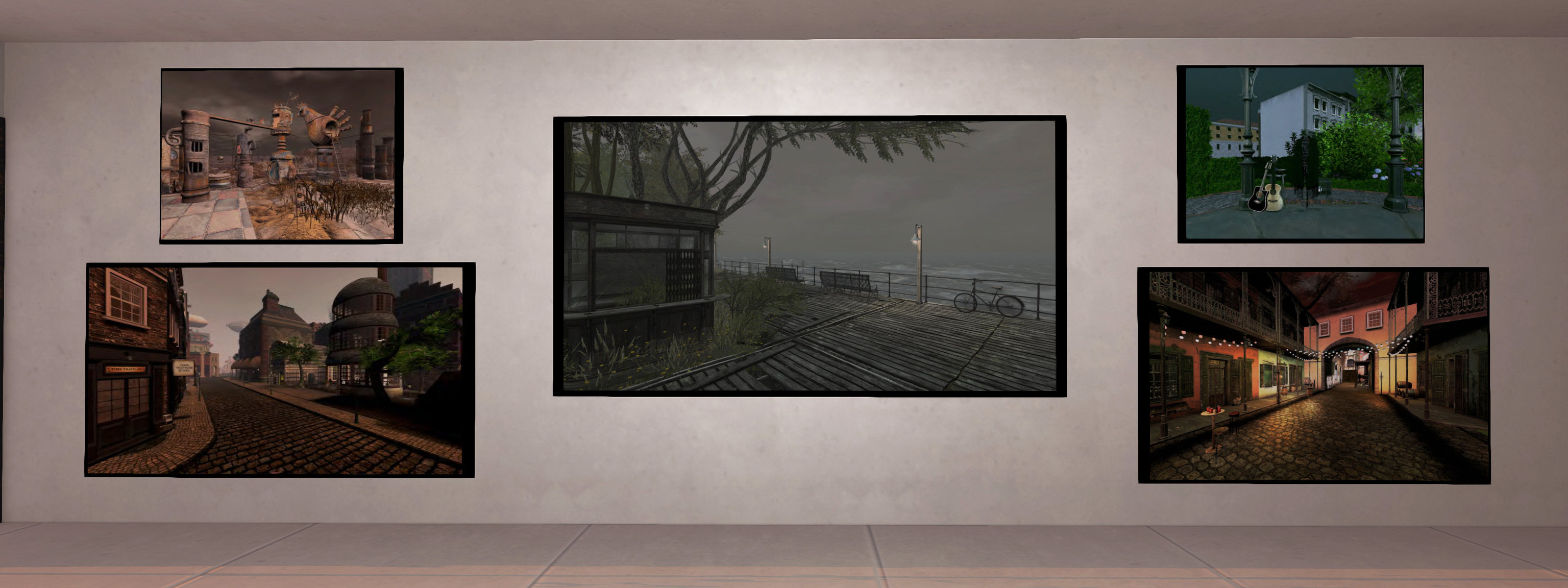
At the time of my visit, the selection comprises pieces by Patrick Ireland, Sophie Marie Sinclair (Perpetua1010), Tayren Theas, Moora (Moora McMillan), Raging Bellls, Ana (oceanida) and … yours truly.
Given the names involved, this is a rich mix of of art from well-known Second Life artists – and I’m flattered to have a piece included among them.
Konecta Art Gallery: Gonzalo Osuna’s Personal Collection
Both galleries offer a worthwhile visit for any patron of the arts, and I’ve not hesitation in recommending both.
SLurl Details
Konecta Radio and Konecta Art are located on Carpathian Island, rated Moderate









 Inara Pey: Living in a Modemworld