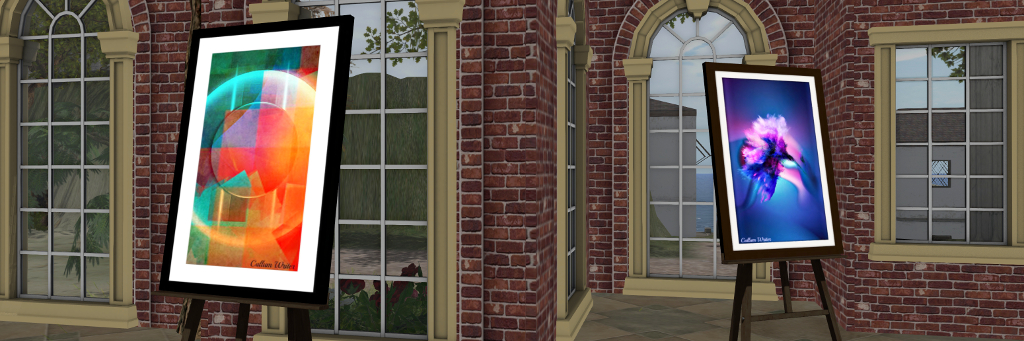
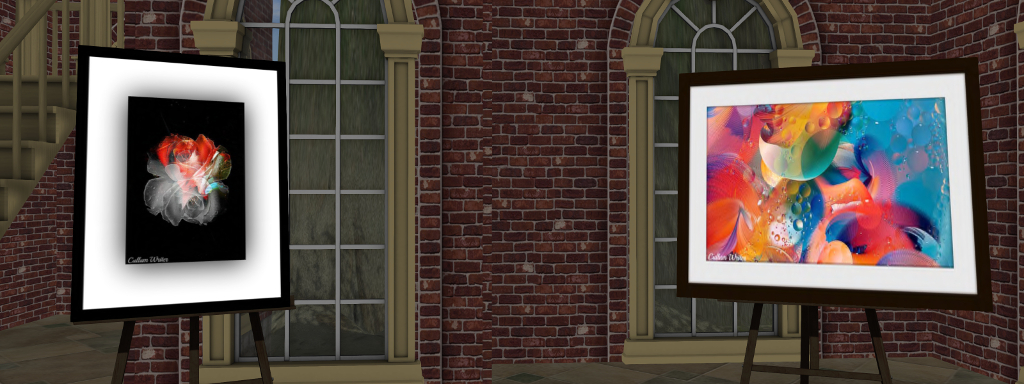
Currently open at the Boston Town Hall is Colors, an exhibition by Callum Writer, an artist I’ve come to admire for the breadth and depth of her work.
Callum found her artistic inspiration through the snapshot capability in the Second Life viewer. From this, she has worked to expand her artistic ability and expression to incorporate techniques such as fractals, collage, abstract, and mixed-media approaches. In all of this, her ability to express emotion, harmony and life through the use of colour is clearly evident, as can very clearly be seen with this exhibition.
Located on the ground floor of the town hall building, the exhibition feature 15 marvellous pieces of Callum’s work. Each and every one of them is stunning in form, colour and expression, starting with Portrait de Femme, to the left of the front entrance to the hall, and proceeding around the space on both the walls and free-standing easels.
The creativity seen in these images is stunning, making any selection of individual pieces meaningless to a degree – although I admit to being drawn in particular She and Dancers 14, alongside the aforementioned Portrait de Femme, because of the manner in which they meld colour, light, movement and life. However, it is impossible not to be taken by each and every piece on display.
Pootling through some of the new Bellisseria continent regions by rail
It’s been a few months since I last wrote about Bellisseria, the Linden Homes continent. At that time, the trailers and campers selection of homes had just been deployed – and proven as popular as the Traditional homes and Houseboat ranges before them.
Since that time, as has been reported elsewhere, the continent has been expanded with a lot of new regions slotting into the southern side to fill out much of the “missing parts” when compared to the SSPE “test continent” used to initially develop Bellisseria’s layout.
These new regions have dropped into Bellisseria fairly close to where my houseboat is located, and I’ve tended to take the occasional look at them as things have been under development (see A little Culprit Moonwalking in Second Life, for example). However, as this a is quiet Monday, I decided to drop in to the regions at a time when I’m unlikely to get in the way of the Linden Department of Public Works (LPDW) as they continue to build-out the regions with everything from landscaping though flora and infrastructure to the Linden Homes themselves.
The new regions bring together a mix of Houseboats, Traditional houses and Trailers and Campers
The majority of the regions continue with the current themes of Traditional, Houseboat and Trailers and Campers homes. This means – on the surface – that the new regions could be dismissed as “more of the same”, but as my Monday trip through some of them – by rail and horse – shows that while they may contain the same types of houses, they have their own unique character and look.
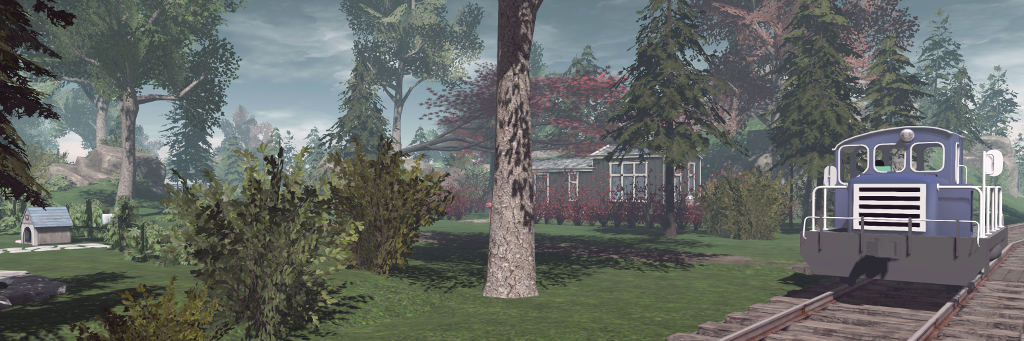
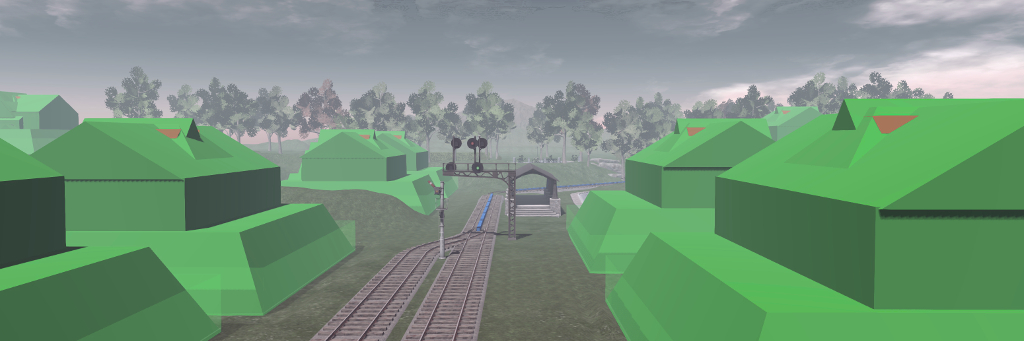
Take, for example, the Bellisseria railway. While this was introduced with the release of the Trailers and Campers, the extension to the continent illustrates it in not to be restricted to regions containing these types of Linden Home – as has been hoped would be the case. Within the new regions, the tracks pass from “camping” regions into Traditional homes regions, and back into “camping” regions once more. Along the way the tracks also branch for what I think is the first time, presenting two potential rail routes through the regions, and one of the new Traditional homes regions has markings for what might be a more substantial station than seen elsewhere (or at least one directly served by road).
The new regions see the Bellisseria rail lines extend into Traditional house regions
Given the continued popularity of the Houseboat styles, it comes as no surprise that the coastal regions offer more moorings for houseboats – some of which have already been populated. But again in what might be an interesting turn where popularity is concerned, the new regions offer an extensive reach of the camping parcels along the coast, presenting people who like the Campers and Trailers with the opportunity to enjoy coastal living, rather than being restricted to just the banks of inland waterways and lakes.
The new regions also offer the first real “blending” of Camper and Trailer regions and Traditional House regions. Until now, the boundaries of the two have tended to be denoted by water. With these new regions, the two types of Linden homes draw together more naturally, sometimes with just low mounds between them, sometimes abutting almost seamlessly.
Trailers and Campers move to being along the coast with the new regions
There are perhaps one or two little things that it would be nice to see. The rail tracks for example run through the regions, passing Campers and Trailer and houses alike running over and under bridges and through deep cuttings; but there are are no tunnels – it would be nice to see one or two in the more hilly areas.
Similarly, while the Traditional house regions and the Trailer and Camper regions do more directly abut one another, the roads of the Traditional house regions and the tracks of the Camper and Trailer regions never actually come together; rather they each end abruptly with a stretch of grass between them, it would be nice to a a more natural joining, asphalt gradually giving way to a narrower, rutted track, for example. Or at least have a fence and (open) gate between them, rather than curbstones, footpath and pristine-looking grass.
Logos representative only and should not be seen as an endorsement / preference / recommendation
Updates for the week ending Sunday, November 10th
This summary is generally published every Monday, and is a list of SL viewer / client releases (official and TPV) made during the previous week. When reading it, please note:
It is based on my Current Viewer Releases Page, a list of all Second Life viewers and clients that are in popular use (and of which I am aware), and which are recognised as adhering to the TPV Policy. This page includes comprehensive links to download pages, blog notes, release notes, etc., as well as links to any / all reviews of specific viewers / clients made within this blog.
By its nature, this summary presented here will always be in arrears, please refer to the Current Viewer Release Page for more up-to-date information.
Note that for purposes of length, TPV test viewers, preview / beta viewers / nightly builds are generally not recorded in these summaries.
Official LL Viewers
Current Release version 6.3.3.531811, formerly the Voice RC viewer, dated October 18, promoted October 31 – NEW.
Release channel cohorts:
Maintenance RC viewer updated to version 6.3.4.532422 on November 7th.
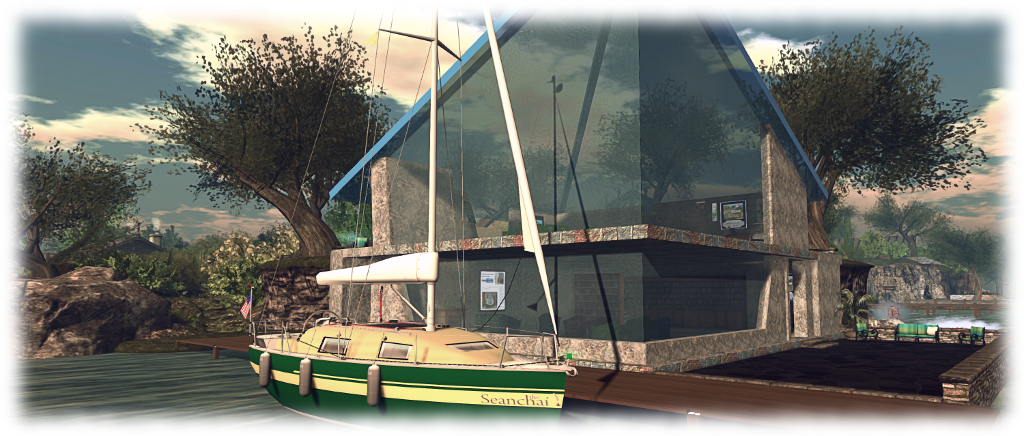
It’s time to highlight another week of storytelling in Voice by the staff and volunteers at the Seanchai Library. As always, all times SLT, and events are held at the Library’s home at Holly Kai Park, unless otherwise indicated.
Monday, November 11th 19:00: Teacher’s Pet / War and Peace
Gyro Muggins returns to Larry Niven’s Known Space universe and the Man-Kzin Wars series to bring us two short stories from that series written by Matthew Joseph Harrington, and which appeared in the Man-Kzin volume 11 (edited by Niven), first published in 2005.
Set after the end of the war, the stories within Man-Kzin XI are predominantly set during a period where the Kzin are down (but not necessarily out) and having to adapt to no longer being the masters of all races they encounter, and are in roughly chronological order.
The two stories by Harrington follow the trio by established writer Hal Colebatch, and marked his début as a published author at the age of 35. They are regarded by many as being strong studies in the Man-Kzin lore, whilst also drawing on other literary sci-fi sources. The stories are also noted for Harrington’s ability to round-out a number of “loose ends” within the Man-Kin wars as well as offering new slants on the broader carves of Niven’s Known Space universe.
Both stories use a play on words in their titles, with War and Peace doing so both in the manner it reflects the period of peace following war, and also for the way it focuses on the life and work of Peace Corben, a human female Protector, who returns in Harrington’s sequel story, Peace and Freedom, published in the 2009 volume Man Kzin Wars XII.
Tuesday, November 11th 19:00: What’s Cookin’?
A favourite food stories and recipe exchange with Caledonia Skytower and friends. This week: Finn Zeddmore with L’Achimista, a short story by American science fiction and fantasy writer, and psychologist N.K. Jemisin, the only author to have won the Hugo Award for Best Novel in three consecutive years. Cale contributes bits and bobs and everyone is invited to bring some of their favourite recipes to share, on note card.
Wednesday, November 12th 19:00 Stories from Home
With Thanksgiving in the United States now approaching, the Seanchai Library staff sit down to celebrate this time of year by sharing local tales from the various regions of the corporeal world where they live, or have lived. This Week Faerie Maven-Pralou and Caledonia Skytower continue with tales from the Wild-ish West. You are invited to recommend stories from your home as well.
Thursday, November 13th
19:00 Anthony and Cleopatra – A Novelisation
With Shandon Loring. Also in Kitely – find teleport from the main Seanchai World grid.kitely.com:8002:SEANCHAI.
21:00: Seanchai Late Night
Contemporary Sci-Fi Fantasy from such on-line sources as Light Speed, Escape Pod, and Clarkesworld online ‘zines and podcasts. With Finn Zinnmore.
Virgin Orbit’s plans to operate from Cornwall Airport, Newquay (CAN) – also called Spaceport Cornwall – is in the process of receiving a £20 million boost. Credit: CAN
The United Kingdom is to have two space centres operating within the next few years, if all goes according to plan, and at opposite ends of the country.
I last wrote about the plans to have both a vertical (i.e. rocket) launch facility and at least one horizontal (i.e. air lift and launch) facility operating in the 2020s (see: British space ports and some female space firsts, July 2018), and more recently plans for both have taken significant steps forward.
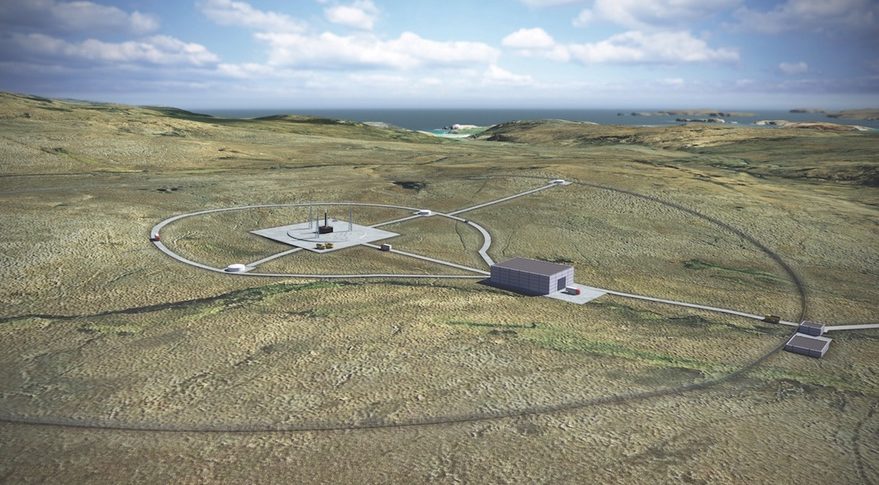
In October 2019 it was announced that construction of the vertical launch facility – now officially called Space Hub Sutherland – to be located at A’Mhoine on the Moine Peninsula, high up on Scotland’s North Atlantic coast, could begin in 2020. It would be used to place small satellites into a polar and sun-synchronous orbits.
An artist’s impression of the Sutherland Space Hub. Credit: Perfect Circle PV
The cost for developing the facility has been estimated at £16.2 million (US $20.7 million), with £2.35 million (US $3 million) already awarded by the UK Space Agency since July 2018. After the required studies, etc., this funding has enabled the Highlands and Islands Enterprise (HIE), a local Scottish government economic and community development agency, to sign a 75-year option to lease the land where the space hub is to be built, and to award contracts for the design of the hub’s launch-control centre and the assembly and integration buildings that will be used by commercial launch organisations to assemble their launch vehicles and integrate payloads ready for launch. Currently, HIE are awaiting formal planning permission to be granted, which will then allow construction to commence.
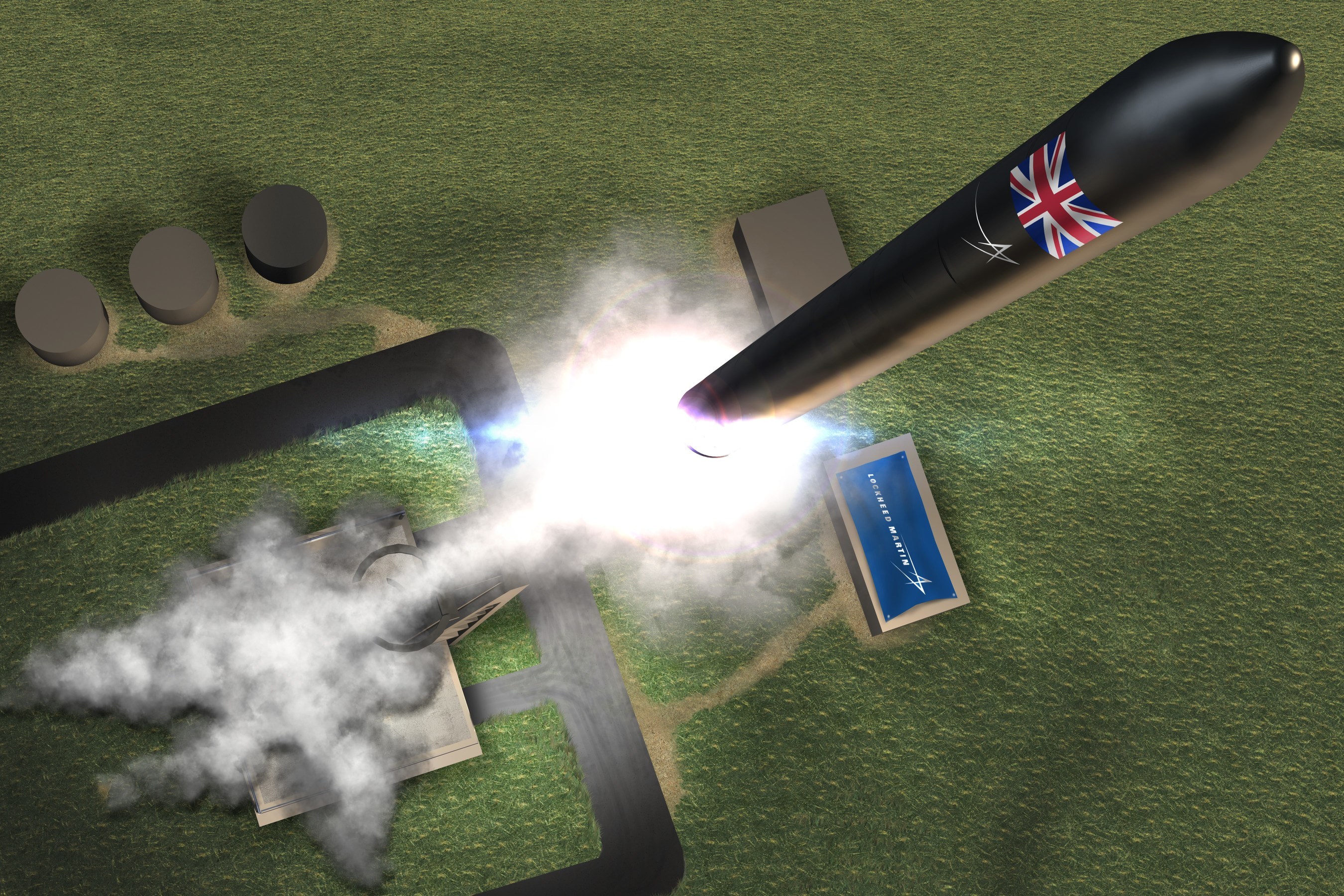
A partnership of US aerospace giant Lockheed Martin and British aerospace company Orbex have committed to using the launch facility once it becomes operational – possibly in the early-to-mid 2020s.
Orbex plans to use the facilities to launch their innovative Prime rocket, and have already announced a series of contracts for the vehicle, including agreements with the Netherlands-based cubesat launch broker, Innovative Space Logistics and the U.K.-based company In-Space Missions, which plans to launch its Faraday-2b demonstration satellite from Scotland in 2022.
An artist’s impression of an Orbex Prime rocket – capable of lifting 150 Kg payloads to 500 km polar / sun-synchronous orbits – lifting off from the Sutherland Space Hub. Credit: PRNewsfoto / Lockheed Martin
Prime is a leading edge technology launch vehicle that among other things uses 3D printed rocket motors that can be produced as a single unit without joins, and utilises a bio-propane fuel and emits 90% less carbon dioxide than conventional, hydrocarbon-fuelled rockets. Bio-propane is an alternative to natural gas that’s produced from waste or sustainably sourced materials like algae. Development of the system is being partially funded by the UK government to the tune of £5.48 million (US $7 million), specifically in relation to the use of the Sutherland Hub.
Lockheed Martin has received funding to the tune of £24.3 million (US $31 million) to develop a vertical launch system suitable for operations out of the hub. However, precisely what they plan to launch from the facility once it is available, is currently unclear.
Planning permission for the facility is liable to meet some opposition, however. Moine Peninsula is part of an expanse of blanket peat bog that is a candidate for UNESCO World Heritage Site status. These peat lands are regarded as some of the most valuable ecosystems on Earth: they preserve global biodiversity, provide safe drinking water and minimise flood risk. In addition, they are the “largest natural terrestrial carbon store”, and when damaged ecologically, can contribute to greenhouse gas emissions (around 6% of global greenhouse emissions can be traced back to damaged peat lands). As such, opposition to the Sutherland Hub has already been voiced, and further objections may well be expected.
Cornwall Airport Newquay, also known as Spaceport Cornwall. Credit: CAN
At the other end of the country, plans for a horizontal launch centre at Cornwall Airport Newquay (CAN) – also known as Spaceport Cornwall – took another step forward with the UK Agency announcing on November 5th, 2019 that it will provide £7.35 million (US $9.5 million) to help develop the necessary infrastructure to support operations of the Virgin Orbit air-launch system.
We want the U.K. to be the first country in Europe to give its small satellite manufacturers a clear route from the factory to the spaceport. That’s why it’s so important that we are developing new infrastructure to allow aircraft to take off and deploy satellites, a key capability that the U.K. currently lacks.
– UK Government Science Minister, Chris Skidmore
Responding to the news of the funding, Virgin Orbit indicated that Spaceport Cornwall could host its first LauncherOne mission potentially around late 2021, the precise date being dependent on various regulatory approvals in the UK and in the United States, quite aside from the completion of the required infrastructure improvements at the airport. Should this time frame be met, a Virgin Orbit launch from Spaceport Cornwall would be the first orbital launch ever conducted from the UK (Britain’s Black Arrow launch vehicle was launched from Australia).
The funding is part of a £20 million (US $25.5 million) package promised to CAN; a further £10 million (US $12.78 million) to come from the Cornish local government and £2.35 million (US $3 million) from Virgin Orbit.
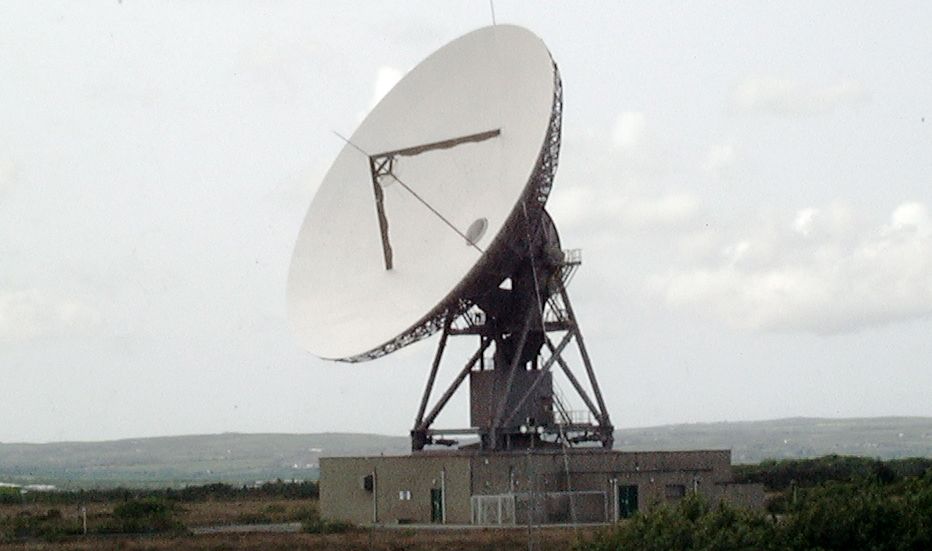
Cornwall itself is well-placed to support space launch operations. It is home to Goonhilly Satellite Earth Station, once the world’s largest satellite earth station, with more than 25 communications dishes in use and over 60 in total, the largest of which were named after characters from the Arthurian legends.
While operations at the facility were pretty much shut down in the early 2000s, the complex has entered into an agreement with CAN to provide communications support for launches from the spaceport, whilst also being subject to possible upgrade and enhancement to support future lunar missions, both crewed and automated – including those planned as a part of NASA’s Artemis programme.
The largest of the Goonhilly communications dishes, the 32m (105 ft) diameter “Merlin”. Goonhilly may provide communications support for Spaceport Cornwall. Credit: British Telecom.
La Digue, November 2019 – click any image for full size
La Digue (“the dam”?) is a recently opened Homestead region offering numerous opportunities for photography and – with a little care – exploration.
Designed by Sablina, famous for producing the likes of La Virevolte (see here, here and here), Ponto Cabina (see here and here) and Field of Dreams (see here), this is a region caught in the changing of the seasons, the trees a mix of summer green and the reds, golds and brown of autumn. Beneath them, the land is cut by two large water channels that feed multiple smaller, canal-like channels that divide-up the land into a series of small islands and one large “central” land mass that also forms the landing point.
La Digue, November 2019
A large gatehouse stands atop the latter, standing guard over the region and is large island and watching over the landing point as it sits on the shingle shore. Surrounded by a sea of sun-dried grass, the gatehouse is one of a number of buildings within the region that collectively give it – along with its name – a feel for northern France (although one of the buildings is admittedly Tuscan in design).
Small bridges connect some of the smaller islands one to another, but to reach others some wading through the shallow channels between them might be required. With corn stalks and cattle grazing, the islands further suggest a rural setting.
La Digue, November 2019
To the north, a sender finger of land points westward and then turns south along a broader stretch of coast to a small railway station (sans tracks) looking out to sea whilst caught under its own rain storm. This crrokes streacth of road and shoreline, coupled with the region’s name, brought to mind the long finger of La Digue du Braek, albeit without the sands on one side and the port of Dunkerque on the other. At the end of this the road, a bridge provides access to a small headland area where stands a lighthouse and work is apparently in progress building a sea wall.
However, what – for me – gives the region character is the broad north-to south channel that cuts through the region, separating the western run of road and its station from the rest of the region. This would appear to be a tidal run, given the dry stone wall supporting some of the land to one side. It is home to numerous wooden moorings alongside of which rowing boats sitting among the reeds and watery growths around the mooring piers.
La Digue, November 2019
This area in particular adds a huge amount of character to the region, rich in detail and photographic opportunity from pretty much any angle. Elsewhere throughout the landscape are further opportunities as well, but it tends to be the waterway that draws the eye and lens back to it again and again. The rowing boats, meanwhile offer numerous places for sitting and posing for photos or chatting.
More places to sit can be found across the region as well, from the little bar a short walk from the station, to benches and chairs, hay bales and more. Getting to some can be a bit of the aforementioned challenge, admittedly: some of the grass and other plants could do with being phantom – but this shouldn’t put people off exploring and wandering.
La Digue, November 2019
Sablina has a reputation for creating regions of beauty that capture landscapes in a most natural manner, and La Digue is further proof of this. It’s a place that invites wandering and spending time within it, the supplied sound scape rounding it out perfectly.
A region that has already caught the attention of photographers and artists, La Digue is not to be missed by Second Life travellers.









 Inara Pey: Living in a Modemworld