The magic of Season’s Cove in Second Life

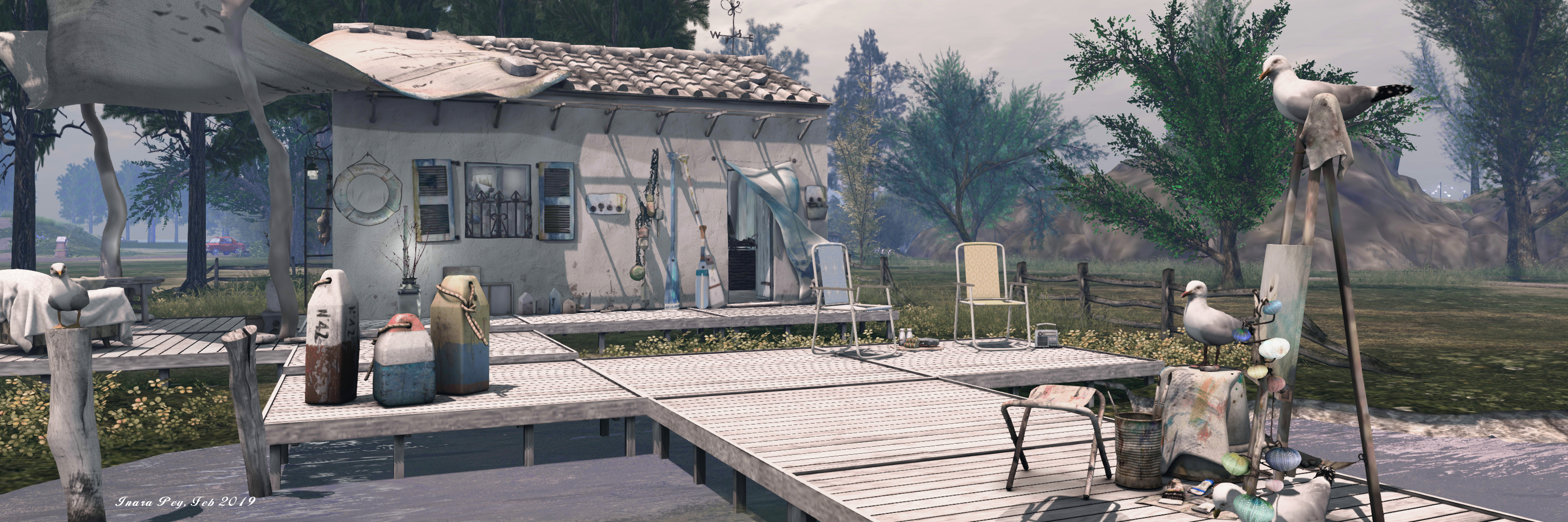
Season's Cove; Inara Pey, April 2019, on FlickrSeason’s Cove – click any image for full size

Update: Season’s Cove appears to have closed.

One type of region we’ve always enjoyed visiting is the type that feels TARDIS-like; that is, when exploring it, it feels much larger than its individual map tile / 256m-on-a-side would suggest. There are many such regions scattered across Second Life, but one of the most imaginative we’ve recently visited is that of Season’s Cove.

Designed by Muira Mingann (Angelique Vanness) with assistance from Takoda Mingann (Mingann), this full region design ticks a lot of boxes for the avid Second Life photographer. The design is rural / coastal with a strong twist of fantasy, hints of magic; a place where wizardly towers overlook tumbledown dance halls, beaches sit above undersea gardens and tunnels with multiple rooms vie with surprise portals to carry you to places in the sky that further extend the feeling of being in a place that’s much bigger that its physical constraints should allow.

Season's Cove; Inara Pey, April 2019, on FlickrSeason’s Cove – click any image for full size

A visit begins innocently enough: a large terrace towards the centre of the region, cliffs to its back, water below its stone walls. It is home to a little café, a carousel and the first hint of the more mystic elements: a fortune teller’s tent. Two wharves sit below the terrace, each offering a way down the water’s edge – and one allowing visitors to travel much further.

Multiple paths lead away from this terrace. Some go around the plateau that sits above it, running south then west. Others point north and then east, promising to perhaps circle the land and meet with their brethren further around the region. Some climb the shoulders of rock to reach the plateau above, others dip down to the water’s edge and promise another means to circumnavigate the island, or to pass by bridge and track to its eastern lowlands, where beaches face the sea, water cuts a winding channel from the large inlet below the landing point terrace to a small pond, all watched over by the ruins of another tower.

Season's Cove; Inara Pey, April 2019, on FlickrSeason’s Cove

A further path leads inwards, under the high table of rock, to where a labyrinth of tunnels connect rooms one to another as water drips from arched stone ceilings and stone cisterns sit with backs to the walls, offering the weary a chance to drink the water purified by its travel though the sandstone. The rooms within these tunnels offer a mix of interior settings, from small bathing pool to rooms clearly intended for more adult pursuits.

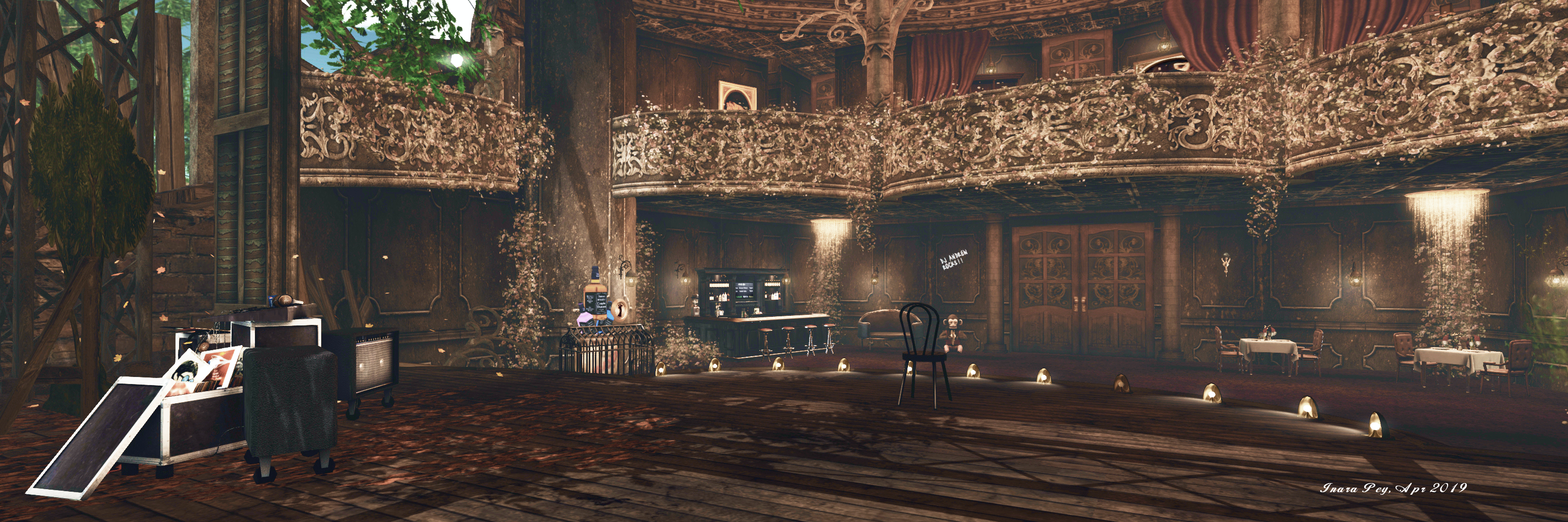
The terrace facing entrance is not the only route into or out of these tunnels: wander far enough around the island or within them, and you will find others. One of these is a wooden walkway that spirals up an open hole on the region’s north-west side. At its top lay numerous further paths waiting to be followed, including one running up to the remains of the old dance hall / theatre which, despite its decrepitude, still offers a place for music to be enjoyed within, complete with tables set for romantic dinners for two.
Season's Cove; Inara Pey, April 2019, on FlickrSeason’s Cove

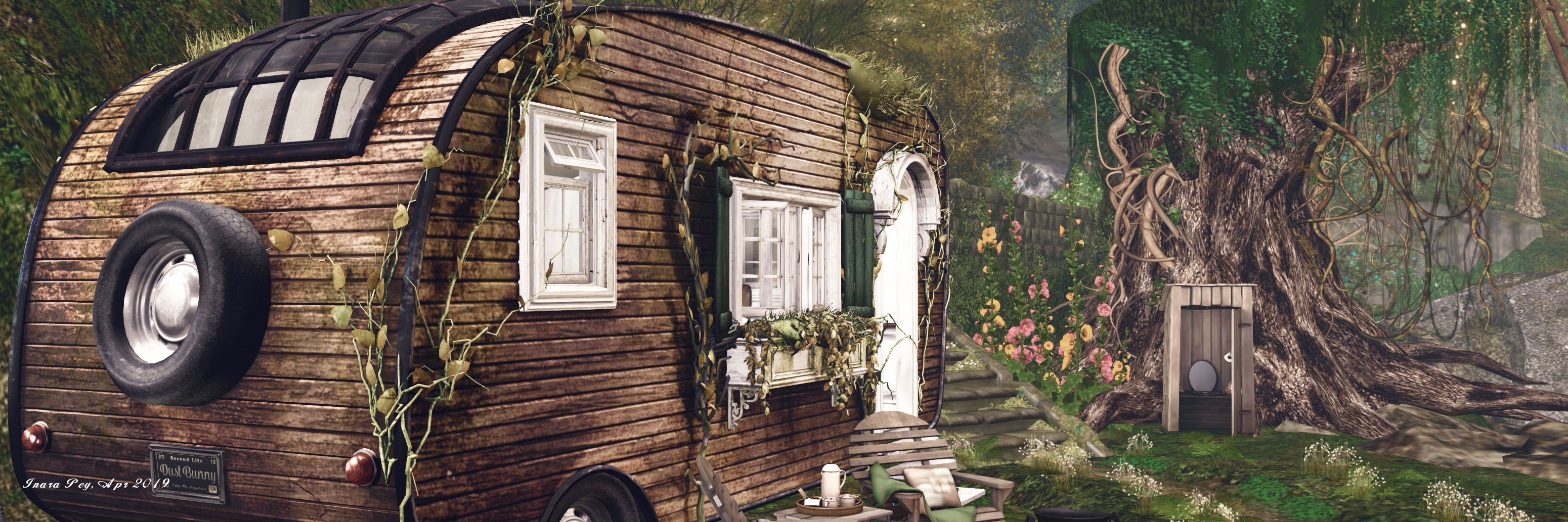
This is another aspect of the delight found within this region: around every corner, at the end of every path is something new and perhaps unexpected to find. Take, for example, the ruins of a Catholic / Orthodox church, complete with confessional, sitting within the low woodlands, or the quaint traveller’s caravan tucked into the lee of the main plateau and looking west to where a tall, rugged island is home to another ancient tower, more ruins lying below it.

Nor is exploration limited to using your feet. It you have a wearable Bento or Animesh horse, you can wear that and take to the paths and trails whilst exploring – most of the routes through the region avoid stairs and steps (although there are some steps and stairs scattered around, to be sure).

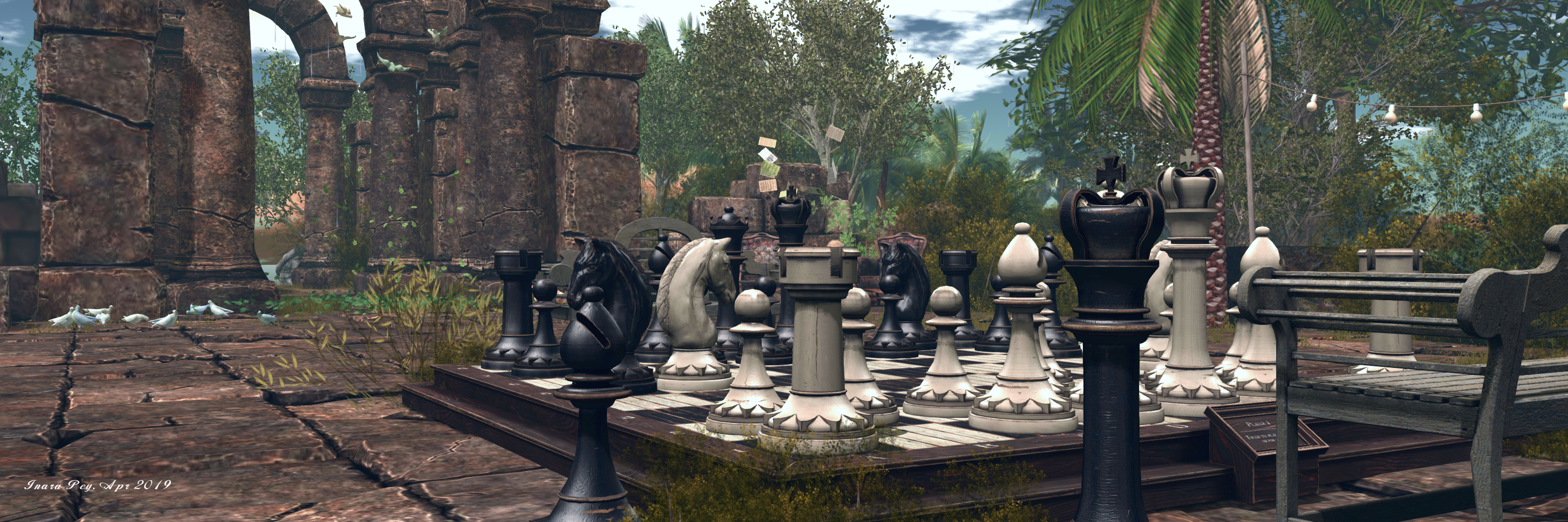
And when it comes to horses – keep your eyes open for pointers to the riding trail. They show the way to what initially appear to be paths passing through rocky arches. They are in fact teleport portals leading to points in the sky – in this case, either the “Season’s Cove Stables” or a riding trail in the sky (just be aware the latter including a giant tree house that is a private residence). Several such portals exist within the region; we found two more (one to a lover’s tryst, another to a “BDSM Dungeon), but there could be others that we might have missed!
Season's Cove; Inara Pey, April 2019, on FlickrSeason’s Cove

Using the portals to connect with these skyboxes will require accepting the region’s experience on the first attempt – but thereafter they should be automatic unless or until you revoke the experience. Be warned, as well, that finding your way back to ground level might take a little work, as some return portals are intentionally hidden. Also, some of the return portals may rotate your direction, with the result yo might step back into the ground-level portal as you try to move clear on landing.

Another element of Season’s Cove that makes a visit a pleasure, is the care with which the design is curated. There is a lot going on the ground, in the air and underwater (look for the steps near the landing point terrace for a way down to the underwater gardens and their delights), neither Caitlyn nor I found our computers under any strain from the load. Yes, fps for me with shadows enabled did drop to the low 20s / high teens, but this can happen elsewhere, and certainly didn’t spoil the visit.

With places to sit and  / or dance throughout, dozens of opportunities for photography and the chance to really explore a quite unique and details setting, Season’s Cove present a genuinely worthwhile and engrossing visit. Should you enjoy your visit as much as well did, do please consider a donation towards the region’s continued presence as a public space.

Season's Cove; Inara Pey, April 2019, on FlickrSeason’s Cove – click any image for full size

Sansar Product Meetings week #15: custom avatars and contest

Felsenmeer – Silas Merlin – blog post

The following notes were taken from my recording of the Sansar Product Meeting held on Thursday, April 11th intended to be on the subjects of custom avatars, upcoming changes to the Sansar Discord channel, and moderation capabilities in Sansar.

Custom Avatars

First Time Avatar Selection for New Users

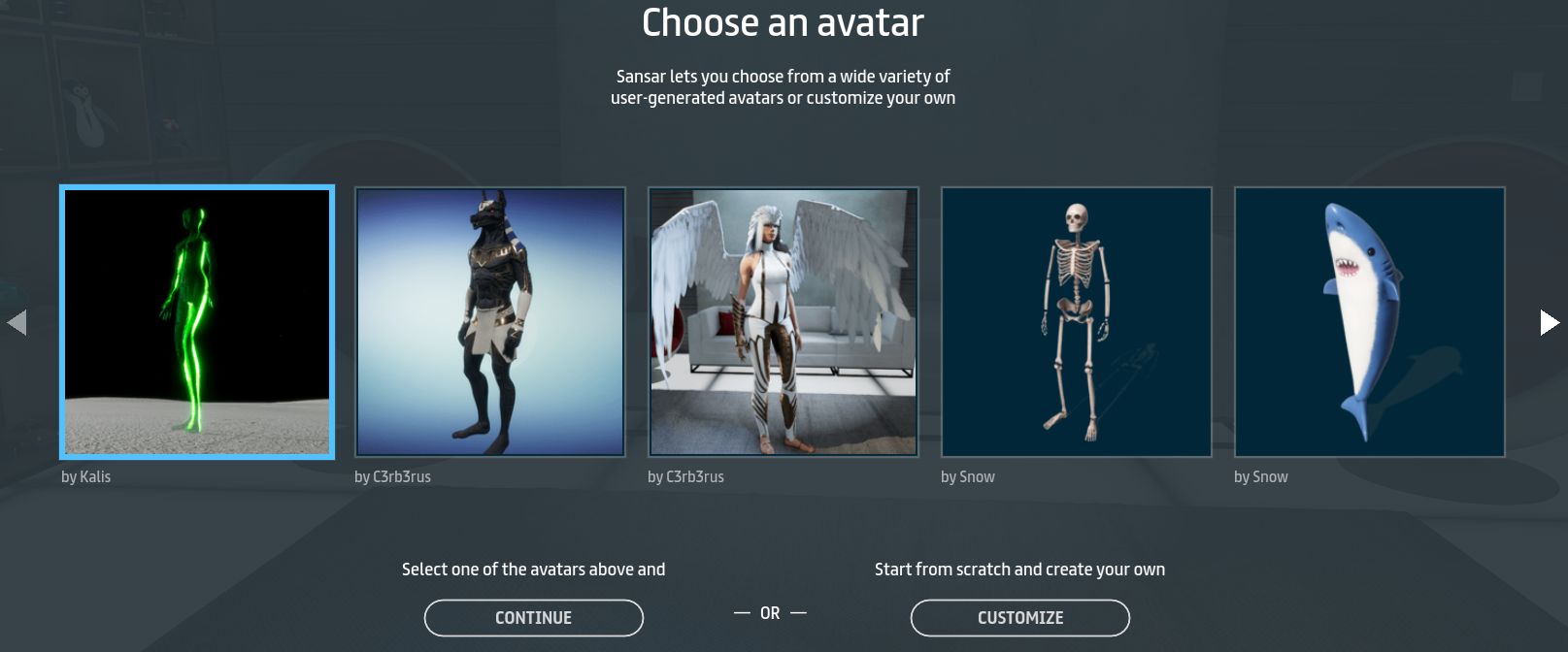
  • With the March Jumping and Questing release, new users can select from a range of (user-created) custom avatars via a new carousel (or opt to create their own look using the system avatars via the Customise button).
  • Stats show that around 50% of new user avatar selections are now custom avatars.
  • Custom avatars are currently selected on the basis of:
    • How good it looks in the Lab’s eyes, particularly to gamers.
    • How appealing the avatar is to all allowed age groups. – including whether the avatar is fully clothed (allowing new users to go directly “in-world” to experiences without having to go to the Look Book to customise their look.
    • Whether the avatar can be easily dressed using Marvelous Designer clothing.
    • Whether the avatar is offered for free in the Sansar Store.
  • The selection of custom avatars will continued to be curated and updated.
A sample of the custom (user-created) avatars on the avatar carousel and available at the time of writing to new Sansar users on signing-up

Avatar Contest: New User Carousel Edition

  • To encourage creators to make custom avatars suitable for presentation to new users through the carousel, Linden Lab have launched the Avatar Contest: New User Carousel Edition.
  • Full details are available in the official blog post. However, in brief:
    • Creators are invited to present custom avatars suitable for use on the new user avatar carousel.
    • Avatars must meet the requirements outlined above, and additionally must have properly rigged hands and mouths.
    • Creators may submit up to five entries (but can only win one of the prizes).
    • Five avatars will be selected from entries, and the designers awards S$27,500 each.
    • The onus is on humanoid avatars, or human anthropomorphic avatars.
    • Avatars can be submitted through until 17:00 PDT on Thursday, May 9th, 2019.
  • If the contest proves popular, it may be run again in the future.

Discord Changes

These are due to come into effect from Monday, April 15th, 2019.

  • Those who wish to keep their view of Discord as it is will be able to do so. All of the changes / new features will be on an opt-in basis.
  • A new public channel (or channels) is to be introduced (most likely on Monday, April 15th) alongside the current “user” channels,.
    • This is specifically aimed at those who might hear about Sansar and who want to check the community, etc., before opting to install the client and sign-up.
    • Existing users are encouraged to join the public channel and participate in discussions there, answer questions, etc.
  • The existing “user” channels will remain only accessible for interaction to those with a Sansar account (which will continue to be the point of entry to them).
    • However, the content of the channels will be available for anyone on the public Sansar Discord channel to read.
  • If the public channel aspect doesn’t work as anticipated, it might be rolled back in the future.

Moderation

This was more of a general discussion / feedback session, rather than an announcement of new features or changes to the current moderation / blocking capabilities. Key points from the discussion are summarised below:

  • The current set of moderation tools with their focus on avatar / avatar blocking have been developed from the perspective of helping new users deal with unwanted situations. It is acknowledged that a broader toolset is required,
  • At present, users can block one another’s avatars – useful if someone is being a particular nuisance, but the experience owner isn’t around to intervene, or if they are just being a very specific annoyance for another user. However:
    • There has been feedback that the current blocking is insufficient, as it doesn’t include removing their text comments from local chat.
    • There is no personal block list, so it is difficult for some to determine whom they might have blocked (possibly accidentally) without the subject of their block actually being present in an experience with them (but being invisible to them).
    • How to unblock also lacks clarity.
  • A lack of ability for experience creators to quickly ban troublemakers from causing issues within an experience being enjoyed by others – such as a single-click eject (back to the user’s Home Space?) / ban capability.
    • Avatar blocking doesn’t work in this situation, as it is purely avatar-to-avatar, so the nuisance can still go on to bother others in an event game, and can also be disruptive as they can continue to interact with elements in the scene.
    • Having to record an avatar’s name, then go to Create > Build Experiences > My Experiences > Publish > Publishing Options > Ban List and then add a name is (rightly) seen as too long-winded.
    • This is something the Lab has considered alongside the current moderation tools and are planning to provide. However, it is also something that hasn’t as yet been prioritised.
    • However, the Lab have looked upon such capabilities as being more event-driven (e.g. large-scale events that require specific moderation  / some form of moderator role which would include the required capabilities.
    • The problem with the Lab’s approach is that potentially, without a broader, more accessible set of moderation capabilities available to them, experience creators already in Sansar are reluctant to hold major events of their own, simply because of the overhead involved in taking action against a troublemaker (or worse, a group of troublemakers) with the current capabilities.
  • Part of the Lab’s approach to moderation is to provide tools that allow users to be both pro-active and to consider the options at their disposal in accordance with a situation (does someone’s behaviour actually warrant blocking, or is muting sufficient? Should they be banned for an experience  – where banning is an option – or should they be reported? Should they be banned and reported? etc).
  • As it is, blocking / muting in VR is not that intuitive. The Lab is aware of this and looking to improve things.

Awesome Fallen at the Itakos Project in Second Life

Itakos Project: Simply Dreaming

In 2017, Akim Alonzo launched the Itakos Project as a Linden Endowment for the Arts installation with the aim of presenting the work of SL photographers who, through their images, engage upon story-telling or presenting the ideas of stories, or who seek to present beauty and emotion through their study of the avatar and the worlds around it (see The Itakos Project in Second Life). However, I confess I lost track of the gallery after its 6-month LEA run came to an end. So an invitation to view a new exhibition at the gallery – now in its own location – offered the perfect reason to resume my acquaintance with it.

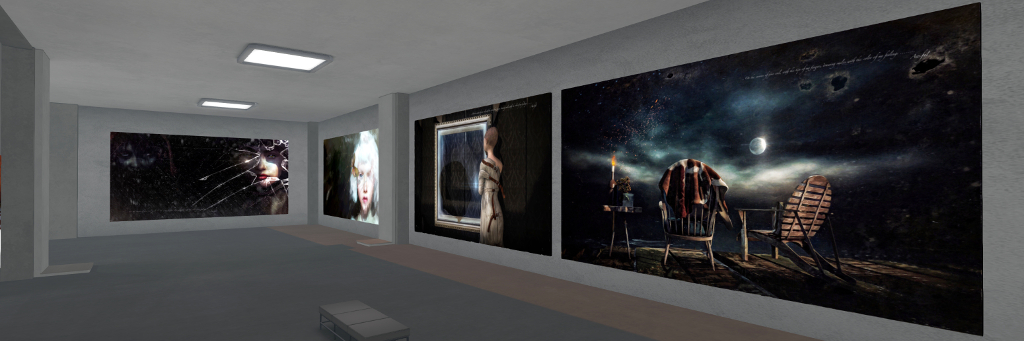
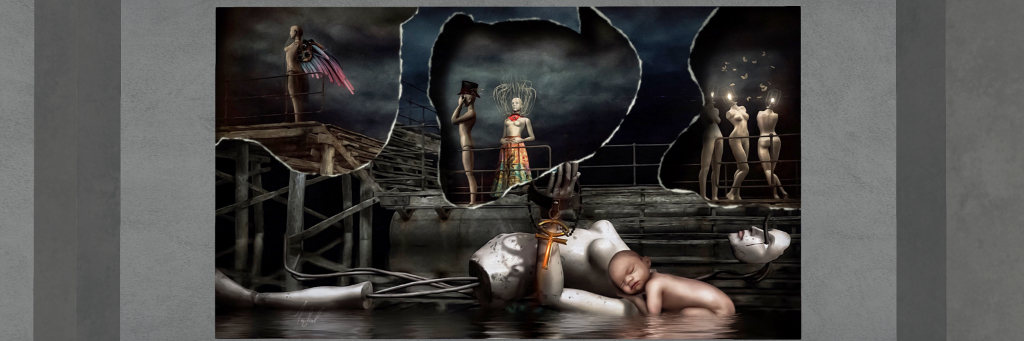
Simply Dreaming is a remarkable selection of pieces by Awesome Fallen, an SL artist whose work I’ve always been drawn to for her richness of narrative and opening of the imagination. With this exhibit, she presents twelve images on the subject of dreams and dreaming, located in the gallery’s entrance level Grey Pavilion. Surreal, marked by the use of heavy and dark colours and tones, these are perhaps images of the darker side of dreams and dreaming.

Itakos Project: Simply Dreaming

Each is  – and I use this term deliberately, despite the dark tones and subject presented – a beautiful representation of an instance of a dream; the moment of recollection we can all have when awakening from a period of REM sleep, a single frame of our dreaming thought processes captured in the lens or the mind, or which is retained and held subconsciously and returns to us at the first moment of waking in the morning.

In this, the surrealist nature of the images is entirely fitting on at least two levels. The first is that dreams are always linear or logical; as the brain processes its way through our sleep, cataloguing, filing, recalling – or doing whatever really is going on in our dream state – we can become observers to those processes without really being aware of what if going on or why. Thus the mental images that we regard as dreams can be both vivid and ethereal; images lying one over the other, some clear and fresh or vibrant in their emotion (if not necessarily in their colour), others faded and faint. Within their mixing we oft encounter surreal views and disjointed images or flashes of thought that are sharded and broken or at least confused.

Itakos Project: Simply Dreaming

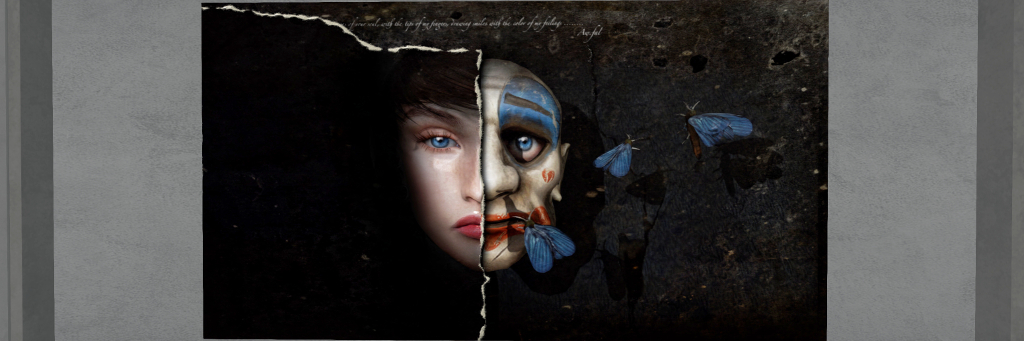
So it is with this images that were are presented with contrasts and juxtapositions: faces split; images that offer a clear view of a subject and a shadowed reflection in the darkness; figures of menace; faces lost; scenes that might be from the day’s activities but turned by the churn of mental processes into scenes that aren’t quite right; negative thoughts and feeling that have become personified. A tumult  of emotions and thoughts given form to become surreal stories without clear narrative except the emotional response they create.

The surrealism approach is also fitting when one considers the origins of this form of art – that of developing painting techniques that allowed the unconscious to express itself. The surrealist movement embraced Freud’s work with free association, dream analysis, and the unconscious. Thus, by presenting these images in a surrealist form, Awesome not only maintains the movement’s idealism, she actually offers a visual treatise on the nature of the movement itself, literally taking the art back to its roots through the presentation of dreams as scenes.

Itakos Project: Simply Dreaming

There is more layering to be found within these images. Take for example the stanza-like line repeated in each of them: On the canvas of your soul, with the tips of my fingers, drawing smiles with the colour of my feelings… Not only does this provide a thread that draws all twelve images into a tapestry; it also suggests that through these images Awesome is offering us windows into her dreams – and into our own. In this latter regard, it is perhaps tempting to see these images as perhaps autobiographical, the capturing of personal dreams; this may be the intent, but equally all twelve pieces speak to our own psyches, offering a means for our subconscious to respond. Hence why, perhaps, on seeing these works we might all feel an odd sense of familiarity and recognition as we look upon them.

A fascinating and absorbing collection.

SLurl Details

2019 SL User Groups 15/2: Content Creation summary

Maderia Springs; Inara Pey, February 2019, on FlickrMaderia Springsblog post

The following notes are taken from the Content Creation User Group (CCUG) meeting, held on Thursday, April 11th 2019 at 13:00 SLT. These meetings are chaired by Vir Linden, and agenda notes, meeting SLurl, etc, are usually available on the Content Creation User Group wiki page.

Environment Enhancement Project

Project Summary

A set of environmental enhancements allowing the environment (sky, sun, moon, clouds, water settings) to be set region or parcel level, with support for up to 7 days per cycle and sky environments set by altitude. It uses a new set of inventory assets (Sky, Water, Day),  and includes the ability to use custom Sun, Moon and cloud textures. The assets can be stored in inventory and traded through the Marketplace / exchanged with others, and can additionally be used in experiences.

Due to performance issues, the initial implementation of EEP will not include certain atmospherics such as crepuscular rays (“God rays”).

Resources

Current Status

The EEP RC viewer updated to version 6.2.0.526104 on Thursday, April 11th. A significant addition to the viewer with this release is the Personal Lighting floater.

When opened, this floater takes a “snap” of the current shared environment (parcel or region / estate) you are in, and present you with a number of controls that allow you to make quick modifications to the environment that only you can see in your viewer, including Sun and Moon positions, ambient lighting cloud and sky colours, etc. These changes will persist until you log out or select World > Environment > Use Shared Environment, so you can close the floater once adjustments have been made.

The new EEP Personal Lighting floater, designed with SL photographers and machinima makers in mind.

This floater has been added in response to concerns raised that where No Modify EEP asset settings are applied to a location, photographers cannot alter the environment lighting, etc., in a manner to suit their needs, and as they’ve been accustomed to being able to do with windlight tools such as Phototools.

Rider notes that this is a first pass at providing photographers / machinima makers with a suite of options that do not claim an unreasonable amount of screen real estate and fulfil the above requirement. However, if there are specific options photographers feel are needed, and which cannot be otherwise tweaked for EEP settings that are No Modify, please submit them as feature requests.

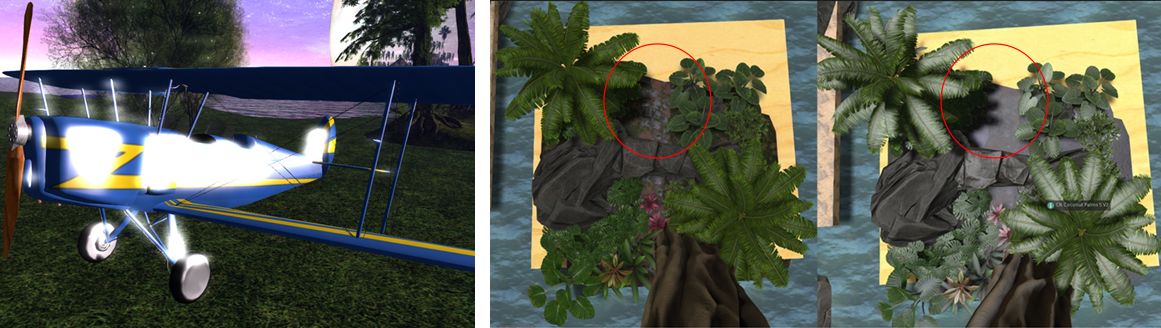
Specularity Issues: the most recent versions of the viewer (nightly builds and the new RC update) contain an unwanted level of specularity, across objects and on Linden Water. Reports have / are being filed on this.

The latest EEP RC has some issues with specularity rendering on objects (l) and circled right (compared with the same terrain mesh seen on the default viewer, centre).

Bugs: Graham Linden continues to try to deal with the remaining shader bugs and clear them.

Bakes On Mesh

Project Summary

Extending the current avatar baking service to allow wearable textures (skins, tattoos, clothing) to be applied directly to mesh bodies as well as system avatars. This involves viewer and server-side changes, including updating the baking service to support 1024×1024 textures, but does not include normal or specular map support, as these are not part of the existing Bake Service, nor are they recognised as system wearables. Adding materials support may be considered in the future.

Resources

Current Status

Anchor Linden is attempting to characterise a couple of viewer bugs that might also require back-end updates as well. The viewer is also awaiting a merge with the latest release viewer (formerly the Love Me Render RC viewer).

Materials and BOM: Bakes on Mesh does not naturally support materials, as the basking service does not support materials, per the project outline above). However it is possible:

  • To manually apply materials directly to the mesh face in additional to BOM applying a worn composite.
  • To apply materials to a mesh via a scripted means. This involves using a script to take the UUID for one of the new universal bake channels (e.g. AUX_1), and pointing it to a normal map, then wearing a universal wearable that uses the same bake channel (e.g. AUX-1). This results in the normal map then being applied to the universal. It’s also not an approach the Lab recommend, and probably won’t be treated as a supported technique.

Animesh Follow-On

Vir has been working on impostor extents see BUG-226359). When impostors are enabled, they can get oddly cropped due to their bounding box size.

The obvious fix is to increase the bounding box size for impostors; however, doing so comes at a performance cost when the viewer renders them – thus potentially negating their purpose (to reduce the render cost / performance hit in rendering complex avatars / Animesh). This likely means that any fix is going to be something of a balance between “padding” (enlarging) impostor bounding box sizes and allowing some truncation to avoid too big a viewer performance impact (fps) when rendering them.

High Fidelity changes direction: the reality of VR worlds today (& tomorrow?)

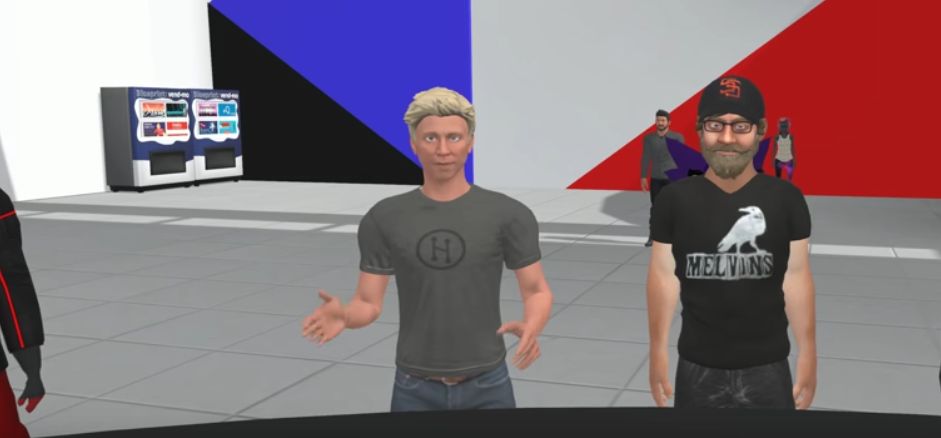
Philip Rosedale, High Fidelity founder and CEO (centre left) addresses the weekly General Assembly meeting in High Fidelity, Friday, April 5th, 2019. Credit: High Fidelity

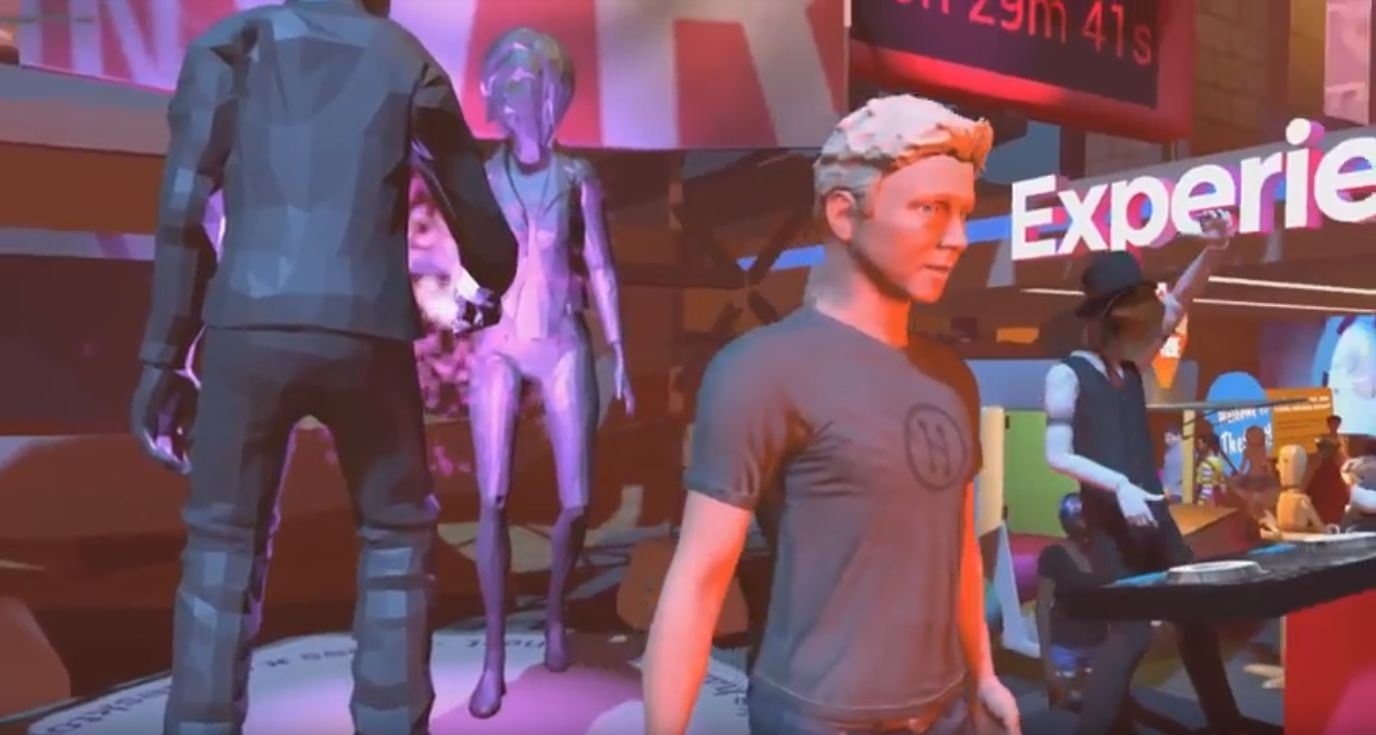
On Friday, April 5th, Philip Rosedale stunned attendees at High Fildelity’s weekly General Assembly meeting (see the video here and embedded at the end of the article), when he announced that the company would no longer be sitting within the content creation / public space provisioning area with its platform, and that forthwith all public spaces hosted by the company, together with the large-scale events they have been hosting would cease as the company switches tracks to focus sole on software / platform development.

The news was greeted with a sense of shock by High Fidelity users, and the company certainly moved very quickly to follow through on the announcement, shutting down all of the public spaces it has hosted, included social spaces and their flagship Avatar Island, which opened just over a year ago as a means of showcase virtual commerce, shopping and the power of the platform’s micro payments capabilities (see Commerce in High Fidelity, this blog, February 2018).

One of the driving forces behind the decision is that High Fidelity is currently unable to gain major traction – and this despite major pushes to do so with some large-scale events pushed out to the media for promotion, and the former monthly stress tests of the system, trying to push concurrency rates up to determine just how well High Fidelity domains can handle multiple hundreds of avatars. Which is not to say all events are coming to an end: the platform’s popular bingo sessions are set to continue and – taking a leaf from Sansar’s book – High Fidelity is promoting coverage of the first operational launch of the SpaceX Falcon Heavy rocket with an in-world event on Thursday, April 11th.

High Fidelity have, until now, straddled themselves across the software development, content creation and event hosting environments in both trying to generate an audience for their platform and develop the platform itself. Going forward, they plan to focus solely on the latter

However, moving away from large-scale event hosting and hosting domains and environments to try to encourage user growth and instead turning to users and (I assume) suitable partners for audience-generating content, means the company will no longer be pulling against itself trying to both develop the software and platform and provide engaging content and events intended to acquire an audience and encourage their retention.

Which, when you think about it, is pretty much what Linden Lab have, for the most part, been trying to do with Sansar. While the company have provided various social spaces, for the most part they have left content development to users, or have facilitated content creation on behalf of partner organisations (Intel, HTC, the Smithsonian, OpTic Gaming, Roddenberry Entertainment to name a handful) through Sansar Studios – and it has recently been indicated that we’ll be seeing more of this in the future.

One potential benefit of the move for High Fidelity domain creators is the move will hopefully spur more interest in their environments, as Rosedale noted:

By shutting down our public servers, I actually make the prediction that there will be… more people concurrent across the servers that you guys run than us. So I’m not saying that we’re giving up on the servers, I’m saying that I want you to run them.

– Philip Rosedale, April 5th, 2019

Another aspect of the decision is the slow growth of VR in the broader public marketplace. In this, High Fidelity is possibly more vulnerable than other platforms, in that while it has a Desktop option, it has largely marketed itself as “the” VR virtual spaces company. All of their major event activities; for example, the monthly One Billion in VR events, the FutVRe Lands festival, etc. (bold emphasis my own), have all been VR-centric in their titles, potentially spurring a feeling among a broader audience that High Fidelity isn’t for them due to the lack of any personal HMD.

One of the factors influence High Fidelity’s decision is the slow take-up of consumer VR

Which is not so say others platform built to try to ride the wave of VR don’t also face issues building an audience. For example, much is made of the “success” of VRChat (which can be played both in VR and via desktop), yet the fact is, its average and peak hourly concurrency is only roughly one tenth that of Second Life. But, having said that, the take up is likely to come in time. In fact, as I’ve noted in other articles on VR, right now there are clear niche markets / environments where VR can have a significant impact  – if someone can leverage them correctly: education; training / simulation; architecture / design / prototyping; healthcare; visualisation and computer modelling, etc. And in the future, as VR / AR (or more particularly MR / XR)  do start to gain a broader consumer audience traction, then opportunities for broader virtual environments will arise.

There is perhaps a broader take-way from the High Fidelity announcement: and that is, companies like High Fidelity, Linden Lab, Altspace VR, etc, are likely to face something of an uphill battle to gain an audience for their emerging platforms, even when VR does gain a firmer consumer foothold.

This is not Second Life in 2004. Second Life actually took off like a rocket, once it got working. Even though it had tons and tons of problems… but it took off like an absolute rocket. And the reason that it did, I think, was that this experience of bringing a lot of people together and letting them build things together live, well, in the time frame when we built Second Life, it had never, ever been seen by anyone …

The problem we have today is that that’s just not true. The internet affords us many, many, many, many different ways to be together as people, for example, or just to chat. And so one of the things we are up against here is that there is not as much of a genesis moment … Coming on-line you just don’t have the kind of meme in the sense of a grand or cultural meme kind of written out there like Second Life did. That doesn’t mean that we’re not going to make it. It simply means that we have to be more clever and the strategy that we use to get people in here has to be somewhat different.

– Philip Rosedale, April 5th, 2019

In other words, Second Life has been successful because, at the time of its birth and in the years of its initial growth, it was largely unique on all fronts in the way it captured people’s imaginations*, and its broadness of scope and its ability to embrace people’s imaginations and desires meant it could gather an audience to its shores long before anything came along to seriously challenge it.

This is no longer the case. Today, the digital realms we have at our fingertips are limitless, be they for gaming, socialising, sharing, entire virtual environments, and so on. Whatever we might be seeking, the chances are there is already something there to sate appetites. Even creators can build and mod for a range of games and environments and – through the likes of Unity and Unreal and so on – build environments, all without necessarily getting too hung up on arcane tools built-in to platforms.

Thus, and even if / when VR does become far more consumer mainstream, any attempt to build a world-girdling, audience-rich metaverse is going to face something of a challenge without a significant fiscal weight behind it. Not just in terms of developing the technology, but also into the marketing and PR and – most importantly – the licensing of content. To put this last point another way: were OASIS real, would all the models, characters, and so on from major franchises / brands seen within it really be user-built, or would they more likely be the result of hefty licensing deals that brings the content to the platform whilst protecting the rights (and royalties) of the licensors?

But this is looking further down the road. Right now, High Fidelity’s decision is worth marking; how much of a wider impact it has is a matter yet to be seen.

* Revised, from the original after Will Burns correctly reminded me Active Worlds predated SL.

NOLA in Fairhaven and beyond in Second Life

NOLA @ Fairhaven; Inara Pey, April 2019, on FlickrNOLA @ Fairhaven – click any image for full size

Update: NOLA @ Fairhaven appears to have closed. SLurls have therefore been removed from this article.

We recently received an invitation to visit NOLA @ Fairhaven. Described as  “an homage to New Orleans, Louisiana”, the estate comprises three regions – two Full and one Homestead, with one of the Full regions providing the homage to New Orleans, and the other a pair of settings I’ll discuss a little later.

Designed by Tatianna (TatiannaDiamond) and Jus Strat (jus4strat), all three regions are an impression combination – but given the amount packed into all three mesh, sculpt and texture-wise, can also be a little heavy going if your viewer is running with any significant bells and whistles (such as shadows) enabled.

NOLA @ Fairhaven; Inara Pey, April 2019, on FlickrNOLA @ Fairhaven

There is no enforced landing point within the regions, and the SLurl supplied by Jus dropped us neatly in the north-east corner of the Full region representing New Orleans (and which is the one I’ve used in this article), with the bridge to the other regions leading away eastwards, the town itself lad out to the west and south of us.

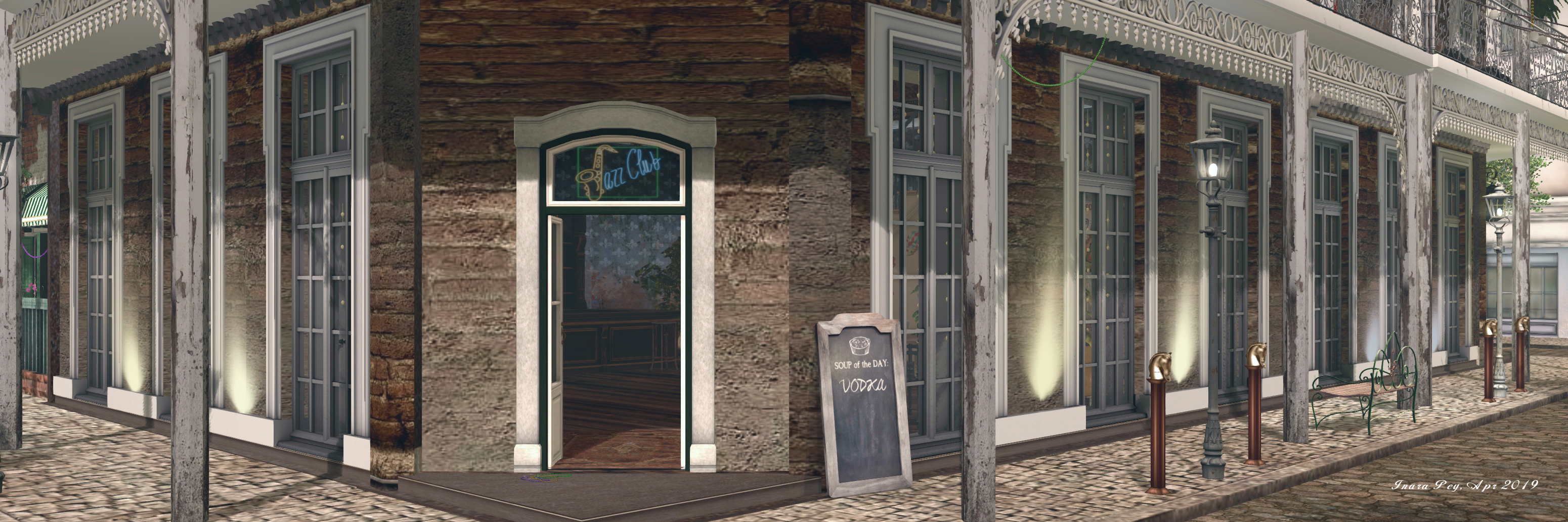
The latter is something of an image of New Orleans perhaps familiar to many from film and television: cobbled roads, balconied establishments whose interiors offer relief from the heat of the day. Cafés rub shoulders with jazz clubs, barbers shops, boutique stores and hotels. Grand houses can be found by wandering through the streets, while squares and formal gardens offer breaks from the urban tightness. To the north-west, the town gives way to a more bayou like setting, with mangroves and swampy-looking grass, while the graveyard betwixt town and bayou offers another “traditional” reflection of New Orleans and its oft-presented ties to voodoo and mysticism.

NOLA @ Fairhaven; Inara Pey, April 2019, on FlickrNOLA @ Fairhaven

The attention to detail within the town is impressive: many of the buildings have interior décor and furnishings, making them attractive points for exploration; several of the roads are lined with ornate, horse-headed bollards, reminding one of the city’s long history, while another reminder lines in the “river” separating the town from the eastern regions of the estate: a stern-wheeled paddle boat (the fabulous Dixie Belle by Analyse Dean), a rickety brow connecting her to an aged wharf where an old mill sits.

Across the water from the town, in the remaining two regions, things take a turn toward a more equatorial tropical feel, with the ground level of both regions styled into the undulating form of a surfer’s paradise. A rocky plateau, reached via the bridge mentioned above, provides a good vantage point as it looks eastwards over the sand and dunes, which in turn gradually narrow into a crooked finger curled around a bay into which white-capped waves roll.

NOLA @ Fairhaven; Inara Pey, April 2019, on FlickrNOLA @ Fairhaven

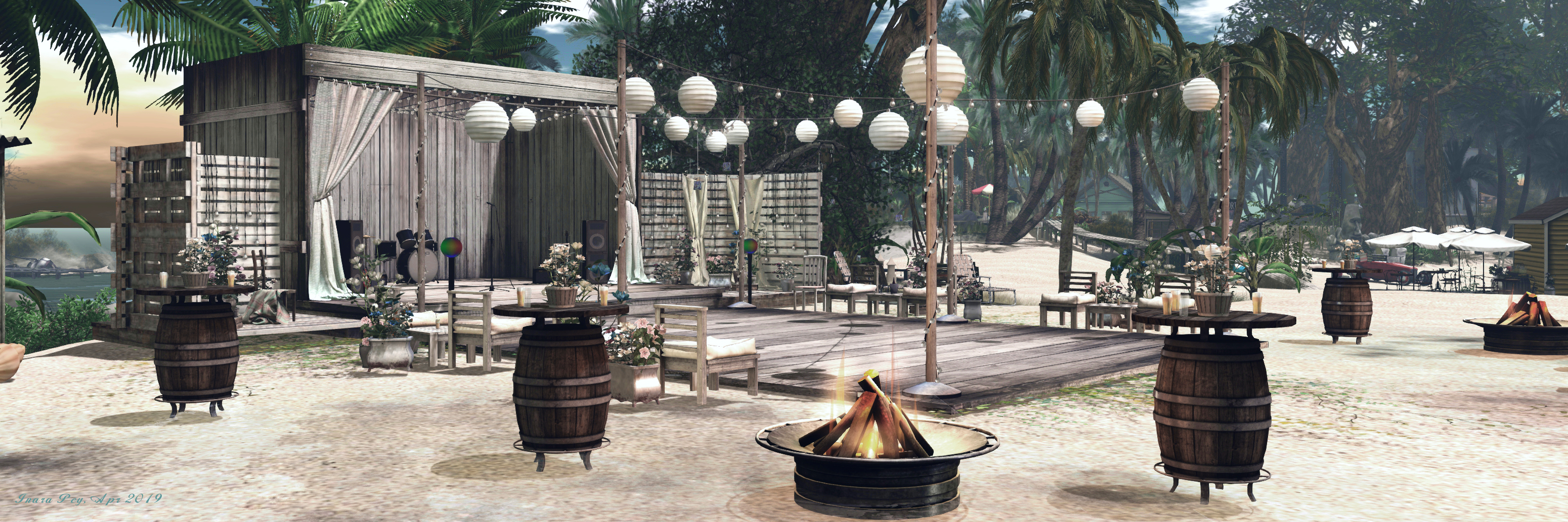
The uplands here are home to a lush area of trees, grass and plants, where an ancient ruins stands and a winding paths disappears through the trees. Touches of fantasy reside here, perhaps most notably in the form of the gondola held aloft by balloons, perhaps as much at home in the air as it might be on a river or canal. Further to the east, the beaches are naturally divided by trees and by raised board walks, with beach houses, shaded spots, lookout points and more scattered throughout.

Nor is this all; find the teleport boards (hard to miss out on the sands!) and you can be carried aloft to where the City of Fairhaven resides in the sky, another venue for music, exploration and photography. Here can be found an amusement park surrounded by trees, and what  – for me at least – is the biggest drive-in cinema screen I’ve come across in Second Life.

NOLA @ Fairhaven; Inara Pey, April 2019, on FlickrNOLA @ Fairhaven

As noted above, there is a lot going on across all three of these regions in terms of mesh, sculpties and textures, which can take its toll on a viewer’s performance (I had to disable shadows to walk comfortably, and even then, in places my viewer still had some issues). However, if you show patience and give things a chance, there is a lot worth seeing here.

Our thanks to Jus for the invitation to visit and explore.

NOLA @ Fairhaven; Inara Pey, April 2019, on FlickrNOLA @ Fairhaven

SLurl Details

  • NOLA and Fairhaven (Stratography, Stratography West and Stratography East, all rated Adult)