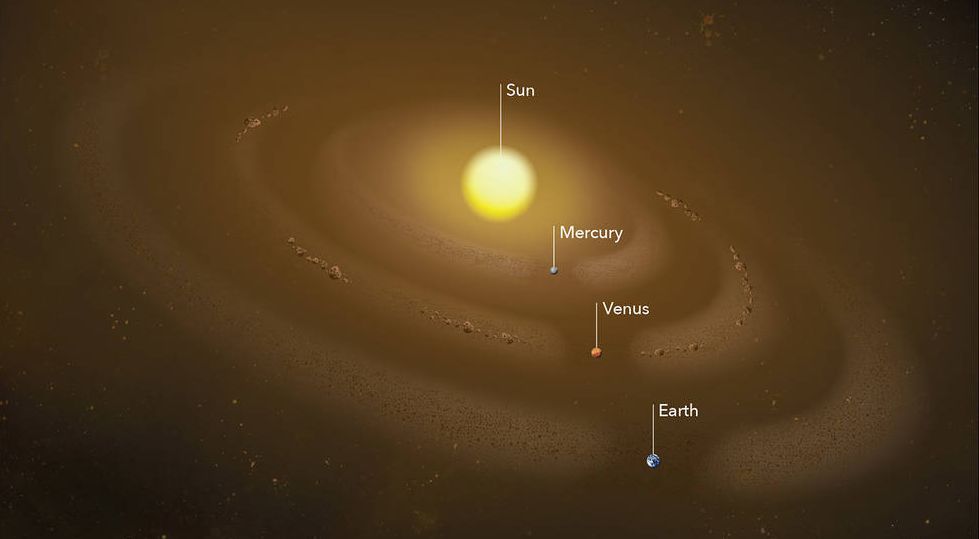
NASA’s Goddard Space Flight Centre / Mary Pat Hrybyk-Keith
We tend to think of the Earth orbiting around the Sun along a path largely free from debris. However, this is not strictly true. Twenty-five years ago, scientists discovered that Earth orbits the Sun along with a giant ring of dust which appears to have originated within the asteroid belt that lies between Mars and Jupiter. This belt is made up of millions of rocks of all sizes, many of which over the millennia crash into one another and grind together, producing a lot of dust. This gradually falls towards the Sun as a result of gravity – but along the way, some of it is influenced by the Earth’s gravity, becoming trapped along and either side of the Earth’s orbit, forming a ring.
Observations of Mars by NASA’s Maven orbiter have also given indications that the Red Planet could have a ring – or at least, a proto-ring – occupying its orbit, while 10 years ago, astronomers discovered a ring straddling the orbit of Venus. Now a new study reveals little Mercury has a ring of dust lying along its orbit – although by rights, it shouldn’t.
Mercury’s ring was discovered entirely by accident – ironically, those responsible for its discovery, Guillermo Stenberg and Russell Howard of Naval Research Centre in Washington, DC, were attempting to find a dust-free region that is thought to surround the Sun, created by solar energy radiating outwards from our star. The idea being that determining the size of this dust-free region would both reveal more about the nature of the Sun and the evolution of the solar system. But instead of locating this area of “empty” space, the astronomers discovered the ring sharing Mercury’s orbit.
People thought that Mercury, unlike Earth or Venus, is too small and too close to the Sun to capture a dust ring. They expected that the solar wind and magnetic forces from the Sun would blow any excess dust at Mercury’s orbit away.
– Astronomer Guillermo Stenberg
The two scientists worked with images from NASA’s STEREO solar observatory. This pair of satellites follow highly elliptical geocentric orbits. Over time, one of them pulls farther ahead of Earth while the other falls further behind. This means that together they provide stereo images of the Sun. In studying the images from the satellites, Stenberg and Howard noticed an area of enhanced brightness along Mercury’s orbit, indicative of a dust ring being present.
The question is – how did it form? There’s no answer to this yet; as Stenberg notes, the ring shouldn’t be there, and the lesson of Venus has revealed that it’s better not to assume common factors in the formation of these rings.
This is because initially, it was assumed the ring around Venus was the result of the same gravitational forces that have created the dust ring along Earth’s orbit. However, when astrophysicists Petr Pokorny and Mark Kuchner from NASA’s Goddard Space Flight Centre attempted to use extensive computer modelling to try to reproduce a dust ring matching the one in Venus’ orbit, they were unable to do so.
As a result, the two started researching and modelling possible explanations, and in a paper published on March 12th, 2019, the two suggest that the Venusian ring is the result of a previously undiscovered group of asteroids occupying the same orbit as Venus with a 1:1 resonance (that is, they complete one orbit of the Sun for every orbit Venus makes). Further, their research suggests that the group of asteroids are the remnants of a much larger asteroid ring that existed when the solar system was born.
The asteroid themselves have yet to be located – no easy task, assuming they do exist, as the Venusian dust ring is 25.5 million km (16 million mi) deep, and 9.6 million km (6 million mi) across, and bright enough to hide larger objects within it. However, if the asteroid are discovered, they would not only confirm the theory about how the dust ring around Venus’ orbit formed, but also hold clues to how the solar system formed.
Further SLS Changes
In my previous Space Sunday report, I covered the announcement by NASA that suggested the Space Launch System rocket might have its initial launch delayed. Now it seems the system is to undergo further changes to both its initial flights and its future development.
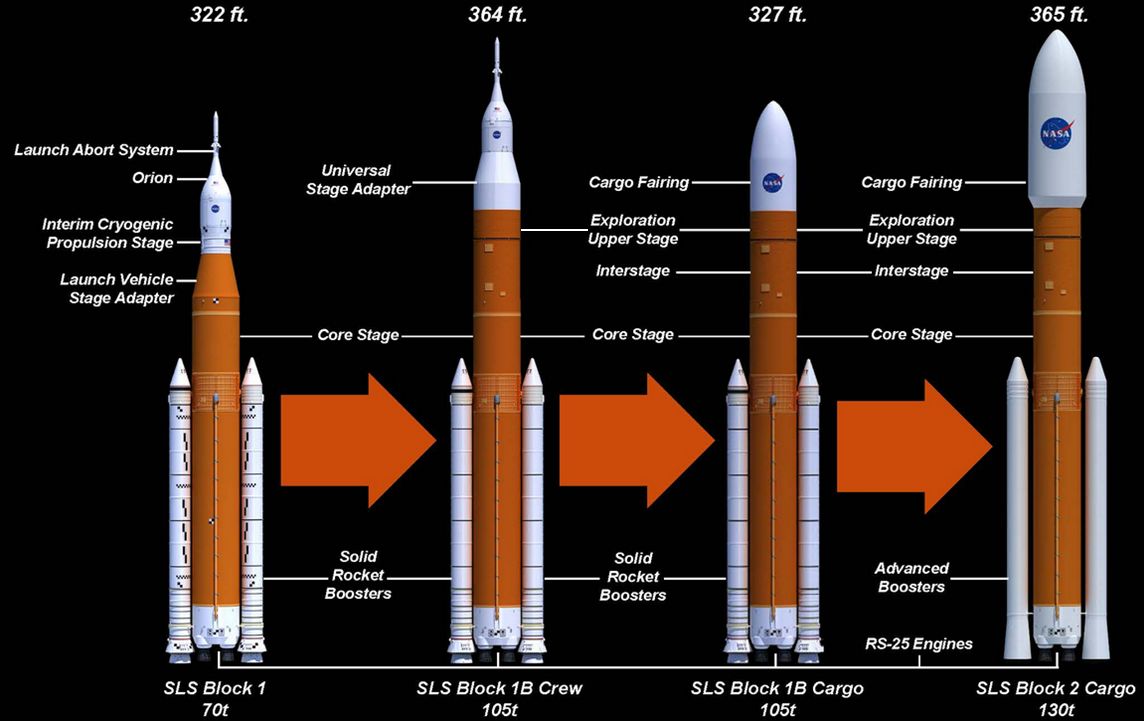
As it was originally planned, the SLS was to have been initially launched in its Block 1 configuration. This would see the vehicle use what is called the Interim Cryogenic Propulsion Stage (ICPS) as its upper stage. After that, launches would switch over to using the Block 1B version, intended to use a more powerful upper stage called the Exploration Upper Stage (EUS), being built by Boeing Aerospace.
Given issues with the development of the EUS, in late 2018 NASA announced the first two SLS launches, referred to as EM-1 and EM-2, and designed to send a Orion vehicle on a month-long trip around the Moon, the first uncrewed, the second crewed, will utilise the Block 1 version of the rocket, with flights thereafter shifting to the Block 1B rocket to undertake tasks such as launching elements of the Lunar Gateway. Now, under the Trump Administration’s 2020 budget request, it appears the introduction of the EUS is to be deferred – possibly indefinitely, with NASA ordered to carry out all initial flights using the Block 1 variant of the rocket.

While the ICPS stage is more than sufficient to achieve the objectives established for EM-1 and EM-2, it is not powerful enough to meet all of the demandd of the proposed Lunar Gateway development. Instead, NASA is expected to supplement SLS flights to build the Gateway with the use of commercial launch vehicles, such as the United Launch Alliance Delta V, the SpaceX Falcon Heavy and – potentially – Blue Origin’s New Glenn.
Continue reading “Space Sunday: dust, rockets, landers and a last image”






 Inara Pey: Living in a Modemworld