The Galleries, curated by Ernie Farstrider is an extensive gallery complex ideal for those wishing to explore many of the rich facets of art in Second Life. As I last wrote about the complex nearly a year ago, I thought it about time I talked a little more about it, this time taking a look at the Ground level facilities of The Galleries Museum.
Modelled on New York’s Solomon R. Guggenheim Museum, designed by the legendary Frank Lloyd Wright, the building is very much a gallery space, despite the “museum” in the title, and at the time of my visit had just opened a new exhibition of art by Violetta Carolina, who returns to the gallery for the first time in five years.
The exhibit features Violetta’s 2D the 3D art, the former presented as a series of bold paintings, rich in colour, leaning towards an abstract look, but each piece individually striking in tone and look. With a distinctly modern cast to them, the sculptures offer both contrast and compliment to the 2D pieces, making this an unusual (in the positive sense of the word) and imaginative exhibit.
Beyond it, in the great atrium section of the building, are exhibition spaces given over to multiple artists, all of which can be toured by climbing the familiar ramp up from the lowest level (or, if you prefer, but taking one of the elevator teleport to the uppermost level and then winding your way back down).
The atrium provides space for at least eight artists on the ramp itself, with additional space on the lowest level, and the range of large on display mixes images captured in-world and creations from the physical world uploaded for display in Second Life. I’m not going to offer a cast list of artists exhibiting their work at the time of my visit, simply because I’m not sure how quickly displays change, and all too often such lists can look more like the reading a cast list. However, I did enjoy seeing images by Graham Collinson, and Kayly Iali during my visit, as I’ve always enjoyed their work.
Located outside the front of the building is a teleporter that will carry visitors up to the sky complex of galleries, where a further exploration of art can be enjoyed – see my review from October 2017, but please keep in mind the artists on exhibition may well have changed.
Team Diabetes of Second Life has announced the 2018 fund-raising season. Founded in 2015 by Jessi2009 Warrhol and John Brianna (Johannes1977 Resident), Team Diabetes of Second Life is the official and authorised team of the American Diabetes Association in SL.
Their mission is to raise awareness, tolerance, and funds for diabetes in the virtual world of Second Life. According to the World Health Organisation in 2016 some 422 million adults in the world have diabetes and 1.5 million deaths are directly attributed to diabetes each year.
The 2018 Team Diabetes of Second life season will run from October through to December, with the following events scheduled to take place:
October 19th though 27th: Scare Me Silly Shopping Event and Autumn Art Show(off-season event).
November 1st through 30th: National Diabetes Month, featuring:
November 1st through 30th: The Red Hunt.
November 3rd: The Red Ball.
November 14th: World Diabetes Day.
November 12th: The Red Ball.
November 30th to December 9th: Winter Showcase & Winter Art Show.
December 31st, 2018: Team Diabetes of Second Life’s Season Ends.
Scare Me Silly and Autumn Art Show
Scare Me Silly is an annual event taking place around Halloween. It features live performances. DJ parties, a hunt and a quest, tricks and treats, a haunted mansion, ghostly rides and – of course – shopping!
Merchant registrations for the event are now open, and the application form, with guidelines and terms can be found here.
The Autumn Art show will take place at the same time as, and alongside of, Scare Me Silly. Registrations are also open to both 2D and 3D artists are invited to apply. The application form, with guidelines and terms can be found here.
About the American Diabetes Association
Established in 1940, the American Diabetes Association is working to both prevent and cure diabetes in all it forms, and to help improve the lives of all those affected by diabetes. It does this by providing objective and credible information and resources about diabetes to communities, and funding research into ways and means of both managing and curing the illness. In addition, the Association gives voice to those denied their rights as a consequence of being affected by diabetes.
About Team Diabetes of Second life
Team Diabetes of Second Life is an official and authorised fund-raiser for the American Diabetes Association in Second Life. Established with the aim of raising funds in support of diabetes treatment and to raise awareness of the disease in SL, Team Diabetes of Second Life was founded by Jessi2009 Warrhol and John Brianna (Johannes1977 Resident), who serve on the Advisory Board along with Eleseren Brianna, Veruca Tammas, Rob Fenwitch, and Dawnbeam Dreamscape.
Logos representative only and should not be seen as an endorsement / preference / recommendation
Updates for the week ending Sunday, September 23rd
This summary is generally published on every Monday, and is a list of SL viewer / client releases (official and TPV) made during the previous week. When reading it, please note:
It is based on my Current Viewer Releases Page, a list of all Second Life viewers and clients that are in popular use (and of which I am aware), and which are recognised as adhering to the TPV Policy. This page includes comprehensive links to download pages, blog notes, release notes, etc., as well as links to any / all reviews of specific viewers / clients made within this blog.
By its nature, this summary presented here will always be in arrears, please refer to the Current Viewer Release Page for more up-to-date information.
Note that test viewers, preview / beta viewers / nightly builds are not recorded in these summaries.
Official LL Viewers
Current Release version 5.1.8.518593, dated August 14th, promoted August 20th. Formerly the SL Voice RC viewer – No Change.
Update: Zone One has closed. SLurls have therefore been removed from this article.
Lam Erin is a skilled Second Life photographer perhaps most noted for his landscape work, which has captured and uniquely accentuated many a region for posterity. Given his skill and eye, it should come as little surprise that were he to turn his attention to region design, he’d produce something equally as eye-catching as his art.
And thus it is with Zone One, the full region that is also the home of Lam’s Soul Identity store and Ohemo. We’ve been watching the development of the ground level of the region since work started in about June 2018, and have made several visits over the last few months to witness how things have grown, which itself has been intriguing to watch.
Zone One
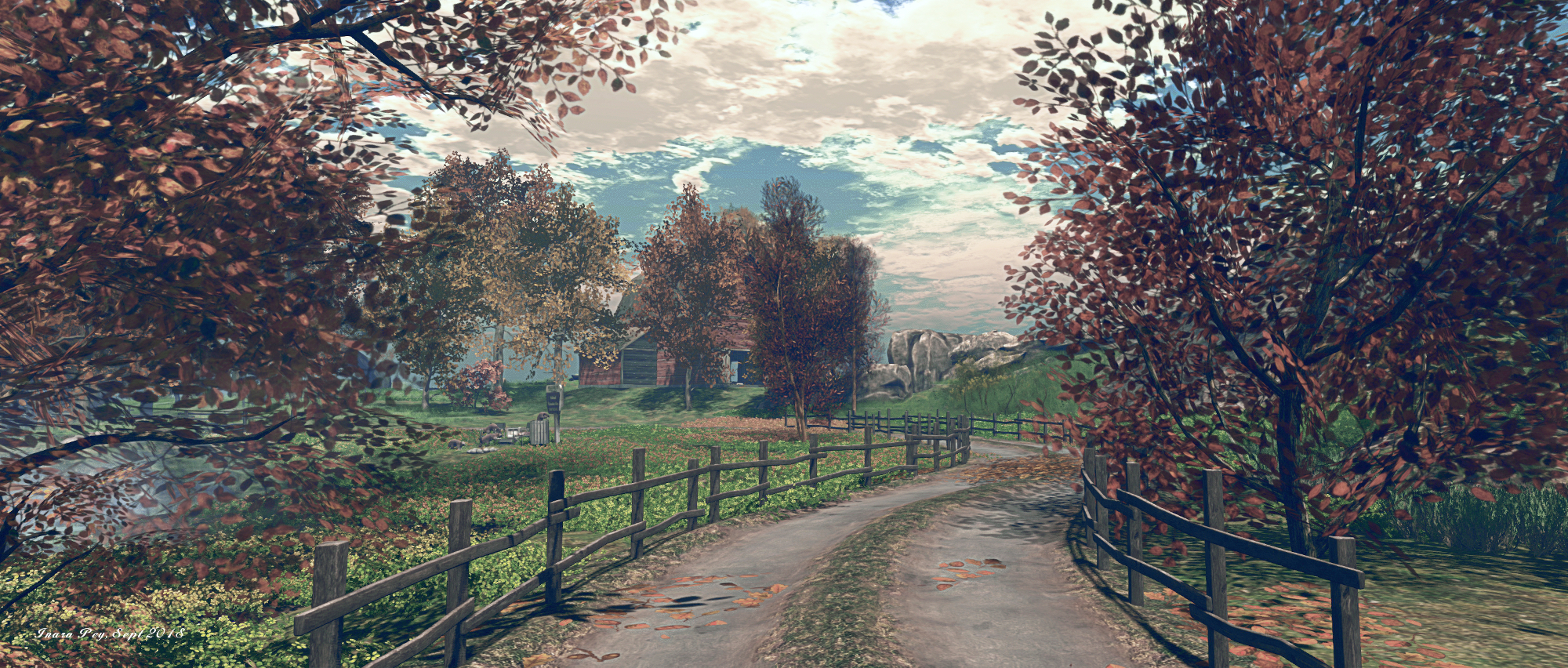
There is no set landing point, so I’ve arbitrarily selected one alongside the landmark giver for the region. This should also double as a teleport to the two stores, but at the time of our most recent visit in September, it didn’t appear to be working. The sign sits alongside a single road that almost circles the land, roughly following the line of an inlet slicing its way inwards from the east side of the region.
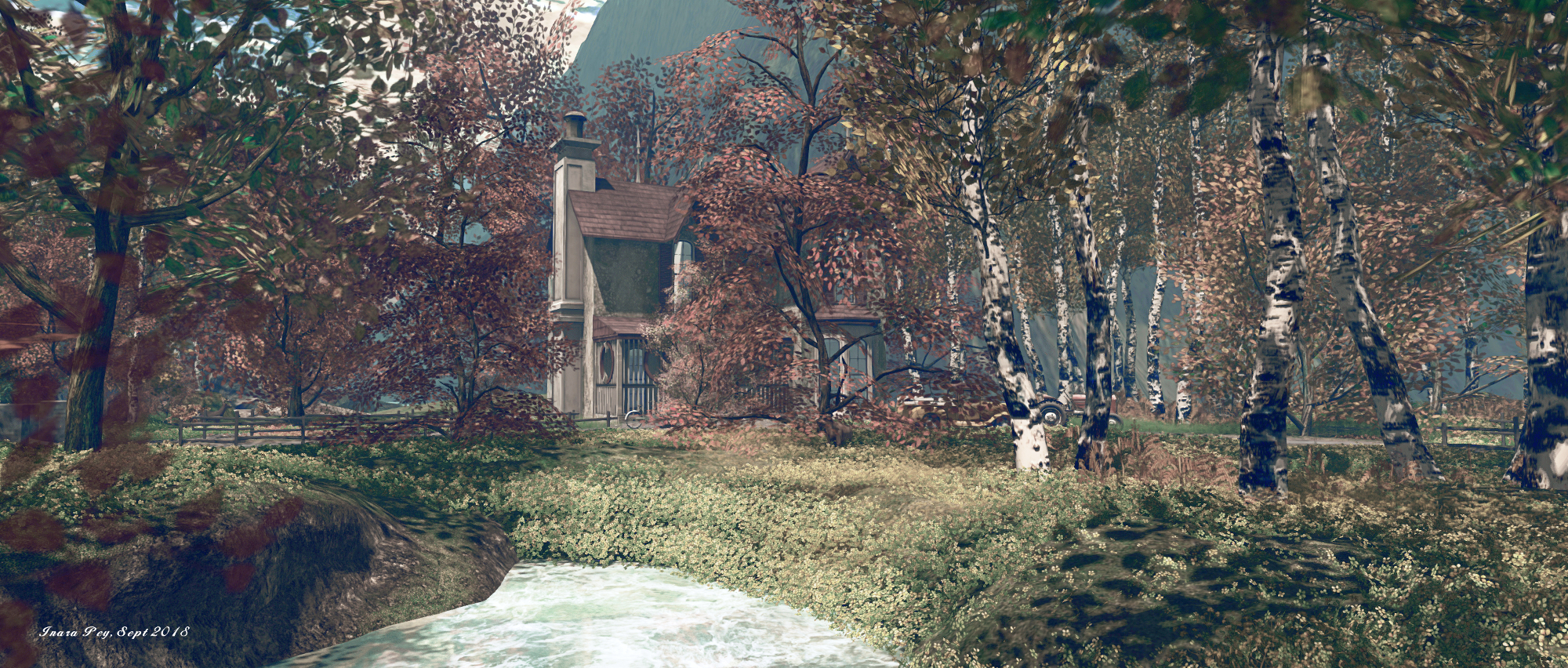
Alongside the inlet and along the road sit a number of houses, surrounded by trees that, in keeping with the time of year during our last visit, are heavy with leaves turning to the colours of autumn. All but one of them are unfurnished, which did have me wondering if more work is yet to come with things. But even unfurnished, each house has its own character, thanks to both its setting and the décor placed around it, allowing each to be used as a photographic backdrop with it’s own look and feel.
Zone One
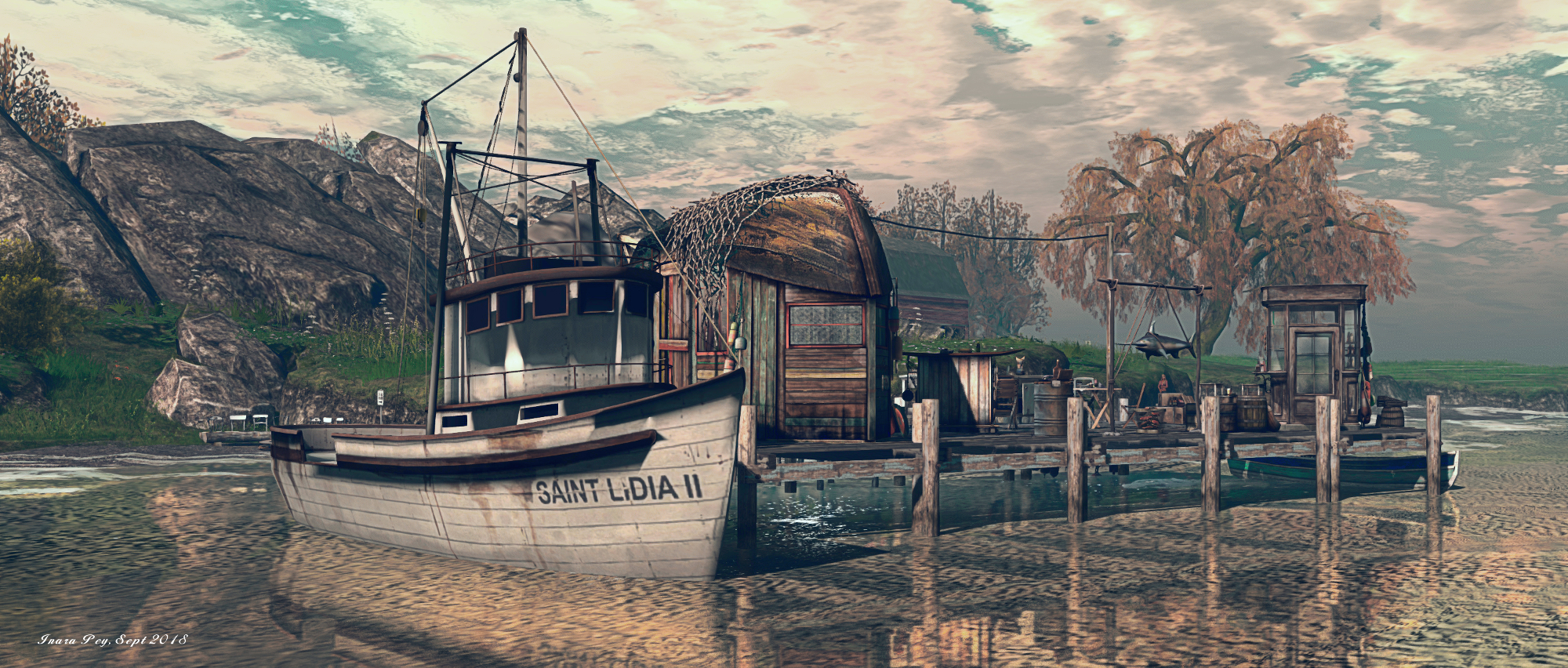
Follow the road south and west from the landing point, and it will point you to where a little wharf sits just offshore and connected to a cinder beach by a raised wooden board walk stretching over the shallow water. Reached via a short walk over grassland after the road has come to an end, it is the home to, among other things, a ramshackle fish and chips shop where one might assume the fish is super fresh, given the little trawler tied up alongside.
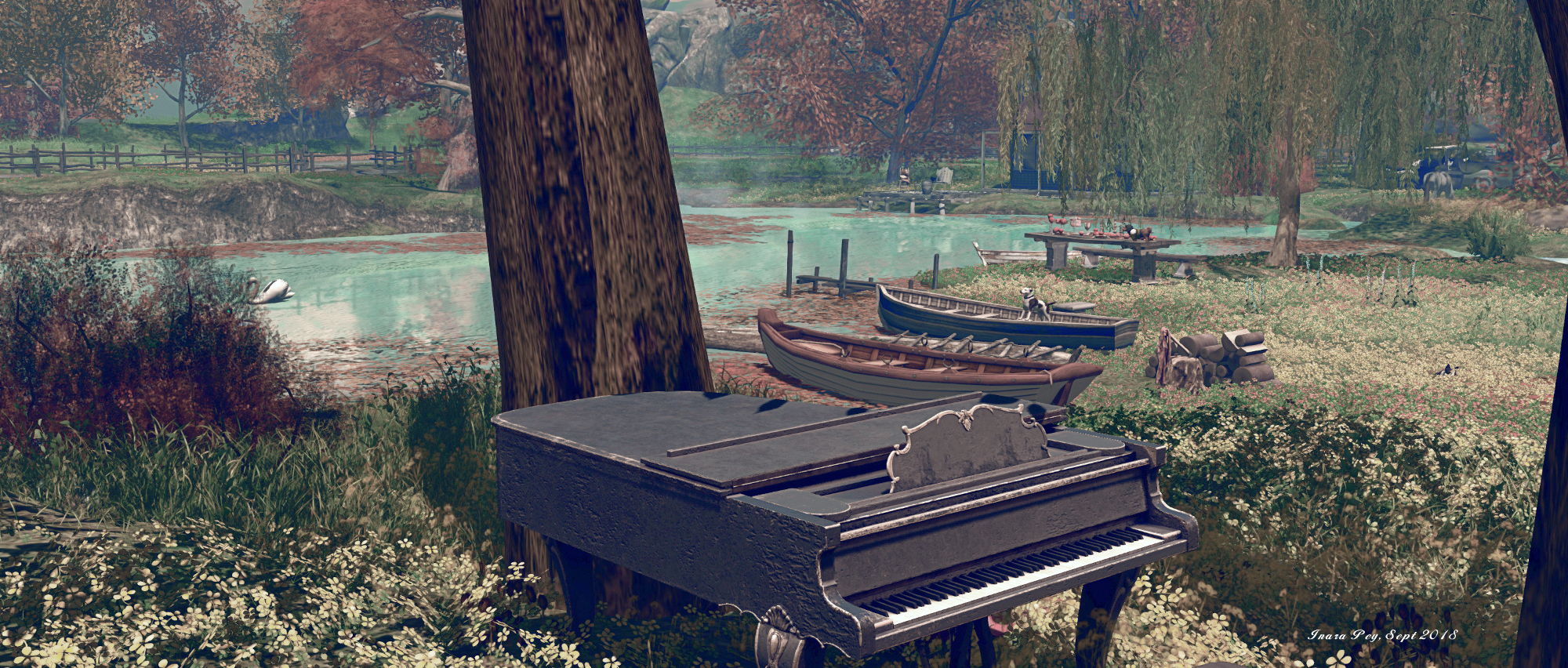
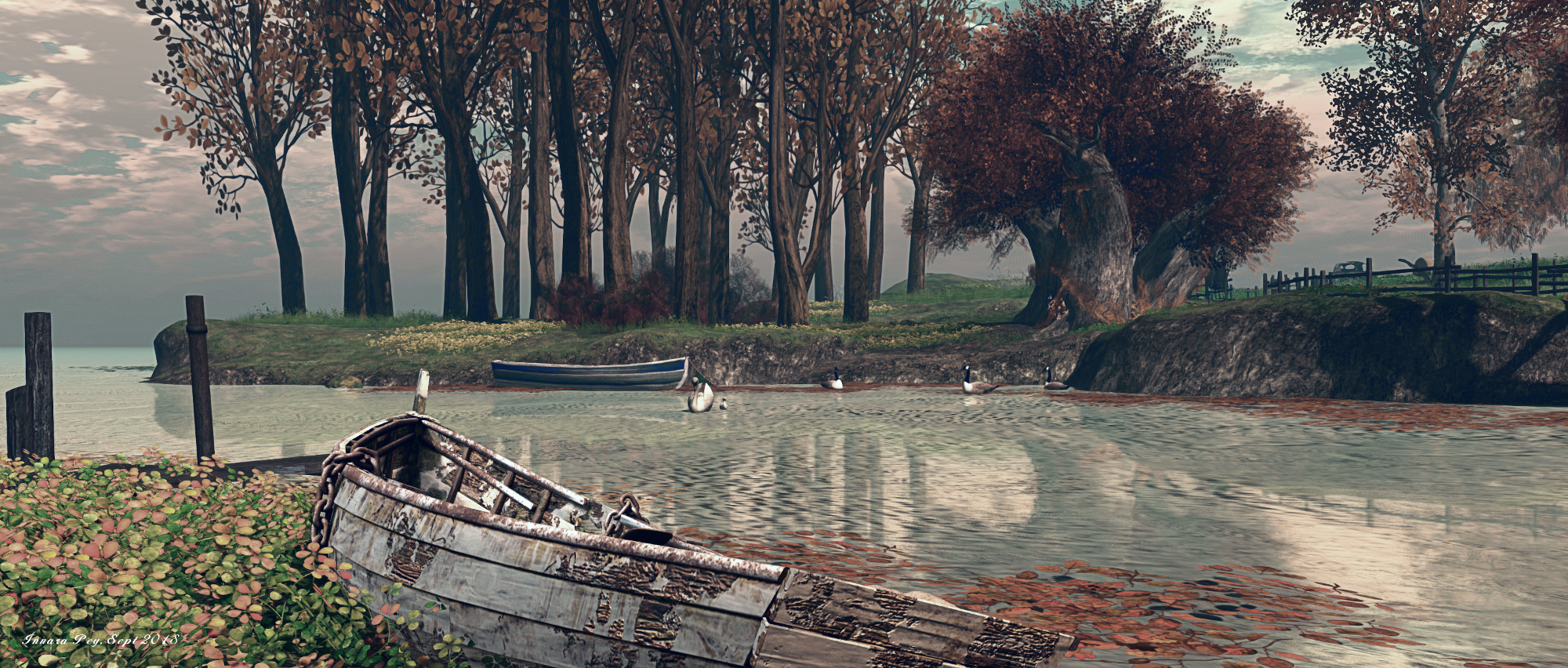
The inlet pushing into the middle of the region offers a pleasant place to tarry. wild flowers grow along the high banks, while on the water swans and ducks paddle and rowing boats offer places to sit and cuddle. A bench has been set with fresh apples to eat and goblets from which to enjoy a drink, but it would seem one of the region’s four-footed denizens appears to have had a little fun on the bench top – possibly in revenge for what he’s (or she’s) having to wear.
Zone One
Zone One is a genuinely peaceful setting, offering plenty of opportunities for photography. You can join the local group to obtain rezzing rights for props, but please be sure to pick them up afterwards. It’s also a setting in which time can just be idled away, and it’s nice to see some of the décor includes sit options for “friends” as well as “singles” and “couples” – a small detail that can make a place that much more welcoming when exploring with a friend.
So, for those looking for an easy-to-explore photogenic location, Zone One is ready for your visit.
In September 2017, Dixmix Source opened DiXmiX Gallery (read here for more). Since then, the gallery has run a series of exhibitions, running on roughly a monthly basis, featuring some of Second Life’s most impressive artists from across the grid.
To celebrate the gallery’s first anniversary, Dixmix held a special party on Saturday, September 22nd, 2018, which including the opening of the latest exhibition, featuring images by Harbor (Harbor Galaxy), Maloe Vansant and Isa Messioptra. All three are making a return to DiXmiX gallery, and between them present an intriguing – some might say disturbing, in places – series of studies, some of which appear to have come as much from the physical world as from Second Life.
The majority of the images are close-up studies, rich in emotional content and expressiveness, each with a story to tell. Some do involve nudity, and should be considered NSFW. All and carefully framed to ensure our focus is solely on the subject of the image, and unlikely to be distracted by sundry elements of their surroundings.
Such is the evocative nature of all three displays,that singling out individual images proved difficult; all three artists have sought to convey feelings through their selected images, and each display deserves to be seen in its own right, and the images I offer here are purely to encourage you to pay a visit for yourself.
As a part of the new season – but not yet in use – The Womb, the underground display area at DiXmiX has been re-developed. “It’s now an 8,000 square metre black room,” DiXmiX informed me during my visit. “We will have new installations there,” he continued, “Alo [Aloisio Congrejo] will be first in there, in October, and then Nevereux.”
I look forward to seeing the installations of both, and in the meantime, the current exhibition will run through until into October.
The updated BFR / BFS combination, as revealed on September 17th, 2018. Credit: SpaceX
On Monday, September 17th, SpaceX CEO, Elon Musk, provided an update on the company’s massive Big Falcon Rocket (BFR) and Big Falcon Ship (BFS – previously referred to simply as “the ship” or “the spaceship”), and revealed the first fare-paying passenger who will supposedly fly around the Moon aboard a BFS some time in the 2020s.
BFR has been in development since 2012/13. Designed to be fully reusable, it was initially referred to as the Mars Colonial Transport (MCT) – reflecting the company’s intention to use it to send humans to Mars. In 2016, SpaceX revealed the first formal design for the vehicle, which had been renamed the Interplanetary Transport System (ITS) to reflect the fact it could fulfil a number of roles. At that time, the vehicle – comprising a first stage booster and upper stage starship – was to be a 12 metre (39 ft) diameter, 122 m (400 ft) tall monster. By 2017, it had been renamed the BFR (for “Big Falcon Rocket”), and redesigned to be 9 m (29.5 ft) in diameter and 106 m (347 ft) tall.
With the 2018 presentation, Musk revealed further design changes to the system, most notably with the upper stage spaceship, the BFS, some of which give it very retro rocket ship look.
Left: The evolution of the BFR from 2016 (as the ITS) to 2018; renderings via the Everyday Astronaut. Right: an animated comparison between the 2017 BFS and the 3-finned 2018 variant (from an idea by Overlook Horizon).
In particular, the BFS now sports three large fins at its rear end. All three are intended to be landing legs – the BFS being designed to land vertically – with two of them actuated to move up and down as flight control surfaces during atmospheric decent. These are matched by two forward actuated canards, also designed to provide aerodynamic control during a descent through an atmosphere.
Two less obvious changes are an increase forward payload section and the design of the nose area of the vehicle, which includes a much larger forward “canopy” design than previous iterations, and an update to the BFS’s motors. Originally designed to be powered by 7 of the new SpaceX Raptor engine optimised for vacuum operations, the BFS will now initially be powered by seven of the same Raptor motors that will be used on the vehicle’s first stage (which uses a total of 31), optimised for thrust in an atmosphere.
The redesigned BFS includes new fore and aft actuated control surfaces for atmospheric entry, and an enlarged crew / cargo space. Credit: SpaceX
Elements of the first BFR system have been under construction for the last 12-18 months. These include one of the fuel tanks, and the initial hull rings, and Musk claims that the company hope to have the first BFS prototype ready for initial “hopper flights” – lifting itself off the ground under thrust and then landing again – by the end of 2019. SpaceX then plan to run high altitude testing of BFS in 2020, together with initial flights of the core stage as well.
Overall, the goal is to have the first BFR / BFS combination ready for orbital flight tests in 2021, building towards the flight around the Moon, which the company has earmarked for 2023.
The first completed cylinder section of the prototype BFR. just visible to the left is a part of one of the tanks that will eventually go inside the vehicle. Credit: SpaceX via The Independent
This is an incredibly ambitious time frame, one most unlikely to be achieved. SpaceX would appear to have some significant engineering challenges to overcome. For example, by combining the landing legs with control surfaces, how are they going to ensure the craft can land sufficiently gently on another surface without damaging the mechanisms designed to move the fins, which will be required when the vehicle returns to earth.
While there was always a risk that landing struts (as were originally going to be used with BFS) might suffer damage as a result of a “hard” landing on the Moon or Mars, integrating landing systems into surfaces vital to the vehicle’s (and a crew’s) safe return to Earth as planned by SpaceX, would appear to add further complexity to the vehicle – or call for contingencies to be able to transfer a returning crew to another vehicle on their return to Earth orbit should one of systems use to actuate the fins suffer damage when landing on the Moon or Mars.
Another view of BFS showing the seven Raptor engines and the additional cargo bays at the rear of the vehicle. This configuration assumes the Raptor engines are the same as those used on the core stage, although the new design means BFS can be equipped with vacuum optimised motors, with larger exhaust bells (with the removal of the ring of cargo bays) to offer better performance in space. Credit: SpaceX
Another of the questions from where is BFR is likely to be launched. When initially revealed with a 12-metre diameter, it required a purpose-built launch facility. But with the core now reduced to a 9 metre diameter, BFR could in theory be launched from the SpaceX facilities at Launch Complex 39A, Kennedy Space Centre (KSC), Florida.
More particularly is the entire question of whether or not such a behemoth is really commercially viable. Payloads are getting progressively smaller, lighter and more capable; SpaceX itself is transitioning its Flacon 9 flights to a mix of dedicated launches and “transporter” (more usually called “rideshare”) launch, combining several customers into one launch, thus lowering the cost per customer.
That’s fine for a vehicle with an all-up semi-useable payload capacity of around 15-16 tonnes, it only takes perhaps a third of that capacity to reach the point where the launch is revenue-earning and the lead time for customers seeing their satellites in space is relatively short. But multiply that out to the scale of Starship, ad the lead-time in getting sufficient customers to fill the a vehicle even one-third full in order to lift income sufficiently over launch costs (assuming the new vehicle is as low-cost as Falcon 9) could be a real problem.
In discussing plans, Musk revealed a final decision on BFR launch facilities has yet to be made, and hinted it might even initially fly from a floating platform. This was an idea first put forward in one of the company’s promotional videos for the system, suggesting it could fly up to 100 people between New York City harbour and Shanghai harbour in 40 minutes. This, simply put, will not happen – because the idea doesn’t work either economically or practically.






 Inara Pey: Living in a Modemworld