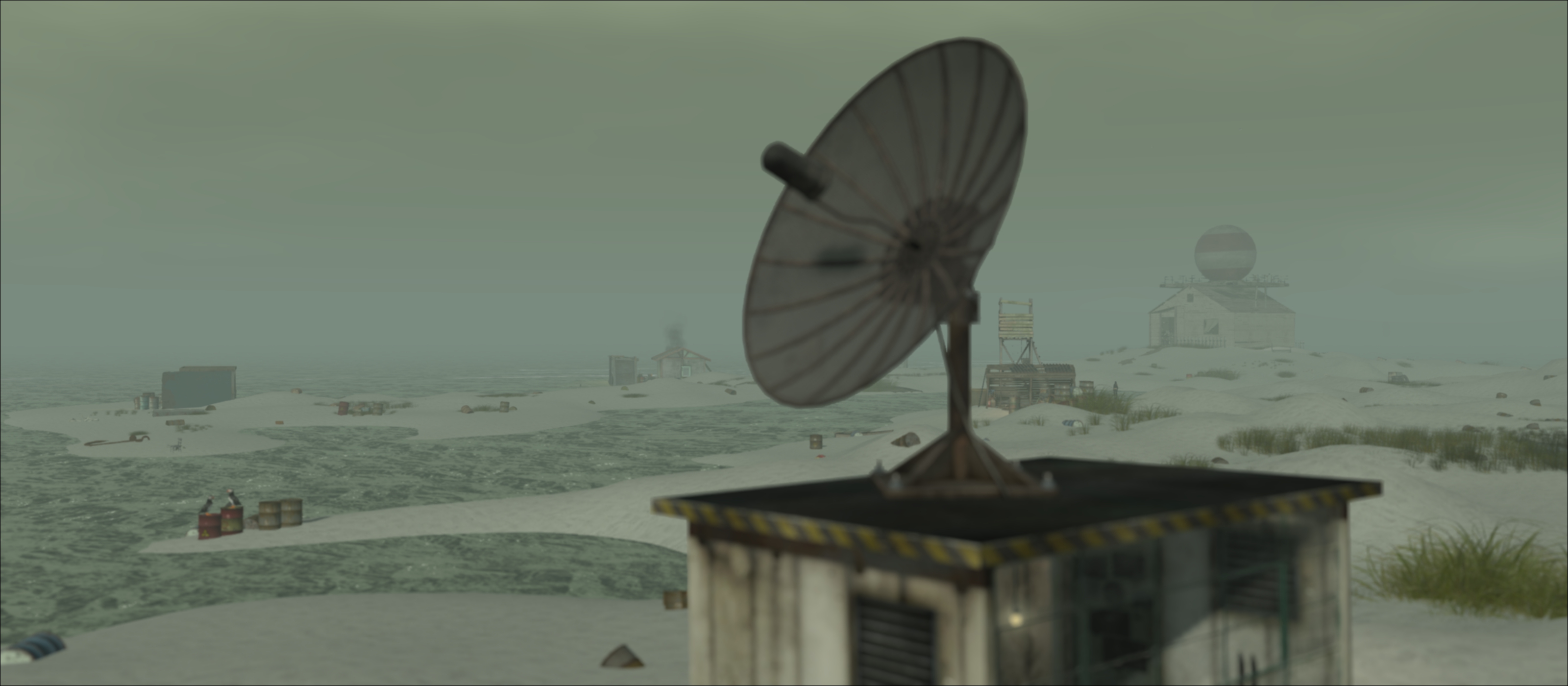
Khodovarikha’s lonely beauty in Second Life

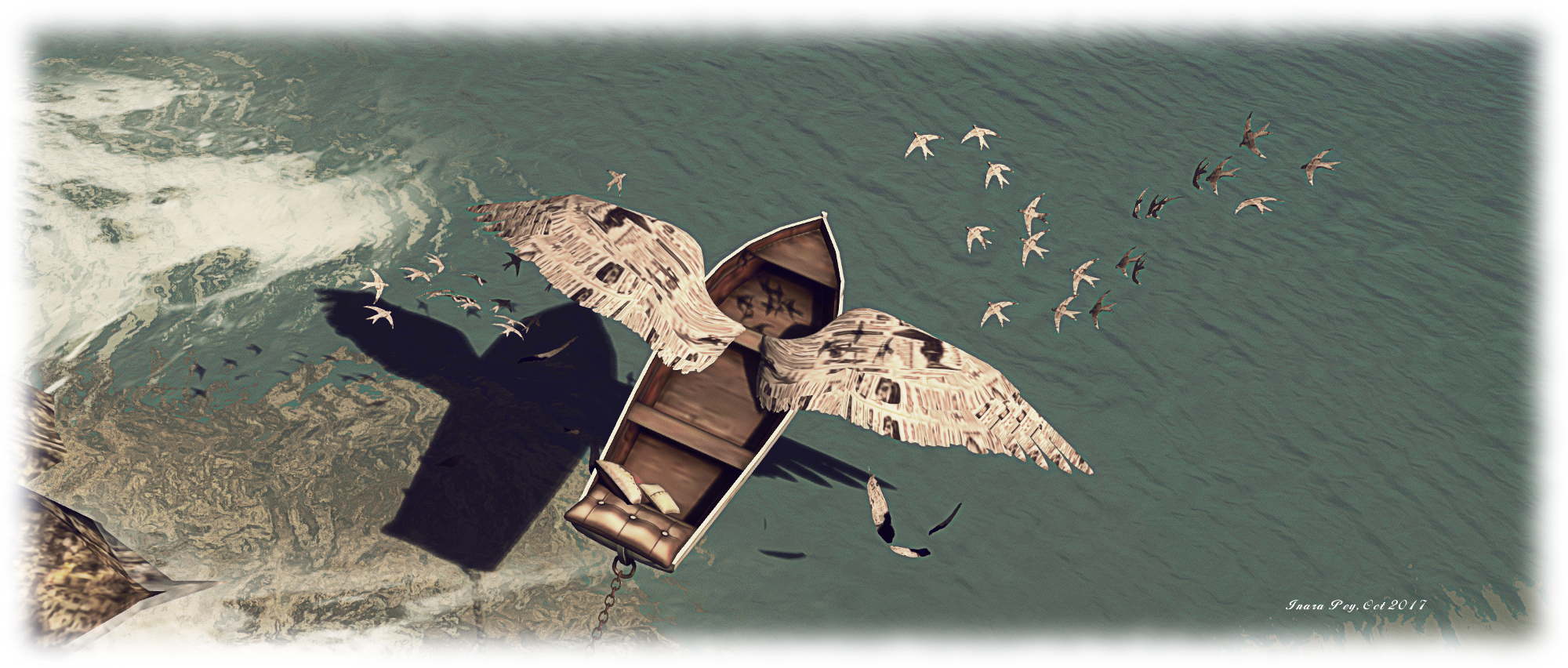
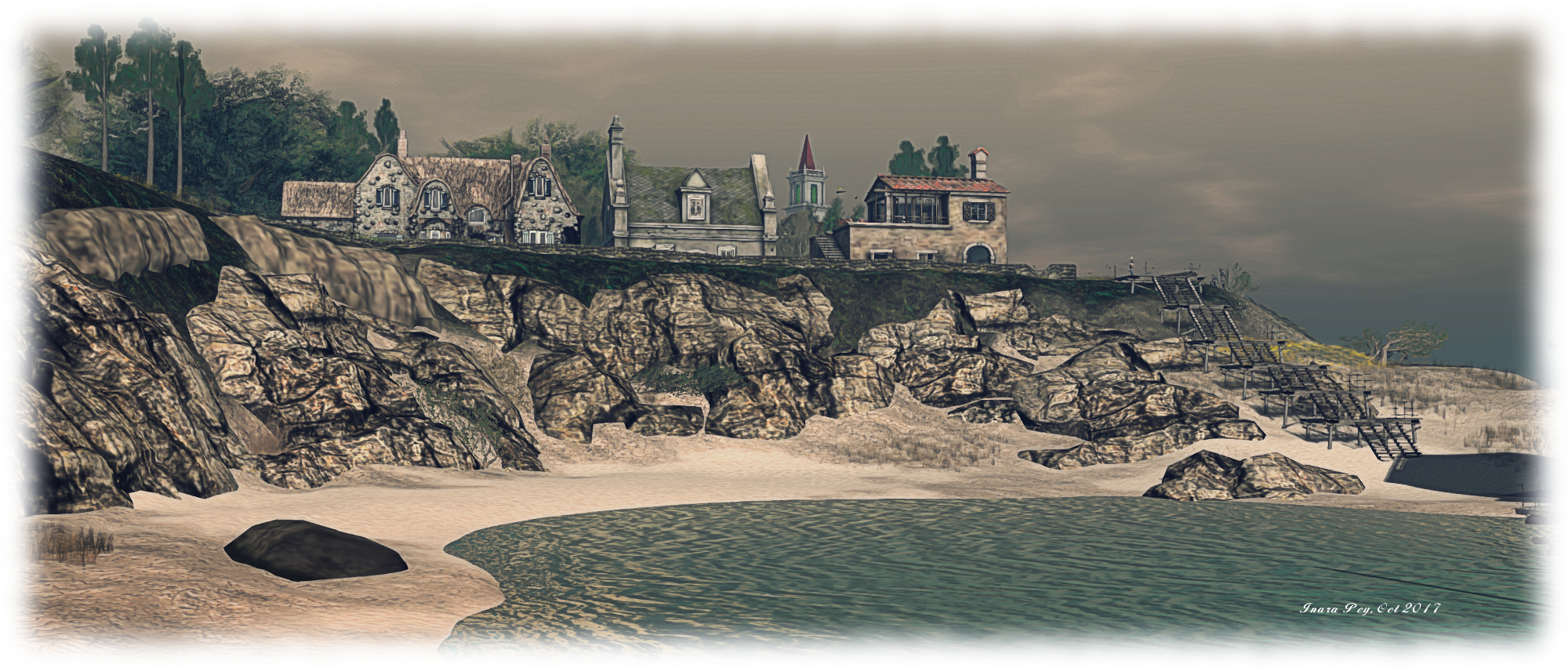
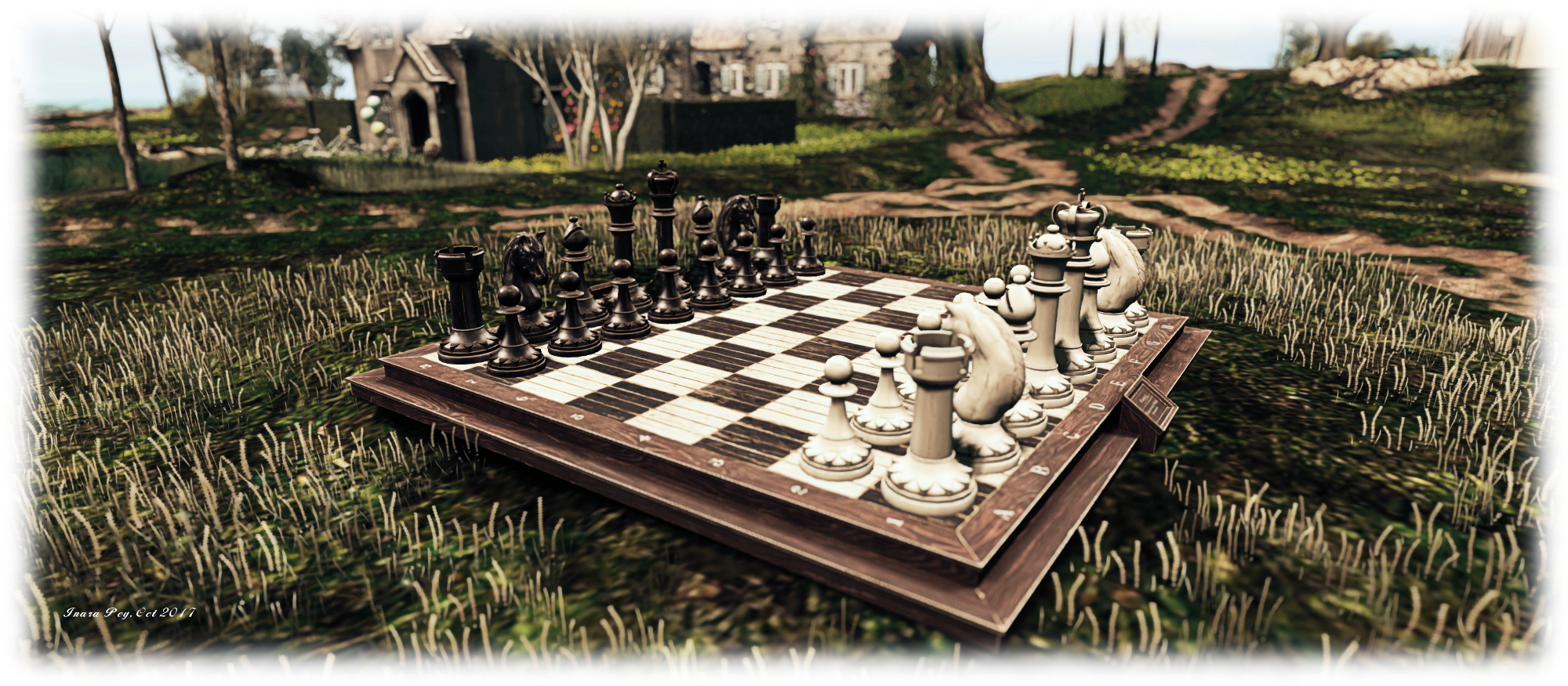
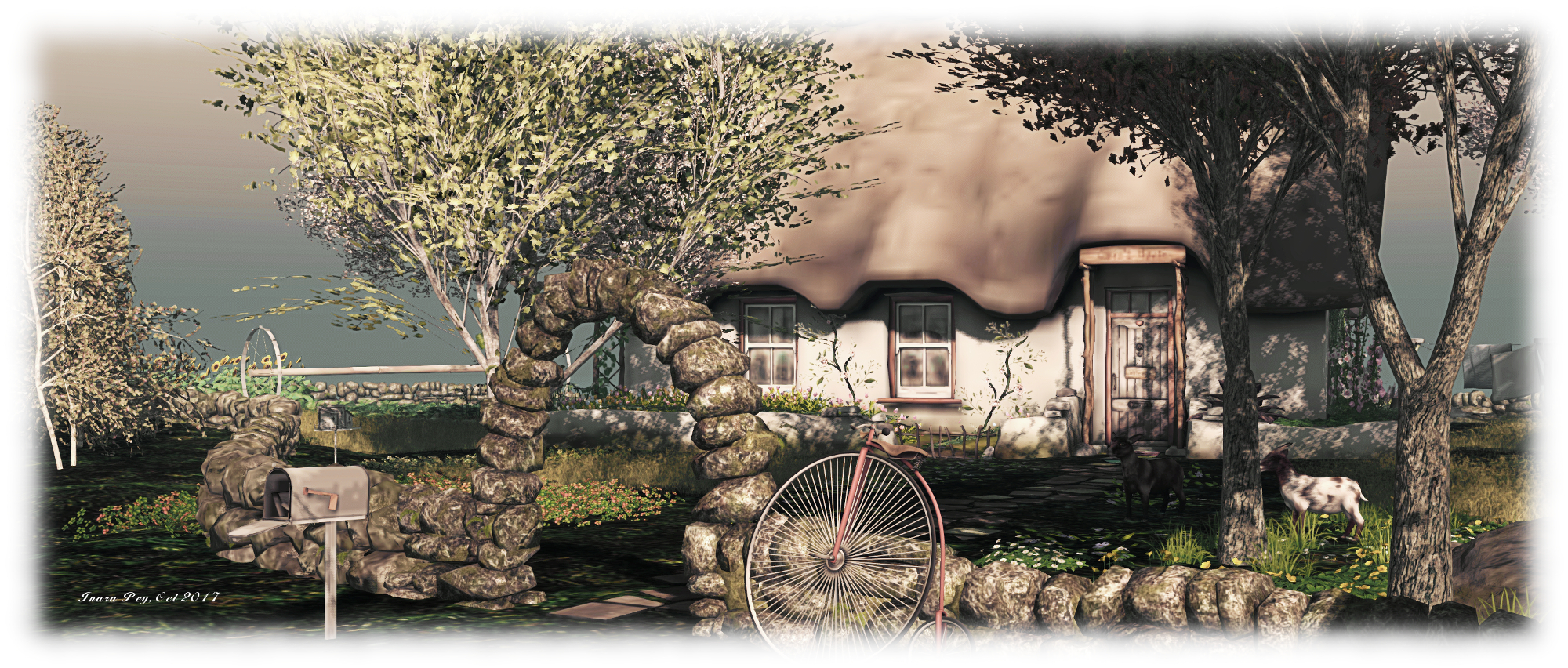
Khodovarikha; Inara Pey, October 2017, on Flickr Khodovarikha – click any image for full size

Serene Footman, the man behind Furillen, (see here, here and here for more) and La Digue du Braek (see here) opened a further region in August 2017. Once again it is an atmospheric setting based on a location in the physical world.

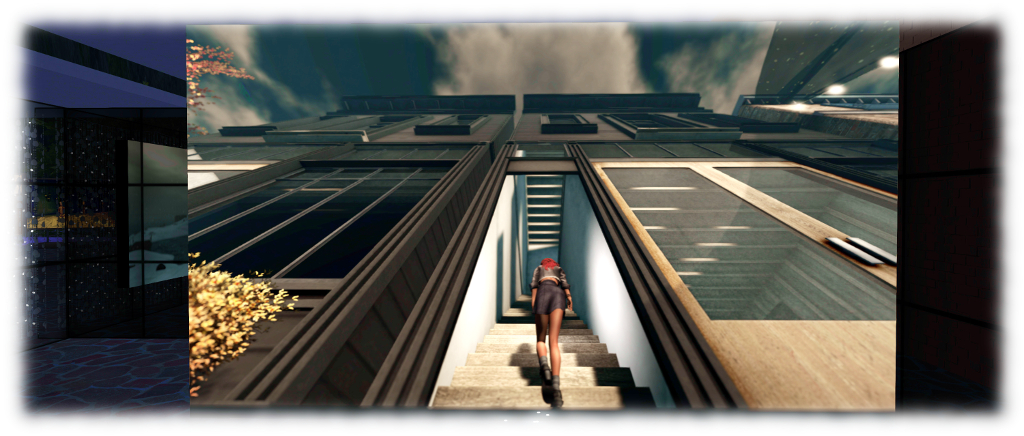
Khodovarikha, a Homestead region, is modelled after the spit of land going by the same name which projects eastwards into the Pechora Sea off the coast of north-west Russia. As you might expect from this description, it is a lonely and desolate place – and such places hold an appeal with Serene. In 2015, the area was the focus of a Russian Television documentary, Arctic Limbo, and this appears to have served as Serene’s inspiration in designing the region.
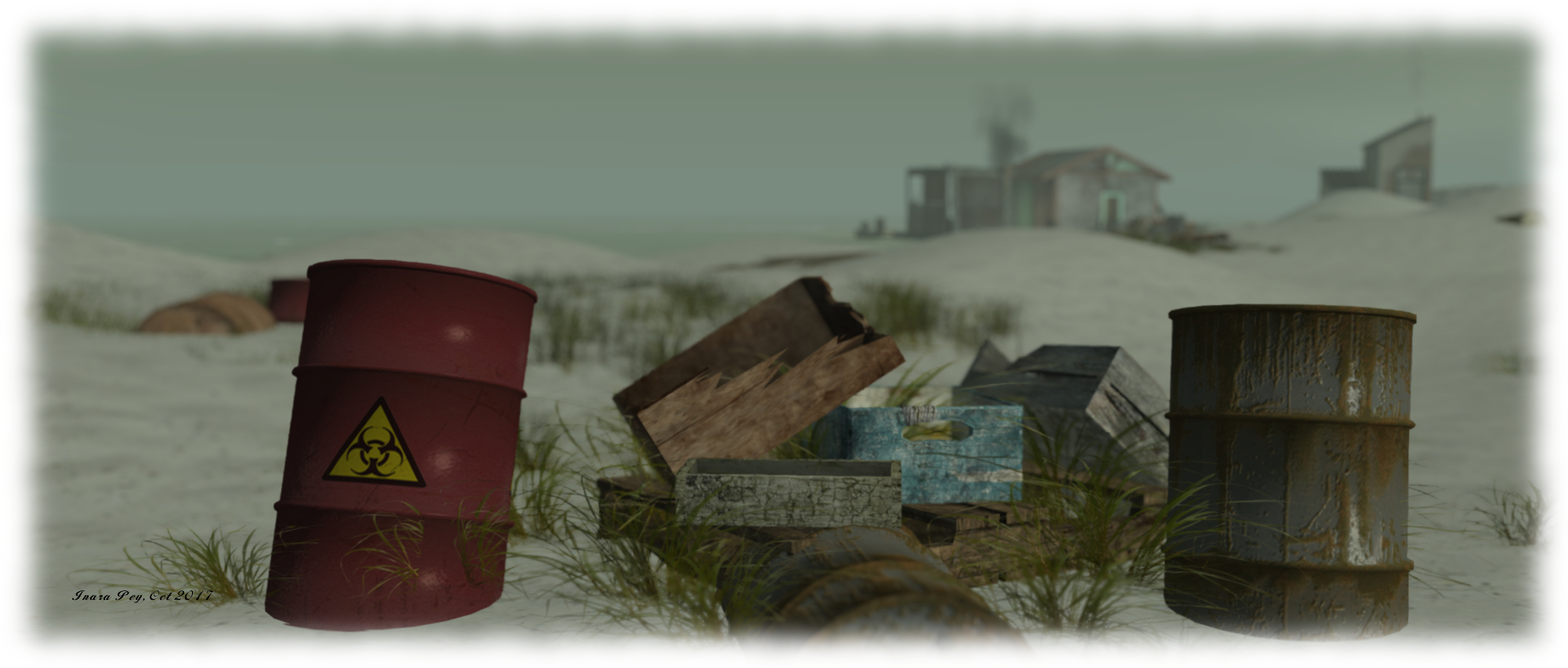
Khodovarikha; Inara Pey, October 2017, on Flickr Khodovarikha

Serene’s vision of Khodovarikha captures the desolate isolation of the area perfectly – and provides a magnificent  reproduction of its most notable landmark: the great wooden lighthouse. This ceased operation in 1996, but played an important role in guiding the convoys bringing supplies and munitions to Russia during World War Two. Within Serene’s setting, the lighthouse is both operational and truly dominates the landscape, but otherwise closely resembles the original right down to a hole in the tower’s base.

The region itself is split into two, with a slender finger running west-to-east to the north, a narrow channel of water separating it from the larger land mass to the south, where the lighthouse resides. The landing point is towards the western end of the northern finger of land, and the easiest route around the island is clockwise, following the rough wooden board walk pointing east from the landing point. This leads visitors over sand and past ageing buildings to where a large wooden warehouse-like structure topped by the dome of a Doppler radar system faces the lighthouse across the neck of water, an old wooden bridge linking the two.

Khodovarikha; Inara Pey, October 2017, on Flickr Khodovarikha

The loneliness of the island is encapsulate in the spread of the building and their generally dilapidated state. The detritus of human living – oil barrels scattered across the sand, sanding in untidy groups or part-buried, sacks of rubbish left to freeze outdoors, and the spoils of collapsed walls and bonfires – all add to the sense of isolation. This is not a place where appearance and neatness matter.

There is also a wealth of detail to be found here that further adds to the remoteness of the setting, particularly inside several of the buildings, where care has been taken to reflect the lonely lifestyle of Khodovarikha’s one full-time inhabitant, Slava, and the work involved in keeping things running – if that’s the right term. The air of untidiness around some of these work spaces perhaps offers a subtle suggestion of  Slava’s one-time assistant, Ustin, moving listlessly around the scattered buildings, carrying out assigned tasks during his year-long stay, missing his family and home.
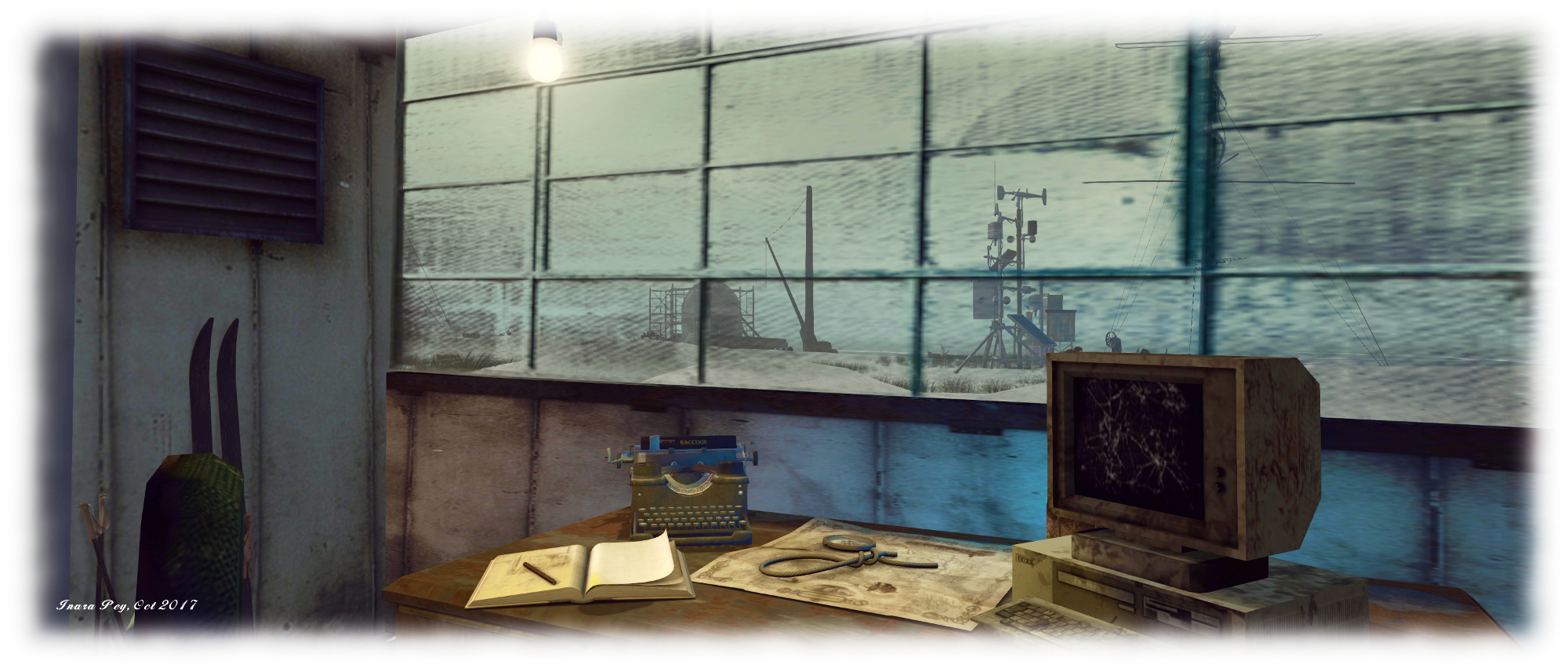
Khodovarikha; Inara Pey, October 2017, on Flickr Khodovarikha

There is a gentle beauty always present in Serene’s builds, and this is certainly the case here. The overcast sky fading to a distant horizon haze, softens the setting and adds to the mystery. Looking out towards that distant horizon, it’s not too difficult to imagine the research vessel  Mikhail Somov looming out of the mists on its annual visit to deliver supplies to Slava. Or, for the more imaginative mind, to see the faint, distant shadows of the wartime convoys slipping past in the distance, ghostly shadows within the grey-blue haze.

Khodovarikha is a magnificent build, reflecting its physical world namesake almost perfectly. It is hauntingly beautiful rendering of desolation and loneliness, richly echoing the RT documentary. It is a perfect destination for those who – like Slava – wish to escape the world (at least for a while). And for those who do, there are plenty of opportunities not just for exploration, but for sitting and pondering or talking, indoors and out – some of which are quite imaginatively placed for the keen-eyed.
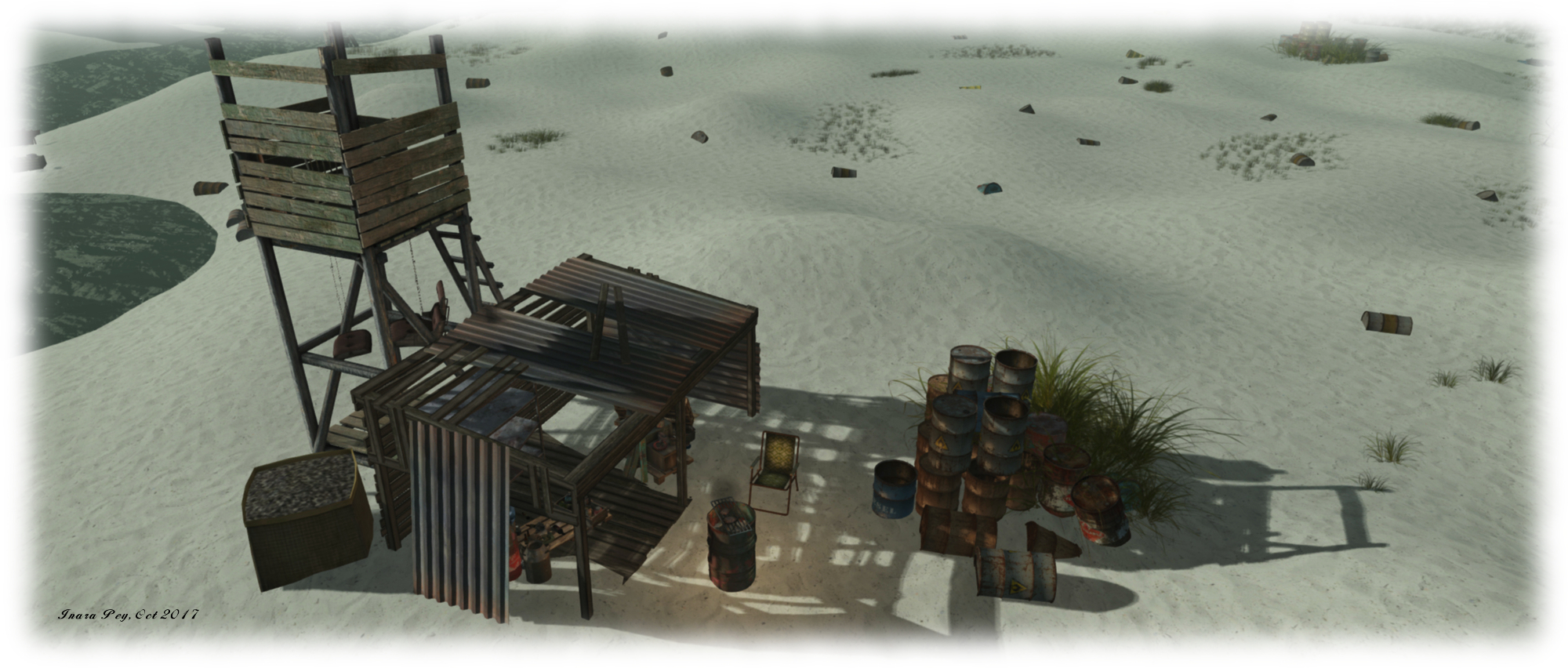
Khodovarikha; Inara Pey, October 2017, on Flickr Khodovarikha

This is a place most definitely deserving of a visit, and you can find out more on the background of the build and on Khodovarikha in general by reading Serene’s own blog post on his inspiration in designing the region, which delves into things like the meaning behind the big building with its striped radar dome and the inclusion of a half-finished Rawin Dome on the south side of the island, all of which adds further depth and context to the build.

SLurl Details

Elemental drawings in Second Life

Elemental – San (Santoshima)

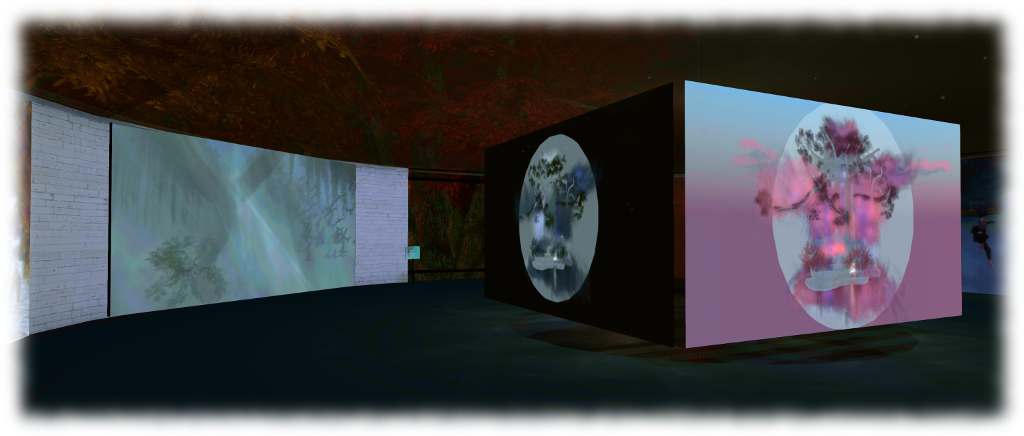
“The exhibit is in celebratory recognition of the 9-year anniversary of Play as Being (PaB) in SL, and as such, is part of a year-long series of solo exhibits by PaB Guardians.” So reads – in part – the introduction to Elemental,  a set of photo drawings by San (Santoshima) on display at the Art of Being gallery through until the end of October, and to which I recently received a personal invitation to visit from the artist.

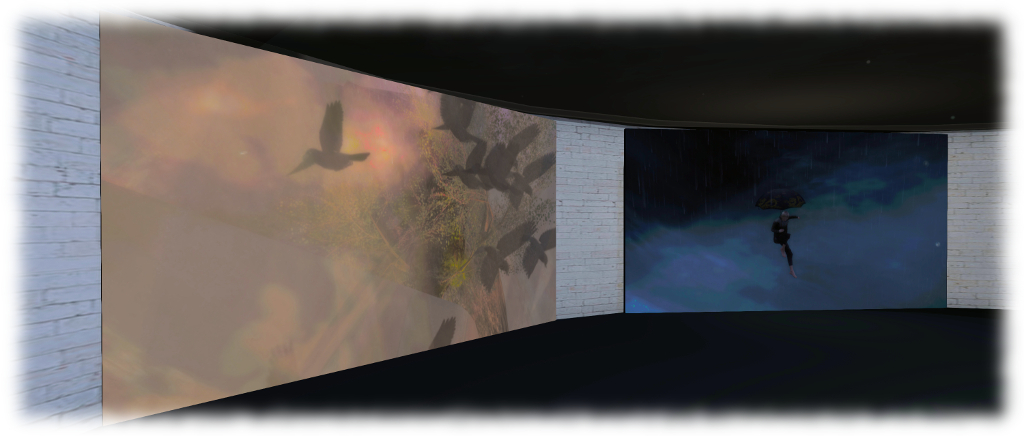
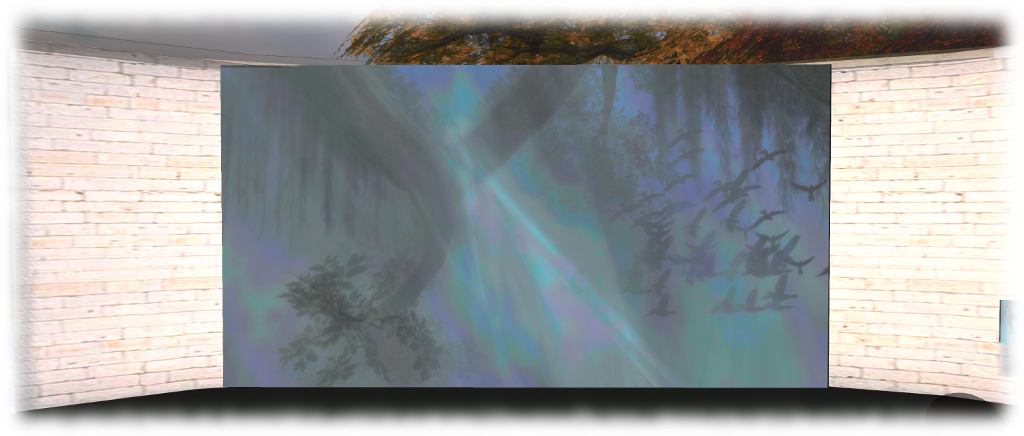
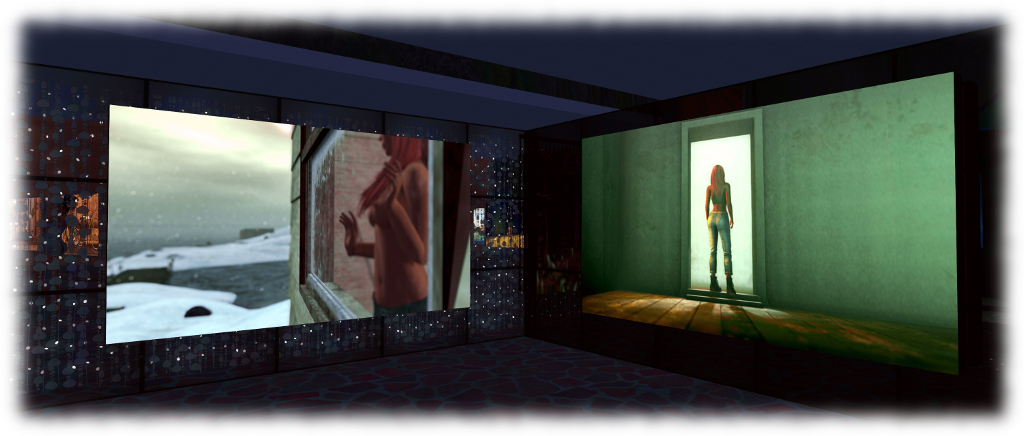
A total of 10 image boards are presented within the gallery space – six on the circular outer wall, four on the square central walls. Each panel contains multiple images, which can be viewed in turn by clicking on the panel (for the four images ranged on the sides of the central walls, click the left or right edges).

Elemental – San (Santoshima)

Thematically, the panels are similar in the images they present; the six outer panels focus on images of birds in flight and a figure with an umbrella. The colour wash in all of them suggest a breezy, perhaps rainy environment the birds and figure and flying / walking (drifting?) through each; thus we get – in part – the title for the exhibit: Elemental. The time of day which appears to suggest different times of day as well, perhaps adding to the title.

The inner four all share the same set of images showing a garden sitting with plants, rocks and trees, again taken at different times of the day. The natural setting for each image, combined with the watercolour-like tones, again suggests the images are Elemental in approach. As you click on the panels to page through the images, it is possible to By clicking on them to page through the images each holds, it is possible to form a story for each.

Elemental – San (Santoshima)

It’s important to note this is not just a visual exhibition. San has included a special sound scape to accompany the images, so it’s important to have local sounds enabled when visiting in order to enjoy the exhibition to the fullest. “[The] live sound recordings were made in a southern Gulf Island, British Columbia,” San explains. “Outside my cabin door; a raven pair conversing, raven parents with three fledglings, various small birds, and Pacific tree frogs.”

Also, as noted in the introduction to the exhibition, Elemental forms part of a celebration of Play as Being, an in-world group which describes itself as, “exploring reality by using our own life as a laboratory. A thought experiment to see what is left if we put down what we have, to see who we are.” More information on the group, together with a schedule of their events, can be found on their wiki page.

Elemental – San (Santoshima)

Elemental is a fascinating exhibition – and a peaceful one; a visit prior to closure is recommended.

SLurl Details

2017 Viewer release summaries week 42

Logos representative only and should not be seen as an endorsement / preference / recommendation

Updates for the week ending Sunday, October 22

This summary is published every Monday, and is a list of SL viewer / client releases (official and TPV) made during the previous week. When reading it, please note:

  • It is based on my Current Viewer Releases Page, a list of all Second Life viewers and clients that are in popular use (and of which I am aware), and which are recognised as adhering to the TPV Policy. This page includes comprehensive links to download pages, blog notes, release notes, etc., as well as links to any / all reviews of specific viewers / clients made within this blog
  • By its nature, this summary presented here will always be in arrears, please refer to the Current Viewer Release Page for more up-to-date information.

Official LL Viewers

LL Viewer Resources

Third-party Viewers

V5-style

V1-style

Mobile / Other Clients

Additional TPV Resources

Related Links

A return to Sol Existence in Second Life

Sol Existence; Inara Pey, October 2017, on FlickrSol Existence – click any image for full size

It’s been over four years since my last visit to Sol Existence, the Full region held by Sunshine Amelia Gilmore; as such, I thought it high time Caitlyn and I returned to spend a little time exploring. (Sunshine Zhangsun). At the time of my 2013 visit, Sunshine was collaborating with Jac Mornington; the current build appears to be largely Sunshine’s own design.

“Somewhat reminiscent of another time,” Sunshine says of the design, “Created with love and happiness. A small seaside island offering solace to the wanderer.” And so it is – albeit, perhaps, a seaside island approaching its off-season given the cast of the sky.

Sol Existence; Inara Pey, October 2017, on FlickrSol Existence

A visit starts on the east side of the island, above the curving “c”  of a sandy bay, reached via broad wooden steps which descend gently sloping rocks in a series of platformed tiers.  The beach is dominated by a large warehouse with a low wooden key, and a trawler appears to be rounding the headline en route to coming alongside. However, a look inside the warehouse reveals it is not a place of work, but actually a place of recreation, housing a bar on the upper floor.  It might be the first indication that some of the buildings here are not as they might first appear.

Atop the cliffs, a little row of shops point the way eastwards, sitting within a ring of cart tracks which set them aside from a chapel and the second lighthouse, both of which sit to the north of them. The lighthouse again is not all it appears, being a centre for Relay for Life, reflecting Sunshine’s long-standing involvement with, and support of, RFL.

Sol Existence; Inara Pey, October 2017, on FlickrSol Existence

Another chapel lies to the east of the houses, appearing to guard the south and west sides of the island. This is the home of Epilogue, described as a “special place for creation and imagination,” where  Charlotte Gilmore hosts reading clubs and craft creating sessions. Beyond this chapel is a pond and farm, the latter with geese, chickens and goats within the walls of its garden, the ruins of an old fortification close by. As with the east side f the island, cart tracks circle this part of the island, including the large pond fronting the farm-house, and a couple of old vehicles, a four-wheeled truck and a Tuk Tuk style mobile library.

A second beach sits in the north-west corner of the island offers another place to relax and enjoy the Sun when it is present over the island. At the top of the slopes above this, and nestled close to the lighthouse, is a hot air balloon and a playable game of chess, available to those so minded for a game. Nor is this the only opportunity for recreation – another little game sits inside Epilogue, while seagulls scattered around the island will be happy to offer dances to those touching them. There are also a number of places where visitors can sit and relax.

Sol Existence; Inara Pey, October 2017, on FlickrSol Existence

Sol Existence is still and picturesque as it has always been, and photography is encouraged across the island, with Sunshine requesting those who do take pictures consider submitting them to the region’s Flickr group. Those who would like to rez props for their photographs can join the region’s Group by clicking on the seagull perched above village sign at the landing point.

All-in-all another pleasing visit whether exploring on your own or with a friend, with plenty of opportunities for photography and plenty of places to sit and relax. For me, the was a welcome return to a region which caught my eye, and which I’ve been away from for a little too long.

Sol Existence; Inara Pey, October 2017, on FlickrSol Existence

SLurl Details

Myra’s Transitions in Second Life

Club LA and Gallery: Transitions

“My art primarily explores the freedom on-line communities, specifically Second Life, provide, allowing you to set aside your cultural roles and explore other roles.” Myra Wildmist in introducing her new exhibition Transitions, which opened at the Club LA and Gallery, curated by Fuyuko ‘冬子’ Amano (Wintergeist), on Sunday, October 22nd 2017.

She continues, “Real life cultural roles are necessary for a functioning society, but they are often extremely confining, almost forcing people into pigeon holes of expected behaviour. Second Life gives us all the opportunity to slip out of our pigeon holes and be almost anything we can imagine.”

Club LA and Gallery: Transitions

What follows is a selection of a dozen images offering some remarkable views of Second Life, each with a touch of the personal as then all include Myra herself in their frames – although it would be unfair to call all of them avatar studies; their compositions being such that the avatar forms a part of the overall scene rather than the focus of the image. Even those which do focus on the avatar do so in ways very different to more “traditional” avatar studies, allowing each one to tell its own story.

There are three pieces in the exhibit which might be considered NSFW, but all twelve are richly expressive, and demonstrate a broad range of approaches to photography which mark Myra as a true exponent of her art.

Club LA and Gallery: Transitions

Transistion shares the gallery space with Twain Orfan’s An Exhibition, which I reviewed in September, and a select of four images from John Brianna’s physical world photography.

SLurl Details

Space Sunday: when neutron stars collide

When neutron stars collide: an artist’s impression of the point when two neutron stars collided in the galaxy NGC 4993, 130 million years ago, and which are now increasing our understanding of neutron stars and the universe. Credit: SF/LIGO/Sonoma State University/A. Simonnet

Around the world on August 17th, 2017, some 70 telescopes and observatories – including the Laser Interferometer Gravitational-Wave Observatory (LIGO), responsible for confirming the existence of gravitational waves (see here and here for more) – quietly turned their attention on the same spot in the constellation Hydra.

“I don’t think it’s out of the question that this is the most observed astronomical event ever. It’s a thrilling notion, and a little overwhelming,” said LIGO spokesperson David Shoemaker. “We’ve got somewhere between a quarter and a third of all the world’s astronomers working with us.”

The reason? Hours earlier, an observatory in Chile had detected gravitational waves followed by a burst of gamma radiation – potentially the signature of two neutron stars colliding far beyond our galaxy. If so, the detection would be the first time gravitational waves have been observed originating from something other than the merger of two black holes. Hence, an alert was issued to observatories around the globe, resulting in the massed focusing on instruments on that single point in space.

Over the coming days, the data revealed that a collision between two neutron stars in what is referred two as a “kilonova”  – which sits between a star going nova and a super-massive star going supernova.  It marks the first confirmation that neutron star mergers can cause gamma ray bursts. However, there is much more to the event.

Neutron stars are the dense remnants of massive stars that long ago exploded as supernovae. The two stars in question are located in galaxy NGC 4993, 130 million light years from Earth. Originally, these stars were each around 10-20 times the mass of our sun; after each went supernova, they collapsed down to bodies around 16 km (10 mi) in diameter, comprised entirely of neutrons so densely packed, that despite their small size, each still had a mass perhaps twice that of our own Sun.

These two neutron stars, located close together, were gradually drawn together over the course of perhaps 11 billion years by their mutual gravities until they collided, venting huge amounts of energy across the spectrum and space-time in what astronomers call a “multi-messenger event”. It was the arrival of the light waves and gravitational waves here on Earth, 130 million years later, that astronomers from around the world were keen to observe, marking the first time a cosmological event of this nature has been observed in both gravitational waves and light, producing a huge amount of data for researchers to study.

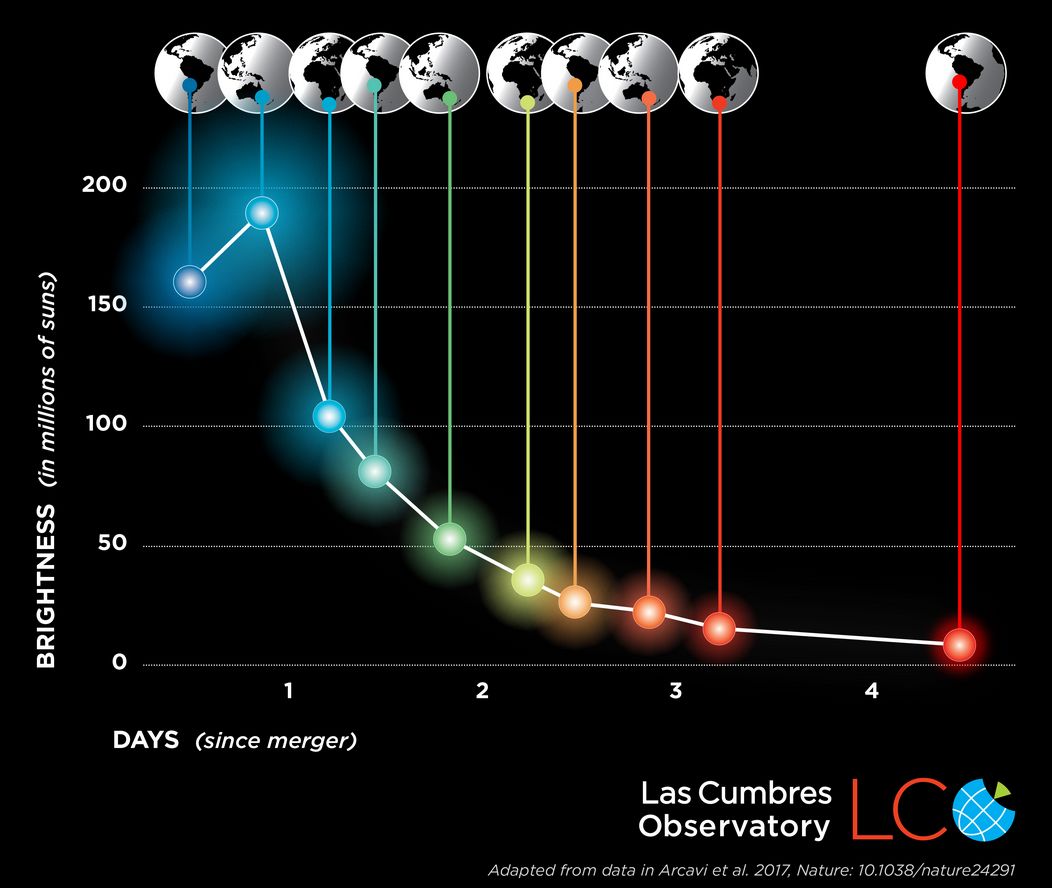
How the kilonova was initially observed through the initial days of visible light observation following the first indication of the collision through to the falling off of light from the initial explosive outburst of energy. Credit: Sarah Wilkinson / LCO.

Thanks to the alert sent out by the Chilean observatory, over 3,500 astronomers and more than 100 instruments  – including LIGO and a the Hubble Space Telescope responded, making the event the first to be observed through the detection of visible light and gravitational waves. Their findings are now being made public, and include some remarkable facts.

These include the first confirmation that neutron star mergers can cause gamma ray bursts – although there is some questions over what this might in fact mean. It also marks the first measurement of the universe’s expansion using gravitational waves.In addition, as the collision was recorded in wavelengths right across the electromagnetic spectrum, from radio to gamma rays, it is the first time a cosmological event of this nature has been observed in both gravitational waves and light. A further result of the observations is that astronomers have witnessed heavy elements being formed from the aftermath of the event.

“People have long suspected that heavy elements were made in neutron star mergers, but this is really the first time we’ve nailed that down,” Andrew Levan, an astronomer at the University of Warwick in the UK. “This merger made something like the mass of the Earth in gold, along with other heavy elements such as platinum, lead and uranium.”

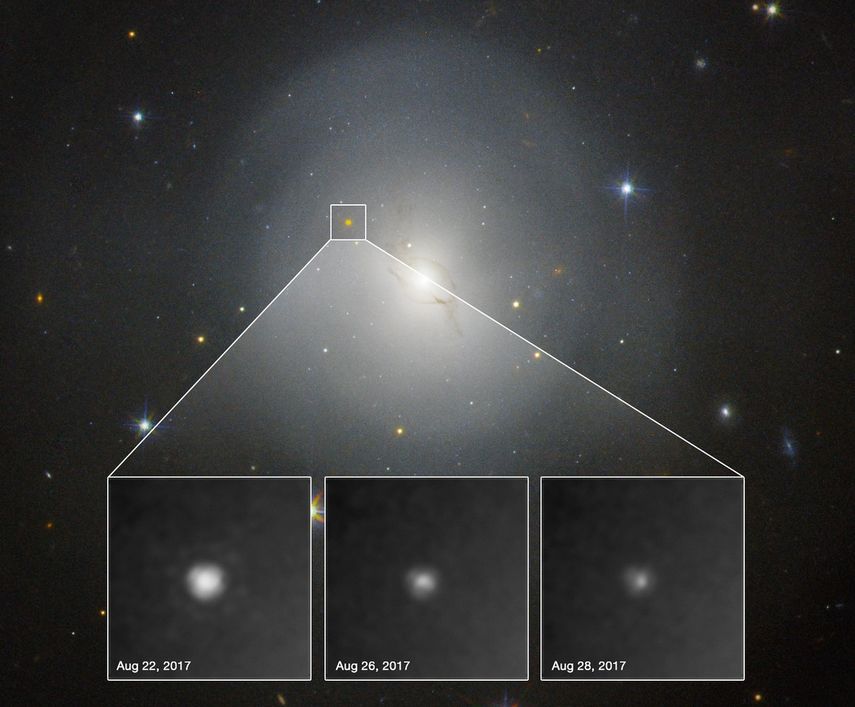
The kilonova as seen from the Hubble Space Telescope a few days after the explosion, tracking it as the initial light faded. Credit: NASA and ESA. Acknowledgement: A.J. Levan (U. Warwick), N.R. Tanvir (U. Leicester), and A. Fruchter and O. Fox (STScI)

It was actually the discovery that heavy elements were being formed in the material resulting from the collision which confirmed the event was an actual collision of two neutron stars. The elements would only be formed if neutrons were being ejected from the two stars to collide with lighter atoms in the surrounding space. Material would only be ejected if the objects in collision each had a surface, something black holes don’t have – they only have an event horizon.

This in turn indicated the event was far closer that the previous five detections of gravitational waves which have occurred since 2015. These have been the result of pairs of black holes merging, none of which have been closer than 1.3 billion light years away. That the gravitational waves were observed alongside of light waves also gave further confirmation of another of Einstein’s general relativity predictions: that light and gravitational waves travel and more-or-less the same speed.

Observations and data gathering continued after the initial explosion was detected, although the light from the collision faded over the 6-8 days following the event, and astronomers are keen to discover what has been left behind. Currently, the region of NGC 4993 where the kilonova occurred is obscured behind a cloud of matter and heavy elements, leading to questions on whether or not the two stars may have merged to form an even larger neutron star, or whether they collapsed into a black hole. Some of those studying the data gathered believe the gamma ray burst recorded after the initial detection of gravitational waves might be indicative of the latter, the result of matter left over from the event and collapse being drawn into the event horizon.

Summing up the significance of the event, astronomer Tony Piro from the Harvard–Smithsonian Centre for Astrophysics said, “The ability to study the same event with both gravitational waves and light is a real revolution in astronomy. We can now study the universe with completely different probes, which teaches things we could never know with only one or the other.”

Continue reading “Space Sunday: when neutron stars collide”