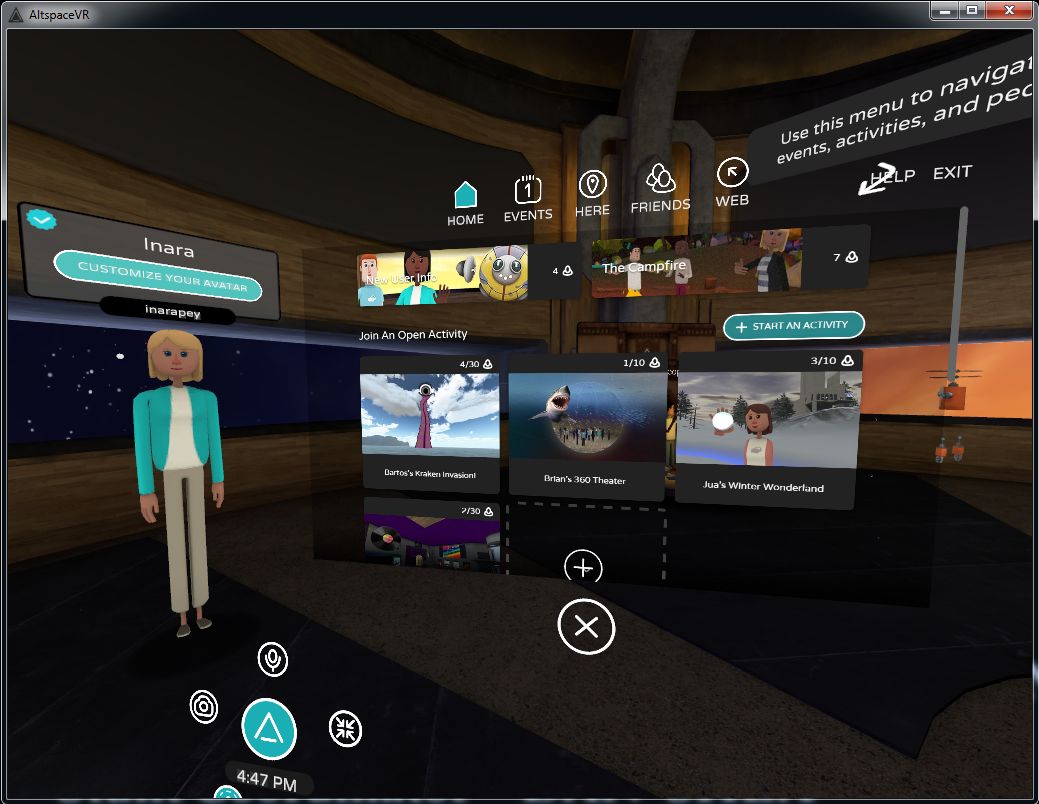
Following the announcement of its closure, Altspace VR is still open. I’d actually been holding off on this since Ciaran Laval first drew my attention to the news on August 16th, in case further details were forthcoming.
As I noted towards the end of July, the company had been planning to close shop on August 3rd. However, following the closure announcement, the company apparently received an outpouring of support – and with it, apparently the means to say open. This prompted an announcement on August 15th that the platform would be continuing:
It has been a roller coaster of a ride for our team and our community since we announced that AltspaceVR was coming to an end. We are elated to follow-up that dismal proclamation with some very good news: AltspaceVR is going to live on…
Thanks to that outpouring of support, we’re now deep in discussions with others who are passionate about AltspaceVR who want to guarantee that our virtual oasis stays open. We feel confident saying to our community that you don’t need to find another place to meet your friends in virtual reality. AltspaceVR is not closing down.
It’s not clear on exactly with whom the company has been in discussion – and that’s primarily the reason I’d been holding back on covering the news, lest further information was forthcoming on this matter. However, speculation following the announcement is the Oculus Rift co-founder Palmer Luckey may be involved in trying to maintain the company’s viability. He tweeted a poll following the news of the company’s intended shut-down, asking followers if he should step in. He then re-tweeted the news that Altspace VR would remain open, which further stoked speculation of his involvement.
Techcrunch were perhaps the first news outlet to cover the evolving situation, with writer Lucas Matney noting:
It’s honestly unclear what to make of the sudden shutdown and un-shutdown announcements and whether they were just efforts to grab attention and put together a last-minute deal, but it is apparent that AltspaceVR still has their work cut out for them as they look to carve out a niche in a crowded social VR space that still has Facebook to compete with.
He goes on to note that sources close to the company indicated that it had laid off several of its employees and had shut down the majority of its servers. However, the AltspaceVR clients all remain available for download, and the platform can be accessed and used (they’ll be hosting a solar eclipse event on Monday, August 21st as well).
Whatever the future of AltspaceVR, given its high-profile nature, the turmoil surrounding its survival highlights the risks associated with virtual reality when reliant on venture capital – and the benefits of being self-financed, as is the case with platforms such as Sansar – which is not so say there are no other risks involved in building a “social VR environment”.
Club LA and Gallery, curated by Fuyuko ‘冬子’ Amano (Wintergeist) has a new ground-level location, which is still partially under construction. To celebrate the move, the gallery is hosting two exhibitions; the first, Selfies: Some of My Faces, by Burke Bode, has been open since July; the second, An Exhibition by Twain Orfan, opens on Sunday, August 20th.
“Pablo Picasso said ‘Everything you can imagine is real,'” Burke says of his exhibition. “He is right. Living in a world that is completely created from scratch just by the imagination of its residents you experience this. A place where you can invent yourself new every day and for a creative person a place where you MUST create yourself new every single day. [I’m] changing my look constantly as shape shifter. Some of my shapes last for a day, for one picture; and some stay.”
He reflects this beautifully with an exhibition of images illustrating many of his various looks. These are presented in an enclosed space within the gallery, the images laid out to present something of a maze visitors walk through. Semi-translucent, the images resemble layers visible one through another so that as you walk through them, each appears to be peeled away, revealing the next, which is in turn peeled back at the next turn, and so on.
It’s both an artistic approach to presenting change and the possibilities to reinvent within the digital medium, and an intriguing means of commenting on the nature of identity and how we present ourselves in the physical world. While we may not be able to change our looks here, we do “change” according to circumstance, situation and those around us: the person we are with a lover is not the same as the person we are with a child; the person we present to colleagues at work is not the same as the one we share with our closest friends, and so on. Thus, Selfies might be seen as a reflection of this.
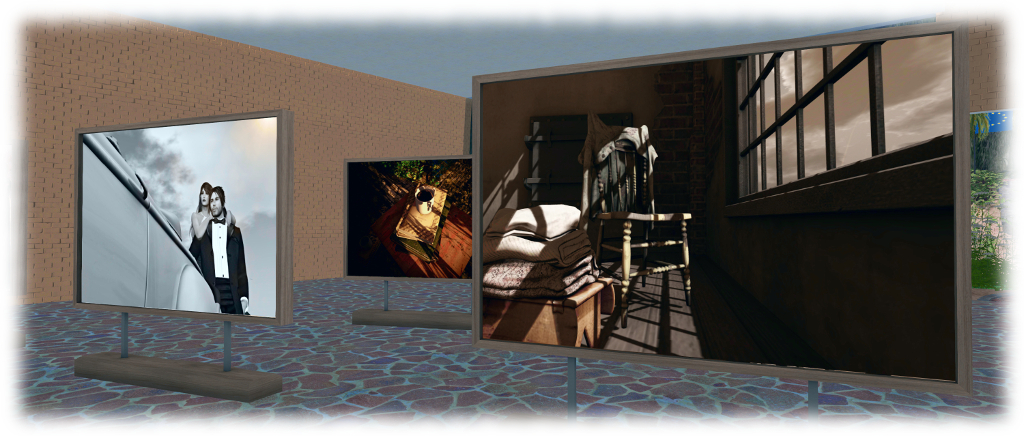
Twain Orfan his been active in Second Life for over eight years, but only immersed himself in the world of SL photography in 2016. “I enjoy taking photo [the] art of items that are often overlooked when photographers visit various sims,” he says of his work. “Finding pure art in objects such as a chair, a table, a flower-pot, or, perhaps a bicycle. From time to time I also try my hand at Landscapes, or an occasional shot involving my own avatar.”
An Exhibition reflects all of this with a collection of 18 images taken from around second life, all of which also demonstrate Twain’s interest in, and experiment with, angle, light and shadow. What is particularly fascinating with the images is the fact they are all raw: Twain resists the use of GIMP or Photoshop for post-processing, relying instead purely on the viewer and Windlight for his pictures. The result is a fascinating collection of pieces which are individual and collectively eye-catching, offering unique windows into our virtual lives.
Both Selfies: Some of My Faces and An Exhibition make for an engaging visit, with the latter officially opening at 12:00 noon on Sunday, August 20th, with music by Marain Dufaux.
The new gallery space itself offers more room for exhibitions, and includes a landscaped garden visitors can enjoy and an information centre / studio space. Teleport disks are provided to assist visitors in getting around – although in truth, everything at ground level is within easy walking distance of the landing point.
In a pair of blog posts, Philip Rosedale of High Fidelity revealed the company’s plans to use blockchain technology as both a virtual worlds currency and for content protection.
The blockchain is described as “an incorruptible digital ledger of economic transactions that can be programmed to record not just financial transactions but virtually everything of value” (Don Tapscott, Blockchain Revolution: How the Technology Behind Bitcoin Is Changing Money, Business, and the World). It allows transactions to be simultaneously anonymous and secure by maintaining a tamper-proof public ledger of value. While it is most recognised for its role in driving Bitcoin, the technology is seen by more than 40 of the world’s top financial institutions as a potential means to provide speedier and more secure currency transactions. However, the technology has the potential to have far wider application.
To understand the basics of the blockchain, think of a database duplicated across the Internet, allowing any part of it to be updated by anyone at any time, and the updates being immediately available across all the duplicates of the database. Information held on a blockchain exists as a shared — and continually reconciled — database existing across multiple nodes. The decentralised blockchain network automatically checks with itself every ten minutes, reconciling every transaction, with each group of transactions checked referred to as a”block”. Within the network, nodes all operate as “administrators” of the entire network, and are encouraged to join it through what is (mistakenly) referred to as “mining” – competing to “win” currency exchanges, sometimes for financial reward to the node’s operators (High Fidelity indicate that node operators will not gain directly from “mining” activities, but will instead be paid in HFCs for their computing resources used by the network).
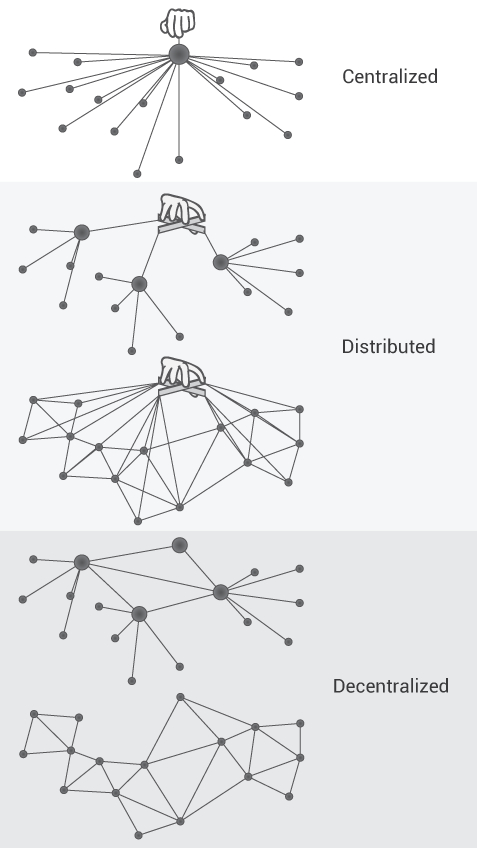
Centralised, distributed and de-centralised networks – blockchains utilised decentralised networks
The key points to all this is that the blockchain is both openly transparent – the data is embedded in the network as a whole, not in any single point, and is by definition “public”. The lack of any centralisation also means it cannot be easily hacked – doing so would require huge amounts of computing power; nor is there a single point of data which can be corrupted or reliant on a single point of management for its continued existence – as High Fidelity point out, this means that the service can continue, even if High Fidelity does not. Thus, blockchain networks are considered both highly robust and very secure.
An estimated 700 Bitcoin-like crypto-currencies are already thought to be in operation, although the potential use of blockchains goes far, far beyond this (identity management, data management, record-keeping, stock broking, etc., etc.).
High Fidelity plans, over the coming months, to deploy their own blockchain network which will support both a new crypto-currency, the HFC (presumably “High Fidelity Currency”), which will ultimately operate independently of High Fidelity’s control. In addition, the system will provide a mechanism to protect intellectual property by embedding object certification affirming item ownership into the blockchain. This means that creators of original digital content. As High Fidelity explain:
Digital certificates issued by the High Fidelity marketplace (and likely other marketplaces choosing to use HFC) will serve a similar function as patents or trademarks — creators will register their works to get the initial certificates, and these certificates will be given out only for work that is not infringing on other or earlier works…. Once granted, these durable certificates cannot be revoked and can then be attached to purchases on the blockchain to prove the origin of goods. The absence of an accompanying digital certificate and blockchain entry will make digital forgery more obvious and impactful than in the real world — for example, server operators may choose not to host content without certificates and end-users may choose not to ‘see’ content according to it’s certificate status.
This approach could provide an extremely durable and trusted means of sharing digital content, one which is more durable than other approaches to digital rights management, for the same reasons as the blockchain offers security, transparency and robustness to operating a crypto-currency.
That the HFC blockchain is designed to operate independently of High Fidelity means that it can become self-sustaining, providing a currency environment that can be traded with other crypto-currencies and which can be exchanged for fiat currency through multiple exchanges.
The two blog posts – Roadmap Currency and Content Protection and Roadmap: Protecting Intellectual Property in Virtual Worlds – are very much companion pieces to be read in the order given. The first provides an overview of the HFC blockchain system and currency management, including how High Fidelity hope to establish a stable exchange rate mechanism without running into the issues of speculative dabbling in the system, inflated ICOs, etc., and on the use of digital wallets and personal security. It also outlines the certification mechanism for content protection, which the second article takes a deeper dive into, explaining how the relative strengthen of a blockchain approach as very quickly sketched out above could be used in protecting creator’s IP and controlling how their products / creations are used.
The decentralised approach to currency and digital rights management is something that has been pointed to numerous times during High Fidelity’s development, but this is the first time the plans have been more fully fleshed out and defined in writing. It’s an ambitious approach, one likely to stir debate and discussion – particularly given the current situation regarding the Decentraland / Ethereum and the risk of speculation around ICOs (again, something High Fidelity hope to avoid).
it’s also one which again points to High Fidelity’s founders looking far more towards more of an “open metaverse” approach to virtual environments and goods than others might be considering.
“My passion for art has been part of my virtual life from the start, and in RL began many years ago,” Alo (Aloisio Congrejo) says of himself. “As an artistic ‘consumer’ there have been many artists both great and lesser known that I have followed and admired, but what is most important to me is to see the work of anyone who can craft various media in such a way as to express their feelings.”
Thus it is that for his latest exhibition, No Life Without Art, he uses his own artistic expressionism to celebrate some of the most influential artists of the early 20th century – Wassily Kandinsky, credited with painting one of the first recognised purely abstract works; Paul Klee, whose unique approach to art drew upon abstraction, cubism, expressionism and surrealism and surrealists Joan Miró, René Magritte and Giorgio de Chirico.
A visit to the installation begins on a platform overlooking a 3D tribute to Kandinsky with a piece that – for me at least – echoes his Small World pieces, produced in the 1920s when teaching at the Bauhaus in Berlin. This part of the installation is perhaps best viewed from above and by camming, although there is a walkway leading down to it for those who wish to explore more closely.
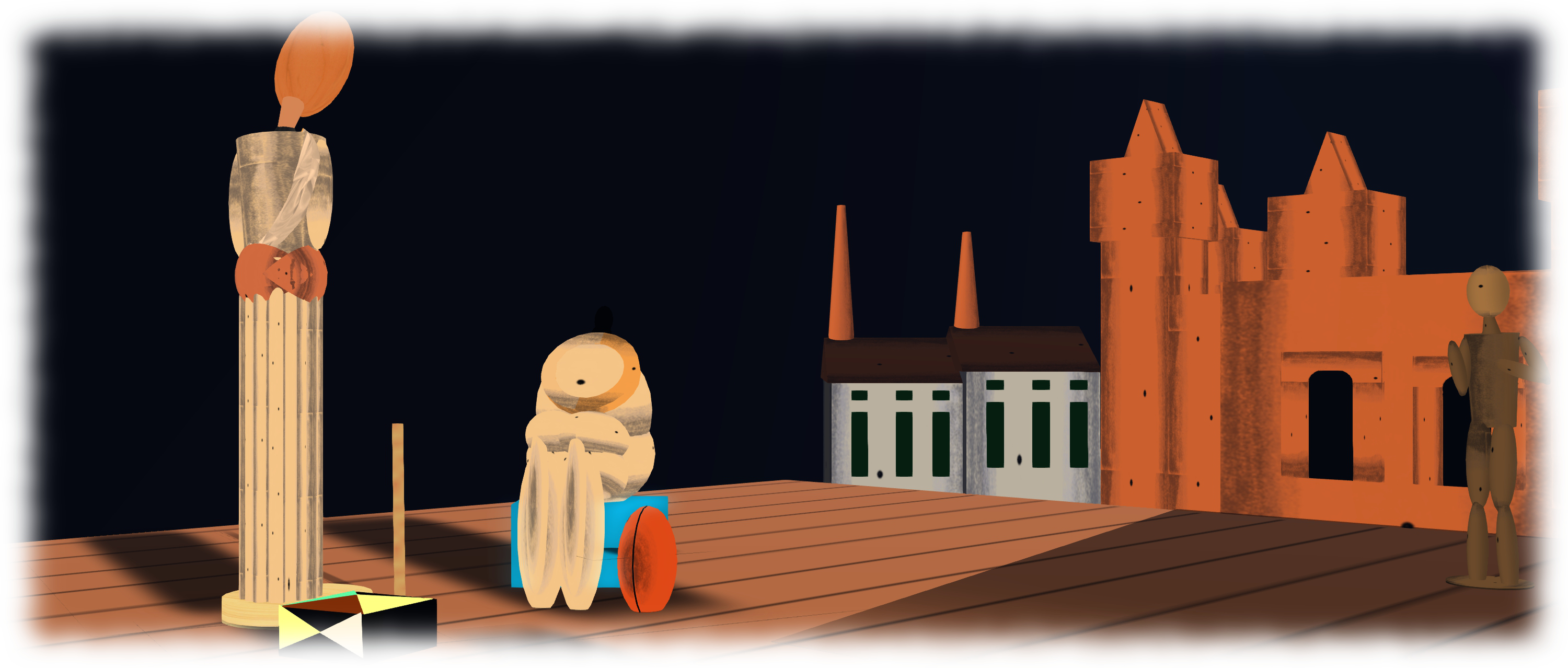
Beneath this, and reached via teleport board at the landing point sit the tributes to Giorgio de Chirico and René Magritte. In the early years of the 20th century, de Chirico founded the scuola metafisica metaphysical art movement, which profoundly influenced the surrealists. Featuring dream-like scenes offering strong contrasts in light and shadow and often with an undertone of mystery or threat, the movement flourished through the second decade of the 20th Century and is notable commemorated in this installation through the inclusion of a representation of The Disquieting Muses (circa 1917) and what might be a play on The Seer (circa 1914/15), together with architecture and backgrounds reflecting those seen in many of de Chirico’s works from this period.
Set across three platforms linked by walkways, the de Chirico pieces overlook a wall of identical pieces which offer a play on Magritte’s 1964 composition The Son Of Man and which also might be said it echo his 1966 piece, The Pilgrim. These form a link with the lowest level, where the artists is again celebrated, with another image of a faceless man, together with that of an apple, which for Magritte symbolised the tension between the hidden and visible. Both of these images are also symbolic for the artist’s influence on the pop, minimalist and conceptual art movements, whilst also offering a tip of the hat towards his own playful use of art.
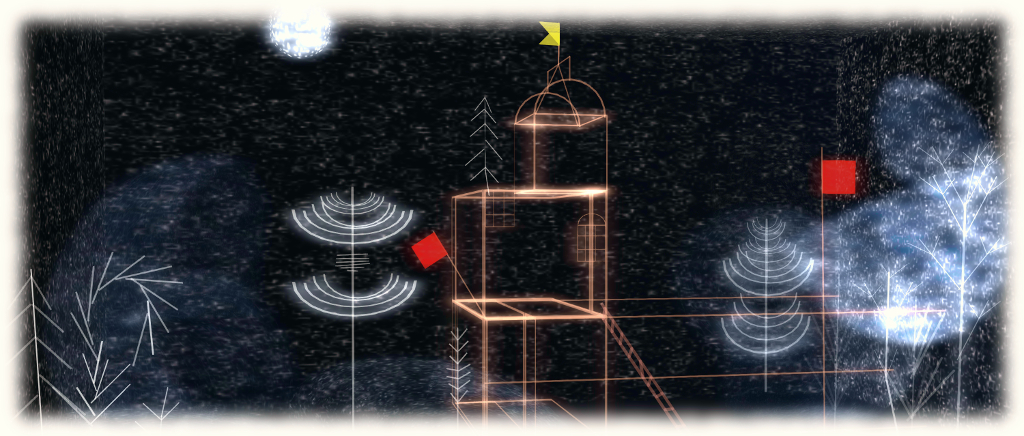
This level also celebrates Joan Miró and Paul Klee, with the latter’s highly individualistic style very well represented through a reproduction of his 1922 composition, Red Balloon, and a 3D representation of Flagged Pavilion (1927), while Miro is represented by his 1925 work, The Garden.
All five artists are well represented, and Alo also provides biographical note cards on each, allowing visitors to gain a greater understanding of their lives and works. In introducing himself, Alo notes that he appreciates those who can express their feelings through their art. In No Life Without Art, he clearly reveals his own depth of feeling for, and admiration of, these five influential and provocative artists.
Marianne McCann brings word of the 2017 Hot Bay City Nights event which will take place at the Bay City Fairgrounds, North Channel, from Saturday, August 19th through until Sunday August 27th, 2016.
Celebrating Bay City’s mid-Twentieth Century theme, as well as the city’s extensive road network, Hot Bay City Nights focuses on top Second Life vintage and classic car makers, showcasing vehicles representing the era between 1940 and 1965.
First held in August 2012, the event was an instant success with Bay City residents and auto makers alike. This year, as with previous years, the week is aimed at raising funds to support Child’s Play, a charity providing toys and games for children in hospitals around the world.
Alongside the auto show there will be various other activities taking place, including charity car washes, and the crowning of Miss Bay City 2017 on Sunday, August 27th. So make sure you get along to Bay City during the week and join in the fun!
About Bay City
Bay City is a mainland community, developed by Linden Lab and home to the Bay City Alliance. The Bay City Alliance was founded in 2008 to promote the Bay City regions of Second Life™ and provide a venue for Bay City Residents and other interested parties to socialize and network. It is now the largest Bay city group, and home to most Residents of Bay City.
About Child’s Play
Established in 2003, Child’s Play is a game industry charity dedicated to improving the lives of children by providing toys and games to over 100 hospitals worldwide. The charity operates in two ways:
Through direct donations of money and fund-raising events. These funds are used to purchase games which can be supplied to hospitals and therapy centres on an age-appropriate basis
By working with hospitals to set-up wish lists of games and toys for the children at those hospitals. Visitors to the Child’s Play website can then use the location map to find their nearest participating hospital, view the wish list and donate a gift of a toy or game directly.
Due to their support of Child’s Play over the years, Bay City and the Bay City Alliance received special recognition by the charity in 2016, and awarded Silver Level sponsor status by Child’s Play. As a part of this, the charity includes a special Second Life page on their website, providing information on the charity’s official avatar and on how Second Life residents can support Child’s Play through in-world events.
“I have wanted an oriental themed sim for the longest time,” Ayla Zhoy (AylaJ) says of her homestead region design Yamagata, “and here it is! I’ve spent some time slowly working on this and I hope you enjoy your visit.”
Regular readers to these pages will know that I’m immediately drawn to anything with an oriental flavour. This being the case, Caitlyn and I hopped over to take a look around as soon as the opportunity arose – and we weren’t at all disappointed.
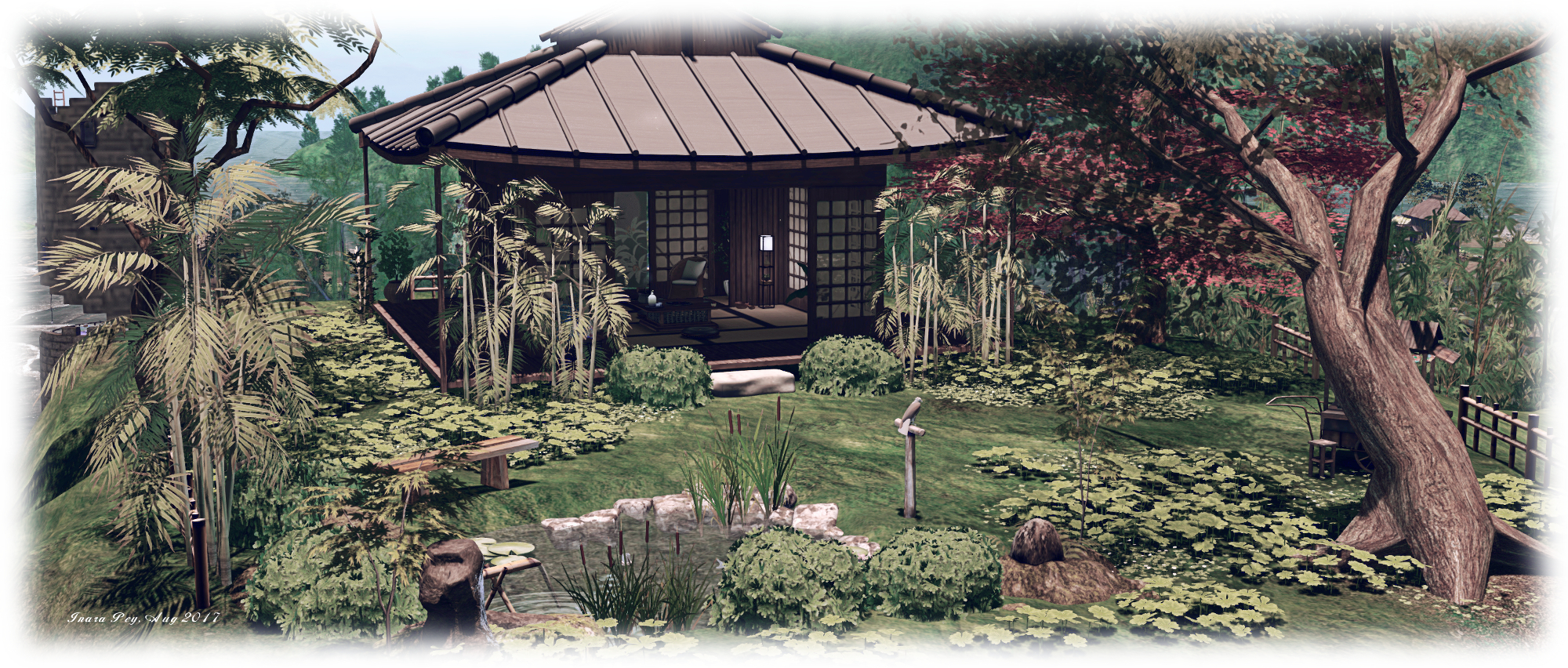
As with many oriental regions in Second Life, Yamagata draws strongly on Sino-Japanese influences, blending the two together to create an environment which is eye-catching, relaxing, fun to explore (although do take note, it is a constant work-in-progess, and so is changing on a fluid basis) and with plenty of opportunities for photography.
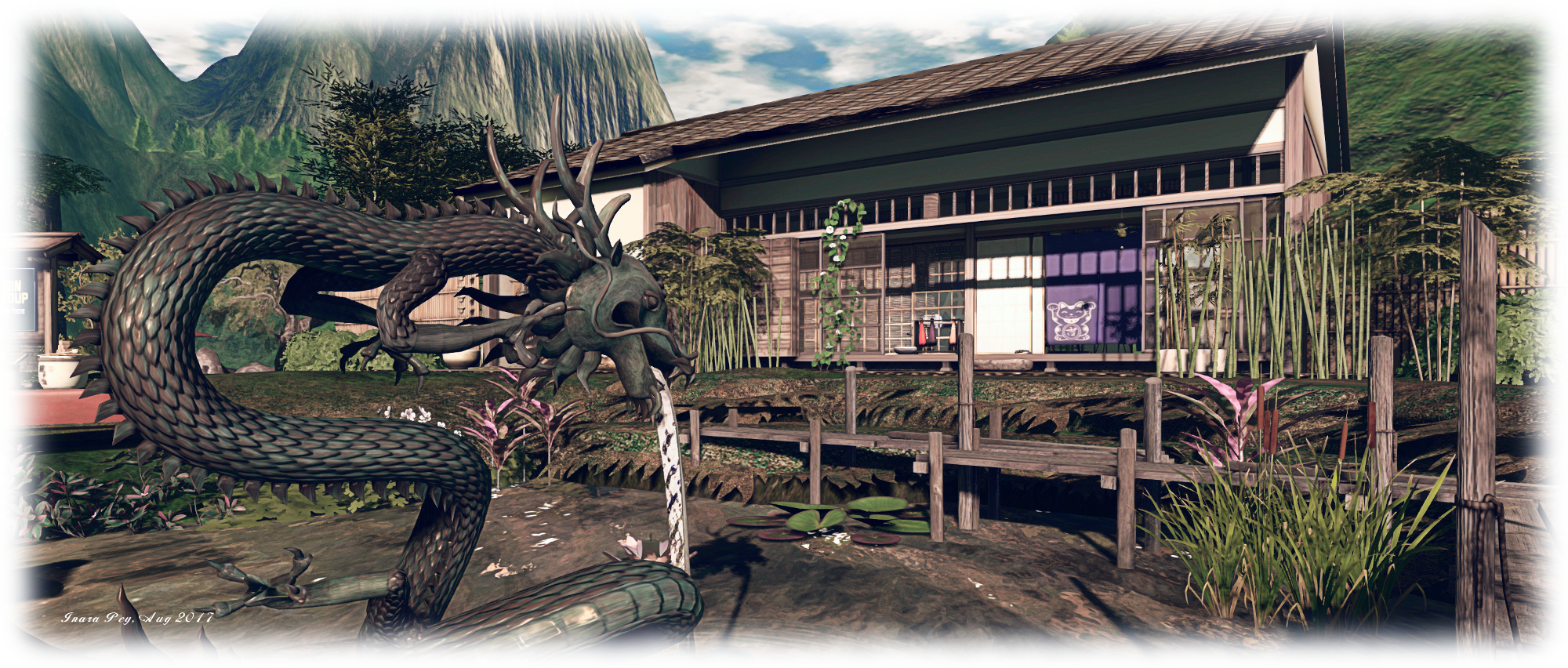
The land is in fact split into a number of small islands – although such is the design, this may not immediately be obvious when exploring. The landing point sits to the north-west of the region, on an elongated islet it shares with a modest traditional Japanese style house and garden. A walk inland from the house will bring you to a stone arch, water tumbling from it as it links the island with one on which a bamboo of Pandas reside. A short distance away, and running through the trees occupying the eastern end of the island, a path provides access to the first of several bridges spanning the channels which divide up the land.
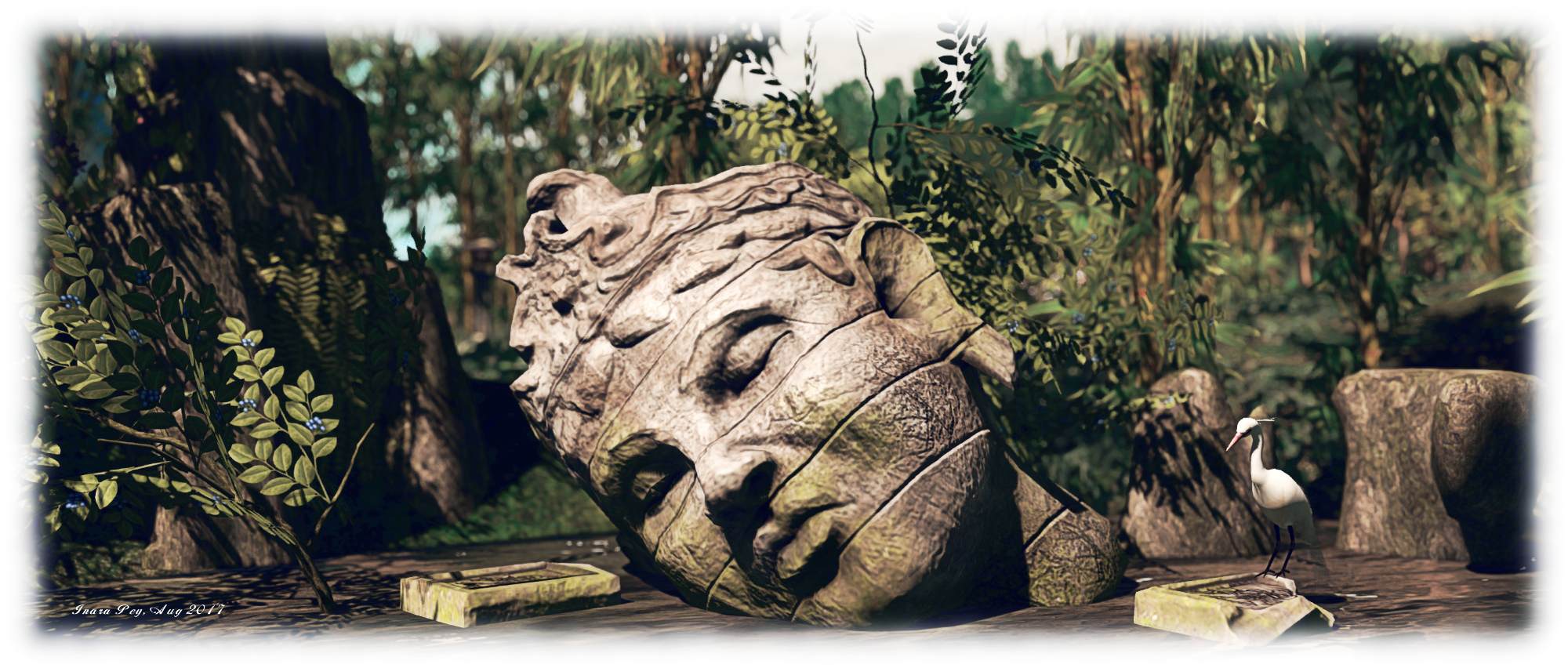
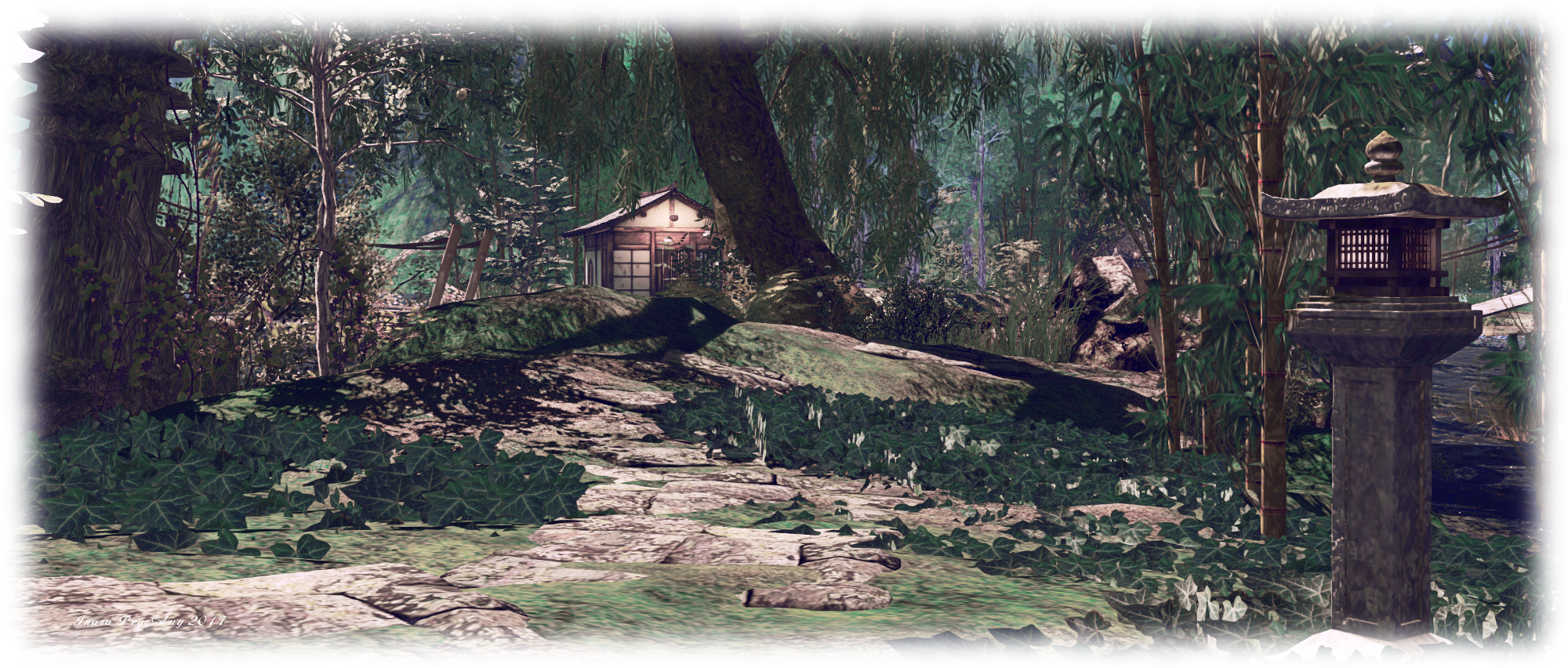
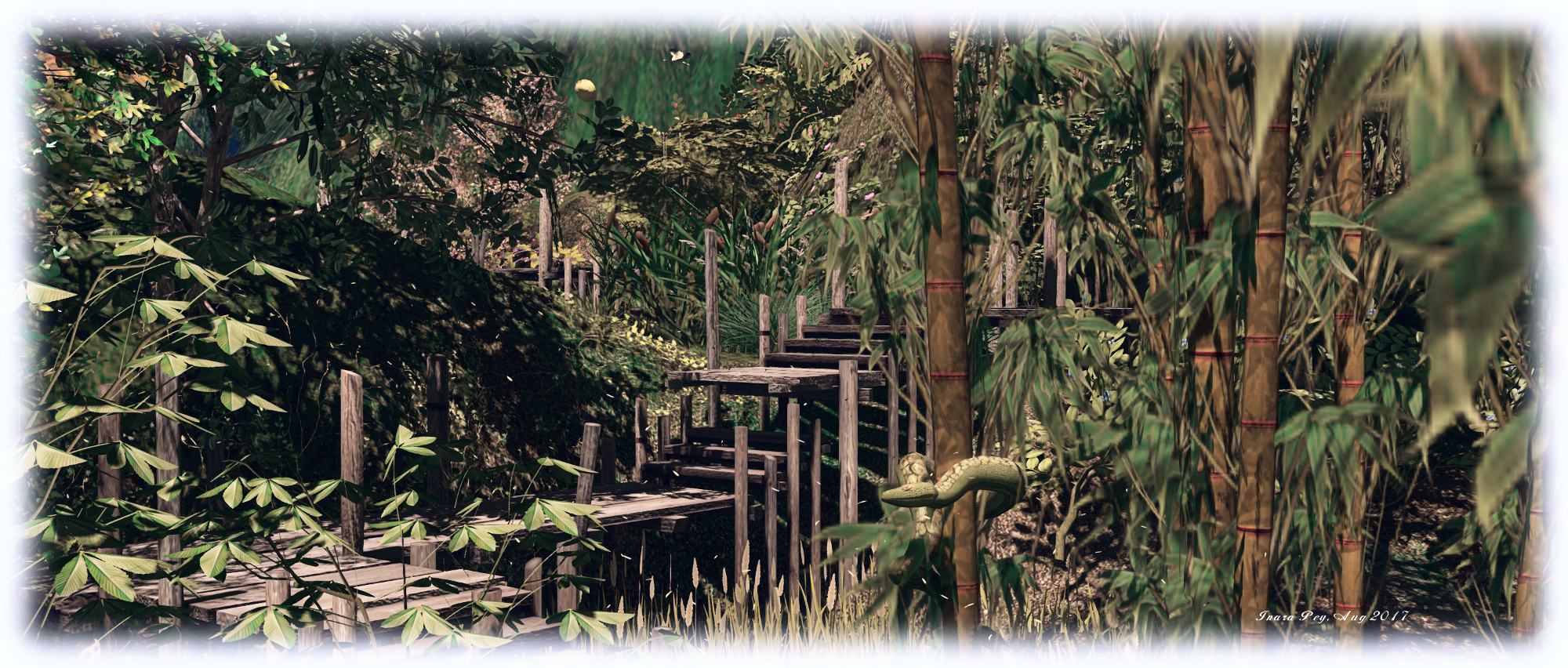
However, before you leave the landing point, make sure you accept the offered note card, it has details of a number of points of interest worth visiting when exploring. These include tea houses, onsens, houses and ruins. They can be explored in any order, and each offers a setting very much worth seeing. Paths and grassy trails run across all of the islands, linking bridges and points of interest to one another, while stone steps provide access to the region’s elevated areas.
One of the more intriguing places to visit is the stone tower rising on the west side of one of the larger islands. This sits in two parts, one preciously balanced atop the other by a mix of what appears to be a narrow neck of stone blocks, an iron ladder and gravity’s attention being otherwise occupied elsewhere! The ladders offer a way up (right-click and sit), and the tower itself is a good vantage point from which to see the rest of the region.
But really, the best way to see everything is obviously on foot, following the paths, discovering all the different locations and places to sit and contemplate or cuddle or bathe along the way. The pandas offer a cute distraction (the stone arch can be climbed over to reach them if you want – although it is not strictly speaking a bridge). There are a couple of boats in the region, but these don’t appear to be set to allow passengers to sit at present – or at least at the time of our visit; which is a pity as the one near the stone water arch makes for a nice spot from which to observe the pandas.
Yamagata really is a lovely setting, well suited to a variety of windlight settings and offering a lot for people to enjoy. The Sino-Japanese theme works well, and is complemented by a soft ambient sound scape entirely in keeping with the region.








 Inara Pey: Living in a Modemworld